seats AUDI S3 2010 Owner's Manual
[x] Cancel search | Manufacturer: AUDI, Model Year: 2010, Model line: S3, Model: AUDI S3 2010Pages: 320, PDF Size: 75.34 MB
Page 93 of 320

Ashtray
Rear ashtray
1.-~-.,
I I
Fig. 93 Rear ashtray
To open ashtray
-Open the cover ~ &.
To empty ashtray
- Hold the ashtray housing=> fig. 93 and lift out .
To reinstall ashtray
-Open the ashtray cover, insert the ashtray and press
down.
& WARNING
Never put waste paper in the ashtray. Hot ashes or other hot
objects in the ashtray could set waste paper on fire .•
Con tro ls and eq uip
ment
Seats and storage
Cigarette lighter /socket
Outlets
The outlet in the front center console and in the luggage
compartment may be used for 12-volt appliances.
Outlet in the front center console
Fig. 94 Center
console, front: 12-volt
outlet
Fig .
95 Luggage
compartment : 12-volt
outlet
- Fold the cover for the outlet down ~ page 91, fig. 94.
-Plug in appliance to be used.
Outlet in the luggage compartment
-Tap cover ~ fig. 95.
Vehicle care I I irechnical data
Page 94 of 320
Seats and storage
-Plu g in ap plia n ce to be us ed.
The ou tlet may be used for 12-volt app liances with maximum
consumption of up to 100 watts, such as a flash light , smal l vacuum
cleaner, etc .
Before you purchase any accessories, always read and follow the
inf orm ati on i n
=> page 300, "Addi tiona l ac cess ories and parts
replacement" .
& WARNING
The outlet plu s any appliances plugged into it remain functional
even if the ignition is switched off or the ignition key is removed .
Ne ver leave children inside the vehicle without supervi sion .
0 Note
To avoid damaging the socket, only use p lugs that fit properly .
[ i ] Tips
When the engine is off and accessories are sti ll plugged in and are
on, the vehicle batte ry can sti ll be d rained .•
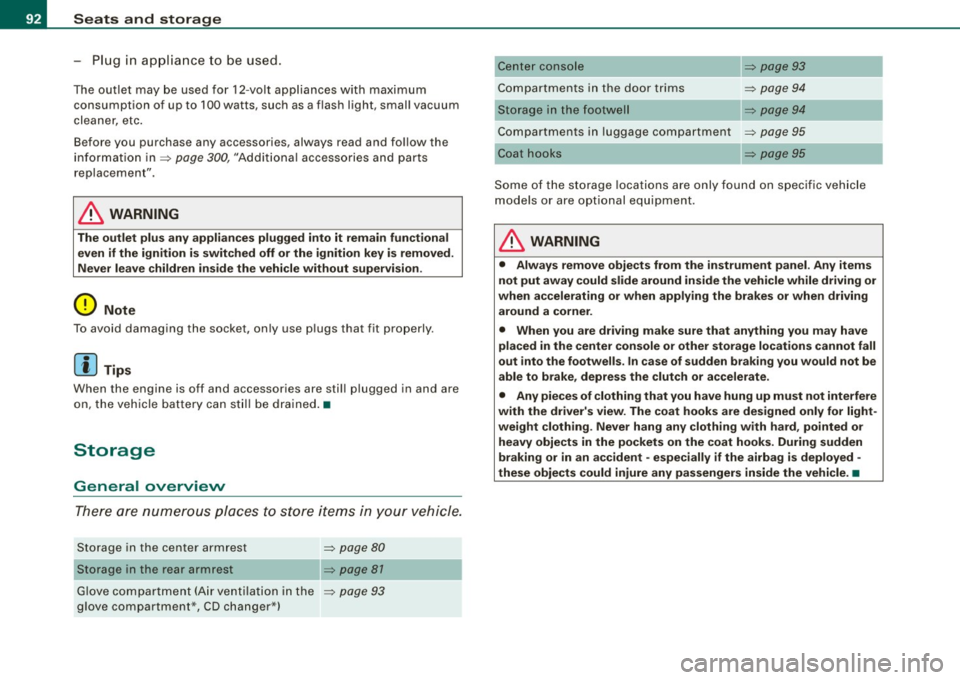
Storage
General overview
There are numer ous places to store items i n your ve hicle.
Storage in the center armrest
Storage in t he rea r armr est => page 80
Glove compart ment (A ir v enti lati on i n t he ::::> page 93
glove compartment*, CD changer *)
Cent er console
Compartments in the door trims
Sto ra ge in the f ootwe ll
=> page93
=> page 9 4
=> page94
Compartments in luggage compartment
=> page 95
Some of the s torage locations are only found on specific veh icle
models or are optional equ ipment .
& WARNING
• Always remove obje cts from the in strument panel. Any items
not put away could slide around inside the vehicle while driving or
when a ccelerating or when applying the bra kes or when driving
around a corner .
• When you are driving make sure that anything you may have
placed in the center console or other storage locations cannot fall
out into the footwells . In case of sudden bra king you would not be
able to brake , depress the clut ch or accelerate .
• Any pie ces of clothing that you have hung up mu st not interfere
with the driver's view. The coat hooks are designed only for light
weight clothing . Never hang any clothing with hard , pointed or
heavy objects in the pockets on the coat hooks . During sudden
bra king or in an accident -especially if the airbag is deployed -
these obje cts could in jure any passengers inside the vehicle. •
Page 95 of 320

Glove compartment
The glove compartment is illuminated and can be Jocked.
"' 10 ., ~ a:. ., 03
To open glove compartment
Fig. 96 Glove compart
ment
Pull the handle=> fig. 96 in the direction of the arrow
push down lid to the fully open position.
To close glove compartment - Push the glove compartment lid upward until the lock
engages.
The light will illuminate when the parking/headlights are turned on
and the glove compartment is open.
In the glove compartment lid, you will find a place to store a pen and
a pad of paper.
& WARNING
To reduce the risk of personal injury in an accident or sudden stop,
always keep the glove compartment closed while driving . •
Con tro ls and eq uip
ment
Seats and storage
Ap plies to veh ic les: w it h stora ge compar tmen t in cente r console
Storage compartment for small objects Ca
I, __] II 0
l
l
I~ u
I
'
Fig . 97 Center console
storage compartment
To open the compartment, press the cover ta=> fig. 97.
To close the compartment, push the drawer all the way in
until it clicks in place.
An additional storage compartment21 for relatively small objects is
located in the center console next to the brake lever. •
2> Not available on vehicles with Audi Nav igat ion System.
Vehicle care I I irechnical data
Page 96 of 320
Seats and storage
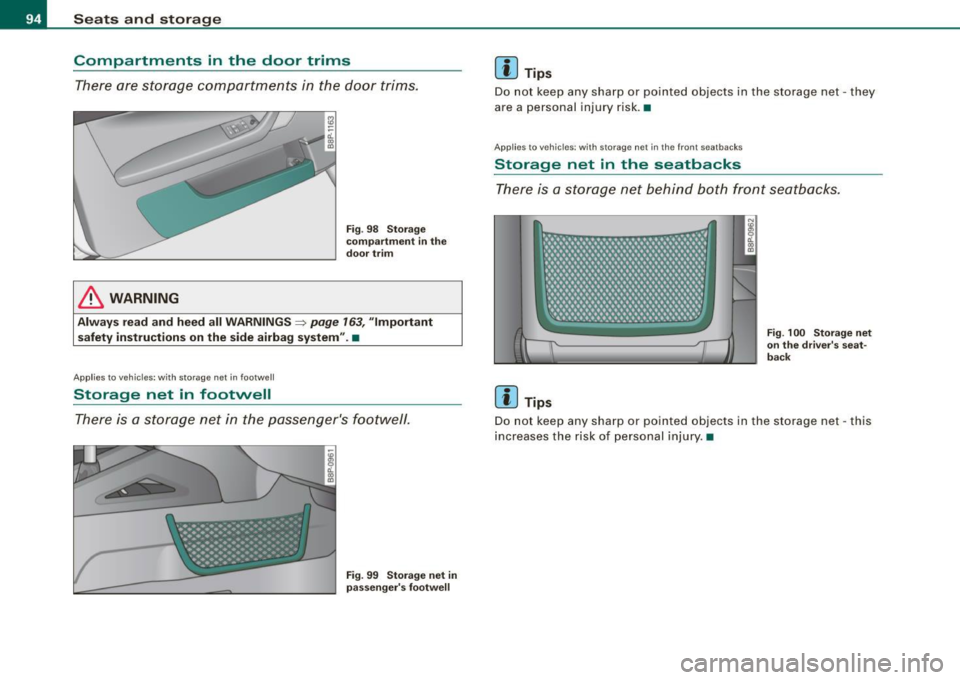
Compartments in the door trims
There are storage compartments in the door trims.
& WARNING
Fig. 98 Storage
compartment in the
door trim
Always read and heed all WARNINGS => page 163, ulmportant
safety instructions on the side airbag system". •
Applies to vehicles: with storage net in footwe ll
Storage net in footwell
There is a storage net in the passenger's footwell.
Fig. 99 Storage net in
pas senger's footwell
[ i ] Tips
Do not keep any sharp or pointed objects in the storage net -they
are a personal injury risk.•
Appl ies to vehicles: with storage net in the front seatbac ks
Storage net in the seatbacks
There is a storage net behind both front seatbacks.
[ i ] Tips
Fig . 100 Storage net
on the driver's seat
back
Do not keep any sharp or pointed objects in the storage net -this
increases the risk of personal injury .•
Page 97 of 320

Applies to veh ic les : w it h stora ge net in lu ggage compa rtm ent
Side storage in the luggage compartment
There is a comportment with a net on the right side of the
luggage comportment.
•
Fig . 101 Side compart
ment in the luggage
compartment
The compartment is suitable for holding small items. •
Coat hooks
There is a coot hook above each rear door.
:I ,,
;:
J ' t
" ::·
/
}
· : : .: ,, 1
} Fig . 102 Coat hook
The coat hooks are located in the headliner above each rear door.
Con tro ls and eq uip
ment
Seats and storage
& WARNING
• Hang clothes in such a way that they do not impair the driver's
v1s1on.
• The coat hooks must only be used for light weight clothing. Do
not leave any heavy or sharp edged objects in the pockets which
may interfere with the side curtain airbag deployment and can
cause personal injury in a crash.
• Do not use coat hangers for hanging clothing on the coat hooks
as this can interfere with proper deployment of the side curtain
airbags in an accident.
• Do not hang heavy objects on the coat hooks, as they could
cause personal injury in a sudden stop. •
Vehicle care
I I Technical data
Page 104 of 320
![AUDI S3 2010 Owners Manual • ..__w_ a_ r_m _ a_ n_d_ c_ o_ ld __________________________________________________ _
Air d ir ected to the dri ver/ front passe nger[~]
All the air is directed to outlets @, G) and Â](/img/6/57545/w960_57545-103.png "AUDI S3 2010 Owners Manual • ..__w_ a_ r_m _ a_ n_d_ c_ o_ ld __________________________________________________ _
Air d ir ected to the dri ver/ front passe nger[~]
All the air is directed to outlets @, G) and Â")
• ..__w_ a_ r_m _ a_ n_d_ c_ o_ ld __________________________________________________ _
Air d ir ected to the dri ver/ front passe nger[~]
All the air is directed to outlets @, G) and © in the instrument
panel. Air also is directed through the center console in the rear.
Air dir ected to th e footw ells ~
All the air is directed to outlets © and to the outlets under the front
seats .•
Air outlets
, _ ,
,~
---- 1
'
Fig . 104 I nstrume nt pan el: a ir out let loca tio ns a nd airfl ow direc tions
T he air out lets G) and 0 on top of t he instrument pane l are
fixed . Outlets 0 and 0 can be adjusted .
Adjusting air outlets 0 and 0
- Turn the vertical thumbwheel beside the outlet to
increase, reduce or shut down t he airflow from that
outle t. - Move t
he smal l tab in the center of the o utlet lo uver side
ways and up or dow n to ad just the level an d direc tion of
airflow.
The supply of air to the outlets is controlled either automatically or manually depending on the operation mode selected . The airflow
from al l outlets can be hea ted, unheated or cooled.
The heater out lets for the rear footwells are located under the front
seats. When you select outlets©, air is also directed to the rear
footwells.
[ i ] Tips
• When defrosting/defogging the windows, air flows from outlets
G), ® and G). To defrost or defog the windows as rapidly as
possible, air out lets
G) should be opened fully with the adjuster
whee ls.
• When the air conditioner is working, cooled air wi ll flow primarily
from outlets ®·
G) and ©-To assure adequate cooling, out lets G)
and © should never be completely closed. •
Using the climate controls economically
Using the climate controls prudently can help save fuel.
When you use the air conditioner, engine power is reduced
and fuel consumption increases. To save fuel, you should
use the a ir conditioner only when necessary . Also please
note the following points:
- If you want to save fuel, sw itch off the air conditioner.
- If you are going to drive w ith the wi ndows open, switc h
off the a ir condit io n er.
~
Page 106 of 320
• ..__w_ a_ r_m _ a_ n_d_ c_ o_ ld __________________________________________________ _
Applies to veh ic les : wi th electr ically heated front seats
Electrically heated front seats
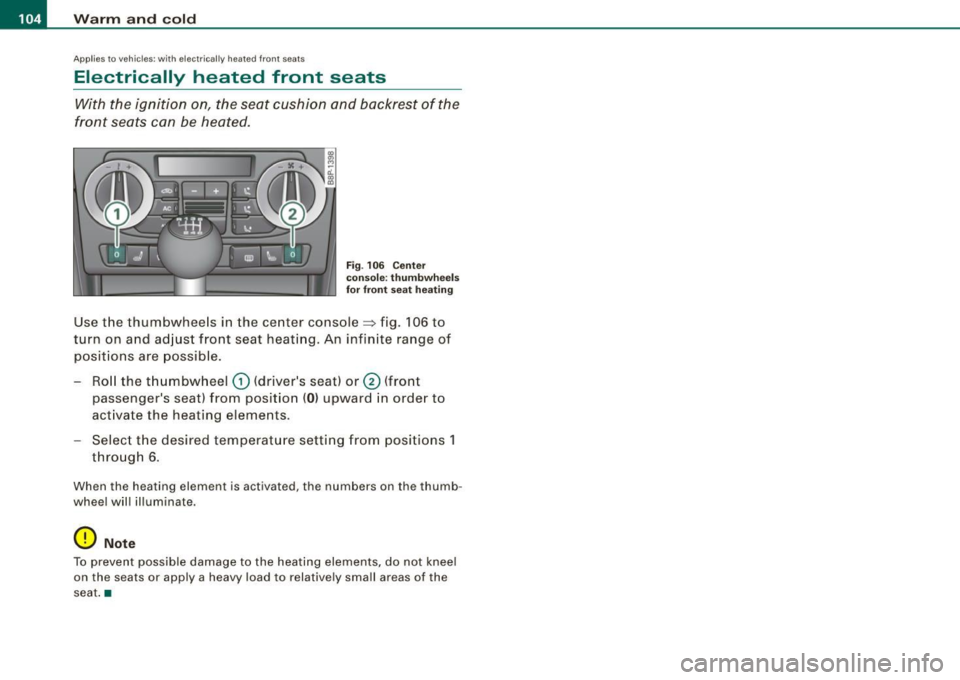
With the ignition on, the seat cushion and backrest of the
front seats can be heated.
Fi g. 10 6 Cente r
co nso le: thu mbwhee ls
for fr ont seat heati ng
Use th e thumbwhee ls in the center console=> fig. 106 to
turn on and ad just front seat heating. An infinite range of
positions are possible.
- Roll the thumbwheel
G) (driver's seat) or 0 (front
passenger's seat) from position
( 0 ) upward in order to
act ivate the heating elements .
- Select the desired temperature setting from positions
1
thro ugh 6.
When the heating element is activated, the numbers on the thumb
whee l wil l illuminate.
0 Note
To prevent possible damage to the hea ting elements, do not knee l
on the seats or apply a heavy load to relatively small areas of the
seat .•
Page 126 of 320
___ o_ r_iv _ i _n....; g::;_ S_ a_f _e _ly=-- -------------------------------------------------
Driving Safely
General notes
Safe driving habits
Please remember -safety first!
This chapter contains important information, tips, instructions and
warnings that you need to read and observe for your own safety, the
safety of your passengers and others. We have summarized here
what you need to know about safety belts, airbags, child rest raints
as well as child safety. Your safety is for us
priority number 1. Always
observe the information and warnings in this section -for your own
safety as well as that of your passengers.
The information in this section applies to all model versions of your
vehicle. Some of the features described in this sections may be
standard equipment on some models, or may be optional equip
ment on others. If you are not sure, ask your authorized Audi dealer.
& WARNING
• Always make sure that you follow the instructions and heed
the WARNINGS in this Manual. It is in your interest and in the
interest of your passengers.
• Always keep the complete Owner's Literature in your Audi
when you lend or sell your vehicle so that this important informa
tion will always be available to the driver and passengers.
• Always keep the Owner's literature handy so that you can find
it easily if you have questions .•
Safety equipment
The safety features are part of the occupant restraint
system and work together to help reduce the risk of injury
in a wide variety of accident situations.
Your safety and the safety of your passengers should not be left to
chance. Advances in technology have made a variety of features
available to help reduce the risk of injury in an accident. The
following is a list of just a few of the safety features in your Audi:
• sophisticated safety belts for driver and all passenger seating
positions,
• safety belt pretensioners,
• safety belt force limiters for the front seats,
• safety belt height adjustment systems for the front seats,
• automatic safety belt height adjustment for the rear seats,
• front airbags,
• side airbags in the front seats and outer rear seats *,
• side curtain airbags,
• special LATCH anchorages for child restraints,
• head restraints for each seating position,
• adjustable steering column.
These individual safety features, can work together as a system to
help protect you and your passengers in a wide range of accidents.
These features cannot work as a system if they are not always
correctly adjusted and correctly used.
Safety is everybody's responsibility! •
Page 128 of 320

___ D_ r _i_v _i_n -=g =--- S_ a_ f_ e____, ly'----------------------------------------------------
Proper occupant seating positi ·ons
Proper seating position for the driver
The proper driver seating position is important for safe,
relaxed driving.
Fig . 124 The correct
distance between
driver and steering
wheel
Fig . 125 Correct head
restraint position for
driver
For your own safety and to reduce the risk of injury in the
event of an accident, we recommend that you adjust the
driver's seat to the following position:
- Adjust the driver's seat so that you can easily push the
pedals all the way to the floor while keeping your knee(s)
slightly bent=:>& . - Adjust the angle of the seatback so that
it is in an upright
position so that your back comes in full contact with it
when you drive.
- Adjust the steering wheel so that there is a distance of at
least 10 inches (25 cm) between the steering wheel and
your breast bone=:> fig. 124. If not possible, see your
authorized Audi dealership about adaptive equipment.
- Adjust the steering wheel so that the steering wheel and
airbag cover points at your chest and not at your face.
- Grasp the top of the steering wheel with your elbow(s)
slightly bent.
- Adjust the head restraint so that the upper edge is as
even with the top of your head as possible but no lower
than eye level and so that it is as close to the back of your
head as possible=:> fig. 125.
- Fasten and wear safety belts correctly=:>
page 139.
- Always keep both feet in the footwell so that you are in
control of the vehicle at all times.
For detailed information on how to adjust the driver's seat, see
=>
page 73, "Adjusting front seats manua lly" or=> page 74,
"Adjusting the power seat".
& WARNING
Drivers who are unbelted, out of position or too close to the airbag
can be seriously injured by an airbag as it unfolds. To help reduce
the risk of serious personal injury:
• Always adjust the driver's seat and the steering wheel so that
there are at least 10 inches (25 cm} between your breastbone and
the steering wheel. .,_
Page 129 of 320
________________________________________________ D_r_iv _ i _n_ g~ S_ a_ fe_ ly __ !II
& WARNING (continued)
• Always hold the steering wheel on the outside of the steering
wheel rim with your hands at the 9 o'clock and 3 o'clock positions
to help reduce the risk of personal injury if the driver's airbag
inflates.
• Never hold the steering wheel at the 12 o'clock position or with
your hands at other positions inside the steering wheel rim or on
the steering wheel hub. Holding the steering wheel the wrong way
can cause serious injuries to the hands, arms and head if the
driver's airbag deploys .
• Pointing the steering wheel toward your face decreases the
ability of the supplemental driver's airbag to protect you in a colli
sion.
• Always sit in an upright position and never lean against or
place any part of your body too close to the area where the airbags
are located.
• Before driving, always adjust the front seats and head
restraints properly and make sure that all passengers are properly
restrained .
• Never adjust the seats while the vehicle is moving. Your seat
may move unexpectedly and you could lose control of the vehicle .
• Never drive with the backrest reclined or tilted far back! The
farther the backrests are tilted back, the greater the risk of injury
due to incorrect positioning of the safety belt and improper
seating position.
• Children must always ride in child safety seats~
page 167.
Special precautions apply when installing a child safety seat on
the front passenger seat~
page 145. •
Controls and equip ment Safety first
Vehicle operation
Proper seating position for the front
passenger
The proper front passenger seating position is important
for safe, relaxed driving.
For your own safety and to reduce the ris k of injury in the
event of an accident, we recommend that you adjust the
seat for the front passenger to the following pos ition:
- Adjust the angle of the seatback so that it is in an upright
position and your back comes in full contact with it
whenever the vehicle is mov ing.
- Adjust the head restraint so that the upper edge is as
even with the top of your head as possible but not lower
than eye level and so that it is as close to the back of your
head as possible::::;,
page 129.
Keep both feet flat on the floor in front of the front
passenger seat.
- Fasten and wear safety belts correctly::::;,
page 139.
For detailed information on how to adjust the front passenger's
seat, see
~ page 72.
& WARNING
Front seat passengers who are unbelted, out of position or too
close to the airbag can be seriously injured or killed by the airbag
as it unfolds. To help reduce the risk of serious personal injury :
• Passengers must always sit in an upright position and never
lean against or place any part of their body too close to the area
where the airbags are located.
• Passengers who are unbelted, out of position or too close to the
airbag can be seriously injured by an airbag as it unfolds with
great force in the blink of an eye. ..
Vehicle care Do-it-yourself service Technical data