sport mode AUDI S3 2010 Owners Manual
[x] Cancel search | Manufacturer: AUDI, Model Year: 2010, Model line: S3, Model: AUDI S3 2010Pages: 320, PDF Size: 75.34 MB
Page 200 of 320

•---=D:..:.. r::..: iv::..: i:..:. n.:.: g_ a:.:..:.. n::..:d:.;_ e:.. n ....:..; v...:i..:..r ..:: o ..:.n..:.. m:...:....:.. e.:...:.. n::..:t:.._ ____________________________________________ _
Avoid damaging the vehicle
When you are driving on poor roads, or over curbs, steep ramps,
etc., make certain that low -lying parts such as spoilers and exhaust
system parts do not bottom out and get damaged.
This is especially true for vehicles with low -slung chassis (sports
chassis) and fu lly loaded vehicles.
Operate your vehicle economically
and minimize pollution
General
Your personal style of driving will determine the economy
o f your vehicle, as well as exhaust and noise levels.
Fuel economy, environmental impact, and wear on your engine,
brakes and tires largely depend on three factors:
• your personal driving style
• operating conditions
• technical limitat ions
If you anticipate what you need to do next and drive economically,
you can easily cu t your fue l consumption by 10 -15 percent . This
section will give you some tips on how you can help the environ
ment and your pocketbook .
[ i ) Tips
The consumption estimates as published by ENVIRONMENTAL
PROTECT ION AGENCY (EPA) and Transport Canada may not corre
spond to your actua l consumption on the road, which wi ll vary
depending upon vehic le load and speed, road and weather condi
tions, trip length, etc.
Drive smo~thly and keep a lookout ahead
Vehicles use the m ost fuel when they are accelerating.
Avoid unnecessary accelerating and braking.
Vehicles use the most fue l when they are accelerating . If you antici
pate what is going to happen next, you will need to brake less and,
thus, accelerate less. Let the vehicle coast whenever possible -for
example when you see that the next traffic light is red.
Avoid full throttle
Driving at moderate speeds saves fuel and improves your
mileage.
-Try and keep we ll below your car's maximum speed.
Acce lerating gently reduces fuel consumption, engine wear, and
does not disturb the environment .
Fuel consumption, exhaust em issions and engine noise increase
disproportionately at high speeds. If you drive at approximately
three quarters of top speed, fuel consumption wil l be reduced by
one half. Never drive faster than the posted speed limit and weather
conditions permit .•
Reducing unnecessary idling
E ven when your car is just idling i t burns up fuel.
- Sh ut the eng ine off when you are not driving the vehicle.
- Do not warm up th e vehicle by letting the eng ine r un at
idle.
I t m akes sense to shut off the engine in traffic jams, when waiting
for trains to pass at rai lroad crossings, or at traffic lights that have
9),
Page 250 of 320
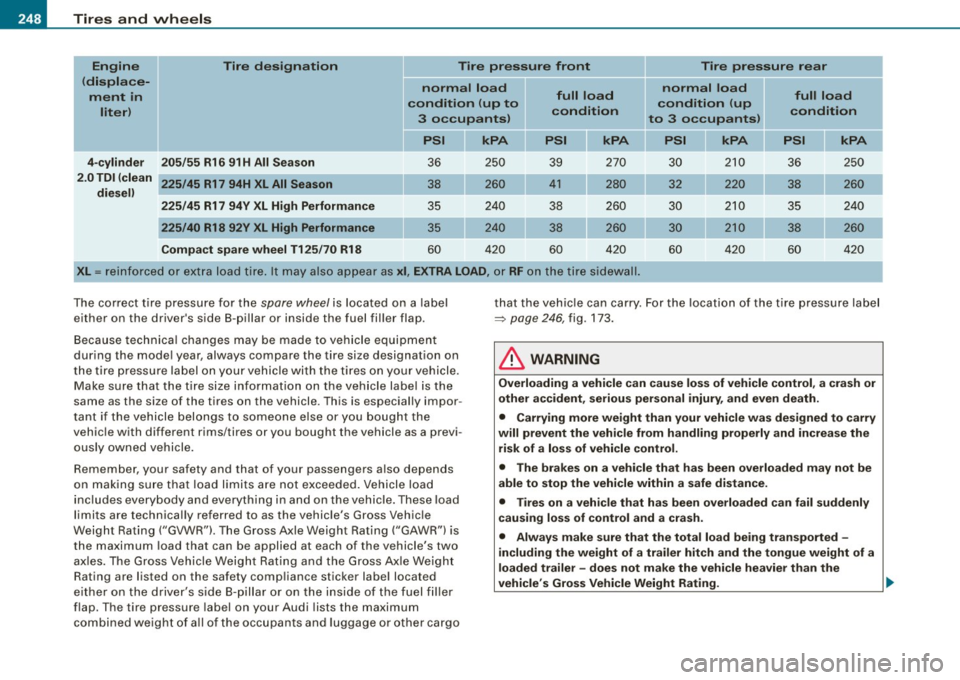
-~_T_ ir_e_ s_ a_ n_d _ w_ h_ e_e _l_s _________________________________________________ _
Engine Tire designation Tire pressur e front Tire pressure rear
(displace- normal load normal load
ment in full load
full load
liter) condition (up to
condition c
ondition (up
condition
3 o ccupants ) to 3 occupants)
PSI kPA PSI kPA kPA kPA
4-cylinder 205 /55 R16 91H All Season 36 250
39 270 3
0 210
36 250
2
.0 TDI (clean 225 /45 R17 94H XL All Season 38 260 41
280 32 220 38 260 diesel)
225/45 R17 94Y XL High Performance
35 240 38 260 30 2 10 3 5 24 0
225 /40 R18 92Y XL High Performan ce 35 240
38 260 30 210 38 260
Compact spare wheel T125
/70 R18 60 420
60 420
60 420
60 420
XL
= reinfo rced or ext ra load t ire . It may als o appea r as xi , EXTRA LOAD , or RF on the tire s idewall.
The correct t ire pressure for the
spare wheel is located on a label
either on the driver's side B-pillar or inside the fue l filler flap.
Because technica l changes may be made to vehicle equipment
during the mode l year, always compare the tire size designat ion on
the tire pressure la bel on y our vehicle with the tires on your vehicle.
Make sure tha t the t ire size information on the veh icle labe l is the
same as the size of the tires on the vehicle. This is especially impor
t ant if the vehicle belongs to someone e lse or you boug ht the
vehic le with different rims/tires or you bought the vehicle as a previ
ously owned vehicle.
Remember, your safety and that of your passengers a lso depends
on making su re tha t load limits a re not exceeded . Vehicle load
inc ludes everybody and everything in and on the vehicle. These load
limits are technically referred to as the vehicle's Gross Vehicle
Weight Rating ("GVWR"). The Gross Axle Weight Rating ("GAWR") is
the maximum load that can be applied at each of the vehicle's two
ax les. The Gross Vehicle We ight Rat ing and the Gross Ax le Weight
Rating are listed on the safety comp liance sticker labe l located
e it he r on the d river's side B-pillar o r on the i nside of the fuel f iller
flap. The tire pressure label on your Audi lists the maximum
combined we igh t of all o f th e occupa nts and luggage o r other cargo t
hat the vehic le can carry. For the location o f the tire pressure labe l
=> page 246, fig. 173.
& WARNING
Overloading a vehi cle can cause los s of vehicle control , a crash or
other accident, serious per sonal injury, and even death .
• Carrying more weight th an your vehicle was de signed to carry
will prevent the vehicle from handling properly and increase the
risk of a loss of vehicle control.
• The brakes on a vehicle that has been overloaded may not be
able to stop the vehicle within a safe distance .
• Tires on a vehicle that has been overloaded c an fail suddenly
cau sing loss of control and a crash .
• Alway s make sur e that the total load being tran sported -
including the weight of a trailer hitch and the tongue weight of a
loaded trailer -does not make the vehicle heavier than the
vehicle 's Gross Vehicle Weight Rating . _.,
Page 297 of 320
_________________________________________________ G_ e_ n_ e_r _a _l_ i_n _f_o _ r_ m_ a_ t _i _o _ n __ _
left door jamb. It shows the month and year of production and the
vehicle identification number of your vehicle (perforation) as well as
the Gross Vehicle Weight Rating (GVWR) and the Gross Axle Weight
Rating (GAWR).
The high voltage warning label
is located on the lock carrier.
The spark ignition system complies with the Canadian
standard ICES-002. •
Weights
Gross Vehicle Weight Rating
The Gross Vehicle Weight Rating (GVWR), and the Gross Axle Weight
Rating (GAWR) for front and rear are listed on a sticker on the left
door jamb.
The Gross Vehicle Weight Rating includes the weight of the basic
vehicle plus full fuel tank, oil and coolant, plus maximum load,
which includes passenger weight (150 lbs/68 kg per designated
seating position) and luggage weight.
Gross Axle Weight Rating
The Gross Axle Weight Rating is the maximum load that can be
applied at each axle of the vehicle ~& .
Vehicle capacity weight
The vehicle capacity weight (max. load) is listed either on the
driver's side B-pillar or inside the fuel filler flap .
Roof weight
The maximum permissible roof weight is 165 lb (75 kgl. The roof
weight is made up of the weight of the roof rack system and the
weight of the object being transported~
page 89, "Loading the
roof rack".
Controls and equip ment Safety first Vehicle operation
& WARNING
•
The actual Gross Axle Weight Rating at the front and rear axles
should not exceed the permissible weights, and their combination
must not exceed the Gross Vehicle Weight Rating.
• Exceeding permissible weight ratings can result in vehicle
damage, accidents and personal injury.
0 Note
• The vehicle capacity weight figures apply when the load is
distributed evenly in the vehicle (passengers and luggage). When
transporting a heavy load in the luggage compartment, carry the
load as near to the rear axle as possible so that the vehicle's
handling is not impaired.
• Do not exceed the maximum permissible axle loads or the
maximum gross vehicle weight. Always remember that the vehicle's
handling will be affected by the extra load. Therefore, adjust your
speed accordingly.
• Always observe local regulations.•
Dimensions
The specifications refer to the basic model. Differences may occur
depending on the model type and options ordered, for example, tire
sizes.
0 Note
When driving up steep ramps, on rough roads, over curbs, etc. it is
important to remember that some parts of your vehicle, such as
spoilers or exhaust system components, may be close to the
ground. Be careful not to damage them. •
Vehicle care Do-it-yourself service Tec hn ica l da ta