steering wheel AUDI S3 2010 Owner's Manual
[x] Cancel search | Manufacturer: AUDI, Model Year: 2010, Model line: S3, Model: AUDI S3 2010Pages: 320, PDF Size: 75.34 MB
Page 170 of 320

-Child Safety -------=---------------------------------------
& WAR NIN G (co ntinued )
• Alw ays in sta ll re ar-facin g child safety s eats on the r ear seat .
• If you m us t in sta ll a rear ward f acing child saf ety s eat on th e
fr ont pa ssenger seat in exceptional circum stan ces and the
PA SSEN GER AIR BAG OFF light do es not come on and sta y on ,
immediately in sta ll the re ar-facing child safety s eat in a rear
s eating po sit ion and ha ve th e airb ag s ystem insp ected immedi
atel y by your autho riz ed Audi dealer .
& WARNING
If, in exceptional circum stance s, you mu st in sta ll a forward -f a cing
c hild re str ain t on th e fr ont p assenger's s eat:
• Always mak e sure the forward -fac ing seat ha s been de signed
a nd ce rt ified by it s m anufa cturer for u se on a fr ont se at w ith a
pa ssenger front and side airbag.
• Always follow the m anufacturer's instru ctions provided w ith
the child safety seat or carr ier.
• Alwa ys mo ve the pa ssenger seat into it s rea rmost positi on in
the seat' s fore and aft adju stment range , as far aw ay from the
ai rbag as possib le bef ore installing the ch ild r estr aint . The ba ck
re st mu st b e adjusted to an upright po sition.
• Alway s m ake sure that the PASSENGER AIR BAG OFF l ight
c om es on and sta y s on all the time whenever the ignition is
s w it c hed on . •
Advanced front airbag system and children
Your vehicle is equipped with an "Advanced Airbag System" in
complia nce with United States Federa l Motor Vehicle Safety Stan
dard (FMVSS) 208 as applicable at the time your vehicle was manu
factu red. T
he Advanced Airbag system in your vehicle has been certified to
meet the " low -risk" requiremen ts for 3 -and 6 -year o ld children on
the passenger side and smal l adults on the driver side . The low risk
deployment criteria are intended to reduce the risk of injury through
interaction with the airbag that can occur, for example, by being too
close to the steering wheel and instrument panel when the airbag
inflates. In addition, the system has been certified to comply with
the "suppression" requirements of the Safety Standard, to turn off
the front airbag for infants up to 12 months who are restrained on
the front passenger seat in child restraints that are listed in the
S tandard.
Even though your vehicle is equipped with an Advanced Airbag
system, all ch ildren, especially those 12 years and younger, should
always ride in the back seat properly restrained for their age and
size . The airbag on the passenger side makes the front seat a poten
tially dangerous p lace for a child to ride. The front seat is not the
safest p lace for a child in a forward -facing child safety seat. It can be
a very dangerous p lace for an infant or a larger ch ild in a rearward
facing seat. •
Advanced Airbags and the weight-sensing
mat in the front seat
The Advanced Airbag System in your vehicle detects the presence
of an infant or child in a chi ld restraint on the front passenger seat
using the weight -sensing mat in the seat cushion and the sensor
below the safety belt latch on the front passenger seat that
measures the tension on the safety belt.
The weight -sensing mat measures total weight of the chi ld and the
child safety seat and a child blanket on the front passenger seat . The
weight on the front passenger seat is related to the design of the
child restraint and its "footprint", the size and shape of the bottom
of the child restraint as it sits on the seat . The weight of a child
restraint and its "footprint" vary for different kinds of child ..,.
Page 191 of 320
actual vehicle behavior. If the two do not match, for example when
th e vehicle begins to skid, ESP brakes the appropriate wheel auto
matical ly .
The vehicle is stabilized again by the forces acting on the wheel
during braking. With an oversteering vehicle (tendency for the rear
end to skid out of the curve), the brake application is mainly at the
front wheel on the outside of the curve, with an
understeering
vehicle (tendency to run wide in the curve) at the rear wheel on the
inside of the curve or additionally at the other wheels as needed.
This brake application is accompanied by noises.
ESP works in conjunction with ABS=>
page 192. If there is malfunc
tion in the ABS, ESP is also inoperative.
Activating
The ESP is automatica lly activated when the engine is started, and
it performs a self-test. As soon as the test is completed, the system
is in normal operating mode. With ASR deactivated, or with ESP/ASR
deactivated, pressing the button=>
page 188, fig. 158 returns the
system to normal operation.
Deactivating
ESP should normally be activated at all times because this ensures
optimum vehicle stability. Only in certain exceptional cases it does
make sense to deactivate Anti-Slip Regulation (ASR) or the Elec
tronic Stability Program (ESP) by pressing the button =>
page 188,
fig. 158. Both deactivation stages can only be activated from normal
mode .
Deactivating ASR
Tap the switch. Deactivation is indicated by slow flashing of the ESP
lamp in the instrument cluster. In certain situations (e .g. driving
with snow chains, in deep snow or on loose ground, or when
rocking the car free), it may be necessary to deactivate ASR.
Deactivating ESP/ASR
Press the button for more than 3 seconds. Deactivation is indicated
by the ESP lamp in the ins trument cluster staying on permanently.
Controls and equip
ment Safety first Vehicle operation
Intelligent technology
This
deactivates the Electronic Stability Program (ESP) in addition to
ASR. No Elec tronic Stability System operation and no Anti -Slip
Regulation is available across the entire speed range; ASR and ESP
are activated only when the brakes are used for the duration of the
braking action and remain active until a stable vehicle condition has
been reached. There is no driving situation which requires ESP to be
deactivated, so this should only be done if the driver's skill and the
traffic situation permit.
& WARNING
• The limits of physics cannot be suspended by ESP. Even in vehi
cles with ESP. you should always adapt your driving to road and
traffic conditions. This is particularly true on a slippery and wet
road . Do not be tempted by the increased safety provided to take
risks -danger of an accident!
• Please note that when ASR or ESP /ASR is deactivated , the drive
wheels can spin on icy and slippery roads and the vehicle can
break away -danger of skidding!
Electronic differential lock CED1
.)
The electronic differential lock monitors the rotational
speed of the drive wheels.
General notes
The elect ronic differential lock (EDU helps the car to start moving,
accelerate and c limb a gradient on surfaces providing poor or
a lmost no grip. Without EDL, this would be difficult, if not impos
s ible.
How the system works
The EDL operates automatical ly. It monitors the rotationa l speed of
the drive wheels on an axle with the help of the ABS sensors
=>
page 192. If a noticeable difference in rotational speed between
the drive wheels on one axle is detected (e.g. on slippery ground
on
one side),
the spinning wheel is braked, thereby transferring power
Vehicle care Do-it-yourself service Technical data
Page 195 of 320
How the ABS system works
An aut omatic check is made whe n a speed of ab out 4 mph (6 km/h)
is reached. When this happens, a pumping noise can be heard.
I f an individua l wheel begins to rotate too slowly in relation to
ve hicle speed and ten ds to lock, the A BS automatical ly reduces
brake pressure to prevent that wheel from locking.
T his auto matic adjust ment p rocess wil l cause a
slight vibration o f
the brake peda l and some noises to alert you that veh ic le speed
must be ada pted to e xisting roa d and traff ic c onditions.
& WARNING
Although the ABS is very effective , always remember that braking
c apability is limited by tire tra ction . Always adjust your driving
speed according to the road and traffic conditions. Do not let the
extra safety afforded by the ABS tempt you into taking e xtra risks .
The ABS cannot overcome the laws of physics.
[ i ) Tips
• I f ABS is not functioning properly, a warning light wil l come on.
See
=> page 16.
• I f a fau lt occurs in the ABS, the E DL is als o not fu ncti onin g. This
is indicated by the ABS warning light. •
Brake assistant
The brake a ssi st ant is de sig ned to a chieve th e opti mum
b ra kin g eff ec t.
The brake assistant helps to increase the effective braking power
and thus to ac hieve a s horte r stop ping dis tance. If the drive r
presses the brake pedal very quick ly, the brake assistant automati
ca lly b oosts the braki ng force to the maximu m level, up to th e point
where the anti -loc k brake function (A BS) intervenes to stop the
whee ls from loc king. You should then keep the brake pedal pressed
Controls and equip
ment Safety first Vehicle operation
Intelligent technology
until
the vehicle has braked to the required speed . The brake assis
t an t swi tc h es itse lf o ff as s oon as you r eleas e the b rake pe dal.
The brake assistant wi ll not be operative if there is a malfunction in
the ABS .
& WARNING
Please remember that the accident risk always increases if you
drive too fast , espe cially in corners or on a slippery road , or if you
follow the vehicle ahead of you too closely . An increased accident
risk cannot be compensated even by the brake assistant , so
always maintain a safe speed. •
ciectro-mechanical power assist
Th e e le ctr o-me ch anic al pow er assis t helps the driv e r
w hen steerin g.
The degree of powe r ass ist is electronically matched to veh icle
speed .
The power steering system assists the driver so that he can steer the
ve hicle with re d uced p hysi ca l eff ort.
Power steering w ill not work if the eng ine is off . As a result, the
stee ring whee l wi ll be ha rd to turn .
& WARNING
If the system develops a problem , you must seek qualified profe s
sional assistance .
0 Note
If there is an electronic ma lfunction, servotronic will still function
like a conventi onal power s teer ing sy stem , pr ovi din g a constant
steerin g support force that is no longer proportionate to the vehicle
Vehicle care Do-it-yourself service Technical data
Page 196 of 320

__ _:_:ln..:..t::.: e::.: l~ li :.;:g t:e::..: n..:.. t:...::. te::::..:: c~h :.:.n .:..: o:::.: l:.: o :.;g~ yL- ________________________________________ _
speed. This is most noticeable when turning the steering wheel at
low speeds (for example when parking), -more effort will be
required than usual.
• Be aware of the different than usual steering response and
adjust your steering force accordingly.
• Have the problem checked and set right by an authorized Audi
dealer as soon as possible.
• If a steering malfunction occurs, this is signaled with the or.
@ indicator lights and a warning tone, see.
[ i) Tips
• If the power steering system should fail, or if the engine is not
running (for example, while being towed), you will still be able to
steer the vehicle. However, more effort will be required to do so.
• If the power steering system is not functioning properly, contact
your authorized Audi dealer immediately.
Applies to vehicles: with All Wheel Drive
Driving with your quattro®
With All Wheel Drive, all four wheels are driven.
General information
With All Wheel Drive, power is distributed to all four wheels. This
happens automatically depending on your driving style and the
road conditions at the time. See also::::,
page 189, "Electronic differ
ential lock (EDU".
Winter tires
When driving in the winter, your vehicle with All Wheel Drive has an
advantage, even with regular tires. In winter road conditions it may
be advisable to mount winter tires (or all -season tires) for improved
driveability and braking: these tires must be mounted on
all four
wheels.
See also ::::, page 259, "Winter ti res".
Snow chains
Where snow chains are mandatory on certain roads, this normally
also applies to vehicles with all-wheel drive:::::,
page 260, "Snow
chains".
Replacing wheels/tires
Vehicles with All Wheel Drive must always have tires of the same
size. Also avoid tires with different tread depths. For details see
page ::::,
page 254, "New tires and replacing tires and wheels".
Off-Road driving?
Your Audi does not have enough ground clearance to be used as an
off-road vehicle. It is therefore best to avoid rough tracks and
uneven terrain as much as possible. Also refer to::::,
page 198.
& WARNING
Always adjust your driving to road and traffic conditions. Do not
let the extra safety afforded by the all-wheel drive tempt you into
taking extra risks.
• Although the quattro ®all-wheel drive is very effective, always
remember that braking capacity is limited by tire traction. You
should therefore not drive at excessive speeds on icy or slippery
road surfaces.
• On wet road surfaces, be careful not to drive too fast because
the front wheels could begin to slide on top of the water (hydro planing). If this should occur, you will have no warning from a
sudden increase in engine speed as with a front-wheel drive
vehicle. Always drive at speeds which are adjusted to the road
conditions -risk of crash!
n
Page 245 of 320

__________________________________________________ T_ ir_e_ s_ a_ n_d _ w_ h_ e_ e_l_s __ __
•
& WARNING (continu ed )
crashes and serious personal in jur ies . Have worn or da maged t ires
replaced immediately .
• Tires age even if they are not being u sed and can fail suddenly ,
especially at high speeds. T ires that are more than 6 years old can
only be used in an emergency and then w ith special care and at
low speed.
Glossary of tire and loading terminology
Accessory weight
means the co mbined we ig ht ( in excess o f those sta nda rd items
which may be rep laced) of automatic transmission, power steering,
power brakes, power w indows, powe r seats, rad io, a nd heater, to
the extent that these items are avai lab le as factory-installed equip
m ent (w hether insta lled or not).
Aspect ratio
means t he ratio o f th e height to t he w idt h of the tire in perce nt.
N umbers of 55 or lower indicate a low sidewa ll for improved
steer ing respo nse and b ette r overall ha ndl ing on dry pave ment.
Bead
means the part of the tire that is made of stee l wires, wrapped or
reinforced by ply cords and that is shaped to fit the rim.
Bead separation
means a breakdow n of the bond be tween co mponents i n the bead.
Cord
means the strands fo rmi ng the plies in the ti re.
& W ARNING (continued )
• Never mount used tires on your vehicle if you are not sure of
their "previous history. " Old used t ire s may ha ve been damaged
even though the damage cannot be seen that can lead to sudden
tire failure and lo ss of vehicle control.
• If you noti ce unusual vibration or if the vehicle pulls to one side
when driving , always stop as soon as it is safe to do so and check
the wheels and tires for damage . •
Cold tire inflation pressure
mea ns t he ti re pressure reco mm ended by the ve hicle ma nufacturer
for a tire of a designated size that has not been d riven for more tha n
a cou ple o f miles (k ilometers) at low speeds in t he t hre e ho ur per iod
before the tire pressure is measured or ad justed .
Curb weight
means the weight of a moto r vehic le with standard equipment
i nc lud ing the max imu m capac ity o f fue l, o il, and coola nt, a ir c ond i
tioning and additiona l weight of optional equipment.
Extra load tire
means a tire designed to ope rate at higher loads and at higher infla
tion pressures than the corresponding standard tire. Extra load tires
my be identified as "XL",
"xi", "EX TRA LOA D", or "RF" on the side
wa ll.
Gross Axle Weight Rating ("GAWR ")
means the load -carrying capacity of a sing le ax le system, measured
at the ti re -ground interfaces.
Gross Vehicle Weight Rating ("GVWR "l
means the ma ximum tot al l oade d weigh t of the vehicle.
Vehicle care I t •
Page 255 of 320
Tires and wheels -_______________ _____.
Tire service life
The service life of tires depends on a lot of different things
including proper installation and balancing, correct tire
pressure and driving style.
(r
\'"-----JJ
Tread Wear Indicator (TWI)
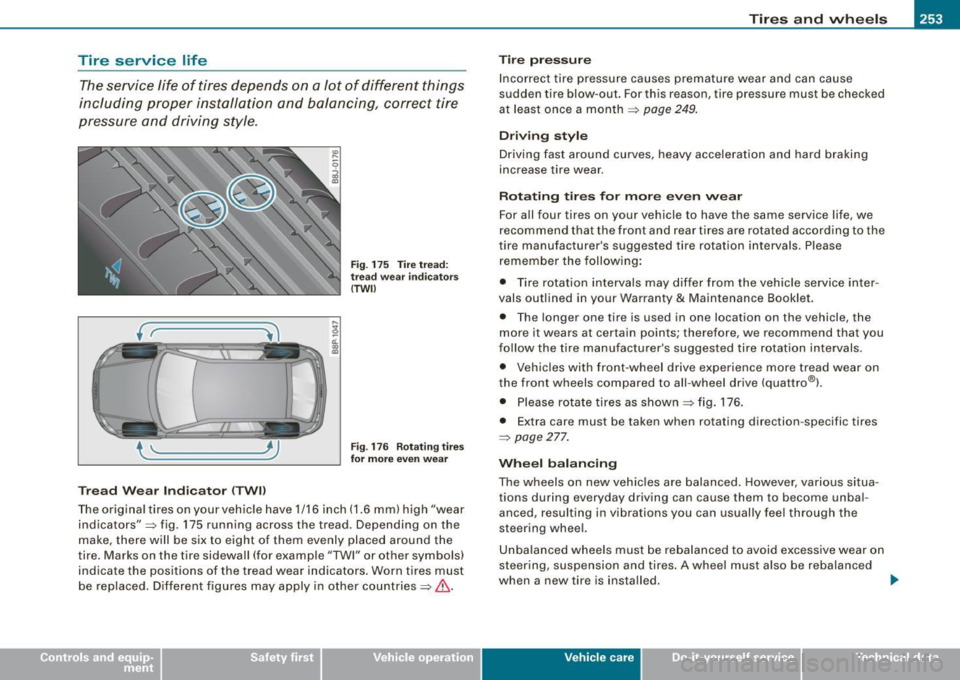
Fig . 175 Tire tread:
tread wear indicators
(TWI)
Fig . 176 Rotating tires
for more even wear
The original tires on your vehicle have 1/16 inch (1.6 mm) high "wear
indicators":::::, fig. 175 running across the tread. Depending on the
make, there will be six to eight of them evenly placed around the
tire. Marks on the tire sidewall (for example "TWI" or other symbols)
indicate the positions of the tread wear indicators. Worn tires must
be replaced. Different figures may apply in other countries.:::::,&.
Tire pressure
Incorrect tire pressure causes premature wear and can cause
sudden tire blow-out. For this reason, tire pressure must be checked
at least once a month .:::::,
page 249.
Driving style
Driving fast around curves, heavy acceleration and hard braking
increase tire wear.
Rotating tires for more even wear
For all four tires on your vehicle to have the same service life, we
recommend that the front and rear tires are rotated according to the
tire manufacturer's suggested tire rotation intervals. Please
remember the following:
• Tire rotation intervals may differ from the vehicle service inter
vals outlined in your Warranty
& Maintenance Booklet.
• The longer one tire is used in one location on the vehicle, the
more it wears at certain points; therefore, we recommend that you
follow the tire manufacturer 's suggested tire rotation intervals.
• Vehicles with front-wheel drive experience more tread wear on
the front wheels compared to all-wheel drive (quattro®l .
• Please rotate tires as shown .:::::, fig. 176.
• Extra care must be taken when rotating direction -specific tires
:::::, page 277.
Wheel balancing
The wheels on new vehicles are balanced. However, various situa
tions during everyday driving can cause them to become unbal
anced, resulting in vibrations you can usually feel through the
steering wheel.
Unbalanced wheels must be rebalanced to avoid excessive wear on
steering, suspension and tires. A wheel must also be rebalanced
when a new tire is installed. _,,
Vehicle care I I Technical data
Page 282 of 320

1111.___F_ u_ s _ e_s _ a_n _ d_ b_ u_lb _ s _______________________________________________ _
Equipment Amps No. Equipment Amps
Manual headlight beam adjustment, automatic
14 Electronic Stabilization Program (ESP) (control 10
1
headlight beam adjustment, AFS control mod-10
module), shift gate automatic transmission
ule, engine components, light switch (switch
15 Interior lights, reading lights 10
lighting/illumination), diagnosis socket
Diagnostic connector, rain sensor, air condition-
Automatic transmission, control module for
16 ing (control module), tire pressure monitor dis-10
CAN data transfer (gateway), electro -mechanical
play (control module)
2 steering, shift gate automatic transmission, 10 17 Anti-theft alarm warning system 5 engine relay, fuel tank control unit, engine con -
trol unit, brakes control (ABS), Electronic Stabili-
18 Diagnose Starter 5
zation Program (ESP), Anti -Slip Regulation (ASR) 19 All Wheel Drive 10
3
Airbag 5 20 Not used
!! Air-conditioning (pressure sensor, air quality
sensor), button for Electronic Stabilization Pro -
21 Not used
gram (ESP), Anti-Slip Regulat ion (ASR), tire pres-
22 Blower fan 40
sure monitor display, oil level sensor, back -up 23 Driver's side power window, front 30
4 light switch, front seat heating , parking aid, 5
seat-occupancy recognition (on USA vehicles), 24 Power outlet front 20
garage door opener, automatic mirror dimming, 25 Rear window defogger 30
headlight assistant, heated windshield washer
26 Power outlet in luggage compartment 20 nozzles, air conditioning (control module)
-27 Fuel tank control module, fuel pump 15
5 AFS headlights (left side) 5
AFS headlights (right side) 5 28 Power window, rear 30
7
Not used 29 Not used
Not used
30 Not used
9 Navigation system, radio system 15 31 Not used
10 digital
radio, cell phone, TV equipment 7,5 32 Not used
11 Automa tic mirror dimming, headlight assistan t 10 33 Sliding/pop-up roof 20
Central locking (front doors) 10 34 Not used
13 Central locking (rear doors) 10 35 Not used
36 Lumbar support 10
Page 284 of 320

IIIJl1.--___;;F...; u::. s .::..:: e~s :.....:: a..:..n .:..; d::....; b.:..:. u..:..lb ;:..:: s _______________________________________________ _
No. UEquipment Amps I No. Equipment
Amps
F6 Steering wheel electronics
5 F28
Not used
F7 Not used F29 Fuse assignment in the
left-side instrument
50
F8 Not used panel (special equipment)
F9 Not used F30 Power supply relay terminal
15 50
F10 Engine control module, main relay 5/10
Variation
(2) with 54 Plug-in Fuses
F11 Not used No. Equipment Amps
F12 Control module for CAN data
transfer (gateway)
5
Body control module (right)
F1 30
F13 Engine control module 15/25/30
20/30
F2 ESP valves, Anti-lock brake system (ABS) valves
F14 Ignition coils, engine components (diesel
20 F3 Terminal 30 40
engine)
Preheating control module/engine component, F4
Battery voltage
5
F15 tank diagnosis, oxygen sensor 5/10
F5 Horn 15
F16 Body control module (right)
30 F6 Not used
F17 Horn 15
F7 Not used
Audio amplifier 30 F8 Not used
F19 Front windshield wiper system 30
F9 Engine components 10
F20 Water pump, volume regulator valve 10/20
F10 Fuel tank control, mass air flow sensor
10
F21 Oxygen sensor, vacuum pump 10/15
F11 Oxygen sensors, in front of catalytic converter 10
F22 Clutch pedal switch, brake light switch 5
F12 Oxygen sensors, behind catalytic converter 10
F23 engine components, water pump 5/10/15
F13 Automatic transmission 15
Engine components, water pump 10 F14 Not used
F25 Pump (ESP/ABS), ABS valve
40
F15 Water pump 10
F26 Body control module (left) 30
F16 Volume control valve 20
F27 Secondary air pump, preheating control module 40 F17 Steering wheel electronics 5
F18 Audio amplifier 30
F19 Not used
Page 306 of 320

-Alphabetical index
----=----------------------------
A
ABS
See Anti-lock brake system . . . . . . . . 192
ABS (An ti-lock brake system)
Wa rning/indicato r lights .. ... .... .. 16
AC (air conditioner) . . . . . . . . . . . . . . . . . . 98
A . ccessones ....... ...... .... ...... .
Adapt er for anti-theft wheel bolts .... . 300
273 Air conditioner ...
... .... ...... ..... . 99
See also Clim ate co111trols .... .. .... . 96
Air conditioning Swi tching on and off . ....... .... .. 99
Air distribution Climate controls
Air outlets Adjusting the outlets for rapid
defrosting/defogging .... .... ... .
Clima te controls ...... ..... .. ... . 101
102
102 How
many airbags does my vehicle have?
152
Important things to know ...... .... 145
Indicator light ................. .. 156
Moni toring . .. ... ........ .... ... .
Repairs ..... .. ... .. .... .. .... .. .
Side airbags ... ... ... ... .. ... ... . 156
159
161
Side curtain airbags .... ... .... ... 164
When must the system be inspected? ...
156
Adaptive Light
defective
. .... .... .... ........ ... 34 Air quality sensor . . . . . . . . . . . . . . . . . . .
100 All Wheel
Drive ... .... ............. . 194
210
Adaptive light .. .. ... ... .... .... .... . 55 Air reci
rculation . .... ..... ... .... ... 101 Alloy wheels .... ... ..... .... .... .. .
Climate controls .. ..... ...... .... 100 A ll-whee l drive
Adding
Engine coo lant .. ... ...... ... .... 234
Engine oil .......... ....... ...... 230
Windshield washer fluid ...... .... 240
Additiona l accessories . ....... .... ... 300
Addi tiona l heater
Climate controls . ...... ..... ..... 103
Additives Engine oil .... .. .. .... ...... . .. .. 230
Adjustable steering wheel column ..... 105
Adjusting Steering wheel co lumn ....... .... 105
Adjusting front seats . .... ..... .. ... .. 72
Advanced Airbag System Components ...... .... ......... . 152
F . b ront air ags . .... .... .... ... ... . 150
How the components work together 153
Monitoring .... .... .... ... .... .. . 156
PASSENGER AIR BAG OFF light ... . . 157 When should I use the air recircu
lation?
100
Air recirculation mode
Climate controls .... .. .... ....... 100
Airbag Warning/indicator lights ........... 14
Airbag System Weight-sensing mat ...... ... .... . 168
A' b
Ir ag system . . . . . . . . . . . . . . . . . . 145, 162
Advanced Airbag System .......... 149
Care . . . . . . . . . . . . . . . . . . . . . . . . . . . . 159
Child restraints . ... .... .... .... .. 169
Children ...... ..... ... ... .... ... 168
Components (front airbags) .. ... ... 152
Danger of fitting a chi ld safety seat on the
front passenger seat . . . . . . . . . . . . 147
Disposal . . . . . . . . . . . . . . . . . . . . . . . . 159
Front airbags .. ... ........ .... ... 149
How do the front airbags work? . . . . 154 Winter
tires ........... .. .. .... .. 259
A lternator
See Generator . . . . . . . . . . . . . . . . . . . . 14
Aluminum alloy wheels .... .. . .. .. ... 210
Ambient lighting ......... .... .... .. . . 60
Anti-glare inside day-night mirror .... .. 67
Anti -lock brake system
How the ABS system works . . . . . . . . 192
Anti -lock brake system (ABS)
Warning/indicator lights . ...... .... . 16
Anti-Slip Regulation System (ASR)
How the system works . . . . . . . . . . . . 190
An ti- theft sys tems
An ti-Theft Alarm System ....... .... 46
Anti -theft wheel bolts ..... .... .... ... 273
Armrest Center armrest ....... .. .. .. ..... .. 80
Rear armrest ............. .... .. .. 81
Page 314 of 320
-Alphabetical
index --=-----------------
Parking brake warning ... ..... ... ..... 30
Parking on a decline (downhill) ....... 109
Parking on an incline (uphill) . ...... .. 109
Parts replacement . . . . . . . . . . . . . . . . . . 300
PASSENGER AIR BAG OFF light ..... ... 157
Passive safe ty syst em . . . . . . . . . . . . . . . 124
Pedals . .... ... .. .... .... .......... 130
Physical pr inciples of a frontal collision 136
Polishing ... .... .... .... .... ... .... 207
Power locking switch . . . . . . . . . . . . . . . . . 42
Rear center console . . . . . . . . . . . . . . . 43
Powe r locking system . . . . . . . . . . . . . . . . 38
Convenience close/open feature .. ... 48
Locking and unlocking the vehicle from
inside .. ... ..... .... .... ........ 42
Opening and c losing the windows .. . 48
Operating locks from with key ...... 41
Rear lid ...... .. .. .... ...... ... .. . 43
Remote con trol . . . . . . . . . . . . . . . . 37 , 40
Un locking and locking vehicle .. .... . 40
Power outlets . . . . . . . . . . . . . . . . . . . . . . . 91
Power seat Adjusting the seatback ............. 75
Adjustment ... .... .... .... ... .... 74
Power steering
See Electro-mechanical power assist . 16,
193
Power sunroof
See panoramic sliding sunroof ...... 49
Power window swi tches . . . . . . . . . . . . . . 47
In the driver's door .... .... ...... .. 47
Reactivating the system . . . . . . . . . . . . 49 Pregnant women
Special considerations when wear ing a
safety belt ............... ... ... 1 41
Proper occupant seating positions .... 126
Prop er safety b elt position . . . . . . . . . . . 140
Proper seat ing position
Front passenger . . . . . . . . . . . . . . . . . 127
Occupants .... .... .. ..... .. .. ... 126
Rear passengers 128
a
Quartz
clock .............. .... ... .... . 9
quattro ®
See All Wheel Drive ...... ...... ... 194
Question
R
What happe ns to unbelted occupants? ..
137
Why safety belts? . . . . . . . . . . . . . . . . 135
Radiator fan ... .. .... .. .. .... .... ... 235
Radio Rep lacing . .... ... .... .... .... ... 301
Rain sensor d efect iv e ... .. .... .... .... 34
Reading light
Rear ...... ... ..... .... .... ....... 60
Reading lights
Front . . . . . . . . . . . . . . . . . . . . . . . . . 58 , 59
Rear ...... ... ..... .... .... .... 58, 59
Rear armrest . .... ...... .... ... .. .... 81
Rear ashtray ..... ..... .. .... .... .... 91 Rear
lid
Emergency release .... ... ... ... .. . 44
Locking/unlocking . .... .... ... ... .. 43
Rear light defective . ...... .... .... .... 34
Rear power locking switch . .... .... ... . 43
Rear seat bottom ...... .... .... .... .. 81
Rear view mirror
Inside rear view mirror ............. 67
Rear window defogger with air-conditioning ... ..... .. ... 103
Refu elling ........... .... ........... 220
Release lever for engine hood ......... 223
Remo te con trol ................... ... 37
Resetting remote con trol ... .... .... 41
Un locking and locking . .... .... .... 40
Remo te mas ter key
Battery replacement ........... .... 37
Check light .... .... .... ....... .. .. 37
Repair manuals ... .... ... .... .... .. . 298
Repairs Airbag system .... .... .... .... ... 159
Replacing Wheel rims . ... .... .... .... .. 254, 256
Replacing a fuse ... ... ....... .... ... 278
Replacing a sound sys tem . ........... 301
Replacing light bulbs .. ..... .. ... .... 283
Replacing tires and wheels ........... 255
Reporting Safety Defects ..... .... 133, 134
Reset button . . . . . . . . . . . . . . . . . . . . . . . . 10
Resetting remote control .. .... .... .... 41
Retractor . . . . . . . . . . . . . . . . . . . . . . . . . . 139