warning lights AUDI S3 2010 Owner's Manual
[x] Cancel search | Manufacturer: AUDI, Model Year: 2010, Model line: S3, Model: AUDI S3 2010Pages: 320, PDF Size: 75.34 MB
Page 70 of 320

Clear vision
Disabling auto dimming
-Press b utto n © => page 6 7, fig. 66 briefly, -th e gr ee n
i nd ica to r li ght @ goes out .
Activating/reactivating auto dimming
Press butto n© br iefly, -the gr een in dicator l ight®
goes on.
Automatic dimming function
The au tomat ic dim ming f uncti on is act iva ted every tim e th e ignit ion
i s tur ned on . The green indi cator light is lit to i ndicate auto dimming
i s ac tive.
When d immin g is activat ed, the inside m irror will darken automati
cally in re spo nse to th e am ount of li ght striki ng the m irror (suc h as
headlights from rearward approachin g vehicles). Even in dimm ing
mod e, the m irror su rface turns br ig ht whe n :
• the interior lig ht is swi tc he d on
• r eve rse gea r is en gage d.
& WARNING
Broken glass of automatic dimming mirror can cause electrolyte
fluid leakage . Electrolyte fluid can irritate skin , eyes , and respira
tory system .
• Repeated or prolonged exposure to electrolyte can cause irrita
tion to the respiratory system, especially among people with asthma or other respiratory conditions . Get fresh air immediately
by leaving the vehicle or , if that is not possible, open windows and
doors all the way.
• If electrolyte gets into the eyes , flush them thoroughly with
large amounts of clean water for at least 15 minutes; medical
attention is recommended .
• If electrolyte contacts skin, flush affected area with clean water
for at least 15 minutes and then wash affected area with soap and
& WARNING (continued)
water; medical attention is recommended . Thoroughly wash
affected clothing and shoes before reuse .
• If swallowed and person is conscious , rinse mouth with water
for at least 15 minutes . Do not induce vomiting unless instructed
to do so by med ical professional. Get medical attention immedi
ately.
0 Note
Liq uid ele ctro lyte leak ed fro m a broke n mirror g lass will d am ag e any
plastic surfaces i t com es in contact with. Clean up sp ill e d e lectroly te
im med iately wi th cle ar w ater and a spo nge.
[ i ] Tips
• If you switch off the automatic dimming function on the inside
mirror, automatic dimming of the outside mirrors will likewise be
disabled .
• Check to make sur e there are no ob jects preventin g light from
r ea ch in g th e insi de mirr or.
• Do not attach any stickers to the windshield in front of the light
s en sor , as this wou ld interfer e w ith th e aut om atic operatio n of t he
headlights and the automatic d imming of the insid e mirror.
• B e aware th at automa tic d imming of the in side mi rror ca n only
operate pro perly if the rea r w indow sun blind* is retracted. •
Page 71 of 320

Outside mirrors
The outside mirrors a re electrically adjuste d (power
mirrors)
Adjusting the outside mirrors
l8 ::: ci. ., m
Fig . 67 Forwa rd
s e ctio n of dri ver 's
a rm re st : po wer m irr or
c ontrol s
Turn the adjust ing knob to=> fig. 67 © (driver 's side
outside m irror) to @ (front passenger's outside mirror) .
- Press the knob in the appropr iate direction to move the
mirror surface so that you have a good view to the rear.
Heat ed mirrors*
- T urn t he ro tary kno b to @ .
Folding both exterior mirrors*
- Rotate the knob to position @.
Depending on outside tempera ture and v ehic le speed, the mirror
surfaces are heated until the ignition is swi tched off -even if the
ro tary knob is no longer in position @.
Yo u are well -advised to fold * the outside mi rrors in when maneu
vering in tight spaces or when leaving the car parked c lose to other
vehic les .
Con tro ls and eq uip
ment
Clear vision
0 Note
• Curved mirro r surfaces (convex or spherica l* ) increase your fie ld
of view. Remember that vehicles or other objects will appear smaller
and far ther away than when seen in a flat mirror. If you use th is
mirror to estimate distances of fo llowing vehic les when changing
lanes, you cou ld estimate incorrectly and cause an accident .
[ i ] Tips
If the re shoul d be a malfunctio n in the electrical system, yo u ca n
still adjust the outside mirrors by pressing the edge of the mirror .•
Ap plies to vehi cles: with automa tic dim m in g for ou tsi de m irro rs
Automatic dimming for outside mirrors
The outside mirr ors are dimmed t ogether wi th the automatic
dimming of the inside mirror. When the ignition is switched on , the
mir ro rs darken automat ically depending on the light s triking the m
(e.g . headlights from the rear) .
When the interior lighting is switched on and when reverse gear is engaged, the mir rors are switched back to their o riginal b rightness
(not dimmed).
& WARNING
Broken glass of automati c dimming mirror can cause electrolyte
fluid leakage . Electrolyte fluid c an irritate skin , eyes , and respi ra
tory system .
• Repeated or prolonged e xpo sure to elect ro lyte can c au se irrita
tion to the respiratory system , e spe cially among people with
asthma or o ther re spiratory condition s. Get fresh air immediately
b y le aving the vehi cle or , if that i s not possibl e, open windows and
doors all the way . .,
Vehicle care I I Technical data
Page 95 of 320

Glove compartment
The glove compartment is illuminated and can be Jocked.
"' 10 ., ~ a:. ., 03
To open glove compartment
Fig. 96 Glove compart
ment
Pull the handle=> fig. 96 in the direction of the arrow
push down lid to the fully open position.
To close glove compartment - Push the glove compartment lid upward until the lock
engages.
The light will illuminate when the parking/headlights are turned on
and the glove compartment is open.
In the glove compartment lid, you will find a place to store a pen and
a pad of paper.
& WARNING
To reduce the risk of personal injury in an accident or sudden stop,
always keep the glove compartment closed while driving . •
Con tro ls and eq uip
ment
Seats and storage
Ap plies to veh ic les: w it h stora ge compar tmen t in cente r console
Storage compartment for small objects Ca
I, __] II 0
l
l
I~ u
I
'
Fig . 97 Center console
storage compartment
To open the compartment, press the cover ta=> fig. 97.
To close the compartment, push the drawer all the way in
until it clicks in place.
An additional storage compartment21 for relatively small objects is
located in the center console next to the brake lever. •
2> Not available on vehicles with Audi Nav igat ion System.
Vehicle care I I irechnical data
Page 108 of 320
• ..__O_ n_ t_h _ e_ r_ o_ a_ d ____________________________________________________ _
Ignition lock and ignition switch
Ignition lock
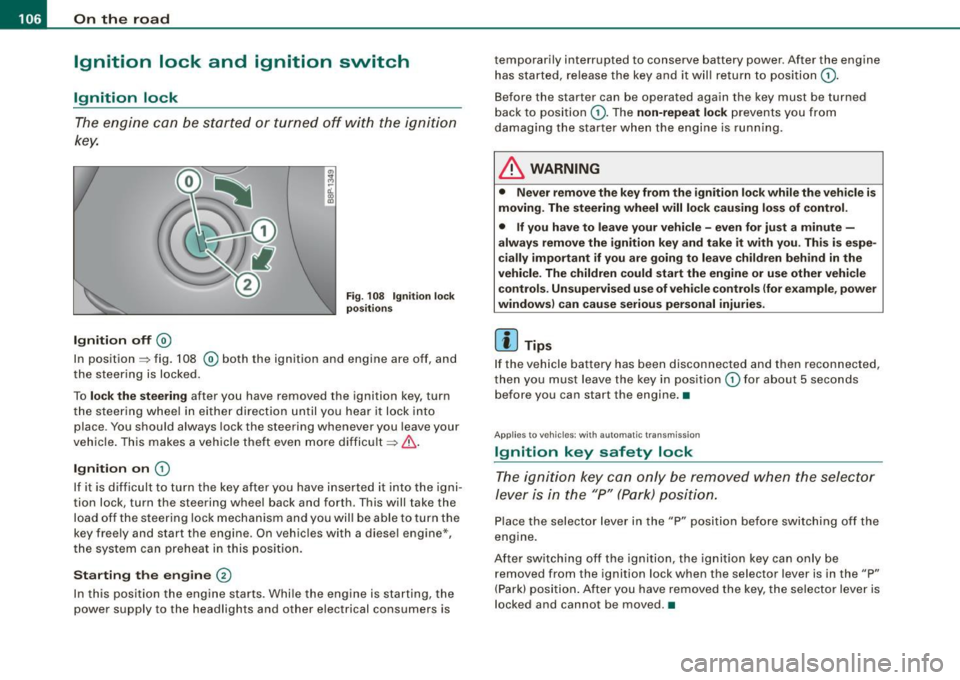
The engine can be started or turned off with the ignition
key.
Ignition off ®
Fi g. 108 Ignit ion lock
p os ition s
In position => fig. 108 ® both the ignit ion and engine are off, and
the steering is locked .
To
lo ck the stee ring after you have removed the ignition key, turn
t he steering whee l in either direction until you hear it lock into
place . You should always lock the steering whenever you leave your
vehic le . This makes a vehicle theft even more difficult =>
& -
Ignition on CD
If it is difficult to turn the key after you have inserted i t into the igni
tion lock, turn the steering wheel back and forth . This will take the
load off the steering lock mechanism and you will be able to turn the
key freely and start the engine . On vehicles with a diesel engine*,
t he system can preheat in this pos ition.
St arting the engine
@
In this position the engine starts . Whi le the engine is starting, the
power supply to the headlights and other electrical consumers is temporarily interrupted to conserve battery power
. After the engine
has started, release the key and it will return to position
CD .
Before the starter can be operated again the key must be turned
back to position
CD -The non-repeat lock prevents you from
damaging the star ter when the engine is runn ing.
& WARNING
• Never remo ve the key from the ignition lo ck w hile the veh icle i s
moving. The steering whe el will lo ck caus ing lo ss of control .
• If you hav e to lea ve your vehicle -even fo r ju st a min ute -
alway s remove the ignition key and take it with you. Th is is espe
ci ally important if you are g oing to lea ve children behind in the
vehicle . The childr en co uld start the eng ine or u se other vehi cle
c on trols . Un supe rvis ed u se of veh icle c ont ro ls ( for e xamp le , po wer
windows) c an cause seriou s per sonal injuries .
[ i ] Tips
If the vehicle battery has been disconnected and then reconnected,
then you must leave the key in position
CD for about 5 seconds
before you can start the engine. •
Applies t o vehi cles : w ith autom atic trans mission
Ignition key safety lock
The ignition key can only be removed when the selector
le ver is in the "P" (Park) p osition.
Place the selector lever in the "P" posi tion be fore switching off the
engine .
After switching off the ignition, the ignition key can only be
removed from the ignition lock when the selector lever is in the "P"
(Park) position . After you have re moved the key, the selector lever is
l ocked and cannot be moved .•
Page 127 of 320
Driving Safely -
----------------
Important things to do before driv ing
Safety is everybody's job! Vehicle and occupant safety
always depends on the informed and careful driver.
For your safety and the safety of your passengers, before
driving always:
-Make sure that all lights and signals are operat ing
correctly.
- Make sure that the tire pressure is correct.
- Make sure that all windows are clean and afford good
visibility to the outside.
- Secure all luggage and other items carefully =>
page 92.
-Make sure that noth ing can interfere w ith the pedals.
- Adjust front seat, head restraint and mirrors correctly for your height .
- Instruct passengers to adjust the head restraints
according to their height.
- Make sure to use the right ch ild restraint correctly to
protect children =>
page 167, "Child Safety ".
- Sit properly in your seat and make sure that your passen
gers do the same=>
page 72, "General recommenda
tions".
- Fasten your safety belt and wear it p roperly. Also instruct
your passengers to fasten the ir safety belts properly
=>
page 135. •
Controls and equip
ment Safety first Vehicle operation
What impa
irs driving safety?
Safe driving is directly related to the condition of the
vehicle, the driver as well as the driver's ability to concen
trate on the road without being distracted.
The driver is responsible for the safety of the vehicle and all
of its occupants. If your ability to drive is impaired, safety
risks for everybody in the vehicle increase and you also
become a hazard to everyone else on the road =>& .There
fore:
Do not let yourself be distracted by passengers or by
using a cellular telephone .
NEVER drive when your driving ability is impaired (by
medications, alcohol, drugs, etc.).
- Observe all traffic laws, rules of the road and speed limits
and plain common sense .
- ALWAYS adjust your speed to road, traffic and weather
conditions.
- Take frequent breaks on long trips. Do not drive for more
than two hours at a stretch.
- Do NOT drive when you are tired, under pressure or when
you are stressed .
& WARNING
Impaired driving safety increases the risk of serious personal
injury and death whenever a vehicle is being used. •
Vehicle care Do-it-yourself service Technical data
Page 138 of 320
___ S_a_ f_ e_ t-= y_ b_e_ l_ t _s _______________________________________________ _
- Make sure that your passengers also b uckle up and prop
erly wea r th eir sa fety belts.
Protect children wit h a child restraint system appropriate
for the size and age.
The warning light i in the instrument cluster lights up when the
ignition is switched on as a reminder to fasten the safety belts. In
addition , you will hear a warning tone.
After the ignition is switched on, the warning light in the instrument cluster will a lways come on for about 6 seconds and if the driver has
not fastened the safety belt, a warning tone will also sound for
about 6 seconds . As soon as the driver has fastened the safety belt,
the warning tone will stop and the warning light will go out .
If the driver or front seat passenger have not buckled -up within
about 10 seconds after the warning tone has stopped and the
vehicle is moving faster than about 15 mph, the warning tone will
sound again for about 6 seconds and then stop for 24 seconds and
then repeat this reminder sequence for a maximum of 2 minutes. At
speeds be low 5 mph, the warning tone will not sound.
Fa sten your safe ty belt and m ake su re that your p assengers also
properl y put on th eir s afet y belts .
& WARNING
• Safety belt s are the single mo st effective mean s available to
reduce th e risk of ser ious injur y and death in a utomobile acci
dent s. For your prote ction and th at of your pas senger s, alwa ys
c orre ctl y we ar safety belt s when t he vehicle is moving .
• Failure t o pay att ention to th e warning light that co me on,
c ould lead to per sonal injury .•
Why safety belts?
Frontal co11isions and the law of physics
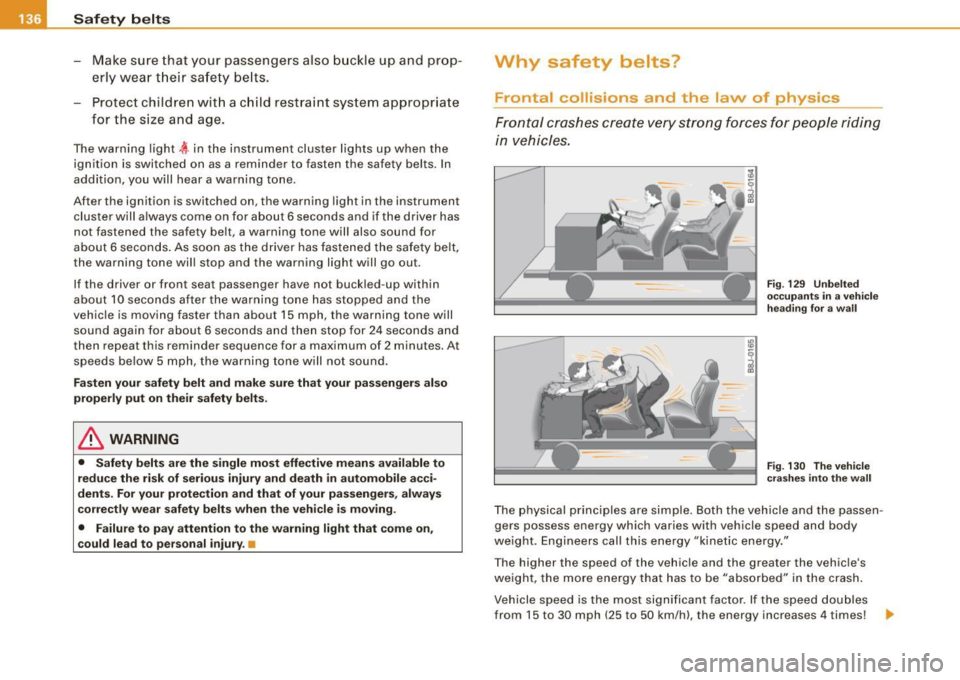
Front al crashes create very strong forces for pe ople riding
in vehicles.
F ig. 12 9 Unbel ted
o cc up ants i n a ve hicle
he ading for a wa ll
Fi g. 13 0 The vehi cle
c ras hes in to t he wa ll
The physical principles are simple. Both the vehicle and the passen
gers possess energy which varies with vehicle speed and body
we ight . Engineers cal l this energy "kinetic energy ."
T he higher the speed of the vehicle and the greater the vehic le's
we ight, the more energy that has to be "absorbed" in the crash .
Vehicle speed is the most significan t factor. If the speed doubles
from 15 to 30 mph (25 to 50 km/h), the energy increases 4 times! .,
Page 196 of 320

__ _:_:ln..:..t::.: e::.: l~ li :.;:g t:e::..: n..:.. t:...::. te::::..:: c~h :.:.n .:..: o:::.: l:.: o :.;g~ yL- ________________________________________ _
speed. This is most noticeable when turning the steering wheel at
low speeds (for example when parking), -more effort will be
required than usual.
• Be aware of the different than usual steering response and
adjust your steering force accordingly.
• Have the problem checked and set right by an authorized Audi
dealer as soon as possible.
• If a steering malfunction occurs, this is signaled with the or.
@ indicator lights and a warning tone, see.
[ i) Tips
• If the power steering system should fail, or if the engine is not
running (for example, while being towed), you will still be able to
steer the vehicle. However, more effort will be required to do so.
• If the power steering system is not functioning properly, contact
your authorized Audi dealer immediately.
Applies to vehicles: with All Wheel Drive
Driving with your quattro®
With All Wheel Drive, all four wheels are driven.
General information
With All Wheel Drive, power is distributed to all four wheels. This
happens automatically depending on your driving style and the
road conditions at the time. See also::::,
page 189, "Electronic differ
ential lock (EDU".
Winter tires
When driving in the winter, your vehicle with All Wheel Drive has an
advantage, even with regular tires. In winter road conditions it may
be advisable to mount winter tires (or all -season tires) for improved
driveability and braking: these tires must be mounted on
all four
wheels.
See also ::::, page 259, "Winter ti res".
Snow chains
Where snow chains are mandatory on certain roads, this normally
also applies to vehicles with all-wheel drive:::::,
page 260, "Snow
chains".
Replacing wheels/tires
Vehicles with All Wheel Drive must always have tires of the same
size. Also avoid tires with different tread depths. For details see
page ::::,
page 254, "New tires and replacing tires and wheels".
Off-Road driving?
Your Audi does not have enough ground clearance to be used as an
off-road vehicle. It is therefore best to avoid rough tracks and
uneven terrain as much as possible. Also refer to::::,
page 198.
& WARNING
Always adjust your driving to road and traffic conditions. Do not
let the extra safety afforded by the all-wheel drive tempt you into
taking extra risks.
• Although the quattro ®all-wheel drive is very effective, always
remember that braking capacity is limited by tire traction. You
should therefore not drive at excessive speeds on icy or slippery
road surfaces.
• On wet road surfaces, be careful not to drive too fast because
the front wheels could begin to slide on top of the water (hydro planing). If this should occur, you will have no warning from a
sudden increase in engine speed as with a front-wheel drive
vehicle. Always drive at speeds which are adjusted to the road
conditions -risk of crash!
n
Page 203 of 320

Trailer lights
Trailer lights must meet all regulations. Be sure to check with your
authorized Audi dealer for correct wiring, switches and relays.
Mirrors
If you are unable to see the traffic behind you using the regular
outside mirrors, then you
must install extended mirrors. It is impor
tant that you
always have clear vision to the rear .
& WARNING
After removing the trailer hitch, do not store it in your vehicle. In
case of sudden braking, the hitch could fly forward and injure you
or your passengers .
.1
Operating instructions
Maximum trailer weight
A trailer for your vehicle is limited to a typical class 1 or class 2
trailer.
Trailer load distribution
Be sure the load in the trailer is held securely in place to guard
against shifting, be it forward, backward or sideways.
Never allow a passenger to ride in a trailer:::::, & in "Driving instruc
tions".
Tire pressure
When towing a trailer, inflate the tires of your vehicle to the cold tire
pressure listed under "Full load" on the sticker on the right door
jamb. Inflate trailer tires to trailer and tire manufacturers' specifica
tions.
Controls and equip ment Safety first Vehicle operation
Trailer towing
Lights
The
headlight settings should be checked with the trailer attached
before driving off. Adjust as necessary so that you can see the road
ahead but not blind oncoming traffic.
Check proper working of vehicle and trailer lights.
Safety chains
Be sure trailer safety chains are properly connected from the trailer
to the hitch on the vehicle. Leave enough slack in the chains to
permit turning corners. When you install safety chains, make sure
they will not drag on the road when you are driving.
The chains should cross under the trailer tongue to prevent it from
dropping in case of separation from the hitch. •
Driving instructions
Driving with a trailer always requires extra care and
consideration.
To obtain the best possible handling of vehicle and trailer,
please note the following:
Do not tow a loaded trailer when your car itself is not
loaded.
- Be especially careful when passing other vehicles.
Observe speed limits.
Do not drive at the maximum permissible speed.
- Always apply brakes early.
Monitor the temperature gauge.
Vehicle care Do-it-yourself service Technical data
Page 208 of 320
___ C_ le_ a _ n_i_n ~g _ a_ n_ d __ p_r _o _t _e _c_ t_ i_o _n ___________________________________________ _
& WARN ING (c o ntinu ed )
• Always read and heed all WARNINGS and oth er informat ion
~ page 2 04 .
0 Not e
• Never try to remove dirt, mud or dust if the surface of the vehicle
is dry. Never use a dry cloth or sponge, since this cou ld scratch your
veh ic le's paint or w indows .
• Never wash your car in bright sunlight. Drops of water act as
magnifying lenses and may damage your paint.
• When you wash your car in t he winter : if you rinse your vehic le
with a hose, be careful not to aim the stream of water directly at
locks, or at door or hatch openings -they can freeze shut.
• Never use sponges designed to remove insects, or any kitchen
scouring s ponges or simila r pr oducts. They can damage your paint
finish .
• Never use a dry cloth or sponge to c lean the head ligh ts. O nly use
wet cloths or sponges to prevent scratches . It is best to use soapy
water.
c£, For the sake of the environment
In the interest of the environment, the vehicle shou ld on ly be
washed in specia l wash bays. •
Washing your vehicle with a power washer
Cleaning the exterior of your car wi th a high -p ressure
power washer is safe as l ong as y ou observe a few simple
rules .
-Before us ing the p ower washer, make s ure you have read
and unde rs too d t he WAR NINGS=:>
& in "General in for
mati on" o n
page 204.
-Always follow the operati ng inst ructions fo r th e pow er
washer.
Make sure that the jet on t he spray hose produces a "fan
sha ped sp ray".
D o
not hold the spray nozzle too close to soft materials.
When cleaning the vehicle with a power washer always follow the
opera ting instructions. Th is appl ies particularly to the
operating
pre ssure
and the spraying distance . Maintain a sufficient distance
t o so ft ma teria ls such as rubber hoses a nd sound/vibrat ion dead
ening materia ls (particularly on the underside of the engine hood).
Do not use a jet which sp rays water in a
direct stream o r one tha t
has a
rotating j et.
Water temperature shou ld not exceed 140 °F (60 °Cl.
& WARNING
Never wash tires with a jet that sp ray s water in a dire ct stream .
This could c ause invi sible damage to the tire s and weake n them ,
even if the spray is from a relatively long distan ce and for a short
time . Damaged and weakened tires can fail and cau se ac cident s
a nd person al injury.
0 Note
To avoid damaging your vehic le, always make sure that there is
suffic ient distance between the spray hea d and so ft m ateria ls like
rubber hoses, plastic parts and sound -deadening materials . Never
aim the spray head at the same p oint for a l ong time . This a lso
applies to cleaning head lights and painted bumpers . Remember:
t he c loser the n ozzle is to the surface of the materia l, the greater the
stress on the material. •
Page 230 of 320
-~_C_ h_e _c _ k_ i_n ...:::g::;...._ a_n_ d_ f_ i_ll _in -'g:::;.._ ___________________________________________ _
Under some circumstances the engine oil should even be changed
more frequently. Change oil more often if you drive mostly short
distances, operate the vehicle in dusty areas or mostly under stop
and -go traffic conditions, or when you use your vehicle where
temperatures stay below freezing point for long periods .
Detergent additives in the oil will make fresh oil look dark after the
engine has been running for a short time. This is normal and is not
a reason to change the oil more often than recommended .
Damage or malfunctions due to lack of maintenance
It is essential that you change your oi l at the recommended intervals
using only engine oil that complies with Audi oil standard
VW 502 00 (vehicles with gasoline engine) or VW 507 00 (vehicles
with diesel engine). Your Limited New Vehicle Warranty does not
cover damage or malfunctions due to failure to follow recom
mended maintenance and use requirements as set forth in the Audi
Owner's Manual and Warranty
& Maintenance booklet. Your dealer
will have to deny warranty coverage unless you present to the dealer proof in the form of Service or Repair Orders that all scheduled
maintenance was performed in a timely manner .•
Engine oil consumption
The engine in your vehicle depends on an adequate
amount of oil to lubricate and cool all of its moving parts.
In order to provide effective lubrication and cooling of interna l
engine components, all internal combustion engines consume a
certain amount of oil. Oil consumption varies from engine to engine
and may change significant ly over the life of the engine. Typically,
engines with a specified break -in period (see=>
page 195) consume
more oil during the break-in period than they consume after oil
consumption has stabilized.
Under normal conditions, the rate of oil consumption depends on
the quality and viscosity of the oil, the RPM (revolutions per minute)
at which the engine is operated, the ambient temperature and road
conditions. Further factors are the amount of oil dilution from water condensation or fuel residue and the oxidation level of the oil. As
any
engine is subject to wear as mileage builds up, the oil consump
tion may increase over time until replacement of worn components
may become necessary .
With all these variables coming into play, no standard rate of oi l
consumption can be established or specified. There is no alternative
to regular and frequent checking of the oil level, see
Note.
If the yellow engine oil level warning symbol in the instrument
cluster lights up, you should check the oil level as soon as
possible
with the oil dipstick=> page 229. Top off the oi l at your
earliest convenience =>
page 230.
& WARNING
Before you check anything in the engine compartment, always
read and heed all WARNINGS
=> &. in "Work ing in the engine
compartment" on
page 224.
0 Note
Driving with an insufficient oil level is likely to cause severe damage
to the engine.
[ i ] Tips
• The oil pressure warning display~ is not an indicator of the oil
level. Do not rely on it. Instead, check the oil level in your engine at
regular intervals , preferably each time you refuel, and always before
going on a long trip.
• If you have the impression your engine consumes excessive
amounts of oil, we recommend that you consu lt your authorized
Audi dealer to have the cause of your concern properly diagnosed .
Keep in mind that the accurate measurement of oil consumption
requires great care and may take some time. Your authorized Audi
dealer has instructions about how to measure oil consumption
accurately. •