ECU AUDI S3 2010 Service Manual
[x] Cancel search | Manufacturer: AUDI, Model Year: 2010, Model line: S3, Model: AUDI S3 2010Pages: 320, PDF Size: 75.34 MB
Page 273 of 320
What do I do now? -__________________ __;__:....:....:..:: __ _
•
-All passengers should leave the car and move to a safe
location (for instance, behind the guardrail)~& .
- Apply the
parking brake firmly ~& .
- Move
selector lever to position Pon an automatic trans-
miss ion; put manual transmission in
first gear ~& .
-If you are towing a trailer : unhitch the trailer from your
vehicle.
- Take the
tool and the spare tire~ page 268 out of the
luggage compartment.
& WARNING
You or your passengers could be injured while changing a wheel if
you do not follow these safety precautions:
• If you have a flat tire, move a safe distance off the road. Turn off
the engine, turn the emergency flasher on and use other warning
devices to alert other motorists.
• Make sure that passengers wait
in a safe place away from the
vehicle and well away from the roadway and traffic.
• To help prevent the vehicle from moving suddenly and possibly
slipping off the jack, always fully set the parking brake and block
the wheel diagonally opposite the wheel being changed. When one
front wheel is lifted off the ground, placing the automatic trans
mission in "P" (Park), or engaging a gear in a manual transmission
will
not prevent the vehicle from moving.
• Before you change a wheel, be sure the ground is level and firm.
If necessary, use a sturdy board under the jack.
• After installing the spare wheel, make sure that you remount
the flat tire/wheel in its storage area properly and tighten the
knurled retaining screw securely. •
Changing a wheel
When you change a wheel, follow the sequence described
below step-by-step and exactly in that order.
1. Remove the decorative wheel cover*. For more details
see also
~ page 272, "Decorative wheel covers" or
~ page 273, "Wheels with cap-covered wheel bolts".
2. Loosen the
wheel bolts~ page 274.
3. Locate the proper mounting point for the jack and align
the jack below that point~
page 274.
4. Lift the car with the jack~ page 274.
5. Take the flat wheel off and then put the spare on
~ page 276.
6. Tighten all wheel bolts lightly .
7.
Lower the vehicle with the jack .
8. Use the wheel bolt wrench and
firmly tighten all wheel
bolts ~
page 274.
9. Put the decorative wheel cover* back on.
& WARNING
Always read and head all WARNINGS and information ::} & in
"Raising the vehicle" on
page 274 and ~ page 277. •
After changing a wheel
A wheel change is not complete without the following
actions.
- Store and secure the replaced wheel in the spare wheel
well. .,._
Do-it-yourself service
Page 277 of 320
What do I do now? -
------------------
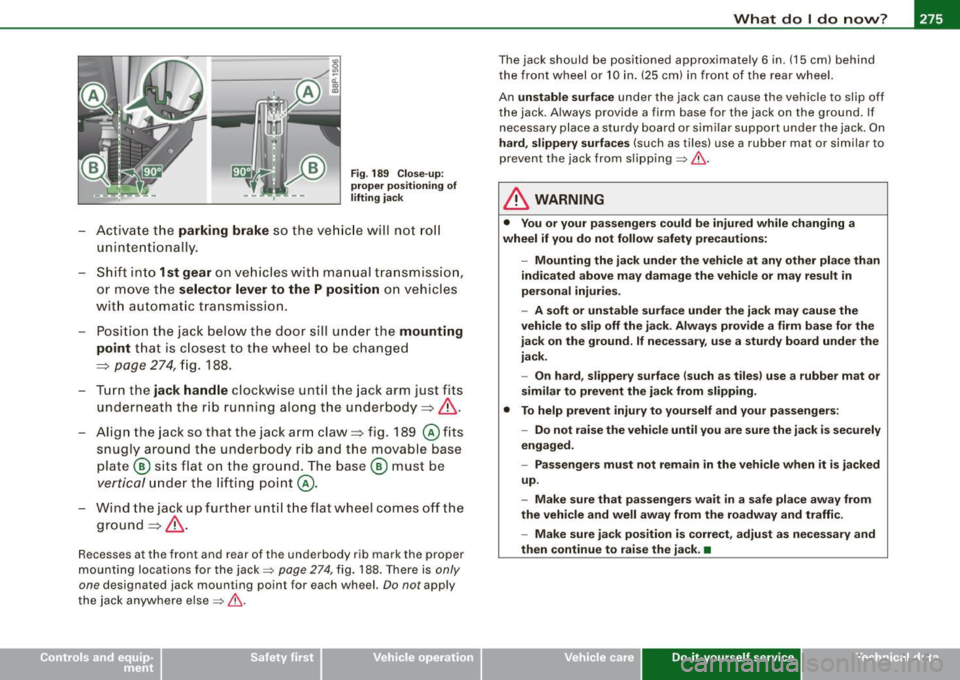
Fig. 189 Close-up:
proper positioning of
lifting jack
-Activate the parking brake so the vehicle will not roll
unintentionally.
- Shift into
1st gear on vehicles with manual transmission,
or move the
selector lever to the P position on vehicles
with automatic transmission.
- Position the jack below the door sill under the
mounting
point
that is closest to the wheel to be changed
=> page 274, fig. 188.
- Turn the
jack handle clockwise until the jack arm just fits
underneath the rib running along the underbody
=> &.
- Align the jack so that the jack arm claw => fig . 189 @ fits
snugly around the underbody rib and the movable base
plate @ sits flat on the ground. The base @ must be
vertical under the lifting point@.
- Wind the jack up further until the flat wheel comes off the
ground =>& .
Recesses at the front and rear of the underbody rib mark the proper
mounting locations for the jack ~
page 274, fig. 188. There is only
one
designated jack mounting point for each wheel. Do not apply
the jack anywhere else~& . The
jack should be positioned approximately 6 in. (15 cm) behind
the front wheel or 10 in. (25 cm) in front of the rear wheel.
An unstable surface under the jack can cause the vehicle to slip off
the jack. Always provide a firm base for the jack on the ground. If
necessary place a sturdy board or similar support under the jack. On
hard, slippery surfaces (such as tiles) use a rubber mat or similar to
prevent the jack from slipping ~& .
& WARNING
• You or your passengers could be injured while changing a
wheel if you do not follow safety precautions:
-Mounting the jack under the vehicle at any other place than
indicated above may damage the vehicle or may result in
personal injuries.
- A soft or unstable surface under the jack may cause the
vehicle to slip off the jack. Always provide a firm base for the
jack on the ground. If necessary, use a sturdy board under the
jack.
- On hard, slippery surface (such as tiles) use a rubber mat or
similar to prevent the jack from slipping.
• To help prevent injury to yourself and your passengers:
- Do not raise the vehicle until you are sure the jack is securely
engaged.
- Passengers must not remain in the vehicle when it is jacked
up.
- Make sure that passengers wait in a safe place away from
the vehicle and well away from the roadway and traffic.
- Make sure jack position is correct, adjust as necessary and
then continue to raise the jack. •
Vehicle care Do-it-yourself service irechnical data
Page 279 of 320
_____________________________________________ W_ h _a_t _ d_ o_ l _d _o _ n_o_ w_ ?_ . __ ffllll
•
• T he whe el bo lts should be cl ean and easy to turn . C heck for dirt
an d corro sion on the mati ng s urfaces o f both th e wheel a nd the
hub. Remove a ll dirt fro m these surfaces before remountin g the
whee l.•
Tires with unidirectional tread design
Tires with unidire ctional tread des ig n must be mou nted
w ith the ir tr ead patter n p oin ted in the right d irection .
Using a spare tire with a tread pattern intended for use
in a specific direction
Whe n u sin g a spare tir e with a trea d p att ern in te nd ed fo r use in a
sp ec if ic dir ection, p lease no te t he followin g:
• T he direction of rotation is ma rked by an arrow o n the side of the
ti re .
• I f the spare tire has to b e ins talled in the inco rrec t d irecti on in th e
e vent of a fla t tire , use t he sp are tir e only tem pora rily sin ce the ti re
wi ll not be ab le to achieve its o ptim um performance cha racteristics
wi th re gar d to aqua planing , n ois e an d wea r.
• W e rec omme nd t hat p arti cula r att enti on be pa id to th is f act
du ring w et we ather and th at you a djust you r sp eed to m atc h ro ad
condition s.
• Re place t he flat t ire w it h a n ew on e and have it insta lled on y our
v e hi cle as soo n as possi ble to res to re the ha nd ling a dvant ages of a
p roper ly pointed di re ction-d epe nde nt tire. •
Notes on wheel change
Ple ase r ead the inf ormatio n=> pa ge 254, "N ew tir es and r eplaci ng
ti res an d wheels" if yo u are g oin g to use a spare ti re wh ich is
d iff ere nt from the tires o n your vehi cle .
A fter you change a tire:
• Check the tire pressure on the spare immediately after
mounting.
• Have the wheel bolt tightening torque checked with a torque
wrench as soon as possible by your authorized Audi dealer or a qualified service station .
• On steel and alloy wheel rims, the wheel bolts are correctly tight
ened with a torque of 90 ft lb (120 Nml.
• If you notice while changing a tire that the wheel bolts are
corroded and difficult to turn , then they should be replaced before
you check the tightening torque.
• Replace the flat t ire with a new one and have it installed on your
vehicle as soon as possible . Remount the wheel cover .
Until then, drive with extra care and at reduced speeds.
& WARNING
• If you are going to equip your vehicle with tires or rims which
differ from those which were factory installed , then be sure to read
the information
=> page 254 , "New tires and replacing tires and
wheels ".
• Always make sure the damaged wheel or even a flat tire and
the jack and tool kit are properly secured in the luggage compart
ment and are not loose in the passenger compartment .
• In an accident or sudden maneuver they could fly forward,
injuring anyone in the vehicle .
• Always store damaged wheel , jack and tools securely in
luggage compartment . Otherwise , in an accident or sudden
maneuver they could fly forward, causing injury to passengers in
the vehicle . •
Do-it-yourself service
Page 288 of 320

IIII.___E_ m_ e_r -=g :...e_ n _ c-=y _ s_ i_t _u _a _t_ i_o _n_ s _______________________________________________ _
& WARN ING (continued )
• Before you check anything in the engine compartment , always
read and heed all WARNINGS=>
page 215, "Engine compa rt m ent" .
0 Note
• Applying a higher voltage booster battery wil l cause expensive
damage to sensitive electronic components, such as contro l units,
relays, rad io, etc.
• There must be no electrical contact between the vehicles as
otherwise current cou ld already star t to flow as soon as th e positive
(+ ) termina ls are connected .
• Improperly connected jumper cab les can cause substantia l
damage to the electrica l system of the vehic le.
[ i ] Tips
• The disc harged battery must be p ro per ly connected to the
ve hicle's elec trica l system .•
General information of starting
assistance
P lease observe tha t the p rocedure described below for conn ecti ng
jumper cab les is intended to provide a jump start for your vehicle.
M ake sure that the connected c la mp s have s ufficien t metal cont act.
& WARNING
Improper handling of the jumper cables can lead to an explosion
of the battery and severe inju ries . To reduce the r isk of injury, note
the following:
& WARNING (continued )
• The sections of the terminal clamps that are not insulated
must not touch each other. In addition , the cable clamped to the
battery's positive terminal must not come in contact with electri
cally connected parts of the vehicle -danger of short circuit!
• Route the jumper cable so that it cannot catch in any rotating
part s in the engine compartment .
• Do not bend over the batteries -danger of chemical burns!
• The battery cell locking screws must be t ightened securely .
• Keep ignition sources (open flame, burning cigarettes, etc .)
away from the batteries -danger of explosion!
• Do not clamp the minus cable to parts of the fuel system or the
brake lines .
0 Note
If you provide start assistance for others with your vehicle, you
s h ould not c lamp t he min us ca ble(-) to t he negat ive ter min al o f the
discharged battery=> fig. 196
© but to a solid meta l part screwed
f ir m ly to the eng ine bloc k, or to the engi ne b loc k it sel f. In ca se of a n
inadequately v entilated battery of the veh ic le receiving power, there
i s a danger of expl osio n due to deto nating gas !•
Page 290 of 320

11111.___E_ m _ e _r-==g :...e_ n_ c...:y _ s_ i_t _u _a _t_ i_o _n_ s _______________________________________________ _
13. Disconnect the cable while the engine is running exactly
in
reverse order to that described in~ page 287,
11Connecting/disconnecting the jumper cable.11
• When
doing so, make sure that the cable cannot contact rotating engine parts.
14. Turn the heater blower and the rear window heating off again.
The battery is vented to the outside to prevent gases from entering
the vehicle interior.
Make sure that the jumper clamps are well connected with their
metal ports in full contact with the battery terminals .
& WARNING
To avoid serious personal injury and damage to the vehicle, heed
all warnings and instructions of the jumper cable manufacturer. If
in doubt, call for road service.
• Jumper cables must be long enough so that the vehicles do not
touch .
• When connecting jumper cables, make sure that they cannot
get caught in any moving parts in the engine compartment.
• Before you check anything in the engine compartment, always
read and heed all WARNINGS =>
page 215, "Engine compartment" .
0 Note
Improperly connected jumper cables can damage or destroy the
generator.
• Do not use the battery negative terminal for jump starting or a
malfunction could occur in the vehicle electrical system.
• Always connect POSITIVE(+) to POSITIVE(+), and NEGATIVE( -) to
NEGATIVE (-l terminal. •
Check that all screw plugs on the battery cells are screwed in
firmly. If not, tighten plugs prior to connecting clamp on negative battery terminal.
• Please note that the procedure for connecting a jumper cable as
described above applies specifically to the case of your vehicle
being jump started. When you are giving a jump start to another
vehicle, do
not connect the minus(-) cable to the minus 1-l terminal
on the discharged battery@=>
page 287, fig. 196. Instead, securely
connect the minus(-) cable to either a massive metal component
that is firmly bolted to the engine block or to the engine block itself.
If the battery that is being charged does not vent to the outside,
escaping battery gas could ignite and explode! •
Emergency towing with commercial
tow truck
General hints
Your Audi requires special handling for towing.
The following information is to be used by commercial tow truck
operators who know how to operate their equipment safely.
• Never tow your Audi, towing will cause damage to the engine
and transmission.
• Never wrap the safety chains or winch cables around the brake
lines.
• To prevent unnecessary damage, your Audi must be transported
with a car carrier (flat bed truck).
• To load the vehicle on to the flat bed, use the towing loop found
in the vehicle tools and attach to the front or rear anchorage
=>
page 289 and => page 289 . .,_
Page 291 of 320

________________________________________________ E_ m_ e_r ,,::g c..e_ n _ c..::y;._ s_ i_t _u _a_ t_ i_o _n_ s _ ___.ffllll
& WARNING
A vehicle being towed is not safe for passengers. Never allow
anyone to ride in a vehicle being towed, for any reason. •
Front towing loop
Do not install the front towing loop until it is needed.
Fig. 197 Front
bumper : removing the
cover cap
Fig . 198 Front
bumper : screwing in
the towing loop
The towing loop fits into the threaded hole located on the
right side of the front bumper and covered by a small cover
when not in use. Note that the towing loop has a
left-hand
thread !
-Remove the towing loop from the vehicle toolkit
=:>
page 268.
- Press on the bottom edge of the cover cap to disengage
and take it out of the bumper. The cap remains
connected to the bumper =:> fig. 197.
- Insert the towing loop into the threaded hole=:> fig. 198
and turn it all the way in until it is seated securely, then
tighten it with the wheel bolt wrench.
When it is no longer needed, unscrew the towing loop and put it
back into the on-board toolkit. Make sure to have the towing loop
stored in the vehicle at all times.
& WARNING
If the towing loop is not screwed in as far as it will go, the thread
can pull out when the vehicle is towed -potential risk of an
accident. •
Rear towing loop
Do not install the rear towing loop until it is needed.
Fig. 199 Rear bumper:
cover ....
Vehicle care Do-it-yourself service irechnical data
Page 292 of 320

IIII...__E_ m_ e_ r -'g==-- e_n _ c_ y=--- s_ i_ t _u _a _ t_ i_o _n _ s _____________________________________________ _
Fig. 200 Rear bumper:
towing loop inserted
On the right side of the rear bumper there is a threaded hole
for the towing loop. The threaded hole is behind a cover.
Note that the towing loop has a left-hand thread!
Remove the towing loop from the vehicle toolkit
~ page 268.
Place the screwdriver against the upper edge of the
cover and carefully pry it out~
page 289, fig. 199.
- Insert the towing loop into the threaded hole~ fig. 200
and turn it all the way in until it is seated securely, then
tighten it with the wheel bolt wrench.
When it is no longer needed, unscrew the towing loop and put it
back into the vehicle toolkit. Be sure to have the towing loop stored in the vehicle at all times.
& WARNING
If you do not screw the towing loop completely, it could come out
of the threaded hole while the vehicle is being towed causing
damage to the vehicle and possible serious personal injury. •
Loading the vehicle onto a flat bed truck
Front
hook up
N
"' :? 0:. .,
"'
Fig. 201 Vehicle on flat
bed truck
-Align the vehicle with the centerline of the car carrier
ramp.
- Attach the winch hook to the front towline eye
~ page 289, fig. 198 previously installed.
Rear hook up
-Align the vehicle with the centerline of the car carrier
ramp.
- Attach the winch hook to the rear towline eye~ fig. 200
previously installed.
[ i] Tips
Check carefully to make sure the hook -up is secure before moving
the car up the flatbed truck ramp. •
Page 302 of 320
___ C_ o_n_ s_ u_m _ e_ r_ ln_ f_o _r_m _ a_ t_ i_o _n ______________________________________________ _
& WARN ING (continued )
• Always be extremely careful when working on the vehicle.
Alway s follow commonly a ccepted safety practices and general
c ommon sen se . Never risk per sonal injury .
• Do not attempt any of the maintenance, checks or repairs
described on the following pages if you are not fully familiar with
the se or other procedures with re spect to the vehicle , or are uncer
tain how to proceed .
• Do not do any work without the proper tools and equipment.
Have the necessary work done by your authorized Audi dealer or
another properly equipped and qualified work shop .
• The engine compartment of any motor vehicle is a potentially
hazardous area . Never reach into the a rea around or touch the
radiator fan. It is temperature controlled and can switch on
suddenly · even when the engine is off and the ignition key has
been removed . The radiator fan switches on automatically when
the coolant reaches a certain temperature and will continue to run
until the coolant temperature drops .
• Always remove the ign ition key before anyone gets under the
vehicle .
• Always support your vehicle with safety stands if it is neces
sary to work underneath the vehicle. The jack supplied with the
vehicle is not adequate for this purpose and could collap se
c ausing serious personal injury .
• If you must work underneath the vehicle with the wheel s on
the ground , always make sure the vehicle is on level ground , that
the wheels are always securely blocked and that the engine c annot be started .
• Always make sure the tr ansmission selecto r lever (automatic
transmission ) is in "P" (Park position ) (automatic transmission ) or
Neutral (manual transmi ssion) and the hand brake is firmly
applied .
W For the sake of the environment
• Cha nging t he en gine setti ngs will adversely a ffec t emi ssio n
l evels. This is detrimenta l to the environment and increases fuel
consumptio n.
• Always o bse rve enviro nmenta l regu lations when dis posing of
o ld eng ine o il, used brake flu id, d irty eng ine coola nt, spe nt batter ies
or worn out tires .
• Undeployed airbag modules and pretensioners might be classi
fied as Pe rchlorate Mate rial -specia l handl ing may apply, see
www .dtsc.ca.gov/ hazardouswaste/perchlora te. W hen t he veh icle or
parts of the restraint system including airbag modu les safety belts
w ith pretens ione rs are sc rapped, all appl icab le laws and regu la
tions must be observed. Your authorized Audi dea ler is familiar with
th ese requi reme nts a nd we reco mme nd t hat you have your dealer
perform this service for you. •
Additional accessories,
modifications and parts replacement
Additional accessories and parts
replacement
A lways co ns ult an author ized Audi d eal er befor e
purc hasing accessorie s.
Your vehicle incorporates the latest safety design features ensuring
a h igh s tanda rd of act ive and pass ive sa fety.
T his safety could be compromised by non -approved changes to the
veh ic le . Fo r thi s reason, if pa rts have to be re place d, please o bserve
the fo llowing points w hen insta lli ng additional accessories:
Approved Audi accessories and genuine Audi parts are avai lable
from autho rized Aud i dea lers.
~
Page 308 of 320
___ A_l.:,. p _h_ a_ b_e _t _ic _ a_l _in _ d_e _x ____________________________________________ _
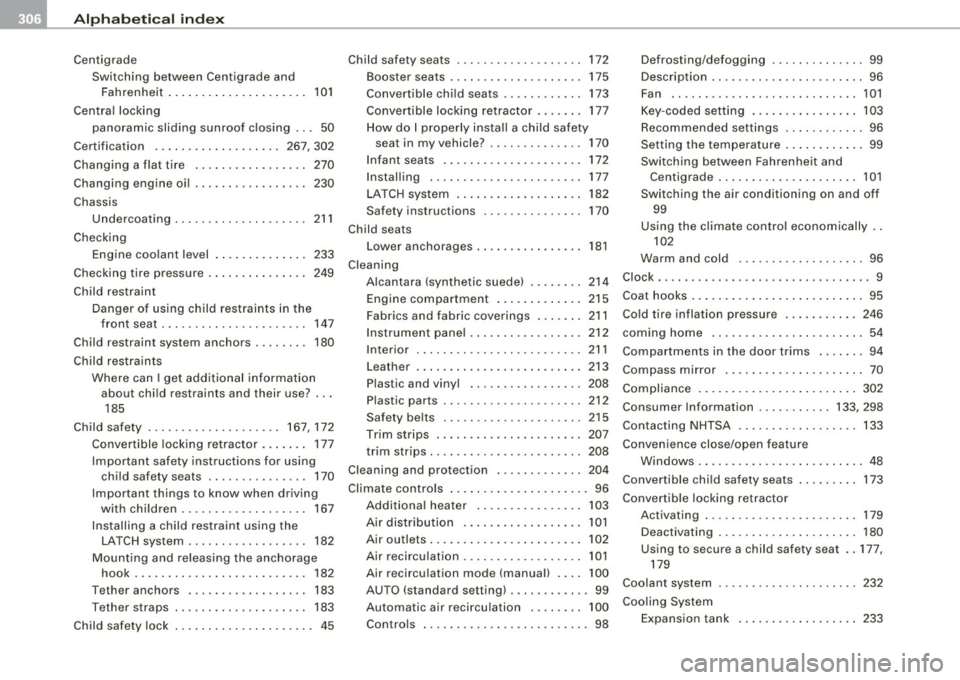
Centigrade
Switching between Centigrade and Fahrenheit ...... .... ........ ... 101
Central locking panoramic sliding sunroof closing .. . 50
Certification . . . . . . . . . . . . . . . . . . . 267, 302
Changing a flat tire ...... .... .... ... 270
Changing engine oi l .. ... ... .. .... ... 230
Chassis Undercoating . . . . . . . . . . . . . . . . . . . . 211
Checking Engine coolant level ...... .... .... 233
Checking tire pressure ............... 249
Child restraint
Danger of using child restraints in the
front seat . . . . . . . . . . . . . . . . . . . . . . 147
Child restraint system anchors ........ 180
Child restraints Where can I get additional information
about child restraints and their use? ...
185
Child safety .. .... .............. 167, 172
Convertible locking retractor . . . . . . . 177
Important safety instructions for using
child safety seats ............... 170
Important things to know when driving with chi ldren ..... ....... ....... 167
Installing a child restraint using the
LATCH system ... .... ........ ... 182
Mounting and releasing the anchorage hook ...... ...... ....... ....... 182
Te ther anchors .................. 183
T ether straps .. .... ....... ....... 183
Child safety lock ...... .... .... .... ... 45 Child safety seats
.... .... .... ...... . 172
Booster seats . . . . . . . . . . . . . . . . . . . . 175
Convertible chi ld seats ............ 173
Convertible locking retractor ... .... 177
How do I properly install a child safety
seat in my vehicle? .... .... ...... 170
Infant seats . . . . . . . . . . . . . . . . . . . . . 172
Installing ....................... 177
LATCH system . . . . . . . . . . . . . . . . . . . 182
Safety instructions .... .... ...... . 170
Child seats Lower anchorages . . . . . . . . . . . . . . . . 181
Cleaning Alcantara (synthetic suede) ... .. ... 214
Engine compartment ............. 215
Fabrics and fabric c ,overings ..... .. 211
Instrument panel .... ... .... .... .. 212
Interior ............ ... ........ .. 211
Leather ..... .. ... ... .. .... ..... . 213
Plastic and vinyl .. ..... ... .... ... 208
Plastic parts ... .. . ... .... ....... . 212
Safety belts . .................... 215
Trim strips ...................... 207
trim strips ..... ...... ..... .... ... 208
Cleaning and protection ...... .... ... 204
Climate controls ... .. .... .... .... .... 96
Addi tional heater . . . . . . . . . . . . . . . . 103
Air distribution . . . . . . . . . . . . . . . . . . 101
Air outlets . . . . . . . . . . . . . . . . . . . . . . . 102
Air recirculation .... .... .... ...... 101
Air recirculation mode (manual) .... 100
AU TO (standard setting) ............ 99
Automatic air recirculation ...... .. 100
Contro ls .. ....... ..... ..... .. .... 98 Defrosting
/defogging ...... .... .... 99
Description ... .. ... .... ...... ... .. 96
Fan .. ...... ... .. .... ........ ... 101
Key-coded setting ................ 103
Recommended settings ............ 96
Setting the temperature .... .... .... 99
Switching between Fahrenheit and
Centigrade ... ........ ...... .... 101
Switching the air conditioning on and off 99
Using the climate control economically . .
102
Warm and cold ... .... .... .... .... 96
Clock .................. ......... ..... 9
Coat hooks . . . . . . . . . . . . . . . . . . . . . . . . . . 95
Cold tire inflation pressure .. .... ..... 246
coming home ..... .. .... .... .... .... 54
Compartments in the door trims ... ... . 94
Compass mirror . ...... ... ... ........ 70
Comp liance .......... ....... .... ... 302
Consumer Information ........... 133, 298
Contacting NHTSA .................. 133
Convenience close/open feature
Windows .......... ....... .... .... 48
Convertible chi ld safety seats
Convertible locking retractor 173
Activating ....................... 179
Deactivating ................. .... 180
Using to secure a child safety seat .. 177,
179
Coolant system ........ .. ... . .... ... 232
Cooling System Expansion tank ... .. ...... .... ... 233
Page 315 of 320
Alphab eti ca l ind ex -
-------------=----
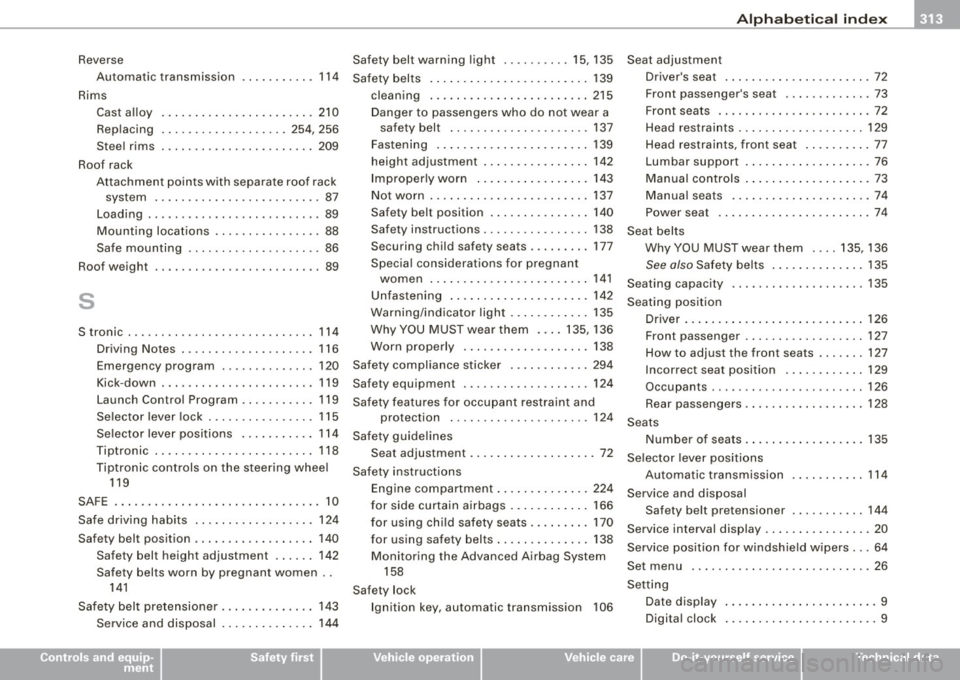
Reverse
Automatic transmission
Rims 114
Cast al loy
210
Replacing ... .... .... .... ... . 254 , 256
Steel rims .... .... ....... ...... .. 209
Roof rack Attachment po ints with separate roof rack
system . ... ..... ....... ......... 87
Loading . ...... .. .... .... .... ..... 89
Mounting locations .. .... .... .... .. 88
Safe mounting ... .... .... ...... ... 86
Roo f w eight .... .... .. ... .. .... .... .. 89
s
Stronic .. ..... .. .... ....... .... .... 114
Driving Notes . . . . . . . . . . . . . . . . . . . . 116
Emergency program . ............. 120
Kick -down ..... .... .... .... .... .. 119
Launch Control Program .. .. .. .... . 119
Selector lever lock .... .... ...... .. 115
Se lector lever posi tions . ... .... ... 114
Tiptronic ... .. .... .... ... .. .. .... 118
Tiptron ic co ntrols on the steer ing whee l
119
SA FE ... .... .... .... .... ... .. .. .... . 10
Sa fe driving habits ...... .... ... .... . 124
Saf ety belt position .... ... .... ...... . 140
Safety belt height ad justment .. .... 142
Safe ty bel ts worn by pregnant women ..
141
Safety belt pretensioner ... ... ....... . 143
Service and disposal ... ... .... .... 144
Controls and equip ment Safety first Safety belt warning
light . ...... ... 15 ,135
Safety belts ... .. .... .... .... .... ... 139
cleaning ... .. .. .. .... .... .... ... 215
Danger to passengers who do not wear a sa fety belt . .... ... .... .... .... . 137
Fas teni ng .. ...... .... .... .... ... 139
height adjustmen t .. .. .... .... .... 142
I mproper ly worn ... .. .... ....... . 143
Not w orn ..... .. . .. .. .... .... .... 137
Safety belt position . ...... .... .... 140
Safety instructions . .... .... ....... 138
S ecuring child safety seats ......... 177
Specia l considerations for pr egnant
women ..... .... .... .... ... .... 1 41
Unfastening ..... .. .. ... .. .. .... . 142
Warning/ind icator light .. ...... .... 135
Why YO U MUST wear them .... 1 35, 136
Worn properly . .... .. .... .... .... 138
Sa fety compl iance sticker . ... .... .... 294
Saf ety equipm ent ... ... .. ..... .. ... . 124
Safety features for occupant restraint and
protection ........... ....... ... 124
Safety guidelines Seat adjustment . ...... ... .... .... . 72
Safety i nstructions
E n gine compartmen t ..... .... .... . 224
f or side curtain airbags .. ...... .... 166
for using chi ld safety seats .. ... .... 170
for using safety be lts ..... .... .... . 138
Monitoring the Advanced Airbag System 158
Saf ety lock
I gnition key , automatic transmission 106 Seat adjustment
Driver's sea t .... .. .... .... ...... .. 72
Front passenger 's seat .... .... ..... 73
Front seats .. ... ..... ... .... .... .. 72
Head res traints . ... .... ... .... .... 129
Head restraints, front seat ...... .... 77
Lu mbar s upport ...... .... .... ... .. 76
Manual c ontr ols ...... .... .... ... .. 73
Manual sea ts .. .. .... .... .... ... .. 74
Power seat .... ... .... .. .. .... .... 74
Seat belts Why YOU MUST wear them .... 135, 136
S ee also Safety belts ...... .... .... 135
Seating capacity ....... ... .... .... .. 135
Seating position Driver ... .. .... .... ... .. .. .... ... 1 26
Front passenger .. ... .. .... .... ... 127
How to adjust the front seats ... ... . 127
Incorrect seat position .... .... .... 129
Occupan ts ...... .... ........ ... .. 126
Rear passengers ... .... ..... .. ... . 128
Seats Number of seats ...... .... .... ... . 135
Se lector lever positions
Automatic trans missi on .. .. ... .... 114
Service and disposal Safety be lt pretensioner ... .... .... 144
Service interval display ... .... .... ... .. 20
Service position for windshie ld wipers . .. 64
Set menu ......... .... .... ... .. ..... 26
Sett ing
Date d isplay ...... .... .. . .. .. .... .. 9
Digital clock ... .. .. ...... .... .. .. .. 9
Vehicle operation Vehicle care Do-it-yourself service Technical data