warning light AUDI S3 2010 Workshop Manual
[x] Cancel search | Manufacturer: AUDI, Model Year: 2010, Model line: S3, Model: AUDI S3 2010Pages: 320, PDF Size: 75.34 MB
Page 128 of 320

___ D_ r _i_v _i_n -=g =--- S_ a_ f_ e____, ly'----------------------------------------------------
Proper occupant seating positi ·ons
Proper seating position for the driver
The proper driver seating position is important for safe,
relaxed driving.
Fig . 124 The correct
distance between
driver and steering
wheel
Fig . 125 Correct head
restraint position for
driver
For your own safety and to reduce the risk of injury in the
event of an accident, we recommend that you adjust the
driver's seat to the following position:
- Adjust the driver's seat so that you can easily push the
pedals all the way to the floor while keeping your knee(s)
slightly bent=:>& . - Adjust the angle of the seatback so that
it is in an upright
position so that your back comes in full contact with it
when you drive.
- Adjust the steering wheel so that there is a distance of at
least 10 inches (25 cm) between the steering wheel and
your breast bone=:> fig. 124. If not possible, see your
authorized Audi dealership about adaptive equipment.
- Adjust the steering wheel so that the steering wheel and
airbag cover points at your chest and not at your face.
- Grasp the top of the steering wheel with your elbow(s)
slightly bent.
- Adjust the head restraint so that the upper edge is as
even with the top of your head as possible but no lower
than eye level and so that it is as close to the back of your
head as possible=:> fig. 125.
- Fasten and wear safety belts correctly=:>
page 139.
- Always keep both feet in the footwell so that you are in
control of the vehicle at all times.
For detailed information on how to adjust the driver's seat, see
=>
page 73, "Adjusting front seats manua lly" or=> page 74,
"Adjusting the power seat".
& WARNING
Drivers who are unbelted, out of position or too close to the airbag
can be seriously injured by an airbag as it unfolds. To help reduce
the risk of serious personal injury:
• Always adjust the driver's seat and the steering wheel so that
there are at least 10 inches (25 cm} between your breastbone and
the steering wheel. .,_
Page 137 of 320

Safety belts -----------------=------
Safety belts
General notes
Always wear safety belts!
Wearing safety belts correctly saves lives!
This chapter explains why safety belts are necessary, how
they work and how to adjust and wear them correctly.
- Read all the information that follows and heed all of the
instruct ions and WARNINGS.
& WARNING
Not wearing safety belts or wearing them improperly increases
the risk of serious personal injury and death.
• Safety belts are the single most effective means available to
reduce the risk of serious injury and death in automobile acci
dents . For your protection and that of your passengers , always
correctly wear safety belts when the vehicle is moving.
• Pregnant women, injured, or physically impaired persons must
also use safety belts . Like all vehicle occupants, they are more
likely to be seriously injured if they do not wear safety belts . The
best way to protect a fetus is to protect the mother -throughout
the entire pregnancy. •
Number of seats
Your Audi has a total of five seating positions: two in the front and
three in the rear. Each seating position has a safety belt.
Controls and equip ment Safety first
Vehicle operation
& WARNING
Not wearing safety belts or wearing them improperly increases
the risk of serious personal injury and death .
• Never strap more than one person, including small children,
into any belt. It is especially dangerous to place a safety belt over
a child sitting on your lap.
• Never let more people ride in the vehicle than there are safety
belts available.
• Be sure everyone riding in the vehicle is properly restrained
with a separate safety belt or child restraint. •
Safety belt warning light ~
Your vehicle has a warning system for the driver and front
seat passenger (on USA models only) to remind you about
t he importance of buckling-up.
Before driving off, always:
Fig. 128 Safety belt
warning light in the
instrument cluster -
enlarged
- Fasten your safety belt and make sure you are wearing it
properly.
1J,,
Vehicle care Do-it-yourself service Technical data
Page 138 of 320
___ S_a_ f_ e_ t-= y_ b_e_ l_ t _s _______________________________________________ _
- Make sure that your passengers also b uckle up and prop
erly wea r th eir sa fety belts.
Protect children wit h a child restraint system appropriate
for the size and age.
The warning light i in the instrument cluster lights up when the
ignition is switched on as a reminder to fasten the safety belts. In
addition , you will hear a warning tone.
After the ignition is switched on, the warning light in the instrument cluster will a lways come on for about 6 seconds and if the driver has
not fastened the safety belt, a warning tone will also sound for
about 6 seconds . As soon as the driver has fastened the safety belt,
the warning tone will stop and the warning light will go out .
If the driver or front seat passenger have not buckled -up within
about 10 seconds after the warning tone has stopped and the
vehicle is moving faster than about 15 mph, the warning tone will
sound again for about 6 seconds and then stop for 24 seconds and
then repeat this reminder sequence for a maximum of 2 minutes. At
speeds be low 5 mph, the warning tone will not sound.
Fa sten your safe ty belt and m ake su re that your p assengers also
properl y put on th eir s afet y belts .
& WARNING
• Safety belt s are the single mo st effective mean s available to
reduce th e risk of ser ious injur y and death in a utomobile acci
dent s. For your prote ction and th at of your pas senger s, alwa ys
c orre ctl y we ar safety belt s when t he vehicle is moving .
• Failure t o pay att ention to th e warning light that co me on,
c ould lead to per sonal injury .•
Why safety belts?
Frontal co11isions and the law of physics
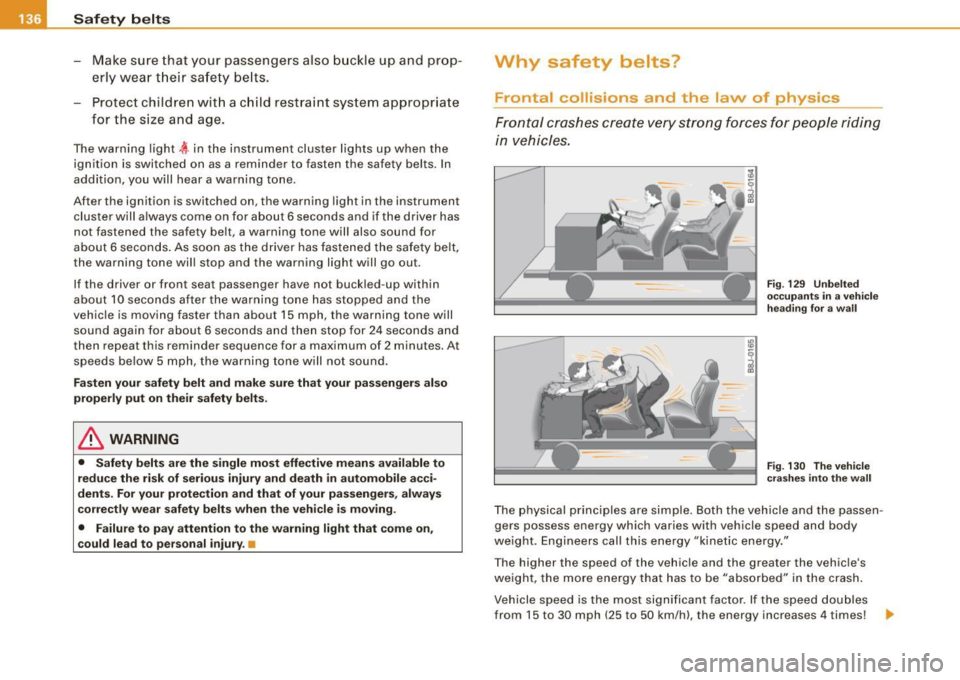
Front al crashes create very strong forces for pe ople riding
in vehicles.
F ig. 12 9 Unbel ted
o cc up ants i n a ve hicle
he ading for a wa ll
Fi g. 13 0 The vehi cle
c ras hes in to t he wa ll
The physical principles are simple. Both the vehicle and the passen
gers possess energy which varies with vehicle speed and body
we ight . Engineers cal l this energy "kinetic energy ."
T he higher the speed of the vehicle and the greater the vehic le's
we ight, the more energy that has to be "absorbed" in the crash .
Vehicle speed is the most significan t factor. If the speed doubles
from 15 to 30 mph (25 to 50 km/h), the energy increases 4 times! .,
Page 142 of 320

___ S_a_ f_ e_ t-= y_ b_e_ l_ t _s _______________________________________________ _
-Insert t he tongue into the correct b uckle of y our seat
unt il you h ea r it la tc h securely~ fig. 134.
Pull on t he belt to make sure that it is securely latched in
the buckle.
Aut om ati c sa fe ty belt re tra cto rs
Eve ry safety be lt is equipped with an automatic belt retractor on the
shoulder belt. This feature locks the belt when the belt is pulled out
fast, during hard braking and in an accident. The belt may a lso lock
when you drive up or down a steep hill or through a sharp curve .
During normal driving the belt lets you move free ly.
Safety belt prete nsi oners
The safety belts are equipped with a be lt pretensioner that he lps to
tighten the sa fety be lt and remove slack when the pretensioner is
activated. The function of the pretensioner is monitored by a
warning light=>
page 14 .
Swit chable locking fe ature
Every safety belt except the one on the driver sea t is equipped with
a switchab le locking feature that
must be used when the safety belt
is used to a ttach a chi ld safe ty sea t. Be sure to read the important
information about this feature=>
page 177.
& WARNING
Improper ly positioned safet y belts can cause seriou s inj ury in an
accident =>
page 140 , "Safety belt po sitio n".
• Safet y belts offer opt imum protection on ly when the seat back
i s upright and belt s are properly po sition ed on t he bod y.
• Always make sure that the rear seat backrest to whi ch the
c enter r ear sa fet y belt i s atta ched i s sec ure ly lat ched whe nev er
the rear center saf ety belt i s being us ed. If the ba ckrest is not
s ecu rely lat ched, the pas senge r will mo ve fo rward with the back
rest dur ing sudden braking , in a sudden maneu ver and e spec iall y
in a cra sh.
& W AR N ING (continu ed )
• Never attach the safety belt to the buck le for anothe r seat .
Atta ch ing th e be lt to the wrong buckle will reduce safety belt
e ffe cti venes s and can ca use seriou s per son al injur y.
• A p assenger who i s not prope rly re str ained can be s eriousl y
injured by the saf ety belt it self wh en it m ove s from the stronger
p art s of the body into criti ca l area s like the abd omen .
• Alway s lock the convert ible lo ck ing retractor when you are
s ecu ring a ch ild safety se at in the ve hi cle =>
page 179. •
Safety belt position
Correc t belt posi ti o n is the key to getting maximum
protecti on f rom safety be lts.
Fig . 1 35 Head r est ra in t
an d safe ty belt p osi
tion a s seen from th e
sid e
Standard features on your vehicle help you adjust the position of
the safety belt to match your body size .
• belt height adjustment for the front seats,
• automatic belt height adjustment for the rear seats.
Page 149 of 320
__________________________________________________ A_ i_ r _b _a...; g::- s_ y=--- s_t _e _m __ !II
Child restraints on the front seat -some
important things to know
- Be sure to read the important information and head the
WARNINGS for important details about children and
Advanced Airbags :=>
page 167.
Even though your vehicle is equipped with an Advanced Airbag
System, make certain that all children, especially those 12 years and
younger, always ride in the back seat properly restrained for their age and size . The airbag on the passenger side makes the front seat
a potentially dangerous place for a child to ride . The front seat is not
the safest place for a child in a forward -facing child safety seat. It
can be a very dangerous place for an infant or a child in a rearward
facing seat.
The Advanced Airbag System in your vehicle has been certified to
comply with the requirements of United States Federal Motor
Vehicle Safety Standard 208 as applicable at the time your vehicle
was manufactured.
The Standard requires the front airbag on the passenger side to be
turned off ("suppressed") if a child up to about one year of age
restrained in one of the rear-facing or forward-facing infant
restraints listed in Federal Motor Vehicle Safety Standard 208 with
which the Advanced Airbag System in your vehicle was certified has been installed on the front passenger seat. For a listing of the child
restraints that were used to certify compliance with the US Safety
Standard =>
page 169.
The PASSENGER AIR BAG OFF light in the instrument panel tells you
when the front Advanced Airbag on the passenger side has been
turned off by the electronic control unit.
Each time you turn on the ignition, the
PASSENGER AIR BAG OFF
light will come on for a few seconds and:
• will stay on if the front passenger seat is not occupied,
Controls and equip
ment Safety first Vehicle operation
•
will stay on if there is a small child or child restraint on the front
passenger seat,
• will go off if the front passenger seat is occupied by an adult as
registered by the weight-sensing mat=>
page 156, "Monitoring the
Advanced Airbag System" .
The
PASSENGER AIR BAG OFF light comes on when the control unit
detects a total weight on the front passenger seat that requires the
front airbag to be turned off.
If the total weight on the front passenger seat is more than that of
a typical 1 year-old child but less than the weight of a small adult,
the front airbag on the passenger side can deploy (the
PASSENGER
AIR BAG OFF
light does not come on). If the PASSENGER AIR BAG
OFF
light does not come on, the front airbag on the passenger side
has not been turned off by the electronic control unit and can
deploy if the control unit senses an impact that meets the condi
tions stored in its memory.
For example, the airbag may deploy if:
• a small child that is heavier than a typical 1 year -old child is on
the front passenger seat (regardless of whether the child is in one
of the child safety seats listed=>
page 169), or
• a child who has outgrown child restraints is on the front
passenger seat.
If the front passenger airbag is turned off, the
PASSENGER AIR BAG
OFF
light comes on in the instrument cluster and stays on.
The front airbag on the passenger side may
not deploy (the
PASSENGER AIR BAG OFF light does not illuminate and stay lit) even
if a small adult or teenager, or a passenger who is not sitting upright
with their back against a non-reclined backrest with their feet on the
vehicle floor in front of the seat is on the front passenger seat
=>
page 126, "Proper seating position for the driver".
If the front passenger airbag deploys, the Federal Standard requires
the airbag to meet the "low risk" deployment criteria to reduce the risk of injury through interaction with the airbag . "Low risk" deploy
ment occurs in those crashes that take place at lower decelerations
I),
Vehicle care Do-it-yourself service Technical data
Page 150 of 320

___ A_ ir_ b_ a-g _ s_y _s_ t_ e_ m _________________________________________________ _
as defin ed i n th e el ectron ic contro l u n it=> page 157, " PASSE NGER
AI R BAG OFF lig ht".
A lways rem em ber, a c hild safet y se at or infant carr ier installe d on
the front seat may be struck and k nocked o ut of po sition by t he
rap id ly in fla ting passe nger's air bag in a fron tal colli sion . The airb ag
cou ld great ly re duce the effectivene ss of the ch ild restrain t and
e ve n seri ous ly injure the chi ld dur ing in flatio n.
For th is reason, and beca use the bac k seat is the safest plac e for
chi ldren -wh en prop erly rest rained acc ording to th eir age and size
- we strong ly recommend that ch ildren a lways sit in the bac k se at
=> p age 167, "Ch ild Safe ty ".
& WARNING
A child in a rearward -facing child safety seat installed on the front
passenger seat will be ser iously injured and can be killed if the
front airbag inflates - even with an Advanced Airbag System .
• The inflating airbag will hit the child safety seat or infant
carrier with great force and will smash the child safety seat and
child against the backrest, center armrest, door or roof .
• Always install rear -facing child safety seats on the rear seat .
• If you must install a rearward facing child safety seat on the
front passenger seat because of exceptional circumstances and
the PASSENGER AIR BAG OFF light does not come on and stay on ,
immediately install the rear-facing child safety seat in a rear
seating position and have the airbag system inspected by your
authorized Audi dealer.
• Forward-facing child safety seats installed on the front
passenger's seat may interfere with the deployment of the airbag
and cause serious personal injury to the child .
& WARNING
If, in exceptional circumstances, you must install a forward-facing
child restraint on the front passenger's seat:
& WARNING (continued)
• Always make sure the forward-facing seat has been designed
and certified by its manufacturer for use on a front seat with a
passenger front and side airbag .
• Never put the forward-facing child restraint up against or very
near the instrument panel.
• Always move the passenger seat into its rearmost position in
the seat's fore and aft adjustment range, as far away from the
airbag as possible before installing the forward-facing child
restraint. The backrest must be adjusted to an upright position .
• Make sure that the PASSENGER AIR BAG OFF light comes on
and stays on all the time whenever the ignition is switched on.
& WARNING
To reduce the risk of serious injury , make sure that the PASSENGER
AIR BAG OFF light will be displayed whenever a child restraint is
installed on the front passenger seat and the ignition is switched
on.
• If the PASSENGER AIR BAG OFF light does not stay on , perform
the checks described
=> page 156, "Monitoring the Advanced
Airbag System" .
• Take the child restraint off the front passenger seat and install
it properly at one of the rear seat positions if the PASSENGER AIR
BAG OFF light does not stay on.
• Have the airbag system inspected by your authorized Audi
dealer immediately.
• Always carefully follow instructions from child restraint manu
facturers when installing child restraints .
& WARNING
If, in exceptional circumstances, you must install a forward or
rearward-facing child restraint on the front passenger's seat :
Page 153 of 320

Airbag syst em -----------------=~-
restrained in one of the rear-facing or forward-facing infant
restraints (listed in Federa l Motor Vehicle Safety S tandard 208 with
which the Advanced Airbag System in your vehic le was certified),
the front airbag on the passenger side may or may not deploy .
The
PA SS ENGER AIR BAG OFF light comes on when the e lect ronic
control unit detects a total weight on the front passenger seat that
requires the front a irbag to be tu rned off . If the
PASSENGER AIR BAG
OF F
ligh t do es no t come on, the fron t airbag on th e passenger side
has not been turned of f by the contro l unit and can dep loy i f the
control unit senses an impact that meets the conditions stored in its
memo ry .
I f the total weight on the front passenger seat is more than that of
a typical
1 year-old, but less than the weight of a small adult, the
front airbag on the passenger side may dep loy (the
PASSENGER AIR
BAG OFF
light does not come on) .
For example, the airbag may deploy if:
• a small child that is heavier than a typ ical 1 year-old child is on
the front passenger sea t (regardless of whether the child is in one
of the child sa fety seats listed~
page 169) ,
• a child who has outgrown child res tra ints is on the front
passenger seat.
I f the front passenger airbag is turned off, the
PASSENGER AIR BAG
OFF
light in the center of the instrument panel wi ll come on and stay
on .
The front a irbag on the passenge r side may
not deploy (the
PAS SENG ER AIR BAG OFF light does not illuminate and stay lit) if:
• a small adult or teenager is on the front passenger seat
• a passenger who is not sitting upright with their back against a
non-reclined backrest with their feet on the vehicle floor in front of
the seat is on the front passenger seat.
I f the fron t pass enger airbag dep loys, the Federal Standard requires
t he air bag t o mee t the "low risk" deployment criteria to help reduce
the risk of injury through interaction with the airbag . "Low risk "
Controls and equip
ment Safety first Vehicle operation
dep
loyment occurs in those crashes that take place at lower decel
erations as defi ned in the electronic con trol unit ~
page 156 .
Alwa ys remember : Even though your vehicle is equipped with
Advanced Ai rbags, the safest place for chi ldren is properly
restra ine d on the back seat . Please be sure to read t he important
information in the sections that follow and be sure to heed a ll of the
WARNI NGS .
& WARNING
To reduce the risk of injury when an ai rbag inf lates , alway s wear
safety belts properly.
• If you a re unre strained , lean ing forward , sitt ing sideways or out
of position in any way , your risk of in jury is mu ch higher .
• You will also recei ve se riou s injur ies and cou ld even be killed if
you are up again st the airbag or too close to it when it inflates -
e ven with an Advan ced Airbag ~
page 145 .
& WARNING
A child i n a re arward-fa cing child safety seat installed on the front
pa ssenger seat will be seriously injured and can be killed if the
fro nt airb ag infl ate s -ev en with an Ad vanced Airbag Sy stem .
• Although the Advan ced Airbag Sy stem in your vehicle is
designed to turn off the front a irb ag when a rearward-fa cing child
restraint ha s been in stalled on the front pa ssenger seat , nobody
ca n ab solutely guarantee that deployment is impo ssib le in all
c onceivable situations that may happen during the u seful life of
yo ur vehicle .
• The inflating airbag will hit the child safety seat or infant
c a rr ier with great for ce and will smash the child safety seat and
c hild against the backrest , center armre st, door , or roof .
• Always inst all rearward-fa cing child re strai nts in the back seat .
• If you mu st in stall a rearw ard facing child safety seat on the
front passenger seat be cause of e xceptional cir cumstances and
IIJ,,
Vehicle care Do-it-yourself service Technical data
Page 154 of 320

-Airbag system ----------------
& WARNING
(continued)
the PASSENGER AIR BAG OFF light does not come on and stay on,
immediately install the rear-facing child safety seat in a rear
seating position and have the airbag system inspected by your
authorized Audi dealer.
& WARNING
If, in exceptional circumstances, you must install a forward-facing
child restraint on the front passenger's seat:
• Always make sure the forward -facing seat has been designed
and certified by its manufacturer for use on a front seat with a
passenger front and side airbag.
• Never put the forward-facing child restraint up against or very
near the instrument panel .
• Always move the passenger seat into its rearmost position in
the seat's fore and aft adjustment range, as far away from the
airbag as possible, before installing the forward-facing child
restraint . The backrest must be adjusted to an upright position.
• Make sure that the PASSENGER AIR BAG OFF light comes on
and stays on all the time whenever the ignition is switched on. •
Advanced Airbag System components
The front passenger seat in your vehicle has a lot of very important
parts of the Advanced Airbag System in it. These parts include the
weight-sensing mat, sensors, wiring, brackets, and more. The func
tion of the system in the front passenger seat is checked by the elec
tronic control unit when the ignition is on. The control unit monitors
the Advanced Airbag System and turns the airbag indicator light on
when a malfunction in the system components is detected. The
function of the airbag indicator light is described in greater detail
below. Because the front passenger seat contains important parts
of the Advanced Airbag System, you must take care to prevent it from being damaged.
Damage to the seat may prevent the
Advanced Airbag for the front passenger seat from doing its job in
a crash .
The front Advanced Airbag System consists of the
following: • Crash sensors in the front of the vehicle that measure vehicle
acceleration/deceleration to provide information to the Advanced
Airbag System about the severity of the crash.
• An electronic control unit, with integrated crash sensors for front
and side impacts. The control unit "decides" whether to fire the
front airbags based on the informa tion received from the crash
sensors. The control unit also "decides" whether the safety belt
pretensioners should be activated.
• An Advanced Airbag with gas generator for the driver inside the
steering wheel hub .
• An Advanced Airbag with gas generator inside the instrument
panel for the front passenger.
• A weight-sensing mat under the upholstery padding of the front
passenger seat cushion that measures the total weight on the seat.
The information registered is sent continuously to the electronic
control unit to regulate deployment of the front Advanced Airbag on
the passenger side.
• An airbag monitoring system and indicator light in the instru
ment cluster => page 156.
• Th e PASSENGER AIR BAG OFF light comes on and stays on in the
center of the instrument panel=> page 157, fig. 142 and tells you
when the front Advanced Airbag on the passenger side has been
turned off.
• A sensor below the safety belt latch for the front seat passenger
to measure the tension on the safety belt . The tension on the safety
belt and the weight registered by the weight -sensing mat help the
control unit "decide" whether the front airbag for the front
passenger seat should be turned off or not=> page 147, "Child
restraints on the front seat -some important things to know". .,_
Page 155 of 320

_________________________________________________ .:.A ..:. i :..:.r..::b :...:a:..:. g~ s::.. y .!....::. s..:t ..:e :..:.m.:....:...._ffllll
• A sensor in the safety belt latch for the driver and for the front
seat passe nger that s enses whe ther that sa fety belt i s latch ed or n ot
and transmits this informatio n to the e lectronic cont rol unit.
& WARNING
Damage to the front passenger seat can prevent the front airbag
from working properly.
• Improper repair or disassembly of the front passenger and
driver seat will prevent the Advanced Airbag Sy stem from func
tioning properly .
• Repairs to the front passenger seat must be performed by qual
ified and properly trained workshop personnel .
• Never remove the front passenger or driver seat from the
vehicle.
• Never remove the upholstery from the front passenger seat .
• Never disassemble or remove parts from the seat or disconnect
wires from it.
• Never carry sharp objects in your pockets or place them on the
seat . If the weight-sensing mat in the passenger seat is punctured
it cannot work properly.
• Never carry things on your lap or carry objects on the
passenger seat . Such items can increase the weight registered by
the weight-sensing mat and send the wrong information to the
airbag control unit .
• Never store items under the front passenger seat. Parts of the
Advanced Airbag System under the passenger seat could be damaged , preventing them and the airbag system from working
properly.
• Never place seat covers or replacement upholstery that have
not been specifically approved by Audi on the front seats.
• Seat covers can prevent the Advanced Airbag System from
recognizing child restraints or occupants on the front passenger
seat and prevent the side airbag in the seat backrest from
deploying properly.
Controls and equip ment Safety first
Vehicle operation
& WARNING (continued )
• Never use cushions, pillows, blankets or similar items on the
front passenger seat . The additional padd ing will prevent the
weight-sensing mat in the seat from a ccurately registering the
child re straint or person on the seat and prevent the Advanced
Airbag System from functioning properly .
• If you must use a child restraint on the front passenger seat
and the child restraint manufacturer's instru ctions requ ire the use
of a towel , foam cu shion or something else to properly position
the child restraint, make certa in that the PASSENGER AIR BAG OFF
light comes on and stays on whenever the child restraint is
installed on the front passenger seat .
• If the PASSENGER AIR BAG OFF light does not come on and stay
on , immediately install child restraint in a rear seating position
and have the airbag system inspected by your authorized Audi
dealer .•
How the Advanced Airbag System
components
work together
The front Advanced Air bag System and the side airbags s upplement
the protection offered by th e front three -point safety belts with
pretensioners and load limiters and the adjustable head restraints
to help re duce the r is k of in jury in a w ide ra nge o f accide nt a nd
crash situations. Be su re to read the important information about
safety and heed the WARNI NGS in t his c hap te r.
Dep loyment of the Advanced Airbag System and the activation of
t he sa fe ty be lt pretensione rs depe nd on the decele ration mea su red
by the crash sensors and registered by the electronic control unit .
C rash severity depends on s peed and deceleration a s well a s the
mass and st iffness o f the veh ic le or object involved in th e c ras h.
When the e lectronic control unit registers a low severity crash and
t he sa fe ty belt is being use d, the a irbag w ill not deploy . If the sa fe ty
~
Vehicle care Do-it-yourself service Technical data
Page 156 of 320

___ A_ ir_b _a_ g;:::;_ s--:.. y_s _t _e _m _________________________________________________ _
belt is not being used, the first stage deploys, followed by the
second stage after a much la ter time in the crash sequence.
If the electronic control unit registers a crash of medium severity,
the first stage of the airbag deploys followed by the second stage at a much later time in the crash sequence -regardless of whether the
safety belt is being used or not . In higher severity crashes as regis
tered by the e lectronic contro l unit, both the first and second stages
deploy almost at the same time.
On the passenger side, regardless of safety belt use, the airbag will
be turned off if the weight on the passenger seat is less than the
amount programmed in the electronic control unit . The front airbag
on the passenger side will also be turned off if one of the ch ild
safety seats that has been certified under Federal Motor Vehicle
Safety Standard 208 has been recognized on the seat. The
PASSENGER AIR BAG OFF light comes on and stays on to tel l you
when the front Advanced Airbag on the passenger s ide has been
turned off=>
page 147, "Child restraints on the front seat - some
i m portant things to know".
& WARNING
To reduce the risk of injury when an airbag inflates, always wear
safety belts properly .
• If you are unrestrained , leaning forward , sitting sideways or out
of position in any way, your risk of injury is much higher.
• You will also receive serious injuries and could even be killed if
you are up against the airbag or too close to it when it inflates -
even with an Advanced Airbag=>
page 145 . •
More important things to knovv about front
airbags
Fig . 141 Inflated front
airbags
Safety belts are important to help keep front seat occupants in the
proper seated position so that airbags can unfold properly and
provide supp lemental protection in a fronta l collision.
The front airbags are designed to provide additional protection for
the chest and face of the driver and the front seat passenger when:
• safety be lts are worn properly,
• the seats have been positioned so that the occupant is properly
seated as far as possible from the airbag,
• and the head restraints have been properly adjusted.
Because airbags inflate in the blink of an eye with great force, things
you have on your lap or have placed on the seat cou ld become
dangerous projectiles, and be pushed into you if the airbag inflates .
When an airbag deploys, fine dust is released. This is normal and is
not caused by a fire in the vehic le. This dust is made up most ly of a
powder used to lubricate the airbags as they deploy. It could irritate
skin.
It is important to remember that while the supplemental airbag
system is designed to reduce the likelihood of serious injuries, other
injuries, for example swelling, bruising and minor abrasions, can
also happen when airbags inflate . Airbags do not protect the arms ._,