belt AUDI S3 2010 Repair Manual
[x] Cancel search | Manufacturer: AUDI, Model Year: 2010, Model line: S3, Model: AUDI S3 2010Pages: 320, PDF Size: 75.34 MB
Page 181 of 320

_______________________________________________ C_h _ i_ld _ S_ a_ f_ e_ t..,:c y __ __
& WARNING (continued)
• Make sure that the PASSENGER AIR BAG OFF light comes on
and stays on all the time whenever the ignition is switched on.
• If the PASSENGER AIR BAG OFF light does not come on and stay
on, immediately install the rear-facing child safety seat in a rear
seating position and have the airbag system inspected by your
Audi dealer. •
Activating the convertible locking retractor
Use the convertible locking retractor to secure a child
restraint.
Always heed the child safety seat manufacturer 's instruc
tions when installing a child restraint in your vehicle. To
activate the convertible locking retractor:
- Place the child restraint on a seat, preferably on the rear
seat.
- Slowly pull the belt
all the way out.
- Route it around or through the child restraint belt path
=>& .
- Push the child safety seat down with your full weight to
get the safety belt really tight .
- Insert the belt tongue into the buckle for that seating
position.
- Gu ide the safety belt back into the retractor until the belt
lies flat and snug on the child safety seat.
Controls and equip
ment Safety first Vehicle operation
- You should
hear a "clicking" noise as the belt winds back
into the inertia reel. Test the convertible locking retractor
by pul ling on the belt. You should no longer be able to
pull the belt out of the retractor. The convertible locking
retractor is now activated .
- Make sure that the red release button is facing away from
the child restraint so that it can be unbuckled quickly.
- Pull on the belt to make sure the safety belt is properly
tight and fastened so that the seat cannot move forward
or sideways more than one inch (2.5 cm).
& WARNING
Using the wrong child restraint or an improperly installed child
restraint can cause serious personal injury or death in a crash.
• Always make sure that the safety belt retractor is locked when
installing a child safety seat. An unlocked safety belt retractor
cannot hold the child safety seat in place during normal driving or
in a crash.
• Always buckle the child safety seat firmly in place even if a
child is not sitting in it. A loose child safety seat can fly around
during a sudden stop or in a crash.
• Always make sure the seat backrest to which the child restraint
is installed is in an upright position and securely latched into place
and cannot fold forward. Otherwise, the seat back with the child
safety seat attached to it could fly forward in the event of an acci
dent or other emergency situation.
• Always read and heed all WARNINGS whenever using a child
restrained in a vehicle is being used=>
page 167 . Special precau
tions apply when installing a child safety seat on the front
passenger seat=>
page 147, "Child restraints on the front seat -
some important things to know". •
Vehicle care Do-it-yourself service Technical data
Page 182 of 320

_,___C_ h_il _d _ S_a_ f_ e _ t...:y ________________________________________________ _
Deactivating the convertible locking retractor The convertible locking retractor for child restraints will
be deactivated aut omatically when the belt is wound all
the way back into the retractor.
- Press the red button on the safety belt buckle . T he belt
tongue w ill pop out of the buckle .
- Guide t he safety belt a ll the way back into its stowed
position .
Always let the safety belt retract completely into its stowed position.
The safe ty belt can now be used as an ordinary safety belt without
the conv ertible locking retractor for child restraints.
If the conver tible locking ret ract or should be activa ted inadvert
ently, the safety belt must be unfastened and guided completely bac k into its stowed position to deactivate this feature. If the
convertible locking retractor is not deactivated , the safety belt will
gradually become tighter and uncomfortable to wear .
& WARNING
Improperly installed child safety seats increase the risk of seriou s
per sonal injury and death in a colli sion .
• Never unfa sten the safety belt to de activate the convertible
lock ing retra ctor for ch ild re straint s while the veh icle i s moving .
You would not be restrained and could be seriously injured in an
acc ident .
• Alway s read and heed all WARNINGS whenever using a child
rest rained in a vehi cle i s being used
=:> page 1 67. S pe cial pre cau
tions apply when installing a child safety seat on the front
pa ssenger seat =:>
pag e 147 , "Child restraint s on the front seat -
some important thing s to know ".•
LATCH Lower anchorages and
tethers for children
Child Restraint System anchors and how are
they related to child safety
T o prov ide a simpler and more practicable way to attach the child
restra int on the vehicle seat, Federa l regulations require spec ia l
lower anchorages in vehicles and devices on new child restraints to
attach to the vehicle anchorages .
The combination of the tether anchorages and the lower anchor
ages is now generally called the
LATCH system for " Lowe r Anchor
ages and Tethers for Children ."
Forward -facing child restraints manufactured after September 1,
1999, are required by U .S . federa l regu lations to comply with new
chi ld head movement performance requirements . These new
performance requiremen ts make a te ther necessary on most new
chi ld seats .
I nstalling a child restraint that requires a top tether without one can
seriously impair the performance o f the child restra int and its abi lity
to protect the child in a collision . Installing a child restraint that
r equires a top tethe r w ithout the top tether may be a v iolat ion o f
state law .
Ch ild restra int manufactu rers offer LATCH lower a nchorages on
their child seats with hook -on or push -on connectors attached to
adjustable straps .
I n addition to the LATCH lower anchorages, these ch ild restraint
systems usually require the use of tether straps to he lp keep the
chi ld restraint firmly in place .
& WARNING
Improper installatio n of child restraint s will increase the risk of
injury and death in a crash .
Page 184 of 320

•---=C:...:.h.:.: i.:.:ld ::.....: S~ a::. f~ e~ t~ y~ ----------------------------------------------
Fig . 153 R ear s eats:
l ower anchor age
br acke t locat ions
Att achment lo cator m arke rs fo r low er a nchora ges
Circular locator bu ttons on the rear seatback indicate the lower
anchorage locations on the rear seating positions=> fig. 152 .
Lower anchorag es
The lower anchorage attachment poin ts a re located between the
rear seatback and rea r seat cushion => fig . 153.
Lower anchorages secure the ch ild restrain t in the seat without
using th e ve hicle's safety belts. Anchorages provide a secure and
easy-to -use attachment an d min imize the possibility of i mproper
child restraint insta llation.
All chi ld res traints manufactured after September 1, 2002 , must
have lower anchorage attachments for the LATCH system .
Remember that the lower anchorage points are only intended for
installation and attachment of child restra ints specifica lly certified
for use with LATCH lower anchorages. Child r estraints that are not
equipped with the lower anchorag e attachments can still be
installed in comp liance wi th the child restrain t manufac turer's
instructions on using vehicle sa fety be lts .
& WARNING
Improper use of LATCH lowe r anchorages can cau se seriou s
pe rsonal injury in an accident.
& W AR N ING (continu ed )
• Alway s care fully follow the child re str aints manufacturer' s
inst ructions fo r proper in stallatio n of the child re straint and
proper u se of th e lower anchor ages or safety belts in yo ur veh icle .
• Never secure o r att ach an y lugg ag e or other item s to the
LAT CH
lower an chorage s.
• Alway s read a nd heed the import ant infor mation about child
restraint s in thi s chapter and WARNINGS =>
page 167, "Child
Safety ".•
Installing a child restraint with LATCH lower
anchorages
Wh eneve r you install a chil d re straint al ways f ollow the
child restraint manufacturer's instructions .
Mounting
F ig . 15 4 Low er
an chor age s: pr ope r
m oun ting
- Remove the cover* to access the lower anchorage attach
ment po ints.
Make sure the seat bac k of the rear seat benc h is in the
upright posit ion and securely latched in place. ._
Page 185 of 320
- Attach both hook-on connectors with the spring catch release on the child safety seat onto the LATCH lower
anchorage so that the connectors lock into place
~ fig. 154.
- Pull on the connector attachments to make sure they are properly attached to the LATCH lower anchorage.
- Pull straps tight following the child restraint manufac
turer's instruct ions.
Releasing
- Loosen the tension on the straps following the child
restraint manufacturer's instructions .
- Depress the spring catches to release the anchorage
hooks from the lower anchorages.
Remember: Use tether straps to help keep the child restraint firmly
in place .
& WARNING
Improper use of the LATCH system can increase the risk of serious
personal injury and death in an accident.
• These anchors were developed only for child safety seats using
the "LATCH" system.
• Never attach other child safety seats, belts or other objects to
these anchors.
• Always make sure that you hear a click when latching the seat
in place. If you do not hear a click the seat is not secure and could
fly forward and hit the interior of the vehicle, or be ejected from
the vehicle.
Safety first
Child Safety
& WARNING
Improper installation of child restraints will increase the risk of
injury in an accident.
• Always follow the child restraint system manufacturer's
instructions for proper installation of the child restraint system
and proper use of tether straps as well as the lower anchorages or
safety belts in your vehicle.
• Always read and heed the important information and WARN
INGS about child safety and the installation of child restraint
systems~
page 167, "Child Safety" .•
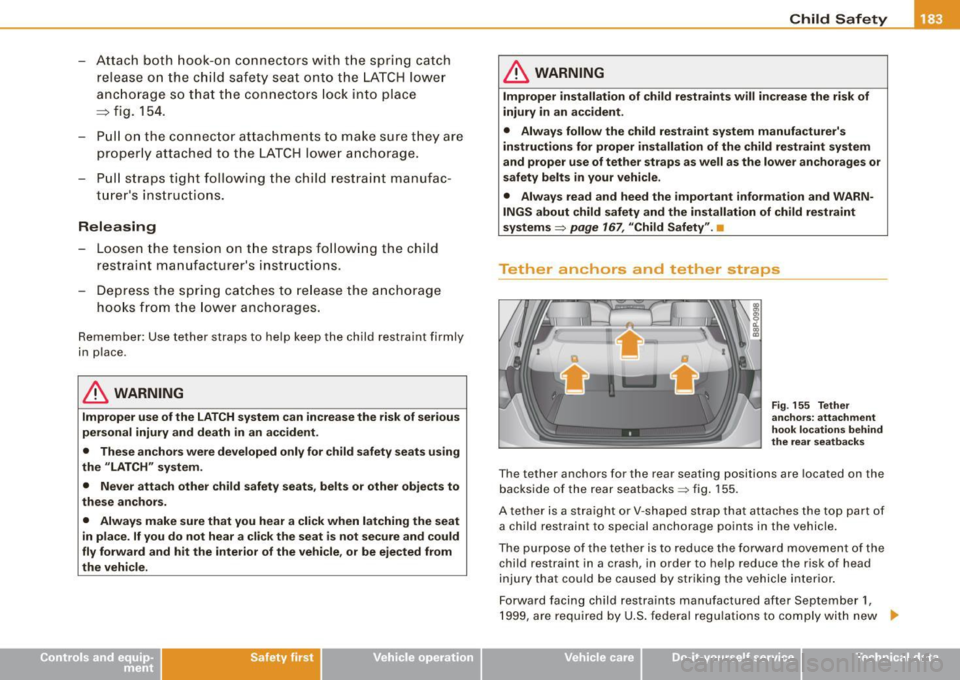
Tether anchors and tether straps
Fig . 155 Tether
anchors: attachment
hook locations behind
the rear seatbacks
The tether anchors for the rear seating positions are located on the
backside of the rear seatbacks
~ fig. 155.
A tether is a straight or V-shaped strap that attaches the top part of
a child restraint to special anchorage points in the vehicle.
The purpose of the tether is to reduce the forward movement of the child res traint in a crash , in order to help reduce the risk of head
injury that could be caused by striking the vehicle interior.
Forward facing child restraints manufactured after September 1,
1999, are required by U.S. federal regulations to comply with new ..
Vehicle care I I irechnical data
Page 186 of 320

___ C_h_ i_ld _ S_ a_ f_ e_ t-= y'------------------------------------------------
child head movement performance requirements . T hese new
per forma nce r equ ireme nts m ak e a tether ne cessary on m ost new
ch ild s afe ty s eats .
& WARNING
Improper installation of child restraints will increase the risk of
injury and death in a crash .
• Always follow the instructions provided by the manufacturer of
the child restraint you intend to install in your Audi.
• Improper use of child restraint anchors (including tether
anchors) can lead to injury in a collision . The anchors are designed
to withstand only those loads imposed by correctly fitted child
restraints.
• Never mount two child restraint systems on one LATCH lower
anchor point .
• Never attach two child restraint systems to one tether strap or
tether anchorage .
• Never attach a tether strap to a tie-down hook in the luggage
compartment.
• Never use child restraint tether anchorages to secure safety
belts or other kinds of occupant restraints .
• Never secure or attach any luggage or other items to the LATCH
lower anchorages or to the tether anchors .
• If a tether or other strap is used to attach a child restraint to the
front passenger seat , make sure that it is not so tight , that it
causes the weight -sensing mat to measure more weight than is
actually on the seat .
• The heavier weight registered can make the Advanced Airbag
System work as though an adult were on the seat and deploy the
Advanced Airbag when it must be suppres sed causing serious or
even fatal injury to the child.
• If you must install a rearward facing child safety seat on the
front passenger seat because of exceptional circumstances and
the PASSENGER AIR BAG OFF light does not come on and stay on ,
& WARNING (continued)
immediately install the rear-facing child safety seat in a rear
seating position and have the airbag system inspected by your
Audi dealer . •
Installing the upper tether strap on the
anchorage
Installing the tether strap
F ig . 156 Tether strap:
proper routing and
mounting
Fig . 157 T ether strap:
proper r outing and
mounting
R el ease or dep lo y the tethe r strap on the chil d restraint
acco rding to the c hild restraint man ufacturer 's instr uc-
ti on s.
11'-
Page 190 of 320

_1--_l_ n _t _ e _ll _,ig ,_,_ e_n _t _ t_ e_ c_ h_n _o_ l_ o ~g""- y.e- __________________________________________ _
Intelligent technology
Notice about data recorded by
vehicle control modules
Your vehicle is not equipped with an Event Data Recorder (EDR),
installed by some manufacturers for the express purpose of
capturing data for retrieval after an accident or crash event . EDR's
are sometimes called "crash recorders".
Some state laws restrict the retrieval or downloading of data stored
by EDR's that were insta lled in a vehicle for the express purpose of
retrieving data after an accident or crash event without the owner's
consent .
Although your vehicle is not equipped with an EDR, it is equipped
with a number of electronic control modules for various vehicle systems such as, for example, eng ine function, emission control, as
well as for the airbags and safety belts.
These electronic control modules also record vehic le -related data
during norma l vehicle operation for diagnostic and repair purposes .
The recording capacity of the electronic cont rol modules is limited
to data (no sound is recorded) and only a small amount of data is
actually recorded over a very limited period of time and stored when
a system fault or other condition is sensed by a control unit . Some
of the data then stored may relate to vehic le speed, direction,
braking as we ll as restraint system use and performance in the
event of a crash or other condition. Stored data can only be read and
downloaded with special equip men t.
Electronic Stabilization Program (ESP)
General
The Electronic Stabili ty Program increases driving
stability.
co ::,
_1, _ __ J"u. __ 11 ... _ ,.....u.,___,lli u.. _ .x,u _ _, r-u ~~ ~!' js:..~&c:',I
I
'
1 J
F ig . 15 8 Cente r
cons ole with E SP
sw itch
With ESP, control over the veh ic le is increased in situations when
the vehicle is close to the limits of grip, such as during acce leration
and in curves. ESP reduces the risk of skidding a nd improves vehicle
stability under all road conditions . It operates at all speeds .
The Anti-Lock Brake System (ABS), E lec tronic Differentia l Lock (EDS)
and Anti-Slip Regulation System (ASR) are integrated in the Elec
tronic Stability Program .
How ESP work s
The ESP control unit processes the fo llowing data from high-sensi
tive sensors : the rotational speed of the vehicle about its vertica l
axis, fore -and -aft and lateral acceleration forces, brake pressure and
steering angle.
Using steering ang le and vehicle speed, the direction the driver
wishes to travel is determined and continuously compared with
t,.
Page 215 of 320
____________________________________________ ...:C :..: l:..: e :.: a::. n:....:..:..: in~ g~ a~n .:..:d::....! p::. r :..:o:::..::. te:::..::: c:..::t ..:..:io ::::.: n:...__11111
•
soiling, etc.), you will need to be somewhat careful with these
leathers, and a certain type of care is required. For example, dark
clo thing materials can discolor leather sea ts (especially if such
clothing is damp and was not dyed correctly) . Dust and dirt particles
in pores , folds, and seams can have an abrasive effect and can
damage the leather surface as well as weaken seams.
The leather should be cleaned regularly as needed. After having
been used for a rela tiv ely long tim e, your lea ther seats will acquire
a rich aged finish. This is a characteristic of natural leather and a
sign of true quality.
In order to maintain the value of this natural product over the life of
your vehicle, you should follow the recommendations below:
0 Note
• To keep your leather from bleaching out, do not allow it to be
exposed to bright sunlight for long periods of time. If you have to
leave the vehicle parked outside for long periods, cover the leather
to protect it from direct exposure to sunlight.
• Sharp objects on clothing, such as zippers, rivets or sharp pieces
on belts can leave permanent scratches or scrape marks on the
surface of the leather.
[ i] Tips
• After each time you clean the leather and at regular intervals, use
a leather preservative creme that contains UV -blockers and that
works into the leather. This creme will nourish and moisturize the leather , helping it to breathe and stay supple . It also helps to build
up a protective coating on the surface.
• Clean the leather every 2 -3 months, and clean any areas that get
soiled.
• Remove fresh marks made by ballpoint pens, ink, lipstick, shoe
polish, etc . as soon as possible.
• Preserve the color of the leather as needed by using a special
colored leather care creme to touch up areas of uneven color .•
Ap plies to veh ic les : wi th n atural leat her
Cleaning and caring for leather upholstery
and trim
Natural leather requires special care and attention.
Normal cleaning
-Clean soiled areas with a slightly moistened cotton or
woolen cloth.
More stubborn dirt
- More stubborn dirt can be removed using a cloth satu
rated with a mild soap solution (2 tablespoons mild
liquid soap).
- Never allow the soap solution to saturate the leather, and
make certain that no water soaks into the seams.
Wipe off the soap solution with a soft, dry cloth.
Cleaning spots
- Remove fresh water-based spots (such as coffee, tea,
juices, blood) with an absorbent cloth or paper towel.
- Remove fresh grease or oil-based spots (such as butter,
mayonnaise, chocolate) with an absorbent cloth or paper
towel, or use the cleaner from the leather care kit if the
spot has not yet penetrated into the surface of the
leather.
- Use an oil/grease dissolving spray, if oil/grease spots
have dried on.
- Remove specific kinds of spots (ballpoint pen, felt
marker, fingernail polish, water-based paint, shoe polish,
etc.) with a spot remover specifically formulated for leather. ._.
Vehicle care I t •
Page 217 of 320

Cleaning and protection -
----------------=-----=------
•
Safety belts
Only well-maintained safety belts work reliably when
needed.
-Keep belts clean.
- For cleaning, use a mild soap and water solution. Let
belts dry thoroughly and away from direct sunlight.
- Do not allow inertia reel safety belts to retract before
they are completely dry.
- Check the condition of your safety belts
regularly.
Heavily soiled safety belts may not retract properly.
& WARNING
Damaged safety belts can break in a crash .
• Anything that might damage your safety belts could mean that
you and your passengers would not be adequately protected in an
accident.
• Safety belt performance depends on correct installation. Never
remove belts from the vehicle to clean them .
• Do not use chemical cleaning agents, bleach or dyes. They have
corrosive properties which weaken the webbing.
• When cleaning your safety belts, inspect them for damage. If
you discover damage, see your authorized Audi dealer.
• Always read and heed all WARNINGS and other information
=:, page 204. •
Engine compartment
Be especially careful when cleaning the engine compart
ment.
Always switch off the ignition before cleaning the engine =:> &.
Plenum panel
Remove leaves from the plenum panel in front of the windshield
under the engine hood. This prevents the water drain holes from
becoming blocked, and it prevents debris from entering the vehicle
interior through the heating and ventilation ducts .
Corrosion protection
The engine compartment and transmission have been corrosion
protected at the factory.
Good anti-corrosion treatment is very important, particularly in the
winter. If the vehicle is frequently driven on salt treated roads, the
entire engine compartment and plenum panel should be thor
oughly cleaned at the end of winter and retreated to prevent salt
damage. At the same time, the underside of the vehicle should be
washed as well.
If the engine compartment is cleaned at any time with grease
removing solutions
3l, or if you have the engine washed , the anti
corrosion treatment is almost always removed as well . It is therefore
essential to have a long-lasting corrosion protection reapplied to all
surfaces, seams, joints and components in the engine compart
ment.
& WARNING
Be aware: The engine compartment of any motor vehicle is a
potentially hazardous area.
• Before working in the engine compartment, be sure to read the
information
=:> page 215 . .,_
31 Use only the correct cleaning solutions. Never use gasoline or diesel fuel.
Vehicle care I t •
Page 227 of 320
_____________________________________________ C_h_ e;::..:. c:..:..k :..:..in ;..:..= g:.....:.; a:..:..n :....:d :..:....:. f.:.:il .:.:li :..:..n :.::g:!-_ ___,JIJIII
& WARNING !continued )
-First, fully apply the parking brake, move selector lever of
automatic transmission to "P" (Park); put manual transmission
in Neutral.
- Always use extreme caution to prevent clothing, jewelry, or
long hair from getting caught in the radiator fan, V-belts or
other moving parts, or from contacting hot parts. Tie back hair
before starting, and do not wear clothing that will hang or
droop into the engine .
• Minimize exposure to emission and chemical hazards
:=> &.
& WARNING
California Proposition 65 Warning :
• Engine exhaust , some of its constituents, and certain vehicle
components contain or emit chemicals known to the State of Cali
fornia to cause cancer and birth defects and reproductive harm . In
addition, certain fluids contained in vehicles and certain products
of component wear contain or emit chemicals known to the State
of California to cause cancer and birth defects or other reproduc
tive harm.
• Battery posts, terminals and related accessories contain lead
and lead compounds , chemicals known to the State of California
to cause cancer and reproductive harms. Wash hands after
handling.
0 Note
When adding fluids , always make sure that they are poured into the
proper container o r filler opening, otherwise serious damage to
vehicle systems will occur .
ffi For the sake of the environment
To detect leaks in time, inspect the vehicle floor pan from under
neath regularly. If you see spots from oil or other vehicle fluids, have
your vehicle inspected by an authorized Audi dealer .•
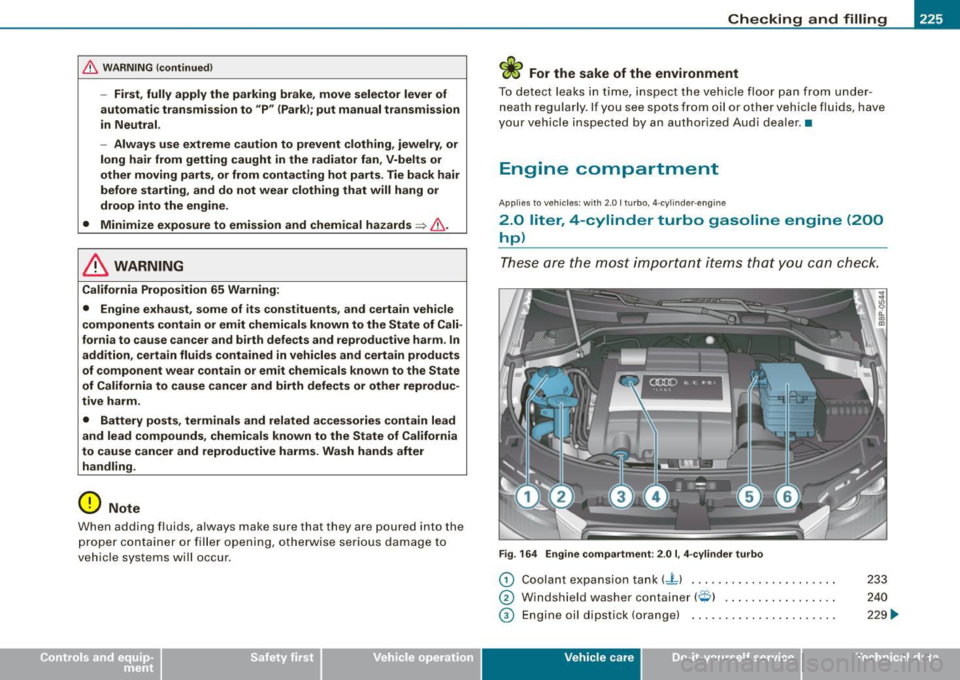
Engine compartment
Ap plie s to veh icl es: wit h 2.0 I tur bo, 4-cy lind er•e ng ine
2.0 liter , 4-cylinder turbo gasoline engine (200
hp)
These are the most important items that you can check.
Fig. 164 Engine compartment : 2 .0 I , 4-cy linder turbo
G) Coolan t expansion tank (- L l .... ... .... .... ... .. . .
0 Windshield washer container (W ) ... .... ... ... ... .
© Eng ine oil d ipstick (orange) .. ...... ........ ..... .
Vehic le care I I
233
240
229 ~
irechnical data
Page 253 of 320

Tires and wheels -
----------------
•
and is more difficult to stop. Overloading can not only lead to loss
of ve hicle control, but can a lso damage important parts of the
vehicle and can lead to sudden tire failure, inc luding a blowout and
sudden deflation that can cause the vehic le to crash.
Your safety and that of your passengers also depends on making
sure that load limits are not exceeded. Vehicle load includes every
body and everything in and on the veh icle . These load limits are
technically referred to as the vehicle's
Gross Vehicle Weight Rating
("GVWR"l.
The "GVWR" includes the weight of the basic vehicle, al l factory
insta lled accessories, a full tank of fuel, oil, coolant and other fluids
plus maximum load. The maximum load includes the number of
passengers that the vehicle is intended to carry ("seating capacity")
with an assumed weight of 150 lbs (68 kg) for each passenger at a
designated seating position and the total weight of any luggage in
the vehicle. If you tow a trailer, the weight of the trailer hitch and the
tongue weight of the loaded trai ler must be included as part of the
vehicle load .
The
Gross Axle Weight Rating ("GAWR") is the maximum load that
can be applied at each of the vehic le's two axles .
The Gross Vehicle Weight Rating and the Gross Axle Weight Rating
are listed on the safety compliance sticker label located either on
the driver's side B-pillar or on the inside of the fuel filler flap. Your
Audi has 5 seating positions, 2 in the front and 3 in the rear for total
seating capacity of 5. Each seating position has a safety belt
=> page 135, "Safety belts".
The fact that there is an upper limit to your vehicle's Gross Vehicle
Weight Rating means that the total weight of whatever is being
carried in the vehicle (including the weight of a trailer hitch and the
tongue weight of the loaded trailer) is limited. The more passengers
in the vehicle or passengers who are heavier than the standard
weights assumed mean that less weight can be carried as luggage .
T he tire pressure label on your Audi also lists the maximum
combined weight of all of the occupants and luggage or other cargo that the vehicle can carry.
For the location of the label
=> page 246,
fig. 173.
& WARNING
Overloading a vehicle can cause loss of vehicle control, a crash or
other accident, serious personal injury , and even death .
• Carrying more weight than your vehicle was designed to carry
will prevent the vehicle from handling properly and increase the
risk of the loss of vehicle control.
• The brakes on a vehicle that has been overloaded may not be
able to stop the vehicle within a safe distance.
• Tires on a vehicle that has been overloaded can fail suddenly,
including a blowout and sudden deflation, causing loss of control
and a crash.
• Always make sure that the total load being transported -
including the weight of a trailer hitch and the tongue weight of a
loaded trailer -does not make the vehicle heavier than the
vehicle's Gross Vehicle Weight Rating .•
Determining correct load limit
Use the example below to calculate the
total weight of the passengers and
luggage or other things that you plan to
transport so that you can make sure that
your vehicle will not be overloaded.
~
Vehicle care I t •