child lock AUDI S3 2010 Owners Manual
[x] Cancel search | Manufacturer: AUDI, Model Year: 2010, Model line: S3, Model: AUDI S3 2010Pages: 320, PDF Size: 75.34 MB
Page 4 of 320
Table of contents
Table of contents
Vehicle literature ........ .
About this Owner's Manual ..... ... ...... ....... .
Controls and
equipment ................. .
Instrumen ts and con trols ..... .
Genera l ill ustration ............. .
Ins trumen ts and
warning/indicat or lig hts ....... .
Instruments ... ... ............ . .
Warning/indicator lights ........ .
Driver in fo rma tion disp lay ..... .
Introduction ... .......... ... ... .
On-Board Diagnostic system (OBD)
Trip compute r ................. .
Menu di splay ............ ...... .
Speed warn ing system ...... ... .
Warnings and symbo ls ......... .
Opening and c losi ng .......... .
Keys .............. ... ......... .
Power locking system .......... .
Doors, power locks ............ .
Powe r w indows ... ... .. .... ... .
Panoramic s liding sunroof ...... .
Emergency mechanical c losing for
t he panoram ic slid ing sunroof .. .
Clear v ision .................... .
Lights . ..... ... ... .... ... ... .. .
Interior lights .................. .
Vision ........ ...... ......... . .
4
5
6
7
7
8
8
1 1
18
1 8
21
22
23
26
28
36
36
38
41
47
49
50
53
53
58
60
Wiper and washer system .. .... .
Mirrors ....................... .
Digital compass ............... .
Seats and storage ............ .
General recommendat ions ..... .
Adjust ing front seats manua lly ..
Ad just ing the power seat ...... .
Adjusting the lumbar support .. .
Head restraints ............... .
Cen ter armrest ... ... ... ... ... . .
Rear seats .................... .
Luggage compartment . ...... . .
Roof rack* installation ......... .
Cup ho lders .......... ........ .
As htray ................ ...... .
Cigarette lighter/socket . .• .... ..
Storage .................. ... . .
War m and cold ........... ... . .
Climate controls ....... ... .... .
Electrically heated front seats . . .
On the road ............... ... . .
Steering ...................... .
Ignition lock and ignition switch .
Sta rting and stopping the engine
Par king bra ke ................. .
Starting on hills ... ...... •.... ..
Cruise control .......... .. ..... .
Transm ission
Manual transmission
S tronic transmission ... .. .. ... .
62
67
70
72
7 2
7 3
74
76
7 7
80
80
81
86
89
91
91
92
96
96
104
105
105
106
107
108
1 10
1 10
1 13
1 13
1 14
Safety first ...... ...... .... .
Driving Safe ly ...... .... ... .... .
Genera l notes ...... ........... .
Proper occupant seating pos it ions
Peda l a rea .................... .
S tow ing luggage .......... .... .
Reporting Safety Defects ...•....
Safety belts ................... .
General notes ....... •..........
Why safety be lts? .. ... ..... •....
Safety belts ........... ... .. ... .
Safety belt pretensioners ....... .
Airbag system ................. .
Important things to know ...... .
Front
airbags .. .... ... ...... .. .
Monito ring the Advanced Airbag
System ... ..... ... .. ..... ... .. .
Side a irbags .............. •....
Side curtain airbags ....... •....
C hild Safe ty ................... .
Important thi ngs to know ...... .
Child safety seats ............. .
Insta lling a ch ild safety seat .... .
LA TCH Lower anchorages and
tethers for children ............ .
Add itio nal Information ......... .
Vehicle operation ...... . .
Intel ligent technology . ... .. .. . .
No tice abo ut da ta recorded by
1 2 4
12 4
12 4
126
130
131
133
13 5
135
136
139
143
145
145
149
156
161
16 4
167
167
172
177
180
185
188
188
ve hicle control modules . . . . . . . . . 188
E lect ronic Stabili zation Program
(ESP) . . . . . . . . . . . . . . . . . . . . . . . . . . 188
Page 38 of 320
Opening and closing
Opening and closing
Keys
Key set
®
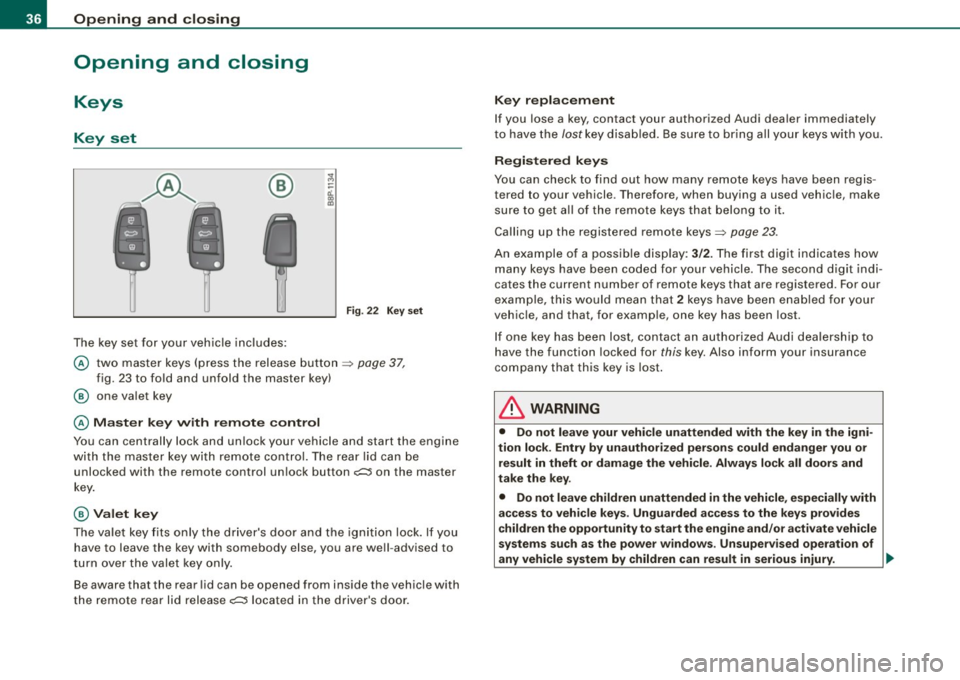
The key set for your vehicle includes:
Fig. 22 Key set
@ two master keys (press the release button => page 37,
fig. 23 to fold and unfold the master key)
@ one valet key
@ Master key with remote control
You can centrally lock and unlock your vehicle and start the engine
with the master key with remote control. The rear lid can be
unlocked with the remote control unlock button
c;:;::::5 on the master
key.
@ Valet key
The valet key fits only the driver's door and the ignition lock. If you
have to leave the key with somebody else, you are well -advised to
turn over the valet key only.
Be aware that the rear lid can be opened from inside the vehicle with
the remote rear lid release
c;:;::::5 located in the driver's door.
Key replacement
If you lose a key, contact your authorized Audi dealer immediately
to have the
lost key disabled. Be sure to bring all your keys with you.
Registered keys
You can check to find out how many remote keys have been regis
tered to your vehicle . Therefore, when buying a used vehicle, make
sure to get all of the remote keys that belong to it.
Calling up the registered remote keys=>
page 23.
An example of a possible display: 3/2. The first digit indicates how
many keys have been coded for your vehicle . The second digit indi
cates the current number of remote keys that are registered . For our
example, this would mean that
2 keys have been enabled for your
vehicle, and that, for example, one key has been lost.
If one key has been lost, contact an authorized Audi dealership to
have the function locked for
this key. Also inform your insurance
company that this key is lost.
& WARNING
• Do not leave your vehicle unattended with the key in the igni
tion lock . Entry by unauthorized persons could endanger you or
result in theft or damage the vehicle. Always lock all doors and
take the key.
• Do not leave children unattended
in the vehicle, especially with
access to vehicle keys . Unguarded access to the keys provides
children the opportunity to start the engine and/or activate vehicle
systems such as the power windows . Unsupervised operation of
any vehicle system by children can result in serious injury . ._
Page 41 of 320
• Remote control feature=> page 37.
• Anti -theft alarm system => page 46.
All the doors and the rear lid are locked by the central locking
sys tem when you lock the veh icle.
Unlo cking th e ve hicle
You can un lock the vehicle from outside either by using the remote
control
o r by inserting and turning the key in the driver's door lock.
When you
unlock your vehicle :
• The anti -theft alarm system is deactivated briefly .
• T he vehicle i nteri or lights illuminate fo r approxi mate ly 30
seconds .
• All tu rn signal lights will flash twice when t he car is unl ocked .
• After un locking the vehicle, you have 30 seconds to open a door
or the rear lid. After 30 seconds, t he vehicle automatically locks and
the anti-theft a larm system activates again.
The rear lid can be locked o r unlocked either by u sing the remote
control
or by inserting and turning the key in the driver's door lock.
Un loc king the vehicle with the remote control
c::::::::5 wi ll only unlock
the rear lid, to open it, the l id handle needs to be pressed.
Lo cking the vehi cle
You can lock the vehic le from outside either by using the remote
control
or by i nserting and tu rning the key in the drive rs's d oor l ock .
When you
lock the vehicle:
• All doors and the rear lid are locked .
• All turn signal lights w ill flash once when the car is locked .
• T he anti -theft alarm sys tem is activated. The horn of the anti
theft alarm system wi ll sound and the anti -theft alarm system readi
ness light, loca ted in the center of the instrument pane l below the
w indshie ld on the right side of the a ir vent, wil l start to b link.
• The ve hicle interior l ights tur n off .
Controls and equip
ment
Opening and clo sing
Automati c locking *
The a utoma tic locking feature l ocks all the vehicle do ors and t he
rear lid when you drive faster than 9 mph (15 km/h).
You can unlock the vehicle from the inside by :
• removi ng the key from the igniti on swi tch (the vehicle wil l a uto
matically un lock itself) or
• pressing the unlock part o f the power lock switch
l!:)) or
• pul ling the inside handle for that door (once -the front doo r is
unlocked and opened at the same time, twice to open the rear doo r).
I f you wish, you can have an authorized Audi dea ler convert your
p ower d oor lock system to auto matic l ocki ng .
& WARNING
• When you lock your vehicle from out side , nobody - especially
c hildren - should remain inside the vehi cle . Re member , when you
lock the vehicle from the out side the window s cannot be opened
from the inside .
• When you leave the vehicle , alway s remove the ignition key and
t a ke it with you . This will prevent passengers (children , for
example ) from accidentally being locked in the vehicle should they
accidentally press the po wer locking swit ch on the center c onsole .
• Do not leave children ins ide the vehicle unsupe rvised. In an
emergen cy it would be imposs ible to open the doors from the
out side without th e key.
[ i ] Tips
• I n the eve nt of a crash with airbag deployment all locked do ors
wi ll be automatically un locked to give access to the vehicle occu
p a nts from the outside.
• I f the power locking system should fail, you can still open the
f u el tank flap in an emergency =>
page 222 . ~
I • •
Page 46 of 320
Opening and closing
Closing the rear lid
- Pull it down and shut it firmly~&. There is a recess in
the interior trim of the lid to make it easier to pull down.
& WARNING
• After closing the rear lid, always pull up on it to make sure that
it is properly closed. Otherwise it could open suddenly when the
vehicle is moving.
• To help prevent poisonous exhaust gas from being drawn into
the vehicle , always keep the rear lid closed while driving. Never
transport objects larger than those fitting completely into the
luggage area, because then the rear lid cannot be fully closed.
• Never leave your vehicle unattended especially with the rear lid
left open. A child could crawl into the car through the luggage
compartment and pull the lid shut, becoming trapped and unable
to get out. To reduce the risk of personal injury, never let children play in or around your vehicle. Always keep the rear lid, as well as
the vehicle doors, closed when not in use.
[ i ) Tips
• If the rear lid is open or not properly locked when the ignition is
turned on, the door and rear lid warning appears in the instrument
cluster display.
• If the rear lid on a locked vehicle is unlocked with the middle
button
cs on the remote key , the rear lid is automatically locked
again immediately after closing. This is indicated by the turn signals
blinking. •
Emergency release for rear lid
If the rear lid cannot be opened, an emergency release is
provided.
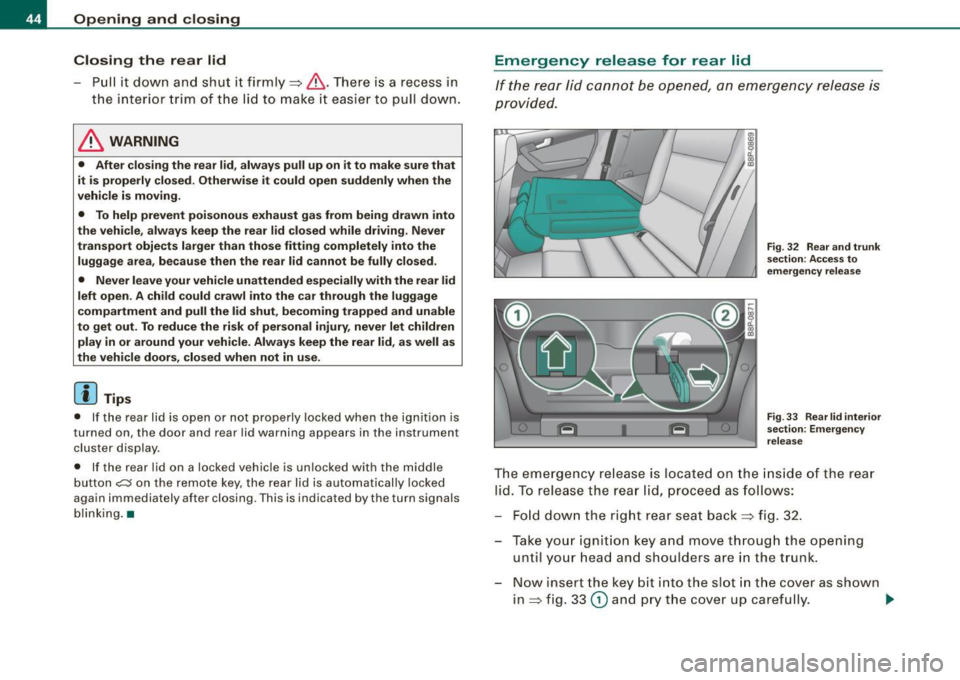
Fig. 32 Rear and trunk
section: Access to
emergency release
Fig. 33 Rear lid interior
section: Emergency
release
The emergency release is located on the inside of the rear
lid. To release the rear lid, proceed as follows:
- Fold down the right rear seat back~ fig. 32.
- Take your ignition key and move through the opening until your head and shoulders are in the trunk.
- Now insert the key bit into the slot in the cover as shown
in ~ fig. 33
(D and pry the cover up carefully. ..,.
Page 47 of 320

- Place the key in the round opening behind the cover@
and turn the key in the direction of the arrow. This
unlocks the lock and the rear lid opens a crack.
- Open the rear lid from the outside and put the ignition
key in a safe place. •
Manual door locking
If the power locking system fails (power failure), you will
need to lock the passenger door separately.
Fig. 34 Emergency
locking device in the
doors
An emergency door locking device is integrated in the rear
edge of the doors (only visible when the door is open) for
those doors without a lock cylinder.
- Open the door.
- Remove the plastic cap using the vehicle key=> fig. 34.
- Stick the key into the internal slot and turn the key about
90 degrees as far as it can go to the right (right-side doors) or to the left (left-side doors).
- Replace the plastic cap .
Contro ls and eq uip
ment
Opening and closing
After you close the door, you will no longer be able to open it from
the outside.
You can open it from the inside, however , by pulling on the door
latch,
once for the front doors and twice for the rear doors. •
Child safety lock
The child safety lock prevents the rear doors from being
opened from the inside.
,._ M
-
-a:. a, (0
Fig . 35 Rear doors:
child safety lock
The rear doors are equipped with a child safety lock. It is
operated with the veh icle key. The child safety lock is only
visible when the door is open.
- To
switch on the child safety lock, turn the ignition key in
the direction of the arrow.
- To
switch off the child safety lock, turn the ignition key in
the opposite direction of the arrow .
The child safety lock prevents the doors from being opened from the
inside when you have small children sitting in the rear. •
Vehicle care I I irechnical data
Page 49 of 320

Power windows
Controls
Fig. 37 Driver's door :
power window
switches
The switches are located in the driver's door. The front passenger's
door has a own power window switch of its own.
To open/close If the respective switch is pushed or pulled, the
window will , respectively.
Switches for front door windows
@ operates the window in the driver's door.
@ operates the window in the front passenger's door.
Switches for rear windows
© operates the left rear window.
@ operates the right rear window.
Safety switch
© Safety switch for rear window operation.
& WARNING
• Do not leave children unattended in the vehicle, especially with
access to vehicle keys. Unsupervised use of the keys can result in
Con tro ls and eq uip
ment
Opening and closing
& WARNING !continued)
starting of the engine and use of vehicle systems such as power
windows, etc. which could result in serious injury.
• Remember -you can still open or close the power windows for
about ten minutes after the ignition is switched off. Only when
either of the front doors are opened are the power windows
switched off.
• Be careful when closing the windows . Check to see that no one
is in the way, or serious injury could result!
• Always remove the ignition key whenever you leave your
vehicle.
• If you lock your vehicle from the outside, no one, especially chil
dren, should remain in the vehicle.
• Do not stick anything on the windows or the windshield that
may interfere with the driver's field of vision. •
Switches in the driver's door
The driver con operate all windows.
In addition to the switches in the driver 's door, there is a
separate switch in each door for the power w indow in that
door~ fig. 37. If the respective switch is pushed or pulled,
the window will open or close. The power window switches
have a
two -position function:
Opening the windows
Push the switch to the
first stop and hold it there until the
window has lowered to the desired position.
Push the switch briefly to the
second stop : the window
will automatically open all the way.
~
Vehicle care I I irechnical data
Page 108 of 320
• ..__O_ n_ t_h _ e_ r_ o_ a_ d ____________________________________________________ _
Ignition lock and ignition switch
Ignition lock
The engine can be started or turned off with the ignition
key.
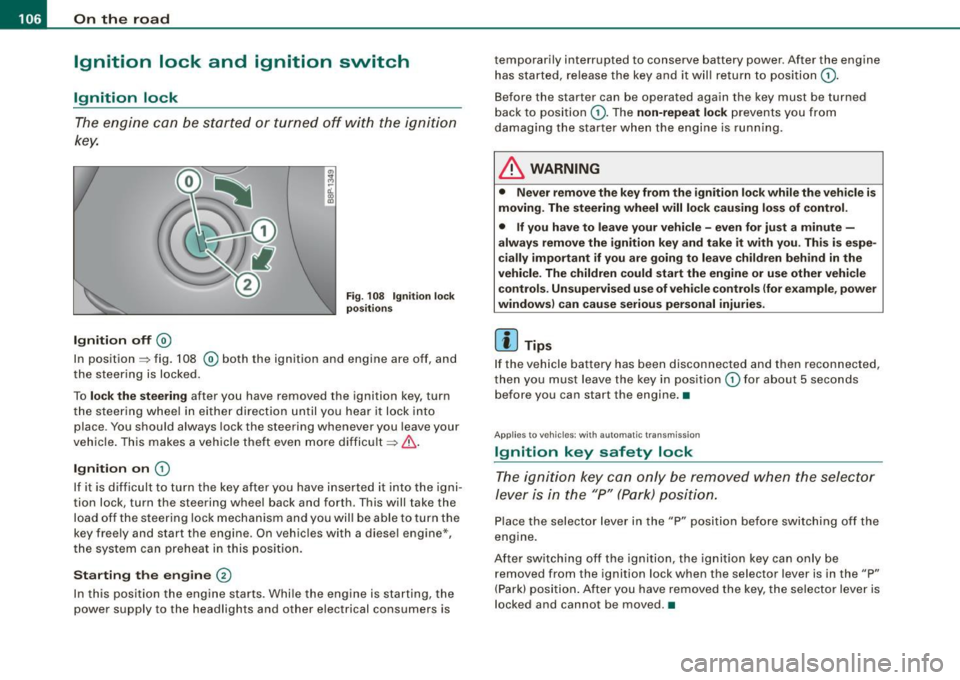
Ignition off ®
Fi g. 108 Ignit ion lock
p os ition s
In position => fig. 108 ® both the ignit ion and engine are off, and
the steering is locked .
To
lo ck the stee ring after you have removed the ignition key, turn
t he steering whee l in either direction until you hear it lock into
place . You should always lock the steering whenever you leave your
vehic le . This makes a vehicle theft even more difficult =>
& -
Ignition on CD
If it is difficult to turn the key after you have inserted i t into the igni
tion lock, turn the steering wheel back and forth . This will take the
load off the steering lock mechanism and you will be able to turn the
key freely and start the engine . On vehicles with a diesel engine*,
t he system can preheat in this pos ition.
St arting the engine
@
In this position the engine starts . Whi le the engine is starting, the
power supply to the headlights and other electrical consumers is temporarily interrupted to conserve battery power
. After the engine
has started, release the key and it will return to position
CD .
Before the starter can be operated again the key must be turned
back to position
CD -The non-repeat lock prevents you from
damaging the star ter when the engine is runn ing.
& WARNING
• Never remo ve the key from the ignition lo ck w hile the veh icle i s
moving. The steering whe el will lo ck caus ing lo ss of control .
• If you hav e to lea ve your vehicle -even fo r ju st a min ute -
alway s remove the ignition key and take it with you. Th is is espe
ci ally important if you are g oing to lea ve children behind in the
vehicle . The childr en co uld start the eng ine or u se other vehi cle
c on trols . Un supe rvis ed u se of veh icle c ont ro ls ( for e xamp le , po wer
windows) c an cause seriou s per sonal injuries .
[ i ] Tips
If the vehicle battery has been disconnected and then reconnected,
then you must leave the key in position
CD for about 5 seconds
before you can start the engine. •
Applies t o vehi cles : w ith autom atic trans mission
Ignition key safety lock
The ignition key can only be removed when the selector
le ver is in the "P" (Park) p osition.
Place the selector lever in the "P" posi tion be fore switching off the
engine .
After switching off the ignition, the ignition key can only be
removed from the ignition lock when the selector lever is in the "P"
(Park) position . After you have re moved the key, the selector lever is
l ocked and cannot be moved .•
Page 112 of 320

• ..__O_ n_ t_h _ e_ r_ o_ a_ d ____________________________________________________ _
& WARNING (continued )
• Never allow anyone -especially small children -to remain in the
vehicle when it is locked. Locked doors make it more difficult for
rescuers to access the passenger compa rtment in the event of an
emergency . Danger to life!
• Never leave children unsupervised in the vehicle. Children
could release the parking brake or move the gearshift lever out of
ge ar. The vehicle could start to roll away and cause an ac cident .
• No matter what the season is , the temperature in a parked
vehicle can reach dangerous levels. •
Applies to vehicles: with hill hold assist
Starting on hills
Hill hold assis t mak es it eas ier to star t on h ills .
T he system is activated when the brake peda l is depressed
for a few
seconds .
After releasing the brake pedal, the brake power is held for a brief
moment to pr event the vehicle fr om r olling back whe n star ting . A t
this time, you can easily begin to move your vehicle.
& WARNING
• If you did not beg in moving immediately after releasing the
brake pedal , under certain circumstances , the vehicle would begin
to roll backward . Depress the brake pedal immediately or engage
the hand brake.
• Should the engine stall , depress the brake pedal immediately
or engage the hand brake .
• In order to prevent the vehicle from rolling back unintentionally
when starting in stop -and-go traffic, keep the brake pedal
depressed for a few seconds before driving off.
[ i ] Tips
You can find out if your ve hicle is equ ipped w it h "Hi ll ho ld ass ist" at
an authorized Audi dealershi p.•
Cruise control
Switching the system on
Th e cruise con trol sys tem mak es it possible to dr ive a t a
c onstant spe ed s tartin g at 20 mp h (30 km /h).
Fig . 111 Control lever
with set button
F ig . 112 Display:
Sele cted speed
P ull the le v er to p ositi o n G) => fig. 11 1 to sw itch the
s y st em o n.
Page 129 of 320
________________________________________________ D_r_iv _ i _n_ g~ S_ a_ fe_ ly __ !II
& WARNING (continued)
• Always hold the steering wheel on the outside of the steering
wheel rim with your hands at the 9 o'clock and 3 o'clock positions
to help reduce the risk of personal injury if the driver's airbag
inflates.
• Never hold the steering wheel at the 12 o'clock position or with
your hands at other positions inside the steering wheel rim or on
the steering wheel hub. Holding the steering wheel the wrong way
can cause serious injuries to the hands, arms and head if the
driver's airbag deploys .
• Pointing the steering wheel toward your face decreases the
ability of the supplemental driver's airbag to protect you in a colli
sion.
• Always sit in an upright position and never lean against or
place any part of your body too close to the area where the airbags
are located.
• Before driving, always adjust the front seats and head
restraints properly and make sure that all passengers are properly
restrained .
• Never adjust the seats while the vehicle is moving. Your seat
may move unexpectedly and you could lose control of the vehicle .
• Never drive with the backrest reclined or tilted far back! The
farther the backrests are tilted back, the greater the risk of injury
due to incorrect positioning of the safety belt and improper
seating position.
• Children must always ride in child safety seats~
page 167.
Special precautions apply when installing a child safety seat on
the front passenger seat~
page 145. •
Controls and equip ment Safety first
Vehicle operation
Proper seating position for the front
passenger
The proper front passenger seating position is important
for safe, relaxed driving.
For your own safety and to reduce the ris k of injury in the
event of an accident, we recommend that you adjust the
seat for the front passenger to the following pos ition:
- Adjust the angle of the seatback so that it is in an upright
position and your back comes in full contact with it
whenever the vehicle is mov ing.
- Adjust the head restraint so that the upper edge is as
even with the top of your head as possible but not lower
than eye level and so that it is as close to the back of your
head as possible::::;,
page 129.
Keep both feet flat on the floor in front of the front
passenger seat.
- Fasten and wear safety belts correctly::::;,
page 139.
For detailed information on how to adjust the front passenger's
seat, see
~ page 72.
& WARNING
Front seat passengers who are unbelted, out of position or too
close to the airbag can be seriously injured or killed by the airbag
as it unfolds. To help reduce the risk of serious personal injury :
• Passengers must always sit in an upright position and never
lean against or place any part of their body too close to the area
where the airbags are located.
• Passengers who are unbelted, out of position or too close to the
airbag can be seriously injured by an airbag as it unfolds with
great force in the blink of an eye. ..
Vehicle care Do-it-yourself service Technical data
Page 134 of 320

-Driving
Safely ------=-------=----------------
& WARNING
Improperly stored luggage or other items can fly through the
vehicle causing serious personal injury in the event of hard braking or an accident. To help reduce the risk of serious personal injury:
• Always put objects, for example, luggage or other heavy items
in the luggage compartment.
• Always secure objects in the luggage compartment using the
tie-down eyelets and suitable straps.
& WARNING
Heavy loads will influence the way your vehicle handles. To help
reduce the risk of a loss of control leading to serious personal
injury :
• Always keep in mind when transporting heavy objects, that a
change in the center of gravity can also cause changes in vehicle
handling:
-Always distribute the load as evenly as possible.
- Place heavy objects as far forward in the luggage compart-
ment as possible.
• Never exceed the Gross Axle Weight Rating or the Gross
Vehicle Weight Rating specified on the safety compliance sticker on the left door jamb. Exceeding permissible weight standards
can cause the vehicle to slide and handle differently.
• Please observe information on safe driving~
page 124.
& WARNING
To help prevent poisonous exhaust gas from being drawn into the
vehicle, always keep the rear lid closed while driving.
• Never transport objects larger than those fitting completely
into the luggage area because the rear lid cannot be fully closed.
& WARNING (continued)
• If you absolutely must drive with the rear lid open, observe the
following notes to reduce the risk of poisoning :
- Close all windows,
- Close the power roof*,
- Open all air outlets in the instrument panel,
- Switch off the air recirculation,
- Set the fresh air fan to the highest speed.
& WARNING
Always make sure that the doors , all windows, the power roof*
and the read lid are securely closed and locked to reduce the risk
of injury when the vehicle is not being used.
• After closing the rear lid, always make sure that it is properly
closed and locked .
• Never leave your vehicle unattended especially with the rear lid
left open. A child could crawl into the vehicle through the luggage
compartment and close the rear lid becoming trapped and unable
to get out . Being trapped in a vehicle can lead to serious personal
injury.
• Never let children play in or around the vehicle.
• Never let passengers ride in the luggage compartment . Vehicle
occupants must always be properly restrained in one of the
vehicle's seating positions.
[ i] Tips
The tire pressure must correspond to the load -see the tire pressure
sticker on the fuel filler door. •