child lock AUDI S3 2010 User Guide
[x] Cancel search | Manufacturer: AUDI, Model Year: 2010, Model line: S3, Model: AUDI S3 2010Pages: 320, PDF Size: 75.34 MB
Page 159 of 320

__________________________________________________ A_ i_ r _b _a...; g::- s_ y=--- s_t _e _m __ !II
PASSENGER AIR BAG OFF light
I, Q
--
&I Ii u ,, , u
I I J' J
Fig. 1 42 Sectio n from
t h e ce nte r co nso le :
PA SS ENGER AIR B AG
OFF light
The PA SSENGER AIR BAG OFF light is located in the center console
=>fig.142 .
The
PA SSENGER AIR BAG OFF light wil l come on and stay on to te ll
you when the front Advanced Airbag on the passenger side has been turned off by the electron ic control unit. Each time you turn on
the ign it ion, the
PA SS ENGER AIR BA G OFF light will flash for a few
seconds and:
• will stay on if the front passenger seat is not occupied,
• will stay on if there is a small child or chi ld restraint on the front
passenge r seat,
• will go out if the front passenger seat is occupied by an adult as
registered by the we ight-sensing mat .
T he
PA SS ENGER AIR BAG OFF light mu st co me on and sta y on if the
ign ition is on and
• a car bed has been insta lled on the front seat, or
• a rearward -facing chi ld restraint has been installed on the front
passenger seat, or
• a forwa rd -facing child restra int has been installed on the front
passenger seat, or
• t he we ight registered on the front passenger seat is equa l to or
less than the combined weight of a typica l 1 year -old restrained in
Controls and equip
ment Safety first
Vehicle operation
one of the rear-facing or forward -facing infant restraints listed in
Federa l Motor Veh icle Safe ty S tandard 208 with which the Advanced
Airbag System in your vehicle was certified.
I f the front passenger seat is not occupied, the front airbag will not
deploy, and the
PA SS ENGER AIR BAG OFF light will stay on . Never
insta ll a rearward -facing child restraint on the front passenger seat,
the sa fest place for a child in any kind of child restraint is at one of
the seating posi tions on the r ear seat =>
page 147, "Child restraints
on the front seat -so me important things to know" and=>
page 167,
"Chi ld Safety ".
If the PASSENGER AIR BAG OFF light com es on when one of the
conditions listed above is met, be sure to check the light regu lar ly
to make certa in that the
PA SS ENGER AIR BAG OFF light stays on
continuously whenever the ignition is on . If the
PA SSENGER AIR
BAG OFF
light does not appear on and does not stay on all the tim e,
stop as soon as it is safe to do so and
• reactivate the system by turning the ignition off and then turning
it on aga in;
• remove and reinstall the child restraint. Make sure that the child
restrain t is proper ly installed and t hat the safety be lt for the front
passenger seat has been correctly routed through the child restraint
as described in the chi ld restraint manufacturer's instructions;
• make sure that the convertible locking feature on the safety belt
for the front passenger sea t has been activated a nd that the safety
belt has been pulled tight . The belt must not be loose or have loops
of slack so that the sensor be low the safety belt latch on the sea t can
do its job =>
page 177.
• make sure that things that may inc rease the we ight of the child
and child safety seat are not being transported on the front
passenger seat;
• make sure that the safety belt tension sensor is not blocked.
Shake the safety belt latch on the front passenger seat back and
forth;
• I f a strap or te ther is being used to tie the child sa fety seat to the
front passenger seat , make sure that it is not so tight that it causes .,
Vehicle care Do-it-yourself service Technical data
Page 172 of 320
___ C_ h_ il_ d _S_ a_fe _ ty ______________________________________________ _
C. Forward-facing convertible child restraint systems,
manufactured on or after September 1, 2004:
• Britax Roundabout 161
• Britax Expressway
• Century Encore 4612
• Century STE 1000 4416
• Cosco Olympian 02803
• Cosco Touriva 02519
• Evenflo Horizon V 425
• Evenflo Medallion 254
• Safety First Comfort Ride 22-400
& WARNING
To reduce the risk of serious injury, make sure that the PASSENGER
AIR BAG OFF light comes on and stays on whenever a child
restraint is installed on the front passenger seat and the ignition
is switched on.
• Take the child restraint off the front passenger seat and install
it properly at one of the rear seat positions if the PASSENGER AIR
BAG OFF light does not stay on.
• Have the airbag system inspected by your authorized Audi
dealer immediately.
[ i] Tips
The child seats listed in categories A to C have been tested by Audi
only for the Advanced Airbag function. •
Important safety instructions for using child
safety seats
Correct use of child safety seats substantially reduces the
risk of injury in an accident!
As the driver, you are responsible for the safety of every
body in the vehicle, especially children:
- Always use the right child safety seat for each child and
always use it properly ::::>
page 172.
-Always carefully follow the child safety seat manufac
turer's instructions on how to route the safety belt prop
erly through the child safety seat.
- When using the vehicle safety belt to install a child safety
seat, you must first activate the convertible locking
retractor on the safety belt to prevent the child safety
seat from moving ::::>
page 177.
-Push the child safety seat down with your full weight to
get the safety belt really tight so that the seat cannot
move forward or sideways more than one inch (2.5 cm).
- If a strap or tether is being used to tie the child safety
seat to the front passenger seat, make sure that it is not
so tight that it causes the weight-sensing mat to
measure more weight than is actually on the seat.
Always remember: Even though your vehicle is equipped with an
Advanced Airbag system, all children, especially those 12 years and
younger, should always ride in the back seat properly restrained for
their age and size. _,,
Page 174 of 320
-Child Safety -------'"---------------
& WARNING
(continued)
-Always move the front passenger seat into the rearmost
position of the passenger seat's fore and aft adjustment range,
and as far away from the airbag as possible before installing
the child restraint .
- Always make sure that nothing prevents the front
passenger's seat from being moved to the rearmost position in
its fore and aft adjustment range .
- Always make sure that the backrest is in the upright posi
tion.
• Always buckle the child safety seat firmly in place even if a
child is not sitting in it. A loose child safety seat can fly around
during a sudden stop or in a collision.
• Always read and heed all WARNINGS whenever using a child
restrained in a vehicle is being used=>
page 135, "Safety belts",
=>
page 145, "Airbag system" and=> page 167, "Child Safety".
& WARNING
To reduce the risk of serious injury, make sure that the PASSENGER
AIR BAG OFF light comes on and stays on whenever a child
restraint is installed on the front passenger seat and the ignition
is switched on.
• Take the child restraint off the front passenger seat and install
it properly at one of the rear seat positions if the PASSENGER AIR
BAG OFF light does not stay on.
• Have the airbag system inspected by your authorized Audi
dealer immediately.
& WARNING
A child in a child restraint installed with the LATCH lower anchor
ages or with the standard safety belt on the rear seat may play
& WARNING (continued)
with unused rear seat safety belts and become entangled
resulting in serious personal injury and even death.
• Always buckle unused rear seat safety belts out of reach of chil
dren in child seats and properly activate the convertible locking
retractor so that the child cannot unreel the safety belt from the
retractor. •
Child safety seats
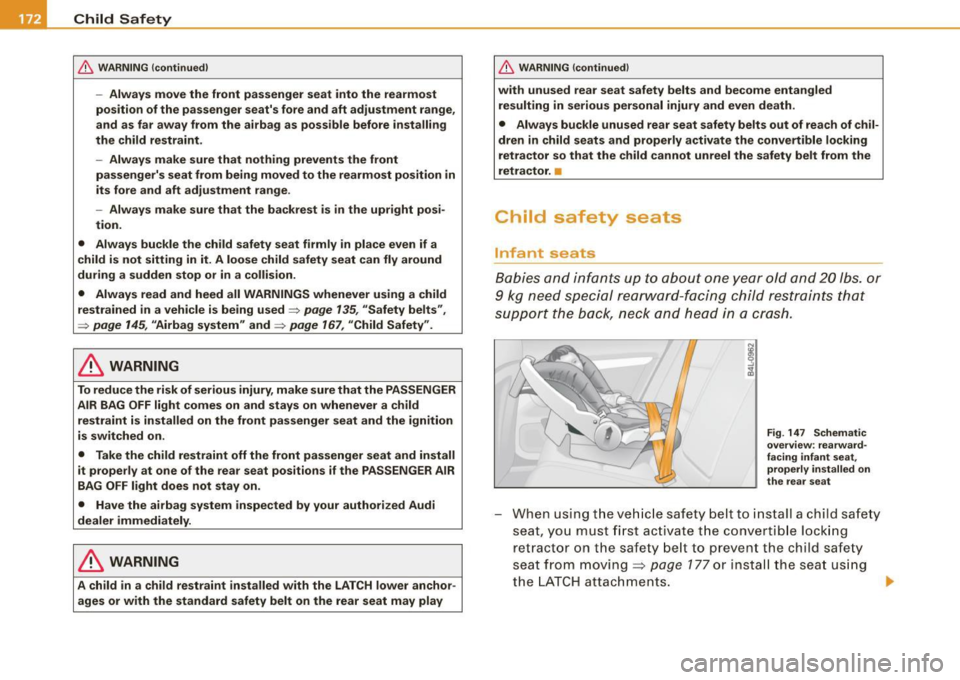
Infant seats
Babies and infants up to about one year old and 20 lbs. or
9 kg need special rearward-facing child restraints that
support the back, neck and head in a crash .
Fig. 147 Schematic
overview: rearward
facing infant seat,
properly installed on
the rear seat
- When using the vehicle safety belt to install a child safety
seat, you must first act ivate the convertible locking
retrac tor on the safety belt to prevent the child safety
seat from moving=>
page 177 or install the seat using
the LATCH attachments. ..,_
Page 176 of 320
•---=C:...:.h.:.: i.:.:ld ::.....: S~ a::. f~ e~ t~ y~ ----------------------------------------------
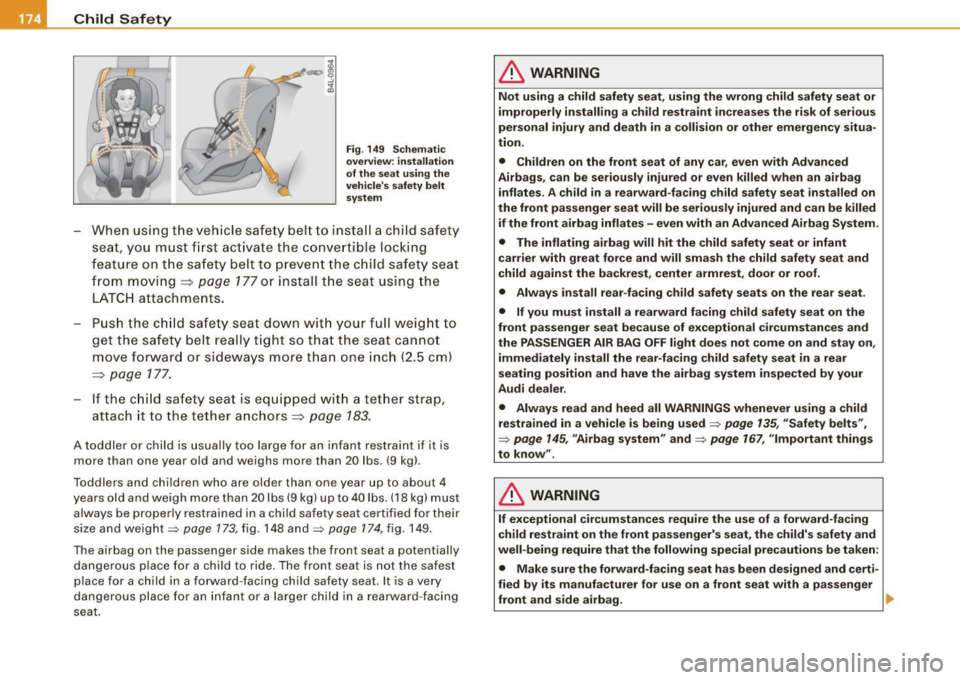
Fig. 149 Schematic
overview: installation
of the seat using the
vehicle's safety belt
system
- When using the vehicle safety belt to install a child safety
seat, you must first activate the convertible locking
feature on the safety belt to prevent the child safety seat
from moving ==>
page 177 or install the seat using the
LATCH attachments.
- Push the child safety seat down with your full weight to
get the safety belt really tight so that the seat cannot
move forward or sideways more than one inch (2.5 cm)
==> page 177.
If the child safety seat is equipped with a tether strap,
attach it to the tether anchors ==>
page 183.
A toddler or child is usually too large for an infant restraint if it is
more than one year old and weighs more than 20 lbs. (9 kg) .
Toddlers and children who are older than one year up to about 4
years old and weigh more than 20 lbs (9 kg) up to 40 lbs. (18 kg) must always be properly restrained in a child safety seat certified for their
size and weight=>
page 173, fig. 148 and => page 174 , fig. 149.
The airbag on the passenger side makes the front seat a potentially dangerous place for a child to ride. The front seat is not the safest
place for a child in a forward-facing child safety seat . It is a very
dangerous place for an infant or a larger child in a rearward -facing
seat.
& WARNING
Not using a child safety seat, using the wrong child safety seat or
improperly installing a child restraint increases the risk of serious
personal injury and death in a collision or other emergency situa
tion.
• Children on the front seat of any car, even with Advanced
Airbags, can be seriously injured or even killed when an airbag
inflates. A child in a rearward-facing child safety seat installed on
the front passenger seat will be seriously injured and can be killed
if the front airbag inflates -even with an Advanced Airbag System.
• The inflating airbag will hit the child safety seat or infant
carrier with great force and will smash the child safety seat and
child against the backrest, center armrest, door or roof.
• Always install rear-facing child safety seats on the rear seat.
• If you must install a rearward facing child safety seat on the
front passenger seat because of exceptional circumstances and
the PASSENGER AIR BAG OFF light does not come on and stay on, immediately install the rear-facing child safety seat in a rear
seating position and have the airbag system inspected by your
Audi dealer.
• Always read and heed all WARNINGS whenever using a child
restrained in a vehicle is being used=>
page 135, "Safety belts",
=> page 145, "Airbag system" and=> page 167, "Important things
to know".
& WARNING
If exceptional circumstances require the use of a forward-facing
child restraint on the front passenger's seat, the child's safety and
well-being require that the following special precautions be taken:
• Make sure the forward-facing seat has been designed and certi
fied by its manufacturer for use on a front seat with a passenger
front and side airbag. ...
Page 177 of 320
& WARNING !continued)
• Always follow the manufacturer's instructions provided with
the child safety seat or infant carrier.
• Always move the front passenger seat into the rearmost posi
tion of the passenger seat's fore and aft adjustment range, and as
far away from the airbag as possible before installing the child
restraint.
• Always make sure that nothing prevents the front passenger's
seat from being moved to the rearmost position in its fore and aft
adjustment range .
• Always make sure the backrest is in an upright position .
• Make sure that the PASSENGER AIR BAG OFF light comes on
and stays on all the time whenever the ignition is switched on.
• If the light does not stay on, perform the checks~
page 156,
uMonitoring the Advanced Airbag System ".
• Take the child restraint off the front passenger seat and install
it properly at one of the rear seat positions if the PASSENGER AIR
BAG OFF light does not stay on whenever the ignition is switched
on. •
Safety first
Child Safety
Booster seats and safety be lts
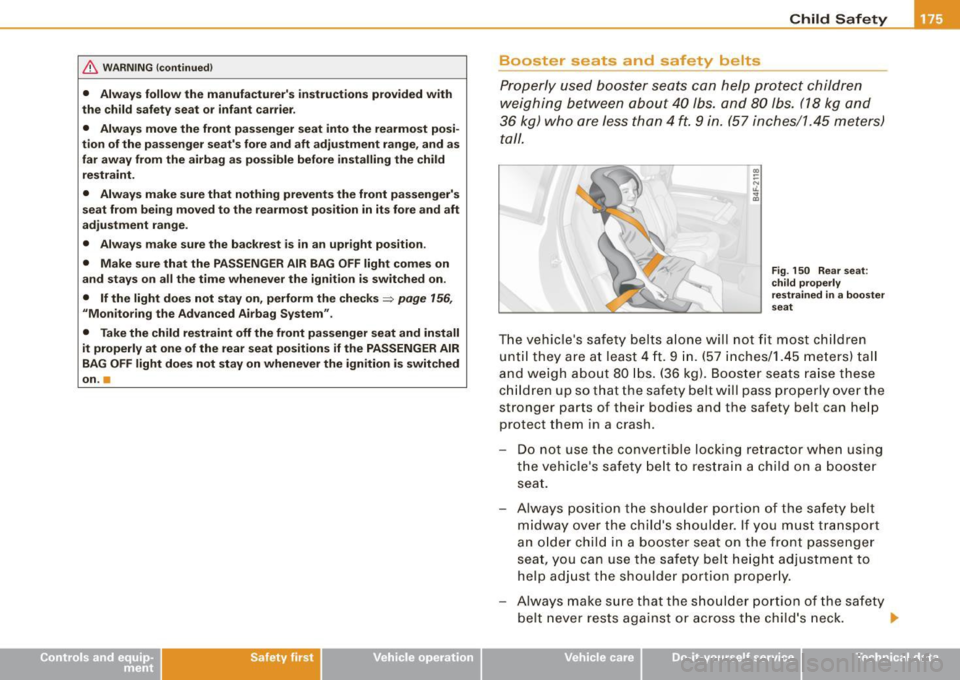
Properly used booster seats can help protect children
weighing between about 40 lbs. and 80 lbs. (18 kg and
36 kg) who are less than 4
ft. 9 in. (57 inches/1.45 meters)
tall.
Fig . 150 Rear seat:
child properly
restrained in a booster
seat
The vehicle's safety belts alone will not fit most children
until they are at least 4 ft. 9 in. (57 inches /1.45 meters) tall
and weigh about 80 lbs. (36 kg). Booster seats raise these
children up so that the safety belt will pass properly over the
stronger parts of their bodies and the safety belt can help
protect them in a crash.
- Do not use the convertible locking retractor when using
the vehicle's safety belt to restrain a child on a booster
seat.
- Always position the shoulder portion of the safety belt
midway over the child's shoulder. If you must transport
an older child in a booster seat on the front passenger
seat, you can use the safety belt height adjustment to
help adjust the shoulder portion properly.
- Always make sure that the shoulder portion of the safety
belt neve r rests against or across the child's neck.
9'>
Vehicle care I I irechnical data
Page 179 of 320
Child Safety -
--------------------''----
& WARNING (continued )
• If you must install a booster seat on the front passenger seat
because of exceptional c ircumstances the PASSENGER AIR BAG
OFF light must come on and stay on , whenever the ignition is
switched on.
• If the PASSENGER AIR BAG OFF light does not come on and stay
on , perform the checks described=>
page 156, "Monitoring the
Advanced A irbag System ".
• Take the ch ild restraint off the front passenger seat and install
it properly at one of the rear seat positions if the PASSENGER AIR
BAG OFF light does not stay on wheneve r the ignition is switched
on .
• Always read and heed all WARNINGS whenever using a child
restrained in a vehicle is being used=>
page 135, "Safety belts",
=> page 145, "Airbag system " and => page 167 , "Important things
to know ".•
Installing a child safety seat
Securing a child safety seat using a safety
belt
S a fety belt s for the rea r sea ts and the front passenger con
b e lo cked with t he conver tible lo ckin g retr actor to p rop
e rly sec ure c hild saf ety sea ts.
T he s afe ty bel ts e merge ncy lo cking re trac to rs fo r th e rea r sea ts
safety belts and for the front pass enger's seat safety belt have a
c o nve rtible loc king re tr ac tor fo r child r estrai nts. The sa fe ty b elt
must be loc ked so that be lt webbin g cannot unr eel. The re trac tor
c an be activa te d to lock the safety be lt and prevent the safet y belt
w ebbi ng fr om l oos en ing up dur in g n orm al dr ivi ng . A chi ld sa fety
seat can only be properly insta lled when t he safety be lt is locked so
th at th e child and chil d sa fet y seat will sta y in p lace .
Controls and equip ment Safety first Vehicle operation A
lways remember: Even though your vehic le is equipped with an
A dva nce d Airb ag sys tem, all chi ld re n, e sp ec ially those 12 yea rs a nd
youn ger, should a lways ride in the back seat prop erly restrained for
t hei r age a nd size .
& WARNING
Improperly installed child safety seats increase the risk of serious
personal injury and death in a collision .
• Always make sure that the safety belt retractor is locked when
installing a child safety seat . An unlocked safety belt retractor
cannot hold the child safety seat in place during normal driving or
in a crash .
• Always buckle the child safety seat firmly in place even if a
child is not sitting in it . A loose child safety seat can fly around
during a sudden stop or in a collision .
• Always make sure that the rear seat backrest to which the
center rear safety belt is attached is securely latched whenever
the rear center safety belt is being used to secure a child restraint.
• If the backrest is not securely latched , the child and the child
restraint will be thrown forward together with the backrest and
will strike parts of the vehicle interior. The child can be seriously injured or killed.
• Never install rear -facing child safety seats or infant carriers on
the front passenger seat . A child will be seriously injured and can
be killed when the passenger airbag inflates .
• The inflating airbag will hit the child safety seat or infant
carrier with great force and will smash the child safety seat and
child against the backrest , center armrest , door or roof .
• Always install rear-facing child safety seats or infant carriers on
the rear seat .
• Forward-facing child safety seats or infant carriers installed on
the front passenger's seat may interfere with the deployment of
the airbag and cause serious injury to the child . ..
Vehicle care Do-it-yourself service Technical data
Page 181 of 320

_______________________________________________ C_h _ i_ld _ S_ a_ f_ e_ t..,:c y __ __
& WARNING (continued)
• Make sure that the PASSENGER AIR BAG OFF light comes on
and stays on all the time whenever the ignition is switched on.
• If the PASSENGER AIR BAG OFF light does not come on and stay
on, immediately install the rear-facing child safety seat in a rear
seating position and have the airbag system inspected by your
Audi dealer. •
Activating the convertible locking retractor
Use the convertible locking retractor to secure a child
restraint.
Always heed the child safety seat manufacturer 's instruc
tions when installing a child restraint in your vehicle. To
activate the convertible locking retractor:
- Place the child restraint on a seat, preferably on the rear
seat.
- Slowly pull the belt
all the way out.
- Route it around or through the child restraint belt path
=>& .
- Push the child safety seat down with your full weight to
get the safety belt really tight .
- Insert the belt tongue into the buckle for that seating
position.
- Gu ide the safety belt back into the retractor until the belt
lies flat and snug on the child safety seat.
Controls and equip
ment Safety first Vehicle operation
- You should
hear a "clicking" noise as the belt winds back
into the inertia reel. Test the convertible locking retractor
by pul ling on the belt. You should no longer be able to
pull the belt out of the retractor. The convertible locking
retractor is now activated .
- Make sure that the red release button is facing away from
the child restraint so that it can be unbuckled quickly.
- Pull on the belt to make sure the safety belt is properly
tight and fastened so that the seat cannot move forward
or sideways more than one inch (2.5 cm).
& WARNING
Using the wrong child restraint or an improperly installed child
restraint can cause serious personal injury or death in a crash.
• Always make sure that the safety belt retractor is locked when
installing a child safety seat. An unlocked safety belt retractor
cannot hold the child safety seat in place during normal driving or
in a crash.
• Always buckle the child safety seat firmly in place even if a
child is not sitting in it. A loose child safety seat can fly around
during a sudden stop or in a crash.
• Always make sure the seat backrest to which the child restraint
is installed is in an upright position and securely latched into place
and cannot fold forward. Otherwise, the seat back with the child
safety seat attached to it could fly forward in the event of an acci
dent or other emergency situation.
• Always read and heed all WARNINGS whenever using a child
restrained in a vehicle is being used=>
page 167 . Special precau
tions apply when installing a child safety seat on the front
passenger seat=>
page 147, "Child restraints on the front seat -
some important things to know". •
Vehicle care Do-it-yourself service Technical data
Page 182 of 320

_,___C_ h_il _d _ S_a_ f_ e _ t...:y ________________________________________________ _
Deactivating the convertible locking retractor The convertible locking retractor for child restraints will
be deactivated aut omatically when the belt is wound all
the way back into the retractor.
- Press the red button on the safety belt buckle . T he belt
tongue w ill pop out of the buckle .
- Guide t he safety belt a ll the way back into its stowed
position .
Always let the safety belt retract completely into its stowed position.
The safe ty belt can now be used as an ordinary safety belt without
the conv ertible locking retractor for child restraints.
If the conver tible locking ret ract or should be activa ted inadvert
ently, the safety belt must be unfastened and guided completely bac k into its stowed position to deactivate this feature. If the
convertible locking retractor is not deactivated , the safety belt will
gradually become tighter and uncomfortable to wear .
& WARNING
Improperly installed child safety seats increase the risk of seriou s
per sonal injury and death in a colli sion .
• Never unfa sten the safety belt to de activate the convertible
lock ing retra ctor for ch ild re straint s while the veh icle i s moving .
You would not be restrained and could be seriously injured in an
acc ident .
• Alway s read and heed all WARNINGS whenever using a child
rest rained in a vehi cle i s being used
=:> page 1 67. S pe cial pre cau
tions apply when installing a child safety seat on the front
pa ssenger seat =:>
pag e 147 , "Child restraint s on the front seat -
some important thing s to know ".•
LATCH Lower anchorages and
tethers for children
Child Restraint System anchors and how are
they related to child safety
T o prov ide a simpler and more practicable way to attach the child
restra int on the vehicle seat, Federa l regulations require spec ia l
lower anchorages in vehicles and devices on new child restraints to
attach to the vehicle anchorages .
The combination of the tether anchorages and the lower anchor
ages is now generally called the
LATCH system for " Lowe r Anchor
ages and Tethers for Children ."
Forward -facing child restraints manufactured after September 1,
1999, are required by U .S . federa l regu lations to comply with new
chi ld head movement performance requirements . These new
performance requiremen ts make a te ther necessary on most new
chi ld seats .
I nstalling a child restraint that requires a top tether without one can
seriously impair the performance o f the child restra int and its abi lity
to protect the child in a collision . Installing a child restraint that
r equires a top tethe r w ithout the top tether may be a v iolat ion o f
state law .
Ch ild restra int manufactu rers offer LATCH lower a nchorages on
their child seats with hook -on or push -on connectors attached to
adjustable straps .
I n addition to the LATCH lower anchorages, these ch ild restraint
systems usually require the use of tether straps to he lp keep the
chi ld restraint firmly in place .
& WARNING
Improper installatio n of child restraint s will increase the risk of
injury and death in a crash .
Page 185 of 320
- Attach both hook-on connectors with the spring catch release on the child safety seat onto the LATCH lower
anchorage so that the connectors lock into place
~ fig. 154.
- Pull on the connector attachments to make sure they are properly attached to the LATCH lower anchorage.
- Pull straps tight following the child restraint manufac
turer's instruct ions.
Releasing
- Loosen the tension on the straps following the child
restraint manufacturer's instructions .
- Depress the spring catches to release the anchorage
hooks from the lower anchorages.
Remember: Use tether straps to help keep the child restraint firmly
in place .
& WARNING
Improper use of the LATCH system can increase the risk of serious
personal injury and death in an accident.
• These anchors were developed only for child safety seats using
the "LATCH" system.
• Never attach other child safety seats, belts or other objects to
these anchors.
• Always make sure that you hear a click when latching the seat
in place. If you do not hear a click the seat is not secure and could
fly forward and hit the interior of the vehicle, or be ejected from
the vehicle.
Safety first
Child Safety
& WARNING
Improper installation of child restraints will increase the risk of
injury in an accident.
• Always follow the child restraint system manufacturer's
instructions for proper installation of the child restraint system
and proper use of tether straps as well as the lower anchorages or
safety belts in your vehicle.
• Always read and heed the important information and WARN
INGS about child safety and the installation of child restraint
systems~
page 167, "Child Safety" .•
Tether anchors and tether straps
Fig . 155 Tether
anchors: attachment
hook locations behind
the rear seatbacks
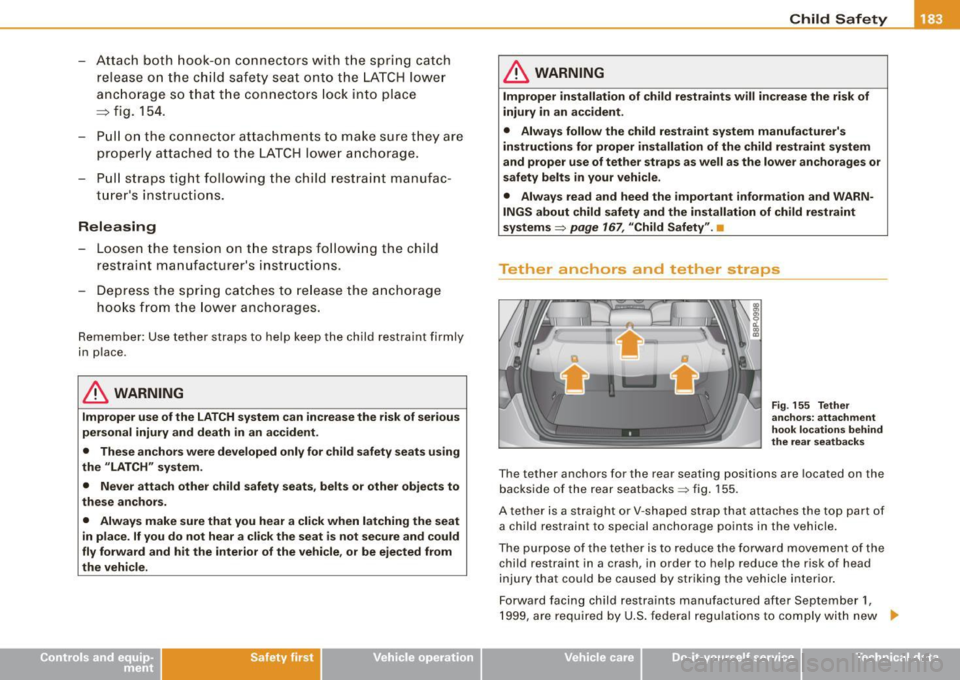
The tether anchors for the rear seating positions are located on the
backside of the rear seatbacks
~ fig. 155.
A tether is a straight or V-shaped strap that attaches the top part of
a child restraint to special anchorage points in the vehicle.
The purpose of the tether is to reduce the forward movement of the child res traint in a crash , in order to help reduce the risk of head
injury that could be caused by striking the vehicle interior.
Forward facing child restraints manufactured after September 1,
1999, are required by U.S. federal regulations to comply with new ..
Vehicle care I I irechnical data
Page 226 of 320
-~_C_ h_e _c _ k_ i_n ...:::g::;...._ a_n_ d_ f_ i_ll _in -'g:::;.._ ___________________________________________ _
Closing the engine hood
- Pull the hood down until the pressure from the strut is
reduced.
- Let the hood
drop down and latch in place. Do not try to
push it shut;
it may fail to engage~& .
& WARNING
A hood that is not completely latched could fly up and block your
view while driving.
• When you close the engine hood, check it to make sure the
safety catch has properly engaged. The hood should be flush with
the surrounding vehicle body parts.
• If you notice while driving that the hood is not secured prop
erly, stop at once and close it. •
Working in the engine compartment
Be especially careful whenever you work in the engine
compartment!
Whenever you must perform any work in the engine compartment,
for example checking and filling different fluids, there is a risk of injury, burns and accidents. To prevent personal injury always
observe the following WARNINGS. The engine compartment of any
vehicle is a hazardous area!
=> &
& WARNING
To help avoid injury, before you check anything under the hood :
• Turn off the engine.
• Remove the ignition key.
• Set the parking brake fully .
& WARNING (continued)
• Move selector lever of automatic transmission to "P" {Park);
put manual transmission in Neutral.
• Always let the engine cool down. Hot components will burn
skin on contact.
• To reduce the risk of being burned, never open the hood if you
see or hear steam or coolant escaping from the engine compart
ment. Wait until no steam or coolant can be seen or heard before
carefully opening the hood .
• Keep children away from the engine compartment.
• Never spill fluids on hot engine components. They can cause a
fire.
• Never touch the radiator fan. The auxiliary electric fan is
temperature controlled and can switch on suddenly.
• Never open the coolant reservoir cap when the engine is still
warm. The coolant system is pressurized and hot coolant could
spray out!
• Protect your face, hands and arm from steam or hot engine
coolant by placing a thick rag over the cap when you open the
coolant reservoir.
• If work on the fuel system or the electrical system is necessary:
- Always disconnect the battery .
- Never smoke or work near heaters or open flames. Fluids in
the engine compartment could start a fire.
- Keep an approved fire extinguisher immediately available.
• To avoid electrical shock and personal injury while the engine
is running or being started, never touch :
- Ignition cables
- Other components of the high voltage electronic ignition
system.
• If you must perform a check or repair with the engine running: .,_