wheel size AUDI S3 2010 Owners Manual
[x] Cancel search | Manufacturer: AUDI, Model Year: 2010, Model line: S3, Model: AUDI S3 2010Pages: 320, PDF Size: 75.34 MB
Page 74 of 320
Seats and storage
Seats and storage
General recommendations
Why is your seat adjustment so important?
The safety belts and the airbag system can only provide
maximum protection if the front seats are correctly
adjusted.
There are several different ways you can adjust the driver's seat and
the front passenger's seat so that it conforms to your body size. It is
especially important that the seat be adjusted properly so that:
• you can easily and quickly reach all the switches and controls in
the instrument panel
• your body is properly supported thus reducing physical stress
and fatigue
• the safety belts and airbag system can offer maximum protec
tion=>
page 145
In the following chapters, you will see exactly how you can best
adjust your seats.
There are special regulations and instructions for installing a child safety seat on the front passenger's seat. Always heed the informa
tion regarding child safety provided in=>
page 167, "Child Safety".
L1}. WARNING
Incorrect seating position of the driver and all other passengers
can result in serious personal injury.
• Always keep your feet on the floor when the vehicle is in motion
- never put your feet on top of the instrument panel, out of the
window or on top of the seat cushion! This applies especially to
the passengers. If your seating position is incorrect you increase
the risk of injury in the case of sudden braking or an accident. If
& WARNING (continued)
the airbag inflates and the seating position is incorrect this could
result in personal injury or even death.
• It is important for both the driver and front passenger to keep
a distance of at least 10 inches (25 cm) between themselves and
the steering wheel and/or instrument panel. If you're sitting any closer than this, the airbag system cannot protect you properly. In
addition to this, the front seats and head restraints must be
adjusted to your body height so that they can give you maximum
protection.
• Always try to keep as much distance as possible between your
self and the steering wheel or instrument panel.
• Do not adjust the driver's or front passenger's seat while the
vehicle is moving . Your seat may move unexpectedly, causing
sudden loss of vehicle control and personal injury. If you adjust
your seat while the vehicle is moving, you are out of position. •
Driver's seat
The correct seat position is important for safe and relaxed
driving.
We recommend that you adjust the driver's seat in the
following manner:
- Adjust the seat in fore and aft direction so that you can easily push the pedals to the floor while keeping your
knees slightly bent=>
& in "Why is your seat adjustment
so important?".
- Adjust the seatback so that when you sit with your back
against the seatback, you can still grasp the top of the
steering wheel.
~
Page 152 of 320

___ A_ ir_ b_ a-g _ s_y _s_ t_ e_ m _________________________________________________ _
& WARN ING (continued )
• Airbag work most effectively when used with properly worn
safety belt s.
• Therefore , always wear your safety belts and make sure that
everybody in your vehicle is properly restra ined .
& WARNING
A person on the front passenger seat , espe cially infants and small
c hildren, will receive serious injuries and can even be killed by
being too close to the airbag when it inflates .
• Although the Advanced Airbag System in your vehicle is
designed to turn off the front passenger airbag if an infant or a
small child is on the front passenger seat , nobody can absolutely
guarantee that deployment unde r these spe cial conditions is
impossible in all conce ivable situations that may happen during
the useful life of your vehicle.
• The Advanced Airbag System can deploy in accordance with
the "low risk" option under the U .S . Federal Standa rd if a child that
is heavier than the typical one -year old child is on the front
pas senger seat and the other cond itions for airbag deployment
are met.
• Accident statistics have shown that children are generally safer
in the rear seat area than in the front seating position .
• For their own safety , all children , espec ially 12 years and
younger, should always ride in the back properly restrained for
their age and size . •
Advanced front airbag system
Your vehicle is equipped with a front Advanced Airbag System in
c ompl ia n ce wi th Un it ed Sta tes Federa l Motor Vehicle Safet y Sta n
dard 208 as appl icab le at the time your vehicle was manufactured. T
he front Advanced Airbag System supplements the safety belts to
p rovide addit ional protecti on for the d river's a nd fro nt passenger's
heads and upper bodies in fronta l crashes . The ai rbags inflate only
in fron tal impac ts w hen the vehic le dece le ra tion is high en ough .
Th e fro nt Advanced A irbag System for t he fro nt seat occupa nts is
not a substitute for your safety belts . Rather, it is pa rt of the overall
occu pan t restra int system in your v ehicle. A lways remembe r that
the airbag system can only help to protect you, if you are sitting
uprigh t, weari ng you r sa fe ty bel t an d wea ring it proper ly . T hi s is w hy
you and your passengers must always be proper ly restrained, not
jus t beca use t he law requi res y ou t o be .
T he Advanced A irbag Syste m in your ve hicle has been cert ified to
meet the " lo w risk" requ irements fo r 3 an d 6 year -o ld chi ldren on the
passen ger side and ve ry small a dults on t he dr iver s ide. The low r isk
deployment criteria are intended to he lp reduce the risk of injury
th ro ugh in te ract io n with the front a irbag t hat ca n occur, fo r
example, by being too close to the steering wheel and instrument
p anel whe n the a irbag inflates.
I n addition, the syst em has been cert ified to comply with the
"su ppression" req uirem en ts of the Safe ty Standa rd, to turn off th e
fron t airbag for in fants 1 2 months o ld a nd youn ger who are
restrained on the front passenger seat in child restraints that are
li s ted in th e Stan dard=>
page 169 .
"Suppress ion" requires the front airbag on the passenger side to be
t urne d off if:
• a child up to about one year of a ge is restra in ed on the front
passenger seat in one of the rear -facing or forward -facing infant
re stra ints l is ted in Fed era l Motor V ehicle Safety Standard 208 w ith
whic h the Advanced Airbag System in your vehic le was ce rtified. For
a lis ting o f the child res traint s th at we re us ed to cer tify y our
vehic le 's compliance with the US Safety Standard =>
page 169,
• weight less t han a thr esho ld leve l sto red in th e contro l un it is
detected on the front passenger seat.
When a pers on is dete ct ed on th e fro nt pas senge r seat, weighi ng
more than the total weight of a ch ild that is about 1 year old ._
Page 170 of 320

-Child Safety -------=---------------------------------------
& WAR NIN G (co ntinued )
• Alw ays in sta ll re ar-facin g child safety s eats on the r ear seat .
• If you m us t in sta ll a rear ward f acing child saf ety s eat on th e
fr ont pa ssenger seat in exceptional circum stan ces and the
PA SSEN GER AIR BAG OFF light do es not come on and sta y on ,
immediately in sta ll the re ar-facing child safety s eat in a rear
s eating po sit ion and ha ve th e airb ag s ystem insp ected immedi
atel y by your autho riz ed Audi dealer .
& WARNING
If, in exceptional circum stance s, you mu st in sta ll a forward -f a cing
c hild re str ain t on th e fr ont p assenger's s eat:
• Always mak e sure the forward -fac ing seat ha s been de signed
a nd ce rt ified by it s m anufa cturer for u se on a fr ont se at w ith a
pa ssenger front and side airbag.
• Always follow the m anufacturer's instru ctions provided w ith
the child safety seat or carr ier.
• Alwa ys mo ve the pa ssenger seat into it s rea rmost positi on in
the seat' s fore and aft adju stment range , as far aw ay from the
ai rbag as possib le bef ore installing the ch ild r estr aint . The ba ck
re st mu st b e adjusted to an upright po sition.
• Alway s m ake sure that the PASSENGER AIR BAG OFF l ight
c om es on and sta y s on all the time whenever the ignition is
s w it c hed on . •
Advanced front airbag system and children
Your vehicle is equipped with an "Advanced Airbag System" in
complia nce with United States Federa l Motor Vehicle Safety Stan
dard (FMVSS) 208 as applicable at the time your vehicle was manu
factu red. T
he Advanced Airbag system in your vehicle has been certified to
meet the " low -risk" requiremen ts for 3 -and 6 -year o ld children on
the passenger side and smal l adults on the driver side . The low risk
deployment criteria are intended to reduce the risk of injury through
interaction with the airbag that can occur, for example, by being too
close to the steering wheel and instrument panel when the airbag
inflates. In addition, the system has been certified to comply with
the "suppression" requirements of the Safety Standard, to turn off
the front airbag for infants up to 12 months who are restrained on
the front passenger seat in child restraints that are listed in the
S tandard.
Even though your vehicle is equipped with an Advanced Airbag
system, all ch ildren, especially those 12 years and younger, should
always ride in the back seat properly restrained for their age and
size . The airbag on the passenger side makes the front seat a poten
tially dangerous p lace for a child to ride. The front seat is not the
safest p lace for a child in a forward -facing child safety seat. It can be
a very dangerous p lace for an infant or a larger ch ild in a rearward
facing seat. •
Advanced Airbags and the weight-sensing
mat in the front seat
The Advanced Airbag System in your vehicle detects the presence
of an infant or child in a chi ld restraint on the front passenger seat
using the weight -sensing mat in the seat cushion and the sensor
below the safety belt latch on the front passenger seat that
measures the tension on the safety belt.
The weight -sensing mat measures total weight of the chi ld and the
child safety seat and a child blanket on the front passenger seat . The
weight on the front passenger seat is related to the design of the
child restraint and its "footprint", the size and shape of the bottom
of the child restraint as it sits on the seat . The weight of a child
restraint and its "footprint" vary for different kinds of child ..,.
Page 196 of 320

__ _:_:ln..:..t::.: e::.: l~ li :.;:g t:e::..: n..:.. t:...::. te::::..:: c~h :.:.n .:..: o:::.: l:.: o :.;g~ yL- ________________________________________ _
speed. This is most noticeable when turning the steering wheel at
low speeds (for example when parking), -more effort will be
required than usual.
• Be aware of the different than usual steering response and
adjust your steering force accordingly.
• Have the problem checked and set right by an authorized Audi
dealer as soon as possible.
• If a steering malfunction occurs, this is signaled with the or.
@ indicator lights and a warning tone, see.
[ i) Tips
• If the power steering system should fail, or if the engine is not
running (for example, while being towed), you will still be able to
steer the vehicle. However, more effort will be required to do so.
• If the power steering system is not functioning properly, contact
your authorized Audi dealer immediately.
Applies to vehicles: with All Wheel Drive
Driving with your quattro®
With All Wheel Drive, all four wheels are driven.
General information
With All Wheel Drive, power is distributed to all four wheels. This
happens automatically depending on your driving style and the
road conditions at the time. See also::::,
page 189, "Electronic differ
ential lock (EDU".
Winter tires
When driving in the winter, your vehicle with All Wheel Drive has an
advantage, even with regular tires. In winter road conditions it may
be advisable to mount winter tires (or all -season tires) for improved
driveability and braking: these tires must be mounted on
all four
wheels.
See also ::::, page 259, "Winter ti res".
Snow chains
Where snow chains are mandatory on certain roads, this normally
also applies to vehicles with all-wheel drive:::::,
page 260, "Snow
chains".
Replacing wheels/tires
Vehicles with All Wheel Drive must always have tires of the same
size. Also avoid tires with different tread depths. For details see
page ::::,
page 254, "New tires and replacing tires and wheels".
Off-Road driving?
Your Audi does not have enough ground clearance to be used as an
off-road vehicle. It is therefore best to avoid rough tracks and
uneven terrain as much as possible. Also refer to::::,
page 198.
& WARNING
Always adjust your driving to road and traffic conditions. Do not
let the extra safety afforded by the all-wheel drive tempt you into
taking extra risks.
• Although the quattro ®all-wheel drive is very effective, always
remember that braking capacity is limited by tire traction. You
should therefore not drive at excessive speeds on icy or slippery
road surfaces.
• On wet road surfaces, be careful not to drive too fast because
the front wheels could begin to slide on top of the water (hydro planing). If this should occur, you will have no warning from a
sudden increase in engine speed as with a front-wheel drive
vehicle. Always drive at speeds which are adjusted to the road
conditions -risk of crash!
n
Page 245 of 320

__________________________________________________ T_ ir_e_ s_ a_ n_d _ w_ h_ e_ e_l_s __ __
•
& WARNING (continu ed )
crashes and serious personal in jur ies . Have worn or da maged t ires
replaced immediately .
• Tires age even if they are not being u sed and can fail suddenly ,
especially at high speeds. T ires that are more than 6 years old can
only be used in an emergency and then w ith special care and at
low speed.
Glossary of tire and loading terminology
Accessory weight
means the co mbined we ig ht ( in excess o f those sta nda rd items
which may be rep laced) of automatic transmission, power steering,
power brakes, power w indows, powe r seats, rad io, a nd heater, to
the extent that these items are avai lab le as factory-installed equip
m ent (w hether insta lled or not).
Aspect ratio
means t he ratio o f th e height to t he w idt h of the tire in perce nt.
N umbers of 55 or lower indicate a low sidewa ll for improved
steer ing respo nse and b ette r overall ha ndl ing on dry pave ment.
Bead
means the part of the tire that is made of stee l wires, wrapped or
reinforced by ply cords and that is shaped to fit the rim.
Bead separation
means a breakdow n of the bond be tween co mponents i n the bead.
Cord
means the strands fo rmi ng the plies in the ti re.
& W ARNING (continued )
• Never mount used tires on your vehicle if you are not sure of
their "previous history. " Old used t ire s may ha ve been damaged
even though the damage cannot be seen that can lead to sudden
tire failure and lo ss of vehicle control.
• If you noti ce unusual vibration or if the vehicle pulls to one side
when driving , always stop as soon as it is safe to do so and check
the wheels and tires for damage . •
Cold tire inflation pressure
mea ns t he ti re pressure reco mm ended by the ve hicle ma nufacturer
for a tire of a designated size that has not been d riven for more tha n
a cou ple o f miles (k ilometers) at low speeds in t he t hre e ho ur per iod
before the tire pressure is measured or ad justed .
Curb weight
means the weight of a moto r vehic le with standard equipment
i nc lud ing the max imu m capac ity o f fue l, o il, and coola nt, a ir c ond i
tioning and additiona l weight of optional equipment.
Extra load tire
means a tire designed to ope rate at higher loads and at higher infla
tion pressures than the corresponding standard tire. Extra load tires
my be identified as "XL",
"xi", "EX TRA LOA D", or "RF" on the side
wa ll.
Gross Axle Weight Rating ("GAWR ")
means the load -carrying capacity of a sing le ax le system, measured
at the ti re -ground interfaces.
Gross Vehicle Weight Rating ("GVWR "l
means the ma ximum tot al l oade d weigh t of the vehicle.
Vehicle care I t •
Page 246 of 320

-~_T_ ir_e_ s_ a_ n_d _ w_ h_ e_e _l_s _________________________________________________ _
Groove
means the space between two adjacent tread ribs.
Load rating (code)
means the maximum load that a tire is rated to carry for a given
inflation pressure . You may not find this information on all tires
because it is not required by law.
Maximum load rating
means the load rating for a tire at the maximum permissible infla
tion pressure for that tire.
Maximum loaded vehicle weight
means the sum of:
(a) Curb weight
(b) Accessory weight
(c) Vehicle capacity weight, and
(d) Production options weight
Maximum (permissible) inflation pressure
means the maximum cold inflation pressure to which a tire may be
in flated. Also called "maximum inflation pressure ."
Normal occupant weight
means 150 lbs. (68 kilograms) times the number of occupants
seated in the vehicle up to the total seating capacity of your vehicle.
Occupant distribution
means distribution of occupants in a vehicle .
Outer diameter
means the overall diameter of an inflated new tire.
Overall width
means the linear distance between the exteriors of the sidewalls of
an inflated tire, including elevations due to labeling, decorations, or
protective bands or ribs .
Ply
means a layer of rubber -coated parallel cords.
Production options weight
means the combined weight of those installed regular production
options weighing over 5 lbs. (2.3 kg) in excess of those standard
items which they replace, not previously considered in curb weight
or accessory weight, including heavy duty brakes, ride levelers, roof rack, heavy duty battery, and special trim.
Radial ply tire
means a pneumatic tire in which the ply cords that extend to the
beads are laid at substantially 90 degrees to the centerline of the
tread.
Recommended inflation pressure
see =:> page 243, "Cold tire inflation pressure".
Reinforced tire
means a tire designed to operate at higher loads and at higher infla
tion pressures than the corresponding standard tire. Reinforced
tires my be identified as "XL", "xi", "EXTRA LOAD", or "RF" on the
sidewall.
Rim
means a metal support for a tire or a tire and tube assembly upon
which the tire beads are seated .
Rim diameter
means nominal diameter of the bead seat. If you change your wheel
size, you will have to purchase new tires to match the new rim diam
eter.
Rim size designation
means rim diameter and width.
Rim width
means nominal distance between rim flanges .
Page 249 of 320

________________________________________________ T_ i _r_e _s_ a_n_ d_ w_ h_ e_e _ l_s __ !II
•
vehicle at its maximum capacity weight and tires that were on your
vehicle at the time it was manufactured .
If yo u w is h to impr ove co mfort w hen op erati ng th e vehicle at
n or mal load (u p to 3 occup ants), y ou ca n adj us t t ire pr essures to
tho se spe cified for normal vehicle load. Before oper ating the vehicle
a t m aximum lo ad , you mu st in cre as e t he t ire pre ssure s to t hose
s pecified for ma ximum vehi cle load =>
&.
Bear in mind that the tire pressure monitoring system * can only
monitor the tire pressu res you have stored. The syste m does not
recognize the load condition of your vehicle .
The effectiveness of the tire pressure monitoring system * will be
impaired if you store normal load pressures but then operate the
vehicle at its maximum load=>& . See the
illustration=>
page 246, fig. 173 for the location of the label
either o n driver's side 8 -p illar or inside the fue l filler flap (color of
the actual label and exact location on the vehicle will vary slight ly).
Note that the following tab le is accurate at the time of going to
press and is subject to change . In the event of discrepancies, the t ire
pressure label (on USA vehicles, the tire pressure label is located on
driver's side 8-pillar; on Canada vehic les, the tire pressure label is
located either on the driver's side 8-pi llar or inside the fuel filler
flap.) always takes precedence .
The table below lists the recommended cold tire inflation pressures
for the Audi mode l covered by your Owner's Literature at the
vehic le's capacity weight and the tire sizes installed on the respec
tive models as original equipment, or as a factory option.
Engin e
(displ ace
ment in
liter )
Tire d es ig nation Tir e pr essur e front Tir e pr essur e rear
4-cylinde r
2 .0 TF SI (ga s
o line) 2
05 /55 R16 91H All Se aso n
225 /45 R17 91W High Performanc e
22 5/45 R1 7 94H XL All Season
2 2 5/45 R17 94V XL High Performan ce
2 25 /40 R18 92V XL High Performance
Comp act spare wheel T12 5/70 R18
norm al lo ad
condit ion (up to
3 o ccup ants )
36 250
35 240
38 260
35 240
38 260
60 420 full lo
ad
condition
PSI kPA
39 270
38 260 39 270
36 250
41 280
60 420
Vehicle care
norm
al lo a d
full load
condition (up
condition
to 3 o ccup ants )
kPA kPA
30 210
38 260
30 2 10 36 250
32 220 38 260
30 2
10
35 240
35 240 41 280
60 420
60 420
I t •
Page 250 of 320
-~_T_ ir_e_ s_ a_ n_d _ w_ h_ e_e _l_s _________________________________________________ _
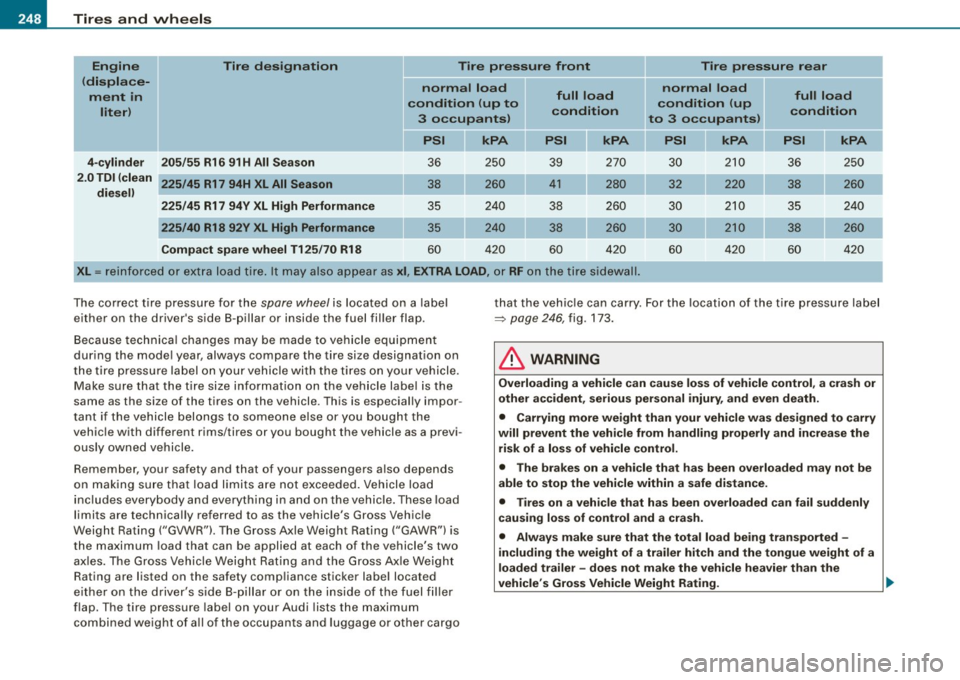
Engine Tire designation Tire pressur e front Tire pressure rear
(displace- normal load normal load
ment in full load
full load
liter) condition (up to
condition c
ondition (up
condition
3 o ccupants ) to 3 occupants)
PSI kPA PSI kPA kPA kPA
4-cylinder 205 /55 R16 91H All Season 36 250
39 270 3
0 210
36 250
2
.0 TDI (clean 225 /45 R17 94H XL All Season 38 260 41
280 32 220 38 260 diesel)
225/45 R17 94Y XL High Performance
35 240 38 260 30 2 10 3 5 24 0
225 /40 R18 92Y XL High Performan ce 35 240
38 260 30 210 38 260
Compact spare wheel T125
/70 R18 60 420
60 420
60 420
60 420
XL
= reinfo rced or ext ra load t ire . It may als o appea r as xi , EXTRA LOAD , or RF on the tire s idewall.
The correct t ire pressure for the
spare wheel is located on a label
either on the driver's side B-pillar or inside the fue l filler flap.
Because technica l changes may be made to vehicle equipment
during the mode l year, always compare the tire size designat ion on
the tire pressure la bel on y our vehicle with the tires on your vehicle.
Make sure tha t the t ire size information on the veh icle labe l is the
same as the size of the tires on the vehicle. This is especially impor
t ant if the vehicle belongs to someone e lse or you boug ht the
vehic le with different rims/tires or you bought the vehicle as a previ
ously owned vehicle.
Remember, your safety and that of your passengers a lso depends
on making su re tha t load limits a re not exceeded . Vehicle load
inc ludes everybody and everything in and on the vehicle. These load
limits are technically referred to as the vehicle's Gross Vehicle
Weight Rating ("GVWR"). The Gross Axle Weight Rating ("GAWR") is
the maximum load that can be applied at each of the vehicle's two
ax les. The Gross Vehicle We ight Rat ing and the Gross Ax le Weight
Rating are listed on the safety comp liance sticker labe l located
e it he r on the d river's side B-pillar o r on the i nside of the fuel f iller
flap. The tire pressure label on your Audi lists the maximum
combined we igh t of all o f th e occupa nts and luggage o r other cargo t
hat the vehic le can carry. For the location o f the tire pressure labe l
=> page 246, fig. 173.
& WARNING
Overloading a vehi cle can cause los s of vehicle control , a crash or
other accident, serious per sonal injury, and even death .
• Carrying more weight th an your vehicle was de signed to carry
will prevent the vehicle from handling properly and increase the
risk of a loss of vehicle control.
• The brakes on a vehicle that has been overloaded may not be
able to stop the vehicle within a safe distance .
• Tires on a vehicle that has been overloaded c an fail suddenly
cau sing loss of control and a crash .
• Alway s make sur e that the total load being tran sported -
including the weight of a trailer hitch and the tongue weight of a
loaded trailer -does not make the vehicle heavier than the
vehicle 's Gross Vehicle Weight Rating . _.,
Page 256 of 320
___ T_ i_ r_e _s_ a_ n_ d_ w_ h_ e_ e _ ls _________________________________________________ _
Incorrect wheel alignment
Incorrect wheel alignment can cause excess ive tire wea r, im pairing
the safety of the vehic le. If tires show excessive wear, have the
whee l alignment c hecked by an au th o rize d Audi deale r or qualifie d
wo rkshop.
All Wheel Drive
Vehicles with quattro® must always have tires of the same size, c ons truc tion and tread type. F or details see ~ page
19 4.
& WARNING
Sudden tire failure can lead to los s of control, a crash and serious
personal injury !
• Never drive a vehicle when the tread on any tire is worn down
to the wear indicators .
• Worn tires are a safety hazard, they do not grip well on wet
roads and increase your risk of "hydroplaning " and loss of control .
• Always keep chemicals that can cause tire dam age , such as
grease, oil , gasoline and brake fluid aw ay from tires .
• Tires age even if they are not being used and can fail suddenly ,
especially at high speeds. Tires that are more than 6 years old can
only be used in an emergency and then with special care and at
lower speeds .
• Never mount used tires on your vehicle if you are not sure of
their "previous history." Old used tires may have been damaged
even though the damage cannot be seen that can lead to sudden
tire failure and los s of veh icle control. •
New tires and replacing tires and wheels
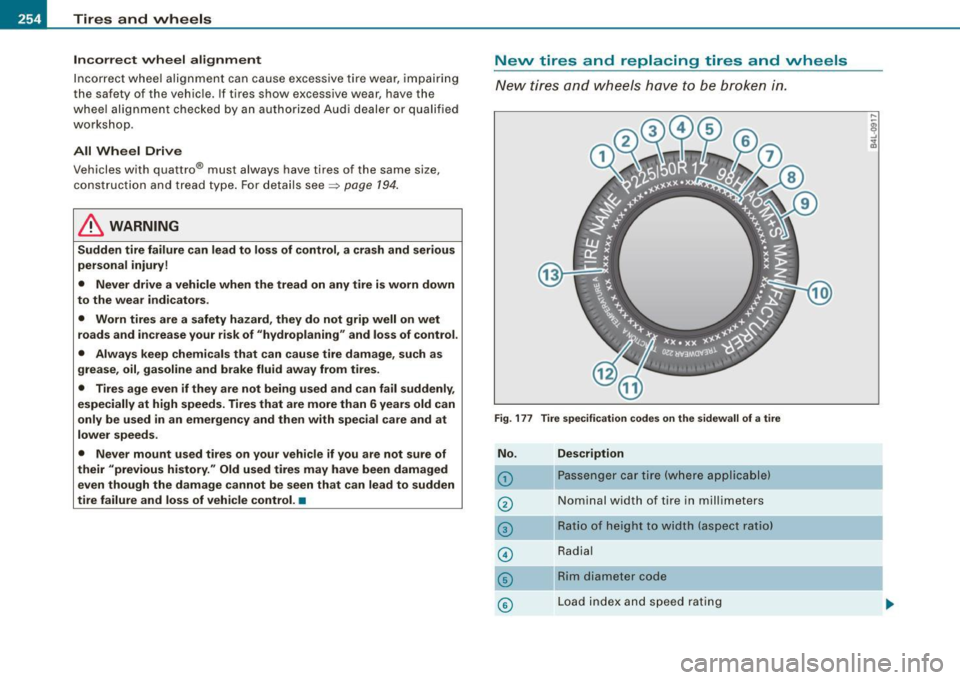
New t ires and wheels h ave t o be broke n in.
Fig . 177 T ir e specif ication cod es on the sidewall of a tir e
No.
©
0
©
©
©
©
Description
Passenger car tire (where applicable)
Nominal width of tire in millimeters
Ratio of height to width (aspect ratio)
Radial
Rim diameter code
L o ad in dex and s peed ra ting
Page 259 of 320
________________________________________________ T_ i _r_e _s_ a_n_ d_ w_ h_ e_e _ l_s __ !II
•
to ring s yst em * would not b e ab le to moni tor the tire pr essur e or
war n yo u if i t is nec essa ry.
• T he battery ins ide of the tire pressure s ensor has a l imited
service life.
• Always driv e with the va lv e stem caps s ecure ly m ounted. We
r e co mm end usi ng fact ory insta lled valve stem cap s. Ask y our a utho
rized Audi d ealer to replac e lost valve stem caps .
T he installat ion of replacement tires with steel cord body plies in
t he ti re s id ew all m ay ca use ma lfun ction o f th e tire press ure m oni
toring system *, and is not recommended (co rd mater ial information
i n mo lded on t he tire sid ewa ll).
Always check your t ire pressure mo nitoring system* indicator after
r eplaci ng o ne or more tir es o n you r veh ic le . If t he ti re p ressu re
mo nito ring syste m* in dicato r flashes o r is ill um in ated, your s ystem
is not working p rope rly . Yo ur replacement t ire might be inco mpat
i b le with you r tir e p ressure mon itori ng sys te m *, or so me comp o
nent of the tire pressure monitoring system * may be damaged .
& WARNING
• Using incorrect or unmatched tires and / or wheels or improper
tire and wheel combinations can lead to loss of control , collision
and serious personal injury .
• Always use tires , rims and wheel bolts that meet the specifica
tions of original factory-installed tires or other combinations that
have been specifically approved by the vehicle manufacturer .
• Tires age even if they are not being used and can fail suddenly,
espe cially at high speeds . Tires that are more than 6 years old can
only be used in an emergency and then with special care and at
lower speeds.
• Never mount used tires on your vehicle if you are not sure of
their "previous history. " Old used tires may have been damaged
even though the damage cannot be seen that can lead to sudden
tire failure and loss of vehicle control.
& WARNING (continued )
• All four wheels must be fitted with radial tires of the same type,
size {rolling circumference ) and the same tread pattern. Driving
with different tires reduces vehicle handling and can lead to a loss
of control.
• If the spare tire is not the same as the tires that are mounted
on the vehicle -for example with winter tires -only use the spare
tire for a short period of time and drive with extra care . Refit the
normal road wheel as soon as safely possible.
• Never drive faster than the maximum speed for which the tires
on your vehicle are rated because tires that are driven faster than
their rated speed can fail suddenly .
• Overloading tires cause heat build-up , sudden tire failure ,
including a blowout and sudden deflation and loss of control.
• Temperature grades apply to tires that are properly inflated and
not over or underinflated.
• For technical reasons it is not always possible to use wheels
from other vehicles -in some cases not even wheels from the
same vehicle model.
• If you install wheel trim discs on the vehicle wheels , make sure
that the air flow to the brakes is not blocked . Reduced airflow to
the brakes can them to overheat , increasing stopping distances
and causing a collision .
• Run flat tires may only be used on vehicles that were equipped
with them at the factory . The vehicle must have a chassis designed
for run flat tires and a factory-installed tire pressure monitoring
system* that indicates a loss of tire pressure . Incorrect use of run
flat tires can lead to vehicle damage or accidents . Check with an
authorized Audi dealer or tire specialist to see if your vehicle can
be equipped with run flat tires . If run flat tires are used , they must
be installed on all four wheels . Mi xing tire types is not permitted. _,.
Vehicle care
I t •