light AUDI S3 2011 Owners Manual
[x] Cancel search | Manufacturer: AUDI, Model Year: 2011, Model line: S3, Model: AUDI S3 2011Pages: 320, PDF Size: 75.79 MB
Page 180 of 320
• .___C_ h_ il_d _ S_a _ f_ e _ t--= y '------------------------------------------------
& WARNING (cont inued)
• If the backrest is not securely latched, the child and the child
restraint will be thrown forward together with the backrest and
will strike parts of the vehicle interior. The child can be seriously
injured or killed.
• Never install rear-facing child safety seats or infant carriers on
the front passenger seat. A child will be seriously injured and can be killed when the passenger airbag inflates.
• The inflating airbag will hit the child safety seat or infant
carrier with great force and will smash the child safety seat and
child against the backrest, center armrest, door or roof .
• Always install rear-facing child safety seats or infant carriers
on the rear seat.
• Forward-facing child safety seats or infant carriers installed on
the front passenger's seat may interfere with the deployment of
the airbag and cause serious injury to the child.
• It is safer to install a forward -facing child safety seat on the
rear seat.
• Always read and heed all WARNINGS whenever using a child
restrained in a vehicle is being used~
page 167. Special precau
tions apply when installing a child safety seat on the front
passenger seat~
page 147, "Child restraints on the front seat -
some important things to know".
L1}. WARNING
Always take special precautions if you must install a forward or
rearward -facing child restraint on the front passenger's seat in
exceptional situations:
• Whenever a forward or rearward-facing child restraint is
installed on the front passenger seat, the PASSENGER AIR BAG
OFF light must come on and stay on whenever the ignition is
switched on.
& WARNING (co ntinued )
• If the PASSENGER AIR BAG OFF light does not come on and
stay on, perform the checks described
~ page 156, "Monitoring
the Advanced Airbag System".
• Take the child restraint off the front passenger seat and install
it properly at one of the rear seat positions if the PASSENGER AIR
BAG OFF light does not stay on whenever the ignition is switched
on.
• Improper installation of child restraints can reduce their effec
tiveness or even prevent them from providing any protection.
• An improperly installed child restraint can interfere with the
airbag as it deploys and seriously injure or even kill the child.
• Always carefully follow the manufacturer's instructions
provided with the child safety seat or carrier.
• Never place additional items on the seat that can increase the
total weight registered by the weight-sensing mat and can cause injury in a crash.
L1}. WARNING
Forward-facing child restraints:
• Always make sure the forward-facing seat has been designed
and certified by its manufacturer for use on a front seat with a
passenger front and side airbag .
• Never put the forward-facing child restraint up, against or very
near the instrument panel.
• Always move the passenger seat into its rearmost position in
the seat's fore and aft adjustment range, as far away from the airbag as possible before installing the forward-facing child
restraint . The backrest must be adjusted to an upright position.
• Make sure that the PASSENGER AIR BAG OFF light comes on
and stays on all the time whenever the ignition is switched on . _.
Page 181 of 320

___________________________________________ C_ h_il _d _ S_a _f _e _t =c,. y __ _
& WARNING
Rearward-facing child restraints:
• A child in a rearward-facing child safety seat installed on the
front passenger seat will be seriously injured and can be killed if
the front airbag inflates -even with an Advanced Airbag System.
• The inflating airbag will hit the child safety seat or infant
carrier with great force and will smash the child safety seat and
child against the backrest, center armrest, door or roof.
• Always be especially careful if you must install a rearward
facing child safety seat on the front passenger seat in exceptional
circumstances.
• A tight tether strap on a rearward-facing child restraint
attached to the front passenger seat can put too much pressure on
the weight-mat in the seat and register a heavier weight in the
Advanced Airbag System. The heavier weight registered can make
the system work as though an adult were on the seat and deploy
the Advanced Airbag when it must be suppressed causing serious
or even fatal injury to the child.
• Make sure that the PASSENGER AIR BAG OFF light comes on
and stays on all the time whenever the ignition is switched on.
• If the PASSENGER AIR BAG OFF light does not come on and
stay on, immediately install the rear-facing child safety seat in a
rear seating position and have the airbag system inspected by
your Audi dealer. •
Activating the convertible Locking retractor
Use the convertible locking retractor to secure a child
restraint.
Always heed the child safety seat manufacturer's instruc
tions when installing a child restraint in your vehicle. To acti
vate the convertible locking retractor:
Controls and equip
ment Safety first Vehicle operation
-
Place the child restraint on a seat, preferably on the rear
seat.
- Slowly pull the belt
all the way out.
- Route it around or through the child restraint belt path
=>& .
- Push the child safety seat down with your full weight to
get the safety belt really tight.
- Insert the belt tongue into the buckle for that seating
position.
- Guide the safety belt back into the retractor until the belt
lies flat and snug on the child safety seat.
- You should hear a "clicking" noise as the belt winds back
i nto the inertia reel. Test the convertible locking retractor
by pulling on the belt. You should no longer be able to pull
the belt out of the retractor. The convertible locking
retractor is now activated.
- Make sure that the red release button is facing away from
the child restraint so that it can be unbuckled quickly.
- Pull on the belt to make sure the safety belt is properly
tight and fastened so that the seat cannot
move forward
or sideways more than one inch (2.S cm).
& WARNING
Using the wrong child restraint or an improperly installed child
restraint can cause serious personal injury or death in a crash.
• Always make sure that the safety belt retractor is locked when
installing a child safety seat. An unlocked safety belt retractor
cannot hold the child safety seat in place during normal driving or
in a crash. ._
Vehicle care Do-it-yourself service Technical data
Page 186 of 320
___ C_h _i_ld _ S_ a_ f_ e_ t_,, y'-----------------------------------------------
Tether anchors and tether straps
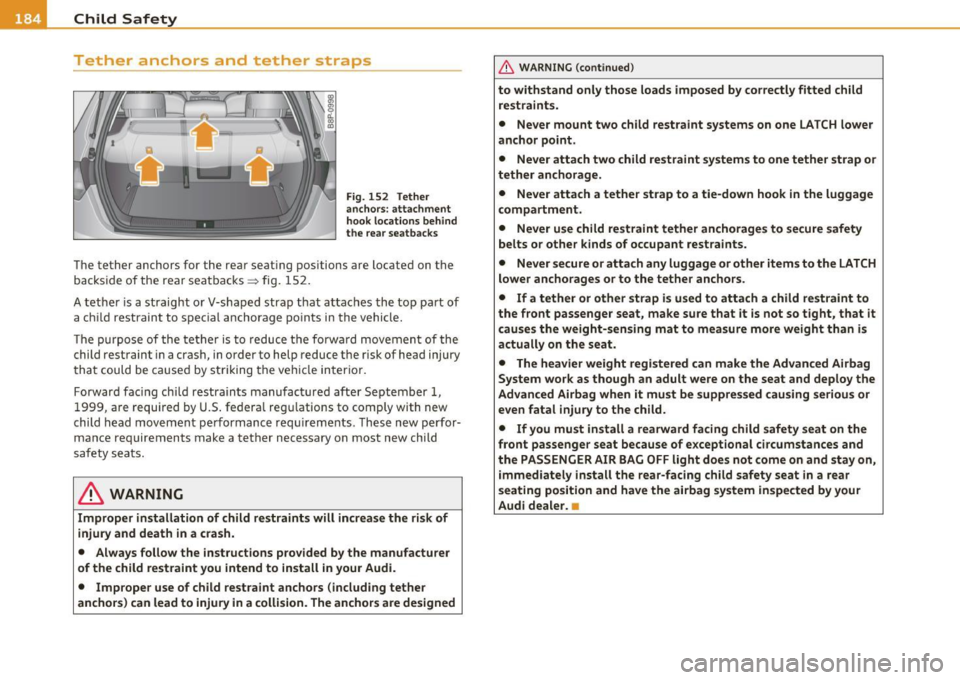
Fig . 152 Tether
an chors: a ttachment
ho ok locatio ns behind
t h e rea r seatba cks
The tether anchors for the rear seat ing pos itions are located on the
backside of the rear seat backs
=> fig. 152.
A tethe r is a st raight o r V-sha ped strap that a tta che s the to p pa rt of
a ch ild restraint to spec ial anchorage po ints in the vehicle .
T he pu rpose of the te the r is to reduce t he fo rw ar d m ovemen t of the
child restraint in a crash, in order to help reduce the risk of h ead injury
t ha t could be c ause d by st riking the ve hicle in terio r.
Forwar d fac ing chi ld re stra in ts manu fac tur ed after Sept em ber 1,
1 999, are requ ired by U.S . federa l reg ulations to comply with new
child head movem ent pe rformanc e req uirem ents. T h ese new p erf or
mance requirements make a tether necessary on most new chi ld
saf ety seats.
& WARNING
Improper installation of child restraints will increase the risk of
injury and death in a crash.
• Always follow the instructions provided by the manufacturer
of the child restraint you intend to install in your Audi.
• Improper use of child restraint anchors (including tether
anchor s) can lead to injury in a collision. The anchors are designed
& WARNING (co ntinued )
to withstand only those loads imposed by correctly fitted child
restraint s.
• Never mount two child restraint systems on one LATCH lower
anchor po int .
• Never attach two child restraint systems to one tether strap or
tether anchorage.
• Never attach a tether strap to a tie-down hook in the luggage
compartment.
• Never use child restraint tether anchorages to secure safety
belts or other kinds of occupant restraints.
• Never secure or attach any luggage or other items to the LATCH
lower anchorages or to the tether anchors .
• If a tether or other strap is used to attach a child restraint to
the front passenger seat, make sure that it is not so tight, that it
causes the weight-sensing mat to measure more weight than is
actually on the seat .
• The heavier weight registered can make the Advanced Airbag
System work as though an adult were on the seat and deploy the
Advanced Airbag when it must be suppressed causing serious or
even fatal injury to the child.
• If you must install a rearward facing child safety seat on the
front passenger seat because of exceptional circumstances and
the PASSENGER AIR BAG OFF light does not come on and stay on,
i mmediately install the rear-facing child safety seat in a rear
seating position and have the airbag system inspected by your
Audi dealer. •
Page 188 of 320
•L_---=C:..:h..:.. i:..: l .=d ~S=-= a..:..f .= e ~ty ~ --------------------------------------------
& WA RNING (conti nued)
• A tight tether or other strap on a rearward-facing child
restraint attached to the front passenger seat can put too much
pressure on the weight -mat in the seat and registe r a hea vier
weight in the Advanced Airbag System . The heavier w eight regis
tered can make the system work as though an adult were on the
s eat and deploy the Advanced Airbag when it mu st be suppressed
causing se rious or e ven fatal injury to the child.
• If you must install a rearward facing child safety seat on the
front p assenger seat because of e xceptional circumstances and
the PASSENGER AIR BAG OFF light does not come on and stay on,
immediately install the rear -facing child safety seat in a rea r
s eating position and have the airbag system inspected by your
Audi dealer. •
Additional Information
Sources of information about child
restraints and the ir use
There are a number of sources of additional information abo ut child
restrain t selec tion, insta llation and use:
NHTSA adv ises that the best chi ld safety seat is the o ne that fits you r
child and fits in your vehicle, and that you will use correctly and
c ons iste ntly .
Try before you buy !
U.S National Highway Traffic Safety Administration
T e l. : 1-888-327 -4236 (T TY: 1-800 -424 -9 153)
www.n htsa.gov
National SAFE KIDS Campaign
Tel. : (202) 662-0600
www.safekids .org
Safety BeltSafe U.S.A
T e l. : ( 800 ) 74 5-SAF E (E ng lish)
Tel.: (800) 747 -SANO (Spa nish)
www.carseat .or g
Transport Canada Information Centre
Te l. : 1 (800) 333-0371 or call 1 (6 13) 998 -8 6 16 if yo u are in t he
Ottawa area
www. tc.gc.ca/ro ads afety
Audi Customer CARE
T el.: (800) 822-2834 •
Page 192 of 320
Intelligent technologyL ______________________________________ _
the drive wheels on one axle is detected (e.g . on slippery ground on
one side),
the spinning wheel is braked, thereby transferring power to
the other drive wheel or wheels (all -wheel drive) . This is done up to a
speed of about 60 mph (100 km/h). Noises from the brake system
signal that wheel sp in is being controlled .
Driving off
When driving off, always be sure to keep road conditions in mind as
you accelerate . If one drive wheel spins because it is on a surface with
less grip, gradually increase the pressure on the accelerator pedal
until the car starts to move. The wheel less ab le to transfer power
spms .
Overheating of brakes
To prevent the disc brake of the braked wheel from overheating if
subjected to excessive loads, the EDL cuts out temporarily. The
vehicle remains operat ional and behaves in the same way as a vehicle
without EDL .
As soon as the brake has cooled down, EDL switch es on again auto
matically.
Electronic limited slip differential*
In vehicles w ith front wheel drive*, an electronic lim ited slip differen
tial engages when driving on curves. The brakes are applied spec ifi
cally to the front wheel that is on the inside of the curve. This mini
m izes sliding on the front wheels and enables precise and neutral
driving through curves. The electronic limited slip differential does
not engage when d riving in wet conditions or snow.
& WARNING
• When accelerating on slippery surfaces, such as on ice or snow,
always be careful when depressing the accelerator pedal. Even
with the EDL and the ele ctronic limited slip differential working,
the drive wheels can spin and reduce your ability to control your
ca r. -Risk of crash!
& WARNING (continued)
• The increased safety afforded by EDL and the electronic limited
slip differential does not mean that you can take safety risks .
Always adapt your driving style to the road conditions and traffic
situation.
[I) Tips
If a fau lt occurs in the ABS, the EDL is also not f unct ioni ng. This is
indicated by the ABS warning light=>
page 16.
Anti-Slip Regulation System (ASR)
The Anti-Slip Regulation System prevents the driven
wheels from spinning when the car is accelerating.
General notes
The Anti-Sl ip Regu lation System (ASR) is integrated in the electronic
stabili zation program (ESP) . When the vehicle starts up and acceler
ates, the wheels are prevented from sp inning by adjust ing the engine
power to match the amount of grip available from the road surface.
How the system works
ASR performs automatica lly, i.e. without the driver's intervention.
With the aid of the ABS sensors=>
page 192, ASR monitors the speed
of the driven wheels. If the wheels start to spin, the engine torque is
reduced automatically until the tires find enough grip to lock onto
the road surface. The system is active across the entire speed range.
The ASR works in conjunction with the ABS. If a malfunction shou ld
occur in the ABS, the ASR w ill also be out of action .
[I) Tips
To ensure that the ASR works properly, all four wheels must be fitted
with identical tires. Any differences in rolling radius of the tires can .,
Page 194 of 320
Intelligent technology
'-----------------------------------------------
& WA RNING (conti nu ed )
• Do not "ride the brakes " by re sting your foot on the pedal when
you do not intend to brake . Thi s may cause the brakes to overheat,
premature wear and increased stopping distance.
• Under certain climatic and operating condition s such as
pa ssing through water, dr iving in heavy rain or after washing the
vehicle, the effectiveness of the brake s can be reduced . In winter ,
ice can accumulate on the brake pads , linings , discs and drums .
Carefully apply brakes for a te st. Brakes will dry and ice coatings
will be cleaned off after a few careful brake applications.
• Driving for an extended period of time on salt-covered roads
without using your brakes can al so affect br aking efficiency. Clean
off accumulated salt coating from brake disc s and pads with a few
careful brake applic ations.
• If you damage the front spoiler , or if you in stall a different
spoile r, be sure the air flow to the front brakes is not obstructed.
Otherwi se th e brake system could overheat reducing the effective
ness of the entire brake system.
• Failure of one brake circuit will impair the braking capability
resulting in an inc reased stopping distance. Avoid driving the
vehicle and have it towed to the nearest authorized Audi dealer or
qualified wo rkshop .
.J
Brake booster
T h e brake booste r adds ext ra braking p ower.
The brake booster works with vacuum pressure which is created on ly
w hen the eng ine is ru nnin g=>&.
& WARNING
• Never let the vehicle roll to a stop with the engine shut off.
• If the brake boo ster i s not working , for example when towing
your veh icle , or because the brake booster has somehow been
& W ARNING (continued )
damaged , the brake pedal must be p ressed considerably harder to
make up for the la ck of booster assi stan ce. •
Functioning of Anti-Lock Brake System
{ABS)
ABS prevents the wheels from l ockin g up under br aking.
Th e ABS contr ibutes effectively to vehicle co ntrol s ince it prevents t he
w heels from
locking when the brakes are applied . This means that the
veh icle rema ins steerable and is less likely to skid .
With ABS you do not need to pump the brake. Just hold the brake
pedal down .
However, do no t expect that the ABS shortens bra king d istance under
all circumstances . When dr iv ing on grave l or on newly falle n snow on
top of icy s urfaces, braking d istance may be even longer, therefo re,
under these circumstances, it is especially important that yo u drive
slowly and with g re at c are.
How the ABS system works
An au tomatic c hec k is made when a speed of about 4 mp h (6 km/ h) is
reached. When t his happens, a pump ing noise can be heard.
If an ind ivi dual wheel begi ns to rot ate too s low ly in relat ion to ve hicle
speed and tends to loc k, t he ABS automatically reduces brake pres
s ur e to p revent t hat wheel from lo cking.
T hi s au tomatic adjustment p rocess w ill cause a
s light vibration of
the bra ke pedal and some noises to a lert you that vehicle speed must
be adapted to ex isting road and traffic co nditions .
& WARNING
Although the ABS is very effective, always remember that braking
capability is limited by tire traction. Always adjust your driving ...
Page 195 of 320

Intelligent technologyz..__~~-____________________________ __.
& WA RNING (c on tinued )
speed acco rding to the road and traffic conditions. Do not let the
e xtra safety afforded by th e ABS tempt you into taking extra risk s.
The ABS cannot overcome the laws of physics .
[ i J Tips
• If ABS is not funct ioning properly, a warning light will come on .
See ~
page 16 .
• If a fault occurs in the ABS, the EDL is also not functioning. This is
ind ic at ed by t he A BS w arni ng light. •
Brake assistant
The broke assistant is designed to achieve the optimum
br oking effect.
Th e b rake ass istant he lps to inc rease t he effective brak ing powe r and
thus to ac hieve a shorter stopping distance.
If the driver presses the
bra ke ped al ve ry qu ickly, the b rake assistant au toma tically bo osts the
brak ing force to the max imum level, up to the point where the anti
lo ck brak e function (ABS) in tervenes to stop the whee ls from l ocking.
You should then keep the brake pedal pressed unti l the vehicle has
bra ke d to t he require d spee d. T he bra ke ass istan t swi tches itse lf off
as soon as you re lease the b rake pedal.
Th e brake assistant will not be operative if there is a ma lfu nctio n in
t he A BS .
& WARNING
Please remember that the accident risk always increases if you
drive too fast , especially in corners or on a slippery road , or if you
follow th e vehicle ahead of you too closely. An increased accident
risk cannot be compensated even by the brake assistant, so always
maintain a safe speed .•
Controls and equip ment Safety first Vehicle operation
Electro-mechanical power assist
---
T
he elec tro-m echa nic al po wer as sist hel ps the dri ver
w he n steering .
The degree of power assist is electronically matched to vehicle speed.
Th e powe r steering system ass ists the dr iver so t hat he ca n stee r the
vehicle with reduced physical effort.
Power steering will not wor k if the engine is off. As a result, the
stee rin g wheel will b e ha rd to tu rn .
& WARNING
If the system deve lops a problem, you must seek qualified profes
sional as sistance.
0 Note
If the re is an elect ronic mal func tion, servotronic will s till f unction
li ke a conven tional power steering system, p rovid ing a constant
steering support fo rce that is no longer proportionate to the ve hicle
spee d. This is most noticeab le whe n tur ning the s teer ing whe el at low
speeds ( for example when park ing), -more effort will be required
t h a n usual.
• Be aware o f the d ifferent than usual steering response and adjust
your st eering force a ccordi ng ly.
• Have the prob lem checked and set r ight by an autho rize d Aud i
dealer as soo n as possib le.
• If a steering ma lf u nction occ urs, t his is signaled w ith the or. ~
indicator l igh ts a nd a wa rning tone, see .
[I] Tips
• If the powe r stee ring system shou ld fa il, or if the engine is not
run ning (for example, while being towed), you w ill still be ab le to
stee r the veh icle. However, more effort wi ll be required to do so . .,.
Vehicle care Do-it-yourself service Technical data
Page 202 of 320
Driving and environment
This is especially true for vehicles with low-slung chassis (sports
chassis) and fully loaded vehicles. •
Operate your vehicle economically
and minimize pollution
General
Your personal style of driving will determine the economy
of your vehicle, as well as exhaust and noise levels.
Fuel economy, env ironmental impact, and wear on your eng ine,
brakes and tires largely depend on three factors:
• your personal driving style
• operat ing conditions
• technical lim itations
If you anticipate what you need to do next and drive economically,
you can easily cut your fuel consumpt ion by 10-15 percent. This
sect ion wi ll g ive you some tips on how you can help the environment
and your pocketbook.
[I) Tips
The consumption estimates as published by ENVIRONMENTAL PROTECTION AGENCY (EPA) and Transport Canada may not co rre
spond to your actual consumption on the road, which will vary
depending upon vehicle load and speed, road and weather conditions,
trip length, etc. •
Drive smoothl} and keep a lookout ahead
Vehicles use the most fuel when they are accelerating.
Avoid unnecessary accelerating and braking .
Vehicles use the most fuel when they are accelerating. If you antici
pate what is go ing to happen next, you will need to brake less and,
thus, accelerate less. Let the vehicle coast whenever possible - for example when you see that the next traffic light is red.
Avoid full throttle
Driving at moderate speeds saves fuel and improves your
mileage.
- Try and keep well below your car's maximum speed.
Accelerating gently reduces fuel consumption, engine wear, and does
not d isturb the env ironment.
Fuel consumption, exhaust emissions and engine noise increase
disproportionately at high speeds. If you drive at approximately three
quarters of top speed, fuel consumption will be reduced by one half.
Never drive faster than the posted speed limit and weather condi
tions perm it. •
Reducing unnecessary idling
Even when your car is just idling it burns up fuel.
- Shut the engine off when you are not driving the vehicle .
- Do not warm up the vehicle by letting the engine run at idle .
It makes sense to shut off the engine in traffic jams, when waiting for
trains to pass at railroad crossings, or at traffic lights that have long
wa its on red. Turn ing the eng ine off for just 30-40 seconds saves
more fuel than is burned starting the engine again.
It takes a long time for the engine to warm up fully when it is running
at idle. However, wear and noxious emissions are espec ially high
when the engine is warming up . So you shou ld drive away as soon as .,_
Page 203 of 320

Driving and environment
------------------------------------------------'
you start the engine and avoid running at high RPMs while the engine
is still warming up.
0 Note
Do not leave engine idling unattended after starting. If warning
lights should come on to indicate improper operation, they would go
unheeded. Extended idling also produces heat, which could result in
overheat ing or other damage to the vehicle or other property.•
Regular maintenance
A badly tuned engine unnecessarily wastes a lot of fuel.
- Have your vehicle serviced at regular intervals.
By having your vehicle regularly serviced by an authorized Audi dealer
helps to ensure that it runs properly and economically. The condition
of your vehicle not on ly affects its safety and ability to hold its value,
it also affects
fuel consumption .
Check your oil each time you fill your tank.
The amount of oil used is related to engine load and speed.
It is normal for the oil consumption of a new engine to reach its
lowest value after a certain mi leage has been driven.
You must drive you r vehicle about 3,000 miles (5,000 kilometers)
before you can properly assess oil consumption.
Thi s also applies to fuel consumption and engine output.
0 Note
• Have your vehicle maintained properly and in accordance with the
service recommendations in your Warranty
& Maintenance booklet.
Lack of proper maintenance as well as improper use of the vehicle will
impa ir the function of the emission control system and could lead to
damage.
Controls and equip ment Safety first Vehicle operation
•
Do not alter or remove any component of the Emission Control
System unless approved by the manufacturer.
• Do not a lter or remove any device, such as heat shie lds, switches,
ignition w ires, va lves, which are designed to protect your vehicle 's
Emission Control System and other important vehicle components.
Fewer short tr ips
Fuel consumption will always be relatively high on short
trips.
- Try to avoid driving short distances with a cold engine.
The engine and catalytic converter have to reach their optimal oper
ating temperature
to reduce fuel consumption and noxious emis
sions effectively .
• Just after starting, a cold eng ine in a mid-size car burns the fuel at
a poor rate of 6-8 miles per gallon (30-40 l/l00km). Half a mile down
the road, the mileage improves to 12 MPG (20 l/100 km). It will take
the engine no less than
two and a half miles (4 km) of driving to
warm up to its proper operat ing temperature and operate at an
economic mileage . This explains why taking the car for sho rt trips is a
rather wasteful convenience .
• Th e
outside temperature is also critical in this regard . Your car
consumes more fuel in the winter than in the summer.
Vehicle care Do-it-yourself service Technical data
Page 204 of 320

Trailer towing
"---------------------------------------------------
Trailer towing
Driving with a trailer
General information
Your Audi was designed primarily for passenger transpor
tation .
If you p lan to tow a t railer, p lease remember that the additional load
w ill affect durability, economy and performance.
Tr ailer towing not on ly p laces mo re s tress on the vehicle, it also calls
for more concentration from the driver.
For this reasons, a lways fo llow the operating and driv ing instr uctions
prov ided and use common sense .•
Technical requirements
Trailer hitch
Use a we ight-carrying hitch conforming to the gross trai ler weight .
Th e h itch mus t be suit able for your veh icle and t railer and mus t be
mounted securely on the vehicle's chassis at a
technically sound l oca
t ion. Use on ly a tra ile r hi tch w ith removable b all moun t. Alw ays check
w ith the trailer hitch manufacturer to make sure that you are using
t he correc t hitch.
Do not use a bumper hitch .
The hitch must be installed in such a way t hat it does not interfere
w ith the impact -ab sorb ing bumper system. No mod ifi cations s houl d
be made to the vehicle exhaust and brake systems . From t ime to
t ime, che ck t hat all hitch mou nting bolts rema in securely faste ned.
W hen you are no t tow ing a trai ler, remove the trailer hitch ball
mount. This prevents the hitch from ca using damage should your
veh icle be s truck from behind=>&.
Tire pressure
When towing a tra iler, inflate the tires of you r vehicle to the cold tire
pressu re listed under "Full lo ad"on t he st ick er o n the r ight doo rjamb.
I n flate trailer t ires to trai ler and tire manufacturers' specifications .
Lights
The headlight settings should be checked with the tra iler attached
befo re d riving o ff. Have the headlights adjusted as necess ary s o that
you can see the road ahead but not b lind oncoming t raffic.
Check to make s ure bo th vehicle and t railer lights a re wor king prop
er ly.
Engine cooling system
Towing a trailer ma kes t he engin e work harder. It is important t hat
t he cooling sys tem' s per formance stands up to the add ition al stra in.
M ake sure that the coo ling sys tem has eno ugh fluid .
Trailer brakes
If your trai ler is equipped with a braking system, check to be su re that
it confo rms to all regula tions .
Th e tra ile r hydrau lic brake system must not be directly con nected to
the vehicle's hydraulic b rake system.
Safety chains
Be sure trailer safety cha ins are p roper ly connected from the t rai ler
to the hitch on the vehicle. Leave enough s lac k in t he chai ns to permit
t u rni ng corners. When you insta ll safety chains, ma ke s ure t hey will
not d rag on t he road when yo u are d riving .
The chai ns should cross under the trailer tongue to prevent it from
drop ping in ca se of separat io n from t he hitch.
Trailer lights
Trailer lights must meet all regulat ions. Be su re to chec k w ith your
author ized A udi dealer for correct wiring, switches and relays. _.