brake fluid AUDI S3 2011 User Guide
[x] Cancel search | Manufacturer: AUDI, Model Year: 2011, Model line: S3, Model: AUDI S3 2011Pages: 320, PDF Size: 75.79 MB
Page 239 of 320

___________________________________________ C_ h _ e_c _k _ i_n -=g .._ a_n _ d_ f_i _ll _i _ n -=g '-- ....... m
• If, in an emergency, only water can be added, the correct ratio
between water and antifreeze=>
page 234 must be restored as soon
as possible.
~ For the sak e of the environment
Ora i ned coolant should not be reused . Always dispose of used coolant
while observing all environmental regulations .•
Radiator fan
The radiator fan switches on automatically by itself.
T he electric radiator fan is controlled by thermoswitches that switch
on and off depending on coolant a nd engine compartment tempera
tures.
An auxilia ry e lectr ic rad iator fan* sw itches on a nd off depend ing on
coo lant temperature and other vehicle operation cond itions .
After switch ing off t he engine, the auxiliary fan -even with the igni
tion off -can continue running for up to 10 minutes . It can even
switch on again later by itself=>& , if
• the temperature of the engine coolant rises due to the hea t build
up from the engine in the engine compartment, or
• the engine compar tment hea ts up because the vehi cle is parked in
intense sunlight.
& WARNING
• To reduce the risk of personal injur y never tou ch the radi ator
fan .
• The auxiliary ele ctric fan i s temperatur e controll ed and can
switch on sudd enly even wh en the engine is not running .
• The auxiliary radiator f an swit che s on aut omati cally when the
engine coolant reaches a certain temp eratur e and w ill continue to
run until the coolant temperature drop s. •
Vehicle OP-eration
Brake fluid
Checking brake fluid level
The brake fluid level can be checke d with a quick glance.
Fig. 167 Eng ine
compartment : b rak e
fl uid res ervoi r
Before you check a nything in t he engine compartment ,
always read and heed all WARNINGS~ & in "Working in
the eng ine compartment" on
page 226 .
-Read the brake fluid level from the bra ke fluid reservoir.
The brake fluid level must be between the "MIN" and
"MAX" markings ~ fig . 167 .
The brake fluid reservoir is located at the rear partition of the engine
compartment on the left side=>
page 227.
The fluid level may drop
slightly after some time due to the auto
m atic adjus tment of the brake pads. This is not cause for alarm .
If the brake fluid level falls
considerably below the "MIN" mark, t he
brake warning/ind icator light (U .S. models :
BRAKE, Canadian mode ls:
ill ) will come on=> page 15 and=> page 32. Do not continue to
operate the vehicle . The complete brake system should be thorough ly
chec ked by an au thor ized Aud i deale r o r other qualified facility and
the cause corrected. If the brake fluid leve l is too low, the brake .,,_
Vehicle care Do-it-yourselt service iTechnical data
Page 240 of 320
___ C_h_ e_c _k _i_n -=g :a,__ a_n_ d_ f_ i_ l _li _n _,g;._ __________________________________________ _
warning/ind icator light will illum inate. Contact an au thorized A ud i
d ealer
immediately .•
Changing brake fluid
H av e th e b rake flu id chang ed by an exper ienced tech ni
ci an.
Br ake flui d abs orbs m oisture fro m the ai r. If t h e w ater con ten t in the
brake fl uid is too hig h, cor ros ion in th e brake system may res ult afte r
a p eriod of time. The boiling po int of t he br ake fl uid will al so decre ase
cons iderab ly and decrease brak ing perfo rma nce .
T he refo re, the brake fl uid m ust be c hanged
every two years . Always
use new brake fluid w hich conforms to Federal Motor Veh icle Stan
dard "F MVSS 1 16 DOT 4".
Th e b rake fl uid r eservo ir can be diffi cult t o re ach, there fore, we
recommend that you have the brake fluid changed by your author ized
Audi dealer . Your dealer ha s t he correc t tool s, the ri ght brake fl uid
and the know -how to do t his for you.
& WARNING
• Brake fluid is poisonous. It must be stored only in the closed
original container out of the reach of children!
• Brake failure can result from old or inappropriate brake fluid.
Observe these precautions :
- Use only brake fluid that meets SAE specification
J 1703 and
conforms to Federal Motor Vehicle Standard 116 . Always check
with your authorized Audi dealer to make sure you are using
the correct brake fluid. The correct type of brake fluid is also
indicated on the brake fluid reservoir .
- The brake fluid must be new. Heavy use of the brakes can
cause a vapor lock if the brake fluid is left in the system too
long . This can seriously affect the efficiency of the brakes as
well as your safety . This could result in an accident .
0 Note
Brake fluid will damage the paint of you r ve hicl e.
<£' For the sake of the environment
Beca us e of the prob le m of proper dispo sal of b ra ke fl uid as well as
the spec ia l too ls req uired and the necessary expe rtise , w e r ecom
me nd that you h ave t he brake fl uid chan ged by yo ur a uth oriz e d Audi
dea ler. •
Battery
General information
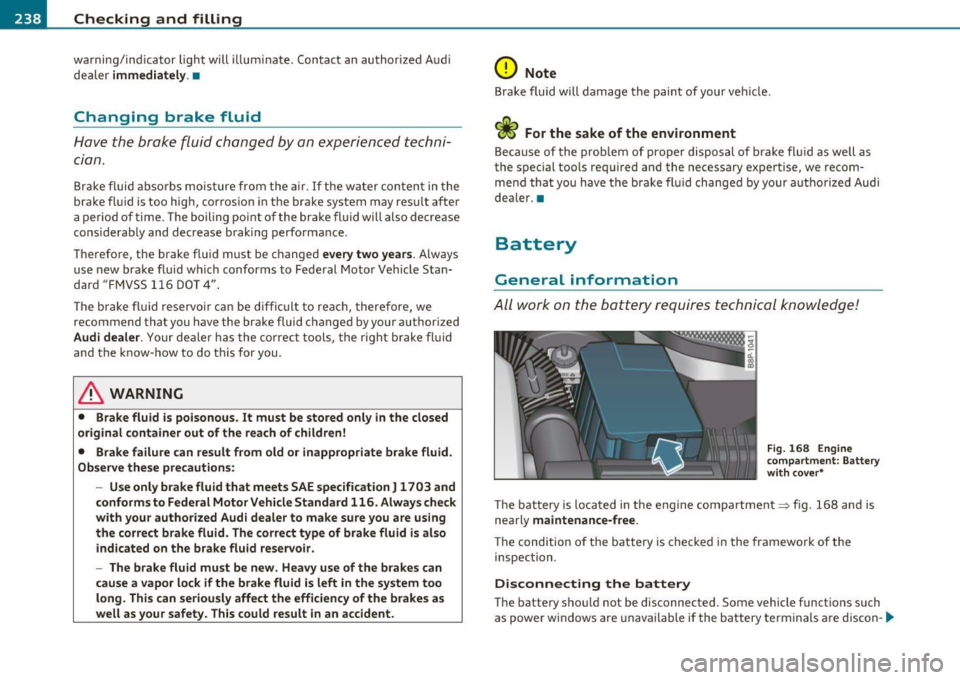
All wo rk on t he battery requires te chnica l k nowl ed ge !
Fig. 168 Engine
comp artment : Battery
with cover*
T he b att ery is lo cat ed in the e ng in e co mpar tmen t~ fig. 1 68 and is
nearly
maintenance-free.
Th e condition of the battery is che cked in the framewo rk of the
inspec tion .
Disconnecting the battery
The batte ry s ho ul d not be disconnected . Some vehicle funct io ns such
as powe r w indows are unavailable if the b attery te rminals a re discon -
~
Page 256 of 320
_L_T.:...:..: i r~ e:.: s~ a:::. n:..:..:: d:.....: w..:...:. h::e:.: e::.:: ls::::._ ______________________________________________ _
is more difficult to stop. Overloading can not only lead to loss of
vehicle control, but can also damage important parts of the vehicle
and can lead to sudden tire failure, including a blowout and sudden
deflation that can cause the vehicle to crash.
Your safety and that of your passengers also depends o n making sure
that load limits are not exceeded. Vehicle load includes everybody
and everything in and on the vehicle. These load limits are techn ically
referred to as the veh icle's
Gross Vehicle Weight Rating ("GVWR").
Th e "GVWR" includes the weight of the basic vehicle, all factory
installed accessories, a full tank of fuel, o il, coolant and other fluids
plus maximum load. The maximum load includes the number of
passenge rs that the vehicle is intended to carry ("seating capacity")
with an assumed weight of 150 lbs (68 kg) for each passenger at a
designated seating posit ion and the total weight of any luggage in
the vehicle. If you tow a trailer, the weight of the trailer hitch and the
tongue weight of the loaded trailer must be included as part of the
vehicle load.
T he Gross Axle Weight Rating ("GAWR") is the maximum load that
can be applied at each of the vehicle's two ax les.
The Gross Vehicle We ight Rating and the Gross Axle Weight Rat ing
are listed on the safety compliance sticker label located e ithe r on the
dr iver's s ide B-pillar or on the inside of the fuel filler flap. Your Audi
has 5 seating positions, 2 in the front and 3 in t he rear for total
seating capacity of 5. Each seating position has a safety belt
=> page 135, "Safety belts".
The fact that there is an upper limit to your veh icle's Gross Veh icle
Weight Rating means that the total weight of whatever is being
carried in the veh icle (in cluding the weight of a trailer hitch and the
tongue weight of the loaded trailer) is limited . The more passengers
in the vehicle or passengers who are heavier than the standard
we ights assumed mean that less we ight can be carr ied as luggage.
Th e tire pressure label on your A udi also lists the maximum combined
we ight of all of the occupants and luggage or other cargo that the
vehicle can carry. For the location of the labe l=>
page 249, fig. 171.
& WARNING
Overloading a vehicle can cause loss of vehicle control, a crash or
other accident, serious personal injury, and even death.
• Carrying more weight than your vehicle was designed to carry
will prevent the vehicle from handling properly and increase the
risk of the loss of vehicle control.
• The brakes on a vehicle that has been overloaded may not be
able to stop the vehicle within a safe distance.
• Tires on a vehicle that has been overloaded can fail suddenly,
including a blowout and sudden deflation, causing loss of control
and a crash.
• Always make sure that the total load being transported -
including the weight of a trailer hitch and the tongue weight of a
loaded trailer -does not make the vehicle heavier than the
vehicle's Gross Vehicle Weight Rating .•
Determining correct load limit
Use the example below to calculate the
total weight of the passengers and luggage
or other things that you plan to transport so
that you can make sure that your vehicle
will not be overloaded. ._
Page 259 of 320

________________________________________________ T_ i_ re _ s_ a_ n_d_ w_ h_ e_ e_l _s _ ....... 91
Incorrect wheel alignment
In correct whee l al ignme nt can ca use excessive tir e wea r, impairing
th e sa fety o f the vehicl e. If t ires show excessive w ear, hav e the w heel
alignment checked by a n authorized A udi dea ler or qualifie d work
shop.
All Wheel Drive
Vehicles wi th quattro® must always have tires of the same size ,
con st ruct ion an d tread type . For details see~
page 194.
& WARNING
Sudden tire failure can lead to los s of control, a cra sh and serious
personal injury!
• Never drive a vehicle when the tread on any tire is worn down
to the wear indicators.
• Worn tires are a safety hazard, they do not grip well on wet
roads and increase your risk of "hydroplaning" and loss of control.
• Always keep chemicals that can cause t ire damage, such as
grease , oil, gasoline and brake fluid away from tires.
• Tires age even if they are not being used and can fail suddenly,
especially at high speeds. Tires that are more than 6 years old can
only be used in an emergency and then with special care and at
lower speeds.
• Never mount used tires on your vehicle if you are not sure of
their "previous history. " Old used tires may have been damaged
even though the damage cannot be seen that can lead to sudden
tire failu re and loss of vehicle control. •
Vehicle OP-eration
New tires and replacing tires and wheels
New t ires an d w hee ls have to be brok en in .
Fig. 175 Tire specificat ion codes on th e sidewall of a tire
No.
©
®
®
©
©
©
Description
Passenger car tire (where applicable)
Nom inal wid th of ti re in mil limeters
Ratio of hei9ht to width (aspect ratio)
Radial
jj Rim diameter code
L oa d index and speed rating
Vehicle care Do-it-yourselt service iTechnical data
Page 307 of 320
_____________________________________________ A_ L .... p_ h _ a_b_ e_ t_ ic_a_ l_ in_ d_e _ x __ _
Audi Service Repair Manuals and Literature
299
AUTO
Climate controls ..... .. .. ....... ..
98
Switching on ........... .. .. .. .. .. 98
When should I use AUTO? . .. .... .. .. 98
Auto Safety Hotline .... .. .. .. .. ..... 133
Automatic air recirculation ......... .... 99
Automatic belt retractor .......... .. . 139
Automatic car wash
See Washing ....... .. .. .. .. .... . 207
Automatic headlights
defective .............. ..........
36
Automatic Transmiss ion
Automatic Transmiss ion .. .. .. .... .
118
Automatic transmission ........... .. . 115
Driving Notes . ...... .. .. .. .. ..... 117
Emergency program .... ..........
121
Emergency release ............ ... . 121
Ignition key safety lock ....... ... .. 106
Kick-down ..... ......... ... .. .. . 120
Launch Control Program .. .. .. .. .. . 120
Selector lever lock ... .... .. .. .. .. . 116
Selector lever positions ..... .... .. . 115
Tiptronic .................... ... . 119
T iptronic controls on the steering wheel .
120
Average fuel mileage ........ ... .. .. .. 21
Average speed ......... ...... .. .. .. .. 21
Avoid damaging the vehicle .. .. .. .. .. . 199
Controls and equip
ment Safety first
B
Battery
... .. ... ... ................. 238
charging . .. .. .. .... .... .. .. ..... 241
Disconnecting and connecting ...... 238
Important warnings when work ing on the
battery ..... ........... ...... ..
239
Low . .. .. .. .. .... .... .. ......... 194
Replacing the battery .. .. .. .... ... 242
State of charge ..... .. ... ...... .. 194
Winter operation ..... ..... ....... 239
Working on the battery .... .... .... 239
Battery voltage .. ........... ...... .. . 35
Before driving .. ... .... .. .. .. .. .....
125
Bioethanol
Engine preheater .... ....... ......
103
Blended gasoline ................. .. 219
Body cavity seal ing . ...... .. .........
212
Booster seats . .. .. ...... ........... 17 5
Brake assistant . ................. ...
193
Brake booster ... .. .... .. .. .. ... ... . 192
Brake fluid
Changing the brake fluid ......... ..
238
Checking the brake fluid level ..... .. 237
Reservoir .. .. .. ... ..... ......... 237
What is the correct brake fluid level? . 23 7
What should I do if the brake fluid warning light comes on? . ... ... ..........
237
Brake pads .. .. .. .... ....... ...... .. 197
Brake system .. .. .. ........ ......... 237
Anti-lock brake system . .. .. ..... ... 16
Brake fluid . ................ ..... 23 7 Brake fluid specifications for
refill and
rep lacement .................. .
238
Brake light defective ....... .... .. .. 36
General information ............ .. 191
How does moisture or road salt affect the
brakes? ... .... .. ..............
191
Malfunction ........ ...... .... .. .. 32
Warning/indicator lights ... .... .. .. 15
Worn brake pads symbol ........... 35
Break-in period ... .. .. .... ... ..... ..
197
Brake pads .. .............. ...... 197
Tires ... ...................... .. 197
Bulbs ................ .. .. .. .... .. . 285
C
California Proposition 65 Warning .. .. . 227
Battery specific .. ................ 241
Capacities ............ ...... .... ... 296
Car care ... ..... ........... ........ 206
Interior ........... .. . .. .. .. .. .. . 213
Plastic and vinyl .. .. ............. . 210
Weatherstrips ........ .... .... .. . 211
Care of exterior . ...... .. . .. .. .. .. .. . 206
Cargo area
See Loading the luggage compartment ..
131
Cargo net ............. ...... .. .. .. .. 83
Catalytic converter .. .. .... .......... 198
Center armrest . .. ... ................ 79
Centigrade
Switching between Centigrade and Fahrenheit . .............. ...... .
99
Vehicle operation Vehicle care Do-it-yourself service Technical data