steering wheel AUDI S3 2011 User Guide
[x] Cancel search | Manufacturer: AUDI, Model Year: 2011, Model line: S3, Model: AUDI S3 2011Pages: 320, PDF Size: 75.79 MB
Page 148 of 320
1111 ....... _A_ i_rb _ a_,g,:;._ s_, y'- s_ t_e _m ________________________________________________ _
costs o r ev en t he lack of v ehicle da mage is no t necessar ily an ind ica
t ion of whe the r an a irbag should inflat e or not.
S ince th e cir cums tances will vary cons idera bly betw een one co llision
and another, it is not possible to define a range o f vehicle spee ds that
w ill co ver eve ry p oss ible kin d and a ngle o f im pact th at w ill alw ay s
tri gg er the a irba gs. Im portant facto rs inclu de, for examp le, the
n at ure (h ard or s oft) of th e obje ct whi ch th e c ar hits , th e ang le of
impact, vehicle speed, etc. The front air bags will also not inflate in
s ide or r ear coll isions , or in roll-ove rs.
Always remember: Airbags w ill deploy only once, an d on ly in certa in
kinds of co llisio ns. Your safety be lts are a lways there to offer protec
t ion in those s ituatio ns in which airbags ar e no t sup pose d to d eploy,
or w hen they have alrea dy de ploye d; for examp le, when your ve hicl e
st rike s or is st ruc k b y ano ther veh icle a fter t he first collision .
T hi s is just one of the reasons w hy an airbag is a s upplementa ry
restra in t a nd is no t a su bst itute for a safe ty bel t. Th e air bag sy stem
works most effectively when used with the safety be lts . Therefore,
always p rope rly wear y ou r safety belts => page 135 .
& WARNING
Sitting too close to the steering wheel or instrument panel will
decrease the effectiveness of the airbags and will increase the risk
of personal injury in a collision.
• Never sit closer than 10 inches (25 cm) to the steering wheel or
instrument panel.
• If you cannot sit more than 10 inches (25 cm) from the
steering wheel, investigate whether adaptive equipment may be
available to help you reach the pedals and increase your seating
distance from the steering wheel.
• If you are unrestrained, leaning forward, sitting sideways or
out of position in any way , your risk of injury is much higher.
• You will also receive serious injuries and could even be killed if
you are up against the airbag or too close to it when it inflates - even with an Advanced Airbag.
& WARNING (co ntinued )
• To reduce the risk of injury when an airbag inflates, always
wear safety belts properly=>
page 139, "Safety belts ".
• Always make certain that children age 12 or younger always
ride in the rear seat. If children are not properly restrained, they
may be severely injured or killed when an airbag infl ates .
• Never let children ride unrestrained or improperly restrained in
the vehicle. Adjust the front seats properly.
• Never ride with the backrest reclined.
• Always sit as far as possible from the steering wheel or the
instrument panel =>
page 126.
• Always sit upright with your back against the backrest of your
seat.
• Never place your feet on the instrument panel or on the seat.
Always keep both feet on the floor in front of the seat to help
prevent seriou s injuries to the legs and hips if the airbag inflates.
• Never recline the front passenger's seat to transport objects .
Items can also move into the area of the side airbag or the front
airbag during braking or in a sudden maneuver. Objects near the
airbags can become projectiles and cause injury when an airbag inflates .
& WARNING
Airbags that have deployed in a crash must be replaced .
• Use only original equipment airbags approved by Audi and
installed by a trained technician who has the neces sary tools and
diagnostic equipment to properly replace any airbag in your
vehicle and assure system effectiveness in a crash.
• Never permit salvaged or recycled a irbags to be installed in
your vehicle. •
Page 152 of 320
........ _A_ i_rb _ a_,g,:;._ s_, y'- s_ t_e _m ________________________________________________ _
& WARNING (conti nued)
• Airbag work mo st effectivel y when us ed with p roperly worn
safety belts .
• Therefore, always wear your safety belts and make sure that
everybody in your veh icle is properly restrained .
& WARNING
A person on the front passenger seat , especially infants and small
c hildren, will receive seriou s injuries and can even be killed by
being too close to the a irbag when it inflates.
• Although the Advanced Airbag System in your vehicle is
designed to turn off the front passenger a irbag if an infant or a
small child is on the front passenger seat, nobody can absolutely
guarantee that deployment under these special conditions is
impossible in all conceivable situations that may happen during
the useful life of your vehicle.
• The Advanced Airbag System can deploy in a ccordance with the
" low risk" option under the U.S. Federal Standard if a child that is
hea vier than the t ypical one-year old child is on the front
passeng er seat and the other condition s for airbag deployment
are met.
• Accident statistics have shown that children are generally safer
in the rear seat area than in the front seating position .
• For their own safety, all children , especially 12 years and
younger, should always ride in the back properly res trained for
their age and size. •
Advanced front airbag system
Your vehicle is equipped with a front Advanced Airbag System in
compliance wit h Unit ed St ates Fe d er al Motor Vehi cle Safe ty Standar d
208 as applicab le at the time your vehicle was manufactured . The front Advanced A
irbag System supplements the safety belts to
prov ide ad ditional prote ct ion for th e d river's and front passenger's
heads and uppe r bodies in fro nta l crashes. The ai rbags i nflate only in
fronta l impacts when the vehicle dece leration is high enoug h.
Th e front Adva nced A irbag Sys tem for the fron t seat oc cupan ts is not
a s ubstitute for your safety be lts. Rathe r, it is part o f the overall occu
p an t restr aint sy stem in y our ve hicl e. Always remembe r that the
airbag system ca n only help to protect you, if you are sitting upr ight,
we aring your sa fe ty be lt and we aring it prope rly. T his is why you and
your passengers must always be properly restra ined, not just because
t he law requires you to be.
Th e A dvan ced A irbag Syst em in your veh icle has been c ertified to
meet the "low r isk" req uir ements fo r 3 an d 6 year-old c hildren on the
pas senge r side and ve ry small ad ults o n the dr ive r side. T he low r is k
dep loyment cr iteria a re intended to help reduce the risk of injury
t hroug h in teraction wi th the front a irbag tha t can oc cur, fo r ex am ple,
by being too close to the steering wheel and instrument panel whe n
t he air bag i nflates .
In add it ion , the system has been cert ified to comply with t he
"supp ression" requirements of the Safety Standa rd, to t urn off the
front airbag for infants 12 mont hs old and young er w ho are
restrained on the front passenger seat in child restra ints that are
listed in the Standard=>
pag e 169 .
"Suppression" requires the front airbag on the passenger side to be
tur ned off if :
• a ch ild up to about one yea r of age is restra ined on the fron t
passenge r seat in one o f th e rear -facing or forward- facing infant
restraints listed in Federa l Motor Vehicle Saf ety St andar d 208 w it h
w hich the Advanced A irbag System in yo ur vehicle was ce rtif ied. Fo r a
lis ting of the chil d res trai nt s t hat were u sed to certify your vehicle' s
compliance with the US Safety Standard =>
page 169,
• weigh t less t han a thres ho ld level stored in the cont ro l un it is
detected on the front passenger seat.
W hen a perso n is de te cte d on t he fro nt pas senger se at, weigh ing
more than the tota l weight of a child that is about 1 year o ld
Page 161 of 320

_______________________________________________ A_ ir_ b_ a_,,,g '--- s.:.y _s _t_ e _ m ___ _
& WARNING (co ntinued )
seating position and have the airbag system inspected by your
authorized Audi dealer.
• A tight tether o r other strap on a rearward -facing child
restraint attached to the front pa ssenger seat can put too much
pressure on the weight -sensing mat in the seat and register more
weight than i s actually on the seat . The heavier weight regi stered
can make the system work as though an adult were on the seat
and deploy the Advan ced Airbag when it mu st be suppre ssed
causing serious or even fatal injury to the child .
• If , in exceptional circumstanc es, you must install a forward
facing child restraint on the front passenger seat, always move
the seat into its rearmost po sition in the seat' s fore and aft adjust
ment range, as far away from the airbag as possible . The backrest
must be adjusted to an upright position. Make sure that the PASSENGER AIR BAG OFF light comes on and stays on all the time
whenever the ignition is switched on.
& WARNING
• If the PASSENGER AIR BAG OFF light doe s not go out when an
adult is sitting on the front passenger seat after taking the steps
described above, make sure the adult is properly seated and
restrained at one of the rear seating positions.
• Have the airbag system inspected by your authorized Audi
dealer before transporting anyone on the front passenger seat .
[ i ] Tips
If the we ight-sensing mat in the front passenger seat detects an
em pty seat , the front airbag on the passenge r side will be t urne d off,
and the PASSENGER AIR BAG OFF light will stay on .•
Controls and equip ment Safety first Vehicle operation
Repair, care and disposal of the airbags
Parts of the airbag system are
insta lled at many different places on
your Audi . Ins tall ing, remov ing, serv icing o r rep airi ng a pa rt in an
area of the vehicle ca n damage a part of a n airbag system and prevent
t ha t sys tem from working prope rly in a coll is io n.
Th ere are some importa nt things you have to know to ma ke sure t hat
the effectiveness of the system will not be impai red and that
dis ca rded compo nents do not cause injury or po llute t he e nvir on
ment .
& WARNING
Improper care , serv icing and repair procedures can increase the
risk of personal injury and death by preventing an airbag from
deploying when needed or deploying an airbag unexpectedly:
• Never cover, obstruct, or change the steering wheel horn pad or
airbag cover or the instrument panel or modify them in any way .
• Never attach any objects such as cup holders or telephone
mountings to the surfaces covering the airbag units.
• For cleaning the horn pad or instrument panel, use only a soft ,
dry cloth or one moistened with plain water . Solvent s or cleaners
could damage the airbag cover or change the stiffness or strength
of the material so that the airbag cannot deploy and protect prop
erly.
• Never repair, adjust, or change any part s of the airbag system .
• All work on the steering wheel, instrument panel , front seats
or electrical sy stem (including the installation of audio equip
ment, cellular telephones and CB radios, etc. ) must be performed
by a qualified technician who has the training and special equip ment necessary .
• For any work on the airbag system, we strongly recommend
that you see your authorized Audi dealer or qualified workshop.
• Never modify the front bumper or parts of the vehicle body . ..,_
Vehicle care Do-it-yourself service Technical data
Page 190 of 320
Intelligent technology
'-----------------------------------------------
Intelligent technology
Notice about data recorded by
vehicle control modules
Your vehicle is not equipped with an Event Data Recorder (EDR),
installed by some manufacturers for the express purpose of
capturing data for retrieva l after an accident or crash event. ED R's are
sometimes called "crash recorders".
Some state laws restrict the retrieval or downloading of data stored
by ED R's that were installed in a vehicle for the express purpose of
retrieving data after an accident or crash event without the owner's
consent.
Although your vehicle is not equipped with an EDR, it is equipped w ith
a number of electronic control modu les for various vehicle systems
such as, for example, engine function, emission control, as well as for
the airbags and safety belts.
T hese electronic contro l modules also record vehicle-re lated data
during normal vehicle operation for diagnostic and repair purposes .
Th e recording capacity of the e lectronic control modu les is limited to
data (no sound is recorded) and only a sma ll amount of data is actu
ally recorded over a very limited period of time and stored when a
system fault or other condition is sensed by a control unit. Some of
the data then stored may relate to vehicle speed, direction, braking
as well as restraint system use and performance in the event of a
crash or other condition. Stored data can only be read and down
loaded with special equipment.
Electronic Stabilization Program
(ESP)
General
The Electronic Stability Program increases driving
stability .
With ESP, contro l over the vehicle is increased in situations when the
vehicle is close to the limits of grip, such as dur ing accelerat ion and in
curves. ESP reduces the risk of sk idding and improves vehicle stability
unde r all road conditions.
It operates at all speeds.
The Anti-Lock Brake System (ABS), Electronic Differential Lock (EDS) and Anti-Slip Regulation System (ASR) are integrated in the Elec
tronic Stability Program .
How ESP works
The ESP control unit processes the following data from high-sensitive
sensors: the rotationa l speed of the vehicle about its vertical axis,
fore-and -aft and lateral acceleration forces, brake pressure and
steering angle .
Us ing stee ring ang le and vehicle speed, the direction the driver
wishes to travel is determined and continuously compared with
actual vehicle behavior. If the two do not match, for example when
the vehicle beg ins to skid, ESP brakes the appropriate whee l auto
matically.
The vehicle is stabilized aga in by the forces act ing on the whee l
during braking. With an oversteering veh icle (tendency for the rear
end to skid out of the curve), the brake app lication is mainly at the
front wheel on the outside of the curve, with an understeering vehicle
(tendency to run wide in the curve) at the rear wheel on the insid e of
the curve or additionally at the other wheels as needed. This brake
application is accompanied by noises. _,
Page 195 of 320

Intelligent technologyz..__~~-____________________________ __.
& WA RNING (c on tinued )
speed acco rding to the road and traffic conditions. Do not let the
e xtra safety afforded by th e ABS tempt you into taking extra risk s.
The ABS cannot overcome the laws of physics .
[ i J Tips
• If ABS is not funct ioning properly, a warning light will come on .
See ~
page 16 .
• If a fault occurs in the ABS, the EDL is also not functioning. This is
ind ic at ed by t he A BS w arni ng light. •
Brake assistant
The broke assistant is designed to achieve the optimum
br oking effect.
Th e b rake ass istant he lps to inc rease t he effective brak ing powe r and
thus to ac hieve a shorter stopping distance.
If the driver presses the
bra ke ped al ve ry qu ickly, the b rake assistant au toma tically bo osts the
brak ing force to the max imum level, up to the point where the anti
lo ck brak e function (ABS) in tervenes to stop the whee ls from l ocking.
You should then keep the brake pedal pressed unti l the vehicle has
bra ke d to t he require d spee d. T he bra ke ass istan t swi tches itse lf off
as soon as you re lease the b rake pedal.
Th e brake assistant will not be operative if there is a ma lfu nctio n in
t he A BS .
& WARNING
Please remember that the accident risk always increases if you
drive too fast , especially in corners or on a slippery road , or if you
follow th e vehicle ahead of you too closely. An increased accident
risk cannot be compensated even by the brake assistant, so always
maintain a safe speed .•
Controls and equip ment Safety first Vehicle operation
Electro-mechanical power assist
---
T
he elec tro-m echa nic al po wer as sist hel ps the dri ver
w he n steering .
The degree of power assist is electronically matched to vehicle speed.
Th e powe r steering system ass ists the dr iver so t hat he ca n stee r the
vehicle with reduced physical effort.
Power steering will not wor k if the engine is off. As a result, the
stee rin g wheel will b e ha rd to tu rn .
& WARNING
If the system deve lops a problem, you must seek qualified profes
sional as sistance.
0 Note
If the re is an elect ronic mal func tion, servotronic will s till f unction
li ke a conven tional power steering system, p rovid ing a constant
steering support fo rce that is no longer proportionate to the ve hicle
spee d. This is most noticeab le whe n tur ning the s teer ing whe el at low
speeds ( for example when park ing), -more effort will be required
t h a n usual.
• Be aware o f the d ifferent than usual steering response and adjust
your st eering force a ccordi ng ly.
• Have the prob lem checked and set r ight by an autho rize d Aud i
dealer as soo n as possib le.
• If a steering ma lf u nction occ urs, t his is signaled w ith the or. ~
indicator l igh ts a nd a wa rning tone, see .
[I] Tips
• If the powe r stee ring system shou ld fa il, or if the engine is not
run ning (for example, while being towed), you w ill still be ab le to
stee r the veh icle. However, more effort wi ll be required to do so . .,.
Vehicle care Do-it-yourself service Technical data
Page 196 of 320
Intelligent technologyL _______________________________________ _
• If the power steering system is not funct ioning properly, contact
your au thori zed A ud i dea le r i mmediately. •
Applies to ve hicl es: wit h A ll Whe el D rive
Driving with your quattro®
With All Wheel Drive, all four wheels are driven.
General information
With All Wheel Drive, power is distributed to all fo ur whee ls. This
happens automatically depending on you r driving s tyle a nd the road
conditions at the time. See also =>
page 189, "Electronic differential
lo ck (E DL)".
W inter tires
W hen d riving in the winter, your vehicle with A ll Whee l Drive has an
advantage, even with reg ular t ires . In winter road cond it ions it may
be advisab le to mou nt w inte r ti res (or all-se aso n t ires) for imp roved
dr iveability and braking: these tires must be mounted on
all four
wheel s.
See also => page 261, "Win ter tires".
Snow chains
W he re snow c ha ins are mand atory on certain roads, this norm ally
also app lies to veh icles with all-wheel drive=>
page 262, "Snow
c hains".
Replacing wheels/tires
Veh icles with All Wheel Drive m ust always have t ires of the same s ize.
Also avoid tires with different tread depths. For details see page
=>
page 257, " N ew tires and replac ing ti res and wheels".
Off-Road driving?
Your Audi does not have enough ground clearance to be used as a n
off-road vehicle. It is therefore best to avoid rough tracks and uneven
te rrain as much as poss ib le. Also refe r to=>
page 199.
& WARNING
Always adjust your driving to road and traffic conditions . Do not
let the extra safety afforded by the all-wheel drive tempt you into
taking extra risk s.
• Although the quattro ®all -wheel drive is very effective, always
remember that braking capacity is limited by t ire traction. You
should therefore not drive at exce ssive speed s on icy or slippery
road surfaces .
• On wet road surfa ces, be careful not to drive too fast becau se
the front wheels could begin to slide on top of the water (hydro
planing ). If this should occur, you will have no warning from a
sudden increase in engine speed as with a front -wheel drive
vehicle. Always dr ive at speed s which are adjusted to the road
conditions -risk of crash! •
Energy management
Starting ability is optimized
Energy managemen t controls the distribution of elec
trical energy and thus optimizes the availability of elec
t r ical ene rgy for s tarting the en gin e.
If a vehicle w ith a convent ional energy sys tem is not d riven fo r a long
period of time, t he battery is discha rged by idling cur rent consumers
(e .g. immob ilizer). In ce rtain c ircumstances it can result i n there
being insufficient energy availab le to start the engine .
Inte lligent ene rgy m anageme nt in yo ur vehicle h andles the dis tribu
tion of electrical energy. Starting ability is markedly improved and
t he life of the bat tery is ex tende d.
Bas ically, energy management consis ts of
battery d iagnosis, idling
current management
and dynamic energy management . ~
Page 248 of 320
-~_T_ ir_e_ s_ a_ n_ d_ w_ h_e_ e_ ls _______________________________________________ _
& WARNING (conti nu ed )
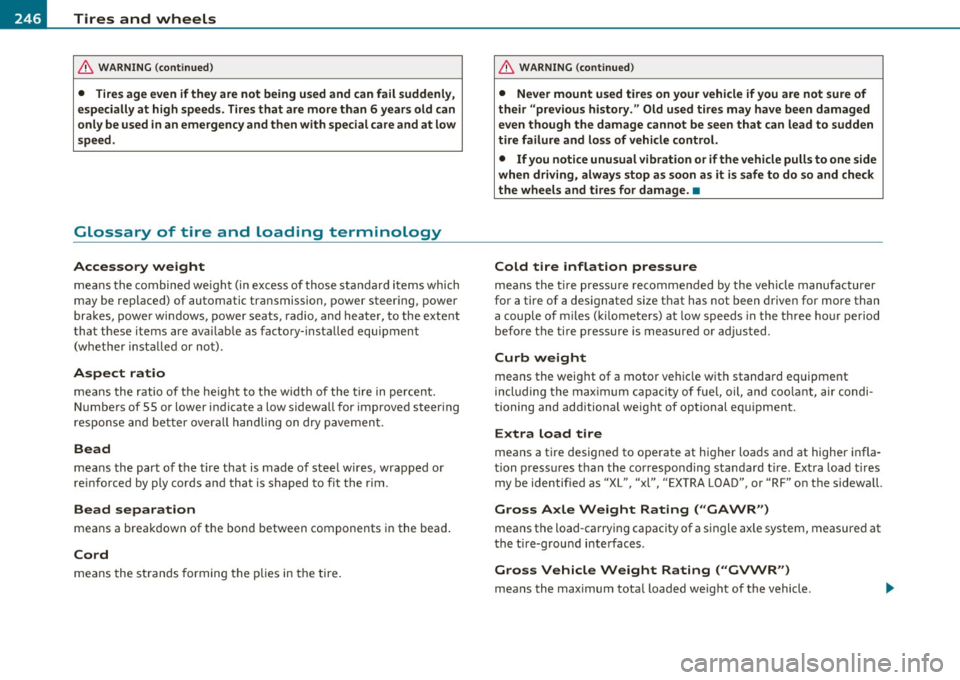
• Tire s age even if they are not being used and can fail suddenly ,
especially at high speeds . Tires that are more than 6 year s old can
only be used in an emergency and then with special care and at low
s peed .
Glossary of tire and loading terminology
Accessory weight
means the combined we ight (in excess of those sta nda rd items which
may be rep lace d) of automatic transmission, power steering, power
bra kes, powe r w indows , power seats, radio, and heater, to the extent
that these items are avai lab le as factory- installed equipment
(w het he r i nsta lled or no t).
Aspect ratio
me ans the ratio of t he he ight to t he w id th of the tir e in percent .
Numbe rs of 55 o r lower indicate a low sidewa ll for improved steer ing
respo nse an d be tter overa ll handling on dry p avemen t.
Bead
means the part o f the tire that is made of stee l w ires , wrap ped o r
re in forced by ply cords and that is shaped to fit the rim.
Bead separation
means a brea kdown of the bon d between components in the bead .
Cord
means the st rands forming the plies in the tire.
& W ARNING (continued )
• Never mount used tire s on your vehicle if you are not sure of
their "previous hi story ." Old used tires may have been damaged
eventhoughthedamagecannotbeseenthatcanleadtosudden
tire failure and lo ss of vehicle control.
• If you notice unu sual vibration or if the vehicle pull s to one side
when driving, alway s stop as soon as it is safe to do so and check
the wheels and tires for damage. •
Cold tire inflation pressure
means the tire pressure recommended by the vehicle ma nufa cturer
for a tire of a des ignated size t hat has not been driven for more than
a couple of m iles ( kilomete rs) a t low speeds in the t hree ho ur period
before the tire pressure is measured or ad justed.
Curb weight
mea ns the weig ht of a motor vehicle wit h standard equ ipment
including the max imum cap aci ty of f ue l, oil, and coo lan t, air condi
tioning and additiona l weight of optional equipment.
Extra load tire
means a t ire designe d to operate at higher loads and at higher infla
t ion p ressures than the co rrespo nd ing standard t ire. Ext ra load tires
my be identif ied as "XL", "xl", "EXTRA LOAD", or "RF" on the sidewa ll.
Gross Axle Weight Rating ( "GAWR ")
means the load -ca rry ing capacity of a s ingle ax le system, measured at
t he t ire-grou nd inte rfaces .
Gross Vehicle Weight Rating ("GVWR")
means the max imum total loaded we ight of the vehicle .
Page 286 of 320
lffll.,___F_ u_ s_e _ s_ a_n_d _b_u _ l_ b_s _______________________________________________ _
(I) Tips
• Whenever replacing a fuse, always consult the sticker on the
i ns ide of the fuse panel cover. It contains the most up-to-date infor
mation regarding the fuse arrangement . If in doubt , ask your autho
rized Audi Service advisor.
• Some of the equipment items listed are optiona l or only available
on certain model configurations. •
Fuse location, left side of engine
compartment
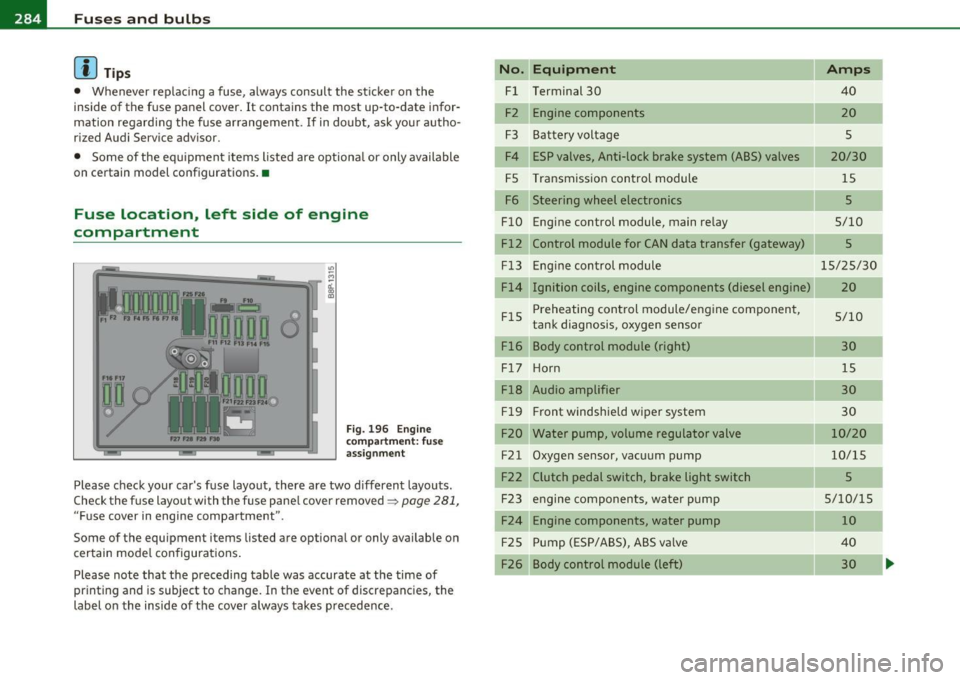
Fig. 196 Engine
compart ment: fuse
assignment
Please check your car's fuse layout, there are two different layouts.
Check the fuse layout with the fuse panel cover removed~
page 281,
"Fuse cover in engine compartment ".
Some of the equipment items listed are optional or only available on
certain model configurations .
Please note that the preceding table was accurate at the time of
printing and is subject to change . In the event of discrepancies, the
label on the inside of the cover always takes precedence .
No. Equipment
Fl Terminal 30
F2 Engine components
F3 Batteryvoltage
F4 ESP valves, Anti-lock brake system (ABS) valves
FS Transmission control module
F6 Steering wheel electronics
FlO Engine control module, main relay
Fl2 Control module for CAN data transfer (gateway)
Fl3
FlS
Fl6 Engine
control module
Ignition coils, engine components (diesel engine)
Preheating control module/engine component,
tank diagnosis, oxygen sensor
Body control module (right)
F l7 Ho rn
Fl8 Audio amplifier
Fl9 Front
windshield wiper system
F20 Water pump, volume regulator valve
F21 Oxygen sensor, vacuum pump
F22 Clutch pedal switch, brake light switch F23 engine components, water pump
F24 Engine components, water pump
F25 Pump (ESP/ABS), ABS va
lve
F26 Body control module (left)
Amps
40
20
s
20/30 15
5
5/10
5
15/25/30
20
5/10 30 15
30
30
10/20
10/15
5
5/10/15 10
40 30
Page 306 of 320

__ _:._A..:. l:.! p:.. h ::....:..:: a:.:b:.. e=-= t.:..:ic :.:a:.. l:.....:..: in~ d:...:e :..: x.:...._ ___________________________________________ _
A
ABS
See Anti-lock brake system ........ 192
AC (air conditioner) .. ... ....... ...... 97
Accessories ................ .... .. .. 301
Adapter for anti -theft wheel bolts . .... 27S
Adding Engine coolant ... ............... 236
E ngine oil ....................... 232
Windshield washer flu id ........ ... 243
Additional accessories .. ............. 301
Add itional heater
Climate controls ................. 102
Additives Engine oil .. .. .. .. .. .. .... .... ... 232
Adjustable steering wheel column . .... 105
Adjusting Steering wheel column . .. .. .. ..... 105
Adjusting front seats .............. .. . 73
Advanced Airbag System Components ............. .... ... 152
Fr ont airbags . .. ................. 150
How the components work together . 153
Monitoring .. ................. .. 156
PASS ENGER AIR BAG OFF light .. ... 157
Air conditioner ....... ............... 97
See also Climate controls ....... ... . 95
Air conditioning Switching on and off ..... .......... 97
Air distribution Climate controls .. .... ... ...... .. 100 Air outlets
Adjusting the outlets for rapid
defrosting/defogging ........... 101
Climate controls ............... .. 101
Air quality sensor .................... 99
Air recirculat ion .......... ... ... ... . 100
Climate controls . . . . . . . . . . . . . . . . . . 99
When shou ld I use the air recirculat ion? ..
99
Air rec irculat ion mode Side curtain airbags .
........... .. 164
When must the system be inspected? 156
All Wheel Drive .. .... .. ........... .. 194
Alloy wheels ............ .... ..... .. 212
All-wheel drive Winter t ires .. .. .... ..... ..... . .. 261
Alternator
See Genera tor ........... .. .. .. .. . 15
Aluminum alloy whee ls ....... ... .. .. 212
Ambient lighting .............. ...... 62
Climate controls .................. 99
6
Anti-glare inside day-night mirror.
. . . 3, 64
Airbag
Anti-lock brake system
Warning/indicator l ights . .. .. .. .. .. 15 k
How the ABS system wor s .. .... .. 192
Ai rbag System
Warning/indicator lights ... ........ 16
Weight-sensing mat ... .... .. ..... 168 ( )
Anti-Slip Regulation System ASR
Airbag system ................ .. 145, 162 H th t k l90
ow e sys em wor s ........ ... .
Advanced Airbag System .......... 149
159 Anti-theft systems
Care .................... .. .. .. .
Child restraints ...... ... .. .. .... . 169 Anti-Theft Alarm System ........... 48
Children ....... .. .. .. ...... .... .
168 Anti-theft whee
l bolts . ......... ... .. 275
Components (front airbags) . .. .... . 152
Danger of fitting a child safety seat on the front passenger seat ............ 147
Disposal ........ .... ..... .. .... . 159
Front airbags .............. ... .. . 149
How do the front ai rbags work? .. ... 154
How many airbags does my vehicle have? .
152
Important things to know ... ... .. . 145
Indicator light ................... 156
Monitoring .............. .. ... .. 156
Repairs ......... .... ..... .. .. ... 159
Side airbags ..................... 161 Armrest
Center armrest . .................. 79
Rear armrest .. .. ... .. . .. .. .. .. .. . 80
ASR How the Anti-Slip Regulation System works . ........... ...... .... .. 190
Asterisk What does it mean when something is
marked with an asterisk? . . . . . . . . . . . 5
Audi magnetic ride . ........... .. . 12, 112
Description .. ...... ............. 112
Indicator light .... .. ............. . 12
Page 307 of 320
_____________________________________________ A_ L .... p_ h _ a_b_ e_ t_ ic_a_ l_ in_ d_e _ x __ _
Audi Service Repair Manuals and Literature
299
AUTO
Climate controls ..... .. .. ....... ..
98
Switching on ........... .. .. .. .. .. 98
When should I use AUTO? . .. .... .. .. 98
Auto Safety Hotline .... .. .. .. .. ..... 133
Automatic air recirculation ......... .... 99
Automatic belt retractor .......... .. . 139
Automatic car wash
See Washing ....... .. .. .. .. .... . 207
Automatic headlights
defective .............. ..........
36
Automatic Transmiss ion
Automatic Transmiss ion .. .. .. .... .
118
Automatic transmission ........... .. . 115
Driving Notes . ...... .. .. .. .. ..... 117
Emergency program .... ..........
121
Emergency release ............ ... . 121
Ignition key safety lock ....... ... .. 106
Kick-down ..... ......... ... .. .. . 120
Launch Control Program .. .. .. .. .. . 120
Selector lever lock ... .... .. .. .. .. . 116
Selector lever positions ..... .... .. . 115
Tiptronic .................... ... . 119
T iptronic controls on the steering wheel .
120
Average fuel mileage ........ ... .. .. .. 21
Average speed ......... ...... .. .. .. .. 21
Avoid damaging the vehicle .. .. .. .. .. . 199
Controls and equip
ment Safety first
B
Battery
... .. ... ... ................. 238
charging . .. .. .. .... .... .. .. ..... 241
Disconnecting and connecting ...... 238
Important warnings when work ing on the
battery ..... ........... ...... ..
239
Low . .. .. .. .. .... .... .. ......... 194
Replacing the battery .. .. .. .... ... 242
State of charge ..... .. ... ...... .. 194
Winter operation ..... ..... ....... 239
Working on the battery .... .... .... 239
Battery voltage .. ........... ...... .. . 35
Before driving .. ... .... .. .. .. .. .....
125
Bioethanol
Engine preheater .... ....... ......
103
Blended gasoline ................. .. 219
Body cavity seal ing . ...... .. .........
212
Booster seats . .. .. ...... ........... 17 5
Brake assistant . ................. ...
193
Brake booster ... .. .... .. .. .. ... ... . 192
Brake fluid
Changing the brake fluid ......... ..
238
Checking the brake fluid level ..... .. 237
Reservoir .. .. .. ... ..... ......... 237
What is the correct brake fluid level? . 23 7
What should I do if the brake fluid warning light comes on? . ... ... ..........
237
Brake pads .. .. .. .... ....... ...... .. 197
Brake system .. .. .. ........ ......... 237
Anti-lock brake system . .. .. ..... ... 16
Brake fluid . ................ ..... 23 7 Brake fluid specifications for
refill and
rep lacement .................. .
238
Brake light defective ....... .... .. .. 36
General information ............ .. 191
How does moisture or road salt affect the
brakes? ... .... .. ..............
191
Malfunction ........ ...... .... .. .. 32
Warning/indicator lights ... .... .. .. 15
Worn brake pads symbol ........... 35
Break-in period ... .. .. .... ... ..... ..
197
Brake pads .. .............. ...... 197
Tires ... ...................... .. 197
Bulbs ................ .. .. .. .... .. . 285
C
California Proposition 65 Warning .. .. . 227
Battery specific .. ................ 241
Capacities ............ ...... .... ... 296
Car care ... ..... ........... ........ 206
Interior ........... .. . .. .. .. .. .. . 213
Plastic and vinyl .. .. ............. . 210
Weatherstrips ........ .... .... .. . 211
Care of exterior . ...... .. . .. .. .. .. .. . 206
Cargo area
See Loading the luggage compartment ..
131
Cargo net ............. ...... .. .. .. .. 83
Catalytic converter .. .. .... .......... 198
Center armrest . .. ... ................ 79
Centigrade
Switching between Centigrade and Fahrenheit . .............. ...... .
99
Vehicle operation Vehicle care Do-it-yourself service Technical data