towing AUDI S3 2011 User Guide
[x] Cancel search | Manufacturer: AUDI, Model Year: 2011, Model line: S3, Model: AUDI S3 2011Pages: 320, PDF Size: 75.79 MB
Page 257 of 320

Steps for Determining Correct Load Limit
1.Locate the statement "THE COMBINED WEIGHT OF OCCUPANTS AND CARGO
SHOULD NEVER EXCEED XXX KG OR XXX LBS"on your vehicle's placard (tire infla
tion pressure label) =>
page 249,
fig. 171.
2. Determine the combined weight of the driver and passengers that will be riding in your vehicle.
3. Subtract the combined weight of the driver and passengers from
"XXX" kilo
grams or
"XXX" pounds shown on the
sticker =>
page 249, fig. 171.
4. The resulting figure equals the available amount of cargo and luggage load
capacity. For example, if the
"XXX"
amount equals 1400 lbs. and there will be five 150 lbs . passengers in your
vehicle, the amount of available cargo
and luggage load capacity is 650 lbs.
(1400-750 (5
X 150) = 650 lbs.)
Safety first
Tires and wheels -
5. Determine the combined weight of
luggage and cargo being loaded on the
vehicle. That weight may not safely exceed the available cargo and luggage
load capacity calculated in Step 4.
6. If your vehicle will be towing a trailer ,
load from your trailer will be transferred
to your vehicle. Consult this manual to
determine how this reduces the available cargo and luggage load capacity of your
vehicle.
- Check the tire sidewall(=>
page 257,
fig. 175) to determine the designated
load rating for a specific tire . •
Vehicle care Technical data
Page 275 of 320
What do I do now? -________________ Vflll
- Move selector lever to position Pon an automatic trans
mission; put manual transmission in
first gear=> &.
-If you are towing a trailer: unhitch the trailer from your
vehicle.
- Take the
tool and the spare tire=> page 270 out of the
luggage compartment.
& WARNING
You or your passengers could be injured while changing a wheel if
you do not follow these safety precautions:
• If you have a flat tire, move a safe distance off the road. Turn
off the engine, turn the emergency flasher on and use other
warning devices to alert other motorists.
• Make sure that passengers wait in a safe place away from the
vehicle and well away from the roadway and traffic.
• To help prevent the vehicle from moving suddenly and possibly
slipping off the jack, always fully set the parking brake and block
the wheel diagonally opposite the wheel being changed. When one front wheel is lifted off the ground, placing the automatic
transmission in "P" (Park), or engaging a gear in a manual trans
mission will
not prevent the vehicle from moving.
• Before you change a wheel, be sure the ground is level and
firm. If necessary, use a sturdy board under the jack .
• After installing the spare wheel, make sure that you remount
the flat tire/wheel in its storage area properly and tighten the
knurled retaining screw securely. •
Safety first
Changing a wheel
When you change a wheel, follow the sequence described
below step-by-step and exactly in that order.
1. Remove the decorative wheel cover*. For more details see
also =>
page 274, "Decorative wheel covers" or
=> page 275, "Wheels with cap-covered wheel bolts".
2. Loosen the
wheel bolts=> page 276.
3. Locate the proper mounting point for the jack and align the jack below that point=>
page 276.
4.
Lift the car with the jack=> page 2 76.
5. Take the
flat wheel off and then put the spare on
=> page 278.
6. Tighten all wheel bolts lightly.
7.
Lower the vehicle with the jack.
8. Use the wheel bolt wrench and
firmly tighten all wheel
bolts=>
page 276.
9. Put the decorative
wheel cover* back on.
& WARNING
Always read and head all WARNINGS and information~ & in
"Raising the vehicle" on
page 276 and~ page 279. •
After changing a wheel
A wheel change is not complete without the following
actions.
- Store and secure the replaced wheel in the spare wheel
well. .,._
Vehicle care Do-it-yourself service Technical data
Page 288 of 320
111.___E_ m_ e_r-= g=- e_ n_c-= y'-- s_ i_t _u _a_ t_ i_ o _ n_ s ____________________________________________ _
Emergency situations
General
This chapter is intended for trained emergency crew s and working
pe rsonnel who have the necessary tool s and equipment to perform
the se operation s. •
Starting by pushing or towing
0 Note
Veh icles with an automatic transmission cannot be started by
pushing or towing .•
Starting with jumper cables
J umper c able : Note the manufacturer 's information .
If the battery is discha rged, another ve hicle can p rovide sta rting
assistance. For this yo u require a jumper cab le. Bot h batter ies m ust
h ave the s ame vo lt a ge (V) and a sim ila r cap acity (Ah).
Jumper cables Use
only jumpe r cables o f sufficiently la rge cross section to safely
carry the starter current. Refer to the man ufact urer's spec ificat ions.
Use only j umpe r ca bles with
isola ted t ermin al cl am ps and pro p erl y
marked for distinct ion:
plu s(+) cable in most cases co lored red
minus( ·) cable i n most cases colo red black .
T he w ire cross sect ion must be at least 0.038 in
2 (25 mm2
) for gaso
line engines and a t least 0. 054 in
2 (3 5 mm2
) for diese l engines.
& WARNING
Batterie s contain el ectricity, acid, and gas . Any of the se can cause
very serious or fatal injury. Follow the inst ructions below for safe
handling of your vehicle 's battery.
• Always shield your eyes and avoid leaning over the battery
whenev er po ssible .
• A discharged battery can alre ady freeze at temperatures just
below 32 °F (0 °C) . Never attempt to provide starting assistance
on a frozen or thawed out battery- Danger of explosion and chem
ical burns! Replace a battery if it has been frozen.
• Do not allow battery acid to contact eyes or skin. Flush any
contacted area with water immediately .
• Improper u se of a booste r battery to start a vehicle m ay cause
an explosion .
• Vehicle batteries generate explosive gases . Keep sparks, flame
and lighted cigarettes away from batteries .
• Do not try to jump start any vehicle with a low acid level in the
battery .
• The voltage of the booster battery mu st also have a 12 -Volt
rating. The capacity (Ah) of the booster battery should not be
lower than that of the discharged battery . Use of batteries of
different voltage or substantially different "Ah" rating may cause
an explosion and personal injury.
• Never charge a frozen battery . Gas t rapped in the ice may cause
an explosion .
• Never charge or use a b attery that has been frozen. The battery
case may have be weakened.
• Use of batteries of different voltage or substantially different
capacity (Ah) rating may cause an explosion and injury. The
capacity (Ah) of the booster battery should not be lower than that
of the di scharged battery .
~
Page 291 of 320
_____________________________________________ E_ m_ e_r-= g ::.. e_ n_c-= y'- s_ i_t _u _a_ t_ i_ o _ n_ s __ _
13. Disconnect the cable w hile the engine is runn ing exactly
in
reverse or der to t hat described in~ page 288,
"Connec ting/discon nect ing the jumper cable" . When
doi ng so , ma ke sure that t he cab le ca nnot contact rotat ing
eng ine parts .
14 . T urn the h eater bl ower a nd th e re ar w indow hea tin g off
a gain.
Th e bat tery is ven ted to the o utsi de to p reven t ga ses from en ter ing
the ve hicle interior .
M ake s ure that the jumpe r clamps a re well connected w ith their
metal parts in full contact with t he battery termi na ls .
& WARNING
To avoid serious personal injury and damage to the vehicle, heed
all warnings and instructions of the jumper cable manufacturer . If
in doubt, call for road service.
• Jumper cable s mu st be long enough so that the vehicles do not
touch.
• When connecting jumper cable s, make sure that they cannot
get caught in any moving parts in the engine compartment.
• Before you check anything in the engine compartment, always
read and heed all WARNINGS=>
page 218, "Engine compart
ment ".
0 Note
Im pro perly con ne cte d jum per c abl es c an dam age or destroy the
generator.
• Do not use the ba ttery nega tive term inal for jum p star ting or a
ma lf u nction co uld occ ur in the vehicle electrica l system .
• Always co nnect POSITIV E(+) to POSI TIVE( +), a nd NEGATIVE( -)
to N EGATIVE{ -) termina l.
Safety first
• Check that all screw p lugs on the battery cells are screwed in
fir mly . If no t, tig hten plugs pr ior to connectin g clamp o n negative
battery term inal.
• P lease note that the pr ocedur e fo r connecting a jumper cable as
described above app lies specifically to the case of your vehicle being
jum p st ar te d . When you are giving a jump start to anot her vehi cle, do
not conn ect the m in u s (-) cable to t he minus( -) term inal on the
discharged battery ©=>
page 288, fig. 197 . In stea d, sec urely
connect the mi nus( -) cable to either a massive metal component
that is f irm ly bo lte d to t he eng ine block or to the engine bloc k itse lf .
If the battery that i s bei ng charged does not ven t to t he ou tside,
escaping battery gas could ignite and explode! •
Emergency towing with
commercial tow truck
c;eneral hints
Your Audi requires s pecial h andling for to win g.
The follow ing informat ion is to be used by commercial tow truck
oper ator s w ho know how to oper ate th eir equipmen t sa fe ly.
• Never tow your Audi, towing will cause damage to the engine
and transmission.
• Never wrap the safety chains or winch cables around the brake
lines.
• To prevent unnecessary damage, your Audi must be transported
with a car carrier (flat bed truck ).
• To load the vehicle on to the flat bed, use the towing loop found
in the vehicle tools and attach to the front or rear anchorage
=> page 290 and=> page 290 . ..
Vehicle care Do-it-yourself service Technical data
Page 292 of 320
llffl!l.,___E_ m_ e_r-=g :.. e_ n_c -=y '-- s_i_t _u _a _ t_ i_ o _ n_ s ____________________________________________ _
& WARNING
A vehicle being towed is not safe for passengers. Never allow
anyone to ride in a vehicle being towed, for any reason. •
Front towing loop
Do not install the front towing loop until it is needed .
Fig. 198 Front
bumper: removing the
cover cap
Fig. 199 Front
bumper: screwing in
the towing loop
The towing loop fits into the threaded hole located on the
right side of the front bumper and covered by a small cover
when not in use. Note that the towing loop has a
left-hand
thread!
- Remove the towing loop from the vehicle toolkit
=> page 270.
-Press on the bottom edge of the cover cap to disengage
and take it out of the bumper. The cap remains connected
to the bumper => fig. 198.
- Insert the towing loop into the threaded hole=> fig. 199
and turn it all the way in unt il it is seated securely, then
tighten it with the wheel bolt wrench .
When it is no longer needed , unscrew the towing loop and put it back
into the on-board toolkit. Make sure to have the towing loop stored
in the vehicle at all times .
& WARNING
If the towing loop is not screwed in as far as it will go, the thread
can pull out when the vehicle is towed -potential risk of an
accident. •
Rear towing loop
Do not install the rear towing loop until it is needed.
Fig. 200 Rear
bumper: cover
Page 293 of 320
_____________________________________________ E_ m __ e_r-=g =- e_ n_c -==y "- s_i_ t _u _a _ t_ i_ o _ n_ s _ __.fflll
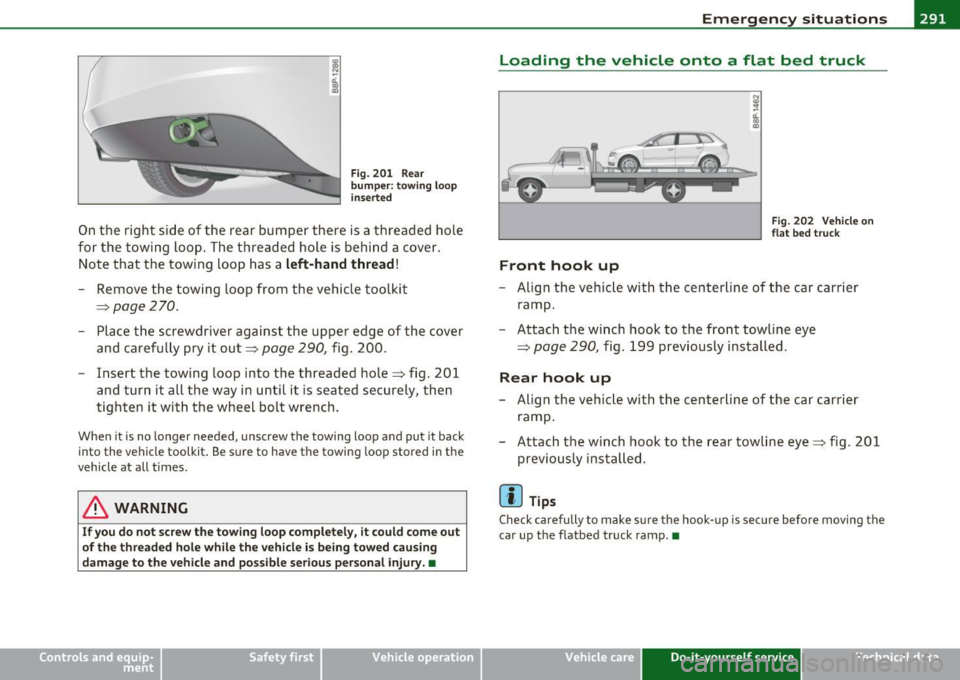
Fig. 201 Rear
bumper: towing loop
inserted
On the right side of the rear bumper there is a threaded hole
for the towing loop. The threaded hole is behind a cover.
Note that the towing loop has a
left-hand thread!
Remove the towing loop from the vehicle toolkit
=> page 270.
Place the screwdriver against the upper edge of the cover
and carefully pry it out :::>
page 290, fig. 200.
- Insert the towing loop into the threaded hole=> fig. 201
and turn it all the way in until it is seated securely, then
tighten it with the wheel bolt wrench.
When it is no longer needed, unscrew the towing loop and put it back
into the vehicle toolkit. Be sure to have the towing loop stored in the
vehicle at all times.
& WARNING
If you do not screw the towing loop completely, it could come out
of the threaded hole while the vehicle is being towed causing
damage to the vehicle and possible serious personal injury. •
Vehicle OP-eration
Loading the vehicle onto a flat bed truck
Front hook up
N (0 :? 0:. CD
"'
Fig. 202 Vehicle on
flat bed truck
- Align the vehicle with the centerline of the car carrier
ramp.
- Attach the winch hook to the front towline eye
=>
page 290, fig . 199 previously installed .
Rear hook up
-Align the vehicle with the centerline of the car carrier
ramp.
- Attach the winch hook to the rear towline eye=> fig. 201
previously installed.
rn Tips
Check carefully to make sure the hook-up is secure before moving the
car up the flatbed truck ramp. •
Vehicle care Do-it-yourself service iTechnical data
Page 310 of 320
-Alphabetical inde x _...,___ _ ______:_:__:_=.:..:...._ _________________ _
Emergency release for selector lever ... 121 Engine hood
Emergency starting ...... .. .. .. ... .. 286 Closing
............. ... .. ... .... 226
Emergency towing . .. .... .. ..... .... 289 Release lever
.............. .... .. 225
Energy management ........ .. .... .. 194 Releasing and open
ing .. .... .... .. 225
Battery power ................. .. 196 Engine malfunction (diesel engine)
Dr iver not ification .... ..... ....... 196 Warning light ............
.. .. .. .. 13
Engine E
ngine oil ........ ...... .... .. .. ... 228
4-cylinde r diesel (140 hp) ...... ... 228 Add
ing ... ... .. .. .. .. .... .. .. ... 232
4-cylinder gasoline (200 hp) . ..... . 227 Add
itives . ... ... ... .. .... .. .. ... 232
Coolant ................ ...... .. 234 Changing
....... ... .... .. .. .... . 232
Hood . ............. .... .. .... .. 225 Checking the engine oil leve
l ..... .. 231
Preheater .... .. .. .. .... ......... 103 Diesel engine .........
.... .. ..... 233
Starting . .. ... ... .... .. .. ... 106, 107
Starting w ith jumper cables . ....... 286
Stopping .. .. ... ... .. ........ ... 108
Engine compartment .. ....... ... . .. . 227
Safety instructions ............. .. 226
Work ing in the eng ine compartment 226
Engine coo lant system . ....... ... . ... 234
Add ing coolant ....... .. ... .... .. 236
Checking coo lant level ... .. .. .. ... 235
Checking the engine coolant level . .. 235 Indicat
ions and conditions requir ing extra
c heck ing .. .................... 231
O il cons ump tion . .... .. .. ... .. .. . 230
Oil grades .... .. .... ...... .. ... . 228
Recommended oil check intervals . .. 231
Specification and viscosity .. .... .. . 228
Specifications D iese l engine . .. ..... 233
Specifications gaso line engine . .... . 228
Engine oil leve l ... .. .... .. .. ...... .. . 3 4
E ngine oil p ressure (mailf u nctio n) ... .. . . 33
Radiator fan ............ ...... .. 237 Engine oil sensor defective
... .. .. ... .. 35
Engine coo lant tempe ra tur e E
ngine preheater ........ .... .. ..... 103
Ga uge ... .. .. .. .. .. .. ... . .. .. .. .. 9 Connecting ................
.... . 103
E ngine coo ling system Engine speed lim
itation . .... ... .... ... 34
Malf unct io n .. ... ......... .... .... 32 Environment
E ngine data ................ ...... .. 296 Brea
k-in period .. .... .. .. ... .... . 197
Engine fau lt
W arning light ........... ...... ... 13 Catalytic converter . . . . . . . .
. . . . . . . 198
Diesel particulate filter ............ 199
Disposing of your vehicle battery . .. . 242
Dr iv ing at hig h speeds .......... .. 200 Dr
iv in g to mi nimize pollution and noise ..
20 0
Fuel . ... .. .. .. ...... ... .. .. . ... 222
Fue l economy . ... .. .. .. ... .... .. 200
Leaks under yo ur vehicle ... .. .. .. . 226
Letting the vehicle stand and warm up ... 200
Proper disposa l of dra ined br ake fluid 238
Proper disposa l of dra ined engine coo lant
236
Prope r disposal of dra ined engine oil 232
Recycl ing used eng ine o il .......... 232
Unleaded fue l ............. .. .. .. 219
W hat sho uld I do w it h an old batte ry?
242
EPC
See Electronic power control . . . . . . . . 13
ES P
See Elect ronic Stability P rogram .. .. 188
Event Data Recorder ( EDR) .. ......... 188
Exhaust ta il pipes
Cleaning ... .... .... .. .. ...... .. 213
Expans ion tank .. ... ................ 235
F
Fahrenheit
Switching between Fahre nhe it and
Centigrade ..... .. .............. 99
Fan Adjusting the fan s peed .. ......... 1 00
Climate cont rols . ... .. .. ... .. ... . 10 0
Radiator ... .. ... ..... ... ...... .. 237
Page 313 of 320
___________________________________________ A_ l!,.. p _h _a_ b_ e_t _ic _a_ l_ in_ d _ e_x __ fflll
Light/rain senso r defective .......... ... 36
Lights ... .. .. .. ..... ....... .. .. . .. .. 56
Emergency flasher .. .. . ... ... .. ... . 59
Front fog lig hts .. .... .. .. .. .. ..... 58
Headlights ................... .. .. 56
H igh beam . . . . . . . . . . . . . . . . . . . 56, 59
High beam warning/indicator light ... 14
I n strument pane l illumination .. ... .. 58
Side marke r lights ........ ........ . 56
Turn s ignals ............... ... .. .. 59
Xe no n headl ights .............. .. .. 56
Loading the luggage compartment ..... 131
Loa ding the roo f rack .. .. .. ...... ..... 88
Locking Manual back-up ........ .. .........
47
Powe r locking switch .. ... .... ..... . 44
Rear lid .................. ...... .. 4 5
Remote cont rol ................... 42
Us ing the fo ld -out key .............. 43
Lower universal anchorage bars (Canada) .. .
180
Lower unive rsal a nchorages (Canada) .. . 180
Luggage Stowing .... ........... ...... .. . 131
L u ggage compartmen t
Cargo net ... .. .. .. ... ... .... .. .. . 83
Fastening eyes ... .. .. .. ...... .. .. . 82
Inc reasing size ... .. ...... ... . ... .. 81
Light ............................ 63
Retractable cover .................. 84
Sk i sack .......................... 85
See also Loading the luggage
comp artment .................. 131
Controls and equip
ment Safety first
Lumbar
support ...... ... .... ... .. .. . 77
M
Maintenance .......... .. .. ..... .... 299
Ma lfunction Ind icator Lamp (M IL) . . . 1 4, 20
Ma nual transmission ................ 114
Gearsh ift leve r ... ... ...... .... ... 114
Master key ................. .. .. .. .. .
39
Battery replacement ............... 40
Master key remote control ..... .. .. .... 39
Menu button .. ... ................... 24
Men u display
Dr iver Info rmation Display ..........
22
Mirrors
Act ivat ing t he d igita l compass ... .. ..
71
Adjusting the anti -g la re . . . . . . . . 63, 64
Automatica lly dim ming inside mirror . 64
Inside day-night mirror ..... .. .. .... 63
Interior mirror . . . . . . . . . . . . . . . . 63, 64
Outside mirrors . ............... ... 65
Monitor ing the Adv anced Airb ag Sys tem 156
Mounting hooks ............... ...... 83
N
Natural leathe r .................. ... 215
New tires and whee ls ..... .. ... .... .. 257
NHTSA
Conta ct ing . .. .... .... .. ... ...... 133
Number of seats ...... ... .... .... ... 135
0
Occupan t seating positions ........... 126
Octane rating . ... .. .. .. .... ... . ... . 219
Odomete r .................. .. .. .. .. 10
Oil
What kind of oil shou ld I put in my eng ine?
228
See also E ngine o il ....... ... . ... . 228
On -Board Diag nostic System ... .... .. .. 20
E le ctroni c speed lim iter .......... .. 20
M alfu nction Indi cato r Lamp ( MIL) .... 20
On-Board Diagnostic System (OBD) .. .. .. 20
Data Link Connecto r (DLC) .......... 20
Open door or front lid wa rning ... . ... .. 18
Ope ra te you r ve hicl e economically a nd mini-
mize pollution .................. 200
Optiona l equipmen t
Marked with an aste risk ... .. .. .. .... 5
O ther eq uipment (effic iency p rogram) ... 26
Outlets ... .. .. .. ...... .. ... .. . ... .. 90
Outside air poll utio n
How to preve nt from enteri ng the vehicle
100
Outside mirrors .. ..... .. . .. ...... .. .. 65
Ou tside temperature display ........... 18
Owner's manual How the Owner's Manual is organ ized .. 5
p
Paint
Touch-up . .. .. .... ..... ........ . 210
Vehicle operation Vehicle care Do-it-yourself service Technical data
Page 317 of 320
Alphabetical index -________________ fWI
Tire specifications ........ .. .. ... . 258 Transmission Vehicle Identification Number (VIN) ... . 294
Tread depth ....... .............. 256 6-speed . .. ................ ... .. 114
Vehicle jack .. ............... .. 270,276
Uniform t ire quality grading ....... . 260 Manual transmission .............. 114
Vehicle literature ... .......... ...... .. 4
Winter tires ..................... 261 S tronic transmission . ............. 115
Vehicle-care products .. .. ..... .... .. . 206
Tires and vehicle load limits ........... 253 Transport Canada ................... 133
Tir es and wheels Tread Wea r Indicator (T WI) .. .. ....... 256
w
Checking tire pressure ............. 252
Trip computer ......... .............. 21
Cold tire inflation pressure ......... 249
Trip odometer ... .... .. .............. 10 Warning light
Dimensions .... .... .. .. ......... 257
What does it mean when dEF appears in Tire pressure monitoring
system ... .. 36
General notes ........... .... .. .. . 245
the trip odometer disp lay? .. .. .. .. . 10 Wa
rning lights . ...... ............. 8 , 11
Glossary of tire and loading terminology .
246
New tir es and wheels .......... .. . 257 Turn
sign als ... .. ... ........ ...... ... 59
Warning/indicator lights ........ .. . 14 Red symbols in the center display
.. .. 30
Yellow symbols in the center display . . 30
Warning/indicator l ights
Replacing .............. ...... .. . 258
Snow chains .............. .. .. ... 262
Tires and vehicle load limits .. .. .... 253
Wheel bolts ................ .. ... 263
Winter tires ..................... 261
u
Undercoating ... .... .... ........... 213
Unfastening safety belts ............. 142
Unidirect iona l tires ...... ... ......... 245 Airbag system ......
.......... .. .. 15
Anti -lock brake system (ABS) ........ 16
Brake system ..................... 15
Cruise control .................... 14
Electronic power control ... ......... 13
Tires/Wheels
Low aspect ratio tires ............. 264
Tir e pressure mon itoring system 13, 264
Torn or frayed safety belts ......... .. . 138 Uniform tire quality grading
.... ...... 260
Unlocking Power locking switch ............ .. . 44
Rear lid ................. .. .... ... 45 E
lectronic stabilization program (ESP) 14
Engine malfunction (diesel engine) ... 13
Generator . .. .... .. .... ........... 15
Glow plug system .. ............... 13
Touch-up paint ................ .. .. . 210
Remote control .. ... .... .......... 42 High beam
.. ..................... 14
T owing
Front eyelet ..................... 290 Using the fo
ld-out key .. .. .......... 43 Malfunction
Indicator Lamp (MIL) .... 14
Parking brake .. ...... .... ... . ... .. 15
Rear eyelet ...................... 290
T ow truck procedures ... .......... 289
V
Safety belt ................ ....... 15
Tire pressure monitoring system . .. .. 13
TPMS Vanity mirror ................
.... ... . 63 T
urn s ignals .............. ...... .. 14
Tire pressure monitoring system .... 265 Vehicle battery Warranty coverages
................. 299
Trailer towing ............. ...... .. . 202 Stationary .
.. .. ...... ........... 239 Washer
reservo ir ............ ... .. .. . 243
Operating instructions ......... .. . 203 Vehicle electrical system .. ............ 15 Wash
ing .................... ... ... 206
Tech nical requirements ....... 202, 203
Vehicle identification ........ .. .... .. 294 Automatic car wash
.......... ..... 207
Trailer towing tips .... ... .. .. ... .. 204
Vehicle identification label ............ 294 by hand .........
.. .. ...... .. .. . 207
Controls and equip
ment Safety first Vehicle operation
Vehicle care Do-it-yourself service Technical data