battery AUDI S3 2011 Owner's Manual
[x] Cancel search | Manufacturer: AUDI, Model Year: 2011, Model line: S3, Model: AUDI S3 2011Pages: 320, PDF Size: 75.79 MB
Page 228 of 320
___ C_ h_ e_c _k _i _ n _g ~ a_n _d_ f_il _l_in _ g _________________________________________ _
Closing the engine hood
- Pull the hood down until the pressure from the strut is
reduced.
- Let the hood
drop down and latch in place . Do not try to
push it shut;
it may fail to engage=> &.
& WARNING
A hood that is not completely latched could fly up and block your
view while driving.
• When you close the engine hood, check it to make sure the
safety catch has properly engaged. The hood should be flush with
the surrounding vehicle body parts.
• If you notice while driving that the hood is not secured prop
erly, stop at once and close it. •
Working in the engine compartment
Be especially careful whenever you work in the engine
compartment!
Whenever you must perform any work in the engine compartment,
for example checking and filling different fluids, there is a risk of
injury, burns and accidents. To prevent personal injury always
observe the following WARNINGS. The engine compartment of any
vehicle is a hazardous area!~
&
& WARNING
To help avoid injury, before you check anything under the hood :
• Turn off the engine.
• Remove the ignition key.
• Set the parking brake fully.
& WARNING (continued)
• Move selector lever of automatic transmission to "P" (Park);
put manual transmission in Neutral.
• Always let the engine cool down. Hot components will burn
skin on contact.
• To reduce the risk of being burned, never open the hood if you
see or hear steam or coolant escaping from the engine compart
ment. Wait until no steam or coolant can be seen or heard before
carefully opening the hood.
• Keep children away from the engine compartment.
• Never spill fluids on hot engine components. They can cause a
fire.
• Never touch the radiator fan. The auxiliary electric fan is
temperature controlled and can switch on suddenly.
• Never open the coolant reservoir cap when the engine is still
warm. The coolant system is pressurized and hot coolant could
spray out!
• Protect your face, hands and arm from steam or hot engine
coolant by placing a thick rag over the cap when you open the
coolant reservoir.
• If work on the fuel system or the electrical system is necessary:
-Always disconnect the battery .
- Never smoke or work near heaters or open flames. Fluids in
the engine compartment could start a fire.
- Keep an approved fire extinguisher immediately available.
• To avoid electrical shock and personal injury while the engine is
running or being started, never touch:
- Ignition cables
- Other components of the high voltage electronic ignition
system.
• If you must perform a check or repair with the engine running: .,_
Page 229 of 320

___________________________________________ C..:__ h:..:.e ..:.c :..:. k.:.... i..:....n :..::g~ a:..:.n..:.... d::.:....: f..:. i.:..:ll :.:.i.:...:n ~g !...._.....Jfflll
& W ARNING (co ntinued )
-First, fully appl y the parking brake , move sele ctor lev er of
automatic tran smission to "P" (Park ); put manual transmis
sion in Neutral.
- Always use extreme caution to prev ent clothing , jewelry, or
long hair from getting caught in the radiator fan , V-belt s or
other moving p art s, or from contacting hot part s. Tie back hair
before starting , and do not wea r clothing that will h ang or
droop into the engine.
• Minimize expo sure to emission and chemical hazards~& .
& WARNING
California Proposition 65 Warning:
• Engine exh aust, some of its constituents , and certain vehicle
c omponents contain or emit ch e mical s known to the State of Cali
fornia to cause can cer and birth defects and rep roductive harm . In
addition , certain fluids contained in vehicle s and certain product s
of component wear contain or emit chem icals known to the State
of California to cau se cancer and birth defect s or other reproduc
tive harm.
• Battery posts, terminal s and related acce ssories contain lead
and lead compounds, chemicals known to the State of California
to cause cancer and reproductive harms . Wash hand s after
handling .
0 Note
When adding fluids, always make sure that they are pou red into the
proper co ntainer or filler opening, otherwise serio us damage to
vehicle systems w ill occur.
Vehicle OP-eration
ffi For the sake of the environment
To detect lea ks i n time, inspect the veh icle floor pan from unde rneath
reg ularly. If yo u see spots from oil or other vehicle fluids, have your
veh icle inspected
b y an au thori zed Au di dea le r. •
Engine compartment
A pp lies to vehicles : w it h 2.0 l t urbo. 4 -cyl ind er en gi ne
2.0 Liter, 4-cylinder turbo gasoline engine
(200 hp)
The se are the most importan t it ems that you can c hec k.
Fig . 16 1 Engi ne c om part men t: 2 .0 I , 4 -c yli nder t urbo
© Coolant expansion tank (-L ) ... ................. .
@ Windshield washer container (W ) .... .... .. .. .. .. .
® Engine oil dipst ick (orange) . ... .. .... .... ... ... . .
Vehicle care Do-it-yourselt service 235
243 231 ~
iTechnical data
Page 240 of 320
___ C_h_ e_c _k _i_n -=g :a,__ a_n_ d_ f_ i_ l _li _n _,g;._ __________________________________________ _
warning/ind icator light will illum inate. Contact an au thorized A ud i
d ealer
immediately .•
Changing brake fluid
H av e th e b rake flu id chang ed by an exper ienced tech ni
ci an.
Br ake flui d abs orbs m oisture fro m the ai r. If t h e w ater con ten t in the
brake fl uid is too hig h, cor ros ion in th e brake system may res ult afte r
a p eriod of time. The boiling po int of t he br ake fl uid will al so decre ase
cons iderab ly and decrease brak ing perfo rma nce .
T he refo re, the brake fl uid m ust be c hanged
every two years . Always
use new brake fluid w hich conforms to Federal Motor Veh icle Stan
dard "F MVSS 1 16 DOT 4".
Th e b rake fl uid r eservo ir can be diffi cult t o re ach, there fore, we
recommend that you have the brake fluid changed by your author ized
Audi dealer . Your dealer ha s t he correc t tool s, the ri ght brake fl uid
and the know -how to do t his for you.
& WARNING
• Brake fluid is poisonous. It must be stored only in the closed
original container out of the reach of children!
• Brake failure can result from old or inappropriate brake fluid.
Observe these precautions :
- Use only brake fluid that meets SAE specification
J 1703 and
conforms to Federal Motor Vehicle Standard 116 . Always check
with your authorized Audi dealer to make sure you are using
the correct brake fluid. The correct type of brake fluid is also
indicated on the brake fluid reservoir .
- The brake fluid must be new. Heavy use of the brakes can
cause a vapor lock if the brake fluid is left in the system too
long . This can seriously affect the efficiency of the brakes as
well as your safety . This could result in an accident .
0 Note
Brake fluid will damage the paint of you r ve hicl e.
<£' For the sake of the environment
Beca us e of the prob le m of proper dispo sal of b ra ke fl uid as well as
the spec ia l too ls req uired and the necessary expe rtise , w e r ecom
me nd that you h ave t he brake fl uid chan ged by yo ur a uth oriz e d Audi
dea ler. •
Battery
General information
All wo rk on t he battery requires te chnica l k nowl ed ge !
Fig. 168 Engine
comp artment : Battery
with cover*
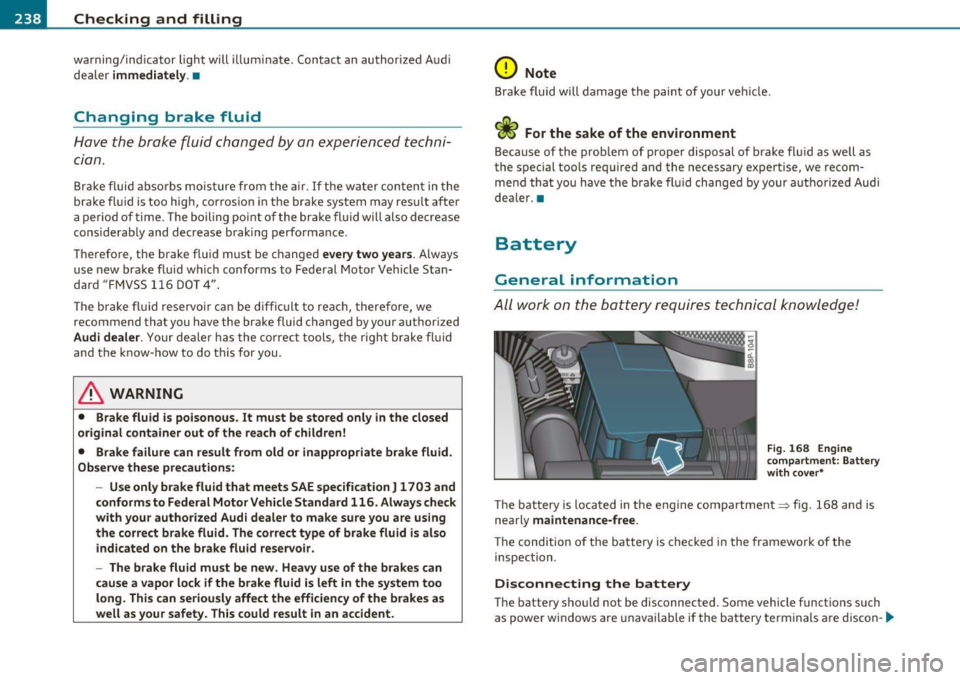
T he b att ery is lo cat ed in the e ng in e co mpar tmen t~ fig. 1 68 and is
nearly
maintenance-free.
Th e condition of the battery is che cked in the framewo rk of the
inspec tion .
Disconnecting the battery
The batte ry s ho ul d not be disconnected . Some vehicle funct io ns such
as powe r w indows are unavailable if the b attery te rminals a re discon -
~
Page 241 of 320

___________________________________________ C_ h_e _c _k_ i_n ~g_ a_n_ d_ f_ i_ll _i_n _g __ _
nected. These functions have to be relearned after the battery termi
nals are connected again. To prevent this, the battery should only be
disconnected from the vehicle electrical system if absolutely neces
sary.
Power window one-touch
up/down function
Reprogramming
~ page 51, "Reactivating the sys
tem after battery disconnection"
Master key with remote control Synchronization~
page 43
Digital clock ~ page 9
ESP indicator light The indicator light goes out after
driving a few meters
Vehicles not driven for long periods and short
distance operation
If you do not drive your vehicle for several days or weeks, e lectrical
consumers are gradually scaled back or switched off. Th is reduces
energy use and ensures the vehicle will be able to start after long
periods of time~
page 194. Some convenience functions such as
opening with the remote control key may not be available. These
convenience functions will be available again once you switch the
ignition on and start the engine. Even when consumers are switched
off, the battery will become deeply discharged by stand-by power
consumers if the vehicle is not driven for several months . Deep
discharging results in a chemica l reaction that destroys the inside of
the battery. The battery must be charged every month to prevent th is
~ page 241. Do not disconnect the battery or the anti-theft alarm
system* will not work.
Winter operation
Cold weather places higher demands on the battery. This results in
reduced starting abi lity. Have the battery checked and recharged if
necessary before the cold weather beg ins.
Avoid unnecessary power consumption, part icularly in city traffic or
when travel ing on ly short distances. Let your author ized Audi dealer
Safety first
check the capacity of the vehicle battery before winter sets in
~ page 241. A well charged battery will not only p revent start ing
problems when the weather is cold, but will also last longer.
(D Note
• All work on the battery requires techn ical knowledge. Please
contact an Audi dealership or another authorized facility for ques
tions about the battery- danger of acid burns and explosion hazard!
• The battery m ust not be opened! Do not try to change the
battery's liquid level, otherwise detonating gas will escape from the
battery - explosion hazard!
• The AGM battery in the luggage compartment cannot leak,
because the electrolyte for this battery is absorbed into a specia l
glass mat . This leak -proof battery must not be replace with a conven
tional battery .
• Make sure the ventilation hose on the side of the battery is
connected, otherwise fumes or battery acid can leak out.
• Battery holder and terminals always have to be secured correctly .
• Before all work on the battery follow the
warnings below~ & in
"Working on the battery" on
page 239. •
Working on the battery
All work on the battery requires technical knowledge! Be
especially careful when working on or near the battery!
Before you check anything in the engine compartment,
always
read and heed all WARNINGS~ & in "Working in
the engine compartment" on
page 226 .
Always heed the safety warnings, when working on the vehicle
battery or the vehicle electrical system to prevent injury .
Vehicle care Technical data
Page 242 of 320
-L~C::!h~e~c~k:.!_i~n~g~a~n~d~f~il~l:!_!in~g !...._ ________________________________________ _
The following WARNINGS are very important when
working on the battery:
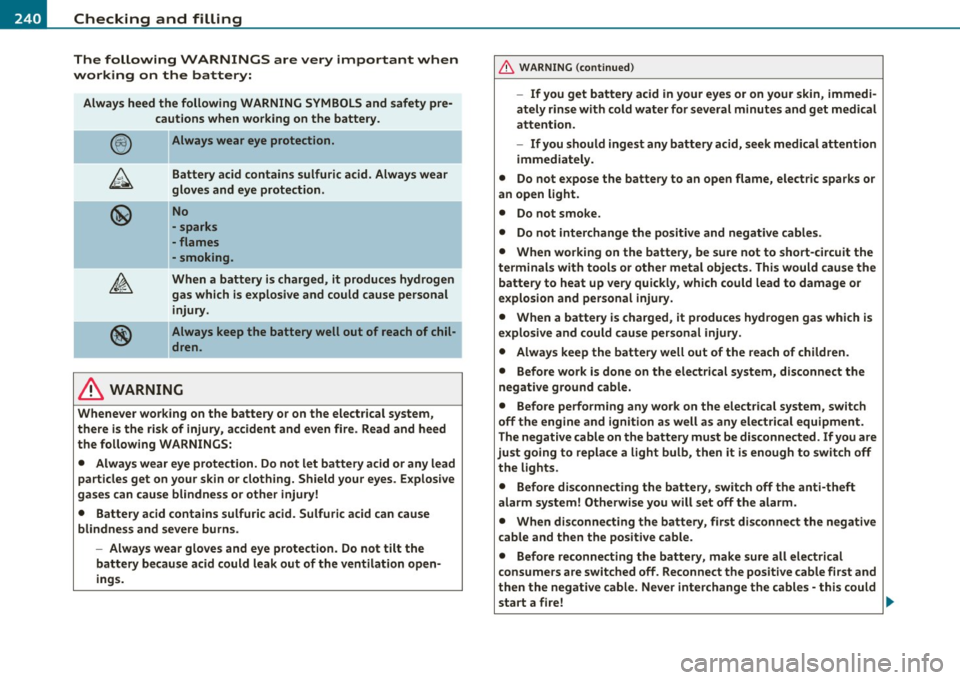
Always heed the following WARNING SYMBOLS and safety pre cautions when working on the battery .
@
®
Always wear eye protection.
Battery acid contains sulfuric acid. Always wear
gloves and eye protection.
No
• s parks
- flames
• smoking .
When a battery is charged, it produces hydrogen
gas which is explosive and could cause persona l
injury.
Always keep the battery well out of reach of chil
dren .
& WARNING
Whenever working on the battery or on the electrical system,
there is the risk of injury , accident and even fire. Read and heed
the following WARNINGS:
• Always wear eye protection . Do not let battery acid or any lead
particles get on your skin or clothing. Shield your eyes . Explosive
gases can cause blindness or other injury!
• Battery acid contains sulfuric acid. Sulfuric acid can cause blindness and severe burns.
-Always wear gloves and eye protection. Do not tilt the
battery because acid could leak out of the ventilation open
ings.
& WARNING (co ntinued )
-If you get battery acid in your eyes or on your skin, immedi
ately rinse with cold water for several minutes and get medical
attention.
- If you should ingest any battery acid, seek medical attention
immediately.
• Do not expose the battery to an open flame, electric sparks or
an open light .
• Do not smoke.
• Do not interchange the positive and negative cables.
• When working on the battery , be sure not to short-circuit the
terminals with tools or other metal objects. This would cause the battery to heat up very quickly, which could lead to damage or
explosion and personal injury.
• When a battery is charged , it produces hydrogen gas which is
explosive and could cause personal injury.
• Always keep the battery well out of the reach of children.
• Before work is done on the electrical system, disconnect the
negative ground cable.
• Before performing any work on the electrical system, switch
off the engine and ignition as well as any electrical equipment.
The negative cable on the battery must be disconnected . If you are
just going to replace a light bulb, then it is enough to switch off the lights.
• Before disconnecting the battery, switch off the anti-theft
alarm system! Otherwise you will set off the alarm .
• When disconnecting the battery, first disconnect the negative
cable and then the positive cable .
• Before reconnecting the battery, make sure all electrical
consumers are switched off . Reconnect the positive cable first and
then the negative cable. Never interchange the cables· this could start a fire! ..,_
Page 243 of 320

_____________________________________________ C_h _ e_ c_ k_in --= g'-- a_n _d_ f_i _ll _i_n -=g ::;__ ____.fflll
& WARNING (continued)
• Never charge a frozen or a thawed-out battery. It could
explode! If a battery has frozen, then it must be replaced. A
discharged battery can freeze over at 32 °F (0 °C).
• Make sure the vent hose is always attached to the opening on
the side of the battery.
• Never use batteries which are damaged. There is the danger of
an explosion! Always replace a damaged battery.
& WARNING
California Proposition 65 Warning:
• Battery posts, terminals and related accessories contain lead
and lead compounds, chemicals known to the State of California
to cause cancer and reproductive problems. Wash hands after
handling.
0 Note
• Do not disconnect the vehicle battery when the ignition is
switched on or when the engine is running, otherwise, you will
damage electronic components in the electrical system.
• When working on the engine, protect the battery housing from
ultraviolet (UV) rays by not parking the vehicle in direct sunlight .
• If your vehicle is going to stand for a long period of time without
being driven, protect the battery from "freezing", otherwise it will be
damaged and will then have to be replaced::::;,
page 241. •
Vehicle OP-eration
Charging of battery
All work on the battery requires technical knowledge!
Fig. 169 Engine
compartment: connec
tors for a charger and
jump start cables
A charged battery ensures good starting performance. A
discharged battery can
freeze at temperatures of only O °C. A
frozen or thawed battery must be replaced, as the battery
housing may be cracked due to freezing and could therefore
leak acid.
- Always read and heed all WARNINGS below==> & and
==> & in "Working on the battery" on
page 239.
-Switch off the ignition and all electrical consumers.
- Make sure the area is well ventilated when you charge the
battery .
- Connect charger cables .
Charger cables must always be
connected POSITIVE
G to POSITIVE G and NEGATIVE
Oto NEGATIVE (jump start pins) (:).
-Switch on the charger.
- Make sure the charging rate is not over 6 amps.
- Turn off the charger==> &.
- Disconnect the charger cables.
Vehicle care Do-it-yourselt service iTechnical data
Page 244 of 320

___ C_ h_ e_c _k _i _ n _g ~ a_n _d_ f_il _l_in _ g _________________________________________ _
- Connect both battery cables to the batt ery if necessary -
first plus, then minus .
The battery m ust not be opened!:::} 0 in "Gene ral informat ion" on
page 238.
Charging the battery
On ly use chargers with a m aximum charging voltage of 14.8 V. T he
ba ttery conne ct ing cab les do not need to be d isco nnected. Do not
open the battery when charg ing.
Read all of the manufacturer's instr uctions for the charge r be fore
charting the battery .
It is not necessary to remove the battery from the engine compart
ment, and i t is also not necessa ry to disconnect the cables.
Norma lly, a battery should be charged at no more tha n 10 perce nt of
i t s rated capaci ty.
For example, a charging cu rrent of 4.5 amps wou ld b e used on a
battery rated at 45 Ah. Rate d capacity of the battery in your ve hicle is
listed on the batte ry housin g.
The bat tery caps shou ld
not be opened when charg ing a battery.
& WARNING
Charging a battery can be dangerous.
• Never charge a frozen battery . It may explode be cause of gas
trapped in the ice. Allow a frozen battery to thaw out first.
• Do not reuse batter ies wh ich were frozen . They must be
replaced. The battery housing may have cracked and weakened
when the battery froze .
• Charge th e battery in a w ell ventilated area. Keep away from
open flame or electrical spark . Do not smoke. Hydrogen gas gener
ated by the battery is explosive.
• To reduce the danger of e xplosion, never connect or disconnect
c harger cable s while the charger i s operating.
& WARNING (c on tinued )
• Fast charging a battery is dangerous and should only be
attempted by a competent technician with the proper equipment .
• Battery acid that may spill during charging should be washed
off with a solut ion of warm water and baking soda to neutralize
the acid.
0 Note
• M ake s ure that the gas venting hose is always connected to the
or ig inal open ing o n the ba tte ry s ide . Othe rw ise gasses or battery aci d
co uld leak out .
• N ever use a fast cha rger as a booster to start t he eng ine . Th is will
ser iously damage sensitive electronic components, such as control
units, relays, radio , etc. , as well as the batte ry c harge r.
• Th e vehicle may be optionally equ ipped wi th a gel ba tte ry, which
can only be charged at a constant current-limited voltage . To prevent
damage to the batte ry and the electronics system, a gel battery that
is connected must under no c ircums tances be charged with a quic k
charger.
[I) Tips
• The veh icle battery must not be c harged with a standard sma ll
c harger that plugs in to the outlet.
• Only charge the battery th rough the connections in the engine
c omp artment .•
Battery replacement
T he new battery must have the s am e specific ations as the
old one.
Inte lligent energy management in yo ur vehicle is responsib le for
distr ib uting the elect rical e nergy througho ut your vehicle
Page 245 of 320

___________________________________________ C_ h _ e_c _k _ i_n -=g .._ a_n _ d_ f_i _ll _i _ n -=g '-- ....... fflll
=:> page 194. The intelligent energy management system will keep
the eng ine battery charged bette r then vehicles withou t this system .
To make sure the additional electrical energy is available o nce again
after you have changed the battery, we recommend t hat you install
batteries of the same type and manufacture only (the same as those
installed at the time your vehicle was delivered). Specif ications are
listed on the batte ry ho using. Your authorized dealer must code the
battery in the energy management system to enable you to use the
ene rgy management functions correct ly after replacing the battery.
If it is not poss ible to use a battery of this type, the new battery must
have the same capacity, voltage (12 volts), amperage, construct ion
and plug sealing.
We recommend that you use maintenance-free or
c y cle-re sis
tant /le ak -proof
batteries that conform to the standards TL 82S 06
(from December 1997) and
VW 7 50 73 (from August 2001).
When installing the battery, make sure the ignition and all electrical
consumers are turned off.
0 Note
• Make s ure that the gas venting hose is always connected to the
original opening on the battery side . Otherwise gasses or battery acid
co uld leak out.
• Battery mounts and clamps must a lways be secured correctly.
• Read and follow the warn ings under=:>
page 239, "Work ing on
the batte ry" before performing any work on the battery .
c£> For the sake of the environment
Because of the problem of proper disposal of a battery, we recom
mend your authorized Audi dealer change the battery for you.
Batteries contain sulfuric acid and lead and must always be d isposed
of prope rly in compliance with all env ironmenta l regulatio ns.
Disposing of vehicle batteries improperly is very dangerous to the
environment . M ake sure that the removed battery cannot overbal
ance, otherw ise sulfur ic acid might escape! •
Vehicle OP-eration
Windshield washer container
Using plain water is not adequate for filling the wind
shield washer system.
Fig . 1 70 En gine
co mpa rt ment : win d
s hi eld w as her f luid
con taine r
The windshield wash er fluid container is loca ted on the right
side of the engine compartment:::::;, fig. 170 . The washer flui d
co nta iner is mar ked with the symbol~ is on its cap.
- Before you ch eck anythin g in t he e ngine compartment,
always
read and heed all WARNINGS=> & in "Working in
the e ng ine compartment" on
page 226.
- Lift t he fi ller cap tongue to add washer fluid. You can fill
th e container to the top.
- Press the cap back onto the filler neck after filling the
container.
You can find the reservoir capacity in the table in=> page 296.
Clean water should be used when fi lling up. If possible, use soft water
to prevent scaling on the washer jets . Always add a glass cleaner solu-
tion (with frost protection in the winter).
tJ,,,
Vehicle care Do-it-yourselt service iTechnical data
Page 249 of 320

________________________________________________ T_i_re _ s_ a _ n_d_ w_ h_ e_ e_l_s __ lffll
Groove
means the spa ce between two ad jacen t tread ribs .
Load rating (code)
mea ns the max imu m load th at a tir e is ra te d to c arry fo r a give n infla
tion pressure. You may not find this information on all t ires beca use
i t is no t required by law .
Maximum load rat ing
me ans the load r ati ng for a t ire at th e maxi mum p ermis sib le in flation
pressure for that tire.
Maximum loaded vehicle weight
means the sum of:
(a) Curb weight
(b) Accessory weig ht
(c) Vehicle ca pacity we ight, and
(d) Pro duct ion op tions weigh t
Maximum (permissible) inflation pressure
means the m aximu m cold infla tio n pr essur e to whi ch a t ire may be
inflated . Also called "maximum inflat ion press ure."
Normal occupant weight
means 150 lbs. (68 k ilog rams) times t he num ber of occupants seate d
in t he vehi cle up to the total sea ting cap aci ty of yo ur vehicl e.
Occupant distribution
means d is tribut ion of occ upan ts i n a vehicle.
Outer diameter
means the ove rall d iameter of an inflated new tire.
Overall width
means the linear distance betwee n the exter iors of the s idewalls of
a n in flated tire, in cludi ng eleva tions due to la beling, dec ora tions, o r
protective bands or ribs.
Safety first
Ply
means a layer o f rubbe r-coate d para llel co rds.
Production options we ight
me ans the co m bine d we ight of tho se in stalled regu lar pr oduction
options weighi ng over 5 lbs. (2.3 kg) in excess of t hose standard
i t ems w hic h they replace, not previously considere d in c urb we igh t o r
accessory weight, includ ing heavy duty brakes , ride levelers, roof
rack, heavy duty battery, and s pecial tr im.
Radial ply tire
me ans a pneuma tic tir e in wh ich the pl y cords that extend to t he
beads are laid at substantially 90 degrees to the centerline of the
t rea d.
Recommended inflation pressure
see => page 246 , "C old tire in fla tion pr essu re".
Reinforced tire
mea ns a t ire designe d to ope rate at hig her loads an d at higher infla
tion pressures than the co rresponding standard ti re. Reinforced t ires
my be iden tifi ed as " XL", "xl", "E XTRA LOAD", o r "R F" on the s idew all.
Rim
mea ns a metal suppo rt fo r a tire or a tire and tube assemb ly up on
wh ic h the t ire beads are seated.
Rim diameter
means nom inal d iameter of the bead seat . If you change yo ur whee l
si ze, yo u w ill have to purchase new tires to ma tc h the new r im diam
eter .
Rim size designation
means r im diamete r and width.
Rim width
mea ns nom inal dis tance be twee n rim flanges.
Vehicle care Technical data
Page 286 of 320
lffll.,___F_ u_ s_e _ s_ a_n_d _b_u _ l_ b_s _______________________________________________ _
(I) Tips
• Whenever replacing a fuse, always consult the sticker on the
i ns ide of the fuse panel cover. It contains the most up-to-date infor
mation regarding the fuse arrangement . If in doubt , ask your autho
rized Audi Service advisor.
• Some of the equipment items listed are optiona l or only available
on certain model configurations. •
Fuse location, left side of engine
compartment
Fig. 196 Engine
compart ment: fuse
assignment
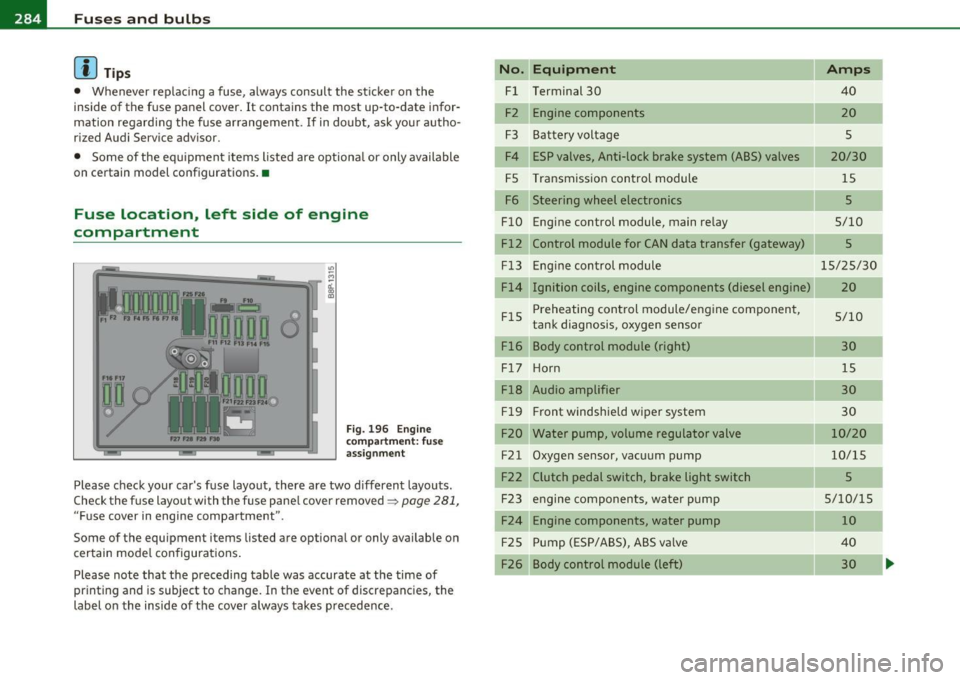
Please check your car's fuse layout, there are two different layouts.
Check the fuse layout with the fuse panel cover removed~
page 281,
"Fuse cover in engine compartment ".
Some of the equipment items listed are optional or only available on
certain model configurations .
Please note that the preceding table was accurate at the time of
printing and is subject to change . In the event of discrepancies, the
label on the inside of the cover always takes precedence .
No. Equipment
Fl Terminal 30
F2 Engine components
F3 Batteryvoltage
F4 ESP valves, Anti-lock brake system (ABS) valves
FS Transmission control module
F6 Steering wheel electronics
FlO Engine control module, main relay
Fl2 Control module for CAN data transfer (gateway)
Fl3
FlS
Fl6 Engine
control module
Ignition coils, engine components (diesel engine)
Preheating control module/engine component,
tank diagnosis, oxygen sensor
Body control module (right)
F l7 Ho rn
Fl8 Audio amplifier
Fl9 Front
windshield wiper system
F20 Water pump, volume regulator valve
F21 Oxygen sensor, vacuum pump
F22 Clutch pedal switch, brake light switch F23 engine components, water pump
F24 Engine components, water pump
F25 Pump (ESP/ABS), ABS va
lve
F26 Body control module (left)
Amps
40
20
s
20/30 15
5
5/10
5
15/25/30
20
5/10 30 15
30
30
10/20
10/15
5
5/10/15 10
40 30