brake light AUDI S3 2011 Owner's Manual
[x] Cancel search | Manufacturer: AUDI, Model Year: 2011, Model line: S3, Model: AUDI S3 2011Pages: 320, PDF Size: 75.79 MB
Page 202 of 320
Driving and environment
This is especially true for vehicles with low-slung chassis (sports
chassis) and fully loaded vehicles. •
Operate your vehicle economically
and minimize pollution
General
Your personal style of driving will determine the economy
of your vehicle, as well as exhaust and noise levels.
Fuel economy, env ironmental impact, and wear on your eng ine,
brakes and tires largely depend on three factors:
• your personal driving style
• operat ing conditions
• technical lim itations
If you anticipate what you need to do next and drive economically,
you can easily cut your fuel consumpt ion by 10-15 percent. This
sect ion wi ll g ive you some tips on how you can help the environment
and your pocketbook.
[I) Tips
The consumption estimates as published by ENVIRONMENTAL PROTECTION AGENCY (EPA) and Transport Canada may not co rre
spond to your actual consumption on the road, which will vary
depending upon vehicle load and speed, road and weather conditions,
trip length, etc. •
Drive smoothl} and keep a lookout ahead
Vehicles use the most fuel when they are accelerating.
Avoid unnecessary accelerating and braking .
Vehicles use the most fuel when they are accelerating. If you antici
pate what is go ing to happen next, you will need to brake less and,
thus, accelerate less. Let the vehicle coast whenever possible - for example when you see that the next traffic light is red.
Avoid full throttle
Driving at moderate speeds saves fuel and improves your
mileage.
- Try and keep well below your car's maximum speed.
Accelerating gently reduces fuel consumption, engine wear, and does
not d isturb the env ironment.
Fuel consumption, exhaust emissions and engine noise increase
disproportionately at high speeds. If you drive at approximately three
quarters of top speed, fuel consumption will be reduced by one half.
Never drive faster than the posted speed limit and weather condi
tions perm it. •
Reducing unnecessary idling
Even when your car is just idling it burns up fuel.
- Shut the engine off when you are not driving the vehicle .
- Do not warm up the vehicle by letting the engine run at idle .
It makes sense to shut off the engine in traffic jams, when waiting for
trains to pass at railroad crossings, or at traffic lights that have long
wa its on red. Turn ing the eng ine off for just 30-40 seconds saves
more fuel than is burned starting the engine again.
It takes a long time for the engine to warm up fully when it is running
at idle. However, wear and noxious emissions are espec ially high
when the engine is warming up . So you shou ld drive away as soon as .,_
Page 204 of 320

Trailer towing
"---------------------------------------------------
Trailer towing
Driving with a trailer
General information
Your Audi was designed primarily for passenger transpor
tation .
If you p lan to tow a t railer, p lease remember that the additional load
w ill affect durability, economy and performance.
Tr ailer towing not on ly p laces mo re s tress on the vehicle, it also calls
for more concentration from the driver.
For this reasons, a lways fo llow the operating and driv ing instr uctions
prov ided and use common sense .•
Technical requirements
Trailer hitch
Use a we ight-carrying hitch conforming to the gross trai ler weight .
Th e h itch mus t be suit able for your veh icle and t railer and mus t be
mounted securely on the vehicle's chassis at a
technically sound l oca
t ion. Use on ly a tra ile r hi tch w ith removable b all moun t. Alw ays check
w ith the trailer hitch manufacturer to make sure that you are using
t he correc t hitch.
Do not use a bumper hitch .
The hitch must be installed in such a way t hat it does not interfere
w ith the impact -ab sorb ing bumper system. No mod ifi cations s houl d
be made to the vehicle exhaust and brake systems . From t ime to
t ime, che ck t hat all hitch mou nting bolts rema in securely faste ned.
W hen you are no t tow ing a trai ler, remove the trailer hitch ball
mount. This prevents the hitch from ca using damage should your
veh icle be s truck from behind=>&.
Tire pressure
When towing a tra iler, inflate the tires of you r vehicle to the cold tire
pressu re listed under "Full lo ad"on t he st ick er o n the r ight doo rjamb.
I n flate trailer t ires to trai ler and tire manufacturers' specifications .
Lights
The headlight settings should be checked with the tra iler attached
befo re d riving o ff. Have the headlights adjusted as necess ary s o that
you can see the road ahead but not b lind oncoming t raffic.
Check to make s ure bo th vehicle and t railer lights a re wor king prop
er ly.
Engine cooling system
Towing a trailer ma kes t he engin e work harder. It is important t hat
t he cooling sys tem' s per formance stands up to the add ition al stra in.
M ake sure that the coo ling sys tem has eno ugh fluid .
Trailer brakes
If your trai ler is equipped with a braking system, check to be su re that
it confo rms to all regula tions .
Th e tra ile r hydrau lic brake system must not be directly con nected to
the vehicle's hydraulic b rake system.
Safety chains
Be sure trailer safety cha ins are p roper ly connected from the t rai ler
to the hitch on the vehicle. Leave enough s lac k in t he chai ns to permit
t u rni ng corners. When you insta ll safety chains, ma ke s ure t hey will
not d rag on t he road when yo u are d riving .
The chai ns should cross under the trailer tongue to prevent it from
drop ping in ca se of separat io n from t he hitch.
Trailer lights
Trailer lights must meet all regulat ions. Be su re to chec k w ith your
author ized A udi dealer for correct wiring, switches and relays. _.
Page 205 of 320

Mirrors
If you are unable to see the traffic beh ind you using the regular
outs ide mirrors, then you
must i nstall extended mirrors. It is impor
tant that you
always have clear vision to the rear.
& WARNING
After removing the trailer hitch, do not store it in your vehicle. In
case of sudden braking, the hitch could fly forward and injure you
or your passengers. •
Operating instructions
Maximum trailer weight
A trailer for your vehicle is lim ited to a typ ical class 1 or class 2 tra iler.
Trailer load distribution
Be sure the load in the trailer is held securely in place to guard aga inst
shifting, be it fo rwa rd, backward or sideways.
Never allow a passenger to ride in a trailer ~ & in "Driving instruc
tions".
Tire pressure
When towing a tra iler, inflate the tires of yo ur veh icle to the co ld tire
pressure listed unde r "Full load" on the sticker on the right doorjamb.
Inflate trailer tires to trai ler and tire manufacturers' specifications.
Lights
T he headlight settings sho uld be checked with the trailer attached
before driving off . Adjust as necessary so that you can see the road
ahead but not blind oncoming traffic.
Check p roper working of vehicle and tra iler lights.
Controls and equip
ment Safety first Vehicle operation
Safety
chains
Be sure trailer safety chains are properly connected from the trailer
to the hitch on the vehicle. Leave enough s lack in the chains to permit
turning corners . When you install safety chains, make sure they will
not drag on the road when you are driving.
The chains should cross under the trailer tongue to prevent it from
dropping in case of separation from the hit ch. •
Driving instructions
Driving with a trailer always requires extra care and
consideration.
To obtain the best possible handling of vehicle and trailer,
please note the following:
- Do not tow a loaded trailer when your car itself is not
loaded .
- Be especially careful when passing other vehicles.
- Observe speed limits.
- Do not drive at the maximum permissible speed .
- Always apply brakes early.
- Monitor the temperature gauge.
Weight distribut ion
Towing a loaded trailer with an empty car results in a highly unstable
distribution of we ight. If th is cannot be avoided drive at very low
speeds only to avoid the risk of losing steering control.
A "balanced " rig is easier to operate and control. This means that the
tow vehicle should be loaded to the extent possible and permiss ible
whi le keeping the trai ler as light as possible under the circumstances .
Whenever possible, transfer some cargo to the luggage compart-
Vehicle care Do-it-yourself service Technical data
Page 206 of 320
Trailer towingL _____________________________________________ _
ment of the tow vehicle while observing tongue load requirements
and vehicle loading considerations.
Speed
The higher the speed, the more difficult it becomes for the driver to
control the rig. Do not drive at the maximum permissible speed. Reduce your speed even more under unfavorable load, weather or
wind conditions -particularly when going downhill.
Reduce vehicle speed
immediately if the trailer shows the slightest
sign of swaying .
Do not try to stop the swaying by accelerating.
Observe speed limits . In some areas speeds for vehicles towing
trailers are lower than for regular vehicles .
Always apply brakes early . When driving downhill, shift into lower
gear to use the engine braking effect to slow down the vehicle. Use of
the brakes alone can cause them to overheat and fail.
Coolant temperature
The coolant temperature gauge~ page 9 must be observed care
fully. If the needle moves close to the upper end of the scale, reduce
speed immediately and/or switch off the air conditioner .
If the coolant temperature warning light in the instrument cluster
starts flashing
-t-, pull off the road , stop and let the engine idle for
about two minutes to prevent heat build-up.
& WARNING
Anyone not properly restrained in a moving vehicle is at a much
greater risk in an accident. Never let anyone ride in your car who is
not properly wearing the restraints provided by Audi. •
Trailer towing tips
Important to know
-------------
Your vehicle handles differently when towing a trailer because of the
additional weight and weight distribution. Safety, performance and
economy will greatly depend on how carefully you load your trailer
and operate your rig.
Before you actually tow your trailer, practice turning, stopping and
backing up in an area away from traffic. Keep practicing until you have
completely become familiar with the way your vehicle-trailer combi
nation behaves and responds.
Backing up is difficult and requires practice. Backing up with a trailer
generally requires steering action opposite of that when backing up
your vehicle without a trailer.
Maintain a greater distance between your vehicle and the one in front
of you. You will need more room to stop.
To compensate for the trailer, you will need a larger than normal
turning radius .
When passing, remember that you cannot accelerate as fast as you normally would because of the added load. Make sure you have
enough room to pass. After passing, allow plenty of room for your
trailer before changing lanes again.
Avoid jerky starts, sharp turns or rapid lane changes.
[I] Tips
• Do not tow a trailer during the break-in period of your vehicle .
• If you tow a trailer, your Audi may require more frequent mainte
nance due to the extra load~
page 299. •
Page 214 of 320
![AUDI S3 2011 Owners Manual -Cleaning and protection pn,,._____ _ __,____ ____________ _
(I] Tips
Keep silicone sprays off the windshield to avoid wiper smear in rain.•
Applies to vehicles: with steel whee](/img/6/57544/w960_57544-213.png "AUDI S3 2011 Owners Manual -Cleaning and protection pn,,._____ _ __,____ ____________ _
(I] Tips
Keep silicone sprays off the windshield to avoid wiper smear in rain.•
Applies to vehicles: with steel whee")
-Cleaning and protection pn,,._____ _ __,____ ____________ _
(I] Tips
Keep silicone sprays off the windshield to avoid wiper smear in rain.•
Applies to vehicles: with steel whee ls (e.g. if refitted with winte r tir es)
Steel wheels
The wheels also have to be cleaned.
-Always include the hub caps and wheel rims when washing
your vehicle to remove road dirt, salt sprays and brake
dust.
If necessary, use a commercial wheel cleaner to remove accumulated
brake dust.
The wheel rims are easier to keep clean if they are regularly coated
with liquid wax.
Paint scratches should be touched up as soon as possible to prevent
corrosion~ page 210, "Touch-up paint".
& WARNING
• Moisture and ice on brakes may affect braking efficiency -
~ page 191, "General information". Test the brakes carefully
after each vehicle wash.
• Always read and heed all WARNINGS and the information
~page206. •
Applies to veh icles: w ith Cas t alloy whee ls
Cast (light) alloy wheels
Cast (light) alloy wheels require special care.
-Wash the wheels with a sponge or hose brush every other
week. -
For deep cleaning afterwards, use only a dedicated
acid
free cast alloy wheel cleaner.
- Rub a coat of
liquid wax onto the rims every three month.
Be sure to reach and treat all parts of the rim.
To preserve the decorative appearance of the cast alloy wheels, some
special care is necessary. In addition to road dirt and salt, brake dust
is also corrosive.
If left on for too long, brake dust can cause pitting.
Use only special
acid-free cleaners formulated for alloy rims. Safe
products are available at your authorized Audi dealer. Never leave the
cleaner on the rims longer than specified on the label. If not rinsed
off promptly, the acid contained in some cleaners can attack the
threads on the wheel bolts.
Never use abrasive or metal polishing cleaning agents.
If the protec
tive coating has been chipped, e.g. by kicked up road dirt, touch it up
as soon as possible.
& WARNING
• Moisture and ice on brakes may affect braking efficiency
~ page 191, "General information". Test the brakes carefully
each time you wash the vehicle.
• Always read and heed all WARNINGS and other information
~page 206. •
Body cavity sealing
The body cavity sealing does not need to be checked.
All body cavities which could be affected by corrosion have been thor
oughly protected at the factory.
This sealing does not require any inspection or additional treatment.
If any wax should seep out of the cavity when the ambient tempera
ture is high, it can be removed with a plastic scraper and a suitable
solvent. ..,
Page 239 of 320

___________________________________________ C_ h _ e_c _k _ i_n -=g .._ a_n _ d_ f_i _ll _i _ n -=g '-- ....... m
• If, in an emergency, only water can be added, the correct ratio
between water and antifreeze=>
page 234 must be restored as soon
as possible.
~ For the sak e of the environment
Ora i ned coolant should not be reused . Always dispose of used coolant
while observing all environmental regulations .•
Radiator fan
The radiator fan switches on automatically by itself.
T he electric radiator fan is controlled by thermoswitches that switch
on and off depending on coolant a nd engine compartment tempera
tures.
An auxilia ry e lectr ic rad iator fan* sw itches on a nd off depend ing on
coo lant temperature and other vehicle operation cond itions .
After switch ing off t he engine, the auxiliary fan -even with the igni
tion off -can continue running for up to 10 minutes . It can even
switch on again later by itself=>& , if
• the temperature of the engine coolant rises due to the hea t build
up from the engine in the engine compartment, or
• the engine compar tment hea ts up because the vehi cle is parked in
intense sunlight.
& WARNING
• To reduce the risk of personal injur y never tou ch the radi ator
fan .
• The auxiliary ele ctric fan i s temperatur e controll ed and can
switch on sudd enly even wh en the engine is not running .
• The auxiliary radiator f an swit che s on aut omati cally when the
engine coolant reaches a certain temp eratur e and w ill continue to
run until the coolant temperature drop s. •
Vehicle OP-eration
Brake fluid
Checking brake fluid level
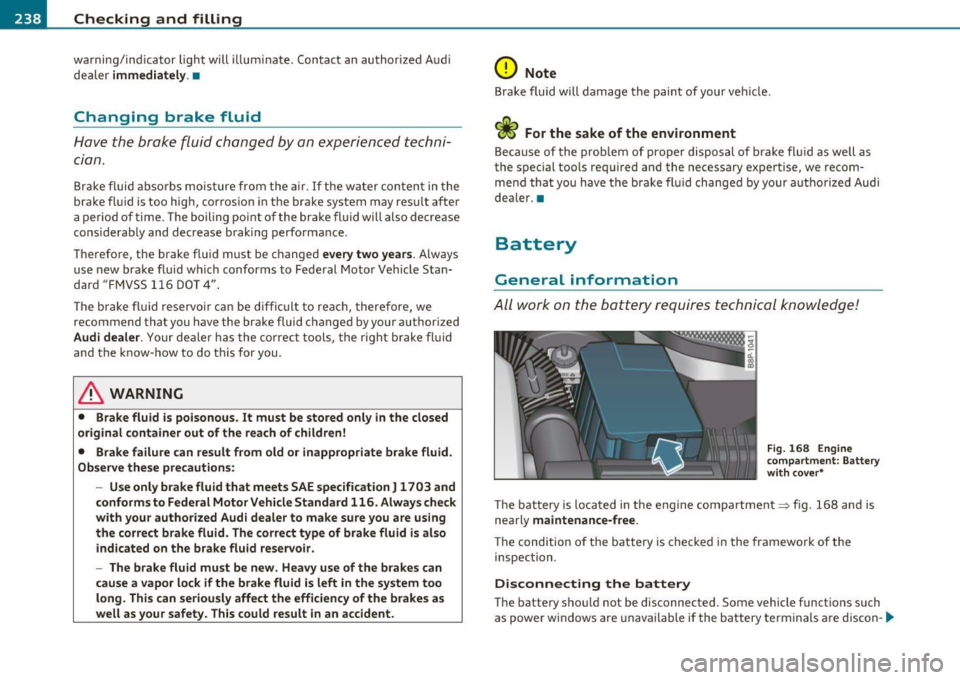
The brake fluid level can be checke d with a quick glance.
Fig. 167 Eng ine
compartment : b rak e
fl uid res ervoi r
Before you check a nything in t he engine compartment ,
always read and heed all WARNINGS~ & in "Working in
the eng ine compartment" on
page 226 .
-Read the brake fluid level from the bra ke fluid reservoir.
The brake fluid level must be between the "MIN" and
"MAX" markings ~ fig . 167 .
The brake fluid reservoir is located at the rear partition of the engine
compartment on the left side=>
page 227.
The fluid level may drop
slightly after some time due to the auto
m atic adjus tment of the brake pads. This is not cause for alarm .
If the brake fluid level falls
considerably below the "MIN" mark, t he
brake warning/ind icator light (U .S. models :
BRAKE, Canadian mode ls:
ill ) will come on=> page 15 and=> page 32. Do not continue to
operate the vehicle . The complete brake system should be thorough ly
chec ked by an au thor ized Aud i deale r o r other qualified facility and
the cause corrected. If the brake fluid leve l is too low, the brake .,,_
Vehicle care Do-it-yourselt service iTechnical data
Page 240 of 320
___ C_h_ e_c _k _i_n -=g :a,__ a_n_ d_ f_ i_ l _li _n _,g;._ __________________________________________ _
warning/ind icator light will illum inate. Contact an au thorized A ud i
d ealer
immediately .•
Changing brake fluid
H av e th e b rake flu id chang ed by an exper ienced tech ni
ci an.
Br ake flui d abs orbs m oisture fro m the ai r. If t h e w ater con ten t in the
brake fl uid is too hig h, cor ros ion in th e brake system may res ult afte r
a p eriod of time. The boiling po int of t he br ake fl uid will al so decre ase
cons iderab ly and decrease brak ing perfo rma nce .
T he refo re, the brake fl uid m ust be c hanged
every two years . Always
use new brake fluid w hich conforms to Federal Motor Veh icle Stan
dard "F MVSS 1 16 DOT 4".
Th e b rake fl uid r eservo ir can be diffi cult t o re ach, there fore, we
recommend that you have the brake fluid changed by your author ized
Audi dealer . Your dealer ha s t he correc t tool s, the ri ght brake fl uid
and the know -how to do t his for you.
& WARNING
• Brake fluid is poisonous. It must be stored only in the closed
original container out of the reach of children!
• Brake failure can result from old or inappropriate brake fluid.
Observe these precautions :
- Use only brake fluid that meets SAE specification
J 1703 and
conforms to Federal Motor Vehicle Standard 116 . Always check
with your authorized Audi dealer to make sure you are using
the correct brake fluid. The correct type of brake fluid is also
indicated on the brake fluid reservoir .
- The brake fluid must be new. Heavy use of the brakes can
cause a vapor lock if the brake fluid is left in the system too
long . This can seriously affect the efficiency of the brakes as
well as your safety . This could result in an accident .
0 Note
Brake fluid will damage the paint of you r ve hicl e.
<£' For the sake of the environment
Beca us e of the prob le m of proper dispo sal of b ra ke fl uid as well as
the spec ia l too ls req uired and the necessary expe rtise , w e r ecom
me nd that you h ave t he brake fl uid chan ged by yo ur a uth oriz e d Audi
dea ler. •
Battery
General information
All wo rk on t he battery requires te chnica l k nowl ed ge !
Fig. 168 Engine
comp artment : Battery
with cover*
T he b att ery is lo cat ed in the e ng in e co mpar tmen t~ fig. 1 68 and is
nearly
maintenance-free.
Th e condition of the battery is che cked in the framewo rk of the
inspec tion .
Disconnecting the battery
The batte ry s ho ul d not be disconnected . Some vehicle funct io ns such
as powe r w indows are unavailable if the b attery te rminals a re discon -
~
Page 275 of 320
What do I do now? -________________ Vflll
- Move selector lever to position Pon an automatic trans
mission; put manual transmission in
first gear=> &.
-If you are towing a trailer: unhitch the trailer from your
vehicle.
- Take the
tool and the spare tire=> page 270 out of the
luggage compartment.
& WARNING
You or your passengers could be injured while changing a wheel if
you do not follow these safety precautions:
• If you have a flat tire, move a safe distance off the road. Turn
off the engine, turn the emergency flasher on and use other
warning devices to alert other motorists.
• Make sure that passengers wait in a safe place away from the
vehicle and well away from the roadway and traffic.
• To help prevent the vehicle from moving suddenly and possibly
slipping off the jack, always fully set the parking brake and block
the wheel diagonally opposite the wheel being changed. When one front wheel is lifted off the ground, placing the automatic
transmission in "P" (Park), or engaging a gear in a manual trans
mission will
not prevent the vehicle from moving.
• Before you change a wheel, be sure the ground is level and
firm. If necessary, use a sturdy board under the jack .
• After installing the spare wheel, make sure that you remount
the flat tire/wheel in its storage area properly and tighten the
knurled retaining screw securely. •
Safety first
Changing a wheel
When you change a wheel, follow the sequence described
below step-by-step and exactly in that order.
1. Remove the decorative wheel cover*. For more details see
also =>
page 274, "Decorative wheel covers" or
=> page 275, "Wheels with cap-covered wheel bolts".
2. Loosen the
wheel bolts=> page 276.
3. Locate the proper mounting point for the jack and align the jack below that point=>
page 276.
4.
Lift the car with the jack=> page 2 76.
5. Take the
flat wheel off and then put the spare on
=> page 278.
6. Tighten all wheel bolts lightly.
7.
Lower the vehicle with the jack.
8. Use the wheel bolt wrench and
firmly tighten all wheel
bolts=>
page 276.
9. Put the decorative
wheel cover* back on.
& WARNING
Always read and head all WARNINGS and information~ & in
"Raising the vehicle" on
page 276 and~ page 279. •
After changing a wheel
A wheel change is not complete without the following
actions.
- Store and secure the replaced wheel in the spare wheel
well. .,._
Vehicle care Do-it-yourself service Technical data
Page 280 of 320
lffll.,___W_ h_ a_t _ d_ o_ I_d_ o_ n_o _w_ ? ___________________________________________ _
Taking the wheel off/putting the spare on
Follow these instructions step-by-step for changing the
wheel
M
"' ;;; u.
1li
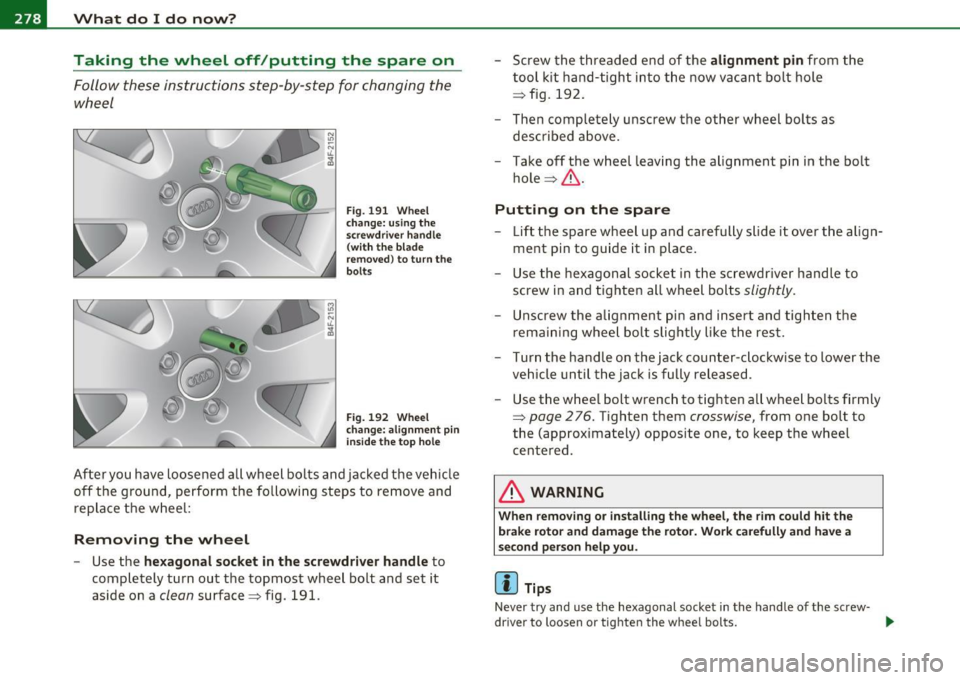
Fig . 191 Wheel
change: using the
screwdriver handle
(with the blade
removed) to turn the
bolts
Fig. 192 Wheel
change: alignment pin
inside the top hole
After you have loosened all wheel bolts and jacked the vehicle
off the ground, perform the following steps to remove and
replace the wheel:
Removing the wheel
- Use the hexagonal socket in the screwdriver handle to
completely turn out the topmost wheel bolt and set it
aside on a
clean surface=> fig. 191. -
Screw the threaded end of the
alignment pin from the
tool kit hand-tight into the now vacant bolt hole
=> fig. 192.
- Then completely unscrew the other wheel bolts as
described above.
- Take off the wheel leaving the alignment pin in the bolt
hole=> &.
Putting on the spare
- Lift the spare wheel up and carefully slide it over the align
ment pin to guide it in place.
- Use the hexagonal socket in the screwdriver handle to
screw in and tighten all wheel bolts
slightly.
Unscrew the alignment pin and insert and tighten the
remaining wheel bolt slightly like the rest.
- Turn the handle on the jack counter-clockwise to lower the vehicle until the jack is fully released.
- Use the wheel bolt wrench to tighten all wheel bolts firmly
=>
page 276. Tighten them crosswise, from one bolt to
the (approximately) opposite one, to keep the wheel
centered.
& WARNING
When removing or installing the wheel, the rim could hit the
brake rotor and damage the rotor. Work carefully and have a
second person help you.
(I) Tips
Never try and use the hexagonal socket in the handle of the screw-
driver to loosen or tighten the wheel bolts.
~
Page 285 of 320
_______________________________________________ F_u _s_ e_ s_ a_ n_ d_ b_u _ l_ b _ s __ _
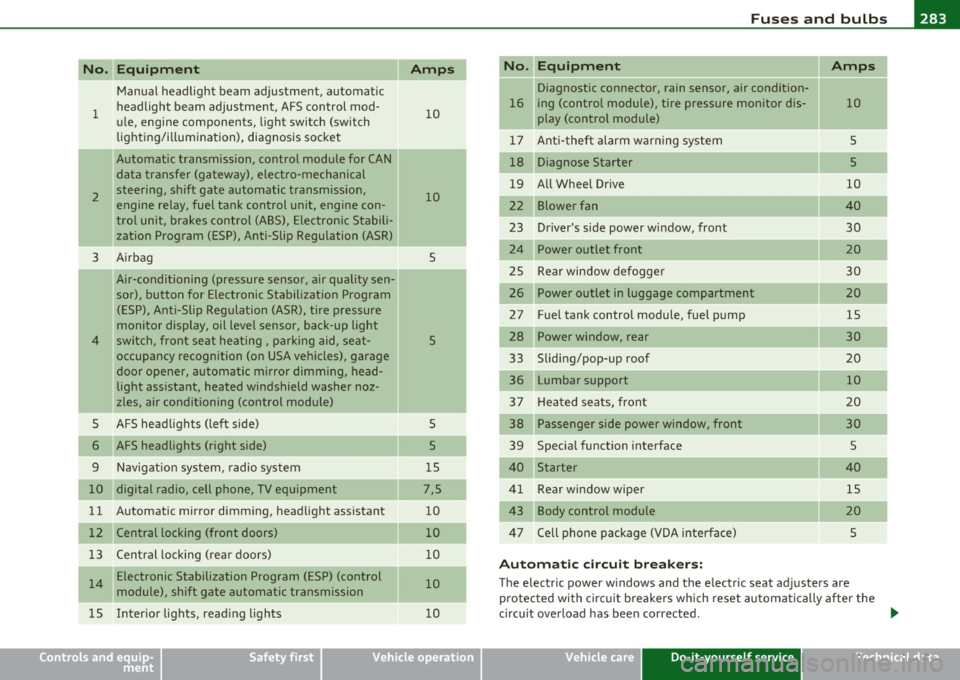
Equipment No. II Equipment
Amps
Manual headlight beam adjustment, automatic Diagnostic connector, rain sensor, air condition-
headlight beam adjustment, AFS control mod-
16 ing (control module), tire pressure monitor dis-10
1 ule, engine components, light switch (switch 10 play (control module)
-lig hti ng/i llum i nation), diagnosis socket 1 7 Ant i-theft alarm warning system 5
Automatic transmission, control module for CAN 18 Diagnose Starter 5
data transfer (gateway), electro-mechanical
19 All Whee l Drive 10 steering, shift gate automatic transmission, 2 10 engine relay, fuel tank control unit, engine con-22 Blower fan 40
trol unit, brakes control (ABS), Electronic Stabili-23 Driver's side power window, front 30 zation Program (ESP), Anti-Slip Regulation (ASR)
3 Airbag 5 24 Power outlet front 20
Air-conditioning (pressure sensor, air quality sen-25 Rear window defogge r 30
sor), button for Electronic Stabilization Program 26 Power outlet in luggage compartment 20
(ESP), Anti-Slip Regulation (ASR), tire pressure 27 Fuel tank control module, fuel pump 15
monitor display, oil level sensor, back-up light
28 Power window, rear 30 4 switch, front seat heating, parking aid, seat-s
occupancy recognition (on USA vehicles), garage 33 Sliding/pop-up roof 20
door opener, automatic mirror dimming, head-
Lumbar support
10 light assistant, heated windshield washer noz-
zles, air conditioning (control module)
3 7 Hea ted seats, front 20
--
5 AFS headlights (left side) 5 38 Passenger side power window, front 30
AFS headlights (right side) 5 39 Specia l function interface 5
9
Navigat ion system, radio system 15 40 Starter 40
digital radio, cell phone, TV equipment 7,5 Rear window wiper 15
11
Automatic mirror dimming, headlight assistant 10 Body control module 20
12 Central locking (front doors) 10 47 Ce ll phone package (VDA interface) 5
13
Central locking (rear doors) 10
A uto m atic c ircu it bre ake rs :
14 Electronic Stabilization Program (ESP) (control 10 The electric power w indows and the electric seat adjusters are
module), shift gate automatic transmission protected with circuit b reakers which reset automatically after the
1 5 Inter ior lights, read ing lights 10 circuit overload has been corrected . ...
Safety first Vehicle care Do-it-yourself service Technical data