check oil AUDI S3 2011 Owner's Manual
[x] Cancel search | Manufacturer: AUDI, Model Year: 2011, Model line: S3, Model: AUDI S3 2011Pages: 320, PDF Size: 75.79 MB
Page 247 of 320

________________________________________________ T_i_re _ s_ a _ n_d_ w_ h_ e_ e_l_s __ _
Tires and wheels
Tires
General notes
Tires may be the least appreciated and most abused
parts of a motor vehicle.
T ir es may be the least appreciated and most abused pa rts of a motor
vehicle . Tires are, however, one of the most important parts of a
vehicle , pa rticul arly conside ring the comparat ive ly small patch of
rubber on eac h tire that assures that all-important contact between
you, your veh icle and the road.
Maintai ning t he cor rect tire pressu re, mak ing su re that your veh icle
and i ts tires do not have to carry more weight t han they can safely
hand le, avoid ing damage from road ha za rds and regularly inspecting
tires for damage includ ing cuts, s lashes irregular wea r and ove rall
condi tion a re the mos t important th ings that you can do to help avoid
sudden t ire failure including tread separation and blowouts.
Avoiding damage
If you have to d rive ove r a cur b or sim ilar obstacle, d rive very slowly
and as close as possible at a rig ht angle to the curb .
Always keep chemicals incl ud ing grease, oil, gaso line and brake f luid
o ff t he t ires .
Ins pect the ti res regularly for damage (cu ts, cracks o r blisters, e tc.) .
Remove any foreign bodies embe dded in the treads.
Storing tires
M ark tires w hen yo u remove t hem to indica te t he d ire ct io n of rota
tion . This ensures you to be ab le to mount them correctly when you
re insta ll them.
Whe n removed, t he wheels or tires should be sto red in a cool, dry and
preferably da rk p lace.
Safety first
Store tires in a v ertica l pos it io n if they a re not mount ed on rims, in a
hor izonta l posit ion if they are mounted on r ims.
New tires
N ew tires have to be broken in=> & .
Th e tre ad d epth of new ti res may v ary, accor ding t o th e type an d
make of t ire and the tread pattern .
Hidden damage
Damage to tires and rims is often not readi ly visible. If yo u notice
unu sual vib ra ti on o r the ve hicle pulls to one side, t his may in dica te
that one of the t ires has been damaged. The tires must be checked
im media tely by an auth oriz ed A ud i d eale r or qual ifie d wor ks hop.
Unidirectional tires
A un id irectional tire can be identified by arrows o n th e sidewall , th at
point in the direct ion the t ire is designed to rotate. You must fo llow
t he s peci fied dire ction o f ro tat io n . This is neces sary so t hat t hese
tires can deve lop their optimum cha racte ristics regard ing g rip, road
noise, we ar an d hy dropl aning res ist an ce. F o r more informat ion
:::>page 279 .
& WARNING
New tires or tires that are old , worn or damaged cannot provide
maximum control and braking ability.
• New tires tend to be slippery and must be broken in. To reduce
the risk of losing control, a collision and serious personal injuries, dri ve with special care for the first 350 miles (560 km).
• Driving with worn or damaged tires can lead to loss of control,
sudden tire failure , including a blowout and sudden deflation ,
crashes and serious personal injuries . Have worn or damaged tires
replaced immediately. _..
Vehicle care Technical data
Page 248 of 320
-~_T_ ir_e_ s_ a_ n_ d_ w_ h_e_ e_ ls _______________________________________________ _
& WARNING (conti nu ed )
• Tire s age even if they are not being used and can fail suddenly ,
especially at high speeds . Tires that are more than 6 year s old can
only be used in an emergency and then with special care and at low
s peed .
Glossary of tire and loading terminology
Accessory weight
means the combined we ight (in excess of those sta nda rd items which
may be rep lace d) of automatic transmission, power steering, power
bra kes, powe r w indows , power seats, radio, and heater, to the extent
that these items are avai lab le as factory- installed equipment
(w het he r i nsta lled or no t).
Aspect ratio
me ans the ratio of t he he ight to t he w id th of the tir e in percent .
Numbe rs of 55 o r lower indicate a low sidewa ll for improved steer ing
respo nse an d be tter overa ll handling on dry p avemen t.
Bead
means the part o f the tire that is made of stee l w ires , wrap ped o r
re in forced by ply cords and that is shaped to fit the rim.
Bead separation
means a brea kdown of the bon d between components in the bead .
Cord
means the st rands forming the plies in the tire.
& W ARNING (continued )
• Never mount used tire s on your vehicle if you are not sure of
their "previous hi story ." Old used tires may have been damaged
eventhoughthedamagecannotbeseenthatcanleadtosudden
tire failure and lo ss of vehicle control.
• If you notice unu sual vibration or if the vehicle pull s to one side
when driving, alway s stop as soon as it is safe to do so and check
the wheels and tires for damage. •
Cold tire inflation pressure
means the tire pressure recommended by the vehicle ma nufa cturer
for a tire of a des ignated size t hat has not been driven for more than
a couple of m iles ( kilomete rs) a t low speeds in the t hree ho ur period
before the tire pressure is measured or ad justed.
Curb weight
mea ns the weig ht of a motor vehicle wit h standard equ ipment
including the max imum cap aci ty of f ue l, oil, and coo lan t, air condi
tioning and additiona l weight of optional equipment.
Extra load tire
means a t ire designe d to operate at higher loads and at higher infla
t ion p ressures than the co rrespo nd ing standard t ire. Ext ra load tires
my be identif ied as "XL", "xl", "EXTRA LOAD", or "RF" on the sidewa ll.
Gross Axle Weight Rating ( "GAWR ")
means the load -ca rry ing capacity of a s ingle ax le system, measured at
t he t ire-grou nd inte rfaces .
Gross Vehicle Weight Rating ("GVWR")
means the max imum total loaded we ight of the vehicle .
Page 259 of 320

________________________________________________ T_ i_ re _ s_ a_ n_d_ w_ h_ e_ e_l _s _ ....... 91
Incorrect wheel alignment
In correct whee l al ignme nt can ca use excessive tir e wea r, impairing
th e sa fety o f the vehicl e. If t ires show excessive w ear, hav e the w heel
alignment checked by a n authorized A udi dea ler or qualifie d work
shop.
All Wheel Drive
Vehicles wi th quattro® must always have tires of the same size ,
con st ruct ion an d tread type . For details see~
page 194.
& WARNING
Sudden tire failure can lead to los s of control, a cra sh and serious
personal injury!
• Never drive a vehicle when the tread on any tire is worn down
to the wear indicators.
• Worn tires are a safety hazard, they do not grip well on wet
roads and increase your risk of "hydroplaning" and loss of control.
• Always keep chemicals that can cause t ire damage, such as
grease , oil, gasoline and brake fluid away from tires.
• Tires age even if they are not being used and can fail suddenly,
especially at high speeds. Tires that are more than 6 years old can
only be used in an emergency and then with special care and at
lower speeds.
• Never mount used tires on your vehicle if you are not sure of
their "previous history. " Old used tires may have been damaged
even though the damage cannot be seen that can lead to sudden
tire failu re and loss of vehicle control. •
Vehicle OP-eration
New tires and replacing tires and wheels
New t ires an d w hee ls have to be brok en in .
Fig. 175 Tire specificat ion codes on th e sidewall of a tire
No.
©
®
®
©
©
©
Description
Passenger car tire (where applicable)
Nom inal wid th of ti re in mil limeters
Ratio of hei9ht to width (aspect ratio)
Radial
jj Rim diameter code
L oa d index and speed rating
Vehicle care Do-it-yourselt service iTechnical data
Page 265 of 320
________________________________________________ T_i_re _ s_ a _ n_d_ w_ h_ e_ e_l_s __ _
& WARNING (co ntinued )
• Snow chain s are available in different sizes. Always make sure
to follow the instructions provi ded by the snow chain manufac
turer.
• Wh en driving with snow cha in s never drive fa ster than the
speed permitted for your specific snow chains .
• Always observe local regulations.
0 Note
• Remove snow chains before d riving on roads not cove red w it h
snow to avoid damaging t ires and wearing t he snow chains down
unnecessar ily .
• Snow chains, which come into direct contact wi th the wheel rim,
can scratch or damage it . The refore, make s ure that the snow chai ns
are sui tably covered. Chec k the pos it ion o f the snow cha ins afte r
driving a few yards and correct if necessary . Follow the instructions
from t he snow chain man ufacturer when doing so .
[ i] Tips
• Where snow chains are mandatory on certa in roads, this normally
also app lies to ve hicles wi th A ll W hee l Dr ive.
• If snow chains are installed, the tire p ress ures s houl d not be
sto red in the tire pressure moni to ring system (TPMS) . Otherwise the
system could malfunction ~
page 267. •
Wheel bolts
Wheel bolts must al ways be tight ened to the c orrect
torqu e.
The desig n of whee l bolts is matc he d to the fa ct ory in stalled rims. If
different r ims are fitted, the cor rect wheel bo lts wi th t he r igh t length
and correctly s haped bolt hea ds must be used . Thi s ensures that
Safety first
wheels are fitted securely and that the brake system funct ions
cor rectly .
I n certa in circumstances, yo u may not use wheel bo lts from a
different vehicle -even if it is the same mo del.
& WARNING
Improperly tightened or maintained wheel bolts can be come
loose causing loss of control, a collision and serious personal
injury.
• Always keep the wheel bolts and the threads in the wheel hubs
clean so the wheel bolt s can turn easily and be properly tightened .
• Never grease or oil the wheel bolts and the th reads in the wheel
hub s. They can become loose while driving if greased or oiled, even
if tightened to the specified torque.
• Only use wheel bolt s that belong to the rim being installed .
• Never use different wheels bolts on your vehicle .
• Always maintain the correct tightening torque for the wheel
bolts to reduce the risk of a wheel loss. If the tightening torque of
the wheel bolts is too low, they can loo sen and come out when the
vehicle is moving . If the tightening torque is too high , the wheel
bolt s and thread s can be damaged and the wheel can become
loose.
0 Note
T he specified torq ue for the wheel bo lts is 90 ft lb (120 Nm) with a
t o le rance of ± 7,4 ft lb( ± 10 N m). Tor qu e wheel bo lts diagonally.
After cha nging a wheel, the torque must be checked as soon as
pos sible wi th a t orque w rench -prefer ably by an auth oriz e d Aud i
dealer or qualified workshop .•
Vehicle care Technical data
Page 286 of 320
lffll.,___F_ u_ s_e _ s_ a_n_d _b_u _ l_ b_s _______________________________________________ _
(I) Tips
• Whenever replacing a fuse, always consult the sticker on the
i ns ide of the fuse panel cover. It contains the most up-to-date infor
mation regarding the fuse arrangement . If in doubt , ask your autho
rized Audi Service advisor.
• Some of the equipment items listed are optiona l or only available
on certain model configurations. •
Fuse location, left side of engine
compartment
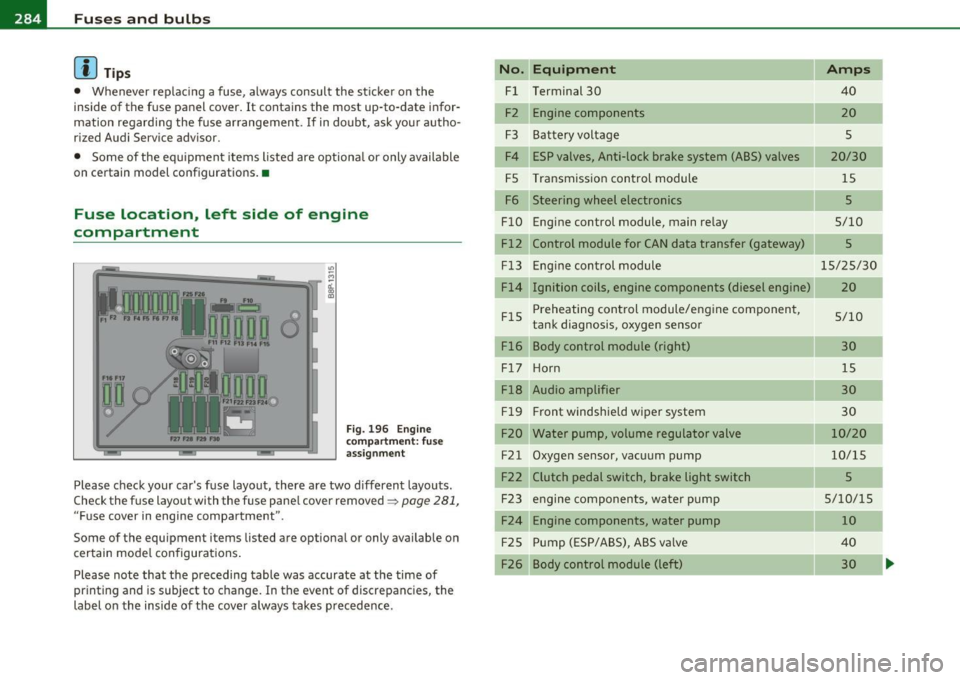
Fig. 196 Engine
compart ment: fuse
assignment
Please check your car's fuse layout, there are two different layouts.
Check the fuse layout with the fuse panel cover removed~
page 281,
"Fuse cover in engine compartment ".
Some of the equipment items listed are optional or only available on
certain model configurations .
Please note that the preceding table was accurate at the time of
printing and is subject to change . In the event of discrepancies, the
label on the inside of the cover always takes precedence .
No. Equipment
Fl Terminal 30
F2 Engine components
F3 Batteryvoltage
F4 ESP valves, Anti-lock brake system (ABS) valves
FS Transmission control module
F6 Steering wheel electronics
FlO Engine control module, main relay
Fl2 Control module for CAN data transfer (gateway)
Fl3
FlS
Fl6 Engine
control module
Ignition coils, engine components (diesel engine)
Preheating control module/engine component,
tank diagnosis, oxygen sensor
Body control module (right)
F l7 Ho rn
Fl8 Audio amplifier
Fl9 Front
windshield wiper system
F20 Water pump, volume regulator valve
F21 Oxygen sensor, vacuum pump
F22 Clutch pedal switch, brake light switch F23 engine components, water pump
F24 Engine components, water pump
F25 Pump (ESP/ABS), ABS va
lve
F26 Body control module (left)
Amps
40
20
s
20/30 15
5
5/10
5
15/25/30
20
5/10 30 15
30
30
10/20
10/15
5
5/10/15 10
40 30
Page 294 of 320
IJIIL--___:E:::..:.. m:..:..: e..:.r-=g ~ e:::..:.. n:..:c ::=y :.....: s..:.i..:.t ..:.u :..:a :... t.:.; i:..: o :... n:..:..: s ____________________________________________ _
Lifting the vehicle
Important safety precautions
Be aware of the following hazards before lifting the vehicle with a
workshop hoist or floor jack:
• The vehicle should never be lifted or jacked up from underneath
the engine oil pan, the transmission housing, the front or rear axle
or the body side members. This could lead to serious damage.
• Use lifting equipment with padded contact surfaces to avoid
damage to the underbody or chassis frame.
• Alternatively, cover the contact surfaces on workshop hoist or
floor jack with rubber pads before lifting.
• Before driving over a workshop hoist, check that the vehicle
weight does not exceed the permissible lifting capacity of the hoist.
• Before driving over a workshop hoist, ensure that there is suffi
cient clearance between the hoist and low parts of the vehicle.
& WARNING
To reduce the risk of serious injury and vehicle damage:
• Always lift the vehicle only at the special workshop hoist and
floor jack lift points illustrated
~ fig. 203 and=> fig. 204.
• Failure to lift the vehicle at these points could cause the vehicle
to tilt or fall from a lift if there is a change in vehicle weight distri
bution and balance. This might happen, for example, when heavy
components such as the engine block or transmission are removed.
• When removing such heavy components, anchor vehicle to
hoist or add corresponding weights to maintain the center of
gravity. Otherwise, the vehicle might tilt or slip off the hoist,
causing serious personal injury. •
Lifting with workshop hoist and with floor
jack
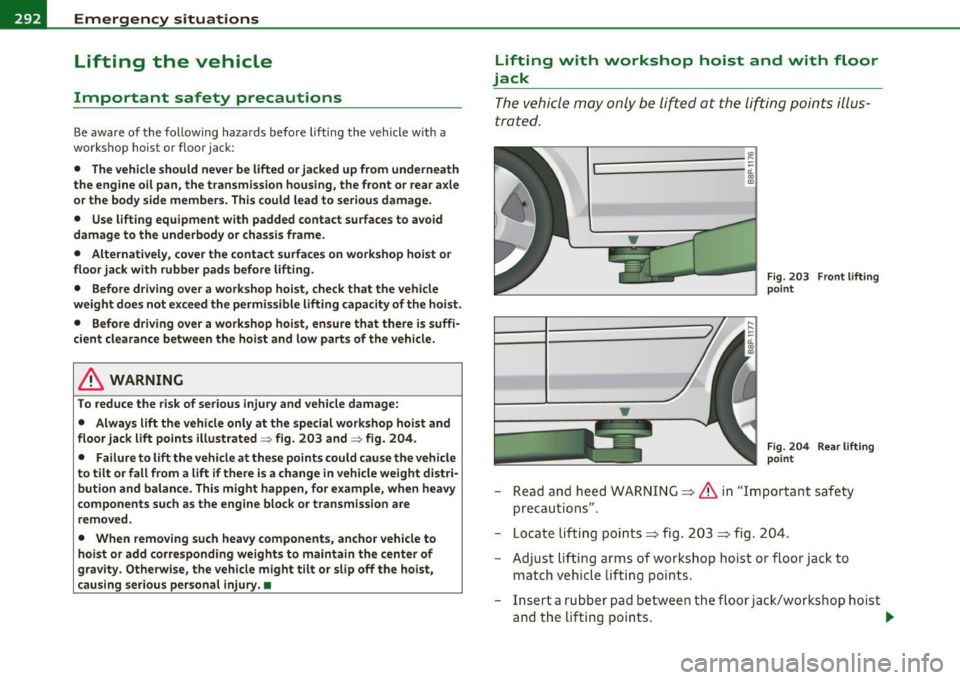
The vehicle may only be lifted at the lifting points illus
trated.
-L==-=--=--=--=--=-----_-_- __,--~ cf..
,,
ex, m
Fig. 203 Front lifting
point
Fig. 204 Rear lifting
point
- Read and heed WARNING=> & in "Important safety
precautions".
- Locate lifting points=> fig. 203 => fig . 204 .
- Adjust lifting arms of workshop hoist or floor jack to
match vehicle lifting points.
- Insert a rubber pad between the floor jack/workshop hoist
and the lifting points. -.,,
Page 295 of 320
_______________________________________________ E_ m_ e_r_, g::;._ e_n _ c""' y:.- s_ it_u_ a_t _ i_o _n_ s __ _
If you must lift your vehicle with a floor jack to work underneath,
be sure the vehicl e is safely supported on stand s intended for this
purpo se .
Front lifting point
The lifting point is located on the floor pan reinforcement about at
t he s ame leve l as the jack mo unting point~
page 292, fig. 2 03. Do
not lift the vehicle at th e vertical sill re inforcement.
Rear lifting point
The lifting po int is located on the ve rtical reinforcement of the lower
sill fo r the onboard ja ck ~
page 29 2, fig. 2 04.
Lifting with vehicle jack
Refe r to ~ page 2 76 .
0 Note
• Be aware of the following points before lifting the vehicle:
- The vehicle should never be lifted or jacked up from under
neath the engine oil pan , the tran smission housing , the front or
rear axle or the body side members. This could lead to serious
damage.
- To avoid damage to the underbody or chassis frame, a rubber
pad must be inse rted between the floor ja ck and the lift points.
- Before dr iving ov er a workshop hoist , check that the vehicle
weight does not exceed the permissible lifting capacity of the hoist.
- Before driving over a work shop hoi st, en sure that there is
sufficient clearance between the hoist and low parts of the
vehicle. •
Safety first Vehicle care Do-it-yourself service Technical data
Page 302 of 320

___ C_ o_n_ s _ u_m_ e_ r_ I_ n_ f_o _r_ m_ a_ t_io _ n _____________________________________________ _
Under difficult operating conditions, for example at extreme ly low
outs ide temperatu res, in very d usty reg ions, whe n tow ing a trailer
very frequently, etc ., some service work s ho ul d be performed
between the intervals specified . This app lies part icu larly to:
• oil changes, and
• cleaning or rep lacing the air fi lter .
For the sake of the environment
By regular ly maintai ning you r vehicle, yo u he lp make sure that emis
sion sta nda rds are ma inta ined, t hus m inimi zin g adve rse effects on
the environment .•
Important considerations for you and your
vehicle
T he increasing use of e lec tronics, sophisticated fuel in jection and
em ission control systems, a nd the generally increasing tec hnical
complexity of to day's automobi les, have stea dily reduced the scope
o f ma inte nance a nd repai rs wh ich can be ca rried out by veh icle
owners.
Also , safety and environmental concerns p lace very strict
limits o n the na ture of repa irs and adjustments to engi ne and trans
mission parts which an owner can perform.
M ainte nance, adjustments and repairs us ually re quire spe cial tools,
testing devices and other equipme nt available to spec ially trained
workshop pe rsonnel in order to assure p roper per formance, reli
ability and safety of the vehicle and its many systems .
Improper maintenance, ad justments and repairs can impa ir the oper
ation and reliability of you r ve hicl e and even void you r vehicle
warranty. Therefore, proof of servicing in accordance with the ma in
t enance schedule may be a c ondi tion for upholding a possib le
warranty claim made w ith in the warra nty period.
Above all, operat iona l sa fety can be a dve rsely af fec ted, crea ting
unnecessary risks for you and your passenge rs . If
in doubt about any serv ic ing, have it done by your authorized Audi
de aler or any o ther p rope rly equippe d and qua lifi ed workshop. We
strongly u rge you to give yo ur aut horized Audi dealer the opportunity
to pe rform all scheduled ma intenance an d necessary repairs . Yo ur
dealer has t he facilit ies, original parts a nd trai ned spec ia lists to keep
your vehicle runni ng proper ly.
Performing Limited maintenance yourself
Th e follow ing pages describe a lim ite d nu mber of proce dures which
can be performed on your vehicle w ith ord inary tools, sho uld the need
arise and traine d personne l be unavailable. Before pe rforming any of
these p rocedures, always tho rough ly read all of the applicable tex t
and caref ully follow the instructions g iven. A lways rigorous ly observe
t he
WARNINGS prov ided.
B efore you check anything in the engine compartment , always read
and heed all WARNINGS=>
& and=> & in "Wor king in t he engine
compartment" on
page 226 .
& WARNING
• Serious personal injury may occur as a result of improperly
performed maintenan ce, adju stments or repairs .
• Always be extremely careful when working on the vehicle.
Alway s follow commonly ac cepted safety practice s and general
common sense. Never risk personal injury.
• Do not attempt any of the maintenance, check s or repairs
described on the following pages if you are not fully familiar with
the se or other procedure s with respect to the vehicle, or are uncer
tain how to proceed.
• Do not do any work without the prop er tools and equipment.
Have the necessa ry work done by your autho rized Audi dealer or
another properly equipped and qualified workshop .
• The engine compartment of any motor vehicle is a potentially
hazardous area . Never reach into the area around or touch the
radiator fan. It is temperature controlled and can switch on
suddenly -even when the engine is off and the ignition key ha s .,_
Page 303 of 320

____________________________________________ _::C :.:o::.:...: n:..:s =..=u::.. m :....:.:..:: e:..:.r...: I ~n:..:...'.. f.::o ~r...:. m~ a~ t~ io~ n'..- __
& WARNING (co ntinued )
been remo ved. The radiator fan switches on automatically when
the coolant reache s a certain temperature and will continue to run
until the coolant temperatu re drops.
• Always remove the ign ition key before anyone gets under the
vehicle.
• Alway s support your v ehicle w ith safety stands if it i s nece ssary
to work underneath the vehicle. The jack supplied with the vehicle
is not adequate for th is purpose and could collapse causing
serious personal injury.
• If you must work underneath the vehicle with the wheels on
the ground, always make sure the vehicle is on level ground , that
the wheels are always securely blocked and that the engine cannot be started.
• Always make sure the transmi ssion selector lever (automatic
transmission) is in "P" (Park position ) (automatic transmission)
or Neutral (manual transmission) and the hand brake is firmly
applied.
'i> For the sake of the environment
• Chang ing the engine settings will adversely affect emiss ion levels.
Thi s is detr imenta l to the environme nt and increases fue l co nsump
tion .
• Alw ays obse rve enviro nmen tal regula tion s when dis pos ing of o ld
eng ine oil, used brake fl uid, d irty engine coo lant, spent batter ies or
wo rn out t ires .
• Undeployed a irbag modules and pretensione rs m ight be classi fied
a s Pe rchlo ra te Ma ter ia l -s pec ia l han dlin g m ay apply , see
www.dtsc.ca.gov/hazardouswaste/perchlorate. When the vehicle or
part s of th e re st ra int system i ncludi ng air bag modu les s afe ty belts
with pretens ioners are scrapped, all applicable laws and regulat ions
must be observe d. Yo ur a uthor ized Au di dealer is f amiliar wi th these
requirements and we recommend that you have your dealer perform
this service for yo u.•
Safety first
Additional accessories,
modifications and parts
replacement
Additional accessories and parts
replacement
Always co nsult an autho riz ed Audi d ealer bef ore
p urchasing acces sories.
Yo ur vehicle incorporates the latest safety design feat ures ens uring a
high standard of active and pass ive safety .
Th is safety could be compromised by non-approved changes to the
veh icle . F o r th is reaso n, if p arts have to be rep la ce d , ple ase obse rve
the following points when installing addit ional accessories:
Approved Audi accessories an d genuine A udi parts are avai lable from
au thori zed Aud i dea le rs .
These dea lers a lso have the necessary facilities, tools and tra ined
specialists to i nstall t he pa rts and ac cesso ries properly.
& WARNING
Using the wrong spare parts non-approved accessories can cause
damage to the vehicle and serious per sonal injury.
• Use only accessories expressly approved by Audi and genuine
Audi spare parts
• These parts and accessories have been specially designed to be
used on your vehicle.
• Never install accessories such as telephone cradles or beverage
holder s on airbag covers or within the airbag deployment zones .
Doing so will increase the risk of injury if airbags are triggered in
an accident!
• Before you check anything
in the engine compartment, always
read and heed all WARNINGS~
page 218. .,
Do-it,yourself service Technical data
Page 308 of 320

-Alphabetical inde x --!.-- _..;____ _______:_::.:...:.....:..:=-=.:...:.. ______________________ _
Central locking
panoramic sl iding sunroof closing .... 52
Certification . ..... .. .... .. ... ... ... 303
Chang ing a flat tire .. .. .. .. ......... 272
Chang ing engine oil .. .. .... ......... 232
Chassis Undercoat ing ... .. .. ...... ... . .. . 213
See also A udi magnetic ri de .... . ... 1 12
Checking Engine coo lant level ............ .. 235
Checking tire pressure ............. .. 252
Ch ild restra int
Danger of using child res traints in the front
seat . ... .... ... ... . .... ... .. .. 1 47
Child restraint system anchors ... .. .. . 180
Chi ld restra ints
Where can I get add it io na l info rmation
about ch ild restraints and the ir use? ...
186
Child safety ......... ... ... ... .. 1 67, 172
Convert ible lock ing retractor ... .. .. 1 77
Important safety inst ruct ions fo r us ing
child safety seats ............. .. 170
Important things to know when driving w it h children ............. .... .. 16 7
Inst alling a child res traint using the LA TCH
system .................... ... 183
Mounting and re leas ing the anchorage
hook . ....... .. ... . ..... .. .... 1 83
Tether anchors . .. .. .. .. .. ... .... 184
Tether straps .................... 184
Chi ld safety lock .............. .... ... 47 Chi
ld safety seats ... .. .. ... . ... .. .. . 172
Booster seats .... .. .. .. .. ... .... 175
Convert ible chi ld seats .......... .. 173
Convert ible lock ing retractor . . . . . . . 177
How do I properly install a child safe ty seat
. h. l 7 inmyve ice ............ .. .. .. . 170
Infant seats .............. .. ..... 172
Insta lling .... .... .. .. .. .... ..... 177
LATC H system .... .... .. .... .. .. . 183
Safety instruct ions .. .. .. .. .. .. ... 170
Chi ld seats
Lower anchorages ......... .. .. ... 182
Cle ani ng
Alcan ta ra (syn thetic suede) . .. .... . 217
E ngine compa rtme nit ... .. ... .. .. . 218
Exha ust ta il pipes .... ... . ... .. .. . 213
Fabrics and fabric coverings ... .... . 213
Instrument pane l ..... .... .. .. .. . 214
Inte rior ..... .. .. .. .. ...... ..... 213
Leather ......... .... .. .. .. .... . 216
Plastic and viny l .. ............. .. 210
Plastic parts ........... ... ...... 214
Safety belts ........... ... ... .... 217
T. t. nm s rips .... ...... ... . ... .. .. . 209
t rim str ips .. ............. .. .... . 210
Cleaning and protection ...... .. ..... 206
Climate controls . ... ... .. ... ... .. .. .. 95
Add itiona l heater . ... .. .. .. .. ... . 102
Air distribution .. ..... .... .. .. .. . 100
Air outlets .... ........... .. .... . 101
Air rec irculation ................. 100
Air rec irculat ion mode (manual) ... .. 99
AUTO (standard setting) .......... .. 98
Automatic a ir recircu lation .. .. .. .. .. 99 Controls ..
..... .. .. .. . ... ... .. .. . 97
Defrost ing/defogg ing ............. 98
Desc ription .. .. .................. 95
Fan .. ..... .. ... .. ... . .. .... .. .. 100
Key-coded set ting . .. ............. 1 02
Recommended se tt ings ........... . 95
Sett ing the tempera ture . .......... 98
Swit ching be tween Fahrenhe it and
Centigrade . .. .. .. .. .. .. ..... ... 99
Switching the a ir condit ion ing on and off .
97
Using the climate cont rol economically ..
10 1
Wa rm and co ld .. .... .. .. .. .. .. .. . 95
Clock ................. ...... .... .. .. 9
Clu tc h pe dal
Indica to r li ght .. .. .. ..... .... ... .. 33
Coa t hoo ks . ................. ...... . 94
Cold t ire inflation p ressure ........... 249
c oming home . .. ...... ............. . 57
Compa rtments in t he door tr ims ....... 93
Compass mirror ... .. .. .. .. ... ..... .. 71
Comp liance ... .. ... ... ... ... ... .. .. 303
Consumer Information ........ .. 133, 299
Con ta ct ing N HTSA ....... ... .. .... .. 133
Conven ience close/open feature
Wi ndows ....... ......... ... .. ... SO
Convert ible child safety seats ......... 173
C onvert ible lo cking re tra cto r
A ct ivat ing .......... ...... ...... 1 79
Deac tiva ting ... .. .. .. .. ... .. . ... 180
Using to sec ure a child safety seat . . 177,
179