check oil AUDI S3 2011 User Guide
[x] Cancel search | Manufacturer: AUDI, Model Year: 2011, Model line: S3, Model: AUDI S3 2011Pages: 320, PDF Size: 75.79 MB
Page 203 of 320

Driving and environment
------------------------------------------------'
you start the engine and avoid running at high RPMs while the engine
is still warming up.
0 Note
Do not leave engine idling unattended after starting. If warning
lights should come on to indicate improper operation, they would go
unheeded. Extended idling also produces heat, which could result in
overheat ing or other damage to the vehicle or other property.•
Regular maintenance
A badly tuned engine unnecessarily wastes a lot of fuel.
- Have your vehicle serviced at regular intervals.
By having your vehicle regularly serviced by an authorized Audi dealer
helps to ensure that it runs properly and economically. The condition
of your vehicle not on ly affects its safety and ability to hold its value,
it also affects
fuel consumption .
Check your oil each time you fill your tank.
The amount of oil used is related to engine load and speed.
It is normal for the oil consumption of a new engine to reach its
lowest value after a certain mi leage has been driven.
You must drive you r vehicle about 3,000 miles (5,000 kilometers)
before you can properly assess oil consumption.
Thi s also applies to fuel consumption and engine output.
0 Note
• Have your vehicle maintained properly and in accordance with the
service recommendations in your Warranty
& Maintenance booklet.
Lack of proper maintenance as well as improper use of the vehicle will
impa ir the function of the emission control system and could lead to
damage.
Controls and equip ment Safety first Vehicle operation
•
Do not alter or remove any component of the Emission Control
System unless approved by the manufacturer.
• Do not a lter or remove any device, such as heat shie lds, switches,
ignition w ires, va lves, which are designed to protect your vehicle 's
Emission Control System and other important vehicle components.
Fewer short tr ips
Fuel consumption will always be relatively high on short
trips.
- Try to avoid driving short distances with a cold engine.
The engine and catalytic converter have to reach their optimal oper
ating temperature
to reduce fuel consumption and noxious emis
sions effectively .
• Just after starting, a cold eng ine in a mid-size car burns the fuel at
a poor rate of 6-8 miles per gallon (30-40 l/l00km). Half a mile down
the road, the mileage improves to 12 MPG (20 l/100 km). It will take
the engine no less than
two and a half miles (4 km) of driving to
warm up to its proper operat ing temperature and operate at an
economic mileage . This explains why taking the car for sho rt trips is a
rather wasteful convenience .
• Th e
outside temperature is also critical in this regard . Your car
consumes more fuel in the winter than in the summer.
Vehicle care Do-it-yourself service Technical data
Page 223 of 320

__________________________________ F_ u_ e_l _s _ u...: p....:.. p ___ ly ~ a __ n _ d_ f _i_ l __ li _n _, g~ y __ o_ u _ r_f __ u_ e=.. l ::......:. t.:...a ..:...n :..:.k.::..._ __
Some states in the USA require permits to purchase diesel fuel. Check
with your State Motor Vehicle Department.
Diesel fuel may not be available outs ide the USA and Canada. Be sure
to check before traveling to other countries .
Winter operation
At temperatures below 20° F (- 7° C), Diesel fue l No. 2 loses its fluidity
due to wax separation, which may clog the fuel filter or tank filter and
keep the engine from running.
T o help the filter from being clogged by wax, the fuel fi lter in your
vehicle is automatically preheated. Preheating the fuel filter makes
operat ion of your vehicle possib le with Diesel fuel No. 2 down to -
10° F (-24° C).
If you expect temperatures below 5° F (-15° C) ask your fuel dealer
whether their Diesel fuel No. 2 is suffic iently w interized for the
prevailing and expected temperatures.
If not winte rized or insuffic iently winterized diesel fuel has already
thickened to the extent that the engine will not start, warm the
vehicle up by leaving it in a heated garage.
It is normal that the engine noise level (dieseling) is louder during the
warm-up period in winter.
It is also normal when whitish -blue smoke
comes out of the tailpipe after start ing and during warm-up. The
amount of smoke depends on the outside temperature.
Do not let your diese l engine id le unnecessari ly after a cold start.
Driving off slowly will shorten the warm-up period.
& WARNING
• Never use "starting assist fluids." They may be potentially
explosive or cause a "run-away" engine condition. This could
result in serious engine damage and personal injury.
• Never use fuel line anti-freeze offered for gasoline engines.
Safety first
0 Note
• Your diesel engine has been specifically designed to operate only
on Ultra Low Sulfur Diesel fue l. Therefore, never use home heating oil
or regu lar gaso line. The properties of these fuels may cause serious
damage to the fuel injection system and to the engine. Using these
fue ls can cause expens ive eng ine repairs and will also adversely affect
your New Vehicle Limited Warranty.
• If diesel fuel should get on any rubber hose, it must be wiped off
immediately. Then wash the contaminated hose portion with soap
and warm water. Do not allow diesel fuel to rema in on connecting
hoses. They may deve lop leaks and cause serious damage. •
Fuel tank
Fuel filler neck
The fuel filler neck is located on the right rear side panel behind the
fue l filler flap.
If the power locking system should fa il, you can still open the flap
manually - for detai led instructions see=>
page 224.
You ca n find the fuel tank capacity of your vehicle in Technical Data
=> page 296 .
The label on the inside of the fue l filler flap tells you the correct fuel
for your veh icle. For more information about fuel specifications, see
=> page 219.
Your vehicle fuel tank has an on-board refuelling vapor recovery
system . This feature helps to prevent fuel vapors from escaping from
the tank and polluting the environment while you refuel your vehicle.
In order to fill the tank properly while protect ing the environment,
please follow this refueling procedure carefully. .,,
Vehicle care Technical data
Page 230 of 320
___ C_h_ e_c _k _i_n -=g :a,__ a_n_ d_ f_ i_ l _li _n _,g;._ __________________________________________ _
©
®
© Engine oil filler cap ('1:'=:?:)
Brake fluid reservoir ( )
Batte ry .... ...... .. .. .. .... ... ... ... .... ... .. .
& WARNING
232
237
238
Before you check anything in the engine compartment , alway s
read and h eed all WARNINGS =>
& in "Work ing in the engine
compartment" on
page 226. •
Applies to vehicle s: with 2.0 l TOI, 4 -cylinder diesel -eng ine
2.0 liter , 4-cylinder turbo diesel engine
(140 hp)
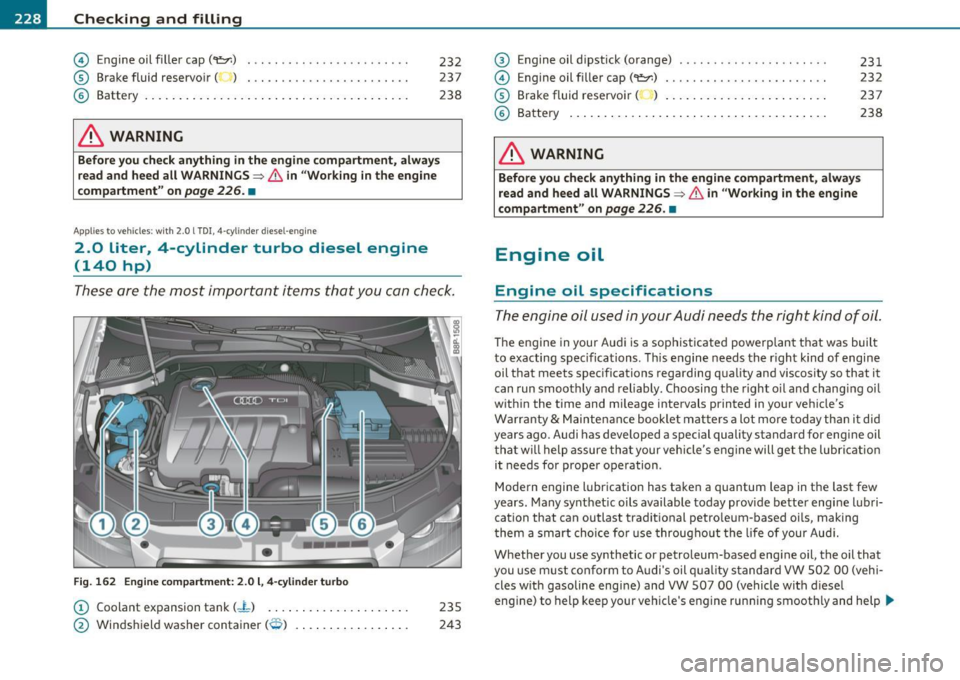
These are the most important items that you can che ck.
Fi g. 1 62 Engine comp artmen t: 2 .0 l, 4 -cyli nder tu rbo
(D Coolant expansion tank (J- ) ... . .. .... .. ... . .. .. .
@ Windshield washer container (~ ) .. .. ... .... .. ... .
235
243
®
©
®
© Engine oil dipstick (orange) ... .. ..... ... ... .... . .
Engine oil filler cap
('1:'=:?:) .................. .. .. . .
Brake fluid reservoi r ( ) ....... ...... ... .. .. .. . .
B atte ry .... . .. .... .. .... ... . .. .. . ... ... .. .. . .
& WARNING
231
232
237
238
Before you check anything in the engine compartment , alway s
r ead and heed all WARNINGS=>
& in "Work ing in the eng ine
compartment " on
page 226 . •
Engine oil
Engine oil specifications
The engine oil used in your Audi needs the right kind of oil.
The engine in your Audi is a sophisticated powe rp lant t hat was buil t
to exacting spec ifications . Th is engine needs the r ight kind of engine
oil that meets specifications regarding quality and viscosity so that it
can run smoo thly a nd reliably . Choosing the right o il and chang ing oi l
w ith in the time and mileage intervals printed in your vehicle 's
W arranty
& Mainte nance booklet ma tters a lot more today than i t did
years ago. Audi has developed a special quality standard for eng ine oil
t ha t wi ll help assure tha t your veh icle's engi ne will get t he lubri cat io n
it needs for proper operation .
Modern engine lu brication has take n a quantum leap in the last few
years . Many synt het ic oils available today provide be tte r engine lub ri
cation that can outlast tradit ional petro leum-based oi ls, making
t hem a smart choi ce fo r use througho ut the life of your Aud i.
Whether you use synthetic or petroleum-based engine oil, the oil that
you use mus t conform to A udi's oil quality standard VW 5 02 00 (veh i
cles wit h gasoline eng ine) and VW 507 00 (vehicle with diese l
eng ine) to help keep your ve hicle's engine runn ing smooth ly and help ..,
Page 232 of 320
___ C_ h_ e_c _k _i _ n _g ~ a_n _d_ f_il _l_in _ g _________________________________________ _
Under some circumstances the engine oil should even be changed
more frequently. Change oil more often if you drive mostly short
distances, operate the vehicle in dusty areas or mostly under stop
and-go traff ic conditions, or when you use your vehicle where temper
atures stay below freezing point for long periods .
Detergent additives in the oil will make fresh oil look dark after the
engine has been run ning for a short time . This is normal and is not a
reason to change the oil more often than recommended .
Damage or malfunctions due to lack of maintenance
It is essentia l that you change your oi l at the recommended intervals
using only engine oil that complies with Audi oi l standard VW 502 00
(vehicles with gasoline engine) or VW 507 00 (vehicles with diesel
engine). Your Limited New Vehicle Warranty does not cover damage
or malfunctions due to failure to follow recommended maintenance
and use requirements as set forth in the Audi Owner's Manua l and
Warranty
& Maintenance booklet. Your dealer will have to deny
warranty coverage unless you present to the dealer proof in the form
of Service or Repair Orders that all scheduled maintenance was
performed in a timely manner .•
Engine oil consumption
The engine in your vehicle depends on an adequate
amount of oil to lubricate and cool all of its moving parts.
In order to provide effective lubrication and cooling of internal
engine components, all internal combustion engines consume a
certain amount of o il. Oil consumpt ion varies from engine to engine
and may change significant ly over the life of the eng ine. Typically,
engines with a specified break- in period (see~
page 197) consume
more oi l during the break-in period than they cons ume after oil
consumption has stabilized.
Under normal cond itions, the rate of oil consumpt ion depends on the
quality and vis cosity of the oil, the RPM (revol utions pe r minute) at
which the engine is operated, the ambient temperature and road
conditions. Further factors are the amount of oi l dilution from water condensation or fuel residue and the ox
idation level of the o il. As any
eng ine is subject to wear as mileage builds up, the oil consumption
may increase over time until replacement of worn components may
become necessary.
With all these variab les coming into play, no standard rate of oil
consumption can be established or specified. There is no alternative
to regular and frequent checking of the oil level , see
Note .
If the yellow engine oil level warning symbol in the instrument
cl uster .... lights up, you should check the oil level as soon as possible
with the oil dipstick~ page 231. Top off the o il at your earliest
convenience ~
page 232.
& WARNING
Before you check anything in the engine compartment, always
read and heed all WARNINGS~
& in "Work ing in the engine
compartment" on
page 226.
0 Note
Driving with an insufficient oil level is likely to cause severe damage
to the engine .
[ i ] Tips
• The oil pressure warning display 't::r. is not an indicator of the oil
level. Do not rely on it. Instead, check the oil level in your engine at
regular intervals, preferably each time you refuel, and alway s
before going on a long trip.
• If you have the impression your eng ine consumes excessive
amounts of oi l, we recommend that you consu lt your authorized Audi
dea ler to have the cause of your concern properly diagnosed. Keep in
mind that the accurate measurement of oil consumption requires
great care and may take some time . Your authorized Audi dea le r has
instructions about how to measure oil consumption accurately. •
Page 233 of 320

Checking and filling --------------------=------=:;______,.J
Checking the engine oil level
Fig. 163 Dipstick
(Version A): O il level
rang es
Fig. 164 Dipstick
(Version B) : Oil level
ranges
Before you check anything in the engine compartment,
always r ead and h eed all WARNINGS ~ & in "Working in
the engine compartment" on
page 226.
D ete rmining oil l ev e l
- Park your vehicle so that it is horizontally level.
- While at operating state temperature, briefly let the
engine run at idle and then shut it off.
- Wait approx . two minutes.
Vehicle OP-eration
-Pull out the oil dipstick. Wipe off the oil dipstick with a
clean cloth, and slide it back in as far as it will go.
- Pull it back out and read off the oil level~ fig. 163 or
~ fig. 164. Top off the engine oil, if applicable
~ page 232 .
Oil level w ithin range @
- Do not add oil.
Oil level within range®
- You can add oil. A~erwards, the oil level should be within
range @.
Oil level within range ©
-You must add oil. A~erwards, the oil level should be
within range @.
The oil level needs to be checked at regular intervals. The best times
to do this are whenever you refuel and prior to long trips.
Depending on the way the vehicle is driven and the operating condi
tions, oil consumption can be up to 1/2 quart per 600 miles (0.5 liter
per 2,000 km). Consumption may be higher within the first 3,000
miles (5,000 km). •
Vehicle care Do-it-yourselt service iTechnical data
Page 234 of 320
--~C:!:h ~e~ c:.! k~ i~ n ~g~ a~n~ d~ f~il ~l~in ~ g ~ ----------------------------------------
Adding engine oil 9=:7,
Fig . 16 5 Engine
c om partment : Oil filler
c ap loc atio n
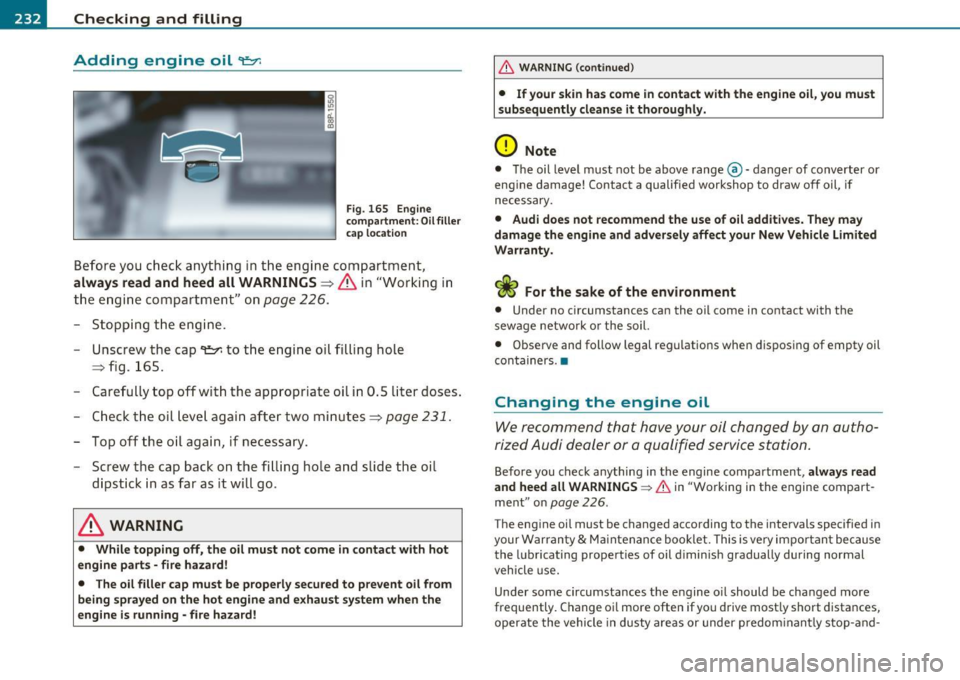
Befo re you ch eck anyt hing i n th e eng ine compart ment,
always read and heed all WARNINGS => & in "W orking in
t h e en gine compar tm ent" on
pag e 22 6.
- Stopp ing the e ngine.
- Unscrew the cap
- C arefully top off wit h the app ropriate oil i n 0.5 liter doses .
- Ch eck the oil lev el agai n afte r two minutes=>
pag e 231.
- To p of f t he oil ag ain, if neces sa ry .
- Screw the cap back on t he fi lling ho le a nd slide the oil
d ip st ic k i n as far as it will go.
& WARNING
• While topping off, the oil must not come in contact with hot
engine part s -fire hazard!
• The oil filler cap must be properly secured to prevent oil from
being sprayed on the hot engine and exhaust sy stem when the
engine is running -fire hazard!
& WA RNING (contin u ed )
• If your skin has come in contact with the engine oil , you must
subsequently cleanse it thoroughly .
0 Note
• The oi l level mus t not be above rang e@ -danger of converter or
eng ine damage! Contact a qualified workshop to draw off oil, if
nece ssary.
• Audi does not recommend the use of oil additives. They may
damage the engine and adversely affect your New Vehicle Limited
Warranty.
W For the sake of the environment
• Under no c ircumstances can the o il come in contact with the
sew age netwo rk o r the soil.
• Observe and follow legal regulations when dispos ing of empty oil
conta iners. •
Changing the eng ine oil
W e recommend th at have your oi l chan ged by an autho
ri zed A udi de aler or a quali fied service station.
Before you check anything in the engine compar tment, always read
and heed all WARNINGS :::,
& in "Working in the engine compart
ment" on
page 226 .
The eng ine oil must be changed according to the intervals specified in
your Warran ty
& M ainte nanc e bo oklet. This is very im po rta nt bec ause
the lub ricating properties of oil d imin ish gradually during normal
vehicle use .
Under some circumstances t he e ngine o il should be changed more
frequently. C hange o il more often if you drive most ly short dista nces,
operate the vehicle in dusty a reas or under p redo minan tly s to p-an d-
Page 235 of 320

Checking and filling --------------~--!'WI
go traffic co ndi tio ns, or have yo ur ve hicle where temperat ures remain _.,
b el ow free zin g f or ext en ded p erio ds.
De terg en t addi tives i n the o il w ill make fr esh oil look dark af ter the
engine has been ru nning for a s hort time . T his is norma l an d is not a
re ason t o change the oil more oft en than r eco mme nde d.
Because of the p roblem of proper disposal, a long w ith the spec ia l
tool s and neces sar y experti se require d, we s tro ngl y rec ommend t hat
yo u have your o il cha nged by an a uth orized
Audi dealer o r a qua lified
service stat io n.
If you choose to change your oil yourself , plea se no te the followi ng
im po rtant i nformation:
& WARNING
To reduce the risk of personal injury if you must change the engine
oil in your vehicle yourself :
• Wear eye protection.
• To reduce the risk of burns from hot engine oil, let the engine
cool down to the touch .
• When removing the oil drain plug with your fingers, stay as far
away as possible. Always keep your forearm parallel to the ground
to help prevent hot oil from running down your arm.
• Drain the oil into a container designed for this purpose, one
large enough to hold at least the total amount of oil in your
engine .
• Engine oil is poisonous. Keep it well out of the reach of chil·
dren.
• Continuous contact with used engine oil is harmful to your
skin. Always protect your skin by washing oil off thoroughly with
soap and water.
Safety first
0 Note
Never m ix o il addi tives w it h your e ngi ne oil. These additives can
dama ge your engine and adverse ly affect yo ur Audi New Vehicle
Li mi ted Warr anty .
c£> For the sake of the environment
• B efore changi ng y our oil, firs t mak e sure you know w he re you ca n
prope rly dispose of the used oil.
• Alw ays dis pose of used eng ine oil prope rly. Do n ot du mp i t on
garden soi l, wooded areas, into open st reams or down sewage drains.
• Recy cle used engine o il by taking it to a used e ngine oil collectio n
facility in your area, o r contact a serv ice stat ion .•
A pp lies to ve hicles : w it h d iese l e ng in e
Important information for vehicles with
diesel engine when adding or changing
engine oil
On v eh ic le s wit h a di ese l en gin e alway s us e engin e oil t hat
co nfo rms t o Audi oi l sp ecifi ca tion VW 5 07 00 w hen
addin g or changing engine oil.
Vehicles with diese l engines require an d must always use special
eng ine oi l that con forms to Audi o il sp ecifica tion
VW 507 00 .
Never use any othe r kind of eng ine o il in your vehicle , not eve n to top
o ff t he o il level.
A t th e t ime o f pr inting , we a re aware that Castro[ ® produces engine
oil that confo rms to Au di oil s peci fica tion VW 507 0 0. T his oi l may
no t ye t be available throughou t North Ame rica . Ot her oil m anufac·
t u rers may offer eng ine oi l t h at con forms to A udi oi l sp ecification
VW 50 7 00 at this t ime or some f uture date . ..,
Vehicle care Technical data
Page 236 of 320
IJIII Checking and filling
-------=:---- =------------------------------------
Please be sure to consu lt with your aut horized Aud i dea ler for infor
m ation and availabili ty of the proper engine oil fo r yo ur vehicle's
diesel engine and fo r the latest technical informat ion .
Beca use t his spec ia l engine o il may not be avai lab le when need it, we
s tr ong ly recommend t hat yo u alw ays car ry with yo u extr a qu art (liter)
of oil that conforms to A ud i oil specificat ion VW 507 00, in case you
have to top off o il wh ile on the road.
& WARNING
Failure to use engine oil for your diesel engine that expressly
conforms to Audi oil specification VW 507 00 can cause engine
failure on the highway that can cau se a cra sh and serious per sonal
injury.
• Never use any amount of engine oil in the diesel engine that
does not conform to Audi oil specification VW 507 00 .
• Always carry with you an extra quart (liter ) of engine oil that
conforms to Audi oil specification VW 507 00
in case you must top
off the oil while on the road .
& WARNING
Improperly stored items can become airborne missiles, flying
through the vehicle causing serious personal injury in the event of
hard braking or an accident. To help reduce the risk of serious
personal injury:
• Always store extra quart (liter ) of engine oil for your diesel
engine in its original oil container that is securely closed in the
luggage compartment. Make sure the container is securely stored
and mounted.
0 Note
• If you use engine oil that does not express ly co nform to A udi o il
spe cifica tion VW 507 00, very ser ious and ve ry expens ive da mage to
your vehicle's eng ine will occ ur. Eng ine damage caused by using the wrong engine oil
is not covered by your New Vehicle Lim ited
W arran ty.
• Not all comme rcia lly available oils conform to t his very rigid Audi
oil qua lity stand ard eve n th ough they may be sy nth et ic -b as ed and
have the same v iscosity .•
Engine cooling system
Coolant
The engine coo lant per forms t wo functions: i t keeps the
engin e fro m ove rhea ting and i t pro tec ts th e engine from
f ree zin g in t he win ter .
The cooling system is sealed and genera lly requ ires little attention.
Th e cooling system has been filled at the factory wit h a permanent
coo lant which does not need to be c hanged. The coolant cons ists of a
mixt ure of water an d the manufacturer's glyco l-basedcoolant ad di
tive G12 ++ a ntifree ze with a nticorros ion addit ives (50% fo r USA
mode ls; 60% for Canadian models). This mixture both ass ures the
nece ssary frost protec tion and p rotects meta l components in the
eng ine's cooling system from corrosion and scaling. It also raises the
boiling poin t of the co olant.
Do not red uce the co ncent ration of the coolant in the summer by
add ing p la in water.
The proportion of coolant additive must be at
least 50 % but not more than 60%
to ma inta in an tifreeze protectio n
and coo ling efficiency. If the coolant frost protect ion is too low, t he
coo lant co uld free ze and damage t he veh icle h eating and eng ine
coo ling system.
F or ye ar-round drivi ng, an tifr ee ze is add ed at t he fa ctory for tempe r
atures dow n to:
• - 31°F( -35°C)USA
• -40 °F ( -40 °C) Canada .
Page 238 of 320
___ C_ h_ e_c _k _i _ n _g ~ a_n _d_ f_il _l_in _ g _________________________________________ _
level sensor, we still recommend you check the coolant leve l from
ti me to time.
Coolant loss
Coolan t loss may ind ic a te a leak in the coo ling sys tem. In the event of
coo lant loss, the cooli ng system should be inspected immed iately by
your au thor ized A udi dealer.
It is no t enough merely to add coolan t.
In a
s ealed system, losses can occur only if the boiling point of the
coo lant is exceeded as a res ult of overheating .
(D Note
Do not add any type of radiator leak sealant to yo ur vehicle's engine
c oo lant. Addi ng radia tor repa ir fluid m ay adverse ly affect the fun c
tion and perfo rmance of your cooling system and could result in
damage not cove red by yo ur New Vehi cle Lim ited Warranty .•
Adding coolant
B e very careful when adding engine coolant.
Before you check anyt hing in the eng ine compartment ,
always read and heed all WARNINGS=> & in " Working i n
the e ngine compartment" on page
226.
-Tur n off the eng ine.
- Let t he engi ne c ool d ow n.
- Place a thick rag over the coolant expansion tank
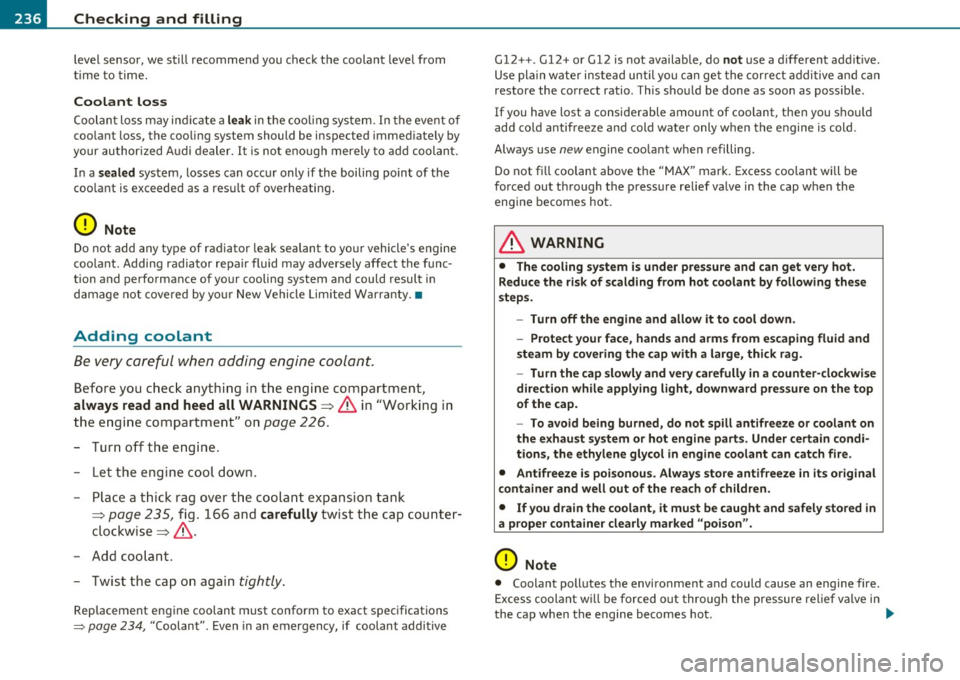
=> pa ge 235, fig . 166 and carefully twist t he cap cou nte r
clockwis e
=> &.
- Add coo lant.
- Tw ist the ca p on aga in
tightly .
Replacement eng ine coolant must conform to exact spec ificat ions
=> page 234, " Coolant" . Even in a n emergency, if coolant additive
Gl2 ++. Gl2+ or Gl2 is not available , do not use a d ifferent addit ive .
Use pla in w ate r ins tead until you can ge t the cor rect addi tive and can
restore the co rrect ratio . This sho uld be done as soon as possib le .
If you have lost a considerable amount of coolant, then you s houl d
ad d c old antifree ze and cold water only when the engine is cold .
Always use
new engine coo la nt w hen refilling .
Do not fill coolant above the "M AX" mark. Excess coo lant will be
forced out th rough the p ress ure relief va lve in the cap w hen the
eng ine becomes hot.
& WARNING
• The cooling system is under pressure and can get very hot.
Reduce the risk of scalding from hot coolant by following these
steps.
-Turn off the engine and allow it to cool down.
- Protect your face , hands and arms from escaping fluid and
steam by covering the cap with a large, thick rag.
- Turn the cap slowly and very carefully in a counter-clockwise
direction while applying light , downward pressure on the top
of the cap.
- To avoid being burned, do not spill antifreeze or coolant on
the exhaust system or hot engine parts . Under certain condi
tions, the ethylen e gly col in engine coolant can catch fire .
• Antifreeze i s poi sonou s. Always store antifreeze in it s original
container and well out of the reach of children.
• If you drain the coolant , it mu st be caught and safely stored in
a p roper container clearly marked "poison ".
(D Note
• Coolant pollutes the environment and could cause an engine fire.
E xcess coolant w ill be forced o ut thro ugh the pressure relie f va lve in
the cap when the e ngine becomes hot .
~
Page 240 of 320
___ C_h_ e_c _k _i_n -=g :a,__ a_n_ d_ f_ i_ l _li _n _,g;._ __________________________________________ _
warning/ind icator light will illum inate. Contact an au thorized A ud i
d ealer
immediately .•
Changing brake fluid
H av e th e b rake flu id chang ed by an exper ienced tech ni
ci an.
Br ake flui d abs orbs m oisture fro m the ai r. If t h e w ater con ten t in the
brake fl uid is too hig h, cor ros ion in th e brake system may res ult afte r
a p eriod of time. The boiling po int of t he br ake fl uid will al so decre ase
cons iderab ly and decrease brak ing perfo rma nce .
T he refo re, the brake fl uid m ust be c hanged
every two years . Always
use new brake fluid w hich conforms to Federal Motor Veh icle Stan
dard "F MVSS 1 16 DOT 4".
Th e b rake fl uid r eservo ir can be diffi cult t o re ach, there fore, we
recommend that you have the brake fluid changed by your author ized
Audi dealer . Your dealer ha s t he correc t tool s, the ri ght brake fl uid
and the know -how to do t his for you.
& WARNING
• Brake fluid is poisonous. It must be stored only in the closed
original container out of the reach of children!
• Brake failure can result from old or inappropriate brake fluid.
Observe these precautions :
- Use only brake fluid that meets SAE specification
J 1703 and
conforms to Federal Motor Vehicle Standard 116 . Always check
with your authorized Audi dealer to make sure you are using
the correct brake fluid. The correct type of brake fluid is also
indicated on the brake fluid reservoir .
- The brake fluid must be new. Heavy use of the brakes can
cause a vapor lock if the brake fluid is left in the system too
long . This can seriously affect the efficiency of the brakes as
well as your safety . This could result in an accident .
0 Note
Brake fluid will damage the paint of you r ve hicl e.
<£' For the sake of the environment
Beca us e of the prob le m of proper dispo sal of b ra ke fl uid as well as
the spec ia l too ls req uired and the necessary expe rtise , w e r ecom
me nd that you h ave t he brake fl uid chan ged by yo ur a uth oriz e d Audi
dea ler. •
Battery
General information
All wo rk on t he battery requires te chnica l k nowl ed ge !
Fig. 168 Engine
comp artment : Battery
with cover*
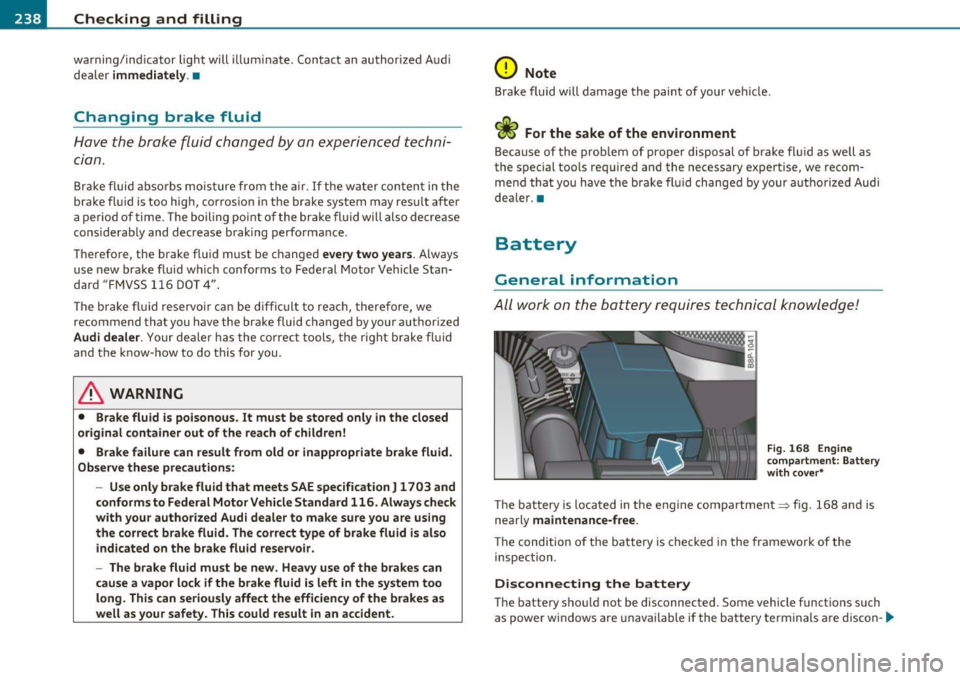
T he b att ery is lo cat ed in the e ng in e co mpar tmen t~ fig. 1 68 and is
nearly
maintenance-free.
Th e condition of the battery is che cked in the framewo rk of the
inspec tion .
Disconnecting the battery
The batte ry s ho ul d not be disconnected . Some vehicle funct io ns such
as powe r w indows are unavailable if the b attery te rminals a re discon -
~