lock AUDI S3 2011 Repair Manual
[x] Cancel search | Manufacturer: AUDI, Model Year: 2011, Model line: S3, Model: AUDI S3 2011Pages: 320, PDF Size: 75.79 MB
Page 223 of 320

__________________________________ F_ u_ e_l _s _ u...: p....:.. p ___ ly ~ a __ n _ d_ f _i_ l __ li _n _, g~ y __ o_ u _ r_f __ u_ e=.. l ::......:. t.:...a ..:...n :..:.k.::..._ __
Some states in the USA require permits to purchase diesel fuel. Check
with your State Motor Vehicle Department.
Diesel fuel may not be available outs ide the USA and Canada. Be sure
to check before traveling to other countries .
Winter operation
At temperatures below 20° F (- 7° C), Diesel fue l No. 2 loses its fluidity
due to wax separation, which may clog the fuel filter or tank filter and
keep the engine from running.
T o help the filter from being clogged by wax, the fuel fi lter in your
vehicle is automatically preheated. Preheating the fuel filter makes
operat ion of your vehicle possib le with Diesel fuel No. 2 down to -
10° F (-24° C).
If you expect temperatures below 5° F (-15° C) ask your fuel dealer
whether their Diesel fuel No. 2 is suffic iently w interized for the
prevailing and expected temperatures.
If not winte rized or insuffic iently winterized diesel fuel has already
thickened to the extent that the engine will not start, warm the
vehicle up by leaving it in a heated garage.
It is normal that the engine noise level (dieseling) is louder during the
warm-up period in winter.
It is also normal when whitish -blue smoke
comes out of the tailpipe after start ing and during warm-up. The
amount of smoke depends on the outside temperature.
Do not let your diese l engine id le unnecessari ly after a cold start.
Driving off slowly will shorten the warm-up period.
& WARNING
• Never use "starting assist fluids." They may be potentially
explosive or cause a "run-away" engine condition. This could
result in serious engine damage and personal injury.
• Never use fuel line anti-freeze offered for gasoline engines.
Safety first
0 Note
• Your diesel engine has been specifically designed to operate only
on Ultra Low Sulfur Diesel fue l. Therefore, never use home heating oil
or regu lar gaso line. The properties of these fuels may cause serious
damage to the fuel injection system and to the engine. Using these
fue ls can cause expens ive eng ine repairs and will also adversely affect
your New Vehicle Limited Warranty.
• If diesel fuel should get on any rubber hose, it must be wiped off
immediately. Then wash the contaminated hose portion with soap
and warm water. Do not allow diesel fuel to rema in on connecting
hoses. They may deve lop leaks and cause serious damage. •
Fuel tank
Fuel filler neck
The fuel filler neck is located on the right rear side panel behind the
fue l filler flap.
If the power locking system should fa il, you can still open the flap
manually - for detai led instructions see=>
page 224.
You ca n find the fuel tank capacity of your vehicle in Technical Data
=> page 296 .
The label on the inside of the fue l filler flap tells you the correct fuel
for your veh icle. For more information about fuel specifications, see
=> page 219.
Your vehicle fuel tank has an on-board refuelling vapor recovery
system . This feature helps to prevent fuel vapors from escaping from
the tank and polluting the environment while you refuel your vehicle.
In order to fill the tank properly while protect ing the environment,
please follow this refueling procedure carefully. .,,
Vehicle care Technical data
Page 224 of 320
-Fuel supply and filling your fuel tank PHf_ -:.....:.-.:._____ --------=-.:-___________ _
& WARNING
Under normal operating conditions, never carry additional fuel
containers in your car. Gas canisters and other containers used to
transport fuel can be dangerous. Such containers, full or empty,
may leak and could cause a fire in a collision. If you must transport
fuel to use for your lawn mower, snow blower, etc., be very careful
and always observe local and state laws regarding the use, trans
portation and storage of such fuel containers. Make certain the
container meets industry standards (ANSI/ASTM F852 - 86).
0 Note
Never drive your vehicle until the fuel tank is completely dry. The
irregular supply of fuel can cause misfiring. Gasoline could enter into
the exhaust system and damage the catalytic converter. •
Refuelling
The fuel filler flap is unlocked from a button in the
driver's door.
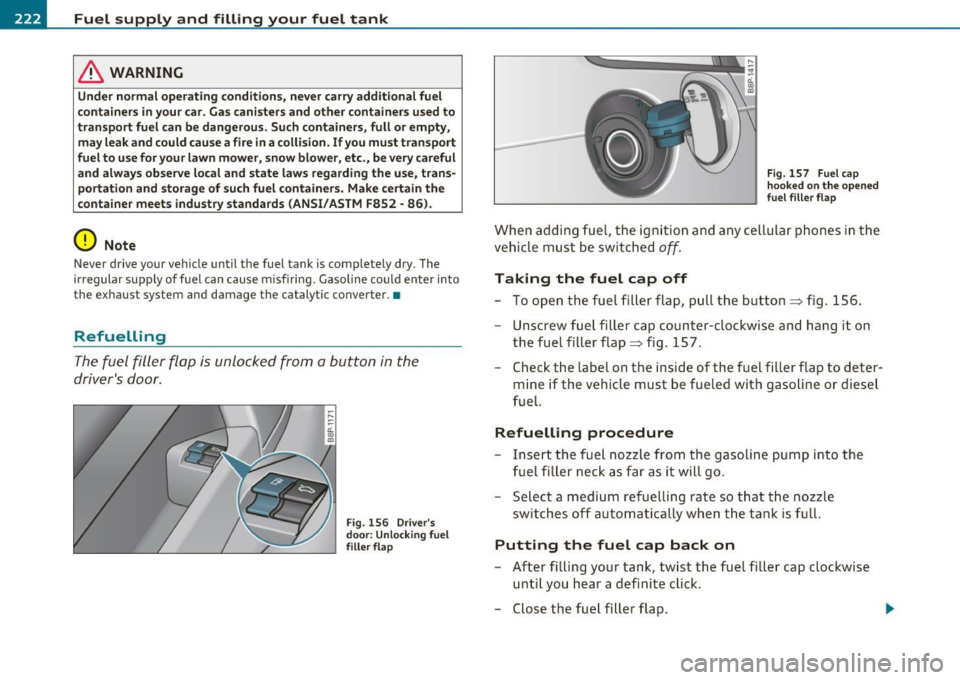
Fig . 156 Driver's
door: Unlocking fuel
filler flap Fig
. 157 Fuel cap
hooked on the opened
fuel filler flap
When adding fuel, the ignition and any cellular phones in the
vehicle must be switched
off.
Taking the fuel cap off
- To open the fuel filler flap, pull the button=> fig. 156 .
- Unscrew fuel filler cap counter-clockwise and hang it on
the fuel filler flap => fig . 157.
- Check the label on the inside of the fuel filler flap to deter
mine if the vehicle must be fueled with gasoline or diesel
fuel.
Refuelling procedure
Insert the fuel nozzle from the gasoline pump into the
fuel filler neck as far as it will go.
- Select a medium refuelling rate so that the nozzle
switches off automatically when the tank is full.
Putting the fuel cap back on
-After filling your tank, twist the fuel filler cap clockwise
until you hear a definite click.
- Close the fuel filler flap. .,
Page 226 of 320
Fuel supply and filling your fuel tank
(I) Tips
• Runn ing your eng ine while refuelling may cause vapors to escape
or even fuel to spill out of the tank. This would then shut off the fuel
nozzle before the tank is fu ll.
• Do not refuel your vehicle with the ignition switched on. The fuel
gauge may otherwise not ind icate the correct fuel level after
refuelling. •
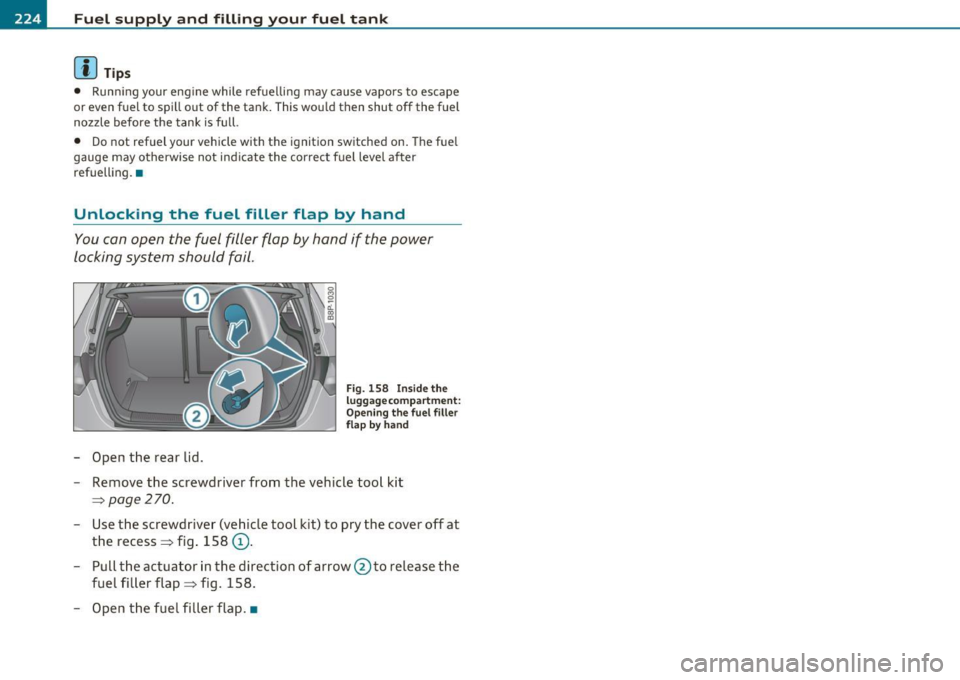
Unlocking the fuel filler flap by hand
You can open the fuel filler flap by hand if the power
locking system should fail.
- Open the rear lid.
Fig. 158 Inside t he
l ug gage compartment :
Open ing th e fue l filler
fl ap
by h an d
- Remove the screwdriver from the vehicle tool kit
=>
page 270.
- Use the screwdriver (vehicle tool kit) to pry the cover off at
the recess=> fig. 158
(D .
- Pull the actuator in the direct ion of arrow @to release the
fuel fi ller flap=> fig. 158 .
- Open the fuel filler flap.•
Page 228 of 320
___ C_ h_ e_c _k _i _ n _g ~ a_n _d_ f_il _l_in _ g _________________________________________ _
Closing the engine hood
- Pull the hood down until the pressure from the strut is
reduced.
- Let the hood
drop down and latch in place . Do not try to
push it shut;
it may fail to engage=> &.
& WARNING
A hood that is not completely latched could fly up and block your
view while driving.
• When you close the engine hood, check it to make sure the
safety catch has properly engaged. The hood should be flush with
the surrounding vehicle body parts.
• If you notice while driving that the hood is not secured prop
erly, stop at once and close it. •
Working in the engine compartment
Be especially careful whenever you work in the engine
compartment!
Whenever you must perform any work in the engine compartment,
for example checking and filling different fluids, there is a risk of
injury, burns and accidents. To prevent personal injury always
observe the following WARNINGS. The engine compartment of any
vehicle is a hazardous area!~
&
& WARNING
To help avoid injury, before you check anything under the hood :
• Turn off the engine.
• Remove the ignition key.
• Set the parking brake fully.
& WARNING (continued)
• Move selector lever of automatic transmission to "P" (Park);
put manual transmission in Neutral.
• Always let the engine cool down. Hot components will burn
skin on contact.
• To reduce the risk of being burned, never open the hood if you
see or hear steam or coolant escaping from the engine compart
ment. Wait until no steam or coolant can be seen or heard before
carefully opening the hood.
• Keep children away from the engine compartment.
• Never spill fluids on hot engine components. They can cause a
fire.
• Never touch the radiator fan. The auxiliary electric fan is
temperature controlled and can switch on suddenly.
• Never open the coolant reservoir cap when the engine is still
warm. The coolant system is pressurized and hot coolant could
spray out!
• Protect your face, hands and arm from steam or hot engine
coolant by placing a thick rag over the cap when you open the
coolant reservoir.
• If work on the fuel system or the electrical system is necessary:
-Always disconnect the battery .
- Never smoke or work near heaters or open flames. Fluids in
the engine compartment could start a fire.
- Keep an approved fire extinguisher immediately available.
• To avoid electrical shock and personal injury while the engine is
running or being started, never touch:
- Ignition cables
- Other components of the high voltage electronic ignition
system.
• If you must perform a check or repair with the engine running: .,_
Page 238 of 320
___ C_ h_ e_c _k _i _ n _g ~ a_n _d_ f_il _l_in _ g _________________________________________ _
level sensor, we still recommend you check the coolant leve l from
ti me to time.
Coolant loss
Coolan t loss may ind ic a te a leak in the coo ling sys tem. In the event of
coo lant loss, the cooli ng system should be inspected immed iately by
your au thor ized A udi dealer.
It is no t enough merely to add coolan t.
In a
s ealed system, losses can occur only if the boiling point of the
coo lant is exceeded as a res ult of overheating .
(D Note
Do not add any type of radiator leak sealant to yo ur vehicle's engine
c oo lant. Addi ng radia tor repa ir fluid m ay adverse ly affect the fun c
tion and perfo rmance of your cooling system and could result in
damage not cove red by yo ur New Vehi cle Lim ited Warranty .•
Adding coolant
B e very careful when adding engine coolant.
Before you check anyt hing in the eng ine compartment ,
always read and heed all WARNINGS=> & in " Working i n
the e ngine compartment" on page
226.
-Tur n off the eng ine.
- Let t he engi ne c ool d ow n.
- Place a thick rag over the coolant expansion tank
=> pa ge 235, fig . 166 and carefully twist t he cap cou nte r
clockwis e
=> &.
- Add coo lant.
- Tw ist the ca p on aga in
tightly .
Replacement eng ine coolant must conform to exact spec ificat ions
=> page 234, " Coolant" . Even in a n emergency, if coolant additive
Gl2 ++. Gl2+ or Gl2 is not available , do not use a d ifferent addit ive .
Use pla in w ate r ins tead until you can ge t the cor rect addi tive and can
restore the co rrect ratio . This sho uld be done as soon as possib le .
If you have lost a considerable amount of coolant, then you s houl d
ad d c old antifree ze and cold water only when the engine is cold .
Always use
new engine coo la nt w hen refilling .
Do not fill coolant above the "M AX" mark. Excess coo lant will be
forced out th rough the p ress ure relief va lve in the cap w hen the
eng ine becomes hot.
& WARNING
• The cooling system is under pressure and can get very hot.
Reduce the risk of scalding from hot coolant by following these
steps.
-Turn off the engine and allow it to cool down.
- Protect your face , hands and arms from escaping fluid and
steam by covering the cap with a large, thick rag.
- Turn the cap slowly and very carefully in a counter-clockwise
direction while applying light , downward pressure on the top
of the cap.
- To avoid being burned, do not spill antifreeze or coolant on
the exhaust system or hot engine parts . Under certain condi
tions, the ethylen e gly col in engine coolant can catch fire .
• Antifreeze i s poi sonou s. Always store antifreeze in it s original
container and well out of the reach of children.
• If you drain the coolant , it mu st be caught and safely stored in
a p roper container clearly marked "poison ".
(D Note
• Coolant pollutes the environment and could cause an engine fire.
E xcess coolant w ill be forced o ut thro ugh the pressure relie f va lve in
the cap when the e ngine becomes hot .
~
Page 240 of 320
___ C_h_ e_c _k _i_n -=g :a,__ a_n_ d_ f_ i_ l _li _n _,g;._ __________________________________________ _
warning/ind icator light will illum inate. Contact an au thorized A ud i
d ealer
immediately .•
Changing brake fluid
H av e th e b rake flu id chang ed by an exper ienced tech ni
ci an.
Br ake flui d abs orbs m oisture fro m the ai r. If t h e w ater con ten t in the
brake fl uid is too hig h, cor ros ion in th e brake system may res ult afte r
a p eriod of time. The boiling po int of t he br ake fl uid will al so decre ase
cons iderab ly and decrease brak ing perfo rma nce .
T he refo re, the brake fl uid m ust be c hanged
every two years . Always
use new brake fluid w hich conforms to Federal Motor Veh icle Stan
dard "F MVSS 1 16 DOT 4".
Th e b rake fl uid r eservo ir can be diffi cult t o re ach, there fore, we
recommend that you have the brake fluid changed by your author ized
Audi dealer . Your dealer ha s t he correc t tool s, the ri ght brake fl uid
and the know -how to do t his for you.
& WARNING
• Brake fluid is poisonous. It must be stored only in the closed
original container out of the reach of children!
• Brake failure can result from old or inappropriate brake fluid.
Observe these precautions :
- Use only brake fluid that meets SAE specification
J 1703 and
conforms to Federal Motor Vehicle Standard 116 . Always check
with your authorized Audi dealer to make sure you are using
the correct brake fluid. The correct type of brake fluid is also
indicated on the brake fluid reservoir .
- The brake fluid must be new. Heavy use of the brakes can
cause a vapor lock if the brake fluid is left in the system too
long . This can seriously affect the efficiency of the brakes as
well as your safety . This could result in an accident .
0 Note
Brake fluid will damage the paint of you r ve hicl e.
<£' For the sake of the environment
Beca us e of the prob le m of proper dispo sal of b ra ke fl uid as well as
the spec ia l too ls req uired and the necessary expe rtise , w e r ecom
me nd that you h ave t he brake fl uid chan ged by yo ur a uth oriz e d Audi
dea ler. •
Battery
General information
All wo rk on t he battery requires te chnica l k nowl ed ge !
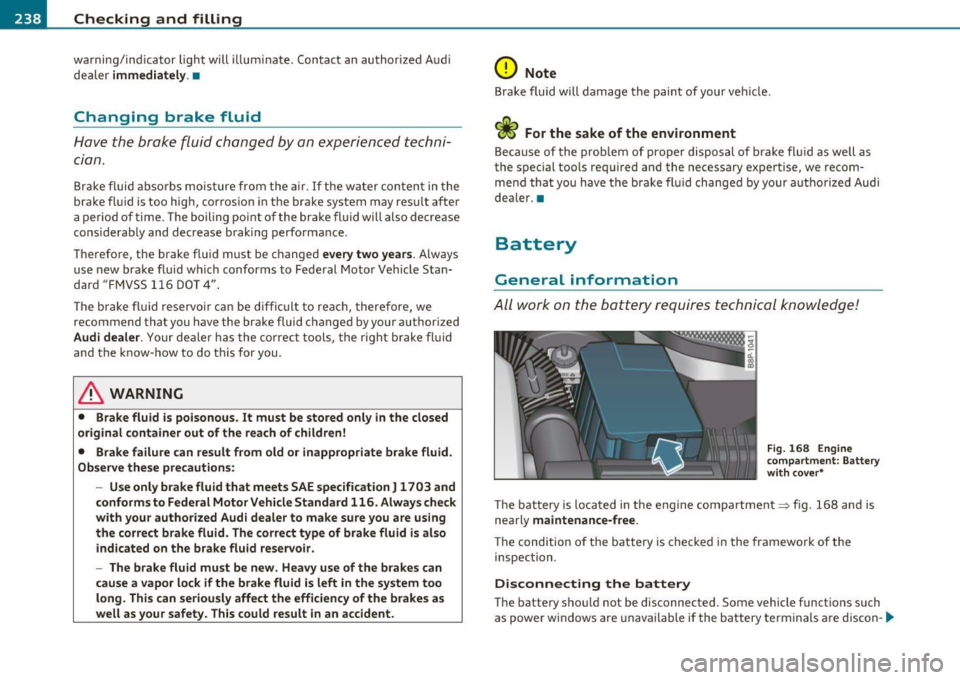
Fig. 168 Engine
comp artment : Battery
with cover*
T he b att ery is lo cat ed in the e ng in e co mpar tmen t~ fig. 1 68 and is
nearly
maintenance-free.
Th e condition of the battery is che cked in the framewo rk of the
inspec tion .
Disconnecting the battery
The batte ry s ho ul d not be disconnected . Some vehicle funct io ns such
as powe r w indows are unavailable if the b attery te rminals a re discon -
~
Page 241 of 320

___________________________________________ C_ h_e _c _k_ i_n ~g_ a_n_ d_ f_ i_ll _i_n _g __ _
nected. These functions have to be relearned after the battery termi
nals are connected again. To prevent this, the battery should only be
disconnected from the vehicle electrical system if absolutely neces
sary.
Power window one-touch
up/down function
Reprogramming
~ page 51, "Reactivating the sys
tem after battery disconnection"
Master key with remote control Synchronization~
page 43
Digital clock ~ page 9
ESP indicator light The indicator light goes out after
driving a few meters
Vehicles not driven for long periods and short
distance operation
If you do not drive your vehicle for several days or weeks, e lectrical
consumers are gradually scaled back or switched off. Th is reduces
energy use and ensures the vehicle will be able to start after long
periods of time~
page 194. Some convenience functions such as
opening with the remote control key may not be available. These
convenience functions will be available again once you switch the
ignition on and start the engine. Even when consumers are switched
off, the battery will become deeply discharged by stand-by power
consumers if the vehicle is not driven for several months . Deep
discharging results in a chemica l reaction that destroys the inside of
the battery. The battery must be charged every month to prevent th is
~ page 241. Do not disconnect the battery or the anti-theft alarm
system* will not work.
Winter operation
Cold weather places higher demands on the battery. This results in
reduced starting abi lity. Have the battery checked and recharged if
necessary before the cold weather beg ins.
Avoid unnecessary power consumption, part icularly in city traffic or
when travel ing on ly short distances. Let your author ized Audi dealer
Safety first
check the capacity of the vehicle battery before winter sets in
~ page 241. A well charged battery will not only p revent start ing
problems when the weather is cold, but will also last longer.
(D Note
• All work on the battery requires techn ical knowledge. Please
contact an Audi dealership or another authorized facility for ques
tions about the battery- danger of acid burns and explosion hazard!
• The battery m ust not be opened! Do not try to change the
battery's liquid level, otherwise detonating gas will escape from the
battery - explosion hazard!
• The AGM battery in the luggage compartment cannot leak,
because the electrolyte for this battery is absorbed into a specia l
glass mat . This leak -proof battery must not be replace with a conven
tional battery .
• Make sure the ventilation hose on the side of the battery is
connected, otherwise fumes or battery acid can leak out.
• Battery holder and terminals always have to be secured correctly .
• Before all work on the battery follow the
warnings below~ & in
"Working on the battery" on
page 239. •
Working on the battery
All work on the battery requires technical knowledge! Be
especially careful when working on or near the battery!
Before you check anything in the engine compartment,
always
read and heed all WARNINGS~ & in "Working in
the engine compartment" on
page 226 .
Always heed the safety warnings, when working on the vehicle
battery or the vehicle electrical system to prevent injury .
Vehicle care Technical data
Page 254 of 320
-Tires and wheels PJTI,.____ ______________ _
in. WARNING
• Incorrect tire pressures and /or underinflation can lead to a
s eriou s or fatal a ccident .
• Incor rect tire p ressu res and /or underinflation cause increased
tire wear and can affect the handling of the vehicle .
• Incorrect tire pressu res and /or underinflation can also lead to
s udden tire failur e, including a blowout and sudden deflation,
caus ing loss of vehicle cont rol. •
Checking tire pressure
The correct tire pressure for the tires ori ginally installed
on your vehicle is listed on the tire pressure la bel located
either on driver's side 8-pillar or inside the fuel filler fla p.
Th e recommended tire pressures a re on the tire press ure labe l and in
t he table~ page 249, "Cold tire infla tion pressure" . This means that
the pressure m ust be checked an d adju sted when the tire has not
bee n dr iven for more than a co uple of miles (kilometers) at low
speeds dur ing the previous three hours. Air in the tires expands w hen
the tire heats up as a resul t of inte rna l fr iction as it flexes in use. The
tire press ure is higher when the t ire has warmed up than when it is
"cold ."
It is the inflation press ure i n a "cold" t ire that counts . Therefore, you
should never let air out of a warm tire to match "Co ld tire inflat ion
pressure" recommendat ions~
page 249 . The t ires would t hen be
underinflated and co uld fail sudden ly .
T he tire p ress ure label on your Audi lists the recommended co ld tire
inflation pressures for the new, or iginal equipment t ires that were on
your vehicle at t he time i t was man ufa cture d. For the location of t he
label~
page 249 , fig. 171.
Most tires lose a ir nat urally over time. They can a lso lose some a ir if
you d rive over a pot hole or hi t a curb while pa rking .
It is usua lly not possible to see whether the rad
ia l tires used today are underinflated
jus t by loo king at th em.
T herefore, be sure to check t ire pressures a t least once a month and
always before go ing on a long trip. Make sure to take the number of
peop le and the amoun t of lugg age i nto a ccount whe n ad justi ng tire
pressure for a trip -even one that you would not consider to be
" lo ng." See ~
page 253, "Ti res and vehicle lo ad lim its " fo r mo re
important informat ion.
Always use an accurate t ire pressure ga uge when check ing and
ad justing i nflat io n pressures . Check all of the tires and be sure not to
forget the s pare tire . If the press ure in any ti re is too hig h when the
t ire is "co ld," let ai r out of t he tire slowly with t he edge of the ti re
gauge and keep checki ng the press ure unt il yo u reach the press ure
that is co rrect for the load (p assenge rs a nd luggage) a nd kind of
driving yo u plan to do.
If the press ure in any t ire is too low , no te the difference between t he
pressure in the cold tire and the pressure you need and add the a ir
t ha t you need to reac h the co rrect pressure fo r the vehi cle load
(passengers a nd luggage) fo r the tires o n yo ur vehicle as listed on the
on your vehicle and in this man ual and the k ind of driving yo u plan to
do .
Never exceed the ma ximum inflation pressure listed on the tire
s idewall for any reason .
Remember that the vehicle manufacturer, not the t ire manufacturer,
determines the cor rec t tire p ress ure for the tires on your ve hicle.
It is important to chec k the tire pressu re whe n the t ires a re co ld.
• Read the required t ire pressure from the t ire pressure labe l. On
U SA vehicles, the tire pressure la bel is loc ated on dr ive r's si de 8- pillar.
On Canada veh icles, t he tire pressu re label is located ei ther on the
dr iver's side 8-pillar o r i ns ide the f ue l f iller flap .
• Turn the va lve stem cap counter-clockw ise to remove it from the
t ire valve.
• Place the air press ure gauge on the valve . .,_
Page 262 of 320
-~_T_ i_ re _ s_ a_n _ d_ w_ h _e_ e_ ls _________________________________________________ _
& WARNING (conti nu ed )
ev en though the damage cannot be seen that can lead to sudden
tire failure and lo ss of vehicl e control.
• All four wheels must be fitted with radial tires of the same
type, size (rolling circumference ) and the same tread patte rn .
Driving with different tires reduces vehicle handling and can lead
to a los s of control.
• If the spare t ire is not the same as the tires that are mounted
on the vehicle -for example with winter tires -only use the spare
tire for a short period of time and drive with e xtra care. Refit the
normal road wheel as soon a s safely possible.
• Never drive faster than the maximum speed for which the ti res
on your vehicle are rated because tires that are driven faster than
their rated speed can fail suddenly .
• Overloading tire s cau se heat build-up, sudden tire failure,
including a blowout and sudden deflation and loss of control.
• Temperature grades apply to tires that are properly inflated
and not o ver or underinflated.
• For technical reasons it is not always possible to use wheels
from other vehicle s- in some cases not even wheels from the same
vehicle model.
• If you install wheel trim discs on the vehicle wheels, make sure
that the air flow to the brakes is not blocked. Reduced airflow to
the brakes can them to overheat , increa sing stopping distance s
and causing a collision.
• Run flat tires may only be used on vehicles that were equipped
with them at the factory. The vehicle must have a chassis designed
for run flat tires and a factory-in stalled tire pres sure monitoring
sy stem* that indicates a loss of tire pressure . Incorrect use of run
flat tires can lead to vehicle damage or accidents. Check with an
authorized Audi dealer or tire speciali st to see if your vehicle can
be equipped with run flat tires .
If run flat tires are used, they must
be installed on all four wheels. Mixing tire types is not permitted .
0 Note
• For tech nica l reasons, it is no t gene rally poss ible to use the wheel
r ims from other vehicles. This ca n hold t rue for w heels of the same
vehicle type .
• If the spa re tire is different from the tires t hat you have mounte d
on you r vehi cle (fo r exa mple w inte r tir es or wide profi le tires), then
use the spa re t ire for a short perio d of time on ly and d rive with e xtra
c are. Replace t he f lat tire w it h t he ti re m atch ing t he ot hers on yo ur
vehicle as soon as possible.
• If you put diffe rent whee ls and t ires o n your ve hicle (e.g . winter
w heels and tires), yo u must be certain t hat the whee ls and tires are
c omp atib le w ith the tire press ure mon ito ring system* . O th erwise the
system will register a malfunction and a fault message w ill be
displayed. For m ore infor mati on, con ta ct y our au thor ized Aud i
dea ler.
• N ever dr ive witho ut the valve stem c ap. The valves could get
damaged.
For the sake of the environment
Dispose of old t ires in accordance with the loca l requ irements. •
Uniform tire quality grading
• Tread wear
• Tr act io n AA A B C
• T emperat ure A B C
Q uali ty g rades can be fo und where applicab le on the tir e s ide wall
between tread sho ulder and max imum sect ion width ~
page 257,
fig. 175.
For example: Tread wear 200, Tract ion
AA , Temperat ure A.
All passenger ca r tires must confo rm to Federa l Safety Requirements
i n addition to these grades. .,_
Page 264 of 320
.,,.___T_ ir_e_ s _ a_ n _ d_ w_ h_e_ e_ ls _______________________________________________ _
Winter tires lose their effectiveness when the tread is worn down to
a dep th o f 0. 15 7 inch (4 m m).
Only drive w it h w inte r tir es under w inte r co nd it io ns. S u mmer t ires
hand le better w hen there is no s now or ice on t he roads a nd the
t em pe ra ture i s above 4 5
°F (7 ° ( ).
If you have a flat tire, see notes on spare wheel~ page 257.
Please always remember that winter tires may have a lower speed
rating than t he t ires originally installed on yo ur ve hicle at the time it
was ma nufact ured . Please see~
page 259, "Speed rat ing ( letter
c ode)" fo r a listing of the speed rating le tte r codes a nd t he maximu m
speed at which the tires can be dr ive n.
Th e spee d rat ing le tt er code( ~
page 259 ) is on the side w all of the
t ire~
page 257 .
& WARNING
Winter tires have ma ximum speed limits that may be lower than
your vehicle's maximum speed. Always know the maximum speed
before driving off. Never drive faster than the speed perm itted fo r
your specific winter tires . This will cause damage to the tire s
leading to an accident and serious personal injury to you and your
passengers.
& WARNING
Driving faster than the maximum speed for which the winter tires
on your vehicle were des igned can cause ti re failure includ ing a
blowout and sudden deflation, lo ss of control, crashes and serious
personal injuries . Have worn or damaged tires replaced immedi
ately.
• Winter t ires have maximum speed rat ing that may be lower
than your vehicle's maximum speed .
• Never drive faster than the speed for which the winter or other
tires installed on your vehicle are rated.
& WARNING
Always adjust your driving to the road and traffic conditions.
Never let the good acceleration of the winter tires and all-wheel
drive tempt you into taking extra risks. Always remember :
• When braking , an all-wheel drive vehicle handles in the same
way as a front drive vehicle .
• Drive carefully and reduce your speed on icy and slippery roads,
even winter tires cannot help under black ice conditions.
do not wear as quickly and reduce fuel consum ption .•
Snow chains
Snow chains may be fit te d on ly to the fr ont w heels, and only to
certain t ire sizes . Ask yo ur aut horized Audi dealer on which tire sizes
snow chains can be used .
If you are go ing to use snow c ha ins, then you must insta ll th em on t he
front wheels at least .
Th e sn ow chain s mus t have low-pr ofile li nks and m ust no t be th icker
than 0 .53 inc h (13.5 mm), including the lock.
R emove wheel cente r covers an d trim discs before putti ng snow
chains on your vehicle~
0. For safety reaso ns cove r caps m ust the n
be fitted over the whee l bo lts. These are availab le from a utho rized
Audi dealers.
& WARNING
Using the wrong snow chains for your veh icle or installing them
incorrectly can incre ase the risk of loss of control leading to
serious personal injury .
~