warning AUDI S3 2012 Owners Manual
[x] Cancel search | Manufacturer: AUDI, Model Year: 2012, Model line: S3, Model: AUDI S3 2012Pages: 280, PDF Size: 70.11 MB
Page 204 of 280
202 Checking and filling
-When removing the oil drain plug with
your fingers, stay as far away as possible.
Always keep your forearm parallel to the
ground to help prevent hot oil from run
ning down your arm.
- Drain the oil into a container designed
for this purpose, one large enough to
hold at least the total amount of oil in
your engine.
- Engine oil is poisonous. Keep it well out
of the reach of children .
- Continuous contact with used engine oil
is harmful to your skin. Always protect
your skin by washing oil off thoroughly
with soap and water.
(D Note
Never mix oil additives with your engine
oil. These additives can damage your en
gine and adversely affect your Audi New
Vehicle Limited Warranty.
@) For the sake of the environment
- Before changing your oil, first make sure
you know where you can properly dispose
of the used oil.
-Always dispose of used engine oil proper
ly. Do not dump it on garden soil, wood
ed areas, into open streams or down
sewage drains.
- Recycle used engine oil by taking it to a
used engine oil collection facility in your
area, or contact a service station.
Important information for vehicles with
diesel engine when adding or changing
engine oil
App lies to vehicles: with diesel engine
On vehicles with a diesel engine always use
engine oil that conforms to Audi oil specifica
tion VW
507 00 when adding or changing en
gine oil.
Vehicles with diesel engines require and
must
always
use special engine oil that conforms to
Audi oil specification
VW 507 00 .
Never use any other kind of engine oil in your
vehicle, not even to top off the oil level.
At the time of printing, we are aware that Cas
trol ® produces engine oil that conforms to Au
di oil specification VW 507 00. This oil may
not yet be available throughout North Ameri
ca. Other oil manufacturers may offer engine
oil that conforms to Audi oil specification
VW 507 00 at this time or some future date.
Please be sure to consult with your authorized
Audi dealer for information and availability of
the proper engine oil for your vehicle's diesel
engine and for the latest technical informa
tion .
Because this special engine oil may not be
available when need it, we strongly recom
mend that you always carry with you extra
quart (liter) of oil that conforms to Audi oil
specification VW 507 00, in case you have to
top off oil while on the road .
.&, WARNING
Failure to use engine oil for your diesel en
gine that expressly conforms to Audi oil
specification VW 507 00 can cause engine
failure on the highway that can cause a crash and serious personal injury.
- Never use any amount of engine oil in
the diesel engine that does not conform
to Audi oil specification VW 507 00.
- Always carry with you an extra quart (li ter) of engine oil that conforms to Audi
oil specification VW 507 00 in case you must top off the oil while on the road.
.&, WARNING
Improperly stored items can become airborne missiles, flying through the vehicle
causing serious personal injury in the
event of hard braking or an accident . To
help reduce the risk of serious personal in
Jury:
-Always store extra quart (liter) of engine
oil for your diesel engine in its original oil
container that is securely closed in the
~
Page 205 of 280
luggage compartment. Make sure the
container is securely stored and mount
ed.
0 Note
-If you use engine oil that does not ex
pressly conform to Audi oil specification
VW 507 00, very serious and very expen
sive damage to your vehicle 's engine will
occur . Engine damage caused by using
the wrong engine oil is not covered by
your New Vehicle limited Warranty .
- Not all commercially available oils con
form to this very rigid Audi oil quality
standard even though they may be syn
thetic-based and have the same viscosi
ty.
Engine cooling system
Coolant
T he engine coolant performs two functions: it
keeps the engine from overheating and it pro
tects the engine from freezing in the winter.
The cooling system is sealed and generally re
quires little attention.
The cooling system has been filled at the fac
tory with a permanent coolant which does not need to be changed. The coolant consists of a
mixture of water and the manufacturer's gly
col-based coolant additive Gl2++ antifree ze
with anticorrosion additives (50% for USA models; 60% for Canadian models). This mix
ture both assures the necessary frost protec
tion and protects metal components in the
engine 's cooling system from corrosion and
scaling.
It also raises the boiling point of the
coolant.
Do not reduce the concentration of the cool
ant in the summer by adding plain water.
The
proportion of coolant additive must be at
least 50% but not more than 60%
to main
tain antifreeze protection and cooling efficien
cy. If the coolant frost protection is too low,
the coolant could freeze and damage the vehi
cle heating and engine cooling system.
Checking and filling 203
For year-round driving, antifreeze is added at
the factory for temperatures down to:
--31°F(-35°C)USA
- - 40 °F ( - 40 °C) Canada.
You can mix the Gl2 ++ coolan t additive with
other additives Gl2 + or Gl2. Always check
with your authorized Audi dealer .
A WARNING
-
Before you check anything in the engine
compartment, always read and heed all
WARNINGS~
& in Working in the engine
comportment on page 194.
(D Note
- Before winter sets in, have the coolant
checked to see if the coolant additive in
your vehicle is sufficient to meet the cli
mate conditions. This is especially impor
tant if you live in a region where the
win
ter is extremely cold. If necessary, in
crease the proportion of coolant additive
to 60% .
- When adding coolant additive to your
cooling system, remember :
- We recommend using only coolant ad
ditive G 12++ (check the label) for your
vehicle. This coolant additive is availa
ble at authorized Audi dealers. Other
types of antifreeze can significantly re
duce corrosion protection. The result
ing corrosion can cause a loss of cool
ant and serious engine damage.
- Do not add any type of radiator leak seal
ant to your vehicle's engine coolant.
Adding radiator repair fluid may adverse ly affect the function and performance of
your cooling system and could result in
damage not covered by your New Vehicle
Limited Warranty.
•
•
Page 206 of 280
204 Checking and filling
Checking the engine coolant level
The engine coolant level can be checked with
a quick glance .
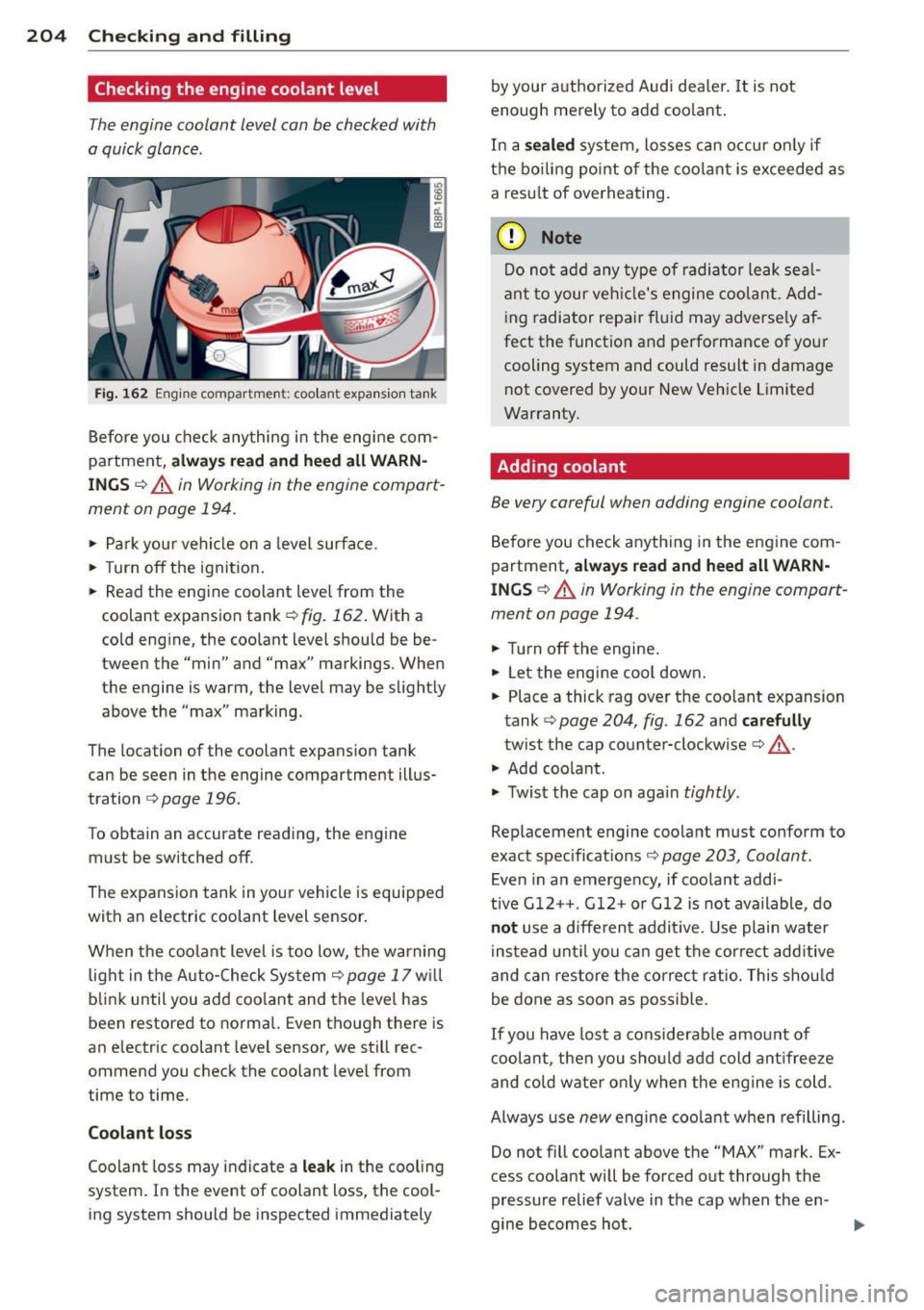
Fig. 162 Engine compartme nt: coo lant expansio n tank
Before you check anything i n the eng ine com
partment,
a lw ays rea d and h eed all WARN
ING S ¢&. in Working in the engine compart
ment on page 194.
.. Park your vehicle on a level surface.
.. Turn
off the ignit ion .
.. Read the eng ine coolant leve l from the
coolant expansion tank<=>
fig. 162 . With a
cold eng ine, the coo lant level should be be
tween the "min" and "max" markings . When
the engine is warm, the level may be slightly above the "max" marking.
The location of the coolant expansion tank
can be seen in the engine compartment illus
tration
i:> page 196.
To obtain an accurate read ing, the engine
must be switched
off.
The expansion tank in yo ur vehicle is equipped
with an e lectric coolant level sensor .
When the coolant level is too low, the warning light in the Auto -Check System
c> page 17 w ill
blink until you add coo lant and the level has
been restored to norma l. Even though there is
an electric coolant level sensor, we still rec
ommend you check the coolant level from
time to time.
Coolant lo ss
Coolant loss may indicate a le ak in the cooling
system . In the event of coolant loss, the cool
ing system should be inspected immediately by your authorized Audi dea
ler .
It is not
enough merely to add coolant .
In a
se aled system, losses can occur on ly if
the boiling point of the coo lant is exceeded as
a res ult of overheating.
(D Note
Do not ad d any type of radiator leak sea l
ant to your veh icle's engine coolant . Add
i ng radiator repair fl uid may adverse ly af
fect the funct ion and performance of your
cooling system and could result in damage not covered by your New Veh icle Limited
Warranty .
Adding coolant
Be very careful when adding engine coolant.
Before you check anything in the eng ine com
partment,
a lw ays re a d and heed all WARN
INGS c::> A in Working in the engine compart
ment on page 194 .
.. Turn off the engine .
.. Let the engine cool down.
.. Place a thick rag over the coolant expansion
tank
c::> page 204, fig . 162 and ca refull y
twist the cap counter-clockwise c::> A.
.. Add coo lant .
.. Twist the cap on aga in
tightly .
Replacement engine coolant must conform to
exact spec ificat ions
c::> page 203, Coolant.
Even in an emergency, if coolant addi-
t ive G12++ . G 12+ or G12 is not ava ilable, do
n ot use a d iffe rent addit ive. Use plain water
instead unt il you can get the correct add itive
and can restore the correct ratio. This shou ld
be done as soon as possible .
If you have lost a considerab le amou nt of
c oolant, then you sho uld add cold ant ifree ze
and co ld wate r on ly when the engine is cold.
Always use
new engine coo lant when refilling .
Do not f ill coolant above the
"MAX" mark. Ex
cess coolant will be forced out through the
pressure relief valve in the cap when the en -
gine becomes hot .
Iii>
Page 207 of 280
& WARNING
-The cooling system is under p ress ure and
can get very hot . Reduce the risk of
sca ld ing from hot coo lant by following
these steps.
- Tur n off the engine and a llow it to cool
down.
- Protect your face, hands and arms from
escap ing flu id and steam by cover ing
the cap wi th a large, thick rag.
- Tu rn the cap slowly and very ca refully
i n a cou nte r-clockw ise d irect ion w hile
ap ply ing ligh t, downw ard press ure on
the top of the cap.
- To avo id being burned, do no t sp ill an
tifreeze o r coolan t on the exhaust sys
tem or hot engine parts. Under certa in
conditions, the ethylene glyco l in en
gine coolant can catc h fir e.
- An tifreeze is poisonous . Always store an
tifreeze in its or iginal co ntainer and we ll
o ut o f the reach of children.
- If you drain the coolant, it must be
caught and safely stored in a p roper con
tainer clearly marked "poison".
(D Note
- Coolant po llutes the env ironment and
could cause an engine fire. Excess coo l
ant wi ll be forced out throug h the pres
su re re lief va lve in the cap when the en
gine becomes hot.
- If, in an emergency, only water can be
added, the cor rect ratio between water
and antifreeze
c:> page 203 must be re
stored as soon as possib le.
@) For the sake of the environment
Drained coolant shou ld n ot be re used. Al
ways dispose of used coolant while obse rv
ing all environmental regulations.
Checkin g and fillin g 205
Radiator fan
The radiator fan switches on automatically by
itself .
The electric radiator fan is controlled by ther
moswitches t hat sw itch on a nd off depending
o n coo lant and eng ine compartment tempera
tures .
An a uxiliary electric radiator fan* sw itches on
and off depending on coolant temperature
and othe r vehicle operat io n conditions.
After switching off the eng ine, the auxiliary
fan -even with the ignition off -can continue
runn ing for up to 10 minutes. It ca n even
switch on aga in later by itself
c:> A , if
- the temperature of the engine coo lant rises
due to the heat build-up from the engine in
the engi ne compartment , or
- the engine compa rtment heats up because
the vehicle is parked in intense sunlig ht.
& WARNING
- To reduce the risk of personal in ju ry nev
er touch the radiator fan .
- The auxiliary electric fan is temperature
contro lled a nd can switch on suddenly
even when the engine is not ru nning.
- The a uxiliary radiator fa n sw itches on a u
tomatically when the engine coo lant
reaches a certa in te mpera tu re and w ill
con tinue to ru n until t he coo lant temper
a ture drop s.
•
•
Page 208 of 280
206 Checking and filling
Brake fluid
Checking brake fluid level
The brake fluid level can be checked with a
quick glance .
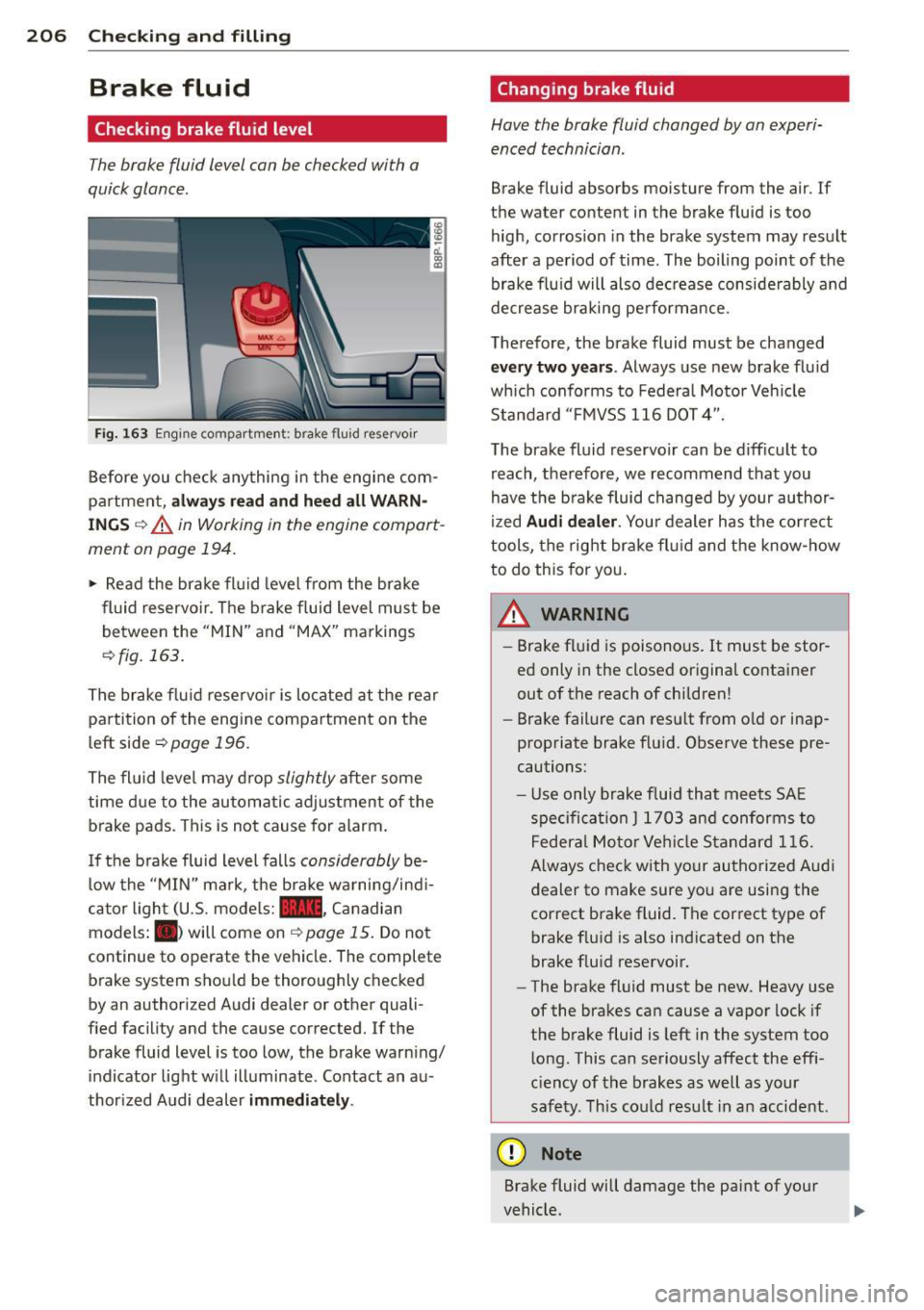
Fig. 163 Engine compartme nt: brake flu id reservo ir
Before you check anything i n the engine com
partment,
a lwa ys rea d and h eed a ll WA RN·
ING S c:> & in Working in the engine compart
ment on page
194.
~ Read the brake fluid level from the bra ke
fluid reservoir. The brake fluid Level must be
between the "MIN" and "MAX" markings
9fig. 163 .
The brake f lu id rese rvoir is located at the rear
partition of the engine compartment on the
L eft side
¢page 196.
The fluid level may drop slightly after some
time due to the automatic adjustment of the b rake pads . This is not cause for alarm .
I f the b rake fluid Level falls
considerably be
low the "MIN" mark, the brake wa rning/ind i
cator Light (U.S. models:
1111 , Canadian
models:
llllt will come on c:> page 15 . Do not
continue to operate the vehicle . The complete
brake system sho uld be thoroughly checked
by an authorized Audi dealer or other quali
fied facility and the cause corrected. If the
brake fluid level is too low, the brake warn ing/
indicator Light w ill illuminate . Contact an au
thor ized Audi dealer
imm ediatel y.
Changing brake fluid
Have the brake fluid changed by an experi
enced technician .
Brake fluid absorbs moisture from the air. If
the water content in the brake fluid is too high, corrosion in the brake system may result
after a period of time . The boiling point of the
brake flu id will also decrease conside rably and
decrease braking pe rformance.
Therefore, the brake fluid must be changed
eve ry two y ears. Always use new brake flu id
which conforms to Federal Motor Veh icle
Standard "F MVSS 116 DOT 4".
The brake fluid reservoir can be diff icult to
reach, therefore, we recommend that you
have the b rake fluid changed by your author
ized
Audi dealer . Your dealer has the correct
tools, the right brake fl uid and the know -how
to do this for you.
A WARNING
- Brake fluid is poisonous . It must be stor
ed only in the closed original container
out of the reach of children!
- Brake failure can resu lt from o ld or inap
propriate brake flu id. Observe these pre
cautions:
- Use only brake f luid that meets SA E
specifica tion
J 1 7 03 and conforms to
Federa l Moto r Ve hicl e Standard 1 16.
Always check with yo ur authorized Aud i
dealer to make sure yo u are using the
correct brake fluid. The correct type of brake f lu id is also ind icated on the
brake flu id reservoir.
- The brake fluid must be new. Heavy use
of the brakes can cause a vapor lock if
the brake fluid is left in the system too
l ong. This can seriously affect the effi
c iency of the brakes as well as your
safety. This cou ld resu lt in an accident.
(D Note
Brake fluid will damage the paint of your
vehicle .
Page 210 of 280
208 Check ing and filling
for questions about the battery -danger
of acid burns and explosion hazard!
- The battery must not be opened! Do not try to change the battery's liq uid level ,
otherwise detonating gas will escape
from the battery- explosion hazard!
- The AGM battery in the luggage com
partment cannot leak, because the elec
trolyte for th is battery is absorbed into a
spec ial glass mat . Th is leak-proof battery
must not be replace with a conventional
battery .
- Make sure the ventilat ion hose on the
s ide of the battery is connected, other
wise fumes or battery acid can leak out .
- Battery ho lder and terminals a lways
have to be secured correctly .
- Before all work on the battery follow the
warning s below c> &. in Working on the
battery on page 208 .
Working on the battery
All work on the battery requires technical
knowledge! Be especially careful when work
ing on or near the battery!
Be fo re you check any thing in the engine com
partment, always
r e ad a nd heed all WARN
INGS
~ .&. in Working in the engine compart
ment on page 194 .
Always heed the s afety warnings , when work
i ng on the vehicle battery or the vehicle elec
tr ica l system to preve nt injury .
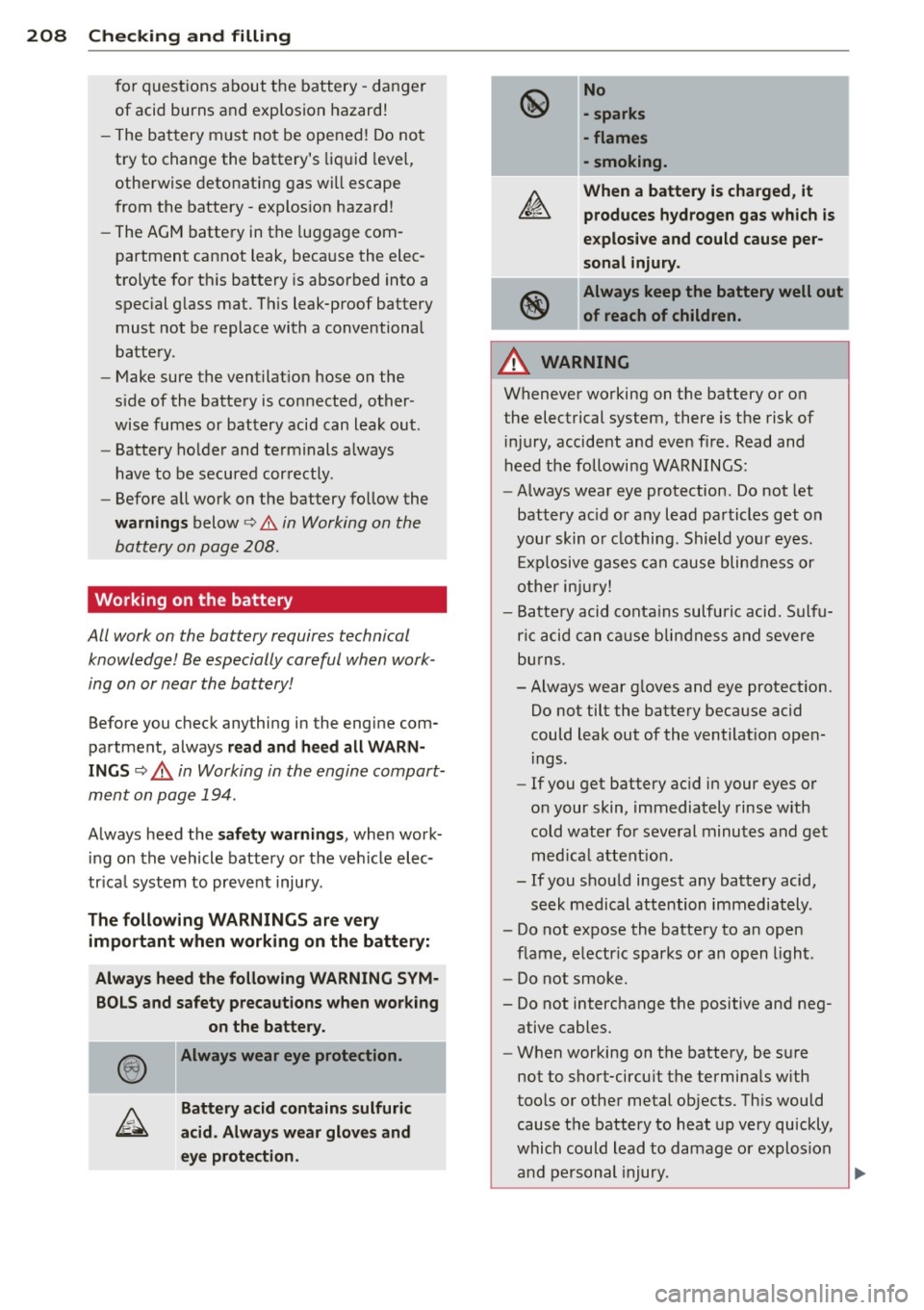
The following WARNINGS are very
important when working on the battery:
Always heed the following WARNING SYM ·
BOLS and safety precautions when working on the battery.
Always wear eye protection.
Battery acid contains sulfuric
acid . Always wear glove s and
eye prote ction . No
• sparks
• flames
- smoking.
When a battery is charged , it
produces hydrogen gas which is
e x plosive and cou ld cause per
sonal injury .
®
Always keep the battery well out
of reach of children.
A WARNING ,___
Whenever working on the battery or on
the electrical system, there is the risk of
i njury, accident and even fire . Read and
heed the following WARNINGS :
- Always wear eye protection . Do not let
battery ac id or any lead particles get on
your skin o r clothing . Shield you r eyes.
Exp losive gases can cause blindness or
o ther inju ry!
- Battery acid conta ins sulfuric acid. Sulfu
ric acid can ca use blindness and severe
bu rns.
-Always wear g loves and eye protection.
Do not tilt the battery because acid
could leak out of the ventilat ion open
ings .
- If you get battery ac id in your eyes or
on your skin, immediately rinse with
cold water for several minutes and get med ica l attent ion .
- If you shou ld ingest any battery acid,
seek medical attention immediately .
- Do not expose the batte ry to an open
flame, electr ic sparks or an open l ight.
- Do not smoke.
- Do not interchange the positive and neg-
ative cables.
- When working on the battery, be s ure
not to short-circu it the terminals w ith
too ls or othe r metal objects. Th is would
cause the battery to heat up very quickly,
which could lead to damage or explosion
-
and pe rsonal injury . ~
Page 211 of 280
-When a battery is charged, it produces
hydrogen gas which is explosive and
could cause personal injury.
- Always keep the battery well out of the
reach of children.
- Before work is done on the electrical sys
tem, disconnect the negative ground ca
ble.
- Before performing any work on the elec
trical system, switch off the engine and
ignition as well as any electrical equip
ment. The negative cable on the battery
must be disconnected. If you are just go
ing to replace a light bulb, then it is
enough to switch off the lights.
- Before disconnecting the battery, switch
off the anti-theft alarm system! Other
wise you will set off the alarm.
- When disconnecting the battery, first
disconnect the negative cable and then
the positive cable.
- Before reconnecting the battery, make
sure all electrical consumers are switch
ed off. Reconnect the positive cable first
and then the negative cable. Never inter
change the cables -this could start a fire!
- Never charge a frozen or a thawed-out
battery. It could explode! If a battery has
frozen, then it must be replaced. A dis
charged battery can freeze over at
32 °F
(0 oc).
-Mak e sure the vent hose is always attach
ed to the opening on the side of the bat
tery.
- Never use batteries which are damaged.
There is the danger of an explosion! Al
ways replace a damaged battery.
_& WARNING
California Proposition 65 Warning:
- Battery posts, terminals and related ac cessories contain lead and lead com
pounds, chemicals known to the State of
California to cause cancer and reproduc
tive problems. Wash hands after han dling.
Checking and filling 209
(D Note
- Do not disconnect the vehicle battery
when the ignition is switched on or when
the engine is running, otherwise, you will
damage electronic components in the
electrical system.
- When working on the engine, protect the
battery housing from ultraviolet (UV)
rays by not parking the vehicle in direct
sunlight .
- If your vehicle is going to stand for a
long period of time without being driven,
protect the battery from "freezing", oth
erwise it will be damaged and will then
have to be replaced
~ page 209.
Charging of battery
All work on the battery requires technical knowledge!
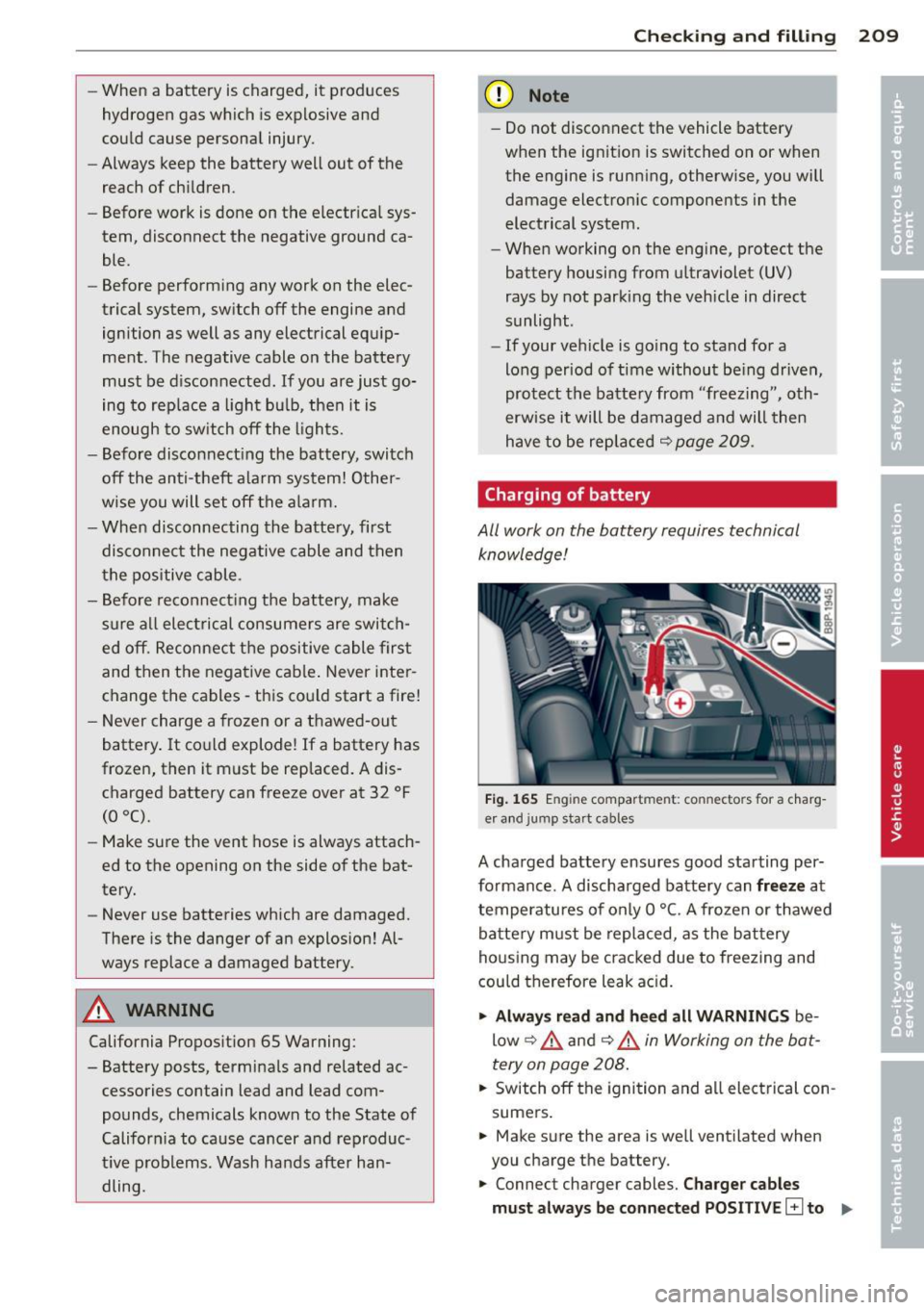
Fig. 165 E ngine compart ment: conne ctors for a charg
er and jump start cables
A charged battery ensures good starting per
formance . A discharged battery can
freeze at
temperatures of only
O 0C. A frozen or thawed
battery must be replaced, as the battery
housing may be cracked due to freezing and
could therefore leak acid.
.,. Always read and heed all WARNINGS be
low~ .&, and ~.&, in
Working on the bat
tery on page 208.
... Switch off the ignition and all electrical con
sumers .
.,. Make sure the area is well ventilated when
you charge the battery.
.,. Connect charger cables.
Charger cables
must always be connected POSITIVE
G to ..,.
Page 212 of 280
![AUDI S3 2012 Owners Manual 210 Check ing and filling
POS IT IVE E] and NEGATI VE [:] to NEGATIVE
(j ump sta rt pins)[:].
.. Switch on the charger.
• Make sure the charging rate is not over
6 amps.
â€](/img/6/57543/w960_57543-211.png "AUDI S3 2012 Owners Manual 210 Check ing and filling
POS IT IVE E] and NEGATI VE [:] to NEGATIVE
(j ump sta rt pins)[:].
.. Switch on the charger.
• Make sure the charging rate is not over
6 amps.
â€")
210 Check ing and filling
POS IT IVE E] and NEGATI VE [:] to NEGATIVE
(j ump sta rt pins)[:].
.. Switch on the charger.
• Make sure the charging rate is not over
6 amps.
• Turn off the charger¢,&..
• Disconnect the charger cables.
• Connect both battery cables to the battery
i f necessary -
first plus, then minus.
The battery must not be opened!
¢ @ in Gen
eral information on page 207 .
Chargi ng the b attery
Only use chargers with a m ax im um cha rg in g
v oltage o f
14.8 V. The battery connecting ca
bles do not need to be disconnected. Do not
open the battery when charging.
Read all of the manufacturer's instructions for
the charger before charting the battery.
It is not necessary to remove the battery from
the engine compartment, and it is a lso not
necessary to disconnect the cables.
Normally, a battery should be charged at no
more than 10 percent of its rated capacity.
For example, a charging current of 4.5 amps
wo uld be used on a battery rated at 45 Ah.
Rated capacity of the battery in your veh icle is
listed on the battery housing .
The battery caps shou ld
not be opened when
cha rg ing a battery.
_& WARNING
Cha rging a battery can be dangerous.
- Never charge a frozen battery. It may ex
plode because of gas trapped in the ice .
Allow a frozen battery to thaw o ut first .
- Do not reuse batteries which we re fro
zen. They must be replaced. The battery
housing may have cracked and weakened
when the battery froze.
- Charge the battery in a we ll ventilated
area. Keep away from open f lame or elec
trical spark. Do not smoke. Hydrogen gas generated by the battery is explosive. -
To reduce the danger of exp losion, never
connect or d isconnect charger cab les
while the charger is operating.
- Fast charging a battery is dangerous and
should only be attempted by a compe
tent techn ic ian with the proper equip
ment.
- Battery acid that may sp ill dur ing charg
ing should be washed off with a solut ion
of warm water and baking soda to neu
tralize the ac id.
{[) Note
-Make sure that the gas venting hose is
always connected to the or iginal opening
on the battery s ide. Otherwise gasses or
battery acid could leak out.
- Never use a fast charger as a booster to start the engine. This will seriously dam
age sensitive electron ic components,
such as contro l units, re lays, radio, etc.,
as well as the batte ry charger.
- T he vehicle may be optionally equ ipped
w ith a gel battery, wh ich can only be
charged at a cons tant current-lim ited
voltage . To prevent damage to the bat
tery and the electronics system, a gel battery that is connected must under no
circumstances be charged with a quick
charger.
{!) Tips
- The vehicle battery must not be charged
with a standard small charger that pl ugs
into the outlet.
- Only charge the battery through the con
nections in the engine compartment.
Battery replacement
The new battery must hove the some specifi
cations as the old one.
Intelligent energy management in your vehi
cle is responsible for distributing the electri
ca l energy throughout your vehicle
¢
page 167. The intelligent energy manage-
ment system will keep the engine battery .,..
Page 213 of 280
charged better then vehicles without this sys
tem . To make sure the additional e lectrica l en
ergy is available once again after you have
changed the battery, we recommend that you install batteries of the same type and manu
facture only (the same as those installed at
the t ime your vehicle was delivered). Specifi
cations are listed on the battery hous ing . Your
authorized dealer must code the battery in
the energy management system to enable yo u
to use the energy management functions cor
rectly after replacing the bat tery.
If it is not possible to use a battery of this
type, the new battery must have the same ca
pacity, voltage (12 volts) , amperage, con
struction and plug sealing.
We re commend that you use ma intenance
free or
cy cle -re sis tant /le ak-proof batteries
that conform to the standards TL
825 06
(from December 1997) and VW 7 SO 73 (from
Aug ust 2001).
When insta lling the bat tery , make sure the ig
n ition and all e lectrica l consumers are turned
off .
CD Note
-Make sure tha t the gas venting hose is
always connected to the o riginal open ing
on the battery side . Otherwise gasses or
battery acid could leak out.
- Battery mounts and clamps m ust always
be secured correctly.
- Read and follow the warnings under
C? page 208, Working on the battery be
fore performing any work on the battery .
@ For the sake of the environment
Because of the problem of proper d isposa l
o f a battery, we recommend your author
ized Audi dealer change the batte ry for
you. Batteries contain su lfuric ac id and
lead and must always be disposed of prop
erly in compliance w ith all environmental
regu lations . D isposing of vehicle batte ries
improperly is very dangerous to the envi
ronment. Make sure that the removed bat-
Checkin g and fillin g 211
tery cannot overbalance, otherwise su lfu
ric acid might escape!
Windshield washer container
Using plain water is not adequate for filling
the $ windshield washer system .
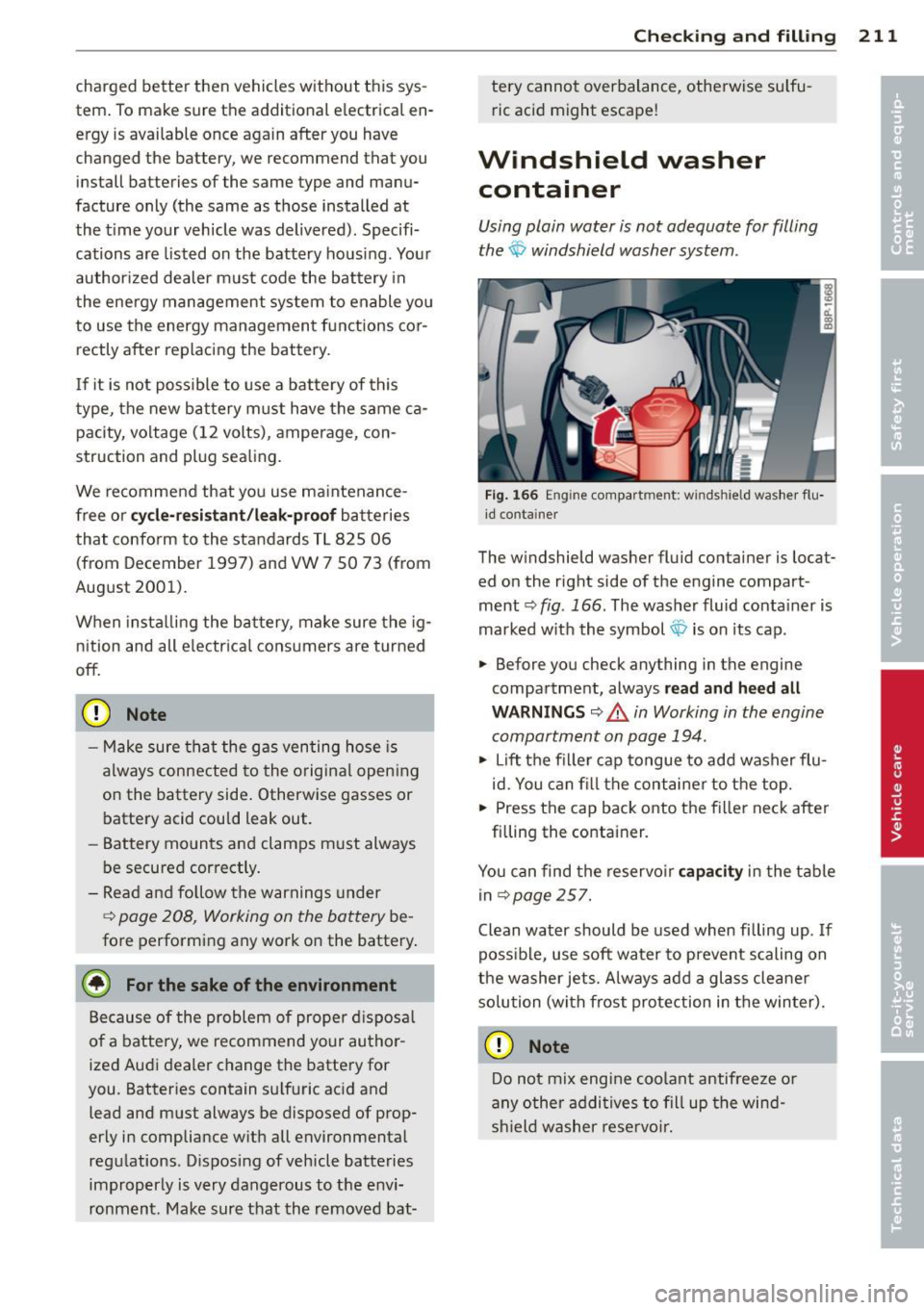
Fig. 166 En gin e compart men t: w in ds hield washer flu
i d co ntai ner
The windshield washer fluid container is locat
ed on the right side of the engine compart
ment ~
fig. 166. The washer fluid conta iner is
marked w ith the symbol $ is on its cap .
.,. Before you check anything in the engine
compartment, always
read and heed all
W ARNINGS ~ _&. in Working in the engine
compartment on page 194.
.,. Lift the fil le r ca p tongue to add washer flu
id. You can fi ll the container to the top.
.,. Press the cap back onto the f iller neck after
f illing the container .
You can find the reservo ir
capacity in t he t able
in
C? page 257.
Clean water should be used when filling up . If
poss ible, use soft water to prevent scaling on
the washer jets. Always add a glass cleane r
solu tion (with frost protection in t he win ter).
CD Note
Do not mix engi ne coolant antifreeze o r
a ny o ther addi tives to fill up the wind
sh ield washer rese rvoi r.
Page 214 of 280
212 Tire s and wheel s
Tires and wheels
Tires
General notes
Tires may be the least appreciated and most
abused parts of a motor vehicle .
Tires may be the least appreciated and most
abused parts of a motor vehicle . Tires are,
however, one of the most important parts of a
vehicle, particularly considering the compara
tive ly small patch of rubber on each tire that
assures that a ll-impo rtant contact between
you, your vehicle and the road.
Maintaining the correct tire pressure, mak ing
sure that your vehicle and its tires do not have
to carry mo re weight than they can safe ly han
d le, avoiding damage from road hazards and
reg ularly inspecting t ires for damage includ
ing cuts, slashes irregu la r wear and ove rall
condition are the most important things that
you can do to he lp avoid sudden tire failure in
cluding tread separation and blowouts.
Avoiding damage I f you have to drive over a curb or similar ob
stacle, drive very s low ly and as close as possi
b le at a right angle to the curb.
A lways keep chem ica ls includ ing gre ase, o il,
gasoline and b rake fluid off the ti res .
Inspect the t ires regularly for damage (cuts,
cracks or b listers, etc.). Remove any fo reign
bod ies embedded in the treads.
Storing tires Mark tires when you remove them to indicate
the direction of rotation . Th is ensures you to
be ab le to mount them correctly when you re
install t hem.
When removed, the whee ls or t ires should be
stored in a cool, d ry and preferably dark place .
Store tires in a vertical pos ition if they are not
mounted on rims, in a horizontal pos it ion if
they are mounted on rims. New tire
s
New t ires have to be broken in¢&,. .
T he tread depth of new t ires may vary, accord
ing to the type a nd make of t ire and the tread
pa tte rn .
Hidden damage
Damage to tires and r ims is ofte n not readily
vis ible . If you notice unusual v ibrat ion or the
vehicle p ulls to one side, th is may ind icate
t h at one of the t ires has been damaged . Th e
t ir es m ust be checked immed iate ly by an au
tho rized Aud i dea le r or q uali fied wor ks hop.
Unidirectional t ires
A un idirectional tire can be identified by ar
rows on the sid ewa ll, that po int in the direc
t ion the t ire is desig ned to rotate. You mus t
f ol low the specified d irection of rotation . This
is necessary so that these tires can develop
their optimum characterist ics regarding grip,
road no ise, wear and hyd rop laning resistance.
For more information ¢
page 241.
A WARNING
-New tires or tires that are old, worn or
damaged cannot provide maximum con
trol and braking ability .
-
-New tires tend to be slippery and must
be broken in . To reduce the risk of losing
control, a co llision and ser ious personal
in jur ies, d rive w ith special ca re fo r the
fi rst 350 m iles (560 km).
- Driving with worn or damaged tires can
le ad to loss of control, sudden tire fail
ure, including a blowou t and sudden de
fl ation, c rashes and seriou s personal in
juries . Have wo rn or damaged t ires re
p laced immediate ly .
- T ires age even if they are not being used
an d can fai l sudden ly, especially at high
speeds. Tires that are more than 6 years
old can only be used in an emergency
and then w ith specia l care and at low
speed.