warning AUDI S3 2012 Service Manual
[x] Cancel search | Manufacturer: AUDI, Model Year: 2012, Model line: S3, Model: AUDI S3 2012Pages: 280, PDF Size: 70.11 MB
Page 66 of 280
64 Seats and storage
-Beca use the driver seat can be electrical
ly ad justed with the ign ition key re
moved, never leave children unattended
in the vehicle . Unsupervised use of the
electric seat adjustments may cause seri o us in jury.
Adjusting the seatback
App lies to vehicles: with power driver seat
u-
Fig . 67 Drive r's seat: switc h for seatback adjustment
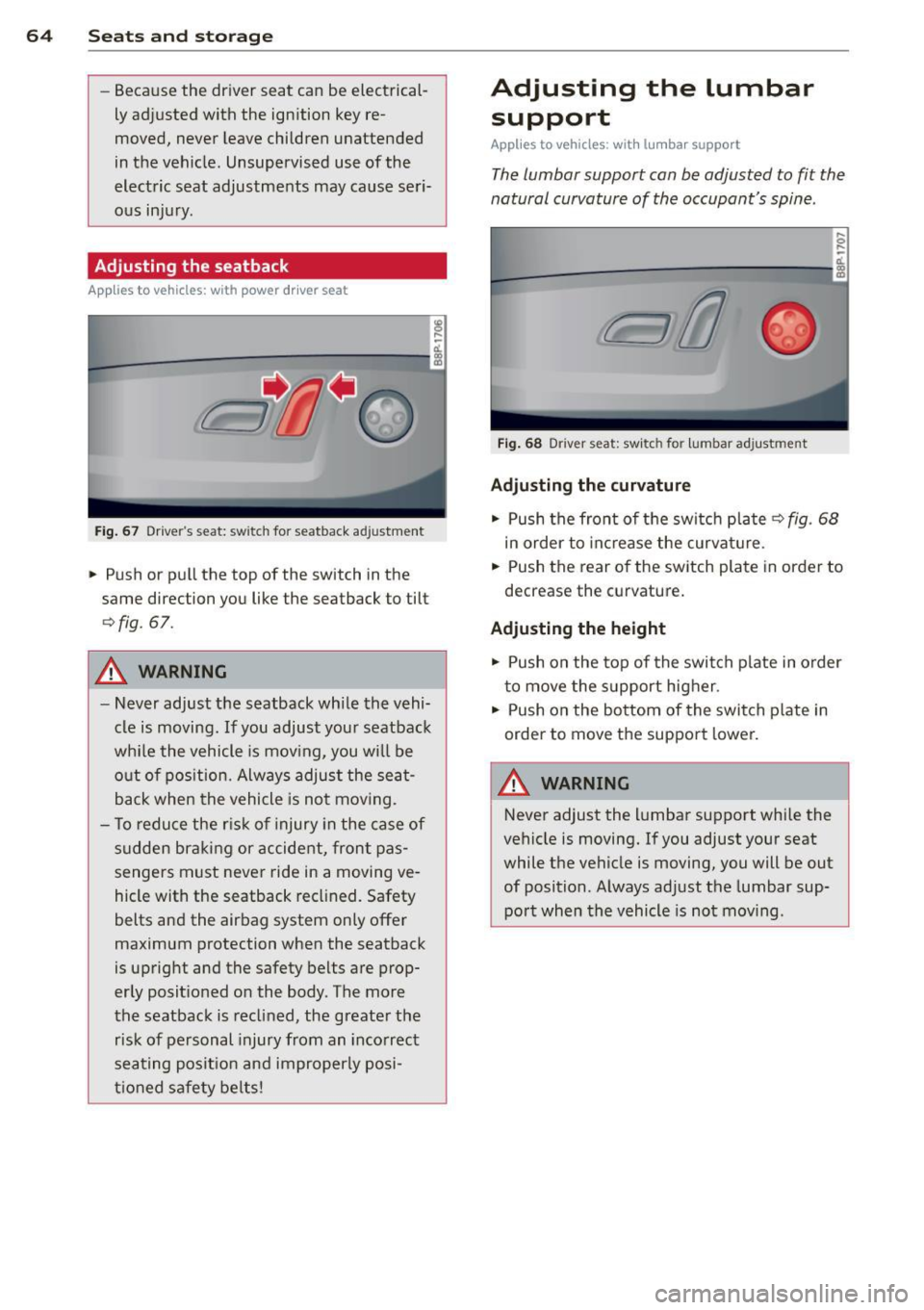
• Push or pull the top of the switch in the
same direction you like the seatback to tilt
¢fig. 67.
A WARNING
- Never adjust the seatback whi le the vehi
cle is moving. If you adjust your seatback
w hil e the vehicle is mov ing, you wi ll be
o ut of pos ition. Always adjust the seat
back when the vehicle is no t mov ing.
- T o redu ce the r is k of injury in the case of
sudden bra king or accident, front pas
sengers must never ride in a moving ve
hicle with the seatback reclined. Safety
belts and the airbag system only offe r
maximum protection when the seatback
is upright and the safety belts are prop
er ly posit ioned on the body . The more
the seatback is reclined, the greate r the
risk of personal injury from an incorrect
seating posit ion and improperly posi
tioned safety be lts!
Adjusting the lumbar
support
Applies to vehicles: with lumba r support
The lumbar support can be adjusted to fit the
natural curvature of the occupant's spine.
F ig . 68 Driver seat: switc h for lumbar ad justment
Ad justing the curv atur e
.,. Push the front of t he sw itch plate c:> fig . 68
in order to in cr ease the curva ture.
• Push the rear o f the switch plate in order to
decrease the curvature.
A dj usting the height
• Push on the top of the switch p late in order
t o move the s upport higher .
• Push on the bottom of the switch p late in
order to move t he support lower.
A WARNING
-
Never adjust the lumbar support while the
vehicle is moving. If you adjust your seat
while the vehicle is moving, you will be out
of position. Always adjust the lumbar sup
port when the vehicle is not mov ing .
Page 67 of 280
Head restraints
Front head restraints
The head restraints must be properly adjust
ed to the occupants's height to provide opti
mal restraint in combination with the seat re
straints.
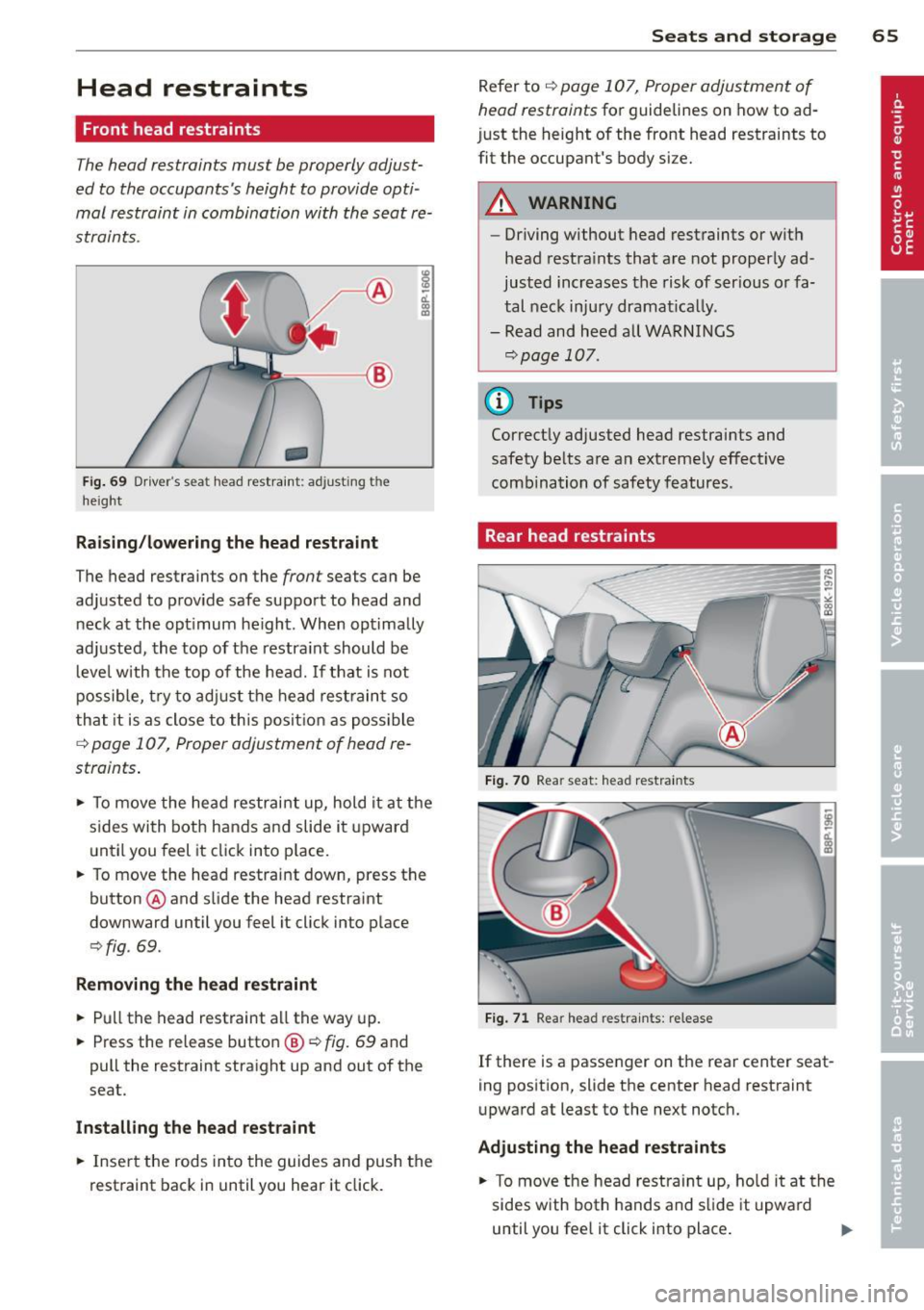
Fi g. 69 Driver's s eat head restra int: ad just ing the
heigh t
Raising /lowering the head restraint
s
-d. a, a,
The head restraints on the front seats ca n be
adjusted to prov ide safe suppo rt to head and
neck at the opt imum he ight. When optimally
adj usted, the top of the restra int should be
L eve l w ith the top of the head. If that is not
possible, try to ad just the head restrain t so
that it is as close to th is pos it ion as poss ible
r:=> page 107, Proper adjustment of head re
straints .
.,. To move the head restrai nt up, hold it a t the
s ides with bot h hands a nd slide it upward
un til you feel it click into p lace .
.,. To move the head restraint dow n, press the
button @ and slide the head restraint
downward until you feel it click into p lace
r:=> fig . 69.
Removing the head re straint
.,. Pu ll the head restraint a ll the way up.
.,. Press the re lease butto n@
r:=> fig. 69 and
pull the restraint stra ight up and out of the
seat.
Install ing the head rest raint
.,. Inse rt the rods into the guides and push the
rest raint back in until you hear it click.
Seats and storage 65
Refer to r=> page 10 7 , Proper adjustment of
head restraints
for guidelines on how to ad
j ust the height of the front head restraints to
fit the occupant's body size.
A WARNING
- Driving without head restraints or wit h
head restra ints that a re not proper ly ad
justed increases the risk of ser ious or fa
tal nec k inju ry dramat ica lly.
- Read and heed all WARNI NGS
r:=>page 107 .
(D Tips
Correct ly adjusted head restrai nts and
safety be lts a re an e xtreme ly effect ive
combination of safety features.
Rear head restraints
Fi g. 7 0 Rea r seat: head restra ints
Fig. 7 1 Rear head res tra ints: release
If there is a passenger on the rear center seat
ing pos ition, slide the center head restraint
u pward at least to the next notch.
Adjusting the head restraints .,. To move t he head restra int up, ho ld it at the
sides with both hands and s lide it upwa rd
until you fee l it click into place .
Page 68 of 280
66 Seats and st o rage
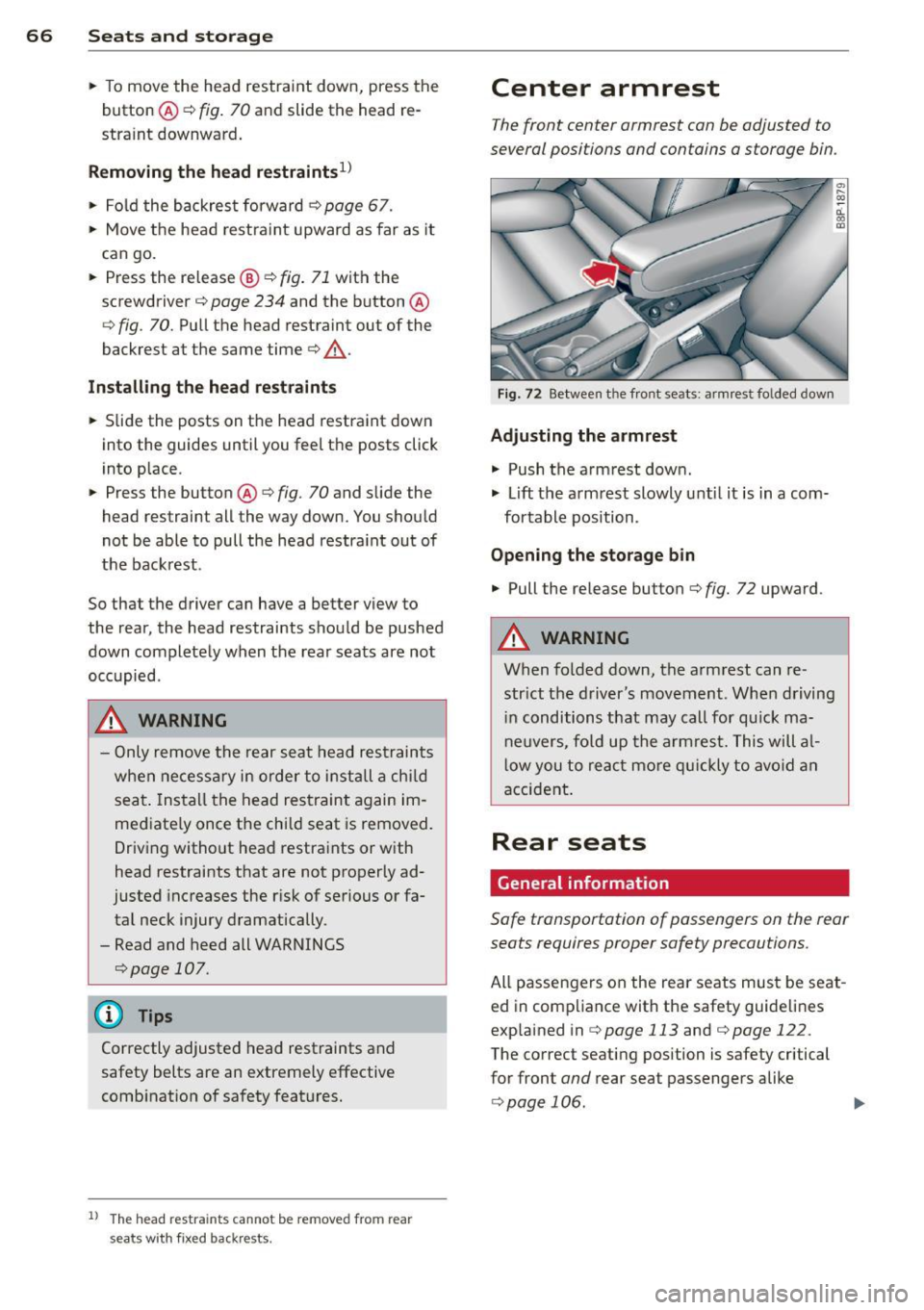
• To move the head restraint down, press the
button @c>
fig. 70 and slide the head re
straint downward.
Removing the h ead restraint s
1>
• Fold the backrest forward ¢ page 67.
• Move the head restra int upward as far as it
can go.
• Press the re lease @ c>
fig. 71 with the
screwdriver¢
page 234 and the button @
¢fig. 70. Pull the head restraint out of the
backrest at the same time
c> &_.
Install ing th e head re st ra int s
• Slide the posts on the head restraint down
into the guides until you feel the posts click
into place.
• Press the button @¢
fig. 70 and slide the
head restraint all the way down. You should
not be able to pull the head restra int out of
the backrest.
So that the driver can have a better view to
the rear, the head restraints should be pushed
down completely when the rear seats are not
occ upied.
A WARNING
- Only remove the rear seat head res traints
when necessary in order to install a chi ld
seat . Install the head restraint again im
mediately once the child seat is removed.
Driving without head restraints or with
head restraints that are not properly ad
justed increases the r isk of serious or fa
tal neck injury dramatically.
- Read and heed all WARNINGS
¢page 107.
@ Tips
Correctly adjusted head restraints and
safety belts are an extremely effective combinat io n of safety features.
l) The head restraints cannot be removed from rear
seats with fixed backrests .
Center armrest
The front center armrest con be adjusted to
several positions and contains a storage bin.
F ig . 72 Between the front seats: armrest folded down
Adjusting the armrest
• Push the arm rest down.
• Lift the arm rest slowly unt il it is in a com
fortable position.
Opening the storage bin
• Pull the release button ¢
fig. 72 upward.
A WARNING
-
When folded down, the a rmrest can re
str ict the d river's movement. Whe n driving
i n conditions that may call for qu ick ma
neuvers, fo ld up the armrest. This will a l
l ow you to react more qu ickly to avoid an
accident .
Rear seats
General information
Safe transportation of passengers on the rear
seats requires proper safety precautions.
All passengers on the rear seats mus t be seat
ed in compliance with the safety guide lines
exp lained in
c> poge 113 and r=>poge 122.
The correct seating position is safety critical
for front
and rear seat passengers alike
r=> poge 106. .,,_
Page 69 of 280
_& WARNING
-Vehicle occupants in the front and rear
seats must always be properly restrain
ed .
- Do not let anyone ride in the vehicle
without the head restra ints provided .
Head restraints help reduce injuries .
- Loose items inside the passenger com
partment, can fly forward in a crash or
sudden maneuver and injure occupants.
Always store articles in the luggage com
partment and use the fastening eyes, es
pecially when the rear seatbacks have
been folded down .
- Read and heed and all WARNINGS
r::';> page 106 , Proper seating positions
for passengers in rear seats .
Rear armrest
The armrest contains a storage compartment
and a cupholder for 2 drinks.
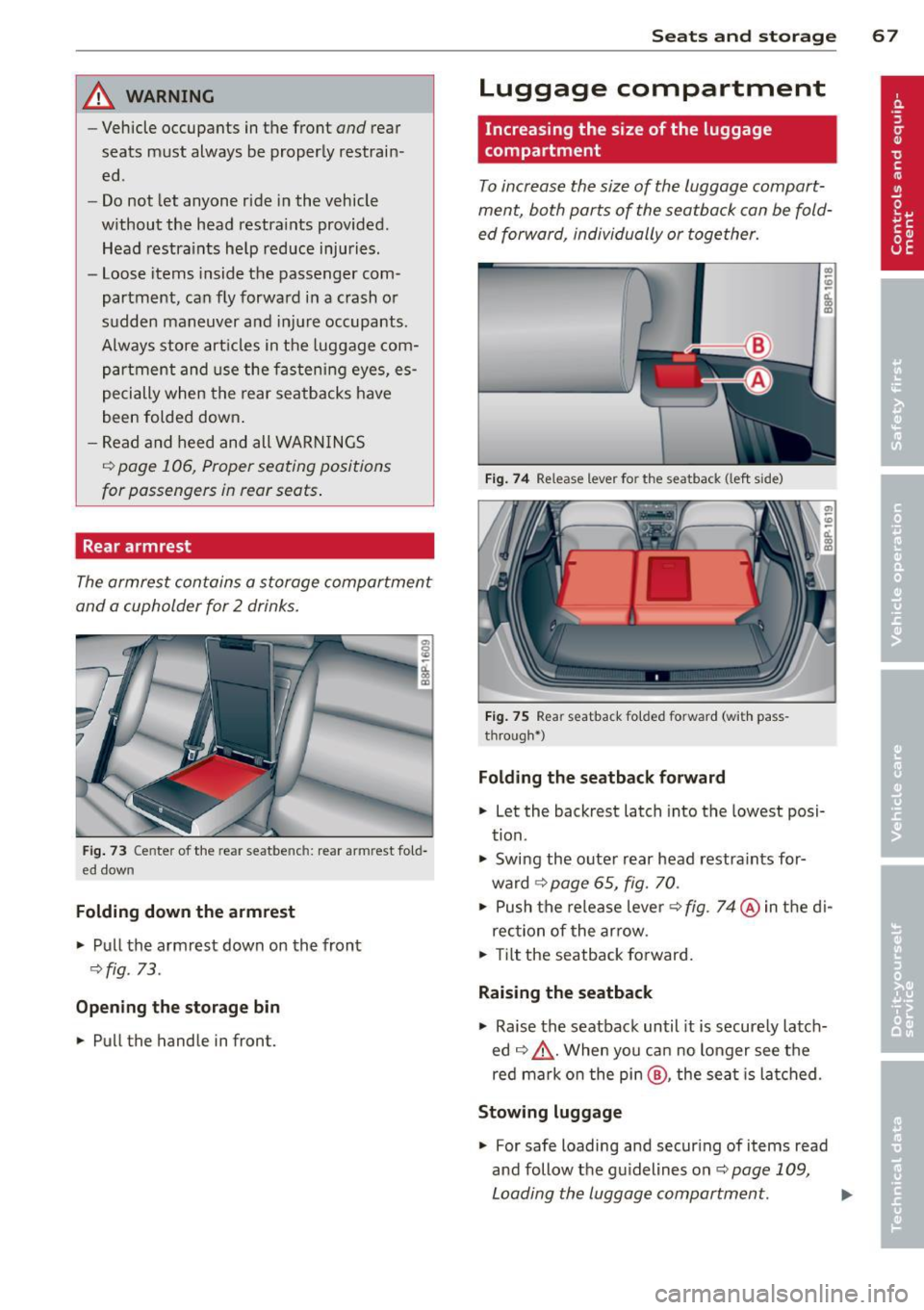
F ig . 73 Ce nter of the re ar s eatbe nch : rear armrest fo ld
e d dow n
Folding d own the armre st
.,. Pull the armrest down on the front
¢fig . 73 .
Opening the stor age bin
.,. Pull the handle in front.
Sea ts a nd s to rage 67
Luggage compartment
Increasing the size of the luggage
compartment
To increase the size of the luggage compart
ment, both parts of the seatback can be fold
ed forward, individually or together.
Fig . 7 4 Re lease leve r fo r th e seatbac k (left side)
Fig . 75 Re ar seatback fo lde d fo rw ar d (w it h pa ss
thro ugh• )
Folding th e seatb ack forward
.,. Let the backrest latch into the lowest posi
tion.
.,. Swing the outer rear head restra ints for
ward
¢ page 65, fig . 70 .
.,. Push the release lever¢ fig. 74 @ in the di-
rection of the arrow .
... Tilt the seatback forward.
Rai sing th e se atback
.,. Raise the seatback until it is secure ly latch
ed
c::> &,. . When you ca n no longer see the
red mark on the pin @, the seat is latched .
Stowing luggage
.,. For safe loading and secur ing of items read
and follow the gu idelines on
c::, page 109 ,
Loading the luggage compartment. ..,.
Page 70 of 280
68 Seats and storage
The rear seatback is divided into two seg
ments - one third/two thirds. You can fold
down either or both parts of the seatback .
.&_ WARNING
-
- The backrest must always be securely
latched so that the safety belt of the cen
ter seat ing pos ition can work properly to
help protect the occupant .
- The backrest must be securely latched i n
posit ion so that no items containe .d in
the luggage compartment can slide for
wa rd upo n sudden b rak ing .
- Never allow safety belts to become dam
aged by being caught in doo r or seat
hardware.
- Torn or frayed safety belts can tear and
damaged belt ha rdware can brea k in a
c rash . Inspect the be lts periodica lly .
Belts showing damage to we bbing, bind
ings, b uckles, or retractors must be re
placed.
.&_ WARNING
Always read and heed WA RNINGS c:> .&. in
Loading the luggage comportment on
page 109.
(D Note
- If you move the fro nt seat back when the
r ear seat backrest is fo lded fo rward, yo u
could damage the head restraints on the rear seat.
- When folding the backrest back into
place, make sure the safety be lt does not
get caught, because it can be damaged.
A damaged be lt can fa il to prov ide safe
r est raint.
-
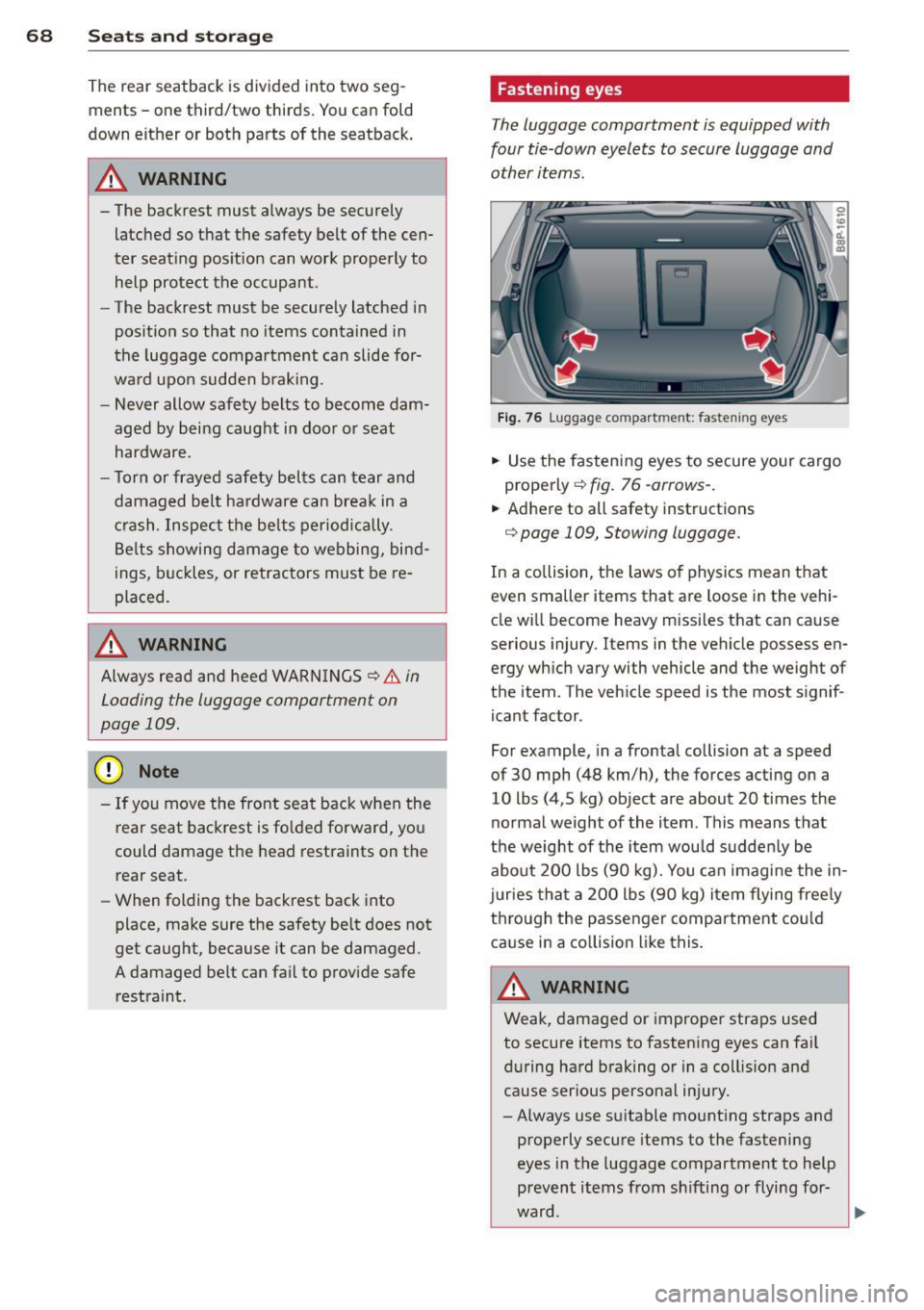
Fastening eyes
The luggage comportment is equipped with
four tie-down eyelets to secure luggage and
other items.
F ig. 7 6 Lugg age compart men t: fas tenin g ey es
.,. Use the fastening eyes to secure your cargo
properly
c:> fig. 76 - arrows -.
.,. Ad here to all safety instructions
<=> page 109, Stowing luggage.
In a co llision, t he laws o f physics mean that
even smaller items that a re loose in the vehi
cle w ill become heavy missiles that can cause
serious injury. Items in the vehicle possess en
ergy wh ich vary with vehicle and t he weight of
the item. The veh icle speed is the most s ignif
icant factor .
For example, in a frontal collision at a speed
of 30 mph (48 km/h), the forces acting on a 10 lbs (4,5 kg) object are about 20 times the
normal weight of the item . This means that
the weight of the item wou ld sudden ly be
about 2 00 lbs (90 kg). You ca n imagine the in
j u ries tha t a 200 lbs (90 kg) item flying free ly
t hr ough the passenger comp artment cou ld
ca use in a co llision like this .
_& WARNING
Weak, damaged or improper straps used
to secure items to fasten ing eyes can fai l
d uring hard braking or in a coll is ion and
cause ser ious personal injury. -
-A lways use s uitable mount ing straps an d
properly secure items to the fasteni ng
eyes in the luggage compartment to help
prevent items from sh ifting or flying for-
~~-~
Page 71 of 280
-When the rear seat backrest is folded
down, always use su itable mounting
straps and properly secure items to the
fastening eyes in the luggage compart
ment to help prevent items from flying
forward into the passenger compart ment.
- Never attach a child safety seat tether
strap to a fastening eye.
Elastic cargo net
App lies to vehicles: with cargo net
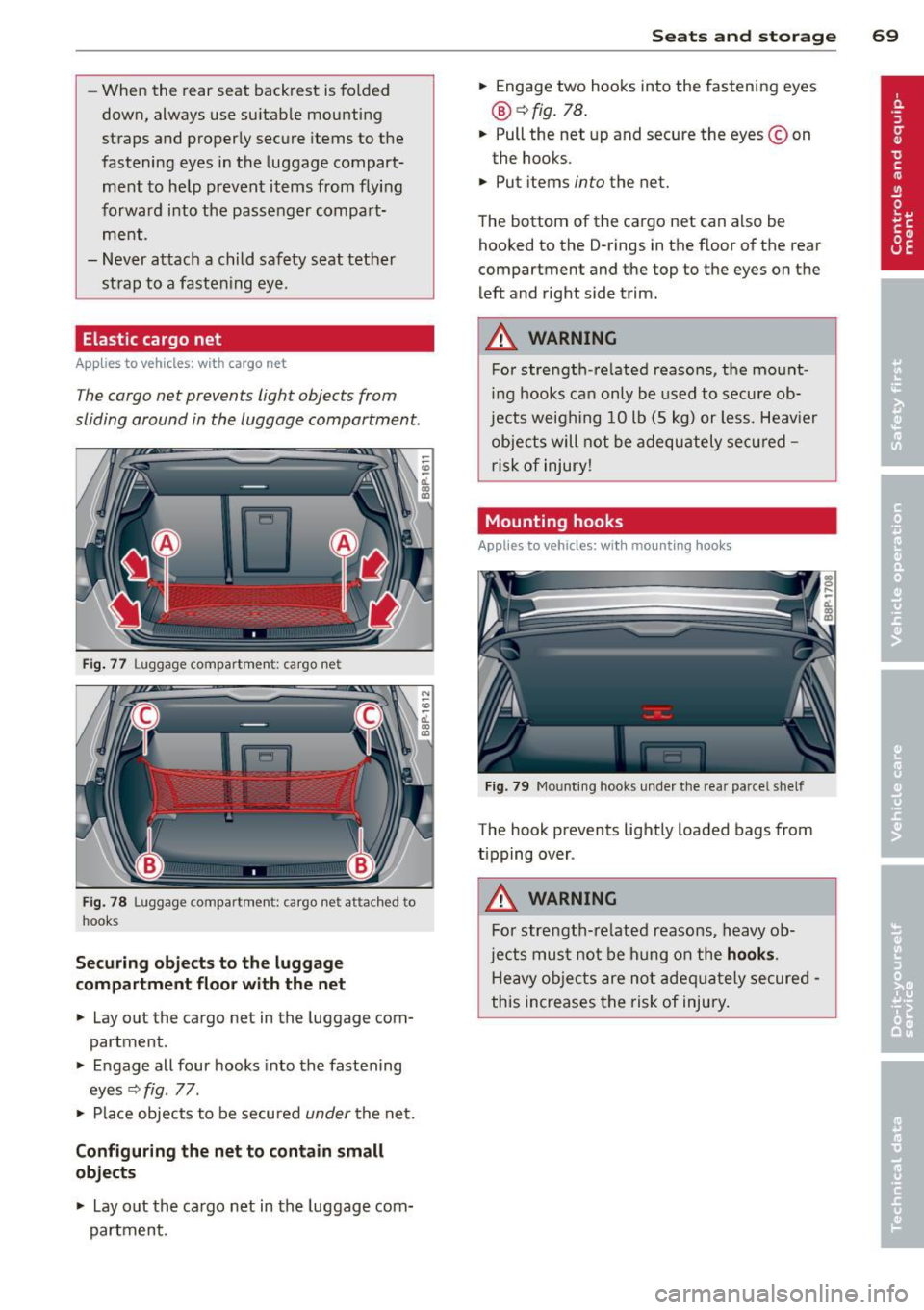
The cargo net prevents light objects from
sliding around in the luggage compartment.
Fig . 77 Luggage compartmen t: cargo net
Fig. 78 Luggage compartmen t: ca rgo net attached to
hooks
Securing objects to the luggage
compartment floor with the net
.. Lay out the cargo net in the luggage com
partment .
.. Engage all four hooks into the fastening
eyes
~ fig . 77 .
.. Place objects to be secured
under the net.
Configuring the net to contain small
objects
.. Lay out the cargo net in the luggage com
partment.
Seats and storage 69
.. Engage two hooks into the fastening eyes
@~fig. 78.
.. Pull the net up and secure the eyes © on
the hooks.
.. Put items
into the net.
The bottom of the cargo net can also be hooked to the D-rings in the floor of the rear
compartment and the top to the eyes on the
left and right side trim .
.&_ WARNING
For stre ngth-re lated reasons, the mount
in g hooks can only be used to secure ob
jects weighing 10 lb (5 kg) or less. Heavier
objects will not be adequately secured -
risk of injury!
Mounting hooks
Applies to vehicles: with mounting hooks
Fig. 79 Mounting hooks under the rear pa rce l shelf
The hook prevents lightly loaded bags from
tipping over .
.&_ WARNING
For strength-related reasons, heavy ob
jects must not be hung on the
hooks.
Heavy objects are not adequately secured -
this increases the risk of injury .
Page 72 of 280
70 Seats and storage
Retractable luggage compartment cover
The luggage compartment cover keeps lug
gage o r other objects out of vi ew .
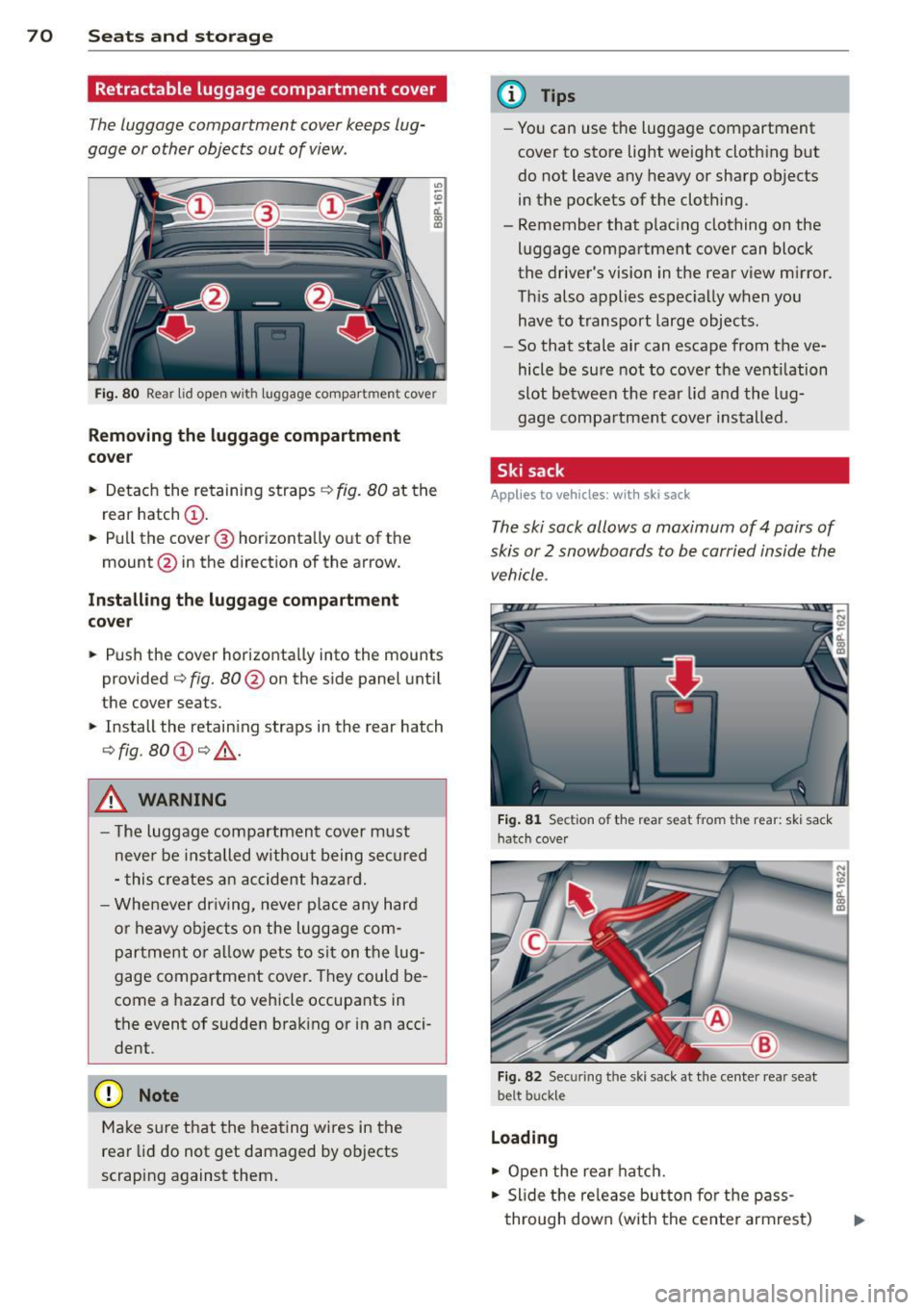
Fi g. 80 Rear lid ope n with luggage compartment cover
Removing the luggage compartment
co ve r
.. Detach the retaining straps¢ fig. 80 at the
rear hatch
(D .
.. Pull the cover@ horizonta lly out of the
mount @in the direct ion of the arrow.
In stall ing the luggage compartment
co ver
.. Push the cover horizonta lly into the mounts
provided¢
fig. B0@on the side panel unti l
the cover seats .
.. Install the retain ing straps in the rear hatch
¢fig . 80 @ ¢_.&. .
&_ WARNING
- T he luggage compartment cover m ust
neve r be i nstalled w ithout being secured
- this c reates an acciden t ha zar d.
- Whe never dr iving, never p lace any hard
o r he avy o bjects on the luggage com
p art ment or allow pets to sit on t he lug
gage compartment cover. They could be
come a hazard to vehicle occupants in
the event of sudden brak ing or in an acci
dent.
{[) Note
Make s ure that the heating wires in the
rea r lid do not get damaged by objects
scraping against them .
(D Tips
-Yo u can use the luggage compartment
cover to store light we ight cloth ing but
do not leave any heavy or sharp objects
in the pockets of the cloth ing.
- Remember that placing clothing on the
luggage compartment cover can block
the driver's vision in the rear view m irror.
Th is also applies espec ially when you
have to transport large objects.
- So that stale air can escape from the ve
hicle be sure not to cover the vent ilation
slot between the rear lid a nd the lug
gage compartment cover installed.
Ski sack
Applies to veh icles : w it h sk i sack
The ski sack allows a maximum of 4 pairs of
skis or 2 snowboards to be carried inside the
vehicle.
Fi g. 81 Sect ion of the rear seat from t he rear: sk i sac k
h atch cover
Fig. 82 Securing the ski sack at th e cente r rear seat
be lt buck le
Loading
.. Open the rea r hatch.
.. Slide the re le ase button fo r the pass
through down (with the cente r armrest)
Page 73 of 280
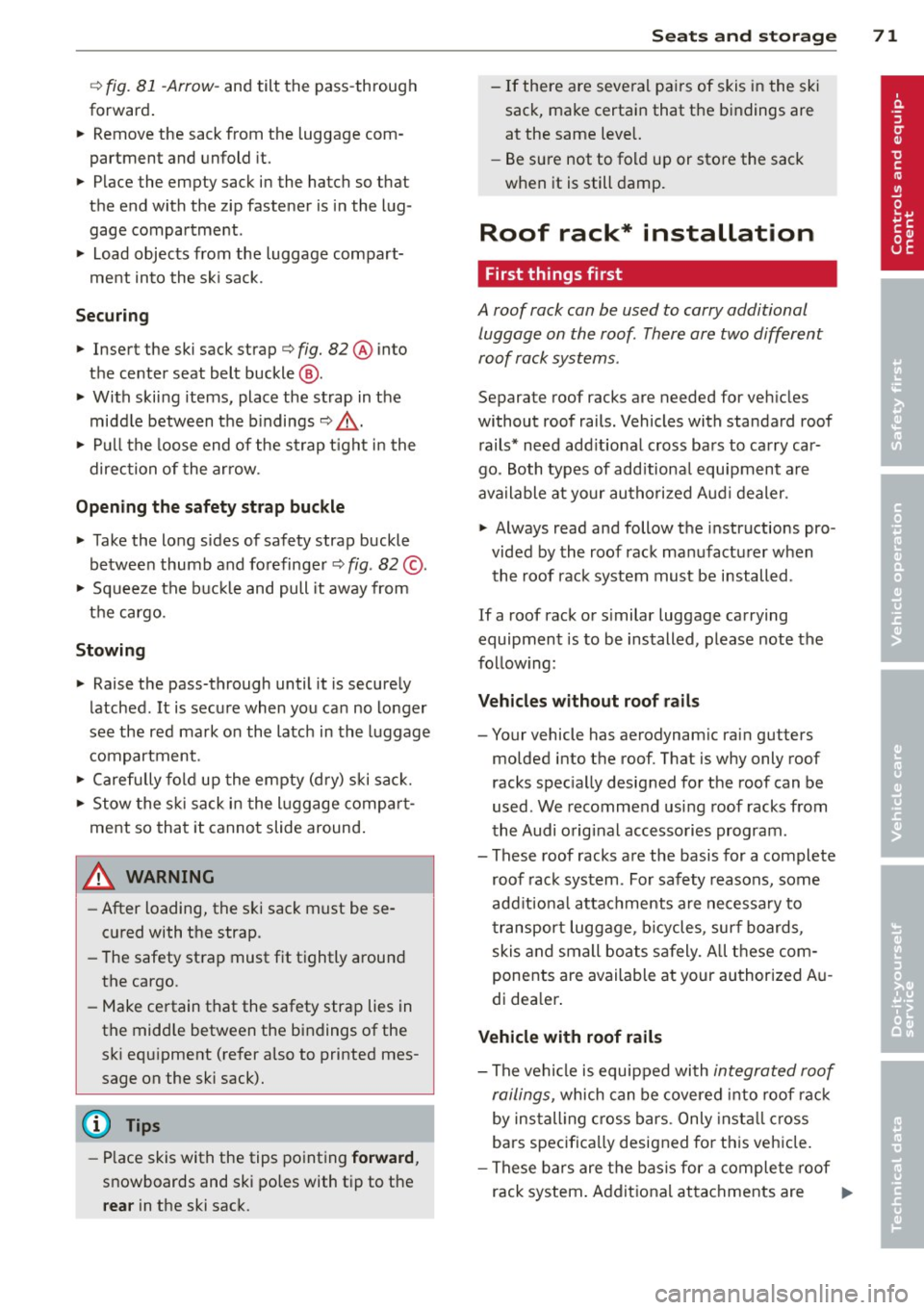
¢ fig. 81 -Arrow-and tilt the pass-through
forward.
~ Remove the sack from the luggage com
partment and unfold it.
~ Place the empty sack in the hatch so that
the end with the zip fastener is in the lug
gage compartment .
~ Load objects from the luggage compart
ment into the ski sack.
Securing
~ Insert the ski sack strap¢ fig. 82@ into
the center seat belt buckle @.
~ With skiing items, place the strap in the
middle between the bindings ¢,&. .
~ Pull the loose end of the strap tight in the
direction of the arrow.
Opening the safety strap buckle
~ Take the long sides of safety strap buckle
between thumb and forefinger¢
fig. 82 @ .
~ Squeeze the buckle and pull it away from
the cargo.
Stowing
~ Raise the pass-through until it is securely
latched. It is secu re when you can no longer
see the red mark on the latch in the luggage
compartment .
~ Carefully fold up the empty (dry) ski sack.
~ Stow the ski sack in the lu ggage compart
ment so that it cannot slide around .
A WARNING
-After loading, the ski sack must be se
cured with the strap.
- The safety strap must fit tightly around
the cargo.
- Make certain that the safety strap lies in
the middle between the bindings of the
ski equipment (refer also to printed mes
sage on the ski sack).
(D Tips
- Place skis with the tips pointing forward,
snowboards and ski poles with tip to the
rear in the ski sack.
Seats and storage 71
-If there are several pai rs of skis in the sk i
sack, make certain that the bindings are
at the same level.
- Be sure not to fold up or sto re the sack
when it is still damp.
Roof rack* installation
First things first
A roof rack can be used to carry additional
luggage on the roof There are two different
roof rack systems .
Separate roof racks are needed for vehicles
without roof rails . Vehicles with standard roof
rails* need add itional cross bars to carry car
go . Both types of add itiona l equipment are
available at your authorized Audi dealer.
~ Always read and follow the instructions pro
vided by the roof rack manufacturer when
the roof rack system must be installed.
If a roof rack or s imilar luggage carrying
equipment is to be installed, please note the
fo llow ing :
Vehicles without roof rails
- Your vehicle has aerodynam ic rain gutters
molded into the roof. That is why only roof
racks specially designed for the roof can be
used . We recommend using roof racks from
the Audi original accessories program .
- These roof racks are the basis for a complete
roof rack system . For safety reasons, some
additional attachments are necessary to
transport luggage, bicycles , surf boards,
skis and small boats safely. A ll these com
ponents are available at your authorized Au
di dea ler .
Vehicle with roof rails
-The vehicle is equipped with integrated roof
railings,
which can be covered into roof rack
by ins tal ling c ross bars . Only install cross
bars specifica lly designed for this vehicle.
- These bars are the basis for a complete roof
rack system . Additional attachments are ..,.
Page 74 of 280
7 2 Seats and storage
necessary to safely trans port luggage,
bicycles, surf boards, skis or small boats.
- All necessary hardware for these systems is
available from yo ur authorized Audi dealer.
When should the roof rack b e removed ?
-Before go ing through an automatic car wash
(it is bes t to ask the car wash opera to r)
- When not in use ( reduce fuel consumpt ion,
reduce wind noise and gua rd against theft)
_& WARNING
- Use of an unapproved roof rack or in cor
rect mo unt ing of an app roved roof rack
can cause the roof rack o r the items car
ried on it to fall
off the roof onto the
road.
- Objects falling from the roof of a ve hicle
can cause a c rash and persona l injury.
- Only mount the system between the markings shown in
r=> page 72, fig . 83
or r=>page 73, fig. 84.
-The roof rack system must be insta lled
exactly according to the instr uctions pro
vided.
(D Note
- Any damage to the veh icle ca used by us
ing roof racks or other types of cross bars
that have not been approved by Audi for
your vehicle, or incorrect roof rack instal
l ation, is not covered by the Warranty.
- Always check the roof rack mount ings
and hardware before each trip and dur i ng a tr ip to make sure eve rything is se
curely tightened . If necessary, retighten
the mount ings and check the ent ire sys
tem from t im e to t im e.
- After mounting a roof rack system, or when you transport objects on the roof
of your veh icle, the height of the v ehicl e
i s n atur ally in creased. Be care ful when
driving u nder low br idges or in pa rk ga
rages for example. This could cause
damage to the veh icle and even the loa d.
Attachment points without roof rails
App lies to vehic les : with out roof rails
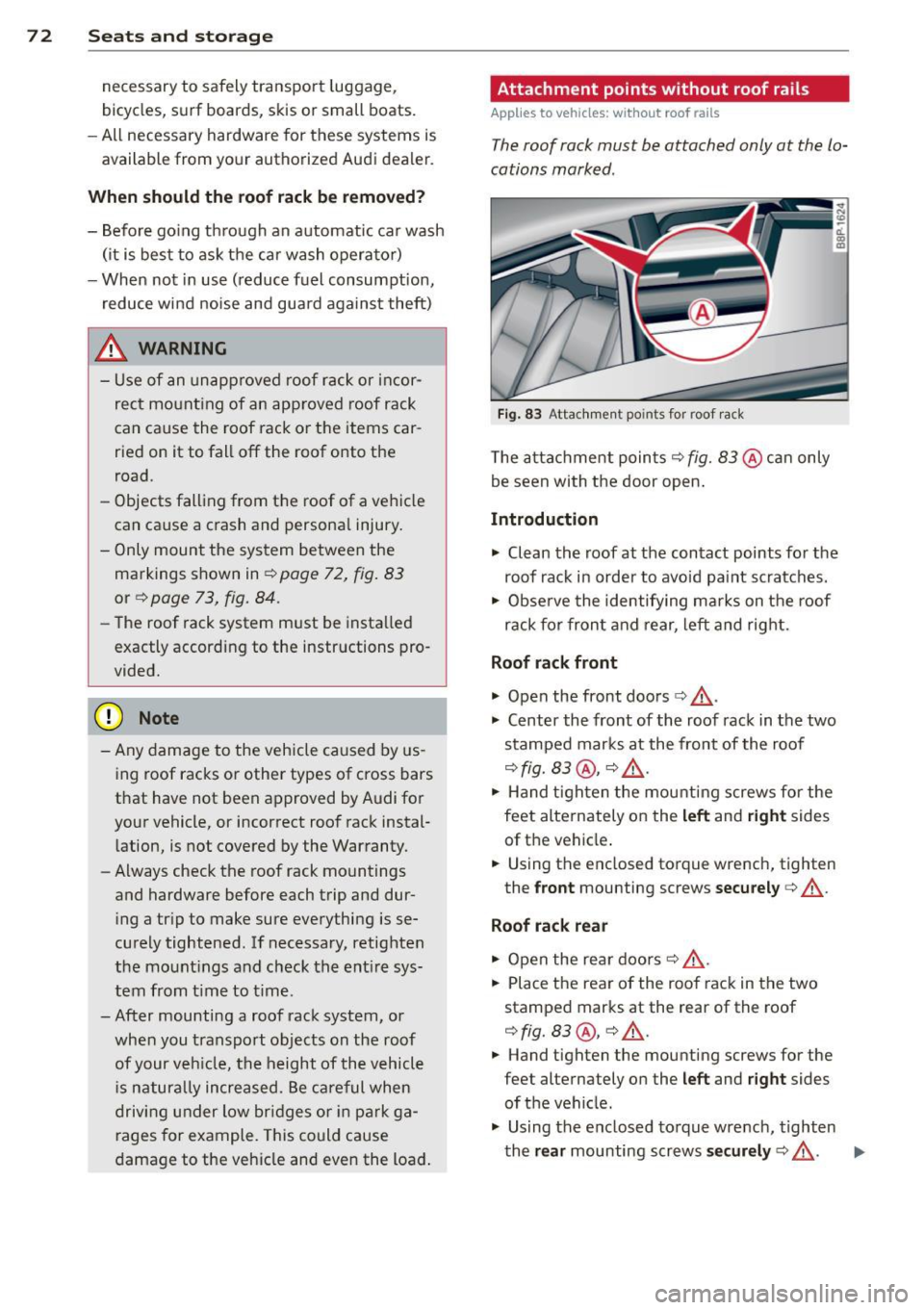
The roof rack must be attached only at the lo
cations marked .
Fig . 83 Attac hmen t po ints fo r roof rac k
The attachme nt poin ts r=> fig. 83 @ can only
be seen with the door open .
Introduction
.,. Clean the roof at the contact points for the
roof rack in order to avoid pa int scratches.
.,. Obse rve the identify ing marks on t he roof
rack for front and rear, left and right.
Roof rack front
.,. Open the front doo rs c:> &_ .
.,. Center the front of the roof rack in t he two
stamped marks at the front of the roof
r=> fig. 83 @ , r::!> & .
.,. Hand tighten the mount ing screws for the
feet alternately on the
left and right sides
of the vehicle .
.,. Using the enclosed torque wrench, tighten
the
front mounting screws securely c:> &_ .
Roof rack rear
.,. Open the rea r doors r=> £ .
.,. Place the rear of the roo f rack in the two
stamped marks at the rear of the roof
r=> fig. 83 @, r=> £.
.,. Hand tighten the mounting screws for the
feet alternately on the
left and r ight sides
of the vehicle.
.,. Us ing the enclosed to rque wre nch, t ighten
the
rear mounting screws s ecurely c:> &_ . ..,.
Page 75 of 280
_& WARNING
-Always follow the instructions prov ided
by the roof rack manufacturer.
- When installing the roof rack with the
vehicle doors open, watch out for other
traffic - there is the risk of an accident .
- Make certain that the feet of the roof
rack are sitting exactly in the four stamp
ed marks - otherw ise you risk an acci
dent!
- After you have driven a few miles, and part icularly during long trips, inspect the
attach ing screws to make certain they
are tight.
- Do not make any modification to the roof
rack - you increase the risk of an acci
dent.
Roof rack mounting locations
App lies to vehicles: with roof rails
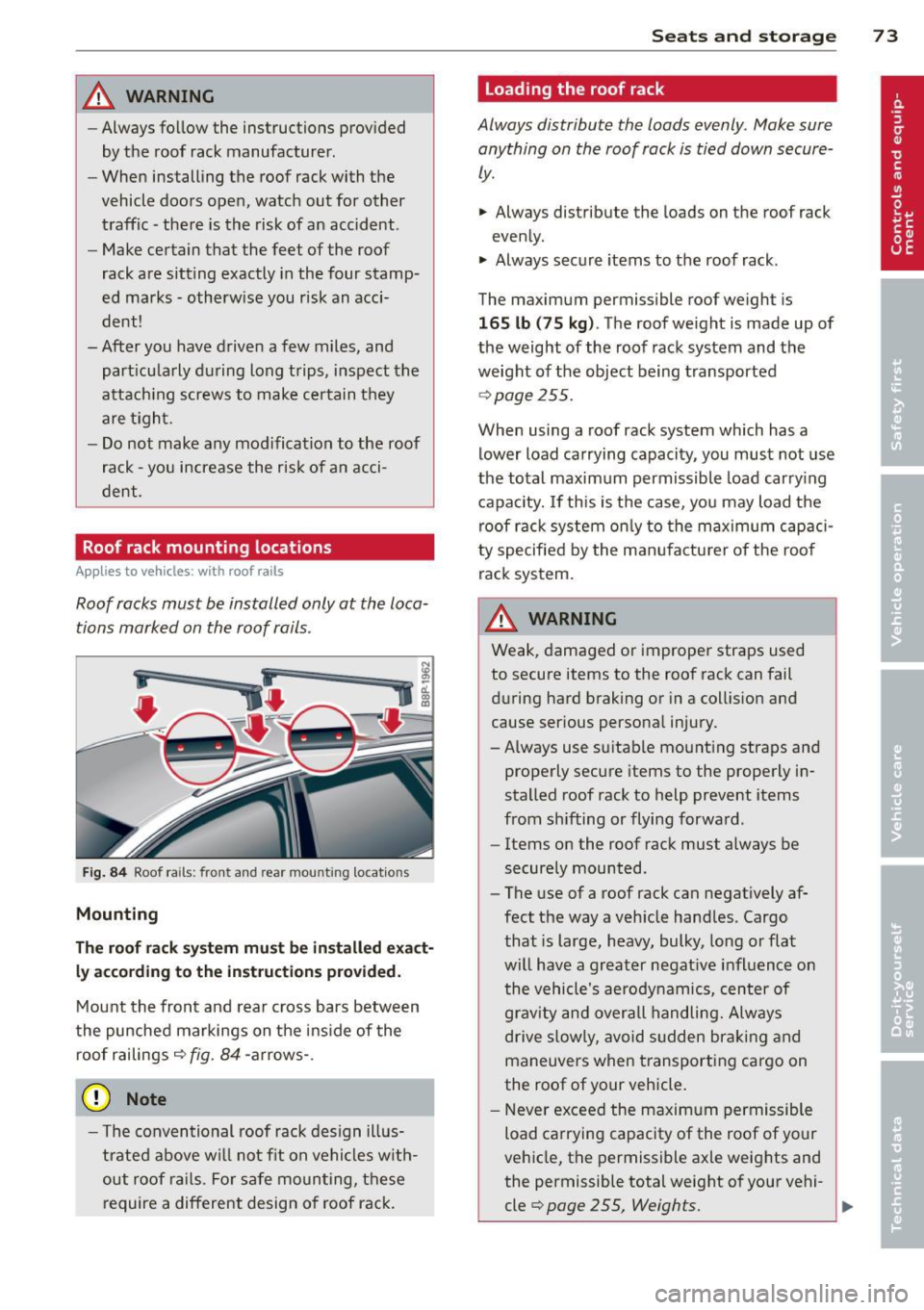
Roof racks must be installed only at the Loca
tions marked on the roof rails .
Fig . 8 4 Roof ra ils: front and rear mou nting locations
Mounting
The roo f rack syste m mu st be in sta ll ed exact
l y accord ing to th e instru cti ons prov ided.
Mount the front and rear cross bars between
the punched markings on the ins ide of the
roof railings
r::;,fig. 84-arrows- .
(D Note
- The conventional roof rack des ign illus
trated above w il l not f it on vehicles w ith
out roof ra ils. For s afe mounting, these
require a different design of roof rack.
S ea ts a nd s to rage 73
Loading the roof rack
Always distribute the Loads evenly . Make sure
anything on the roof rack is tied down secure
ly.
.. Always distribute the loads on the roof rack
evenly.
.. Always secure items to the roof rack.
The maximum permissible roof weight is
16 5 lb (75 k g). The roof weight is made up of
the weight of the roof rack system and the
weight of the object being transported
.;, page 255.
When using a roof rack system which has a
lower load carrying capacity, you must not use
the total maximum permissible load carry ing
capacity. If th is is the case, you may load the
roof rack system on ly to the maximum capaci
ty specified by the manufacturer of the roof
rack system.
A WARNING
Weak, damaged or improper straps used
to secure items to the roof rack can fail
during hard braking or in a coll is ion and
cause ser ious persona l injury.
-Always use suitable mounting straps and
properly secure items to the properly in
stalled roof rack to help prevent items
from sh ifting or flying forward .
- Items on the roof rack must always be
securely mounted.
- The use of a roof rack can negat ively af
fect the way a veh icle hand les . Cargo
that is large, heavy, bulky, long or flat
will have a greater negat ive influence on
the vehicle's aerodynamics, center of
grav ity and overa ll handling. Always
drive s lowly, avoid sudden braki ng and
maneuvers when transporting cargo on
the roof of your vehicle.
- Never exceed the maxim um permissible
load carrying capacity of the roof of your
vehicle, the permissible axle weights and
the permissible total weight of your vehi- cle
r::;, page 255, Weights. ~