warning AUDI S3 2015 Owners Manual
[x] Cancel search | Manufacturer: AUDI, Model Year: 2015, Model line: S3, Model: AUDI S3 2015Pages: 310, PDF Size: 76.15 MB
Page 169 of 310
M N
0 > co ,....,
The inflatable side curtain airbags are located
on both sides of the interior above th e front
and rear side windows . T hey are identified by
the word "AIRBAG" on the windsh ield frame
and the center roof pillar.
The side curtain airbags contain features that prov ide ejection m itigation to he lp prevent ve
h icle oc cupant s or parts of their bodies from
being comple tely or partially ejected from the
vehicle interior in certain side impacts and ve
h icle rollovers .
The s ide curtain airbag system supp lements
the safety belts and can help to reduce the risk of injury for occupa nts ' heads and upper
torso on the side of the veh icle that is struck
i n a side collision . T he side curta in a irbag in
flates in s ide impacts and on ly w hen the veh i
cle acce le rat ion reg iste red by the cont ro l u nit
is high enough . If this rate is below the refer
ence value programmed into t he control unit,
the side c urtain airbag will not be t riggered,
even though the car may be badly damaged as
a result of the collision. It is not possible to
define an airbag triggering range tha t will
cover every possible angle of impact, since the
circumstances will vary considerably between
one co llision and another. Important factors
i nclude, for examp le, the natu re (hard o r soft)
of the impacting object, the ang le o f impact ,
ve hicl e speed, et c.
q page 168, How sid e cur
tain airbags work .
Besides their normal safety f unction, safety
be lts work to help keep the dr iver or front
passenger in position in the event of a frontal
collision so that the side curtain airbags can provide protection.
The airbag system is not a s ubst itute for yo ur
safety be lt . Rathe r, it is pa rt of the overall oc
cupant restraint system in your vehicle . Al
ways rememb er that the airbag system can
only help to protect you if you are wearing
your safety belt and wear ing it properly. Th is
is another reason why you shou ld always wear
your safety belts, not just because the law re
q uir es you to do so
q page 135, General
~ notes .
M l/'I ,....,
Airbag system 167
It is important to remembe r that wh ile the
side curtain airbag system is designed to help
reduce the likelihood of ser ious injuries, other
injur ies, for example, swelling, bru is ing, fric
tion burns and minor abras ions can also be as
sociated w ith these airbags upon deployment .
Remember too , these airbags will deploy only
once a nd only in ce rtain kinds of accide nts -
you r safety be lts a re a lways the re to offer p ro
tection .
The side curtain airbag system basically
consists of:
-The e lectronic control module and external
side impact sensors
- The side curta in a irbags above the front and
rear s ide windows w it h ejection mitigation
featu res
- The a irbag indicator light in the instr ument
p ane l
The airbag system is mon itored e lectronically
to make ce rtain it is func tioning prope rly at all
times. Each time you sw itch on the ig nition,
the air bag system indicator light will come on
f o r a few se conds (sel f diagnos tic s) .
The side curtain airbag is not activat ed:
- if the ignition is sw itched off,
- in side collisions whe n the acceleration
measured by the sensor is too low,
- in rear-end collisions.
A WARNING
-Safety belts and the airbag system will
only provide pro tection when occupa nts
are in the proper seating position
q page 57, Front seats .
-If the ai rbag ind icator light q page 21
comes when the veh icle is being used,
have the system inspected imme diately
by your au thori zed A udi dealer.
It is pos
sible tha t the airbag will inflate when i t
is not supposed to , or will not inflate
when it should .
•
•
•
Page 170 of 310
168 Airbag system
How side curtain airbags work
Side curtain airbags can work together with
side airbags to help reduce the risk of head
and upper torso injuries for occupants who
are properly restrained.
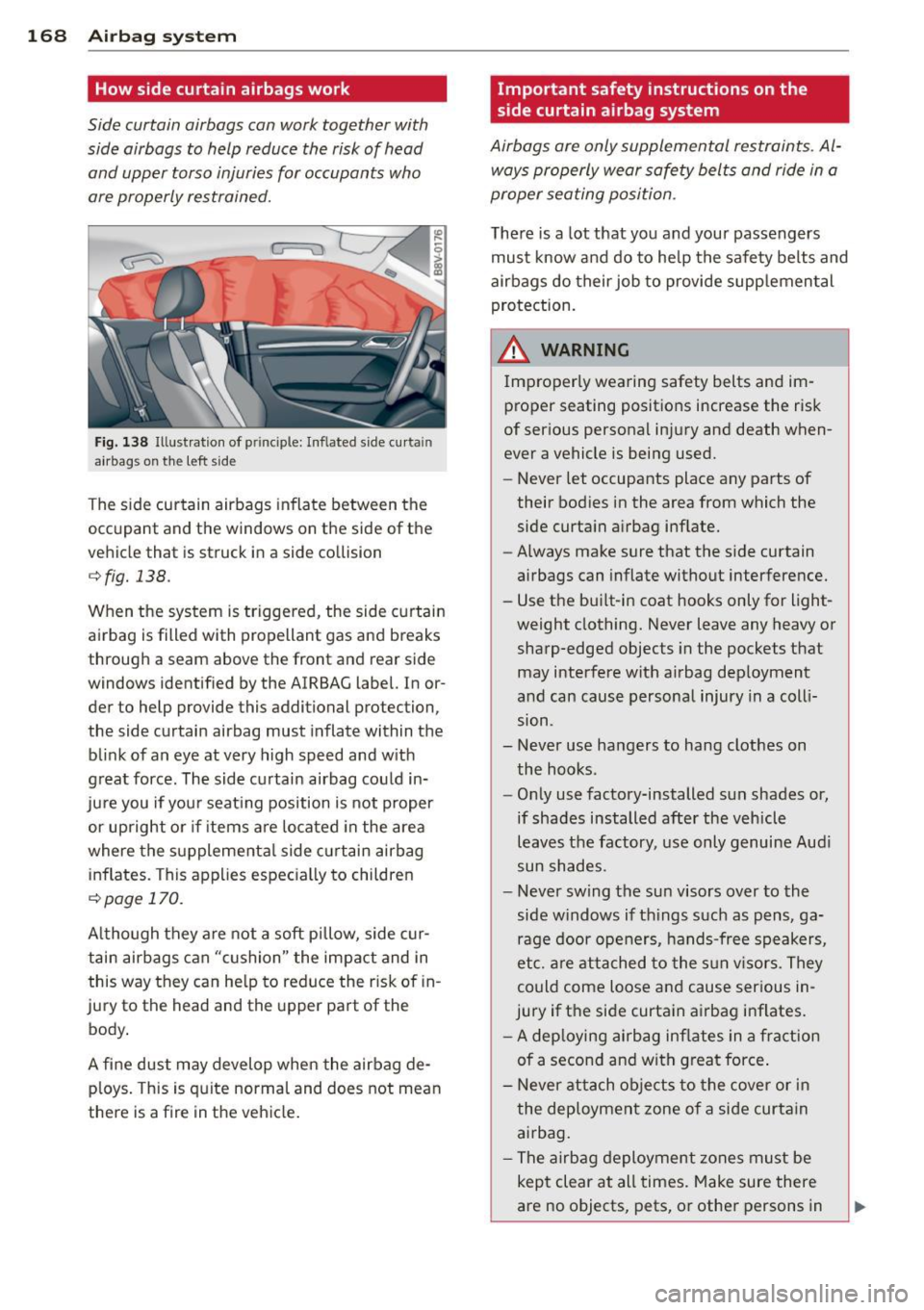
Fig. 138 Illustration of p rincipl e: In flated s ide curt ain
airbags on th e Left side
The side curtain airbags inflate between the
occupant and the windows on the side of the
vehicle that is struck in a side collision
c::> fig. 138.
When the system is triggered , the side curtain
airbag is filled with propellant gas and breaks
through a seam above the front and rear side
windows identified by the AIRBAG label. In or
der to help provide this additional pro tection,
the side curtain airbag must inflate within the
blink of an eye at very high speed and with
great force . The side curtain airbag could in
jure you if your seating position is not proper or upright or if items are located in the area
where the supplemental side curtain airbag
inflates . This applies especially to children
<=:> page 170.
Although they are not a soft pillow, side cur
tain airbags can "cushion" the impact and in
this way they can he lp to reduce the risk of in
jury to the head and the upper part of the
body .
A fine dust may develop when the airbag de ploys. This is quite norma l and does not mean
there is a fire in the vehicle. Important safety instructions on the
side curtain airbag system
Airbags are only supplemental restraints
. Al
ways properly wear safety belts and ride in o
proper seating position.
There is a lot that you and your passengers
must know and do to he lp the safety belts and
airbags do their job to provide supp lemental
protection.
A WARNING
Improperly wearing safety belts and im
proper seating positions increase the risk
of serious personal injury and death when
ever a vehicle is being used.
- Never let occupants place any parts of
their bodies in the area from which the
side curtain airbag inflate.
- Always make sure that the side curtain
airbags can inflate without interference.
- Use the built-in coat hooks only for light
weight clothing. Never leave any heavy or
sharp-edged objects in the pockets that
may interfere with airbag deployment
and can cause personal injury in a colli
sion.
- Never use hangers to hang clothes on
the hooks .
- Only use factory-installed sun shades or,
if shades installed after the vehicle
leaves the factory, use only genuine Aud i
sun shades.
- Never swing the sun visors over to the
side windows if things such as pens, ga rage door openers , hands-free speakers,
etc. are attached to the sun visors. They
could come loose and cause serious in
jury if the side curtain airbag inflates .
- A deploying airbag inflates in a fraction
of a second and with great force .
- Never attach objects to the cover or in
the deployment zone of a side curtain
airbag.
- The airbag deployment zones must be
kept clear at all times. Make sure there
are no objects, pets, or other persons in
-
Page 171 of 310
M N
0 > co ,...., \!) ..,.,
M ..,., ,....,
the space between any vehicle occupant and any airbag at any time.
- Do not attach any accessories to the
doors.
A WARNING
- The airbag system can deploy only once.
If the airbag has been triggered, the sys
tem must be replaced by an author ized
Audi dealer or qualified workshop.
- Always have work involving the side cur
tain a irbag system, remova l and installa
t ion of the a irbag components, o r other
repai rs perfo rmed by a qualified dealer
ship. Othe rwise the airbag system may
not wo rk corre ctly.
- Never attempt to modify any compo
nent s of the airbag system in any way.
A irbag system 169
•
•
•
Page 172 of 310
1 70 Child Saf ety
Child Safety
Important things to
know
Introduction
The rear seat is generally the safest place in a
collision.
The physical principles of what happens when
your veh icle is in a crash app ly also to chi ldren
¢ page 136, What happens to occupants not
wearing safety belts?.
But unlike adults and
teenagers, their muscles and bones are not
fu lly developed. In many respects children are
at greater risk of serious injury in crashes than
adults.
Because children's bodies are not fully deve l
oped, they require restraint systems especial
ly designed for their size, weight, and body
structure. Many countries and all states of the
United States and provinces of Canada have
laws requiring the use of approved child re
straint systems for infants and small ch ildren.
In a fronta l crash at a speed of 20 -35 mph
(30-56 km/h) the forces acting on a 13-pound
(6 kg) infant w ill be more than 20 t imes the
weight of the child. This means the weight of
the child would suddenly be more than 260 pounds (120 kg). Under these conditions,
only an appropriate ch ild restraint properly
used can reduce the risk of ser ious injury.
Child restraints, like adult safety belts, must
be used properly to be effective. Used improp
erly, they can increase the risk of serious in
jury in an accident.
Consult the child safety seat manufacturer's instructions to be sure the seat is right for
your child's size¢
page 174, Important safe
ty instructions for using child safety seats.
Please be sure to read and heed all of the im
portant information and WARNINGS about
ch ild safety, Advanced Airbags, and the instal
l ation of chi ld restraints in this chapter.
There is a lot you need to know about the Ad
vanced Airbags in your vehicle and how they
work when infants and children in child re- straints are on the front passenger seat
. Be
cause of the large amount of important infor
mation, we cannot repeat it all here . We urge
you to read the detailed information in this
owner's manual about airbags and the Ad
vanced Airbag System in your vehicle and the
very important information about transport
ing children on the front passenger seat.
Please be sure to heed the WARNINGS - they
are extremely important for your safety and
the safety of your passengers, especially in
fants and small children.
A WARNING
-Accident statistics have shown that chil
dren are generally safer in the rear seat
area than in the front seating position.
Always restrain any child age 12 and un
der in the rear.
- All vehicle occupants and especially chil
dren must be restrained properly when
ever riding in a vehicle. An unrestrained
or improperly restrained chi ld could be
injured by str iking the i nterior or by be
ing ejected from the vehicle during a
sudden maneuver or impact. An unre
strained or improperly restrained chi ld is
also at greater risk of injury or death
through contact with an inflating airbag.
- A suitable chi ld restraint properly instal
led and used at one of the rear seating positions provides the highest degree of
protection for infants and small children
in most accident situations.
A WARNING ,_
Children on the front seat of any car even
with Advanced Airbags can be ser iously in
jured or even killed when an airbag in
flates. A child in a rearward-facing child
safety seat installed on the front passen
ger seat will be seriously injured and can
be killed if the front airbag inflates.
- The inflating airbag will hit the child
safety seat or infant carrier with great
force and will smash the child safety seat and child against the backrest, center
armrest, or door.
II>-
Page 173 of 310
M N
0 > co ,...., \!) 1.1'1
M 1.1'1 ,....,
-Always install rear-facing child safety
seats on the rear seat.
- If you must install a rearward facing
child safety seat on the front passenger
seat in exceptional circumstances and
the
PASSENGER AIR BAG OFF light does
not come on and stay on, immediately
install the rear-facing child safety seat in
a rear seating position and have the air
bag system inspected immediately by
your Audi dealer.
_& WARNING
- Forward-facing child safety seats instal
led on the front passenger's seat may in
terfere with the deployment of the air
bag and cause serious injury to the child.
- If exceptional circumstances require the
use of a forward-facing child restraint on
the front passenger's seat, the child's
safety and well-being require the follow ing special precautions to be taken:
- Always make sure that the forward-fac
ing seat has been designed and certi
fied by its manufacturer for use on a
front passenger seat with a front and
side airbag.
- Always carefully follow the manufac
turer's instructions provided with the
child seat or infant carrier.
- Never install a child restraint without a
properly attached top tether strap if
the child restraint manufacturer's in
structions require the top tether strap
to be used.
- Never put the forward-facing child re
straint up against or very near the in
strument panel.
- Always set the safety belt upper an
chorage to the adjustment position
that permits proper installation in ac
cordance with the child restraint manu
facturer's instructions.
- Always move the passenger seat into its rearmost position in the seat's fore
and aft adjustment range, as far away
from the airbag as possible before in-
Child Safety 1 71
stalling the child restraint. The back
rest must be adjusted to an upright po
sition.
- Always make sure that nothing pre
vents the front passenger's seat from
being moved to the rearmost position
in its fore and aft adjustment range.
- Never place objects on the seat (such
as a laptop, CO player, electronic games device, power inverter or seat
heater for child seats) . These may in
fluence the electrical capacitance
measured by the capacitive passenger
detection system and can also fly
around in an accident and cause serious personal injury.
- Never place or use any electrical device
(such as a laptop, CO player, electronic
games device, power inverter or seat
heater for child seats) on the front pas
senger seat if the device is connected
to the 12-volt socket or the cigarette lighter socket.
- If a seat heater has been retrofitted or
otherwise added to the front passen ger seat, never install any child re
straint system on this seat.
- Make sure that there are no wet objects (such as a wet towel) and no water or
other liquids on the front passenger
seat cushion .
- Always make sure that the
PASSENGER
AIR BAG OFF
light comes on and stays
on all the time whenever the ignition is
switched on.
- If the PASSENGER AIR BAG OFF light
does not come on and stay on, immedi
ately install the rearward-facing child
safety seat in a rear seating position
and have the airbag system inspected by your authorized Audi dealer.
- Always buckle the child seat firmly in
place even if a child is not sitting in it.
A loose child seat can fly around during
a sudden stop or in a collision.
- Always read and heed all WARNINGS
whenever using a child restraint in ave-
hicle
¢ page 135, Safety belts, ..,
•
•
•
Page 175 of 310
M N
0 > co ,...., \!) ..,.,
M ..,., ,....,
passenger seat, that the front passenger air
bag is turned off, and that the airbag status is
always correctly signaled by the
PASSENGER
AIR BAG OFF
li ght.
Many types and models of child restraints
have been avai lable over the years, new mod
e ls are introduced regular ly incorporating new
and improved designs and older models are
taken out of production. Child restraints are
not standardized. Ch ild restra ints of the same
type typically have different we ights and s izes
and d ifferent "footprints", the size and shape
of the bottom of the child restraint that sits
on the seat, when they are installed on a veh i
cle seat . These differences make it virtually
imposs ible to certify compliance with the re
quirements for advanced airbags with each
and every child restraint that has ever been
sold in the past or will be sold over the course
of the useful life of your vehicle.
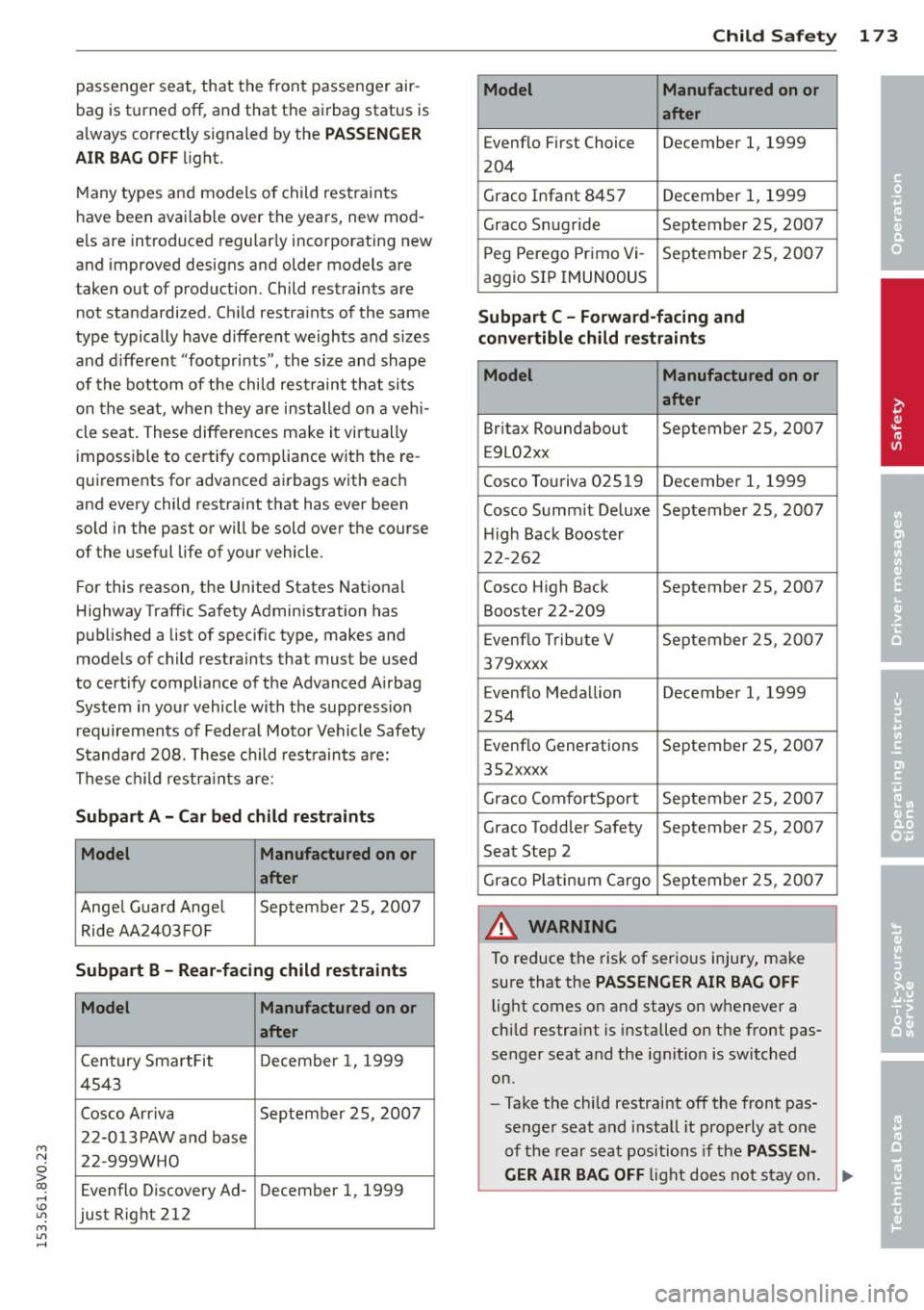
F or this reason, the United States National
Highway Traffic Safety Administration has
published a list of specific type, makes and
models of child restraints that must be used
to certify compliance of the Advanced Airbag
System in you r vehicle with the supp ress io n
requirements of Federal Motor Vehicle Safety
Standa rd 208. These child rest raints are:
These c hild restr aints are:
Subpart A -Car bed child rest raints
Model Manufactured on or
after
Angel G uard Ange l September 25, 200 7
Ride AA2403 FOF
Subpart B -Rear -facing child restraints
Model Manufactured on or
after
Century SmartFit December 1, 1999
4543
Cosco Arriva September 25, 2007
2 2-0 13PAW a nd base
22-999WHO
Evenflo Discovery Ad- December 1, 1999
just Right 212
Child Sa fet y 173
Model Manufactured on or
after
Evenflo First Choice December 1, 1999
204
Gr aco Infant 8457 December 1, 1999
Graco Snug ride September 25, 2007 P eg Perego Pr imo Vi-
September 2 5, 2007
aggio SIP IMUNOOUS
Subpart C -Forward-facing and
convertible child re straint s
Model Manufactured on or
after
Br itax Roundabout September 25, 2007
E9L02xx
Cosco Touriva 025 19
December 1, 1999
Cosco Summit Deluxe September 25, 2007 H igh Back Booster
22- 262
Cosco High Back September 25, 2007
Booster 22-209
E venflo T ribute V September 2 5, 2007
379xxxx
Evenflo Medallion December 1, 1999
254
Evenf lo Generations
September 25, 2007
352xxxx
Graco ComfortSport September 2 5, 200 7
Graco Toddler Safety September 25, 2007
Seat Step 2
Gr aco P lat inum Cargo September 25, 2007
_& WARNING
To reduce the risk of serious injury, make
sure that the
PASSENGER AIR BAG OFF
light comes on and stays on whenever a
chi ld restraint is installed on the front pas
senger seat and the ignit ion is switched
on.
- Take the chi ld restraint off the front pas
senger seat and install it prope rly at one
of the rear seat positions if the
PASSEN -
GER AIR BAG OFF
li ght does not stay on. ~
•
•
•
Page 176 of 310
174 Child Safety
-Have the airbag system inspected by
your authorized Audi dealer immediate
ly.
The child seats listed in categories A to C have been statically tested by Audi only for
the Advanced Airbag function.
Important safety instructions for using
child safety seats
Correc t use of child safety seats substantially
reduces the risk of injury in an accident!
As the driver, you are responsible for the safe
ty of everybody in the vehicle, especially chil
dren :
• Always use the right child safety seat for
each child and always use it properly
c:> page 176.
• Always carefully follow the child safety seat
manufacturer's instructions on how to route
the safety belt properly through the child
safety seat.
• When using the vehicle safety belt to install
a child safety seat, you must first activate
the convertible locking retractor on the
safety belt to prevent the child safety seat
from moving
c:> page 181.
• Push the child safety seat down with your
full weight to get the safety belt really tight so that the seat cannot move forward or
sideways more than one inch (2.5 cm) .
• Secure unused safety belts on the rear seat
cc> page 176.
Always remember: Even though your vehicle is
equipped with an Advanced Airbag system, all
children , especially those 12 years and young
er, should always ride in the back seat proper
ly restrained for their age and size.
.&_ WARNING
Not using a child safety seat, using the
wrong child safety seat or improperly in stalling a child restraint increases the risk
of serious personal injury and death . -
-All vehicle occupants and especially chil
dren must be restrained properly when
ever riding in a vehicle. An unrestrained
or improperly restrained child could be
injured by striking the interior or by be
ing ejected from the vehicle during a
sudden maneuver or impact. An unre
strained or improperly restrained child is
also at greater risk of injury or death
through contact with an inflating airbag.
- Commercially available child safety seats
are required to comply with U.S. Federal
Motor Vehicle Safety Standard (FMVSS)
213 (in Canada CMVSS 213).
- When buying a child restraint, select one that fits your child and the vehicle.
- Only use child restraint systems that fully contact the flat portion of the seat cushion . The child restraint must
not tip or lean to either side . Audi does
not recommend using child safety
seats that rest on legs or tube-like
frames. They do not provide adequate
contact with the seat.
- Always heed all legal requirements per
taining to the installation and use of
child safety seats and carefully follow
the instructions provided by the manu
facturer of the seat you are using.
- Never allow children under 57 inches
(1.45 meters) to wear a normal safety
belt. They must always be restrained by a
proper child restraint system . Otherwise,
they could sustain injuries to the abdo men and neck areas during sudden brak
ing maneuvers or accidents.
- Never let more than one child occupy a
child safety seat.
- Never let babies or older children ride in
a vehicle while sitting on the lap of an
other passenger .
- Holding a child in your arms is never a
substitute for a child restraint system .
- The strongest person could not hold
the child with the forces that exist in
an accident. The child will strike the in
terior of the vehicle and can also be struck by the passenger.
Page 177 of 310
Child Safety 175
-The child and the passenger can also heater for child seats) on the front pas-
injure each other in an accident . senger seat if the device is connected
- Never install rear-facing child safety to the 12-volt socket or the cigarette
seats or infant carriers on the front pas- lighter
socket.
senger seat. A child will be seriously in- -If a seat heater has been retrofitted or
jured and can be killed when the passen- otherwise added to the front passen-
ger airbag inflates - even with an Ad -ger seat, never install any child re-
•
vanced Airbag System. straint system on this seat.
•
-The inflating airbag will hit the child -Make sure that there are no wet objects
safety seat or infant carrier with great (such as a wet towel) and no water or
force and will smash the child safety seat other liquids on the front passenger
and child against the backrest, center seat cushion.
armrest, door or roof. -Never place objects on the seat (such
- Always install rear-facing child safety as a laptop, CD player, electronic
seats or infant carriers on the rear seat. games device, power inverter or seat
- Forward-facing child safety seats instal- heater for child seats). These may
in-
led on the front passenger's seat can in- fluence the electrical capacitance
terfere with the airbag when it inflates measured by the capacitive passenger
and cause serious injury to the child. Al- detection system and can also fly
ways install forward-facing child safety around in an accident and cause serious
seats on the rear seat. personal injury.
- If exceptional circumstances require the -
Always buckle the child safety seat firmly
use of a forward-facing child restraint on in place even if a child is not sitting
in it.
the front passenger's seat, the child's A loose child safety seat can fly around
safety and well-being require that the during a sudden stop or in a collision
.
following special precautions be taken: -Always read and heed all WARNINGS
- Make sure the forward-facing seat has whenever using a child restrained in ave-
been designed and certified by its man- hide is being used
c> page 135, Safety
ufacturer for
use on a front seat with a belts, ¢ page 144, Airbag system and
passenger front and side airbag.
¢ page 170, Child Safety .
-Always carefully follow the manufac-
A WARNING turer's instructions provided with the
child safety seat or carrier. To reduce the risk of serious injury, make
- Always move the front passenger seat
sure that the
PASSENGER AIR BAG OFF
into the rearmost position of the pas-
light comes on and stays on whenever a
senger seat's fore and aft adjustment child restraint is installed on the front pas-
range, and as far away from the airbag senger seat and the ignition is switched
as possible before installing the child on.
restraint. - Take the child restraint off the front pas-
- Always make sure that nothing pre-
senger seat and install it properly at one
vents the front passenger's seat from of the rear seat positions if the
PASS EN-
being moved to the rearmost position GER AIR BAG OFF light does not stay on.
in its fore and aft adjustment range .
-Have the airbag system inspected by
- Always make sure that the backrest is
your authorized Audi dealer immediate-
M • N in the upright position. ly. 0 > - Never place or use any electrical device co ,....,
(such as a laptop, CD player, electronic \!) 1.1"1
M
games device, power inverter or seat 1.1"1 ,....,
Page 178 of 310
1 7 6 Child S afet y
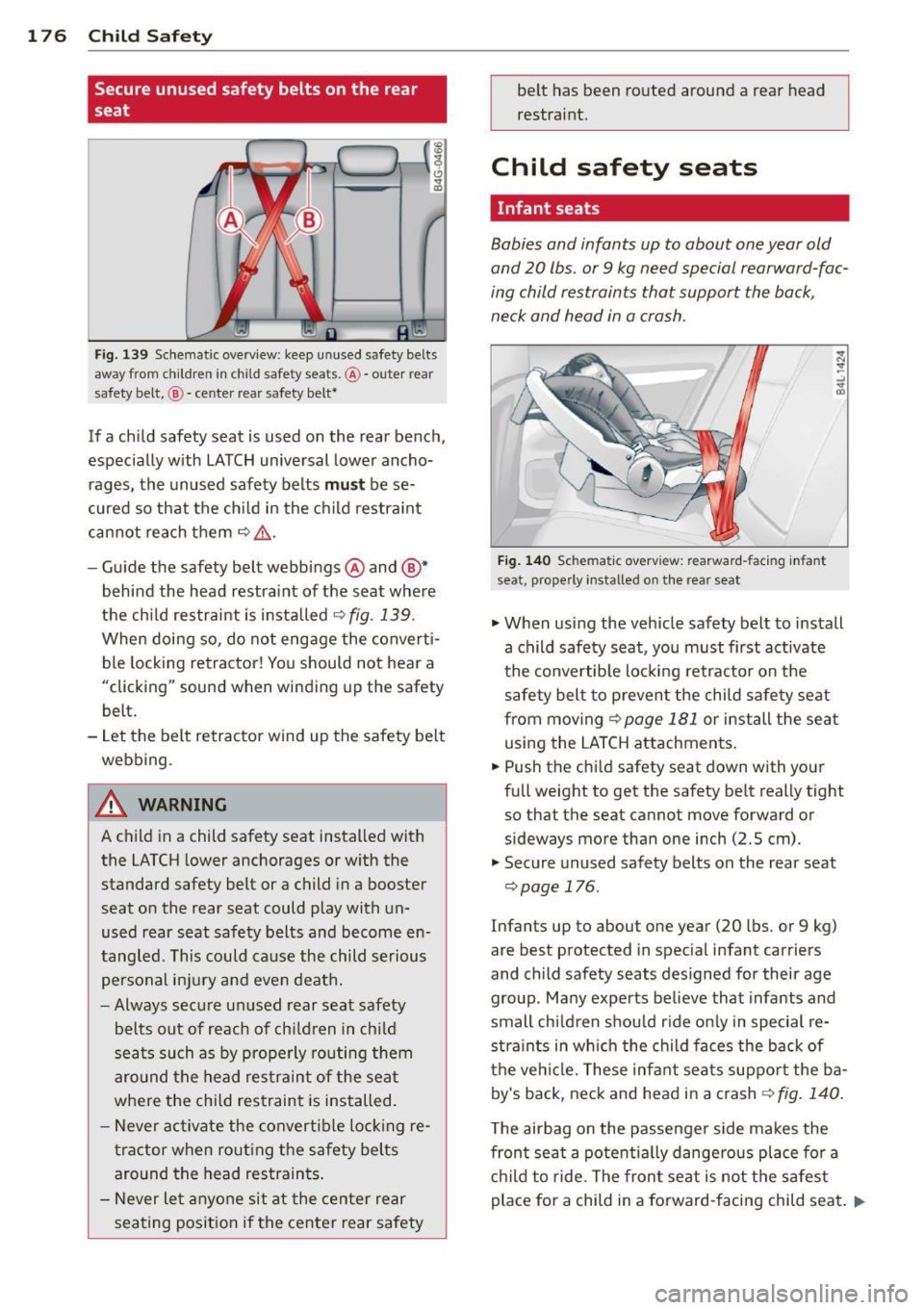
Secure unused safety belts on the rear
seat
F ig. 139 Schematic overview: keep unused safety belts
away from children in child safety seats.@-outer rear
safety belt,
® -center rear safety belr
If a child safety seat is used on the rear bench,
espec ially w ith LATCH unive rsal lower ancho
rages, the unused safety belts
mu st be se
cured so that the ch ild in the child restra in t
cannot reach them¢,&..
- Gui de the safety belt webbings @and
®*
behind the head restraint of the seat whe re
the chi ld restrai nt is installed ¢
fig. 139.
When doing so, do not engage the converti
ble locking retractor! You should not hear a
"clicking" sound when winding up the safety
belt .
- Let the belt re tractor wind up the safety be lt
webbing.
A WARNING
A child in a child safety seat installed with
the LATCH lower anchorages or w ith the
standard safety belt or a child in a booster
seat on the rear seat could play with un
used rear seat safety belts and become en
tangled. This could cause the child serious personal i nju ry an d even deat h.
- Always secu re un used rear seat safety
belts out of r each of ch ildren in ch ild
seats such as by properly routi ng them
around the head restraint of the seat
where the child restraint is installed.
- Never ac tivate the convertib le lo cking re
t ractor when rou ting the s afety belts
around the head restraints .
- Never le t anyone sit at the center re ar
sea ting posit io n if the center rear safety be
lt has been ro uted around a rear head
restraint.
Child safety seats
Infant seats
Babies and infants up to about one year old
and 20 lbs . or 9 kg need special rearward-fac
ing child restraints that support the back,
neck and head in a crash.
F ig . 14 0 Schem atic overview: rearward -facing infant
seat, properly installed o n the rear seat
.,. When usi ng the vehicle safety belt to install
a child safety seat, you must first activate
the convertib le locking retr actor on the
safety belt to p revent the child safe ty seat
from mov ing¢
page 181 or ins tall the seat
using the LATCH attachmen ts.
.,.. Push the chi ld safety seat down with you r
full weight to get the safety belt really tight
so that the seat cannot move forward or
sideways more than one inch (2.5 cm).
.,. Secure unused safety belts on the rear seat
¢page 176.
Infants up to about one year (20 lbs. or 9 kg)
are best protected in spec ial infant carriers
and ch ild safety seats designed for their age
group. Many experts believe that infants and
small ch ild ren shou ld r ide o nly in special re
stra ints in wh ich the child faces the back of
the ve hicl e. These infa nt sea ts suppor t the ba
by's back, nec k and head in a crash
¢ fig. 140 .
The airbag on the passenger side makes the
fron t seat a pote ntia lly dange ro us place for a
chil d to ride. The front se at is not the s afest
place for a child in a forward-facing child seat . ..,.
Page 179 of 310
....,
N
0 > co
rl I.O
"' ....,
"' rl
It is a very dangerous place for an infant or a
la rger child in a rearward-facing seat.
A WARNING
Not using a child safety seat, using the
wrong child safety seat or improperly in stalling a child restraint increases the risk
of serious personal injury and death in a
crash.
- Never install rear-facing child safety
seats or infant carriers on the front pas
senger seat -even with an Advanced Air
bag System. A child will be seriously in
jured and can be killed when the inflat
ing airbag hits the child safety seat or in
fant carrier with great force and smashes
the child safety seat and child against
the backrest, center armrest, door or
roof
c::> page 146, Child restraints on the
front seat -some important things to
know.
- Always install rear-facing child safety
seats or infant carriers on the rear seat.
- Never install a rear-facing child restraint in the forward-facing direction. Such re
straints are designed for the special
needs of infants and very small children
and cannot protect them properly if the
seat is forward-facing .
-If you must install a rearward facing
child safety seat on the front passenger
seat because of exceptional circumstan
ces and the
PASSENGER AIR BAG OFF
light does not come on and stay on, im
mediately install the rear-facing child
safety seat in a rear seating position and have the airbag system inspected by your
Audi dealer.
- Never place or use any electrical device
(such as a laptop, CD player, electronic
games device, power inverter or seat
heater for child seats) on the front pas
senger seat if the device is connected to
the 12-volt socket or the cigarette light
er socket .
- If a seat heater has been retrofitted or
otherwise added to the front passenger
Child Safety 177
seat, never install any child restraint sys
tem on this seat.
- Make sure that there are no wet objects
(such as a wet towel) and no water or
other liquids on the front passenger seat
cushion.
- Never place objects on the seat (such as
a laptop, CD player, electronic games de
vice, power inverter or seat heater for
child seats). These may influence the
electrical capacitance measured by the
capacitive passenger detection system
and can also fly around in an accident
and cause serious personal injury.
- Always read and heed all WARNINGS
whenever using a child restrained in ave
hicle is being used
c::> page 135, Safety
belts,
c::> page 144, Airbag system and
c::> page 170, Important things to know.
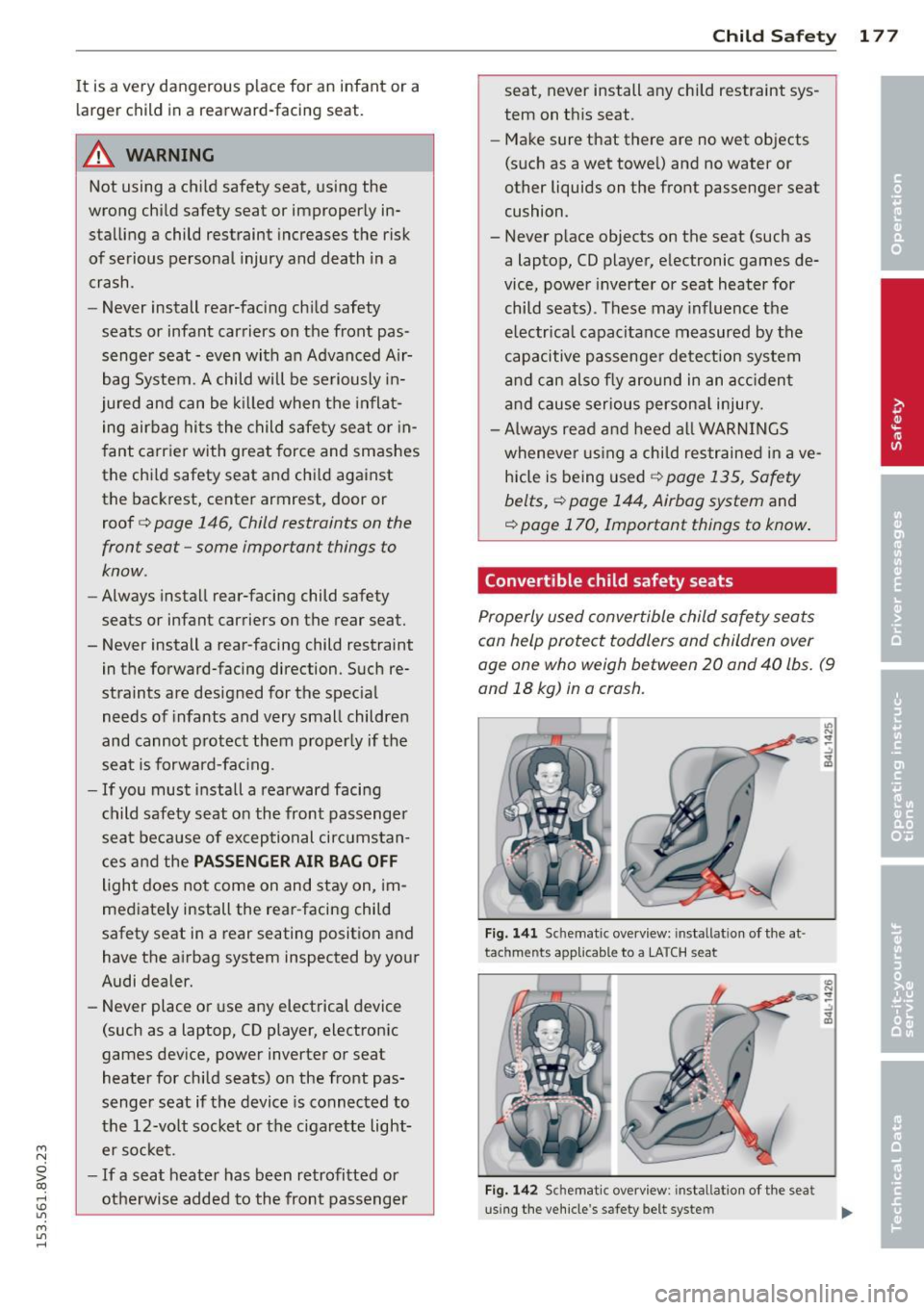
Convertible child safety seats
Properly used convertible child safety seats
can help protect toddlers and children over
age one who weigh between 20 and 40 lbs. (9
and 18 kg) in a crash.
Fig. 141 Schematic overview: installat ion of the at
tachments applicable to a LATCH seat
Fig. 142 Schematic overview: installation of the seat
using the vehicle 's safety be lt system
I),,