warning AUDI S3 2015 Owners Manual
[x] Cancel search | Manufacturer: AUDI, Model Year: 2015, Model line: S3, Model: AUDI S3 2015Pages: 310, PDF Size: 76.15 MB
Page 207 of 310
M N
0 > co ,...., \!) ..,.,
M ..,., ,....,
Care and cleaning
General information
Regular, proper care helps to maintain your
vehicle's val ue . It can also be a requirement
when submitting warranty claims for corro
sion damage and paint defects on the body.
The necessary care products can be obtained
from your a uthorized Audi dea ler . Read and
follow the instructions for use on the packag ing.
A WARNING
- Us ing clean ing and care products incor
rect ly can be dangerous to your hea lth .
- Always store cleaning and care products
out of reach of children to reduce the r isk
of po isoning.
@ For the sake of the environment
- Preferably use environmentally-friendly
products when buying cleaning agents.
- Do not d ispose of leftover cleaning and
care products with household trash.
-
Car washes
The longer that deposits such as insects, bird
droppings, tree sap or road sa lt rema in on the
veh icle, the more the surface can be dam
aged . High tempe ratures such as those
caused by sunlight increase the damag ing ef
fect .
Before washing, rinse off heavy depos its with
p lenty of water .
Stubborn depos its s uch as bird dropp ings or
tree sap are best removed with plenty of wa
ter and a m icrof iber cloth.
A lso, wash the underside of your vehicle once
road salt stops be ing used for the season.
Pressure washers
When washing your veh icles w ith a pressure
washer, always fo llow the operating instr uc
tions provided with the pressure washer. This is especially important in regard to the pres -
Care and cleanin g 205
sur e and sp raying distance. Do not aim the
spray direct ly at sea ls on side windows, doors,
the hood, the rear lid or the sunroof* or at
tires, rubber hoses, insulating material, sen
sors* or camera lenses*. Keep a d istance of at
least 16 inches (40 cm) .
Do not remove snow and ice with a pressure
washer.
Never use rotary nozzles or h igh pressure noz
zles .
T he wate r temperature m ust not be above
140
° F (60 °().
Automatic car washes
Spray off t he ve hicle before washing .
Make sure that the w indows and roof* are
closed and the winds hield wipers are off. Fol
low instructions from the car wash operator,
especially if there are accessories attached to
you r vehicle .
If possible, use car washes that do not have
brushes .
Washing by hand
Clean t he ve hicle starting from the top and
working down us ing a soft sponge or cleaning
brush. Use solvent-free clean ing products .
Washing vehicles with matte finish paint
by hand
To avoid damaging the paint when washing,
first remove dust and large particles from
your vehicle. Insects, grease spots and finger
pri nts are best removed w ith a spec ial cleane r
for matte finish paint .
Apply the product us ing a microfiber cloth. To
avo id damaging the paint surface, do not use
too much pressure.
Rinse the vehicle thoroughly with water. Then
clean using a neutral shampoo and a soft mi
crofiber cloth.
Rinse the ve hic le thoroughly again and let it
air dry . Remove any water residue using a
shammy.
•
•
•
Page 208 of 310
206 Care and cleaning
_& WARNING
- Only wash the vehicle when the ignition
is off and follow the instructions from
the car wash operator to reduce the risk
of accidents.
- To reduce the risk of cuts, protect your
self from sharp meta l components when
wash ing the underbody or the inside of
the wheel housings.
- After washing the vehicle, the braking ef
fect may be de layed due to mo isture on
the brake rotors or ice in the winter. The
brakes must be dried first with a few
careful brake applicat ions .
@ Note
- If you wash t he vehicle in an automatic
ca r wash, you must fold the exterior m ir
r o rs in to reduce the r isk of damage to
t h e m irrors. Power foldi ng exterior m ir
r o rs* must on ly be folded in and o ut us
i ng the p ower folding function.
- To prevent pa int damage, do not wash
t h e ve hicle in direc t sunli ght. -
To reduce the ris k of damage to the sur
face, do not use insect removing spong
es, kitchen sponges or similar items.
- Matte finish painted veh icle compo
nents:
- To reduce the risk of damage to the
surface, do not use polishi ng agen ts or
h a rd wax.
- Never use protect ive wax. It can de
stroy the matte fi nish effec t.
- Do not place any stickers o r mag net ic
s igns on vehicle parts painted w ith
matte fi nish pa int. The paint cou ld be
d amaged when the sticke rs o r mag nets
ar e removed. @ For the sake of the environment
Only wash the ve hicl e in facilities spec ia lly
de signed for that purpose. This will red uce
the r is k of dirty w ater contam ina ted with
oi l from entering the sewer sys tem.
Cleaning and care information
When clea ning and ca rin g for individua l vehi
cle components, refer to the fo llow ing tab les.
The informa tion con taine d there is s imp ly rec
ommendations. Fo r quest ions or for compo -nents that ar
e not listed, refer to an author
i z ed Audi dea ler. Also follow the in format io n
f o und in¢ ,&..
Exterior cleaning
Component Situation Solution
Wind shield wip-
Deposi ts ¢ page 51, Cleaning windshield wiper blades
er blade s
H eadlights /
Deposits Soft sponge with a m ild soap solutiona>
Tail lights
Sensors /
Deposits Sensors: soft cloth with a so lvent-free cleaning product
camera lenses Camera lenses: soft cloth with an alcohol-free cleaning
so lution
Snow/ ice Hand brush/solvent -free de -icing spray
Wheels Road sa lt Water
Brake d ust Acid-free special cleaning so lution
E x haust ta il Road sa lt Water, cleaning solut ion sui table fo r sta inless steel, if
pipes necessary
Page 210 of 310
208 Care and cleaning
Component Situ ation Solution
Tex tile s,
Deposits adhering to Vacuum cleaner
art ifi cial l eather , the surface
Alcan ta ra Water-based depos- Absorbent cloth and m
ild soap so lution a>
its such as coffee,
tea, blood, etc.
Oil-based deposits Apply
a mild soap solut ion a>, blot away the dissolved oil
such as oil, make- or dye, treat afterward w ith water, if necessary
up, etc.
Special deposits Special stain remover, blot with absorbent material,
such as ink, nail pol-treat afterward with mild soap so lution, if necessary a)
ish, latex paint, shoe
polish, etc.
Natu ral leathe r Fresh stains Wool
cloth with a mi ld soap so lutiona >
Water-based depos- Fresh stains: absorbent cloth its such as coffee, Dr ied stains: stain remover suitable for leather
tea, blood, etc.
Oi l-based deposits Fresh stains: absorbent cloth and stain remover suitable
such as oil, make- for leather
up, etc . dried stains: Oil clean ing spray
Special deposits Spot remover suitable for leathe r
such as ink, nail po l-
ish, latex paint, shoe
polish, etc.
Ca re Regularly apply cond it io ni ng cream that protects from
light and penetrates into the mater ia l. Use spec ially-
co lored! conditioning cream, if necessary.
Carb on p art s Deposits clean th e same way as plastic parts
a) Mi ld soap solution: maximu m two tablespoons of neutral soap in 1 quart (l liter) of water
_& WARNING
The windsh ie ld may not be treated with
water-repelling windshield coating agents .
Unfavorab le conditions such as wetness,
darkness, or low sun can result in in
creased glare. Wiper blade chatter is also
possible .
([) Note
-Headlight s/tail li ght s
-Never clean headlights or tail lights
w ith a dry cloth or sponge.
- Do not use any cleaning product that
conta ins alcohol, because they could
cause cracks to form.
-
- Whee ls
- Never use any pa int polish or other
abrasive materials.
- Damage to the protective layer on the
rims s uch as stone chips or scratches
must be repaired immediately.
- Sen sors/ cam era len ses
-Never use warm or hot water to re-
move snow or ice from the camera
lens. This could cause the lens to crack.
- Never use abrasive cleaning mater ials
or alcohol to clean the camera lens.
This could cause scratches and cracks.
-Door windo ws
-Remove snow and ice on windows and
exter ior mirrors with a plastic scrape r.
Page 214 of 310
212 Checking and Fill in g
- If you put any amount of incorrect fue l in
the fue l tank, do not start the engine un
der any circumstances. Immediately con
tact the nearest authorized Audi dealer
or authorized Audi Service Facility for as
sistance. These fuels contain substances
that can severely damage the fuel sys
tem and the engine if the engine is start
ed.
- If the diesel fuel quality is poor, it may
be necessary to have the water drained
from the water sepa rator in the
f ue l fi l
te r
more often than specified in the
maintenance schedu le . This can help re
duce engine ma lfunctions
Q page 24.
Fuel tank
Fuel filler neck
The fuel filler neck is located on the right rear
side panel behind the fuel fi ller flap.
If the power locking system should fail, you
can st ill open the flap manually- for detailed
instructions
seer:::.> page 214.
You can find the fuel tank capacity of your ve
hicle in
Qpage 288.
The label on the inside of the fuel filler flap
tells you the correct fuel for your vehicle. For
more information about fuel specifications,
see
c;,page 210.
Your veh icle fuel tank has an onboard refue l
ling vapor recovery system . This feature helps
to prevent fuel vapors from escaping from the
tank and polluting the environment while you refuel your vehicle . In order to fill the tank
properly while protect ing the env ironment,
p lease follow t his refueling procedure careful
ly.
.&_ WARNING
Under norma l operating conditions, neve r
carry additiona l fuel containers in your car .
Gas can isters and other containers used to
transport fue l can be dangerous. Such con
tainers, full or empty, may leak and cou ld
cause a f ire in a collision. If you must transpo
rt fuel to use for your lawn mower,
snow b lower, etc., be very careful and al
ways observe local and state laws regard ing the use, transportation and storage of
such fuel containers. Make certa in the con
tainer meets industry standa rds (ANSI/
ASTM F8S2 -86).
(D Note
Neve r drive your veh icle until the fue l tank
i s completely empty. The irregular supply
of fue l can cause misfir ing. Gasoline cou ld
enter the exhaust system and damage the
catalytic converter.
Fueling procedure
F ig. 15 1 Righ t rear side of the vehicle: opening the
fuel filler flap
Fig . 1 52 Fue l filler door w ith attached fuel cap
Read and follow the information and warn
ings when filling Ad B lue
c;, page 215.
T he fue l filler door is u nlocked or locked by
the centra l locking sys tem.
Openin g the fuel c ap
" Press the left side of the fuel f iller door to
open it -arrow-
Q fig. 151.
"Unscrew the tank cap counterclockw ise .
-;:;
> a, a,
Page 215 of 310
M N
0 > co ,...., \!) ..,.,
M ..,., ,....,
~ Place the cap from above on the open fuel
filler door
¢ fig. 152.
Closing the fuel cap
~ Turn the fuel cap clockwise until you hear it
lock.
~ Close fuel filler door until it latches.
Once the pump nozzle switches off, the fuel
tank is "full". Do not fill the tank more. Other
wise the expansion space in the tank will be
filled.
The correct fuel type for your vehicle can be
found on a label located on the inside of the
fuel filler door. For additional information on
fuel, refer to ¢
page 210.
The fuel tank capacity of your vehicle is in the
Technical Data ¢ page 288.
To avoid fuel spilling or evaporating from the
fuel tank always close fuel filler cap properly
and completely. An improperly closed fuel fill
er cap may also cause the MIL lamp ¢
page 30
to come on .
A WARNING
Not paying attention when fueling or han
dling fuel incorrectly can lead to fires, ex
plosions or serious injuries.
- Fuel ignites easily and can cause serious
burns and other injuries.
- If you do not switch the engine off when
fueling and/or do not insert the fuel noz
zle completely into the tank opening,
fuel can leak out or run over. Leaked fuel
can ignite and start a fire.
- Do not use the telephone while fueling.
The electromagnetic rays can cause
sparks, which can ignite fuel vapors and
start a fire .
- Do not sit in your vehicle while fueling. If
you must make an exception and enter
your vehicle again while fueling, close
the door and touch metal to discharge
static electricity before touching the fuel
nozzle. Static electricity can create
sparks, which can ignite vapors when fu
eling.
Checking and Filling 213
- Do not smoke or have an open flame in
the area when fueling your vehicle or fill
ing a fuel container because this increas
es the risk of an explosion .
- For your safety, carrying fuel containers
in your vehicle is recommended. Wheth
er full or empty, the container can leak
and cause a fire in the event of an acci
dent.
- If you must make an exception and
transport a fuel container, note the fol lowing:
- Never fill the fuel container with fuel
while it is in or on the vehicle. Static
electricity is discharged when filling
which can cause the fuel vapors to ig nite and increases the risk of an explo
sion.
- Always place a fuel container on the
ground before filling.
- Always hold the fuel nozzle completely
in the fuel container when filling .
- If the fuel container is made of metal,
the fuel nozzle must always be in con
tact with the container when filling it
with fuel. This prevents static electrici
ty from discharging.
- Never spill fuel in the vehicle or the
luggage compartment. Evaporated fuel
is explosive and increases the risk of
serious injury or death.
- Follow legal requirements when using,
storing and transporting fuel contain
ers.
- Make sure the fuel container conforms
to industry standards (ANSI/ASTM
F8S2-86).
@ Note
- Remove spilled fuel from vehicle paint
immediately, because it can damage
paint.
- Never drive until the fuel tank is com
pletely empty . The irregular supply of
fuel that results from that can cause the
engine to misfire. Uncombusted fuel will
enter the exhaust system and increase
1111-
•
•
Page 217 of 310
....,
N
0 > co
rl I.O
"' ....,
"' rl
Selective catalytic reduction
General information
Applies to vehicles: with diesel e ngine
In vehicles with se lective cata lytic reduction, a
urea solut ion (Ad Blue) is injected into the ex
haust system before a nitrogen oxide catalytic
converter to reduce nitrogen -emissions .
Ad Blue is the marketing name for Diese l Ex
ha ust Fluid (DEF) .
The AdBlue is carried in a separa te tank in t he
vehicle . The AdBl ue usage accounts for ap
proximately 0.5% to 1.2% of the diese l fuel
that is used .
When a message abo ut refil ling the Ad Blue
appears in the inst rume nt cl uste r dis play, you
must refi ll the Ad B lue yourse lf or have it refil
l ed by an authorized Audi dealer or aut horized
Aud i Service Facility
Q page 216.
A WARNING
Failure to heed Ad Blue refill information in
the inst rume nt cluste r can p revent the
ve
hicle from being started and driven . If the
veh icle cannot be driven and an eme rgency
ar ises, perso na l inju ry can occur.
- Always have the Ad Blue tank refilled well
before the tank r uns d ry.
(!) Tips
- The instrument cluster display indicates
the d istance remaining that ca n be dr iv
en
Q page 215. If the AdBlue tank is
complete ly empty, the engi ne will not
sta rt again after the ign ition is switched
o ff.
- Ad B lue is requ ired by law to operate this
vehicle.
Che cking and Fillin g 215
Indicators in the instrument cluster
d isplay
Appl ies to vehicles: with diesel engine
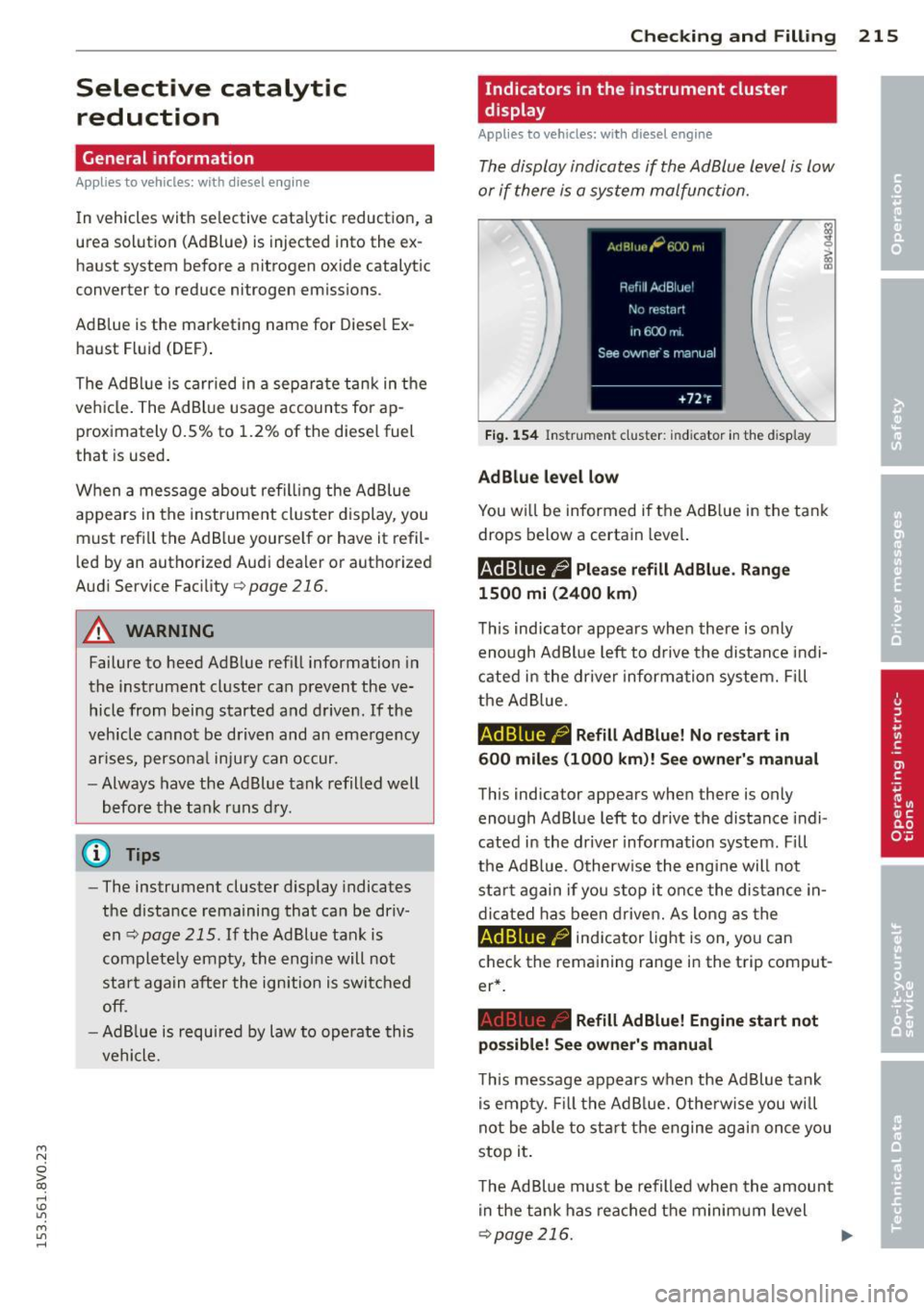
Th e display indicates if th e Ad Blue lev el is low
or if there is a system malfunction.
Fi g. 1 54 Ins trum ent cluster : indicator in the display
AdBlue level low
You w ill be informed if t he AdBlue in the ta nk
drops below a certain leve l.
Ad Blue /9 Please refill Ad B lu e. Range
1500 mi (2400 km)
T his ind icator appea rs whe n there is only
eno ugh Ad Bl ue left to d rive the distance i ndi
cated in the driver information system. F ill
the Ad Blue .
AdBlue /9 Refill AdBlue! No re start in
600 mile s (1000 km )! See owner' s manual
This indicator appears when there is only
enough AdBlue left to drive the distance indi
cated in the dr iver information syst em. F ill
the Ad Blue. Otherwise the eng ine will not
star t again if you s top it o nce the dis tance in
dicated has been drive n. As long as the
AdBlue /9 ind icator light is on, yo u can
check the remaining range in the trip comput
er* .
Refill AdBlue! Engine start not
po ssible! See owner' s manual
This message appears w hen the Ad Blue tank
i s emp ty. Fill the AdB lue. Othe rw ise you w ill
not be able to sta rt the engine ag ain on ce you
stop it .
T he Ad Blu e mu st be refilled when the amount
i n the tank has rea ched t he minim um level
Q poge 216.
Page 219 of 310
M N
0 > co ,...., \!) 1.1"1
M 1.1"1 ,....,
~ If there was no Ad Blue left in the tank and a
range of
O mi (0 km) was displayed in the
instrument cluster, switch the ignition on
for about 15 seconds before starting the en gine.
_& WARNING
Ad Blue can irritate the skin, eyes and respiratory system. If there is contact with
the fluid, flush immediately with plenty of
water. Consult a physician if necessary.
(D Note
- Only use Ad Blue that conforms to the standard ISO 22241-1. Do not mix any
additives with the Ad Blue and do not dilute it with water .
- Do not add Ad Blue to the diesel tank or
add diesel fuel to the Ad Blue tank. Mix
ing can lead to damage to the engine
and the Ad Blue tank system. Warranty
does not cover damage caused by this.
- AdBlue attacks surfaces such as painted
vehicle components, plastic and carpet.
Remove the fluid as quickly as possible
with a damp cloth and plenty of cold wa
ter. If the Ad Blue has already crystal lized, use warm water and a sponge .
AdBlue residue that is not removed will
crystallize and can damage the affected
surface .
- Do not store the refill bottle in the vehi cle. If it leaks, the escaping Ad Blue could
damage the vehicle interior.
- Do not allow AdBlue to come into con
tact with clothing . If there is contact
with the fluid, flush immediately with
plenty of water.
@ Tips
- You can obtain refill bottles from an au
thorized Audi dealer or authorized Audi
Service Facility.
- Follow the AdBlue manufacturer's in
structions for use and storage.
Checking and Filling 217
Hood
Working in the engine compartment
Special care is required if you are working in
the engine compartment
For work in the engine compartment such as
checking and filling fluids, there is a risk of
injury, scalding, accidents, and burns. For
this reason, follow all the following listed
warnings and general safety precautions.
The engine compartment is a dangerous
area.
c::> .&. .
_8 WARNING
To reduce the risk of injuries, complete the
following steps before opening the hood:
- Turn the engine off.
- Switch the ignition off.
- Set the parking brake.
- Place the selector lever in the P position.
- Let the engine cool down.
- Never open the hood when you see that
steam or coolant drips from the engine
compartment- there is a danger of burns! Wait until no steam or coolant
flows out .
- Keep children away from the engine com
partment.
- Never spill fluids on a hot engine . These
fluids (such as the freeze protection con
tained in the coolant) can catch fire .
- Avoid short circuits in the electrical sys
tem, especially the battery .
- When working in the engine compart
ment, remember that the radiator fan
can switch on even if the ignition is
switched off, which increases the risk of
personal injury.
- Never open the cap on the coolant ex
pansion tank when the engine is warm.
The cooling system is under pressure.
- To protect your face, hands, and arms
from hot steam or coolant, cover the cap
with a large cloth when opening.
II>-
•
•
•
Page 220 of 310
218 Check ing and F illin g
- Do not remove the engine cover under
any circumstances. Th is increases the
risk of burns.
- If tests need to be performed with the
engine running, there is additional dan
ger due to moving components (such as
the ribbed belt, generator and radiator
fan) and from the high voltage ign ition
system .
- Never reach into the rad iator fan . The
electric auxiliary fan is controlled by
tempe ratu re and can sw itch on suddenly.
- Pay attention to the following warn ings
listed wh en work on the fue l system or
on the electrical equipment is required.
- Always disconnect the vehicle battery
from the vehicle electrical system
- Do not smoke
- Never work near open flames
- Always have a working fire extinguisher
nearby
- To reduce the r isk of electric sho ck a nd
injury, never touch the following compo
nents when the engine is running or is
being started:
- Ignition cable
- Other components in the electronic
h igh voltage ignition system
- If you must check or perform work on
the engine while it is running:
- Set the parking brake and place these
lector lever in the P (park) posit ion
first.
- Always proceed with ext reme caut ion
so that clothing, jewelry or long hair do not become ca ugh t in the radiator fan,
fan belt o r other moving components
or do not come into contact with hot
components . Tie back long hair before
beginning work and do not wear cloth
ing that can hang down into the en
g ine.
- Limit your exposure to exhaust and
chemica ls to as short a time as poss ible
~ .&. -
A WARNING
Ca lifornia Proposition 6S Warning:
- Engine exhaust, some of its constituents,
and certain vehicle components contain
or emit chemicals known to the State of
California to cause cancer and birth de
fects and reproductive harm. In addition,
certa in flu ids contained i n veh icles and
certain products o f componen t wear con
tain or emit chemic als known to t he
State of California to ca use cancer and
birth defects or other reproductive ha rm .
- Battery posts, terminals and related ac
cessories contain lead and lead com
pounds, chemicals known to the State of
California to cause cancer and reproduc
tive harms. Wash hands after handling.
(D Note
When filling fluids, be sure not to mix the
fl ui ds up . Otherwise severe ma lf u nctions
and engine damage w ill occur.
@ For the sake of the environment
You sho uld reg ularly chec k the ground un
der your vehicle in order to detect leaks
quick ly. If there are visib le spots from oil
or other fluids, br ing your vehicle to an au
thorized Audi dealer or qua lified repair fa
cility to be checked .
Page 221 of 310
....,
N
0 > co
rl I.O
"' ....,
"' rl
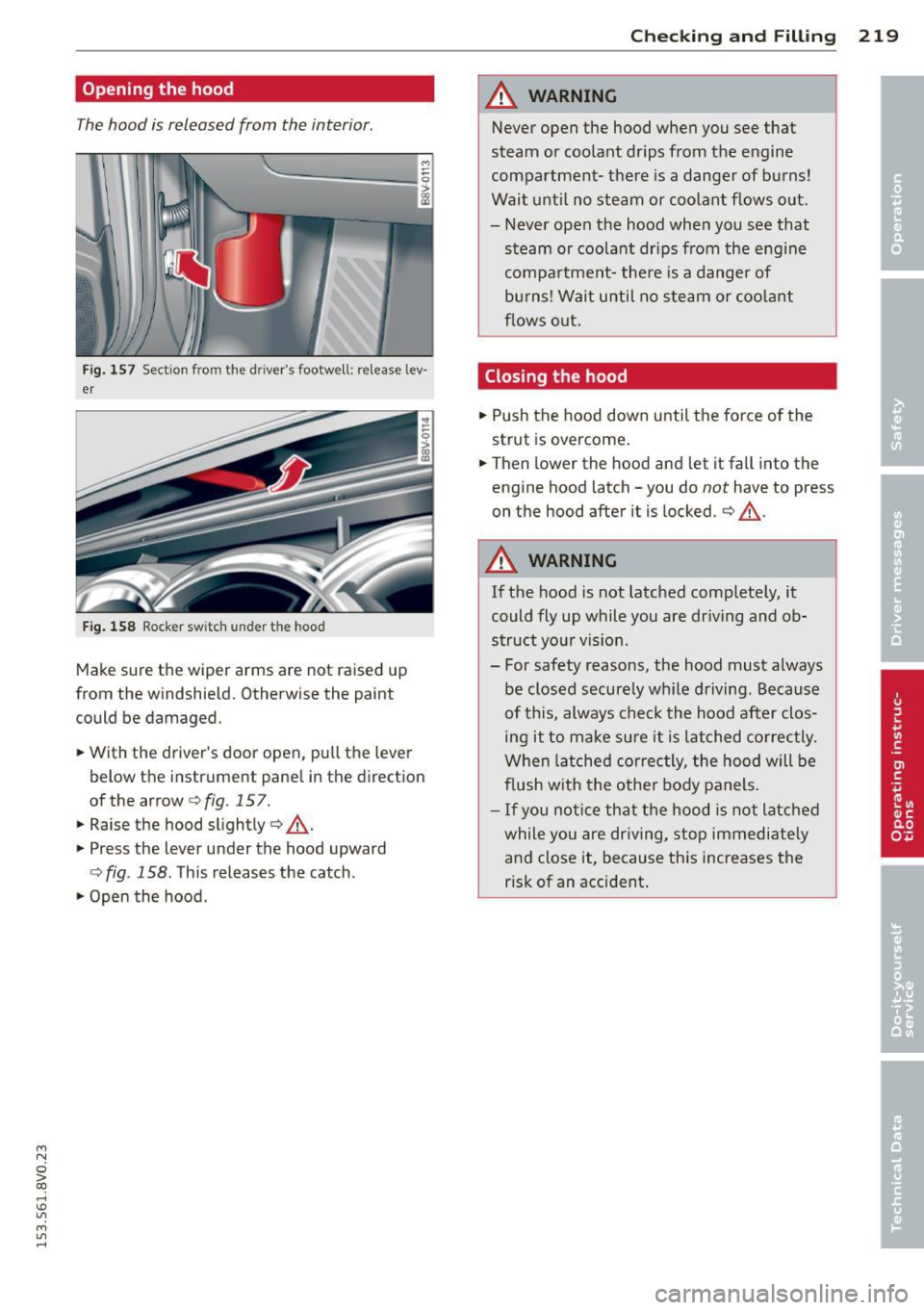
Opening the hood
The hood is released from the interior.
Fig. 157 Sect ion from the driver's footwe ll: release lev·
er
F ig. 158 Rocker switch un de r the hood
Make sure the wiper arms are not raised up
from the windshield. Otherwise the paint
could be damaged.
• With the driver's door open, pu ll the lever
below the instrument pane l in the direction
of the arrow
¢ fig. 157.
• Raise the hood slightly c;, &_ .
• Press the lever under the hood upward
c;, fig . 158. This releases the catch .
• Open the hood .
Che cking and Fillin g 219
A WARNING
Never open the hood when you see that
steam or coo lant drips from t he e ngine
compartment· there is a danger of burns!
Wait unti l no steam or coolant flows o ut.
- Never open the hood when you see that
steam or coo lant dr ips from the engine
compa rtment- the re is a dange r of
bu rns! Wai t until no ste am or coo lan t
flows o ut.
Closing the hood
• Push the hood down unti l the fo rce of the
strut is overcome .
• Then lower the hood and let it fall into the
engine hood latch -you do
not have to press
on the hood after it is locked.
c;, &_ .
A WARNING
If the hood is not latched complete ly, it
could fly up while you are dr iv ing and ob
struct you r vis io n.
- For safety reasons, the hood must always
be closed secure ly wh ile d riving. Because
of this, always check the hood after clos
ing it to make sure it is lat ched co rrectly.
When latched correc tly, the hood will be
f lush w ith the othe r body panels .
-If you no tic e th at t he hood is not latched
while you are dr iving, stop immedi ately
and close it, because this increases the
ris k of an accident .
Page 222 of 310
220 Checking and Filling
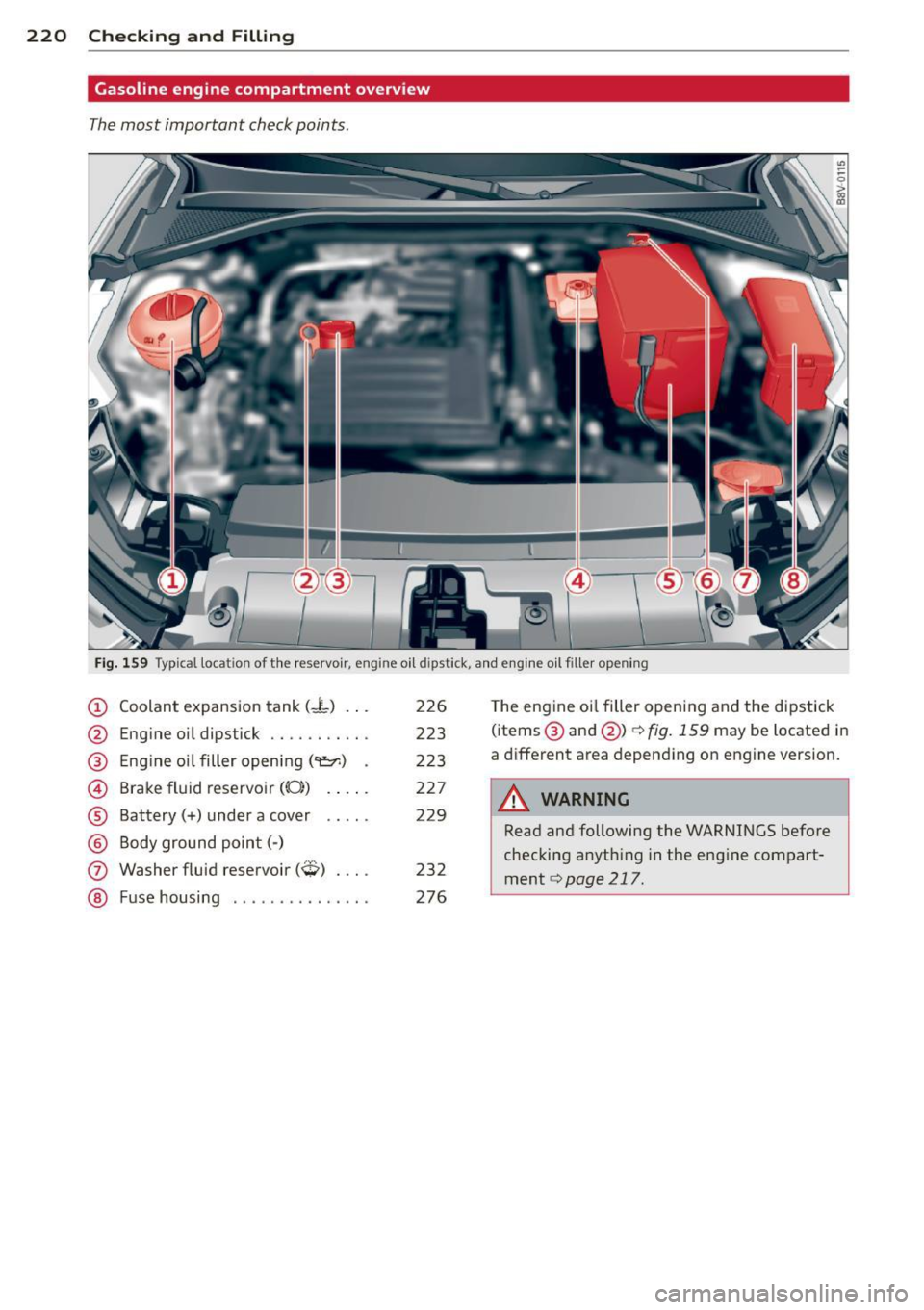
Gasoline engine compartment overview
The most important check points.
Fig. 159 Typical locat ion of th e reservo ir, engine oi l d ipstick, and engine oil filler opening
CD Coolant expansion tank ( ... L) ... 226 The eng ine oi l filler opening and the d ipstick
@ Engine oil dipstick
...........
223 (items® and @)¢ fig. 159 may be located in
® E
ngine oi l filler open ing
('t=r.) 223 a different area depending on engine version.
© Brake fluid reservoir ((0) .. .. . 227 A WARNING
® Battery(+) under a cover 229 .. ... -
® Body ground point(-) Read
and following the WARNINGS before
checking anyth ing in the eng ine com part-
(j) Washer fluid reservoir(<$) . ... 232 ment ¢ page 217.
® Fuse housing ............. .. 276