check oil AUDI S3 2015 User Guide
[x] Cancel search | Manufacturer: AUDI, Model Year: 2015, Model line: S3, Model: AUDI S3 2015Pages: 310, PDF Size: 76.15 MB
Page 225 of 310
....,
N
0 > co
rl I.O
"' ....,
"' rl
@ Tips
- The oil pre ssure wa rning display. i s
not an indicator of the o il level. Do not
rely on it. Instead , chec k the oil le vel in
your engine at regular inter vals, pref
era bly each t ime you r efuel , and always
before going on a long trip .
-If you have the impression your engine
consumes excessive amounts of oi l, we
r ecommend that you consult an author
iz ed Audi dealer to have the cause of
you r concern properly di ag nose d. Keep in
mind tha t the ac curate measuremen t of
oi l consumption requires great care and
may take some time. An authorized Audi
dealer has instructions about how to measure oil consumption accurately.
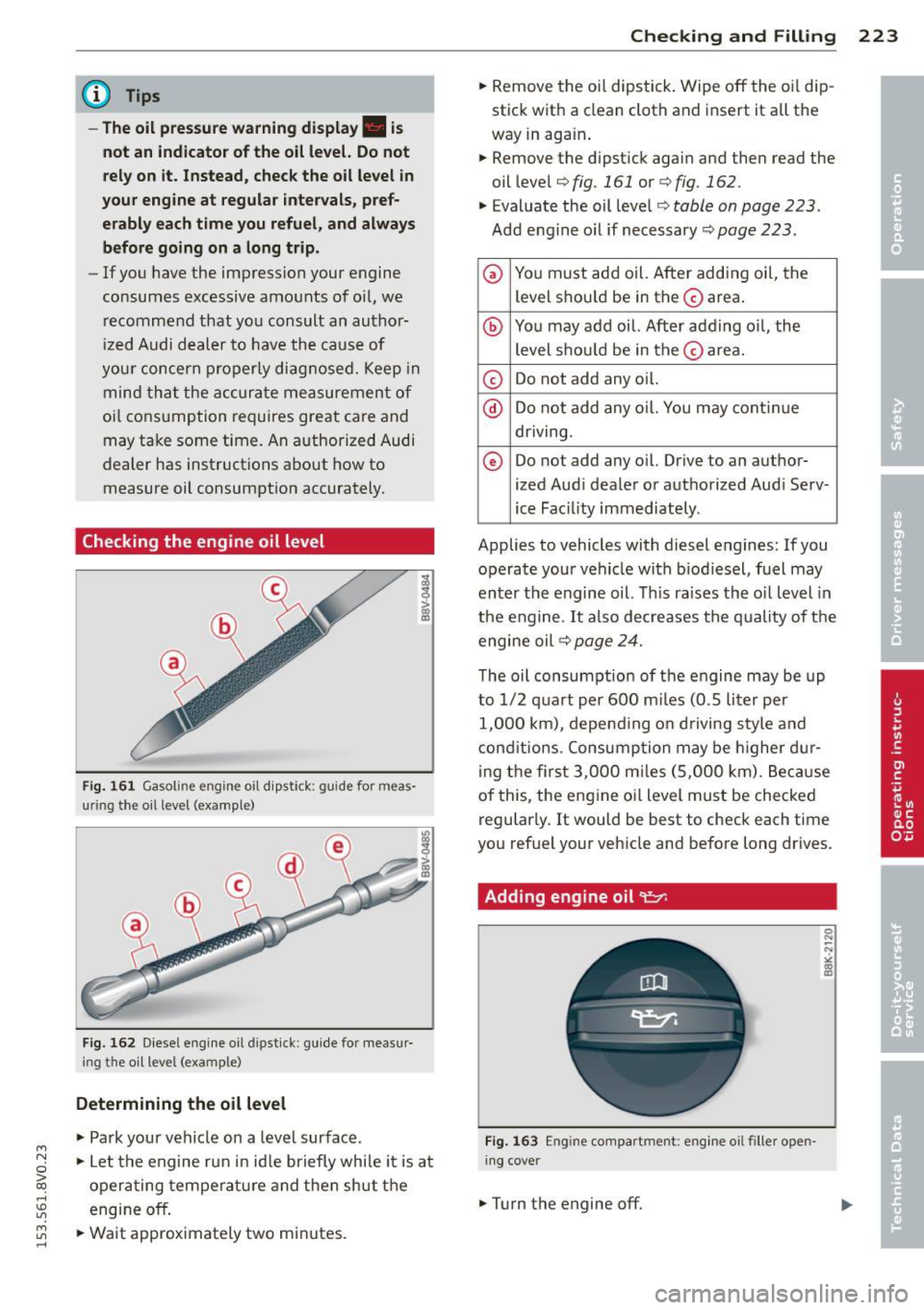
Checking the engin e oil lev el
Fi g. 1 61 Ga so line e ngine oil d ip sti ck: guide for meas
urin g the oil level (ex ample)
F ig . 162 Diese l e ngine oil dipstick : guide for m easur
i ng the o il leve l (exa mple)
Determining the oil level
• Pa rk your vehicle on a level surface .
• Let the engine run in id le briefly while it is a t
opera ting temperat ure and then shut the
engi ne off .
• Wa it approximately two mi nutes .
Che cking and Fillin g 223
• Remove the oi l dipstick . Wipe off the oi l dip
stick with a clean cloth and insert it all the
way in aga in .
• Remove the dipstick again and then read the
oil level ¢
fig. 161 or¢ fig. 162 .
• Evaluate the oil level¢ table on page 223 .
Add e ngine o il if necessary ¢ page 223.
0 You must add o il. After add ing oil, the
level shou ld be in the @ area .
® You may add oil. After adding o il, the
level s hou ld be in the@area.
@ Do not add any o
il.
@ Do not add any o il. You may cont inue
driving .
0 Do not add any o il. Drive to an author-
ized Aud i dealer or authorized Aud i Serv -
ice Fac ility immediately .
Applies to vehicles with diesel engines: If you
operate your vehicle with b iod iesel, fuel may
enter the engine oil. T his ra ises the o il level in
the engine.
It also decreases the quality of t he
engine oil¢
page 24.
The oil consumptio n of the engine may be up
to 1/2 q uart per 600 m iles (0.5 liter per
1,000 km), depend ing on d riving style and
cond it io ns. Consump tion may be higher du r
ing the first 3,000 m iles (5,000 km) . Be ca u se
of this, the eng ine oi l level must be checked
regular ly . It would be best to check each time
you ref uel your vehicle and before long dr ives.
Adding engine oil~
Fig . 1 63 En gin e co mpar tment: e ng in e o il fi ller ope n
ing cover
• Turn the engine off.
0 N
~ a, a,
Page 226 of 310
224 Check ing and F illin g
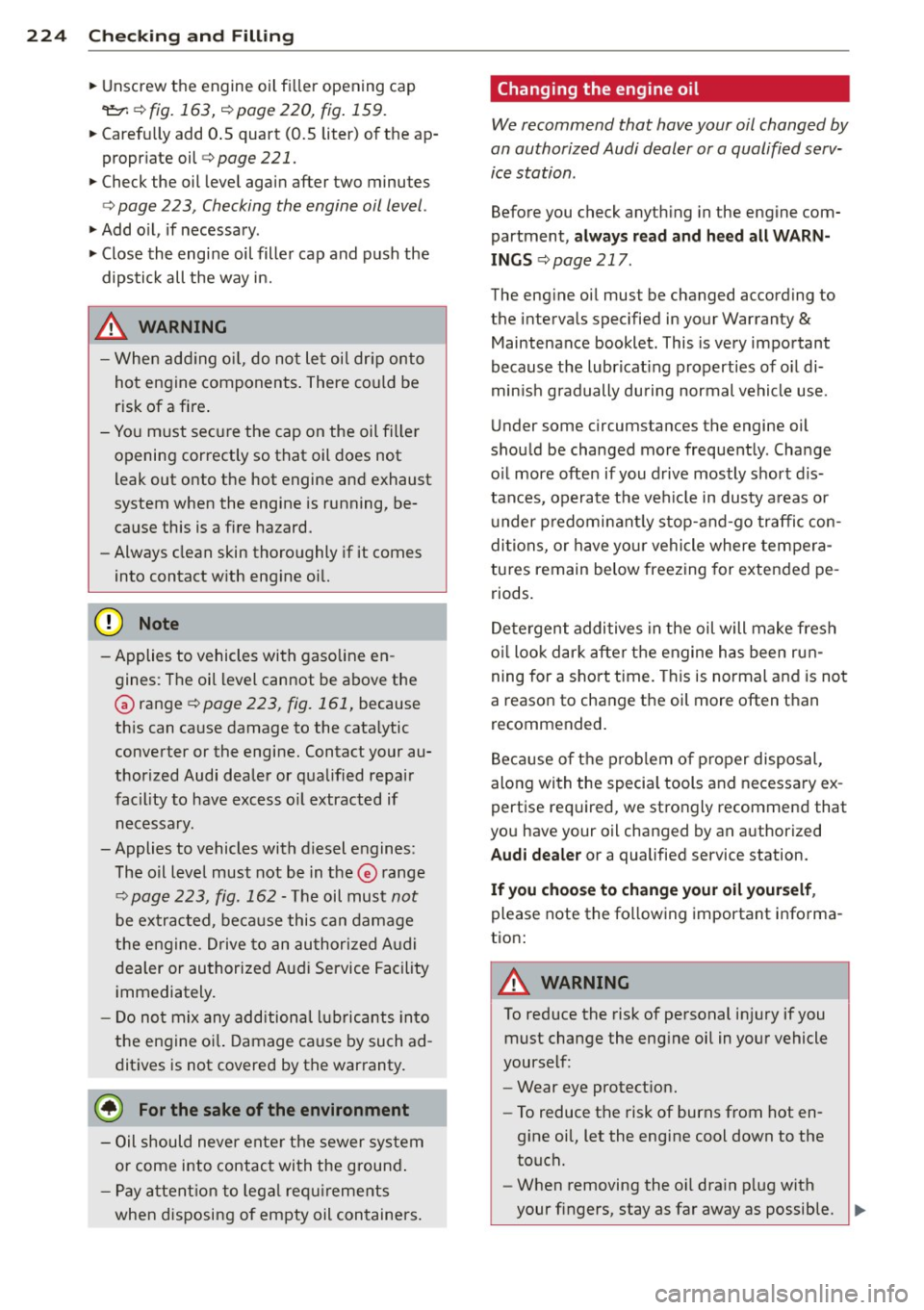
• Unscrew the engine oil fi ller opening cap
~ ¢ fig. 163, ¢page 220, fig . 159.
• Carefu lly add 0 .5 quart (0.5 liter) of the ap
propr iate oil¢
page 221.
• Check the oil level again after two minutes
¢ page 223, Checking the engine oil level.
• Add o il, if necessary .
• Close the engine oil filler cap and push the
dipstick all the way in.
.&_ WARNING
- When add ing o il, do not le t oi l dr ip onto
hot engine components . There could be
risk of a fire .
- You must sec ure the cap on the oil filler
opening correctly so that oil does not
leak out onto the hot engine and exhaust
system when the engine is running, be
cause this is a fire hazard.
- Always clean skin thoroughly if it comes
into contact w ith eng ine oil.
([) Note
- Applies to vehicles with gasoline en
gines: The oil level cannot be above the
(!) range¢
page 223, fig. 161, because
th is can ca use damage to the cata lytic
converter or the engine. Contact your au
thorized Audi dealer or qua lified repair
facil ity to have excess o il extracted if
necessary.
-Applies to vehicles with diesel engines: The oil level must not be in the
0 range
¢
page 223, fig. 162 -The oil must not
be extracted, because this can damage
the engine. Drive to an au thorized A udi
dealer or authorized A udi Service Facility
immediately.
- Do not mix any additiona l lubricants into
the engine o il. Damage cause by such ad
ditives is not covered by the war ranty.
@) For the sake of the environment
- Oil should never enter the sewer system
or come into contact with the ground .
- Pay a tte ntion to leg al req uirements
when disposing of empty oil containers .
Changing the engine oil
We recommend that have your oil changed by
an authorized Audi dealer or a qualified serv
ice station.
Before you check anyth ing in the engine com
partment,
always read and h eed all WARN
INGS
¢ page 217.
The engine oil must be changed according to
the interva ls specified in your Warranty
&
Maintenance booklet . This is very important
because the lubricat ing propert ies of o il di
min ish g radually du ring normal vehicle use.
Under some circumstances the engine oil
should be changed more frequently. Change o il more often if you drive mostly short d is
tances, operate the ve hicle in dusty a reas or
under p redo min ant ly stop-and-go traffic con
di tions, or have yo ur vehicle where tempera
tures remain below freezing for extended pe
riods .
De te rgent additives in the oil will make fresh
o il look dark after the engine has been run
ning for a sho rt time. This is normal and is not
a reason to change the oil more often than
recommended.
Beca use of the p roblem of proper disposal,
along wi th the specia l tools and necessary ex
pertise req uired, we st rongly recommend that
you have your oil changed by an a uthorized
Audi deale r or a qualified service station.
If you choo se to chan ge your oil your self ,
please note the fo llowing important informa
tion:
.&_ WARNING
To reduce the risk of personal in jury if you
must change the eng ine oil in your vehicle
yourself:
- Wear eye protect ion.
- To reduce the risk of burns from hot en-
g ine oi l, let the engine cool down to the
touch.
- When removing the o il drain p lug with
your fingers, stay as far away as possible. ..,
Page 227 of 310
M N
0 > co ,...., \!) 1.1"1
M 1.1"1 ,....,
Always keep your forearm parallel to the
ground to help prevent hot oil from run
ning down your arm.
- Drain the oi l into a conta iner designed
for this p urpose, one large eno ugh to
hold at least the total amount of oil in
your engi ne.
- Engine oil is poisono us. Keep it well out
of the reach of c hildren .
- Cont inuo us contact with used engine oil
is harmful to your skin. Always protect
you r sk in by washing oil off thoroug hly
with soap and water .
(D Note
Never mix oil addit ives with your engine
oil. These additives can damage your en
gine and adversely affect y our Aud i Limit
ed New Vehicle Wa rra nty .
@ For the sake of the environment
- Before changing your oi l, f irst make sure
you know whe re you can proper ly dispose
of the used o il.
- Always d ispose of used engine oil proper
l y. Do not dum p it o n ga rden so il, wood
ed a reas, into open streams or down
sewage dra ins.
- Recycle used engine o il by taking it to a
u se d engine oil collection facility in your
a rea, or contact a servi ce station .
Cooling system
Coolant
The engine coolant performs two functions: it
keeps the engine from overheating and it pro
tects the engine from freezing in the winter.
The cooling system is sea led an d generally re
q uir es little attention.
The cooling system has been filled at the f ac
tory with a pe rm anen t coo lan t which does no t
n eed to be changed. The coolant consists of a
mixture of specia lly conditioned water and the
manufacturer's glyco l-based coo lant add i-
tive Gl3 antifree ze with ant icorros ion addi-
Checking and Fillin g 225
tives (50% for USA mode ls; 60% fo r Canadian
models) . This mixture both ass ures the neces
sary frost protection and protects metal com
ponents in the eng ine's cooling system from
corros io n and scaling. It also raises the bo il
ing point of the coolant .
Do not reduce the concentration of the cool
ant in the s ummer by adding p lain water.
The
proportion of coolant additive must be at
least 50°/o but not more than 60 %
to main
ta in antifreeze protect io n and cool ing eff ic ien
cy . If the coo lant frost p rotection is too low ,
t he coo lan t could freeze and damage the vehi
cl e heating and engine cooling sys tem.
Fo r year- round drivi ng, a ntifreeze is added at
the factory fo r temperatures down to:
- -31 °F
< -3s0c) u sA
- -40°F ( - 40°C) Canada.
If you must ad d coo lant, use a mixture o f wa
te r and coolant additive. Mixing the coo lant
additive with dist illed water is recommended.
A WARNING
Before you chec k anything in the engine
compartment, always read and heed all
WARNI NGS
c:> page 217.
-
(D Note
- Before winter sets in, have the coo lant
checked to see if the coolant additive in
your vehicle is sufficient to meet the cli mate condit ions. This is especially impor
t ant if you l ive i n a region where the win-
t er is extremely cold. If necessary, in-
c rea se t he p ropo rtion of coo lant add itive
t o 6 0% .
- Whe n ad d ing coolant addi tiv e to yo ur
c ooling sys te m , reme mbe r:
- We recommend using on ly coo lant ad
d itive Gl2 ++ or Gl3 (check the labe l)
for your vehicle. This coolant additive is ava ila ble at autho rized Aud i dea le rs .
Othe r ty pes of antifreeze ca n sig nifi
cantly reduce cor ros io n protec tion . The
r esu lting co rrosion can cause a lo ss of
c o o lant a nd serio us e ng ine da mage.
IJI,,
•
•
•
Page 228 of 310
226 Checking and Fill in g
- Do not add any type of radiator leak sea l
ant to your ve hicle's engine coolant.
Adding rad iator repair fluid may adverse
ly affect the function and performance of
your cooling system and could result in damage not covered by your New Vehicle
Limited Warranty.
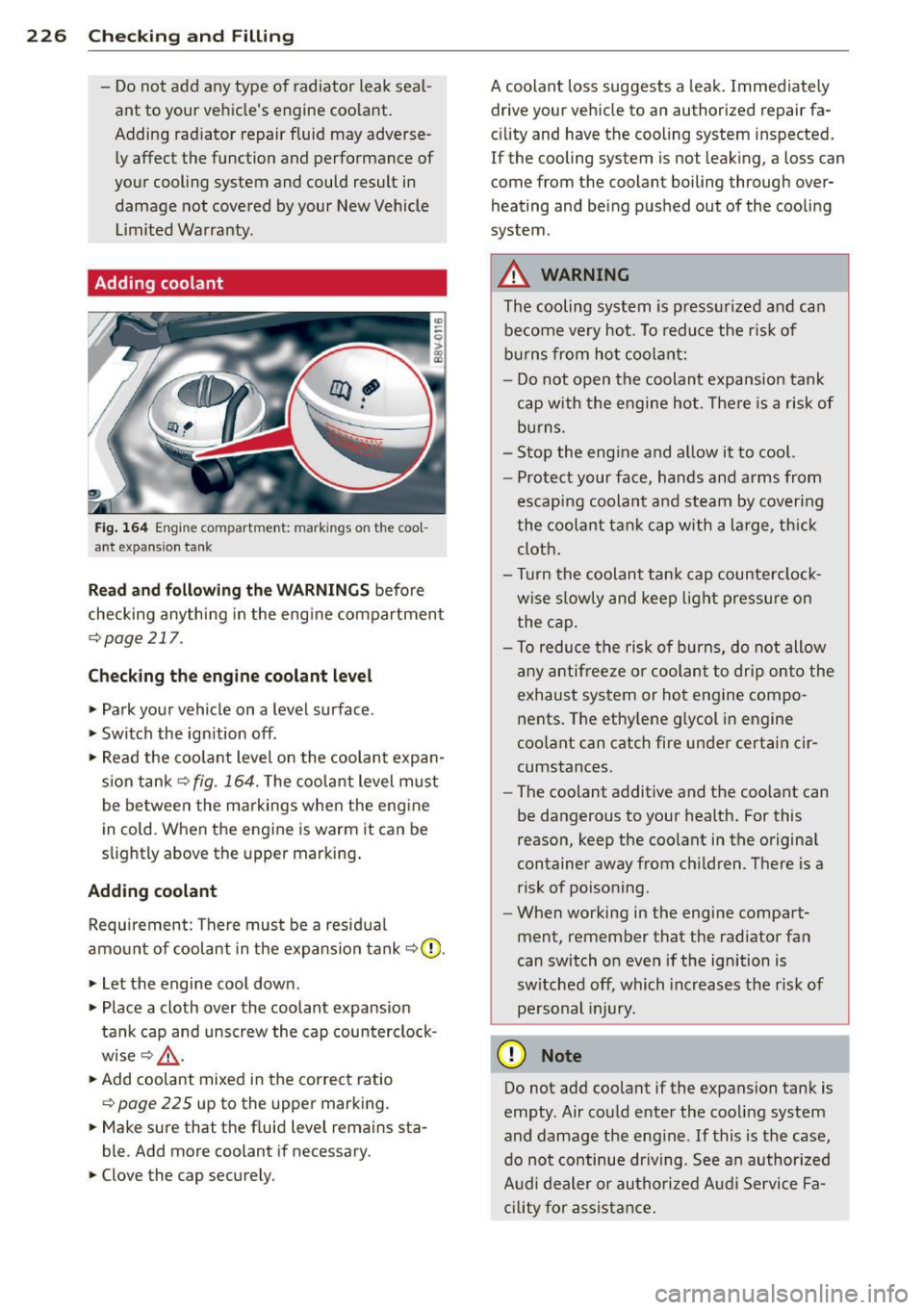
Adding coolant
Fig . 164 Engine co mpa rtment: mark in gs on the coo l
ant expans ion tank
R ea d a nd f ollow ing th e W ARNING S before
checking anything in the eng ine compartment
¢ page 217.
Ch eck ing t he e ngi ne coolant level
"Park your vehicle on a level surface .
.. Switch the ign ition off .
" Read the coo lant level on the coolant expan
s ion tank ¢
fig. 164. The coo lant level must
be between the markings when the eng ine
in cold. When the engine is warm it can be
sl ightly above the upper marking .
Adding coolan t
Requirement : There must be a residual
amount of coolant in the expansion tank ¢(D .
.. Let the engine cool down.
" Place a cloth over the coolant expansion
tank cap and unscrew the cap counterclock
wise ¢&_ .
.. Add coolant mixed in the correct ratio
¢ page 225 up to the upper marking.
.. Make sure that the fluid level remains sta
ble. Add more coolant if necessary.
" Clove the cap securely. A coolant loss suggests a
leak. Immediately
drive your vehicle to an authorized repair fa
c ility and have the cooling system inspected.
If the cooling system is not leaking, a loss can
come from the coolant boiling through over
heating and being pushed out of the cooling
system.
A WARNING
The cooling system is press urized and can
become very hot. To reduce the r isk of
b urns from hot coolant:
- Do not open the coolant expansion tank
cap with the engine ho t. T here is a risk of
burns.
- Stop the eng ine and a llow it to cool.
- Protect your face, hands and arms from
escaping coolant and steam by covering
the coolant tan k cap with a large, th ick
cloth.
- Turn the coolan t tank cap counterclock
wise slowly and keep light pressure on
the cap .
- To reduce the risk of burns, do not allow
any antifreeze or coolant to drip onto the
exhaust system or hot engine compo
nents. The ethy lene g lycol in engine
coo lant can catch fire under certain cir
cumstances.
- The coolant additive and the coolant can
be dangerous to your health . For this
reason, keep the coo lant in the origina l
container away from ch ildren . There is a
risk of poisoning.
- When working in the engine compart
ment, remember that the rad iator fan
can switch on even if the ignition is
sw itched off, which increases the risk of
pe rsonal injury.
(D Note
Do not add coolant if the expansion tank is
empty . Air could enter the cooling system
and damage the eng ine .
If this is the case,
do no t continue dr iving. See a n author ized
A udi dealer or authori zed Aud i Service Fa
cility for assist ance.
Page 229 of 310
....,
N
0 > co
rl I.O
"' ....,
"' rl
Radiator fan
The radiator fan switches on automatically by
itself
An auxiliary electric radiator fan switches on
and off depending on coolan t temperature
and other vehicle operating conditions .
After you switch the engine off, the auxiliary
fan can continue running for up to 10 minutes
- even with the ignition off. It can even switch
on again later by itself<=>.& , if
- the temperature of the engine coolant rises
due to the heat build-up from the engine in
the engine compartment, or
- the engine compartment heats up because
the vehicle is parked in intense sunlight.
A WARNING
-To reduce the risk of personal injury nev
er touch the radiator fan.
- The auxiliary electric fan is temperature
controlled and can switch on suddenly
even when the engine is not running.
- The auxiliary radiator fan switches on au
tomatically when the engine coolant
reaches a certain temperature and will
continue to run until the coolant temper
ature drops.
Brake fluid
Checking brake fluid level
N
N
N
>< ~
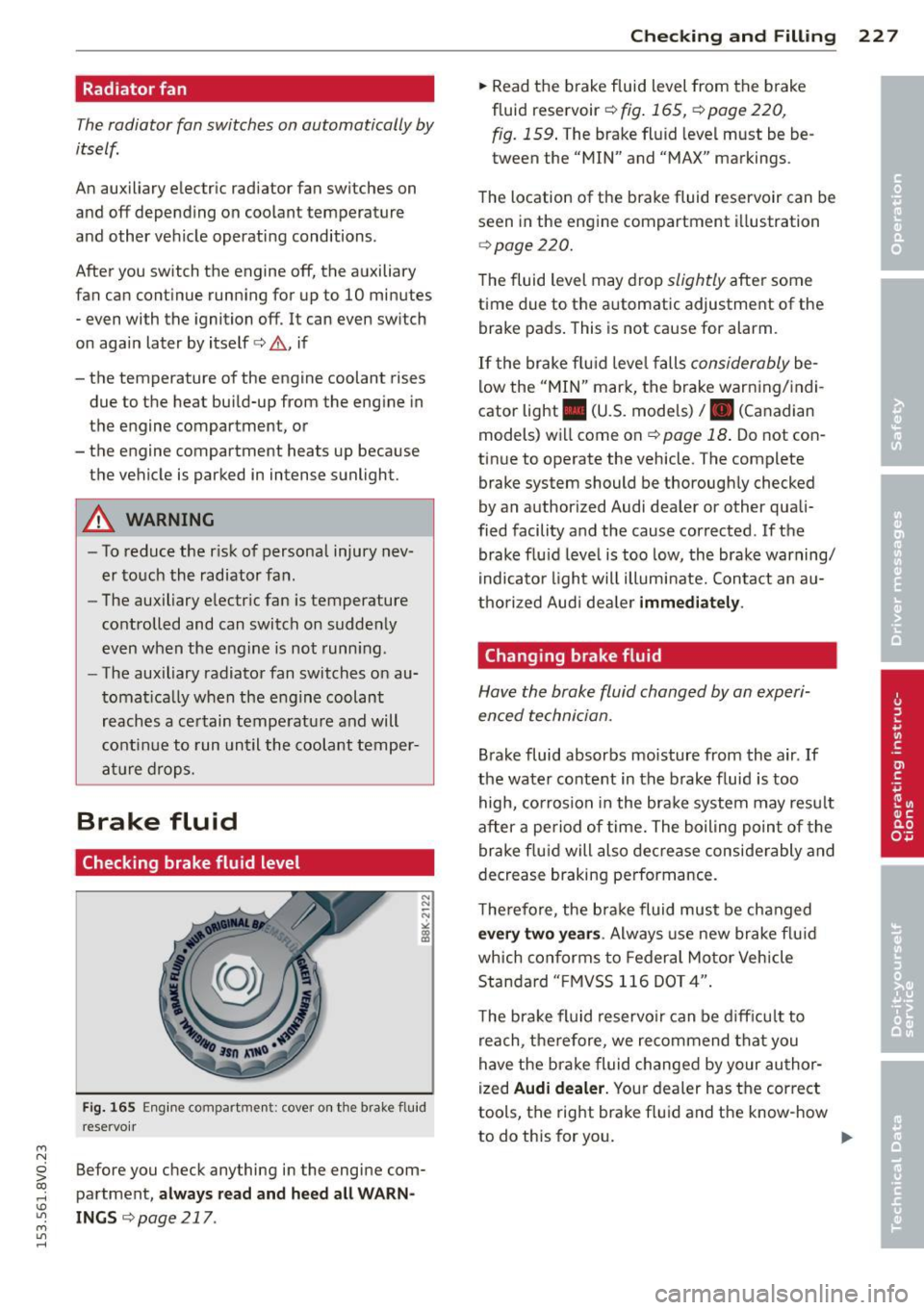
Fig. 165 Engine compa rtment: cove r on the brake fluid
rese rvoir
Before you check anything in the engine com
partment,
always read and heed all WARN
INGS r::;, page 217 .
Checking and Filling 22 7
.. Read the brake fluid level from the brake
fluid reservoir <=>
fig. 165, <=> page 220,
fig. 159.
T he brake fluid level must be be
tween the "MIN" and "MAX" markings.
The location of the brake fluid reservoir can be seen in the engine compartment illustration
<=>page 220.
The fluid level may drop slightly after some
time due to the automatic adjustment of the
brake pads. This is not cause for alarm.
If the brake fluid level falls considerably be
low the "MIN" mark, the brake warning/indi
cator light . (U.S. models)
I. (Canadian
models) will come on
c:> page 18 . Do not con
tinue to operate the vehicle. The complete
brake system should be thoroughly checked
by an authorized Audi dealer or other quali
fied facility and the cause corrected . If the
brake fluid level is too low, the brake warning/
indicator light will illuminate. Contact an au
thorized Audi dealer
immediately.
Changing brake fluid
Have the brake fluid changed by an experi
enced technician.
Brake fluid absorbs moisture from the air . If
the water content in the brake fluid is too
high, corrosion in the brake system may result
after a period of time. The boiling point of the
brake fluid will also decrease considerably and
decrease braking performance.
Therefore, the brake fluid must be changed
every two years . Always use new brake fluid
which conforms to Federal Motor Vehicle
Standard "FMVSS 116 DOT 4".
The brake fluid reservoir can be difficult to
reach, therefore, we recommend that you
have the brake fluid changed by your author
ized
Audi dealer. Your dealer has the correct
tools, the right brake fluid and the know-how
to do this for you.
II>-
Page 255 of 310
-The longer one tire is used in one location on the vehicle,
the more it wears at certain points; therefore, we recom
mend that you follow the tire
manufacturer's suggested tire
rotation intervals.
-Vehicles with front-wheel drive experience more tread
wear on the front wheels com pared to all-wheel drive (quat
tro).
-Please rotate tires as shown
¢ fig. 171.
-Extra care must be taken when
rotating direction-specific
tires
Q page 2 74.
Wheel balancing
The wheels on new vehicles are balanced. However, various sit
uations during everyday driving
can cause them to become un
balanced, resulting in vibra
tions you can usually feel
through the steering wheel.
Unbalanced wheels must be re
balanced to avoid excessive
wear on steering, suspension
and tires. A wheel must also be
rebalanced when a new tire is
M N
~ installed. co ,...., \!) 1.1"1
M 1.1"1 ,....,
Tires and wheels 253
Incorrect wheel alignment
Incorrect wheel alignment can
cause excessive tire wear, impairing the safety of the vehi
cle. If tires show excessive
wear, have the wheel alignment checked by an authorized Audi
dealer or qualified workshop.
All-wheel drive
Vehicles with quattro must al
ways have tires of the same size, construction and tread
type. For details see
¢ page 193 .
.8, WARNING
Sudden tire failure can lead
to loss of control, a crash and serious personal injury!
-Never drive a vehicle when the tread on any tire is worn down to the wear indica
tors.
-Worn tires are a safety haz ard, they do not grip well on
wet roads and increase your risk of "hydroplaning" and
loss of control.
-Always keep chemicals that can cause tire damage, such
-
as grease, oil, gasoline and
brake fluid away from tires.
~
' •
•
' •
Page 265 of 310
M N
0 > co ,...., \!) 1.1'1
M 1.1'1 ,....,
In certain circumstances, you may not use
wheel bo lts from a different vehicle -
even if it
i s the same mode l
Q page 291.
A WARNING
Improperly tightened or maintained wheel
bolts can become loose caus ing loss of
control, a collision and ser ious personal in
jury .
- Always keep the wheel bolts and the
threads in the wheel hubs clean so the
wheel bolts can turn easily and be prop
erly t ightened.
- Never grease or oil the wheel bolts and
the threads in the wheel hubs. They can
become loose w hile d riving if greased or
o iled,
even if tightened to the spec ified
torq ue.
- Only use wheel bo lts that belong to the
rim being ins talled.
- Never use different whee ls bolts on your
vehicle .
- Always maintain the correct tightening
torque fo r the wheel bolts to reduce the
risk of a wheel loss. If the tigh teni ng tor
que of the wheel bolts is too low, they
can loosen and come out when the vehi
cle is moving . If the tightening torque is
too high, the whee l bolts and threads
can be damaged and the wheel ca n be
come loose .
(D Note
The specified torque for the wheel bo lts is
90 ft lb (120 Nm) w ith a tolerance of
± 7,4 ft lb(± 10 Nm). Torque whee l bolts
diagonally. After changing a wheel, the
torque must be checked as soon as possi
b le with a torque wrench -prefe rably by an
author ized Audi dealer or qualified wo rk
shop.
Low aspect ratio tires
Your Audi is factory-equipped with low aspect
ratio tires . These tires have been thorough ly
tested and been selected spec ifically for your
model for the ir superb performance, road feel
Tire s an d wheel s 263
and handling under a variety o f driving condi
tions. Ask your authorized A udi dealer for
more details .
T he low aspec t ratio of these tires is ind icate d
by a numera l of
55 or le ss in the tire's size
designation. The numera l represents the ratio
of the t ire's sidewa ll height in relation to its
tread width expressed in percentage.
Conven
tiona l tires have a he ight/w idth rat io of 60 or
more .
The performance of low-a spect-ratio tire s is
particularl y sens it iv e to improper inflation
pressure. It is therefore important that low
a spect ratio tir es are inflated to the specified
pre ssure and that the inflation pr essure i s
regularly checked and ma intain ed . Tire pr es
s ure s should be checked at lea st on ce a
month and alway s bef ore a long trip
~ page 245 , Checking tire pressure .
A Word about Low Aspect Ratio and High
Performance Ti res
Hig h pe rformance tires are des igned for bet
ter performance and handling in warm cli
mates. When driving in cold, snowy or icy
weather, you sho uld equ ip your vehicle w it h
four all-season or winter tires, which
offer
better traction under those condit ions. We
suggest you use the Audi recommended win
te r or a ll-season tires specified for you r Audi.
High performance tires a lso have a lower as
pect ratio that aids performance and han
dling . Driving over rough or damaged road
surfaces, as well as debr is, cu rbs and other
obstacles can cause serious damage to
whee ls, tires, vehicle body, and suspens ion
parts . B e carefu l to avo id road hazards and re
du ce your speed , espec ia lly if your vehicle is
equipped wi th low prof ile tires .
Please a lso remember when making your se
lection that, wh ile these tires deliver respon
s ive handling, t hey m ay ride less comfo rtably
and make more noise than o thers . Finally,
these tires may wear more quickly than other
c h oices.
IJJ>
•
•
•
Page 287 of 310
M N
0 > co ,...., \!) ..,.,
M ..,., ,....,
fall fro m a lift if the re is a c hange in ve
h icle we ight d istr ibut ion a nd ba lance.
This might happen, for e xamp le, w hen
heavy compone nts such as the engi ne
b lock or transmiss io n are removed .
- Whe n remov ing heavy components li ke
t hese, ancho r vehicl e to hoist o r add cor
r es pond ing w eig hts to mai ntain the cen
t e r of g ravity . Othe rwise, the v ehicl e
m ight til t or slip off th e hois t, causi ng
serious person al inju ry.
(D Note
- Be awa re of the fo llowing po in ts befo re
li fting the vehicle:
- The vehicle should never be lifted or
jacked up from unde rneath the engine
oil pan, the transmission housing, the
front or rear axle or the body side
members. This could lead to serious
damage .
- To avoid damage to the underbody or
chassis frame , a rubber pad must be
inserted between the floor jack and
the lift points.
- Before driving over a workshop hoist,
check that the vehicle weight does not
exceed the permissible lifting capacity
of the hoist.
- Before driving over a workshop hoist,
ensure that there is sufficient clear ance between the hoist and low parts
of the vehicle .
Emergency situations 285
•
•
•
Page 293 of 310
M N
0 > co ,...., \!) ..,.,
M ..,., ,....,
in P (Park position) and the park brake is
applied.
@ For the sake of the environment
-Changing the engine settings wi ll ad
versely affect emission levels . This is det
rimenta l to the environment and increas
es fue l cons umption .
- Always observe env ironmental regula
tions when dispos ing of old engine oil,
used brake fluid, dirty engine coolant,
spent batter ies or worn out tires.
- Undeployed airbag modules and preten
s ioners might be classified as Perchlo
rate Material -spec ial handling may ap
ply, see www .dtsc .ca .gov/hazardous
waste/perch lorate . When the veh icle or
parts of the restraint system includ ing
airb ag mod ules safety be lts wit h preten
s ioners are scrapped, all applic able laws
and regulations must be observed. Your
a utho rized Audi dea le r is familiar with
these req uirements and we recommend
that you have your dealer perform this
serv ice for you .
Additional accessories,
modifications and
parts replacement
Additional accessories and parts
replacement
Always consult an authorized Audi dealer be
fore purchasing accessories .
Your vehicle incorporates the latest safety de
sig n features ensuring a high standard of ac
tive and passive safety .
This sa fe ty could be compromised by non-ap
proved changes to the veh icle . For this reason ,
if pa rts have to be replaced, p lease observe
the following points when install ing addition
a l acc essories:
Approved Audi accessor ies and genuine Audi
pa rts are ava ilable from authorized Aud i deal
ers .
Con sumer In formation 29 1
These dea le rs a lso have the necessary facili
ties, tools a nd trained specialists to install the
parts and accessories properly .
_& WARNING
Using the wrong spare parts or using non
approved accessories can cause damage to
the vehicle and ser ious persona l injury .
- Use on ly accessories express ly approved
by Audi and ge nuine Audi spare parts
- These parts and accessories have been
specially designed to be used on your ve
hicle .
- Never install accessor ies such as tele
phone crad les or beverage ho lders on air
bag covers or w ithi n the airbag deploy
ment zones. Do ing so wi ll increas e the
ris k of injury if a irbags are triggered in an
accide nt!
- Before you check anything in the engine
compa rtment, always read and heed a ll
WARNIN GS
<:!) page 217.
(D Note
-If items other than ge nuine Audi spare
parts, add-on equipment and accessory
items are used o r if repair wo rk is no t
perf ormed ac cord ing to spe cified meth
ods, this ca n resu lt in seve re dam age to
your vehicle's engine and bo dy (such as
co rrosion) an d adve rsely affect yo ur vehi
cle 's warranty .
- If emergency repairs must be performe d
elsewhere , have the vehicle examine d by
an authorized A udi dealer as soon as
possible.
- The manufacturer cannot be held liable
for damage wh ich occ urs due to failure
to comply with these stipu lations.
Technical Modifications
Our guidelines must be complied with when
technical modifications are made.
A lways consult an authorized Audi dealer be-
-
fore start ing work on any modifications. ..,_
•
•
Page 297 of 310
M N
0 > co ,...., \!) er,
M er, ,....,
Cargo area ... .................. .... 131
Cargo net ...... .............. ... ... . 65
Catalytic converter ......... .... .. .. . 198
CD-ROM player (navigation) .. .. .. .. .. .. 61
CD changer 61
Central indicator light ......... ... .. .. 14
Central locking ............ .... .. .. .. 35
Central locking switch ..... .. .. .. .. .. 39
Convenience key . . . . . . . . . . . . . . . . . . . . 38
Emergency locking .............. .. .. 41
Folding the exterior mirrors . ... .. .. .. 40
Luggage compartment lid ..... ... .. .. 42
Panorama sunroof ........ .... .. .. .. 43
Power windows .......... .... .. .. .. 43
Remote control key . . . . . . . . . . . . . . . . . 3 7
Safety central locking ....... .. .. .. . .
Setting
Certification . ............. .... .. .. .
Changing a wheel .......... .... .. .. .
41
40
292
269
Changing engine oil ............. .... 224
Checking Tire pressure .. ........... .. .. .. .. . 245
Child restraints
Danger of using child restraints in the
front seat . . . . . . . . . . . . . . . . . . . . . . . .
146
Where can I get additional information
about child restraints and their use? . .
188
Child restraint system anchors . .. .. .. . 184
Child safety .. .. ... ... ... .... .. .. ... 170
Convertible locking retractor .. .. ... .. 181
Important safety instructions for using
child safety seats . . . . . . . . . . . . . . . . . .
17 4
I mportant things to know when driving
with chi ldren ............ .. .. .. .. .
170
Tether anchors .............. ... .. . 187
Tether straps .................. .. . 187
Child safety lock
Power windows .......... .. .. .. .. .. 43
Rear doors . ............. .... .. .. .. 42
Child safety seats ............... ....
176
Booster seats . . . . . . . . . . . . . . . . . . . . . 179
Convertible ch ild seats .... .. .. .. .. . 177
Convertible locking retractor .. .. .. .. .
How do I properly install a child safety
. h' l 7 seat in my ve 1c e ................. .
Infant seats ................ ... .. .
Installing .. .. .............. ... .. .
181
174
176
181
Index 295
Installing a child restraint using the
LATCH system .. .. .. ...............
186
LATCH system . . . . . . . . . . . . . . . . . . . . . 186
Lower anchorages ................. 185
Mounting and releasing the anchorage
hook ........ ... .. ...............
186
Safety instructions . . . . . . . . . . . . . . . . . 17 4
Unused safety belts on the rear seat ..
176
Cleaning ... .. .. .. .. .. ........... .. 205
Cleaning/removing ice from windows . .. 207
Cleaning Alcantara ........ .......... 208
Cleaning artificial leather ............ . 208
Cleaning carbon parts . . . . . . . . . . 207, 208
Cleaning controls .. ................. 207
Cleaning decorative parts/trim ....... . 207
Cleaning displays ......... .......... 207
Cleaning exhaust tail pipes ........... 206
Cleaning plastic parts ............ .. .. 207
Cleaning rims ...... ...... .......... 206
Cleaning seat covers . ................ 208
Cleaning textiles . .. .... ........... .. 208
Cleaning the tail lights ............... 206
Climate control system
Key recognition . . . . . . . . . . . . . . . . . . . .
68
Climate control system (automatic)
Adjusting air vents . . . . . . . . . . . . . .
71 , 72
Air distribution, air vents ........ .... . 71
Audi drive select . ... ............... 106
AUTO (climate control system) . . . . . . . . 70
Blower ...... ' .. ................. . 71
Controls . . . . . . . . . . . . . . . . . . . . . . . . . . 70
Defrosting the windshield ....... .. .. . 71
Rear window defogger . . . . . . . . . . . . . . . 72
Recirculation mode ................. 71
Setting the temperature .... .... .... . 71
synchronizing .. ... ................. 71
Climate control system (manual)
Adjusting air vents . . . . . . . . . . . . . .
69, 72
Adjusting the temperature . . . . . . . . . . . 69
Air distribution, air vents . . . . . . . . . . . . . 69
Blower ......... .. ................ 69
Defrosting windows ............ .. .. . 69
Operation . . . . . . . . . . . . . . . . . . . . . . . . . 69
Rear window defogger . . . . . . . . . . . . . . . 72
Recirculation mode ................. 70
Clock ............ .. ..... ........... 10
•
•