maintenance AUDI S3 2015 Owners Manual
[x] Cancel search | Manufacturer: AUDI, Model Year: 2015, Model line: S3, Model: AUDI S3 2015Pages: 310, PDF Size: 76.15 MB
Page 3 of 310
M N
0 > co ,...., \!) 1.1'1
M 1.1'1 ,....,
2015 Audi A3 Sedan
2015 Audi 53 Sedan
Foreword
Thank you for choosing an Audi -we · value your trust in us.
Your new Audi will allow you to experience the best in groundbreaking technolo
gy and premium quality equipment a vehicle has to offer. We recommend that
you read your Owner's Manual thoroughly so that you quickly become acquaint ed with your Audi and make use of all of its features .
In addition to explaining how the different features work, we provide many use
ful tips and information concerning your safety, how to care for your vehicle and
how to maintain your vehicle's value. We also give you useful tips and informa
tion on how to drive your vehicle more efficiently and in an environmentally
friendly manner .
In the Owner's Manual packet, you will also find an Owner's Manual for your In
fotainment system and the vehicle maintenance schedule.
We hope you enjoy driving your Audi and we wish you safe and pleasant motor ing.
AUDIAG
Page 7 of 310
M N
0 > co ,...., \!) 1.1'1
M 1.1'1 ,....,
In addition to this Owner's Man ual, your Audi
comes with the
- MM I Operating Ins truc tions
- Warranty
& Ma intenance book let.
If you are miss ing one of these publicat ions,
or if you believe that the information is not
complete, contact your authorized Audi dealer
for assistance.
MMI Operating In struction s
contain detailed description of the Audi Mu lti
Media Interface (MMI) including the naviga
tion system, the sound system and the hand
held pho ne.
The Warranty & M aintenance booklet
explains how yo u can keep your A udi in top
driving condition by having it serviced regular
ly and conta ins detai led information about
the warranties covering your Aud i. Always
have the book let with you when you take your
ve hicle to an author ized Audi dealer for serv
i ce. Your Audi Servi ce Adviso r will record each
sched uled service and can answe r any q ues
tions you may have regarding how to ma intain
your vehicle .
In Canada,
the vehicle lite ratu re is also avai lab le in
Fr ench. To obtain a co py, contact your dea le r
or write to:
Au Canada, on peut se p rocure r un exempla ire
e n frarn;ais de ce document aupres du conces
sionn aire ou de:
Aud i Canada
Client Assistance
Assistance a la Clientele
7 77 Bayly S treet, West,
Ajax, Ontario LlS 7G7
If you sell y our Aud i
all lite rature should be left in the veh icle to
make the Warranty terms as we ll as a ll oper
ating, safety and ma intenance information
av ail ab le to the next owner.
Vehicle literature 5
If you change your address or if you
bought thi s Audi u sed
be sure to send in a "Notice of Address
Change"/ "Notice of Used Car Purchase" post
card. This card can be found in the Warranty
&
Maintenance booklet or obtained from your
authorized Audi dea ler.
It i s in your own inte rest that we are able to
contact you should the need arise .
•
•
•
Page 37 of 310
M N
0 > co ,...., \!) ..,.,
M ..,., ,....,
Opening and closing
Central locking
Key set
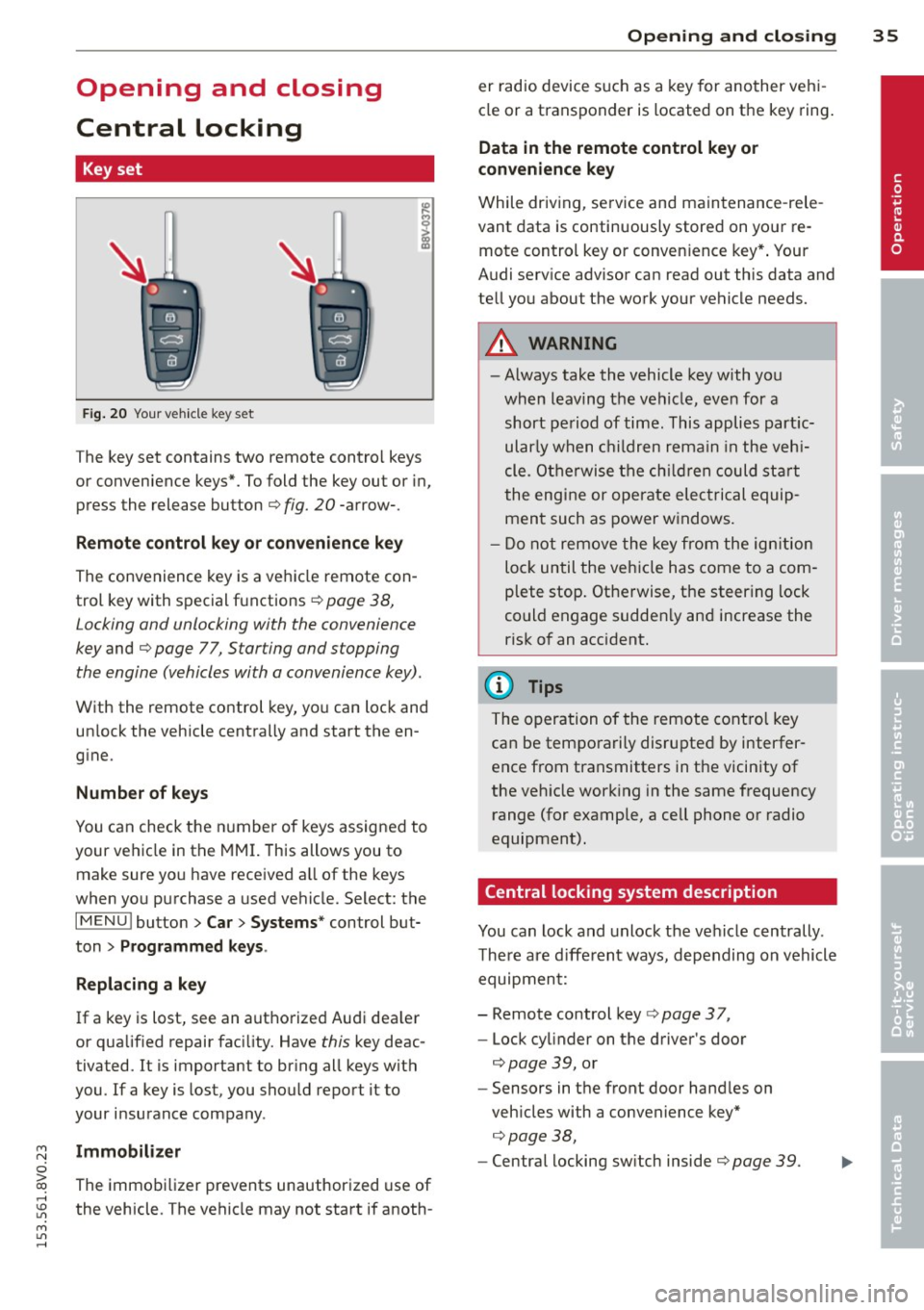
Fig . 20 Your vehicle key set
The key set contains two remote contro l keys
or convenience keys*. To fold the key out or in,
press the release button
q fig. 20 -arrow-.
Remote control key or convenience key
The convenience key is a vehicle remote con
trol key with special functions
q page 38,
Locking and unlocking with the convenience
key and q page 77, Star ting and stopping
the engine (vehicles with a convenience key).
With the remote control key, you can lock and
un lock the vehicle centrally and start the en
g ine.
Number of keys
You can check the number of keys assigned to
your vehicle in the
MMI. T his allows you to
make sure you have received a ll of the keys
when you purchase a used vehicle. Select: the
I MENU I button > Car> Systems* control but
ton
> Programmed keys.
Replacing a key
If a key is lost, see an authorized Audi dea ler
or qualified repair facility. Have
this key deac
tivated. It is important to br ing all keys with
you.
If a key is lost, you should report it to
your insurance company .
Immobilizer
The immobilizer prevents unauthorized use of
the vehicle . The vehicle may not start if anoth -
Opening and closing 35
er radio device such as a key for another veh i
cle or a transponder is located on the key ring.
Data in the remote control key or
convenience key
While driving , service and maintenance -rele
vant data is continuously stored on your re
mote control key or convenience key*. Your
Audi serv ice advisor can read out this data and
tell you about the work your vehicle needs.
_& WARNING
- Always take the vehicle key with you
when leaving the vehicle, even for a
short period of time. This applies partic
ularly when children remain in the vehi
cle . Otherwise the children could start
the engine or operate electrical equip
ment such as power windows.
- Do not remove the key from the ignition
lock until the vehicle has come to a com
plete stop. Otherwise, the steering lock
could engage sudden ly and increase the
risk of an accident.
{i) Tips
The operation of the remote control key
can be temporarily disrupted by interfer
ence from transmitters in the vicinity of
the veh icle working in the same frequency
range (for example, a cell phone or radio
equipment).
Central locking system description
You can lock and unlock the vehicle centrally .
There are different ways, depending on vehicle
equipment:
- Remote control key
q page 3 7,
- Lock cylinder on the driver's door
qpage 39, or
- Sensors in the front door handles on
veh icles with a convenience key*
q page 38,
-Central locking sw itch inside q page 39. •
Page 162 of 310
160 Airbag system
Repair, care and disposal of the airbags
Parts of the airbag system are installed at
many different places on your Audi. Installing,
removing, servicing or repairing a part in an
area of the vehicle can damage a part of an
airbag system and prevent that system from
working properly in a collision.
There are some important things you have to know to make sure that the effectiveness of
the system will not be impaired and that dis
carded components do not cause injury or pol lute the environment.
A WARNING
Improper care, servicing and repair proce
dures can increase the risk of personal in
jury and death by preventing an airbag from deploying when needed or deploying
an airbag unexpectedly:
- Never cover, obstruct, or change the
steering wheel horn pad or airbag cover
or the instrument panel or modify them
in any way.
- Never attach any objects such as cup
holders or telephone mountings to the
surfaces covering the airbag units.
- For cleaning the horn pad or instrument
panel, use only a soft, dry cloth or one
moistened with plain water. Solvents or
cleaners could damage the airbag cover
or change the stiffness or strength of the material so that the airbag cannot de
ploy and protect properly.
- Never repair, adjust, or change any parts
of the airbag system.
- All work on the steering wheel, instru
ment panel, front seats or electrical sys
tem (including the installation of audio
equipment, cellular telephones and CB
radios, etc .) must be performed by a
qualified technician who has the training
and special equipment necessary.
- For any work on the airbag system, we
strongly recommend that you see your
authorized Audi dealer or qualified work
shop. -
Never modify the front bumper or parts
of the vehicle body.
- Always make sure that the side airbag
can inflate without interference:
- Never install seat covers or replace
ment upholstery over the front seat
backs that have not been specifically
approved by Audi.
- Never use additional seat cushions that
cover the areas where the side airbags
inflate.
- Damage to the original seat covers or
to the seam in the area of the side air
bag module must always be repaired
immediately by an authorized Audi
dealer.
- The airbag system can deploy only once.
After an airbag has been deployed, it must be replaced with new replacement
parts designed and approved especially
for your Audi model version. Replace
ment of complete airbag systems or air
bag components must be performed by
qualified workshops only . Make sure that
any airbag service action is entered in
your Audi Warranty
& Maintenance book
let under
AIRBAG REPLACEMENT RE
CORD.
- For safety reasons in severe accidents,
the alternator and starter are separated
from the vehicle battery with a pyrotech nic circuit interrupter.
- Work on the pyrotechnic circuit inter
rupter must only be performed by a
qualified technicians who have the ex perience, information and special tools
necessary to perform the work safely.
- If the vehicle or the circuit interrupter
is scrapped, all applicable safety pre
cautions must be followed.
@) For the sake of the environment
Undeployed airbag modules and preten
sioners might be classified as Perchlorate
Material -special handling may apply, see
Page 201 of 310
M N
0 > co ,...., \!) 1.1"1
M 1.1"1 ,....,
can reach the catalytic converter . This
could result in overheating of the con
verter, requ iring its replacement.
- To assure efficient operation of the Emis
sion Control System :
- Have your veh icle ma inta ined properly
and in accordance with the service rec
ommendations in your Wa rranty
&
Ma intenance booklet.
- Lac k of proper maintenance as well as
improper use of the vehicle will impa ir
t he funct ion of the emission control
system and cou ld lead to damage.
@) For the sake of the environment
Even when the Emission Cont ro l System is
operating properly, t he exhaus t gas can
have a s ulfu r-like exhaust gas smell unde r
some operating states. This depends on
the s ulfur content of the fue l being used .
Using a different brand of fuel may help,
or filling the tank w ith lead-free super
grade gasoline.
Diesel particulate filter
Applies to vehicles: with d iesel eng ine
The diesel particulate filter fi lters nearly a ll of
the soot part icles out of the exhaust. The fil
ter cleans itse lf automatically under normal
driving conditions. If the filter cannot clea n it
self (for examp le, because you are only driving
short d istances) , the fil ter becomes clogged
with soot and the
II symbo l for the diesel
particulate f ilter illum inates ~ page 23.
A WARNING
- Do not park yo ur vehicle ove r flammable
materials such as g rass or leaves because
the high temperature of the diesel par
t icu late filter could start a fire .
- Do not apply an underbody protectant in
the exhaust system area or a fire could
start.
Dri ving and the en vironm ent 199
Placing your vehicle
out of service
If you would like to take your vehicle out of
se rv ice for a longer time, contact your author
ized Audi dealer or qualified repair fac ility .
They w ill advise yo u of impo rtant measures,
such as corrosion p rotection , maintenance
and storage p roced ures. Also follow the infor
ma tion about the battery ~ page 228 .
Operate your vehicle
economically and
minimize pollution
General
Your personal style of driving will determine
the economy of your vehicle, as well as ex
haust and noise levels .
Fuel economy, env ironme ntal impact, and
wea r on your eng ine, b rakes and tires la rgely
depend on three factors:
- your personal d riving s tyle
- operating conditions
- technical limitat ions
If you ant ic ipate what you need to do next and
drive economically, you can easily cut your
fuel consumpt ion by 10-15 percent. This sec
tion w ill give you some tips on how you can
help t he env ironment and your pocketbook.
@ Tips
The consumption estimates as published
by ENVIRONME NTAL PROTECTION AGENCY
(EPA) and Transpo rt Canada may not corre
spond to your actual consumption on the r oad, which will va ry depending upon vehi
cle load and speed, ro ad and weather con
ditions, trip leng th, etc.
Drive smoothly and keep a lookout
ahead
Vehicles use the most fuel when they are ac
celerating .
.,. Avo id unne cessary acceler ating and bra ki ng . .,..
•
•
•
Page 202 of 310
200 Driving and the environment
Vehicles use the most fuel when they are ac
celerati ng. If you anticipate what is going to
happen next, you will need to brake less and,
thus, accelerate less. let the vehicle coast
whenever poss ible -for example when you see
that the next traffic light is red.
Avoid full throttle
Driving at moderate speeds saves fuel and
improves your mileage.
.. Try and keep well be low your car's max imum
speed.
Accelerating gently reduces fuel consump
tion, engine wear, and does not disturb the
environment. F ue l consumption, exhaust emissions and en
gine noise increase disproportionately at hig h
speeds . If you drive at approximately three
quarters of top speed, fue l consumption will
be reduced by one half. Never dr ive faster
tha n the posted speed limit and weather con
d itions permit.
Reducing unnecessary idling
Even when your car is just idling it burns up
fuel.
.. Sh ut the engine off when you are not dr iving
the vehicle.
.. Do not warm up the vehicle by letting the
engine run at idle.
It is efficient to switc h off the engine when
stopped at railroad crossings and long red
lights. Turning the engine off for just 30-40
seconds saves mo re fuel than is burned by
start ing the eng in e again.
It takes a long time for the engine to warm up
fu lly when it is running at idle. However, wear
and nox ious em issions are especially high
when the engine is warming up. So you should
d rive away as soon as you sta rt the eng ine and
avoid ru nning a t high RPM wh ile the engine is
still warming up .
(D Note
Do not leave engine i dling unattended af
ter start ing. If wa rning lights sho uld come
on to indicate improper operation, they
would go unheeded. Extended idling also
produces heat , w hich could result in over
hea ting o r othe r damage to the veh icle or
othe r property.
Regular maintenance
A badly tuned engine unnecessarily wastes a
lot of fuel.
.. Have your ve hicle serviced at regu lar inter-
vals.
Having your veh icle regu larly serviced by an
authorized Aud i dealer helps to ensure that it
runs properly and econom ica lly. The cond it io n
of your veh icle not on ly affects its safety and
ability to ho ld its va lue, i t also affects
fuel
c onsumption .
Check your oil each t ime you fill your tank.
The amount of oi l used is re lated to engine
l oad and speed.
It is normal for the oil consump tion of a new
engine to reach its lowest value after a certain
mileage has been driven .
You m ust drive your ve hicle abou t 3,000 m iles
(5,000 kilometers) before you can properly
assess oil consumpt ion .
T his also ap plies to fue l consumption and en
gine o utp ut.
(D Note
- Have your veh icle ma inta in ed properly
and i n acco rdance with the service rec
ommendations in you r W arranty
& Main
t enance boo klet. l ack of proper ma inte
nance as well as im proper use of the ve
hicle will impair the function of the
em iss ion cont ro l system and cou ld lead
to damage.
Page 206 of 310
204 Trailer towing
different weight distribution. Safety, perform
ance and economy wi ll greatly depend on how
carefu lly you load your trailer and operate
your rig.
Before you actually tow your trailer, practice
turning, stopping and backing up in a n area
away from traffic. Keep practicing until you
have become comp letely fam iliar with the way
your veh icle-trailer comb ination behaves and
responds.
Backing up is d iff icult and requires practice.
Backing up with a tra iler genera lly requires
steering action opposite to that when back ing
up your veh icle without a trailer.
Maintain a greater distance between your ve
h icle and the one in front of you. You will need
more room to stop. To compensate for the
trailer, you will need a larger than normal
turning radius.
When passing, remember that yo u cannot ac
celerate as fast as you normally would be
cause of the added load. Make sure you have
enough room to pass. After passing, allow
p lenty of room for your tra iler before chang
ing lanes aga in.
Avoid jerky starts, sharp turns or rapid lane
changes.
(D Tips
- Do not tow a tra iler dur ing the break-in
period of you r vehicle.
- If you tow a trailer, your Audi may re
quire more frequent maintenance due to
the ext ra load
¢ page 289.
Parking on a slope
Do not park on a slope with a trailer. If it can
not be avoided, do so only after doing the fol
lowing:
Wh en park ing:
.. Apply the foot brake .
.. Have someone place chocks under both the
vehicle and the trailer wheels. ..
With chocks in place, slowly release the
brakes unti l the whee l chocks absorb the
load.
.. Turn the whee ls towards the curb.
.. App ly the parking brake.
.. Select the P selector lever posit ion.
When re starting afte r park ing :
.. App ly the foot brake.
.. Start the engine.
.. Select the D/S se lector lever position.
.. Release the parking brake and s lowly pull
out and away from the wheel chocks .
.. Stop and have someone retr ieve the wheel
chocks .
@ Tips
If you move the selector leve r of the auto
matic transmission to P befo re applying
the pa rking brake and before bloc king the
whee ls, you may h ave to use more force
la ter to move the lever out of the P posi
tion .
Page 214 of 310
212 Checking and Fill in g
- If you put any amount of incorrect fue l in
the fue l tank, do not start the engine un
der any circumstances. Immediately con
tact the nearest authorized Audi dealer
or authorized Audi Service Facility for as
sistance. These fuels contain substances
that can severely damage the fuel sys
tem and the engine if the engine is start
ed.
- If the diesel fuel quality is poor, it may
be necessary to have the water drained
from the water sepa rator in the
f ue l fi l
te r
more often than specified in the
maintenance schedu le . This can help re
duce engine ma lfunctions
Q page 24.
Fuel tank
Fuel filler neck
The fuel filler neck is located on the right rear
side panel behind the fuel fi ller flap.
If the power locking system should fail, you
can st ill open the flap manually- for detailed
instructions
seer:::.> page 214.
You can find the fuel tank capacity of your ve
hicle in
Qpage 288.
The label on the inside of the fuel filler flap
tells you the correct fuel for your vehicle. For
more information about fuel specifications,
see
c;,page 210.
Your veh icle fuel tank has an onboard refue l
ling vapor recovery system . This feature helps
to prevent fuel vapors from escaping from the
tank and polluting the environment while you refuel your vehicle . In order to fill the tank
properly while protect ing the env ironment,
p lease follow t his refueling procedure careful
ly.
.&_ WARNING
Under norma l operating conditions, neve r
carry additiona l fuel containers in your car .
Gas can isters and other containers used to
transport fue l can be dangerous. Such con
tainers, full or empty, may leak and cou ld
cause a f ire in a collision. If you must transpo
rt fuel to use for your lawn mower,
snow b lower, etc., be very careful and al
ways observe local and state laws regard ing the use, transportation and storage of
such fuel containers. Make certa in the con
tainer meets industry standa rds (ANSI/
ASTM F8S2 -86).
(D Note
Neve r drive your veh icle until the fue l tank
i s completely empty. The irregular supply
of fue l can cause misfir ing. Gasoline cou ld
enter the exhaust system and damage the
catalytic converter.
Fueling procedure
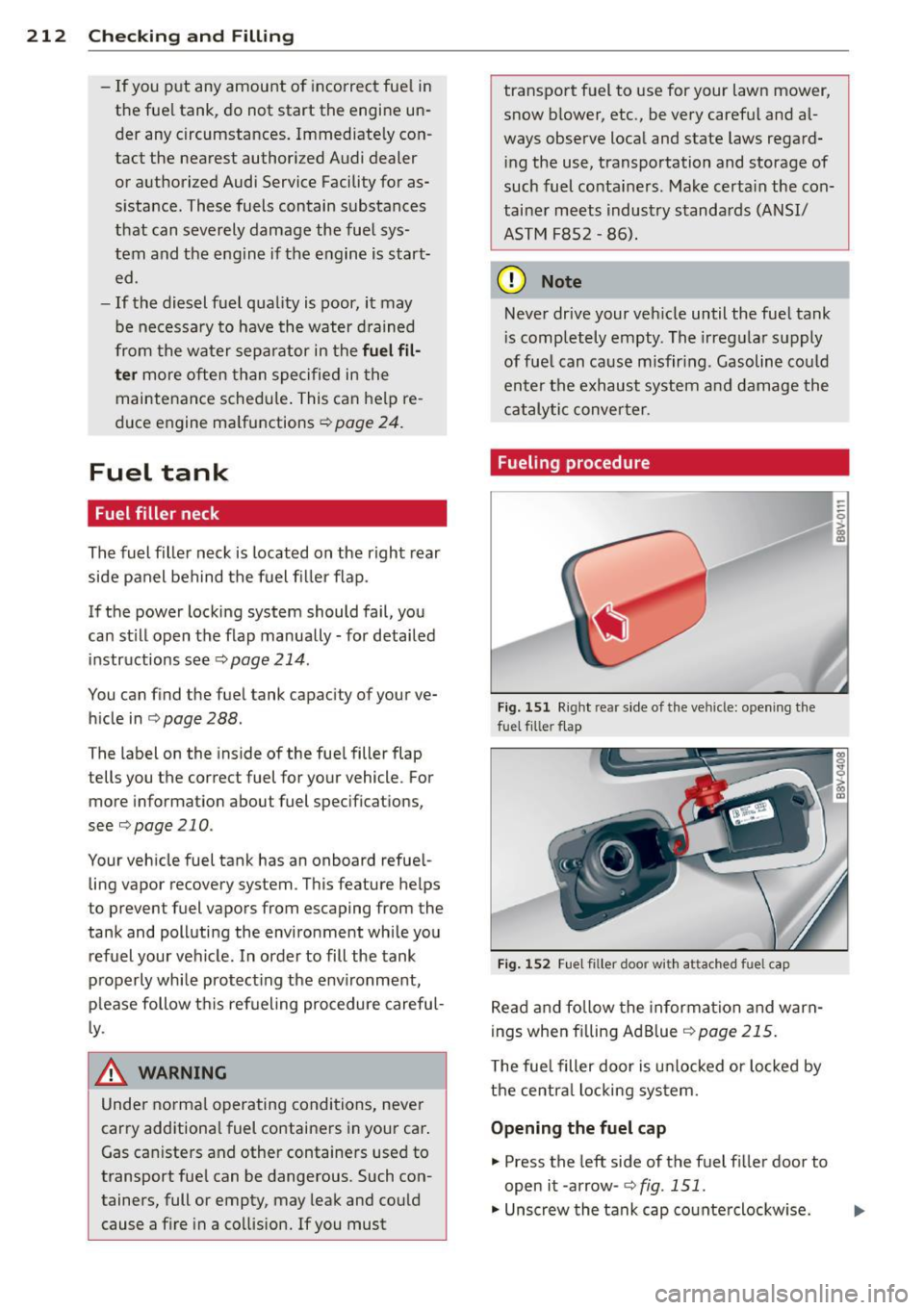
F ig. 15 1 Righ t rear side of the vehicle: opening the
fuel filler flap
Fig . 1 52 Fue l filler door w ith attached fuel cap
Read and follow the information and warn
ings when filling Ad B lue
c;, page 215.
T he fue l filler door is u nlocked or locked by
the centra l locking sys tem.
Openin g the fuel c ap
" Press the left side of the fuel f iller door to
open it -arrow-
Q fig. 151.
"Unscrew the tank cap counterclockw ise .
-;:;
> a, a,
Page 226 of 310
224 Check ing and F illin g
• Unscrew the engine oil fi ller opening cap
~ ¢ fig. 163, ¢page 220, fig . 159.
• Carefu lly add 0 .5 quart (0.5 liter) of the ap
propr iate oil¢
page 221.
• Check the oil level again after two minutes
¢ page 223, Checking the engine oil level.
• Add o il, if necessary .
• Close the engine oil filler cap and push the
dipstick all the way in.
.&_ WARNING
- When add ing o il, do not le t oi l dr ip onto
hot engine components . There could be
risk of a fire .
- You must sec ure the cap on the oil filler
opening correctly so that oil does not
leak out onto the hot engine and exhaust
system when the engine is running, be
cause this is a fire hazard.
- Always clean skin thoroughly if it comes
into contact w ith eng ine oil.
([) Note
- Applies to vehicles with gasoline en
gines: The oil level cannot be above the
(!) range¢
page 223, fig. 161, because
th is can ca use damage to the cata lytic
converter or the engine. Contact your au
thorized Audi dealer or qua lified repair
facil ity to have excess o il extracted if
necessary.
-Applies to vehicles with diesel engines: The oil level must not be in the
0 range
¢
page 223, fig. 162 -The oil must not
be extracted, because this can damage
the engine. Drive to an au thorized A udi
dealer or authorized A udi Service Facility
immediately.
- Do not mix any additiona l lubricants into
the engine o il. Damage cause by such ad
ditives is not covered by the war ranty.
@) For the sake of the environment
- Oil should never enter the sewer system
or come into contact with the ground .
- Pay a tte ntion to leg al req uirements
when disposing of empty oil containers .
Changing the engine oil
We recommend that have your oil changed by
an authorized Audi dealer or a qualified serv
ice station.
Before you check anyth ing in the engine com
partment,
always read and h eed all WARN
INGS
¢ page 217.
The engine oil must be changed according to
the interva ls specified in your Warranty
&
Maintenance booklet . This is very important
because the lubricat ing propert ies of o il di
min ish g radually du ring normal vehicle use.
Under some circumstances the engine oil
should be changed more frequently. Change o il more often if you drive mostly short d is
tances, operate the ve hicle in dusty a reas or
under p redo min ant ly stop-and-go traffic con
di tions, or have yo ur vehicle where tempera
tures remain below freezing for extended pe
riods .
De te rgent additives in the oil will make fresh
o il look dark after the engine has been run
ning for a sho rt time. This is normal and is not
a reason to change the oil more often than
recommended.
Beca use of the p roblem of proper disposal,
along wi th the specia l tools and necessary ex
pertise req uired, we st rongly recommend that
you have your oil changed by an a uthorized
Audi deale r or a qualified service station.
If you choo se to chan ge your oil your self ,
please note the fo llowing important informa
tion:
.&_ WARNING
To reduce the risk of personal in jury if you
must change the eng ine oil in your vehicle
yourself:
- Wear eye protect ion.
- To reduce the risk of burns from hot en-
g ine oi l, let the engine cool down to the
touch.
- When removing the o il drain p lug with
your fingers, stay as far away as possible. ..,
Page 254 of 310
252 Tires and wheels
Tire service life
The service life of tires depends
on a lot of different things in
cluding proper installation and
balancing, correct tire pressure
and driving style.
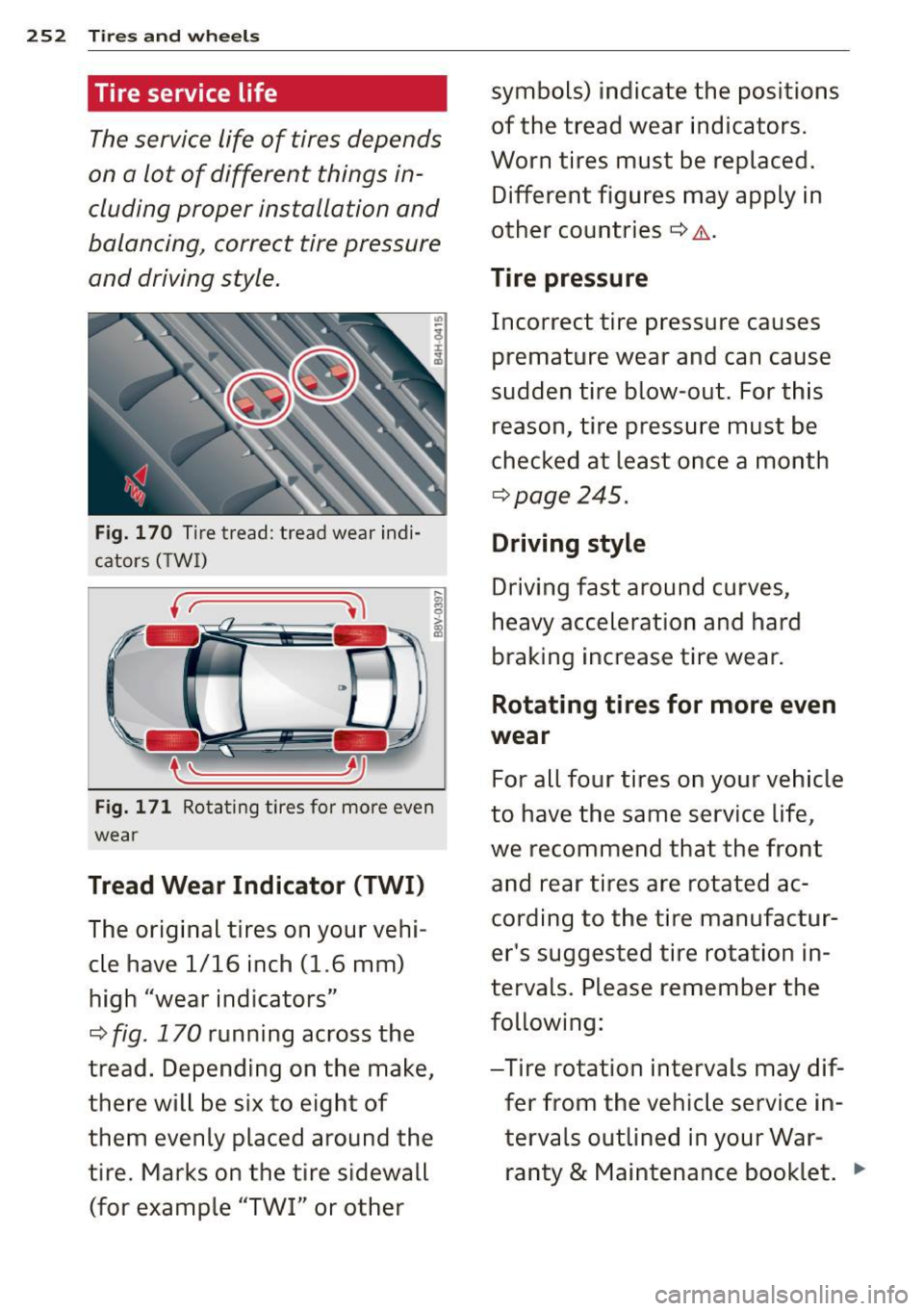
Fig. 170 Tire tread: tread wear indi
cators (TWI)
Fig. 171 Rotating tires for more even
wear
Tread Wear Indicator (TWI)
The original tires on your vehi
cle have 1/16 inch (1.6 mm)
high "wear indicators"
¢ fig. 170 running across the
tread. Depending on the make,
there will be six to eight of
them evenly placed around the
tire. Marks on the tire sidewall (for example "TWI" or other symbols)
indicate the positions
of the tread wear indicators.
Worn tires must be replaced.
Different figures may apply in
other countries
¢ ..1.. .
Tire pressure
Incorrect tire pressure causes
premature wear and can cause
sudden tire blow-out. For this
reason, tire pressure must be
checked at least once a month
¢page 245.
Driving style
Driving fast around curves,
heavy acceleration and hard
braking increase tire wear.
Rotating tires for more even
wear
For all four tires on your vehicle
to have the same service life,
we recommend that the front and rear tires are rotated ac
cording to the tire manufactur
er's suggested tire rotation in
tervals. Please remember the
following:
-Tire rotation intervals may dif
fer from the vehicle service in
tervals outlined in your War
ranty
& Maintenance booklet. ""