roof AUDI S3 2015 User Guide
[x] Cancel search | Manufacturer: AUDI, Model Year: 2015, Model line: S3, Model: AUDI S3 2015Pages: 310, PDF Size: 76.15 MB
Page 149 of 310
M N
0 > co ,...., \!) 1.1'1
M 1.1'1 ,....,
Fo r exa mple, the a irbag may depl oy if:
-a small child that is heavier than a typical 1
year-o ld child is on the front passenger seat
(regardless of whether the child is in one of
the chi ld seats listed
page 172), or
- a ch ild who has outgrown child rest raints is
on the front passenger seat.
If the front passenger airbag is turned off, the
P ASS ENGER AIR B AG OFF light comes on in
the instrument cluster and stays on.
If the front passenger airbag deploys, the
Federal Standard requires the airbag to meet
the "low risk" deployment criter ia to reduce
the r isk of injury through interaction with the
airbag. "Low risk" deployment occurs in those
crashes that take place at lower decelerations
as defined in the electronic control unit
r::> page 15 7, PASSENGER AIR BAG OFF light.
Always remember, a chi ld seat or infant carri
er insta lled on the front seat may be struck
and knocked out of position by the rapidly in
flating passenger's airbag in a frontal colli
sion. The airbag could greatly reduce the ef
fectiveness of the child restraint and even se
riously injure the child during inflat ion.
For this reason, and because the back seat is
the safest place for children -when properly
restrained according to their age and size - we
strongly recommend that children always sit in the back seat
r::> page 170, Child Safety .
A WARNING
A child in a rearward-facing child seat in
stalled on the front passenger seat will be
ser iously injured and can be killed if the
front airbag inflates -even with an Ad
vanced Airbag System .
- T he inflating airbag will hit the child seat
or infant carrier with great force and wi ll
smash the child seat and child against
the backrest, center armrest, door or roof.
- Always install rear-facing child seats on
the rear seat.
- If you must install a rearward facing
child seat on the front passenger seat
-
A irbag system 147
because of exceptional circumstances
and the
PA SSENGER AIR BAG OFF light
does not come on and stay on, immed i
ately install the rear-fac ing child seat in a
rear seat ing pos ition and have the airbag
system inspected by your A udi dealer.
- Forward-facing child seats installed on the front passenger's seat may interfere
with the dep loyment of the a irbag and
cause serious persona l injury to the
child.
A WARNING
If, in except iona l circumstances, you must
install a forward -facing child restraint on
the front passenger's seat:
- Always ma ke s ure the forward-facing
seat has been designed and certified by its manufacturer for use on a front seat
with a passenger front and s ide a irbag.
- Never put the forward-facing child re
straint up against or very near the instru
ment panel.
- Always move the passenge r seat into its
rea rmost pos ition in the seat's fore and
aft ad justment range, as far away from
the airbag as possible before installing
the forward-fac ing ch ild restra int. The
backrest must be adjusted to an upright
position.
- Make sure that the
PASSENGER AIR BAG
OFF
l ight comes on and stays on all the
time wheneve r the ig nit ion is switched
on.
A WARNING
To reduce the ri sk of ser ious injury, ma ke
sure that the
PASSENGER AIR BAG OFF
light comes on and stays on whenever a
chi ld restraint is installed on the front pas
senger seat and the ignition is switched
on.
- If the
PA SSENGER AIR BAG OFF light
does not stay on, perform the checks de
scribed¢
page 156, Monitoring the Ad-
vanced Airbag System.
~
•
•
•
Page 153 of 310
M N
0 > co ,...., \!) ..,.,
M ..,., ,....,
the passenger side may deploy (the PASS EN
GER AIR B AG OFF
light does not come on).
For exa mple, the ai rba g may d epl oy if :
- a small child that is heavier than a typical 1
year-o ld child is on the front passenger seat
(regardless of whether the child is in one of
the ch ild seats listed
¢ page 172),
- a ch ild who has outgrown child restra ints is
on the front passenge r seat.
If the front passenger airbag is turned off, the
P A SSENGER AIR BAG OFF light in the center
of the instrument panel w ill come on and stay
on.
If the front passenger airbag deploys, the
Federal Standard requires the airbag to meet
the "low risk " deployment criteria to help re·
duce the risk of injury through interaction
with the airbag . "Low risk" deployment occurs
in those crashes that take place at lower de
celerations as defined in the electronic control unit
r=> page 156.
Alwa ys r em emb er: E ven tho ugh you r vehicle
is equipped with Advanced Airbags, the safest
p lace for children is properly restrained on the
back seat . Please be sure to read the impor
tant information in the sect ions that follow
and be sure to heed all of the WARNINGS .
A WARNING
To reduce the risk of injury when an airbag
inflates, always wear safety belts properly .
- If you are unrestrained, lean ing forward,
sitting sideways or out of position in any
way, your risk of injury is much higher .
- You w ill also receive serious injuries and
cou ld even be killed if you are up against
the a irbag or too close to it when it in·
flates -even with an Advanced Airbag
r::!v page 144.
A WARNING
A child in a rearward-facing child sea t in
stalled on the front passenger sea t will be
ser iously injured and can be killed if the
-
A irbag system 15 1
front airbag inflates - even with an Ad·
vanced Airbag System .
- Altho ugh the Advanced Airbag System in
your veh icle is designed to turn off the
front airbag when a rearward-facing
child restraint has been installed on the
front passenger seat, nobody can abso
lutely guarantee that deployment is im
possible in all conceivable s ituations that
may happen dur ing the usefu l life of your
veh icle.
- The inflating airbag will h it the ch ild seat
or infant carrier with grea t force and will
smash the child seat and child against
the backrest, center armrest, door, or
roof.
- Always install rearward -facing chi ld re
straints on the rear seat .
- I f you must install a rearward fac ing
child seat on the front passenger seat
because of exceptional circumstances
and the
PASSENG ER AIR BAG O FF light
does not come on and stay on, immed i·
ately install the rear-fac ing child seat in a
rear seat ing pos ition and have the airbag
system inspected by your Audi dealer .
A WARNING
If, in except ional circumstances, you must
install a forward-facing child restraint on
the front passenge r's seat:
- Always make sure the forward-facing
seat has been designed and certified by
its manufacture r fo r u se on a front seat
with a passenger front and s ide a irbag.
- Never put the fo rward-faci ng child re
straint up against or ve ry near the instru
ment panel.
- Always move the passenge r seat into its
rearmost pos ition in the seat's fore and
aft ad justment range, as fa r away from
the airbag as possible before installing
the forward-fac ing chi ld restraint . The
backrest must be adj usted to an upright
position.
- Always make sure that there is nothing
on the front passenger seat that will •
•
•
Page 157 of 310
M N
0 > co ,...., \!) 1.1'1
M 1.1'1 ,....,
or the lower parts of the body. Front airbags
supp lement the three-point safety belts only
in some frontal collisions in which the vehicle
dece leration is high enough to deploy the air
bags.
F ront airbag s will no t deplo y:
- if the ignition is switched off when a crash
occurs,
- in side collisions,
- in rear-end collisions,
- in rollovers,
- when the crash deceleration measured by
the a irbag system is less than the m inimum
threshold needed for airbag deployment as
registered by the electronic control unit.
The f ront pas seng er airbag al so will n ot
deploy:
- when the front passenger seat is not occu
pied,
- when the electrical capac itance measured by
the capacitive passenger detect io n system
for the front passenger seat indicates that
the passenger side frontal airbag must be
switched off by the electronic control unit
(the
P AS SENGER A IR BA G OFF light
Q page 157 and how they work comes on
and stays on).
A WARNING
Sitting in the wrong position can increase
the risk of serious injury in crashes.
- To reduce the r isk of injury when the air
bags inflate, the driver and passengers
must always sit in an upright posit ion,
must not lean against or place any part
of the ir body too close to the area where
the a irbags are located.
- Occupants who a re unbelted, out of posi
t ion or too close to the airbag can be se
riously injured by an airbag as it unfolds
with great force in the blink of an eye
Qpage 146 .
A WARNING
A child in a rearward-facing child seat in
stalled on the front passenger seat will be
-
A irbag system 15 5
seriously injured and can be killed if the
front airbag inflates -even w ith an Ad
vanced A irbag System.
- The inflating airbag will hit the ch ild seat
or infant carrier with great force and will
smash the child seat and child against
the backrest, center armrest, door or roof.
- Always install rear-fac ing ch ild seats on
the rear seat.
- If you must install a rearward fac ing
child safety seat on the front passenger
seat because of exceptional c ircumstan
ces and the
PASSENGER AIR BAG OFF
light does not come on and s tay on, im
mediately install the rearward-fac ing
child safety seat in a rear seating posi
tion and have the airbag system inspect
ed by your authorized Audi dealer.
A WARNING
Objects between you and the airbag will increase the r isk of injury in a crash by in
terfering with the way the airbag unfolds
or by be ing pushed into you as the airbag
inflates.
- Never hold things in your hands or on
your lap when the veh icle is in use.
- Never transport items on or in the area
of the front passenger seat. Objects
could move into the area of the front air
bags during braking or other sudden ma
neuvers and become dangerous projec
tiles that can cause ser ious personal in
jury i f the a irbags inflate.
- Never p lace or a ttach accesso ries o r oth
er objects (such as cup holders, te le
phone brackets, large, heavy or bulky ob
jects) on the doors, over or near the area marked "AIRBAG" on the steering wheel,
instrument panel, seat backrests or be
tween those areas and yourself. These objects could cause injury in a crash, es pecially when the airbags inflate.
- Never recline the front passenger 's seat
to transport objects. Items can a lso
move into the area of the s ide a irbag or
-
•
•
Page 169 of 310
M N
0 > co ,....,
The inflatable side curtain airbags are located
on both sides of the interior above th e front
and rear side windows . T hey are identified by
the word "AIRBAG" on the windsh ield frame
and the center roof pillar.
The side curtain airbags contain features that prov ide ejection m itigation to he lp prevent ve
h icle oc cupant s or parts of their bodies from
being comple tely or partially ejected from the
vehicle interior in certain side impacts and ve
h icle rollovers .
The s ide curtain airbag system supp lements
the safety belts and can help to reduce the risk of injury for occupa nts ' heads and upper
torso on the side of the veh icle that is struck
i n a side collision . T he side curta in a irbag in
flates in s ide impacts and on ly w hen the veh i
cle acce le rat ion reg iste red by the cont ro l u nit
is high enough . If this rate is below the refer
ence value programmed into t he control unit,
the side c urtain airbag will not be t riggered,
even though the car may be badly damaged as
a result of the collision. It is not possible to
define an airbag triggering range tha t will
cover every possible angle of impact, since the
circumstances will vary considerably between
one co llision and another. Important factors
i nclude, for examp le, the natu re (hard o r soft)
of the impacting object, the ang le o f impact ,
ve hicl e speed, et c.
q page 168, How sid e cur
tain airbags work .
Besides their normal safety f unction, safety
be lts work to help keep the dr iver or front
passenger in position in the event of a frontal
collision so that the side curtain airbags can provide protection.
The airbag system is not a s ubst itute for yo ur
safety be lt . Rathe r, it is pa rt of the overall oc
cupant restraint system in your vehicle . Al
ways rememb er that the airbag system can
only help to protect you if you are wearing
your safety belt and wear ing it properly. Th is
is another reason why you shou ld always wear
your safety belts, not just because the law re
q uir es you to do so
q page 135, General
~ notes .
M l/'I ,....,
Airbag system 167
It is important to remembe r that wh ile the
side curtain airbag system is designed to help
reduce the likelihood of ser ious injuries, other
injur ies, for example, swelling, bru is ing, fric
tion burns and minor abras ions can also be as
sociated w ith these airbags upon deployment .
Remember too , these airbags will deploy only
once a nd only in ce rtain kinds of accide nts -
you r safety be lts a re a lways the re to offer p ro
tection .
The side curtain airbag system basically
consists of:
-The e lectronic control module and external
side impact sensors
- The side curta in a irbags above the front and
rear s ide windows w it h ejection mitigation
featu res
- The a irbag indicator light in the instr ument
p ane l
The airbag system is mon itored e lectronically
to make ce rtain it is func tioning prope rly at all
times. Each time you sw itch on the ig nition,
the air bag system indicator light will come on
f o r a few se conds (sel f diagnos tic s) .
The side curtain airbag is not activat ed:
- if the ignition is sw itched off,
- in side collisions whe n the acceleration
measured by the sensor is too low,
- in rear-end collisions.
A WARNING
-Safety belts and the airbag system will
only provide pro tection when occupa nts
are in the proper seating position
q page 57, Front seats .
-If the ai rbag ind icator light q page 21
comes when the veh icle is being used,
have the system inspected imme diately
by your au thori zed A udi dealer.
It is pos
sible tha t the airbag will inflate when i t
is not supposed to , or will not inflate
when it should .
•
•
•
Page 177 of 310
Child Safety 175
-The child and the passenger can also heater for child seats) on the front pas-
injure each other in an accident . senger seat if the device is connected
- Never install rear-facing child safety to the 12-volt socket or the cigarette
seats or infant carriers on the front pas- lighter
socket.
senger seat. A child will be seriously in- -If a seat heater has been retrofitted or
jured and can be killed when the passen- otherwise added to the front passen-
ger airbag inflates - even with an Ad -ger seat, never install any child re-
•
vanced Airbag System. straint system on this seat.
•
-The inflating airbag will hit the child -Make sure that there are no wet objects
safety seat or infant carrier with great (such as a wet towel) and no water or
force and will smash the child safety seat other liquids on the front passenger
and child against the backrest, center seat cushion.
armrest, door or roof. -Never place objects on the seat (such
- Always install rear-facing child safety as a laptop, CD player, electronic
seats or infant carriers on the rear seat. games device, power inverter or seat
- Forward-facing child safety seats instal- heater for child seats). These may
in-
led on the front passenger's seat can in- fluence the electrical capacitance
terfere with the airbag when it inflates measured by the capacitive passenger
and cause serious injury to the child. Al- detection system and can also fly
ways install forward-facing child safety around in an accident and cause serious
seats on the rear seat. personal injury.
- If exceptional circumstances require the -
Always buckle the child safety seat firmly
use of a forward-facing child restraint on in place even if a child is not sitting
in it.
the front passenger's seat, the child's A loose child safety seat can fly around
safety and well-being require that the during a sudden stop or in a collision
.
following special precautions be taken: -Always read and heed all WARNINGS
- Make sure the forward-facing seat has whenever using a child restrained in ave-
been designed and certified by its man- hide is being used
c> page 135, Safety
ufacturer for
use on a front seat with a belts, ¢ page 144, Airbag system and
passenger front and side airbag.
¢ page 170, Child Safety .
-Always carefully follow the manufac-
A WARNING turer's instructions provided with the
child safety seat or carrier. To reduce the risk of serious injury, make
- Always move the front passenger seat
sure that the
PASSENGER AIR BAG OFF
into the rearmost position of the pas-
light comes on and stays on whenever a
senger seat's fore and aft adjustment child restraint is installed on the front pas-
range, and as far away from the airbag senger seat and the ignition is switched
as possible before installing the child on.
restraint. - Take the child restraint off the front pas-
- Always make sure that nothing pre-
senger seat and install it properly at one
vents the front passenger's seat from of the rear seat positions if the
PASS EN-
being moved to the rearmost position GER AIR BAG OFF light does not stay on.
in its fore and aft adjustment range .
-Have the airbag system inspected by
- Always make sure that the backrest is
your authorized Audi dealer immediate-
M • N in the upright position. ly. 0 > - Never place or use any electrical device co ,....,
(such as a laptop, CD player, electronic \!) 1.1"1
M
games device, power inverter or seat 1.1"1 ,....,
Page 179 of 310
....,
N
0 > co
rl I.O
"' ....,
"' rl
It is a very dangerous place for an infant or a
la rger child in a rearward-facing seat.
A WARNING
Not using a child safety seat, using the
wrong child safety seat or improperly in stalling a child restraint increases the risk
of serious personal injury and death in a
crash.
- Never install rear-facing child safety
seats or infant carriers on the front pas
senger seat -even with an Advanced Air
bag System. A child will be seriously in
jured and can be killed when the inflat
ing airbag hits the child safety seat or in
fant carrier with great force and smashes
the child safety seat and child against
the backrest, center armrest, door or
roof
c::> page 146, Child restraints on the
front seat -some important things to
know.
- Always install rear-facing child safety
seats or infant carriers on the rear seat.
- Never install a rear-facing child restraint in the forward-facing direction. Such re
straints are designed for the special
needs of infants and very small children
and cannot protect them properly if the
seat is forward-facing .
-If you must install a rearward facing
child safety seat on the front passenger
seat because of exceptional circumstan
ces and the
PASSENGER AIR BAG OFF
light does not come on and stay on, im
mediately install the rear-facing child
safety seat in a rear seating position and have the airbag system inspected by your
Audi dealer.
- Never place or use any electrical device
(such as a laptop, CD player, electronic
games device, power inverter or seat
heater for child seats) on the front pas
senger seat if the device is connected to
the 12-volt socket or the cigarette light
er socket .
- If a seat heater has been retrofitted or
otherwise added to the front passenger
Child Safety 177
seat, never install any child restraint sys
tem on this seat.
- Make sure that there are no wet objects
(such as a wet towel) and no water or
other liquids on the front passenger seat
cushion.
- Never place objects on the seat (such as
a laptop, CD player, electronic games de
vice, power inverter or seat heater for
child seats). These may influence the
electrical capacitance measured by the
capacitive passenger detection system
and can also fly around in an accident
and cause serious personal injury.
- Always read and heed all WARNINGS
whenever using a child restrained in ave
hicle is being used
c::> page 135, Safety
belts,
c::> page 144, Airbag system and
c::> page 170, Important things to know.
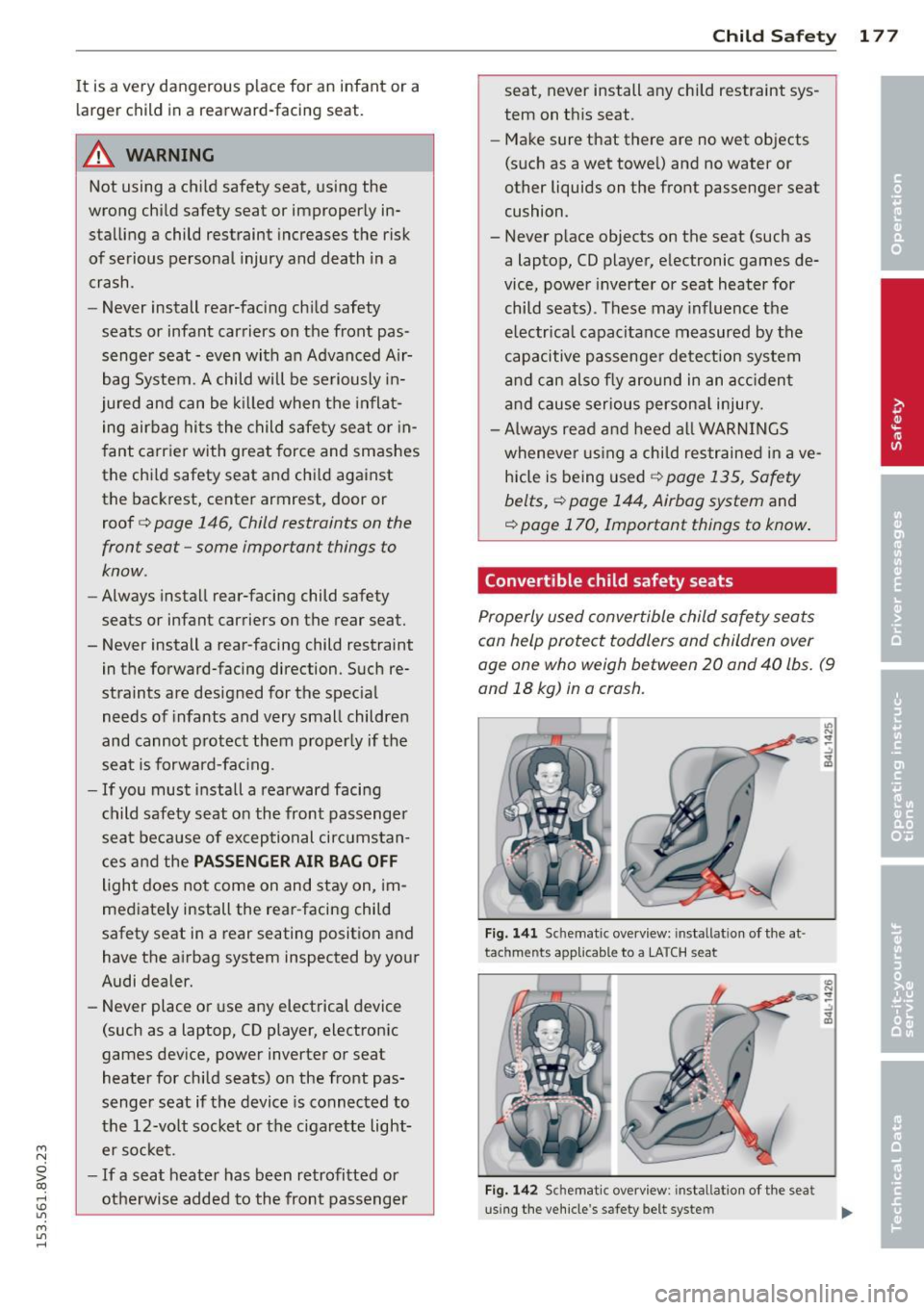
Convertible child safety seats
Properly used convertible child safety seats
can help protect toddlers and children over
age one who weigh between 20 and 40 lbs. (9
and 18 kg) in a crash.
Fig. 141 Schematic overview: installat ion of the at
tachments applicable to a LATCH seat
Fig. 142 Schematic overview: installation of the seat
using the vehicle 's safety be lt system
I),,
Page 180 of 310
178 Child Saf ety
• When using the vehicle safety be lt to insta ll
a chi ld safety seat, you must first activate
the convertible locking retractor on the
safety belt to prevent the child safety seat
from moving ¢
page 181 or install the seat
using the LATCH attachments .
• Push the child safety seat dow n with your
full weight to get the safety belt rea lly t ight
so that the sea t ca nnot move forward or
s ideways more than one inch ( 2.5 cm)
¢page 181.
• If the child safety seat is eq uipped with a
tether strap, attach it to the tether anchors
¢ page 187.
• Secure unused safety belts on the rear seat
¢ page 176.
A toddler or child is usually too large for an in
fant restraint if it is more than one year o ld
and weighs more than 20 lbs. (9 kg) .
Todd lers and c hildren who are o lder than one
yea r up to abo ut 4 years o ld and weigh more
than 20 lbs (9 kg) up to 40 lbs . (18 kg) must
a lways be properly restrained in a ch ild safety
seat certified for the ir s ize and weight
¢
fig . 141 and ¢ fig. 142.
The airbag on the passenger side makes the
front seat a potentially dangerous place for a child to r ide . The fro nt seat is not the safest
p lace for a child in a forwa rd-facing child safe
ty seat.
It is a very dange rous p lace for an in
fant or a la rger chi ld in a rearwa rd-fa cing seat.
A WARNING
Not u sing a ch ild safety se at, using the
wrong ch ild safety sea t or improper ly in
stal ling a child restraint increases the risk
of serious personal injury and death in a
co llision or other emergency s ituation.
- Children on t he front seat of any car,
even w ith Advanced A irbags, can be seri
o usly injured or even killed when an a ir
bag inf lates. A child in a rearward-facing
child safety seat installed on the front
passenge r seat w ill be seriously injured
and can be kil led if the front ai rbag in-
-
f lates -even with an Advanced Airbag
System .
- The inflating air bag will h it the ch ild
safety seat or infant carrier with great
force and will smash the child safety seat
and child aga inst the backrest , center
arm rest, door or roof .
- Always install rear-fac ing ch ild safety
seats on the rear seat .
- If you must install a rearward fac ing
child safety seat on the front passenger
seat because of exceptiona l circumstan
ces and the
PASSENGER AIR BAG OFF
light does not come on and stay on, im
mediately insta ll t he rear-fac ing c hild
s a fety se at in a re ar seating positi on and
have the air bag system ins pected by your
Aud i deale r.
- T he rear side o f the child safety seat
should be pos itioned as close as possi ble
to the backrest on the vehicle seat .
- For a djustable head restra ints: adjust or
remove the rea r seat hea d restra int if it
is difficult to install the c hild seat w ith
the head restraint in place¢
page 59. In
stall the head restraint again immed iate
ly once the child seat is removed. Dr iv ing
without head restraints o r with head re
s traints that are not properly adjus ted
increases the risk of serious or fatal neck
in jur y drama tically.
- Always read and heed all WAR NIN GS
wheneve r using a child restraine d in ave
h icle is being u sed
¢ page 135, Safe ty
bel ts,
¢ page 1 44, Airbag system and
¢ page 170, Important things to know .
A WARNING
-
If exceptional circums tances require the
use of a fo rward-facing child restraint on
the front passenger 's seat, the child's safe
ty and well -being require that the follow
i ng spec ial precautions be taken:
- Make sure the forward- facing seat has
been designed and cert ified by its man u
facturer fo r use on a front seat with a
passenger front and side airbag.
Page 184 of 310
182 Child Safety
-If the backrest is not securely latched,
the child and the child restraint will be
thrown forward together with the back
rest and will strike parts of the vehicle
interior. The child can be seriously in
jured or killed.
- Never install rear -facing child safety
seats or infant carriers on the front pas
senger seat. A child will be seriously in
jured and can be killed when the passen ger airbag inflates.
- The inflating airbag will hit the child
safety seat or infant carrier with great
force and will smash the child safety seat
and child against the backrest, center
armrest, door or roof.
- Always install rear-facing child safety
seats or infant carriers on the rear seat.
- Forward-facing child safety seats or in
fant carriers installed on the front pas
senger's seat may interfere with the de
ployment of the airbag and cause serious
injury to the child.
- It is safer to install a forward-facing
child safety seat on the rear seat.
- Always read and heed all WARNINGS
whenever using a child restrained in ave
hicle is being used ¢
page 170. Special
precautions apply when installing a child
safety seat on the front passenger seat
¢ page 146, Child restraints on the front
seat -some important things to know .
A WARNING
-
Always take special precautions if you
must install a forward or rearward-facing
child restraint on the front passenger's
seat in exceptional situations:
- Whenever a forward or rearward-facing
child restraint is installed on the front
passenger seat, the
PASSENGER AIR
BAG OFF
light must come on and stay on
whenever the ignition is switched on.
- If the
PASSENGER AIR BAG OFF light
does not come on and stay on, perform
the checks described ¢
page 156, Moni
toring the Advanced Airbag System.
- Take the child restraint off the front pas
senger seat and install it properly at one
of the rear seat positions if the
PASSEN
GER AIR BAG OFF
light does not stay on
whenever the ignition is switched on.
- Improper installation of child restraints
can reduce their effectiveness or even
prevent them from providing any protec
tion .
-An improperly installed child restraint can interfere with the airbag as it de
ploys and seriously injure or even kill the
child.
-Always carefully follow the manufactur
er's instructions provided with the child
safety seat or carrier.
- After checking to make sure that the
child restraint is properly installed, make
certain that the child restraint is correct ly recognized by the capacitive passenger
detection system in the front passenger
seat and that the
PASSENGER AIR BAG
OFF
light signals the correct front pas
senger frontal airbag status.
A WARNING
-Forward-facing child restraints:
- Always make sure the forward-facing seat has been designed and certified by
its manufacturer for use on a front seat
with a passenger front and side airbag.
- Never put the forward-facing child re
straint up, against or very near the in
strument panel.
- Always move the passenger seat into its
rearmost position in the seat's fore and
aft adjustment range, as far away from
the airbag as possible before installing
the forward-facing child restraint. The
backrest must be adjusted to an upright
position.
- Make sure that the
PASSENGER AIR BAG
OFF
light comes on and stays on all the
time whenever the ignition is switched
on.
Page 200 of 310
198 Driving and the environment
Driving through water
on roads
Note the following to avoid vehicle damage
when driving through water, for example on
flooded roads:
- The water must not be any higher than the
bottom of the vehicle body.
- Do not drive faster than wa lking speed.
A WARNING
After driving through water or mud, the
braking effect can be reduced due to mois
ture on the brake discs and brake pads. A
few careful brake applications should dry off the brakes.
@) Note
Vehicle components such as the engine, transmiss ion, suspension or electrical sys
tem can be severely damaged by driving
through water.
- Determ ine the depth before driving
through water.
- Do not stop the vehicle, drive in reverse
or switch the engine off when driving
through water .
- Keep in mind that oncoming vehicles may create waves that raise the water
level and make it too deep for your vehi
cle to drive through safely.
- Avoid dr iving through salt water (corro
s ion).
Catalytic converter
App lies to vehicles: with gasoline engine
It is very important that your emission con
trol system (catalytic converter) is function
ing properly to ensure that your vehicle is run
ning in an environmentally sound manner.
> Always use lead-free gaso line r=;, page 210,
Fuel supply .
> Never run the tank down all the way to emp-
ty.
> Never put too much motor o il in your engine
r=;, page 223, Adding engine oil
The catalytic converter is an efficient "clean
up" device built into the exhaust system of
the vehicle . The cata lytic converter burns
many of the pollutants in the exhaust gas be
fore they are released into the atmosphere.
The exclusive use of unleaded fuel is critica lly
important for the life of the catalytic convert
er and proper functioning of the engine.
A WARNING
-
The temperature of the exhaust system is high, both when driv ing and after stopping
the eng ine .
- Never touch the exhaust tail pipes once
they have become hot . This could result
in burns.
- Do not park or operate the vehicle in
areas where the hot exhaust system may
come in contact with dry grass, brush,
fue l spill or other material wh ich can
cause a fire.
- Do not app ly additional undercoating or
rustproofing on or near the exhaust manifold, exhaust pipes, catalytic con
verter or heat shields . Dur ing driving, the
substance used for undercoating could
overheat and cause a fire.
(D Note
- Be aware that just one tank filling with
leaded fuel will already seriously de
grade the performance of the catalytic
converter.
- Do not exceed the correct engine oil level
r=;, page 223.
-Do not drive until the fuel tank becomes
completely empty. The engine could mis
fire . Unburned fuel could also get into
the exhaust system and this cou ld cause
the catalytic converter to overheat.
- Do not switch off the ignition while the
vehicle is moving.
- Do not continue to operate your vehicle
under these conditions, as otherwise fuel
IIJ,,
Page 207 of 310
M N
0 > co ,...., \!) ..,.,
M ..,., ,....,
Care and cleaning
General information
Regular, proper care helps to maintain your
vehicle's val ue . It can also be a requirement
when submitting warranty claims for corro
sion damage and paint defects on the body.
The necessary care products can be obtained
from your a uthorized Audi dea ler . Read and
follow the instructions for use on the packag ing.
A WARNING
- Us ing clean ing and care products incor
rect ly can be dangerous to your hea lth .
- Always store cleaning and care products
out of reach of children to reduce the r isk
of po isoning.
@ For the sake of the environment
- Preferably use environmentally-friendly
products when buying cleaning agents.
- Do not d ispose of leftover cleaning and
care products with household trash.
-
Car washes
The longer that deposits such as insects, bird
droppings, tree sap or road sa lt rema in on the
veh icle, the more the surface can be dam
aged . High tempe ratures such as those
caused by sunlight increase the damag ing ef
fect .
Before washing, rinse off heavy depos its with
p lenty of water .
Stubborn depos its s uch as bird dropp ings or
tree sap are best removed with plenty of wa
ter and a m icrof iber cloth.
A lso, wash the underside of your vehicle once
road salt stops be ing used for the season.
Pressure washers
When washing your veh icles w ith a pressure
washer, always fo llow the operating instr uc
tions provided with the pressure washer. This is especially important in regard to the pres -
Care and cleanin g 205
sur e and sp raying distance. Do not aim the
spray direct ly at sea ls on side windows, doors,
the hood, the rear lid or the sunroof* or at
tires, rubber hoses, insulating material, sen
sors* or camera lenses*. Keep a d istance of at
least 16 inches (40 cm) .
Do not remove snow and ice with a pressure
washer.
Never use rotary nozzles or h igh pressure noz
zles .
T he wate r temperature m ust not be above
140
° F (60 °().
Automatic car washes
Spray off t he ve hicle before washing .
Make sure that the w indows and roof* are
closed and the winds hield wipers are off. Fol
low instructions from the car wash operator,
especially if there are accessories attached to
you r vehicle .
If possible, use car washes that do not have
brushes .
Washing by hand
Clean t he ve hicle starting from the top and
working down us ing a soft sponge or cleaning
brush. Use solvent-free clean ing products .
Washing vehicles with matte finish paint
by hand
To avoid damaging the paint when washing,
first remove dust and large particles from
your vehicle. Insects, grease spots and finger
pri nts are best removed w ith a spec ial cleane r
for matte finish paint .
Apply the product us ing a microfiber cloth. To
avo id damaging the paint surface, do not use
too much pressure.
Rinse the vehicle thoroughly with water. Then
clean using a neutral shampoo and a soft mi
crofiber cloth.
Rinse the ve hic le thoroughly again and let it
air dry . Remove any water residue using a
shammy.
•
•
•