towing AUDI S3 2015 User Guide
[x] Cancel search | Manufacturer: AUDI, Model Year: 2015, Model line: S3, Model: AUDI S3 2015Pages: 310, PDF Size: 76.15 MB
Page 253 of 310
M N
0 > co ,...., \!) 1.1'1
M 1.1'1 ,....,
KG OR XXX LBS" on your ve
hicle's placard (tire inflation
pressure label)
c:> page 240,
fig. 168.
2. Determine the combined
weight of the driver and pas sengers that will be riding in
your vehicle.
3 . Subtract the combined
weight of the driver and pas sengers from
"XXX" kilo
grams or
"XXX" pounds
shown on the sticker
c:> page 240 , fig. 168.
4. The resulting figure equals
the available amount of car
go and luggage load capaci
ty. For example, if the "XXX"
amount equals 1400 lbs.
and there will be five 150 lbs. passengers in your vehi
cle, the amount of available
cargo and luggage load ca
pacity is 650 lbs. (1400-750 (5
X 150) = 650 lbs.)
5. Determine the combined weight of luggage and cargo being loaded on the vehicle.
That weight may not safely
exceed the available cargo
and luggage load capacity
calculated in Step 4.
Tires and wheels 251
6. If your vehicle will be towing a trailer, load from your trail
er will be transferred to your
vehicle. Consult this manual
to determine how this re
duces the available cargo
and luggage load capacity of
your vehicle.
~check the tire sidewall
(¢ page 254, fig . 172) to de
termine the designated load rating for a specific tire.
' •
•
' •
Page 271 of 310
....,
N
0 > co
rl I.O
"' ....,
"' rl
-Do not drive faster than 50 mph (80 km/
h). You r isk having an accident.
- Avoid full-throttle acceleratio n, heavy
braking, and fast cornering . You risk hav
ing an acc ident.
- Never drive us ing more than one spare
wheel and tire. You risk having an acci
dent.
- Normal summer or winter tires must not
be mounted on the compact spare whee l
rim.
- For technical reasons, the use of tire
chains on the spare tire is not permitted.
If it is necessary to dr ive with tire chains,
the spare wheel must be mounted on the
front axle in the event of a flat in a rear
t ir e. The newly ava ilable front wheel
must then be i nstalled in pla ce of the
re ar wheel with the f lat tir e. Ins tall ing
the tire chai n befo re mo unting the wheel
and tire is recommended .
- Loose items in the passenger compart
ment can cause serio us personal inj ury
dur ing hard braking or in an accident.
Never store the inf latable spare tire or
jack and tools in the passenger compart ment.
- Norma l summer or winter tires m ust not
be mounted on the compact spare wheel
rim .
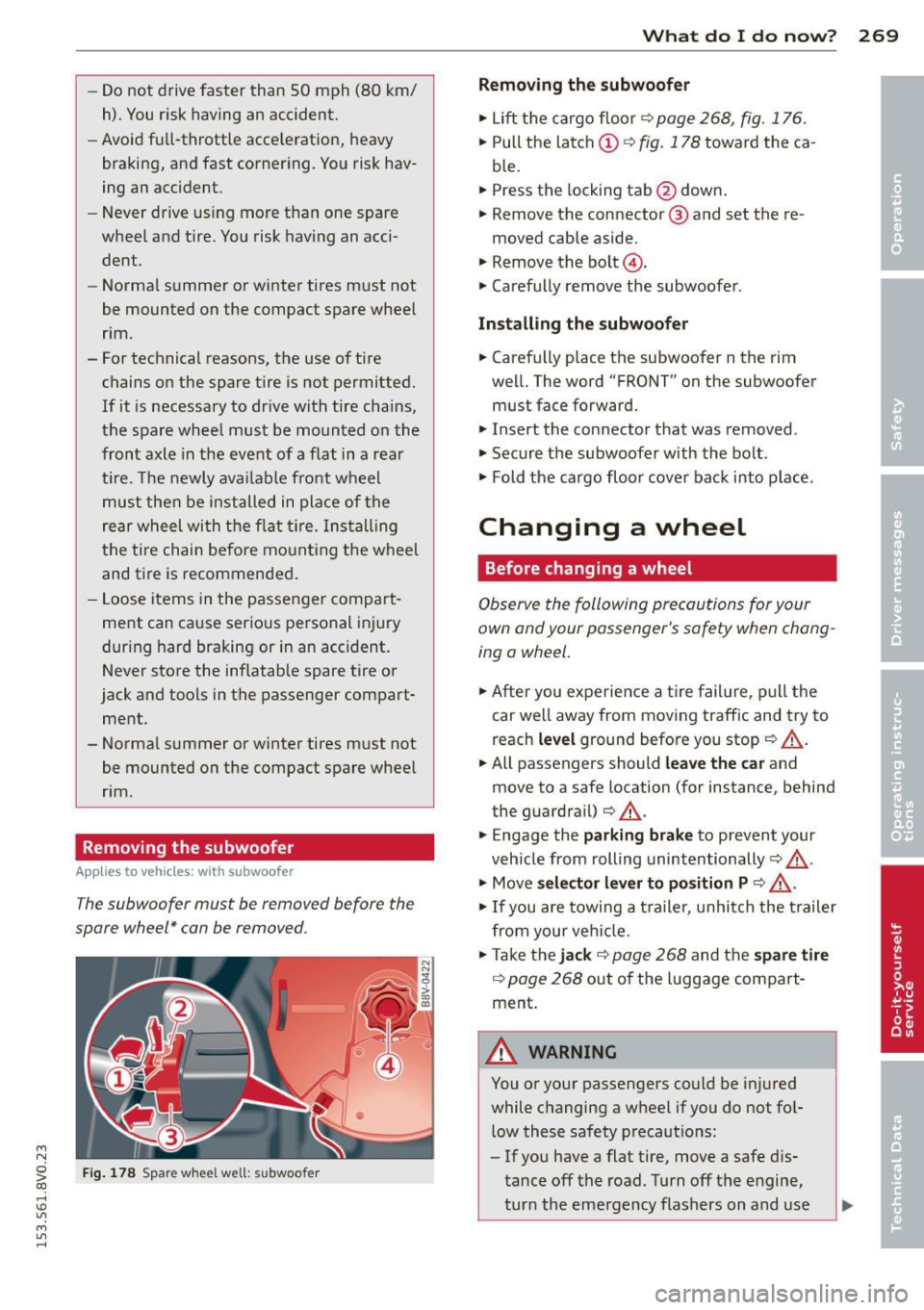
Removing the subwoofer
App lies to vehicles : with subwoofer
The subwoofer must be removed before the
spare wheel* can be removed .
Fig. 178 Spa re whee l w ell : subwoo fer
What do I do now ? 269
Removing the subwoofer
.,. Lift the cargo floor¢ page 268, fig . 176.
.,. Pull the latch (D ¢ fig. 178 toward the ca -
ble.
.,. Press the locking tab @down .
.,. Remove the connector ® and set the re-
moved cable as ide .
.,. Remove the bolt @ .
.,. Carefully remove the subwoofer .
Installing the subwoofer
.,. Carefully place the subwoof er n the rim
wel l. The word "FRONT" on the subwoofer
must face forward.
.,. Insert the connector that was removed.
.,. Secure the subwoofer with the bolt .
.,. Fold the cargo floo r cover back into place.
Changing a wheel
Before changing a wheel
Observe the following precautions for your
own and your passenger 's safety when chang
ing a wheel .
.,. Aft er you experience a tire failure, pull the
car we ll away from mov ing traffic and try to
reac h
level ground before you stop ¢ &_ .
.,. All passenge rs should
leave the car and
move to a safe location (for instance, behind
the guardrail)¢ &_ .
.,. Engage the
parking brake to prevent your
veh icle from rolling unintentionally¢&_ .
.,. Move
sel ector lever to po sition P ¢ ,&. .
.,. If you are towing a t ra iler, unhi tch the trailer
from your ve hicle .
.,. Take t he
jack ¢ page 268 and the sp a re tire
¢ page 268 out of the luggage com part
ment .
A WARNING
You or your passengers could be inj ured
while changing a w heel if you do not fo l
l ow these safety p recaut io ns:
- If you have a flat tire, move a safe d is
tance off the road. Turn off the engine,
turn the emergency flashers on and use
Page 282 of 310
280 Emergency situations
Emergency situations
General
This chapter is intended for trained emer
gency crews and working personnel who
have the necessary tools and equipment to
perform these ope rations.
Starting by pushing or
towing
Q;) Note
Vehicles w ith an automatic transmission
cannot be started by pus hing o r tow ing.
Starting with jumper
cables
If necessary, the engine can be started by
connecting it to the battery of another vehi
cle.
If the engine should fail to start because of a
discharged or weak battery, the battery can be
connected to the battery of
another vehicle,
using a
pair of jumpe r cables to start the en
g ine .
Jumper cables
Use only jumper cables of sufficiently large
cross section to carry the starter current safe
ly. Refer to the manufacturer's specif ications.
Use only jumper cables with
insulated termi
na l clamps which are distinctly marked:
plus(+) cable in most cases colored red
minu s(-) cable
in most cases colored black .
A WARNING
Batteries contain electricity, acid, and gas.
Any of these can cause very serious or fatal
inju ry. Follow the instructions below for
safe handling of your veh icle's battery.
- Always shield you r eyes and avoid lean
ing over the battery whenever possible.
- A discharged battery can freeze at tem
peratures just be low 32 °F (0 °C). Before connecting a
jumper cable, you must
thaw the frozen battery complete ly, oth
erwise it could explode.
- Do not allow battery acid to contact eyes
or skin . Flush any contacted area with
water immediately .
- Improper use of a booster battery to start a vehicle may cause an explosion.
- Vehicle batteries generate explosive gas
es. Keep sparks, flame and lighted ciga
rettes away from batteries.
- Do not try to jump start any vehicle with a low acid level in the battery.
- The vo ltage of the booster battery must
also have a 12-volt rating. The capacity
(Ah) of the booster battery should not be
lower than that of the discharged bat
tery . Use of batteries of d ifferent voltage
or substantially different "Ah" rating
may cause an exp losion and personal in
jury.
- Never charge a frozen batte ry. Gas trap
ped in the ice may cause an explosion.
- Never charge or use a battery that has
been frozen. The battery case may have
be weakened.
- Use of batter ies of different voltage or
substantially different capacity (Ah) rat
ing may cause an exp losion and injury.
The capacity (Ah) of the booster battery
should not be lower than that of the dis
charged battery.
- Before you check anything in the engine
compartment, always read and heed a ll
WARNINGS
¢page 217.
(D Note
-App lying a higher voltage booster bat
tery will cause expensive damage to sen
sitive electronic components, such as
contro l units, relays, radio, etc .
- Th ere must be no electrical contact be
tween the vehicles as otherwise current cou ld already start to f low as soon as the
positive(+) terminals are connected. .,.
Page 284 of 310
28 2 Em ergency sit uat ions
installed. Make sure the cables do not get
caught in moving engine components .
11. Sw itch the heater fan and rear window de-
froster
off.
12. Close the battery cover.
The battery is vented to the outside so that
not gases enter the passenger compartment.
Make sure that the connected positive termi
nal clamps on the jump start cable have suffi
cient contact with metal.
A WARNING
Follow the warn ings and instructions from
the jump start cable manufacturer to re
duce the risk of ser ious injuries and vehicle
damage.
If you are uns ure about anyth ing,
call roadside assistance.
- T he jump start cables must be long
enough so that the vehicles do not
touch.
- Route the jump sta rt cab les so they can
not get caught in the moving parts in the
engine compartment .
- Always read and follow the warn ings be
fore checking anything in the engine compartment ¢
page 217.
([) Note
Correctly jump start cables incorrect ly can
destroy the a lternator .
- Always connect the positive terminal(+)
to the positive terminal( +) and the neg
at ive termina l(- ) to the negative termi
nal(-) on the body ground point, b ut not
the negative termina l on the battery.
- Make sure the screw plugs on the battery ce lls are insta lled securely.
If not, tig ht
en the plugs before connecting the
clamps to the negat ive terminal on the
battery.
- Please note that the connecting process
described be low for the jump start ca
bles is intended for when your vehicle is
being jump started . If you are jump
starting another vehicle, do not connect
the negat ive cab le to the negative termi
nal (-) on the drained battery, but rathe r connect it to a
large metal component
that is bolted securely to the engine block, or to the engine block itsel f. If the
battery in the vehicle being jump started
is not vented to the outside, there is a
risk of explosion due to hydrogen gas .
- Make sure that the connected positive
terminal clamps have sufficient contact
w ith metal.
- Do not use the battery negative terminal
for jump start ing or a malfunct ion could
occur in the vehicle electrical system.
Emergency towing
with commercial tow
truck
General hints
Your Audi requires special handling for tow
ing .
The following information is to be used by
commerc ial tow truck operators who know
how to operate the ir equipm ent safely .
-Never tow your Aud i. Towing will cause
damage to the engine and transmission.
- Never wr ap the s afet y chains or winch ca
bles around the b rake lines.
- To p re v ent unnece ssary damage , your Aud i
must be transpo rted with a flat bed truck.
- To load the vehicle on to the fl at bed, u se
the towing loop found in the vehicle tools
and attach to the front or rea r ancho rage
c;,page 283 and c;,page 283.
A WARNING
A vehicle being towed is not safe for pas
sengers . Never allow anyone to ride in a
vehicle be ing towed, fo r any reason.
-
Page 285 of 310
....,
N
0 > co
rl I.O
"' ....,
"' rl
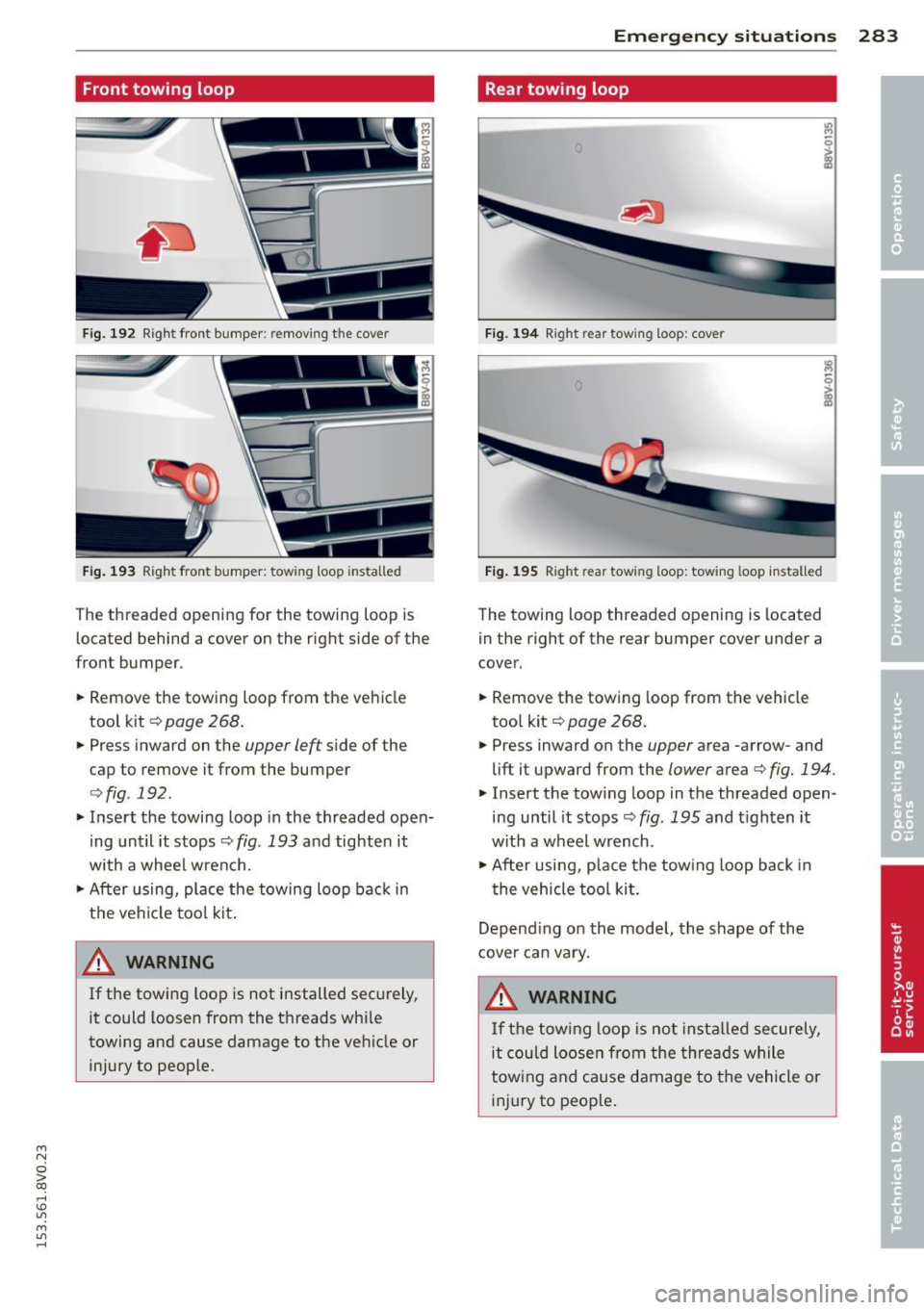
Front towing loop
Fig. 192 Right front bumpe r: remov ing the cover
Fig. 193 Right front bumper: towing loop installed
The threaded opening for the towing loop is
located behind a cover on the rig ht side of the
front bumper.
.. Remove the towing loop from the vehicle
tool kit¢
page 268 .
.. Press inward on the upper left side of the
cap to remove it from the bumper
¢fig. 192.
.. Insert the towing loop in the threaded open
ing until it stops¢
fig. 193 and tighten it
with a whee l wrench.
.. After using, place the towing loop bac k in
the vehicle too l kit .
A WARNING
If the towing loop is not i nstalled sec urely,
it could loosen from the t hreads whi le
towing and cause damage to the veh icle or
injury to people.
Emergenc y situ ation s 283
Rear towing loop
Fig. 194 Right rea r tow ing loop : cover
F ig . 1 95 Right rea r tow ing loop: tow ing loop installed
The towing loop threaded opening is located
in the right of the rear bumper cover under a
cover .
.. Remove the towing loop from the vehicle
too l kit ¢
page 268.
.. Press inward on the upper area -arrow- and
lift it upward from the
lower area¢ fig. 194.
.. Insert the tow ing loop in the threaded open
ing until it stops¢
fig. 195 and t ighten it
w ith a wheel wrench .
.. After using, p lace the tow ing loop back i n
t he vehicle tool kit.
Depend ing on the model, the shape of the
cove r ca n va ry.
A WARNING
If t h e tow ing loop is not insta lled securely,
it cou ld loose n from the threa ds while
tow ing and cause damage to the vehicle or
inj ury to people .
Page 291 of 310
M N
0 > co ,...., \!) 1.1"1
M 1.1"1 ,....,
Consumer Information
Warranty coverages
Your Audi is covered by the following war
ranties :
-New Vehicle Limited Warranty
- Limited Warranty Against Corrosion Perfo-
ration
- Emissions Control System Warranty
- Emissions Performance Warranty
- California Emissions Control Warranty (USA
vehicles only)
- California Emissions Performance Warranty
(USA vehicles only)
Detailed information regarding your warran
ties can be found in your
Warranty & Mainte
nance booklet .
Operating your vehicle
outside the U.S.A. or
Canada
Government regulations in the United States
and Canada require that automobiles meet
specific emission regulations and safety
standards. Therefore, veh icles built for the
U.S.A. and Canada differ from vehicles sold in
other countries .
If you p lan to take your vehicle outside the
continental limits of the United States or Can
ada, there is the possibility that:
- unleaded fuels for vehicles with catalytic
converter may not be available;
- fuel may have a considerably lower octane
rating . Improper fuel may cause engine
damage;
- service may be inadequate due to lack of
proper service facilities, tools or testing
equipment;
- replacement parts may not be readily availa
ble.
- Navigation systems for vehicles built for the
U.S.A. and Canada will not necessari ly work
in Europe, and may not work in other coun
tries outside North America .
Consumer Information 289
@ Note
Audi cannot be responsible for mechanical
damage that could result from inadequate
fuel, service or parts availab ility.
Audi Service Repair
Manuals and Literature
Audi Offic ial Factory Service Manuals and Lit
erature are published as soon as possible after
model introduction. Service manuals and lit
erat ure are available to order from the Audi
T echnical Literature Ordering Center at:
www.audi.techliterature.com
Maintenance
' General
Your vehicle has been designed to help keep
maintenance requirements to a minimum.
However, a certain amount of regular mainte
nance is still necessary to assure your vehicle's
safety, economy and reliability . For detailed
vehicle maintenance consult your Warranty &
Maintenance booklet.
Under difficult operating conditions , for ex
ample at extremely low outside temperatures,
in very dusty regions, when towing a tra iler
very frequently, etc., some serv ice work
shou ld be pe rformed between the intervals
specified. This applies particularly to:
- oil changes, and
- cleaning or replacing the air filter.
® For the sake of the environment
By regularly maintaining your vehicle, you
help make sure that emission standards
are maintained, thus min imizi ng adverse
effects on the environment .
Important considerations for you and
your vehicle
The increasing use of electronics, sophisticat
ed fuel injection and emission contro l sys-
tems, and the genera lly increasing technica l ..,_
•
•
Page 299 of 310
M N
0 > co ,...., \!) 1.1'1
M 1.1'1 ,....,
Driver information system ... .. .. .. .. .. 27
Boost ..... .. .. .. .. .... ... .. .. .... 29
CD/radio display ....... ... .. .. .. .. .. 27
Door/rear lid warning ..... .. .. .. .. .. 27
Driver messages . . . . . . . . . . . . . . . . . . . . 14
Efficiency program . . . . . . . . . . . . . . . . . . 29
E ng ine o il temperature indicator .. .. .. 32
I ndicator lights . . . . . . . . . . . . . . . . . . . . 14
L ap time r .. ............... .. .. .. .. 3 2
On- boa rd comp ute r . . . . . . . . . . . . . . . . . 28
Outside tempera ture display . ... .. .. .. 27
Service interval disp lay . ... .. .. .. .. .. 13
Using the multifunction steer ing whee l . 27
Dr iver sea ting posi tion ...... .. .. .. .. . 126
Drive se lect
refer to Audi dr ive se lect . ...... ... .. 106
D riving safe ly . .. .. ..... ... .. .. .. .. . 125
D riving through water . . . . . . . . . . . . . . . 198
Driving time . . . . . . . . . . . . . . . . . . . . . . . . 28
D ust filter
refer to Po llutant filte r . . . . . . . . . . . . . . 68
E
EC O mode ( autom atic clima te control sys -
tem) . ..... .. .. ... .. ..... ... .. .. .... 70
E fficiency program . . . . . . . . . . . . . . . . . . . 29
D escr ipt io n ................. ... ... . 29
Fu el economy messages . . . . . . . . . . . . . 30
O the r equipmen t . . . . . . . . . . . . . . . . . . . 30
Elect rical accessories
refer to Socket . . . . . . . . . . . . . . . . . . . . . 60
Elect romechanical par king brake
refer to Parking brake ..... .. .. .. .. .. 80
E lect romechan ic a l steering .. .. .. .. .. . 193
I ndica tor ligh ts .. ..... ... .. .. .. .. . 193
E lect ron ic diffe rent ial loc k ... .. .. .. .. . 189
I ndicator light . . . . . . . . . . . . . . . . . . . . . 2 2
Electronic immobili zer ...... .. .. .. .. .. 40
also refer to Immobilizer .. .. .. .. .. .. 35
E lect ro nic spee d limiter .. ... .. .. .. .. .. 31
E lect ronic stabilization control (ESC)
I ndicator light . . . . . . . . . . . . . . . . . . . . . 2 2
Sport mode .. ........... .. .. .. .. . 190
Electro nic Stabilization Control (ESC) .. . 189
Eme rgency ass istance ... ... .. .. .. .. . 26 7
E mergency flasher ...... ... .... .. .. .. 47
Inde x 297
Emergency flashe rs
Indicator light ... .. . ... ...... ... .. . 26
Emergency operation Emergen cy bra king f unct ion ..... .. .. . 82
F ron t passenger's door/rear doors .. .. . 41
L uggage compartment lid .... ... .. .. 2 67
Pano rama sunroof . .. .. ..... ... .. .. . 4S
with convenience key . . . . . . . . . . . . . . . . 79
E mergency re lease
F uel fi ller doo r ... .. . .............. 214
S e lector lever . . . . . . . . . . . . . . . . . . . . . 116
Emergency starting ................. 280
Emergency towing . ................. 282
E nergy m anagement ............ .. .. 19 4
Ind icator lig ht ... .. .. .. ...... ... .. . 2 0
E ngine
Coolant ......... .. ............... 225
Pr ewa rm ing (butto n) ............... . 77
P rewarm ing ( key) . .... ........... .. . 74
Star ting with jumper cables .. ... .. .. 2 80
S tar ting (driver messages with conven -
ience key) . . . . . . . . . . . . . . . . . . . . . . . . . 79
Starting (eng ine) . .. ............... . 77
Starting
(key) . . . . . . . . . . . . . . . . . . . . . . 7 4
stopp ing (button) .................. 78
stopp ing (key) . ......... ........... 76
Engine compartment Closing the hood ..... ............. 219
Open ing the ho od ............. .. .. 219
Overview.. .. .. .. ............ 220,221
Safety precautions ... . .. ...... .... . 217
Engine co ntrol (indicato r light) . . . . . . . . . 23
En gine coolant .. .. ................. 225
Radiator fan . .. .. .... ............. 227
Engine o il .. .. .. .. .. . .. .. ..... ... .. 221
adding ......... .. ............... 223
Changi ng ... .. .. .. . .. .... .... .. .. 224
Checking the oi l level ............. .. 22 3
Dip stic k ... .... .. .. . ..... 2 20, 22 1,22 3
Ind icator lig ht . .. .... ........... .. . 20
Oil consumpt ion . ... . .. .. ..... ... .. 2 22
Specificatio n and viscosity .... ... .. .. 221
T emperature indicato r ... .... ... .. .. . 32
U se ...... .. .. .. ................. 223
Engine speed lim itation ( indica to r li gh t) . 24
•
•
•
Page 306 of 310
304 Index
------------------------------------
With button . . . . . . . . . . . . . . . . . . . . . . . 77
With key ... ... .......... .. .. .... .. 74
Steering
Elect rom echan ical steering . . . . . . .
193, 0
Indicator light . . . . . . . . . . . . . . . . . . . . . 21
Lockin g steering (ignition key) .... .. .. 76
Locking the steering (button) ....... . . 78
Locking (mechanical ignition lock) ... . . 74
also refer to Electromechan ica l steer-
ing .. .. .. .. ........... .......... .
193
Steering wheel
adjusting . .... .......... .. .. .... ..
74
Buttons ..... .. .......... .. .. .... .. 28
Multifunction steering wheel ... ...... 27
Shift paddles (automatic transmission) 114
Steps for determining correct load limit . 250
Stopping (engine)
with button . . . . . . . . . . . . . . . . . . . . . . .
78
with key ..... .............. ..... .. 76
Storage compartments . . . . . . . . . . . 61, 62
Storage hooks . . . . . . . . . . . . . . . . . . . . . . . 66
S tronic transmission
refer to Automatic transmission . ..... 109
Subwoofer ... ................ ... ... 269
Sun visors . . . . . . . . . . . . . . . . . . . . . . . . . .
50
Switching daytime runn ing ligh ts on and
off ................................ 49
Switching the ign ition on/off (with key) .. 74
Switch the ig nition on/off (with key) . .... 74
Symbo ls
refer to Indicator lights ......... ..... 14
System indicator light ( MIL) . . . . . . . 23, 30
T
Tachometer..................... 10 , 11
TOI clean diesel
refertoAdBlue ....................
215
Technical Data ...................... 286
Technical modifications ....... .. .. ... 291
Temperature display
Coolant .. .. ................ ... .. ..
10
Outside temperature ................ 11
Tether anchors . . . . . . . . . . . . . . . . . . . . . 187
Tether strap .. .. .......... .. .. .... . 187
The first 1,000 miles (1,500 km) and after-
wards ... .. .... .............. ......
197
Tie-downs . . . . . . . . . . . . . . . . . . . . . 65, 132
Tips for the environment
Saving fu el .... .. .... ......... .....
63
tip tron ic (a utomatic transm ission) ..... 114
T ire pressure .... .. .. ........... .. .. 245
T ire pressure monitoring system ....... 264
Tires .............................. 233
Serv ice life .... .. ................ . 252
Speed rating letter code ............ 257
Tire manufacturing date ............ 256
Tire pressure monitoring system ... .. 265
Ti re specifications ................. 256
Tread depth . ................. .... 252
Unif orm tire quality grading ......... 260
Winter tires ..... ... .......... .. .. 261
T ires and vehicle load limits ...... ... .. 249
Tires and wheels
Checking t ire pressure .......... .. ..
245
Co ld tire inflation pressure .......... 240
Dimensions .. .. .................. . 254
General notes .. .................. . 233
Glossary of tire and loading terminolo-
gy ..............................
235
Low a spect ratio tires ............... 263
New tires and wheels ............... 254
Replacing ..... .. .. ........... .. .. 255
Snow chains ..... .. ........... .. .. 262
Tires and veh icle load limits ......... 249
Wheel bolts . .. .. .......... ....... 262
Winter tires ..... .............. ... 261
Tire service life .... .. ........... .. .. 252
Tool kit ....... ................... . 268
Torn or frayed safety belts ............ 138
Towing
To w t ruck procedures ......... .. .. ..
282
Towing loop ....................... . 283
TPMS (tire pressure monitoring system) . 265
Trai le r towing . .. .. .............. ... 202
Operating instruct ions .......... .. .. 202
Technical requirements . . . . . . . . 202, 203
Trai ler towing tips . ............ .. .. 203
Transmission malfunction (indicator
light ) .............................
115
Transport Canada ................... 134
Travel mode . . . . . . . . . . . . . . . . . . . . . . . . 49
Tread Wear Indicator (TWI) ........... 252