ABS AUDI S3 2015 Owners Manual
[x] Cancel search | Manufacturer: AUDI, Model Year: 2015, Model line: S3, Model: AUDI S3 2015Pages: 310, PDF Size: 76.15 MB
Page 18 of 310
16 Instruments and indicator lamps
or
~~
&
CD
TPMS
;
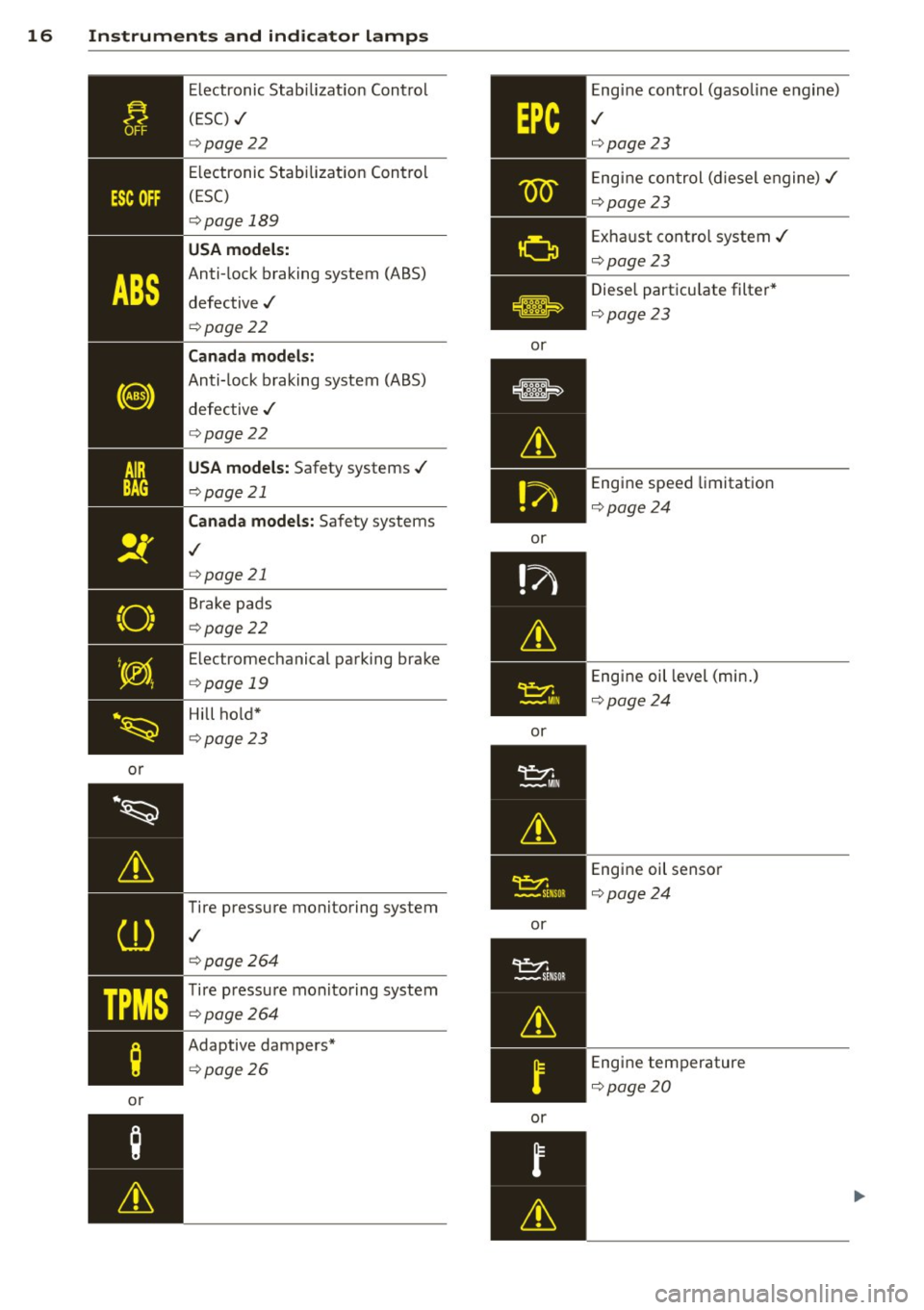
or Electronic
Stabilizat ion Control
(ESC) ../
c:>page22
Electronic Stabilization Control
(ESC)
c:> page 189
USA models:
Anti-lock braking system (ABS)
defective../
c:> page22
Canada models:
Anti-lock braking system (ABS)
defective ../
c:>page22
USA models: Safety systems ../
c:>page 21
Canada models: Safety systems
,I
c:>page 21
Brake pads
c:>page22
Electromechanical parking brake
c:>page 19
Hill ho ld*
c:>page23
Tire pressure monitoring system
,I
c:> page264
Tire pressure monitoring system
c:>page264
Adaptive dampers*
c:>page26
or
or
or
or
or E
ngine control (gasoline e ngine)
,I
c:>page23
Eng ine control (diesel engine)../
c:>page23
Exhaust control system../
Qpage23
Diesel particu late filter*
Q page23
Engine speed limitation
Qpage24
Engine oil level (min.)
Q page24
Engine oil sensor
Qpage24
Engine temperature
Qpage20
Page 20 of 310
18 Instruments and indicator lamps
Ad Blue -I"
or
Ad Blue/
~
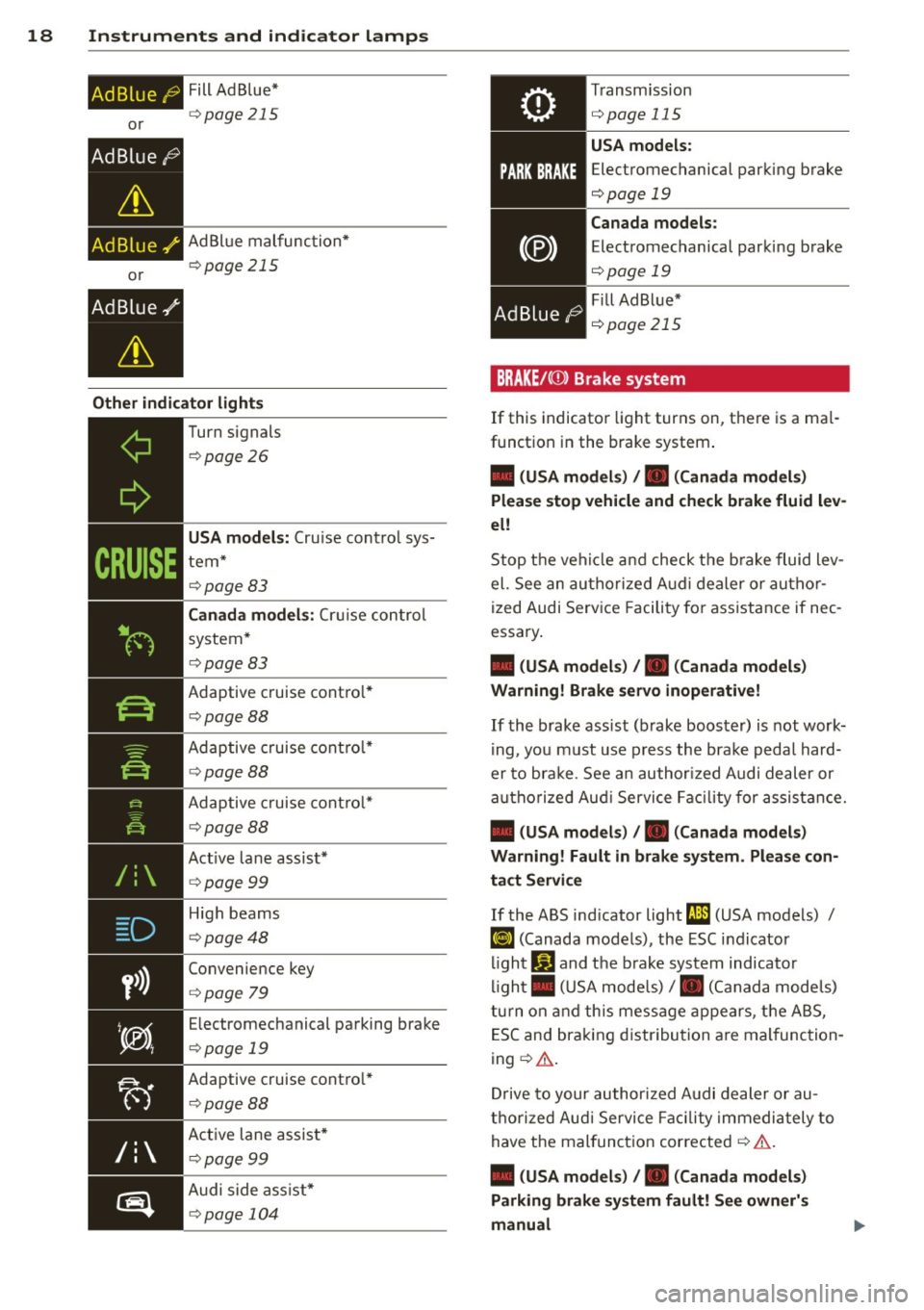
AdBlue malfunction*
Qpage 215
Other indicator lights
-------------
Turn signals
Qpage26
USA models: Cruise control sys
tem*
Q page 83
Canada models: Cruise control
system*
Q page 83
Adaptive cruise control*
Qpage 88
Adaptive cruise control*
Qpage88
Adaptive cruise control*
Qpage 88
Active lane assist*
Qpage 99
High beams
Qpage48
Convenience key
Qpage 79
Electromechanical parking brake
Qpage 19
Adaptive cruise control*
Qpage88
Active lane assist*
Qpage 99
Audi side assist*
Qpage 104
Transmission
Qpage 115
USA models:
Electromechanical parking brake
Qpage 19
Canada models:
Electromechanical parking brake
c::>page 19
Fill Ad Blue*
r::!) page 215
BRAKE/C(D) Brake system
If this indicator light turns on, there is a mal
function in the brake system.
• (USA models) , • (Canada models)
Please stop vehicle and check brake fluid lev
el!
Stop the vehicle and check the brake fluid lev
el. See an authorized Audi dealer or author
ized Audi Service Facility for assistance if nec
essary.
• (USA models) , • (Canada models)
Warning! Brake servo inoperative!
If the brake assist (brake booster) is not work
ing, you must use press the brake pedal hard
er to brake . See an authorized Audi dealer or
authorized Audi Service Facility for assistance.
• (USA models) , • (Canada models)
Warning! Fault in brake system. Please con
tact Service
If the ABS indicator light (JD (USA models) /
II] (Canada models), the ESC indicator
light
G1 and the brake system indicator
light . (USA models)/ . (Canada models)
turn on and this message appears, the ABS,
ESC and braking distribution are malfunction
ing
r::!) & .
Drive to your authorized Audi dealer or au
thorized Audi Service Facility immediately to
have the malfunction corrected
i::::> A .
• (USA models) , • (Canada models)
Parking brake system fault! See owner's
manual
Page 21 of 310
M N
0 > co ...... \!) ..,.,
M ..,., ......
-If the indicator light and the message ap
pear
when the vehicle is stationary or after
switching the ignition on,
check if you can
release the parking brake . If you cannot re
lease the parking brake, see your authorized
Audi dealer or authorized Audi Service Facili
ty. If you can release the parking brake and
the message still appears, see an authorized
Audi dealer or authorized Audi Service Facili
ty immediately to have the malfunction cor
rected.
- If the indicator light and message appear
while driving, the hill start assist or emer
gency braking function may be malfunction
ing.
It may not be possible to set the park
ing brake or release it once it has been set.
Do not park your vehicle on hills and see an
authorized Audi dealer or authorized Audi
Service Facility for assistance.
(USA models): If the. and&] indicator
lights turn on together, take your vehicle to an
authorized Audi dealer or authorized Audi
Service Facility immediately to have the brake
pads inspected c;, page 22 .
There is also a warning tone when the lights
turn on.
A WARNING
-
-Follow the warnings on c::;, page 217,
Working in the engine compartment
be
fore opening the hood and checking the
brake fluid level.
-If the brake system indicator light does
not turn off or it turns on while driving,
the brake fluid level in the reservoir is
too low, and this increases the risk of an
accident. Stop the vehicle and do not
continue driving. See an authorized Audi
dealer or authorized Audi Service Facility
for assistance.
-If the brake system indicator light turns
on together with the ABS and ESC indica
tor lights, the ABS/ESC regulating func
tion may be malfunctioning. Functions
that stabilize the vehicle are no longer
available . This could cause the rear of the
vehicle to swerve, which increases the
Instruments and indicator lamps 19
risk that the vehicle will slide. Drive care
fully to the nearest authorized Audi deal
er or authorized Audi Service Facility and have the malfunction corrected.
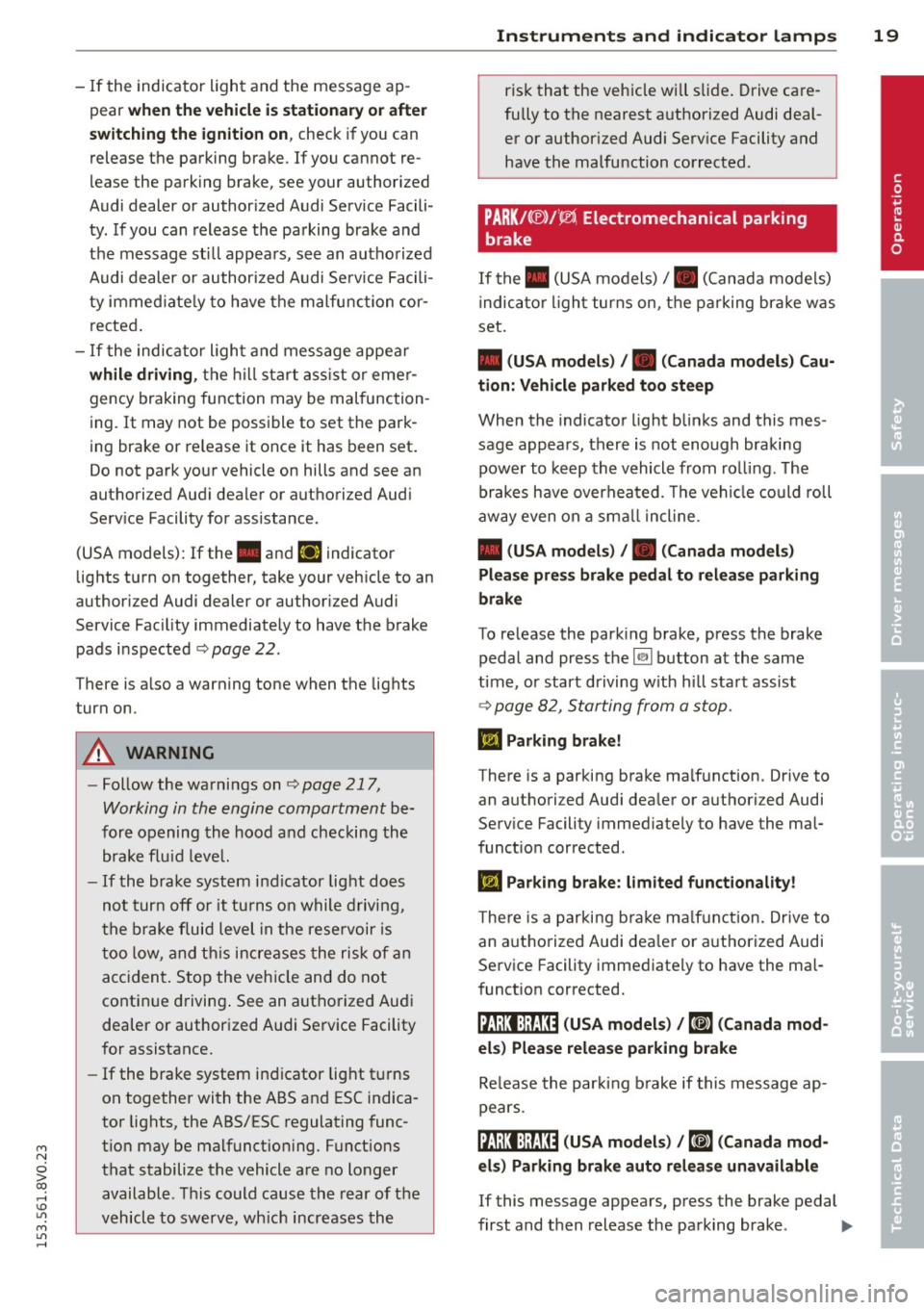
PARK /C®)/¢5, Electromechanical parking
brake
If the . (USA models) /. (Canada models)
indicator light turns on, the parking brake was
set.
• (USA models) I. (Canada models) Cau
tion: Vehicle parked too steep
When the indicator light blinks and this mes
sage appears, there is not enough braking
power to keep the vehicle from rolling. The
brakes have overheated. The vehicle could roll
away even on a small incline .
• (USA models) I. (Canada models)
Please press brake pedal to release parking
brake
To release the parking brake, press the brake pedal and press the~ button at the same
time, or start driving with hill start assist
c::;, page 82, Starting from a stop.
Ill Parking brake!
There is a parking brake malfunction. Drive to
an authori zed Audi dealer or authorized Audi
Service Facility immediately to have the mal
function corrected.
Iii Parking brake: limited functionality!
There is a parking brake malfunction. Drive to
an authorized Audi dealer or authorized Audi
Service Facility immediately to have the mal
function corrected.
ll:1;1:tl:j;J:134 (USA models) I mil (Canada mod
els) Please release parking brake
Release the parking brake if this message ap
pears.
ll,1;1:tl:j;(;134 (USA models) / mil (Canada mod
els) Parking brake auto release unavailable
If this message appears, press the brake pedal
first and then release the parking brake .
IJJ,,
•
Page 24 of 310
22 Instruments and indicator lamps
See an authorized Audi dealer o r autho riz ed
Audi Service Facility for assistance.
A WARNING
If the eng ine stops whi le driving, yo u wi ll
need to use more force to b rake the vehi
cle. This increases the risk of an accident.
T here will still be power steer ing if the ig
nition is switched on w hile the vehicle is
rolling and ther e is suffici ent ba tte ry
c h arge. Othe rwise, you mu st use greate r
force when s tee ring.
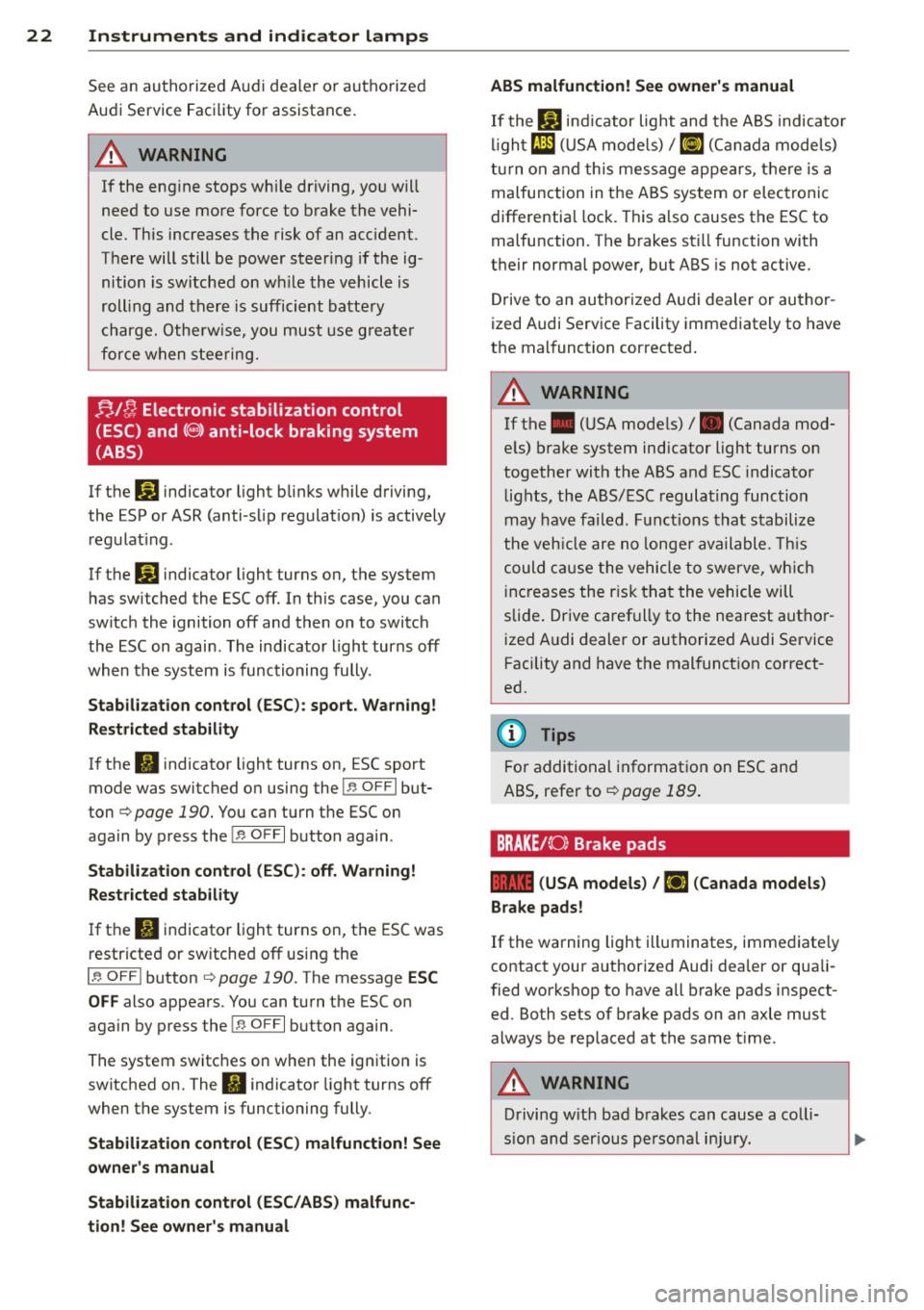
f;! ~ Electronic stabilization control
(ESC) and
( @ ) anti-lock braking system
(ABS)
If t he Jj;J indicato r light b links w hile driving,
the ESP or ASR (anti-s lip regulat io n) is actively
regulat ing .
If the
J;.) indicato r light turns on, t he system
h as sw itched the ESC off . In this case, you can
sw itch the ignition off and then on to switch
the ESC on again. The indicator light turns off
when t he system is functioning fully .
Stabilization control (ESC): spo rt. Warning!
Restricted stability
If the II indicato r light turns on, ESC sport
mode was switched o n using the!.$ OFF I but
ton
c> page 190 . You can turn the ESC on
aga in by press the!.$ OFFI button again .
Stabilization control (ESC ): off. Warning!
Restricted stab ility
I f the II indicator light turns on, t he ESC was
restricte d or sw itched off using the
I .$ OFF i button
c> page 190. The message ESC
OFF
also appears. You can tu rn the ESC o n
again by p ress the!.$ OFFI button again .
The system switc hes on when the ign ition is
switched on. The
II i ndicato r light turns off
when t he system is functioning fully .
Stabilization control (ESC) malfunction! See
owner's manual
Stabilization control (ESC/ABS) malfun c
tion! See owner 's manual ABS malfunction! See owner's manual
I
f the Bl ind icator light and the ABS indica to r
li gh t
El] (US A mode ls)/ ilJ (C anad a m ode ls)
tu rn on and th is message appears, t he re is a
malfunction in the A BS system or electronic
differentia l lock. This also causes the ESC to
malfu nction. The b rakes st ill function with
their normal power, but ABS is not active.
Drive to an au thori zed A udi dealer or au tho r
ized Audi Serv ice Facility immediately to have
t h e mal function c orrected .
A WARNING "--
If th e . (U SA mode ls) /. (Canada mod -
e ls) b rake system indicator light turns on
t o gether wi th the ABS a nd ESC indicato r
lig hts, the A BS/ ESC regula ting func tion
may have fa iled. F unctions that stabilize
t he veh icle are no longe r ava ilable. This
could cause the vehicle to swerve, wh ich
i nc reases the r is k th at the vehicle will
slide . Dr ive caref ully to the nearest aut ho r
i zed A udi dealer or authorized A udi Service
Facility and have the mal funct ion c orrect
ed.
(D Tips
Fo r additional informat io n on ES C an d
ABS, refer to
c> page 189 .
BRAKE/{ 0: Brake pads
1111 (USA models ) I riJ (Canada models )
Brake pads!
If the warning light i lluminates, imme diate ly
contact your a uthorized Audi dea ler or qua li
fied workshop to have all b rake pads inspect
ed. Both sets of brake pads on an axle must
always be replaced at the same t ime .
A WARNING
Driving w it h ba d brakes can cause a colli
sion and s erious pe rsonal in ju ry.
Page 31 of 310
....,
N
0 > co
rl I.O
"' ....,
"' rl
.. To switch between the tabs, p ress the rocker
button ® to the left or right~
fig. 10.
.. To access additional information be low or
above, rotate the thumbwheel @down or
up .
.. To confirm a selection, press the thumb
wheel @.
.. To select a function programmed to a steer
ing wheel button, p ress the button@. Fo r
addi tional informa tion, see¢
page 29, As
signing a function to the programmable
steering wheel button
Calling up the Vehicle functions
.. Se lect the first tab w ith the button @ .
.. Press the button @. The
V eh icle fun ction s
menu is displayed 9fig. 11 .
.. To select a menu item, turn and press the
th umbwheel @.
Resetting values to zero
.. In the Vehicle function s menu, select On·
board computer or Efficien cy prog ram .
.,. Se lect a v alue in the desired trip computer
or in the efficiency program .
.. To reset the values in a memo ry, press and
hold the thumbwhee l@ for one second.
Recalling indicator lights and messages
.. Press the button (!) repeated ly until the Q
tab appears.
The
Q tab is only vis ible when there is a mal
function.
Assigning a function to the programmable steering wheel button
.. Select: the I MENU ! button >Car > Sy stem s*
control button > Vehi cle setting s > Stee ring
wheel button progr amming .
The Q tab is only vis ible when there is at
least one indicator light or message dis
p layed.
(0 Tips
- If the vehicle battery is d iscon nected, all
memo ry valu es a re e rased.
Dr iver in formation system 29
- In formation on the efficiency program
¢page 29 .
-There is more information on the multi
function stee ring wheel in the MMI *
owne r's man ual.
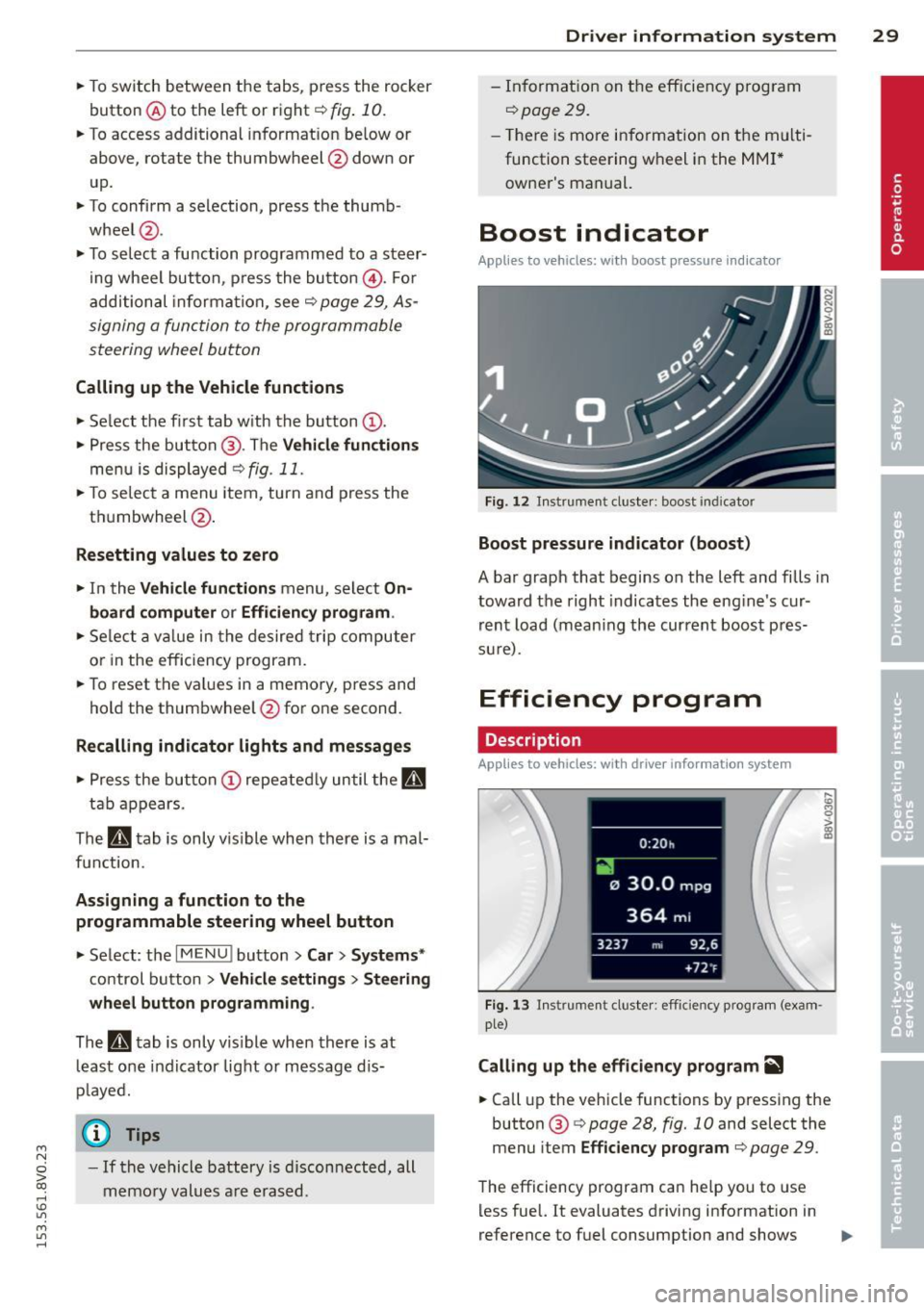
Boost indicator
Applies to vehicles: with boost pressure indicator
Fig. 12 Instrument cluste r: boost indicator
Boost pressure indicator (boost)
A bar graph that begins on the left and fills in
toward the right indicates the eng ine's cur
rent load (m ean ing the current boos t pres
su re).
Efficiency program
Description
Applies to vehicles: with driver information system
Fig. 1 3 In strument cluster: efficie ncy program (exam
ple)
Calling up the efficiency program~
.. Call up the vehicle functions by pressing the
button ®
9 page 28, fig. 10 and select the
menu item
Efficiency p rogram ¢page 29 .
The efficiency program can he lp you to use
less fuel.
It evaluates driving information in
reference to fuel consumption and shows .,..
Page 80 of 310
78 Driving
must use more force to steer or brake
the vehicle. Because the usual steering
and braking capability is not available,
the risk of accidents or injuries increases .
- Avoid high engine speed, full throttle,
and heavy engine load as long as the en
gine has not reached operating tempera
ture yet. You could damage the engine .
- The engine cannot be started by pushing
or towing.
@ For the sake of the environment
Do not let the engine run while parked to
warm up. Begin driving immediately. This
reduces unnecessary emissions.
{D) Tips
- After starting a cold engine, there may
be a brief period of increased noise be
cause the oil pressure must first build up in the hydraulic valve adjusters. This is
normal and not a cause for concern .
- If the . indicator light blinks in the in
strument cluster before switching the ig
nition off, the ignition will not switch on
again.
9 page 193
- If you leave your vehicle with the ignition
switched on, the ignition will switch off
after a certain amount of time. Make
sure that electrical equipment such as
the exterior lights are switched off.
Turning the engine off using the button
Applies to vehicles: with conven ience key
• Bring the vehicle to a full stop.
• Move the selector lever into the P position .
• Press the
I START ENGIN E STOPI button
9page 77, fig. 71 .
Steering lockll
The steering locks when you turn the engine
off using the
I START E NGIN E STOP t* button,
l) Thi s fun ction is not available in all c oun tries.
move the selector lever into the P position
and open the driver's door.
The locked steering helps prevent vehicle
theft .
Emergency off function
If it is absolutely necessary, the engine can al
so be turned off while driving at speeds lower
than 6 mph (10 km/h). If you press the
I STAR T ENGINE ST OPI* button while driving,
the message
Pressing start/stop button
again will switch off engine!
appears. To
switch the engine off, press the
I S TAR T ENGINE ST OPI* button twice in a row
briefly or press and hold for longer than two
seconds.
A WARNING ~
- Never turn off the engine before the ve- hicle has come to a complete stop . The
full function of the brake booster and the
power steering is not guaranteed . You
must use more force to turn or brake if
necessary. Because you cannot steer and
brake as you usually would, this could
lead to crashes and serious injuries.
- Please note that the brake booster and
power steering only work when the en
gine is running. When the engine off, you
must use more force to steer or brake
the vehicle. Because the usual steering
and braking capability is not available,
the risk of accidents or injuries increases.
- Always take the vehicle key with you
when leaving the vehicle, even for a
short period of time. This applies partic
ularly when children remain in the vehi
cle . Otherwise the children could start
the engine or operate electrical equip
ment such as power windows.
- For safety reasons, always park the vehi
cle with the selector lever in the P posi
tion. Otherwise, there is the risk that the
vehicle could roll.
Page 84 of 310
82 Driving
Starting from a stop
The start assist function ensures that the
parking brake is released automatically upon
starting.
St opping and sett ing the p ark ing br ake
.. Pull the switch@¢
page 80, fig. 73 to set
the parking brake.
St arting a nd aut omaticall y relea sing the
pa rking br ake
Requirement: The driver's door must be
locked and the driver's safety belt must be
fastened.
.. When you press the accelerator pedal, the
parking brake is automatically released and
your vehicle begins to move.
When stopping at a traffic signa l or stopping
in city traffic, the parking brake can be ap
plied. The vehicle does not have to be held
with the brake pedal. The parking brake elim i
nates the tendency to creep when a selector
l ever pos ition is engaged . As soon as you
press the accele rator pedal, the parking bra ke
re leases automatically and the veh icle starts
to move.
Starting on slope s
When starting on incl ines, the hill start ass ist
prevents the vehicle from unintentiona lly roll
i ng back. The braking force of the parking
brake is not released until sufficient dr iving
force has been bu ilt up at the whee ls.
(D Tips
For safety reasons, the park ing brake is re
leased automatically only when the dr iv
er 's sa fety belt is fastened and the driver 's
door is locked. Emergency braking function
This is used if the conventional brake system
fails or locks up .
.. To brake your vehicle in an emergency, pull
the @switch ¢
page 80, fig. 73 and hold it
pulled .
.. As soon as you release the@ switch or ac-
celerate, the b rak ing process stops.
Pul ling and ho ld ing the @switch while dr iv
ing at a speed of about 2 mph (3 km/h) or
higher init iates the emergency braking func
t ion. The vehicle is braked at a ll four wheels
by activating the braking hyd rauli cs . The brake
performance is sim ila r to heavy braking.
~ .&.
To he lp prevent activating the emergency
braking by mistake, a n aud ible war ning tone
(buzzer) sounds when the @switch is pulled .
Emergency brak ing stops as soon as the@
swi tch is re leased or the acce lerator pedal is
pressed.
.&, WARNING ,_
Emergency braking should only be used in
an emergency, when the normal brake pedal has fa iled or the brake pedal is ob
structed. During emergency brak ing, your
vehicle will brake s imilar to heavy b rak ing .
E SC and the associated components (ABS,
ASR, EDL) canno t overcome the laws of
physi cs. In corne rs and when road or
weather conditions are bad, a fu ll brake
application can cause the vehicle to skid or
the rea r end to break away, which increas
es the risk of an accident.
Hill hold
Applies to veh icles : w ith Hill Hold
Hill hold makes it easier to start on hills.
Req uirement: The dr iver door mus t be closed
and the engine must be running.
T he system is activated when the bra ke peda l
is p ressed while the vehi cle is stationa ry.
T o p revent the vehicle from rolling back when
sta rting, the b rake power is held fo r a b rief
ll>
Page 134 of 310
132 Driving saf ety
A WARNING
Heavy loads will influence the way your ve
hicle handles. To help reduce the risk of a
loss of control leading to ser ious personal
injury:
-Always keep in m ind when transporting
heavy objects, that a change in the cen
ter of gravity can also cause changes in
vehicle handling:
- Always distribute the load as evenly as
possible.
- Place heavy objects as far forward in
the luggage compartment as possible.
- Never exceed the Gross Ax le Weight Rat
ing or the Gross Vehicle Weight Rating
specified on the safety compliance stick
er on the left door jamb. Exceeding per
missible we ight standards can cause the
vehicle to slide and handle differently.
- Please observe information on safe driv
ing
opoge 125.
A WARNING
To help prevent poisonous exhaust gas
from be ing drawn into the veh icle, always
keep the rea r lid closed while dr iving.
- Never transport objects larger than those fitting completely into the luggage
area because the rear lid cannot be fully
cl osed.
- If you absolutely must drive w ith the rear
lid open, observe the follow ing notes to
reduce the risk of poisoning:
- Close all w indows,
- Close the power roof *,
- Open all air outlets in the instrument
panel,
- Sw itch off the air recircu lation,
- Set the fresh a ir fan to the highes t
speed.
A WARNING
Always ma ke s ure th at the doors, all win
dows, the power roo f* and the rear lid are
securely closed and locked to reduce the risk of injury when the vehicle is not being
used.
- After closing the rear lid, always make
sure that it is properly closed and locked.
- Never leave your vehicle unattended es
pecially with the rear lid left open. A
child cou ld craw l into the vehicle thro ugh
the luggage compartment and close the rea r lid becoming trapped and unable to
get out. Being t rapped in a vehicle can
lead to serious pe rsonal in jury.
- Never let children play in or around the veh icle.
- Never let passengers ride in the luggage
compa rtment. Vehicle occupants must
always be prope rly restra ined in one of
the vehicle's seating posit ions.
(D Tips
- Air circulation helps to reduce window
fogging. Stale a ir escapes to the outside
through vents in the t rim panel. Be sure
to keep these slots free and open.
- The tire pressure m ust correspond to the
load. The tire pressure is shown on the
t ire pressure label. The tire pressure la
bel is located on the drive r's side B-pilla r.
The tire pressure label lists the recom
mended co ld tire inflation pressures for
the vehicle at its maxim um capacity
we ight and the tires that we re on your
vehicle at the t ime it was manufactured.
For recommended tire pressures for nor
ma l load cond itions, please see chapter
opoge240.
Tie -downs
The luggage comportment is equipped with
four tie-downs to secure luggage and other
items.
Use the t ie-downs to secure your cargo prop
erly
o page 131, Loading the luggage com
portment .
In a collision, the laws of physics mean that
even smaller items that are loose in the vehi-
cle w ill become heavy missiles t hat can cause .,..
Page 138 of 310
136 Safet y belt s
-Failure to pay attention to the warning
light that come on, could lead to person
al injury.
Why safety belts?
Frontal collisions and the law of physics
Frontal crashes create very strong forces for
people riding in vehicles.
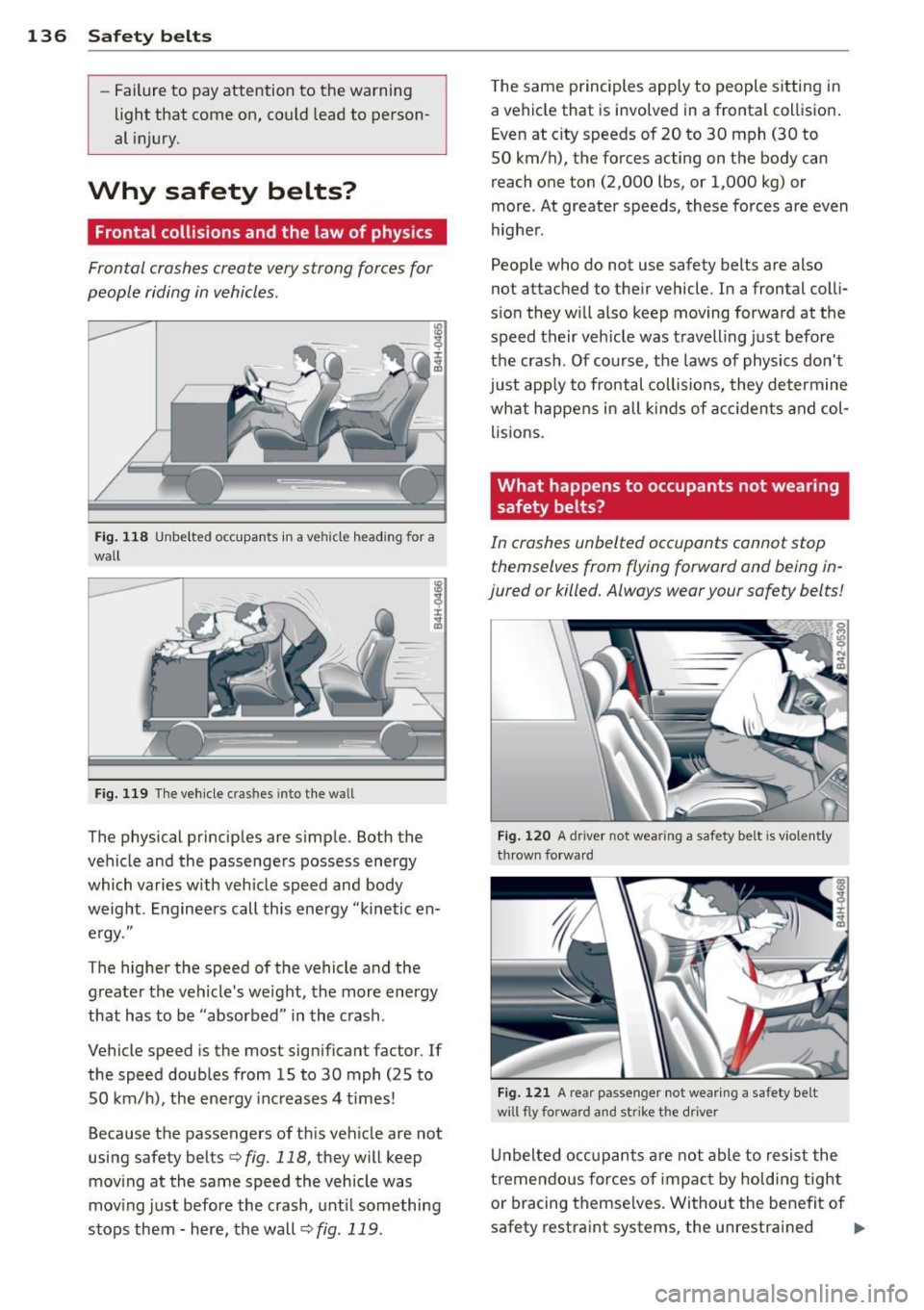
F ig. 11 8 Unbelted occ upants in a ve hicle h eading for a
wall
Fig. 1 19 Th e vehicle c rash es into t he wall
The physical principles are simple. Both the
vehicle and the passengers possess energy
which varies w ith veh icle speed and body
weight . Engineers call this energy "kinetic en
e rgy ."
T he higher the speed of the vehicle and the
g reater the vehicle's we ight, the more energy
that has to be "absorbed" in the crash .
Vehicle speed is the most sign ificant factor.
If
the speed doubles from 15 to 30 mph (25 to
50 km/h), the energy increases 4 t imes!
Because the passengers of this veh icle are not
using safety belts
c::;, fig. 118, they w ill keep
mov ing at the same speed the vehicle was
mov ing just before the c rash, unt il something
stops them - here, the wall ¢
fig. 119 .
The same principles apply to people sitting in
a vehicle that is involved in a frontal collision .
Even at c ity speeds of 20 to 30 mph (30 to
50 km/h), the forces acting on the body can
reach one ton (2,000 lbs , or 1,000 kg) or
more . At greater speeds, these forces are even
highe r.
Peop le who do not use safety belts are also
not attached to their vehicle. In a frontal colli
s io n they will also keep moving forward at the
speed their veh icle was t ravell ing just before
the crash . Of co urse, the laws of physics don't
just app ly to frontal collisions, they determine
what happens i n all kinds of acc idents and col
lisions .
What happens to occupants not wearing
safety belts?
In crashes unbelted occupants cannot stop
themselves from flying forward and being in
jured or killed. Always wear your safety belts!
F ig . 120 A d river not wea ring a safety b elt is viol en tly
thrown fo rwa rd
F ig . 12 1 A rear passe nge r no t wea ring a safety be lt
w ill fl y forward a nd strike the dr iver
Un belted oc cupants a re not able to resist the
t remendous forces o f impac t by ho lding tight
o r bracing themse lves. Withou t the benefit of
safety restraint systems , the unrestrained
ll-
Page 139 of 310
....,
N
0 > co
rl I.O
"' ....,
"' rl
occupant will slam violently into the steering
wheel, instrument panel, w indshield , or what
ever else is in the way
c::> fig. 120. This impact
with the vehicle interior has all the energy
they had just before the crash.
Never rely on airbags alone for protection.
Even when they deploy, airbags provide only
additional protection. Airbags are not sup
posed to deploy in all kinds of accidents. Al
though your Audi is equipped with airbags, all
vehicle occupants, including the driver, must
wear safety belts correctly in order to mini mize the risk of severe injury or death in a
crash.
Remember too, that airbags will deploy only
once and that your safety belts are always
there to offer protection in those accidents in
which airbags are not supposed to deploy or
when they have already deployed. Unbelted
occupants can also be thrown out of the vehi
cle where even more severe or fatal injur ies
can occur.
It is also important for the rear passengers to
wear safety belts correctly. Unbelted passen
gers in the rear seats endanger not only them
selves but also the driver and other passen
gers
c::> fig. 121. In a frontal collision they will
be thrown forward violently, where they can
hit and injure the driver and/or front seat pas
senger.
Safety belts protect
People think it's possible to use the hands to
brace the body in a minor collision . It's simply
not true!
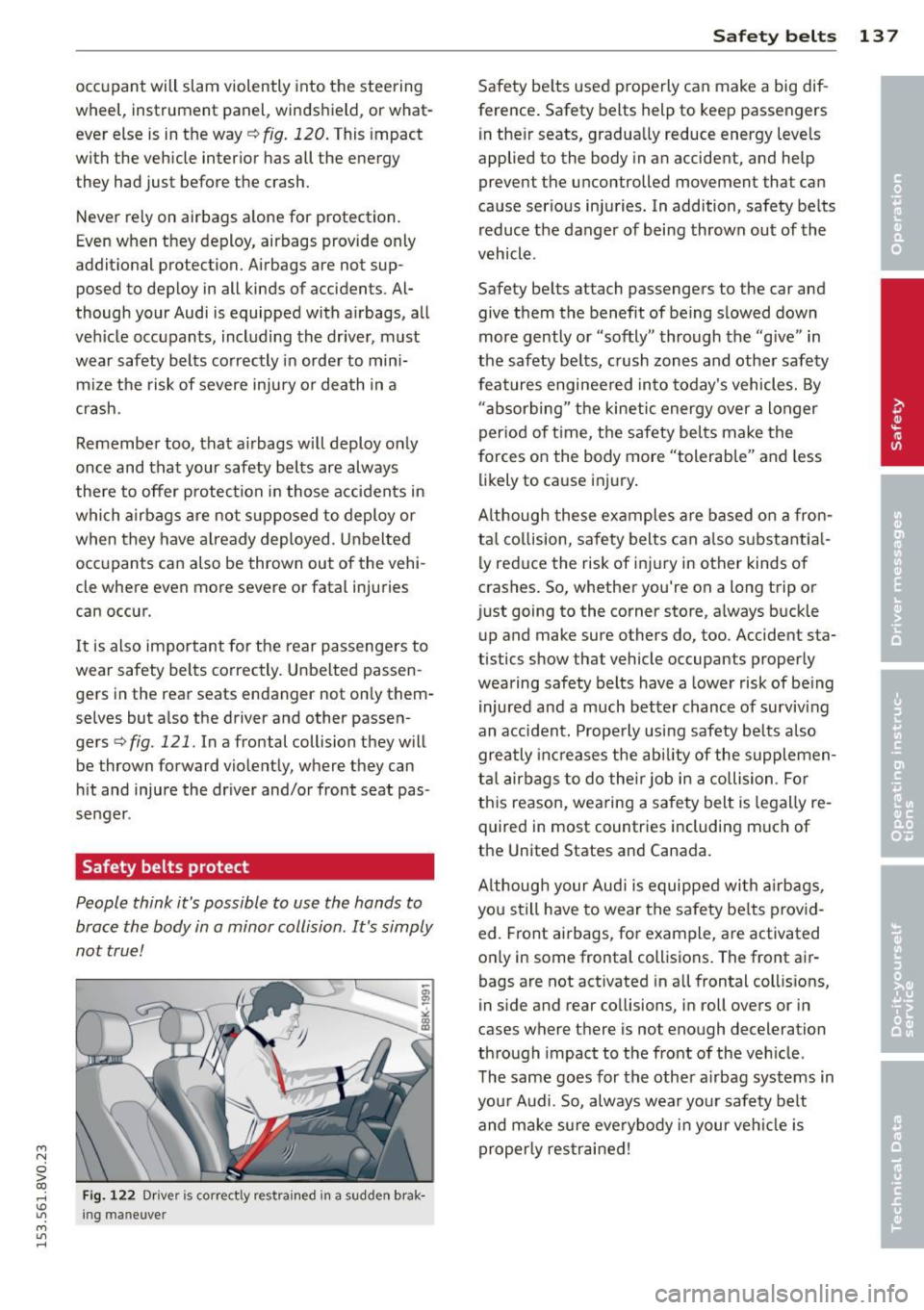
Fig. 122 Driver is cor rect ly r est rain ed in a sudd en brak
ing man euve r
Safety belts 13 7
Safety belts used properly can make a big dif
ference. Safety belts help to keep passengers
in their seats, gradually reduce energy levels
applied to the body in an accident, and help
prevent the uncontrolled movement that can
cause serious injuries . In addition, safety belts
reduce the danger of being thrown out of the
vehicle .
Safety belts attach passengers to the car and
give them the benefit of being slowed down more gently or "softly" through the "give" in
the safety belts, crush zones and other safety
features engineered into today's vehicles. By
"absorbing" the kinetic energy over a longer
period of time, the safety belts make the
forces on the body more "tolerable" and less
likely to cause injury.
Although these examples are based on a fron
tal collision, safety belts can also su bsta ntia l
ly reduce the risk of injury in other kinds of
crashes. So, whether you're on a long trip or
just going to the corner store, always buckle
up and make sure others do, too. Accident sta
tistics show that vehicle occupants properly
wearing safety belts have a lower risk of being
injured and a much better chance of surviving
an accident. Properly using safety belts also
greatly increases the ability of the supplemen
tal airbags to do their job in a collision . For
this reason, wearing a safety belt is legally re
quired in most countries including much of
the United States and Canada.
Although your Audi is equipped with airbags,
you still have to wear the safety belts provid
ed. Front airbags, for example, are activated
only in some frontal collisions. The front air
bags are not activated in all frontal collisions,
in side and rear collisions, in roll overs or in
cases where there is not enough deceleration
through impact to the front of the vehicle.
The same goes for the other airbag systems in
your Audi. So, always wear your safety belt
and make sure everybody in your vehicle is
properly restrained!