belt AUDI S3 2015 Owner's Manual
[x] Cancel search | Manufacturer: AUDI, Model Year: 2015, Model line: S3, Model: AUDI S3 2015Pages: 310, PDF Size: 76.15 MB
Page 139 of 310
....,
N
0 > co
rl I.O
"' ....,
"' rl
occupant will slam violently into the steering
wheel, instrument panel, w indshield , or what
ever else is in the way
c::> fig. 120. This impact
with the vehicle interior has all the energy
they had just before the crash.
Never rely on airbags alone for protection.
Even when they deploy, airbags provide only
additional protection. Airbags are not sup
posed to deploy in all kinds of accidents. Al
though your Audi is equipped with airbags, all
vehicle occupants, including the driver, must
wear safety belts correctly in order to mini mize the risk of severe injury or death in a
crash.
Remember too, that airbags will deploy only
once and that your safety belts are always
there to offer protection in those accidents in
which airbags are not supposed to deploy or
when they have already deployed. Unbelted
occupants can also be thrown out of the vehi
cle where even more severe or fatal injur ies
can occur.
It is also important for the rear passengers to
wear safety belts correctly. Unbelted passen
gers in the rear seats endanger not only them
selves but also the driver and other passen
gers
c::> fig. 121. In a frontal collision they will
be thrown forward violently, where they can
hit and injure the driver and/or front seat pas
senger.
Safety belts protect
People think it's possible to use the hands to
brace the body in a minor collision . It's simply
not true!
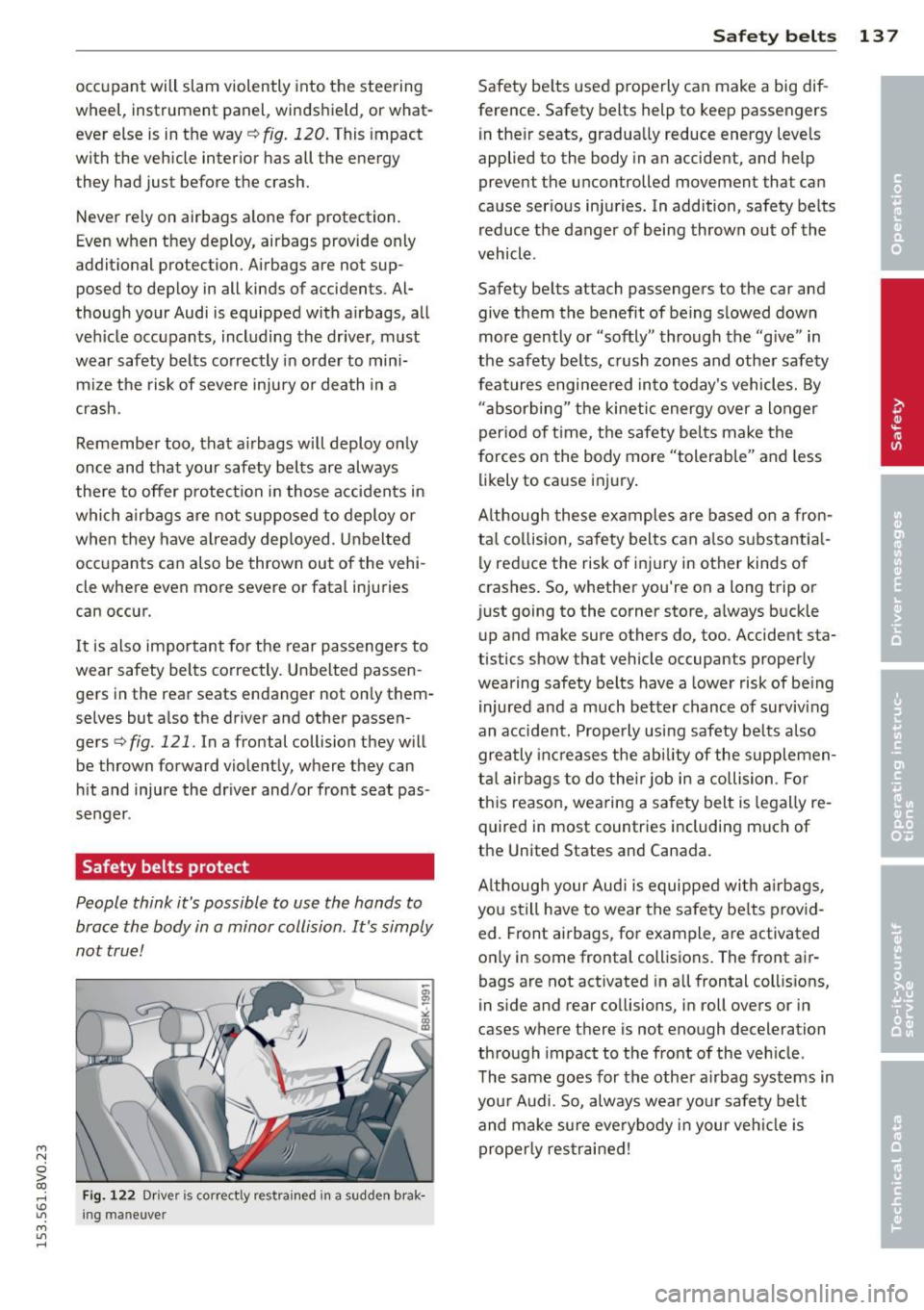
Fig. 122 Driver is cor rect ly r est rain ed in a sudd en brak
ing man euve r
Safety belts 13 7
Safety belts used properly can make a big dif
ference. Safety belts help to keep passengers
in their seats, gradually reduce energy levels
applied to the body in an accident, and help
prevent the uncontrolled movement that can
cause serious injuries . In addition, safety belts
reduce the danger of being thrown out of the
vehicle .
Safety belts attach passengers to the car and
give them the benefit of being slowed down more gently or "softly" through the "give" in
the safety belts, crush zones and other safety
features engineered into today's vehicles. By
"absorbing" the kinetic energy over a longer
period of time, the safety belts make the
forces on the body more "tolerable" and less
likely to cause injury.
Although these examples are based on a fron
tal collision, safety belts can also su bsta ntia l
ly reduce the risk of injury in other kinds of
crashes. So, whether you're on a long trip or
just going to the corner store, always buckle
up and make sure others do, too. Accident sta
tistics show that vehicle occupants properly
wearing safety belts have a lower risk of being
injured and a much better chance of surviving
an accident. Properly using safety belts also
greatly increases the ability of the supplemen
tal airbags to do their job in a collision . For
this reason, wearing a safety belt is legally re
quired in most countries including much of
the United States and Canada.
Although your Audi is equipped with airbags,
you still have to wear the safety belts provid
ed. Front airbags, for example, are activated
only in some frontal collisions. The front air
bags are not activated in all frontal collisions,
in side and rear collisions, in roll overs or in
cases where there is not enough deceleration
through impact to the front of the vehicle.
The same goes for the other airbag systems in
your Audi. So, always wear your safety belt
and make sure everybody in your vehicle is
properly restrained!
Page 140 of 310
138 Safety belts
Important safety instructions about
safety belts
Safety belts must always be correctly posi
tioned across the strongest bones of your
body.
,.. Always wear safety belts as illustrated and
described in this chapter.
,.. Make sure that your safety belts are always
ready for use and are not damaged.
A WARNING
Not wearing safety belts or wearing them
improperly increases the risk of serious
personal injury and death. Safety belts can
work only when used correctly .
- Always fasten your safety belts correctly
before driving
off and make sure all pas
sengers are correctly restrained.
- For maximum protection, safety belts must always be positioned properly on
the body .
- Never strap more than one person , in
cluding small children, into any belt.
- Never place a safety belt over a child sit ting on your lap.
- Always keep feet in the footwell in front
of the seat while the vehicle is being driv
en .
- Never let any person ride with their feet on the instrument panel or sticking out
the window or on the seat.
- Never remove a safety belt while the ve
hicle is moving. Doing so will increase
your risk of be ing injured or killed.
- Never wear belts twisted.
- Never wear belts over rigid or breakable
objects in or on your clothing, such as
eye glasses, pens, keys, etc., as these
may cause injury.
- Never allow safety belts to become dam
aged by being caught in door or seat
hardware .
- Do not wear the shoulder pa rt of the belt
under your arm or otherwise out of pos i
tion . -
Several layers of heavy clothing may in
terfere with correct positioning of belts
and reduce the overall effectiveness of
the system .
- Always keep belt buckles free of anything
that may prevent the buckle from latch
ing securely .
- Never use comfort clips or devices that
create slack in the shoulder belt . Howev
er, special clips may be required for the
proper use of some child restraint sys
tems .
- Torn or frayed safety belts can tear, and
damaged belt hardware can break in an
accident. Inspect belts regularly .
If web
bing, bindings, buck les, or retractors are
damaged, have belts replaced by an au
thorized Audi dealer or qualified work
shop.
- Safety belts that have been worn and
loaded in an accident must be replaced
with the correct replacement safety belt
by an authorized Audi dealer . Replace
ment may be necessary even if damage
cannot be clearly seen . Anchorages that
were loaded must also be inspected.
- Never remove, modify, disassemble, or
try to repair the safety belts yourself.
- Always keep the belts clean. Dirty belts
may not work properly and can impair
the function of the inert ia reel
c::> ta
ble Internal cleaning on page 207.
Safety belts
Fastening safety belts
Safety first -everybody buckle up!
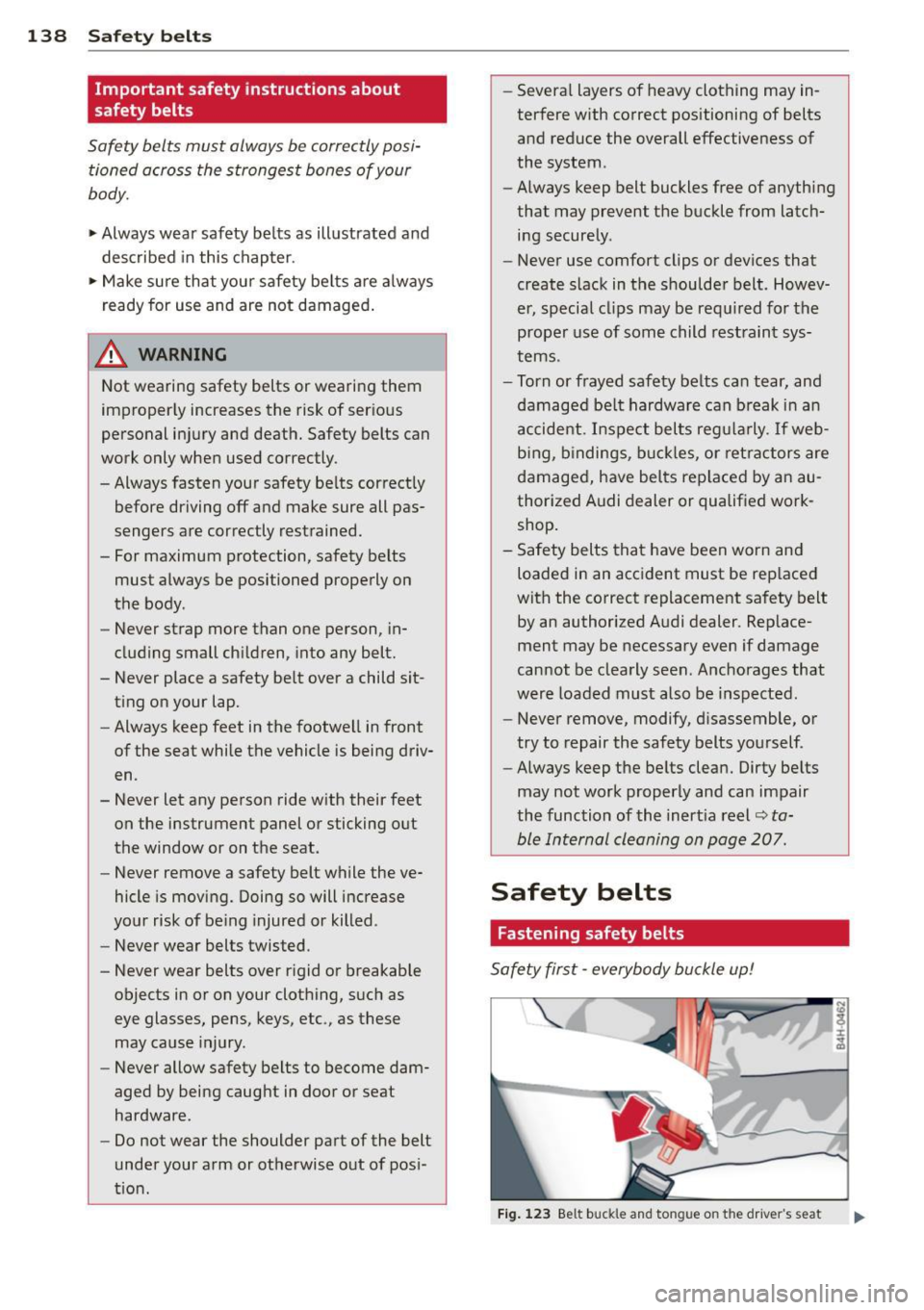
Fig. 123 B elt buck le and to ngue o n th e drive r's se at
Page 141 of 310
....,
N
0 > co
rl I.O
"' ....,
"' rl
To provide maximum protection, safety belts
must always be positioned correctly on the
wearer's body.
... Adjust the front seat and head restraint
properly
c::> page 5 7, Front seats.
• Make sure the seatback of the rear seat
bench is in an upright position and securely
latched in place before using the belt
c::> ,&..
... Hold the belt by the tongue and pull it even
ly across the chest and pelvis
c::> ,&. .
""Insert the tongue into the correct buckle of
your seat until you hear it latch securely
c::> fig. 123.
.., Pull on the belt to make sure that it is se-
curely latched in the buckle.
Automatic safety belt retractors
Every safety belt is equipped with an automat
ic belt retractor on the shoulder belt . This fea
ture locks the belt when the belt is pulled out
fast, during hard braking and in an accident.
The belt may also lock when you drive up or
down a steep hill or through a sharp curve. During normal driving the belt lets you move
freely.
Safety belt pretensioners
The safety belts are equipped with a belt pre
tensioner that helps to tighten the safety belt
and remove slack when the pretensioner is ac
tivated
c::> poge 142. The function of the pre
tensioner is monitored by a warning light
c::> page 21.
Convertible locking retractor
Every safety belt except the one on the driver
seat is equipped with a convertible locking re
tractor that
must be used when the safety
belt is used to attach a child seat. Be sure to
read the important information about this
feature
c::> poge 181.
A WARNING
Improperly positioned safety belts can
cause serious injury in an accident
o::> page 139, Safety belt position.
-Safety belts offer optimum protection
only when the seatback is upright and
Safety belts 139
belts are properly positioned on the
body.
- Always make sure that the rear seat
backrest to which the center rear safety
belt* is attached is securely latched
whenever the rear center safety belt is
being used. If the backrest is not secure
ly latched, the passenger will move for
ward with the backrest during sudden
braking, in a sudden maneuver and espe
cially in a crash .
- Never attach the safety belt to the buck
le for another seat. Attaching the belt to
the wrong buckle will reduce safety belt
effectiveness and can cause serious per
sonal injury.
- A passenger who is not correctly restrain
ed can be seriously injured by the safety
belt itself when it moves from the stron
ger parts of the body into sensitive areas
like the abdomen.
- Always lock the convertible locking re
tractor when you are securing a child seat in the vehicle
c::> page 183.
(D Tips
For information on safety belt pretension
ers, refer to
c::> page 142.
Safety belt position
Correct belt position is the key to getting
maximum protection from safety belts.
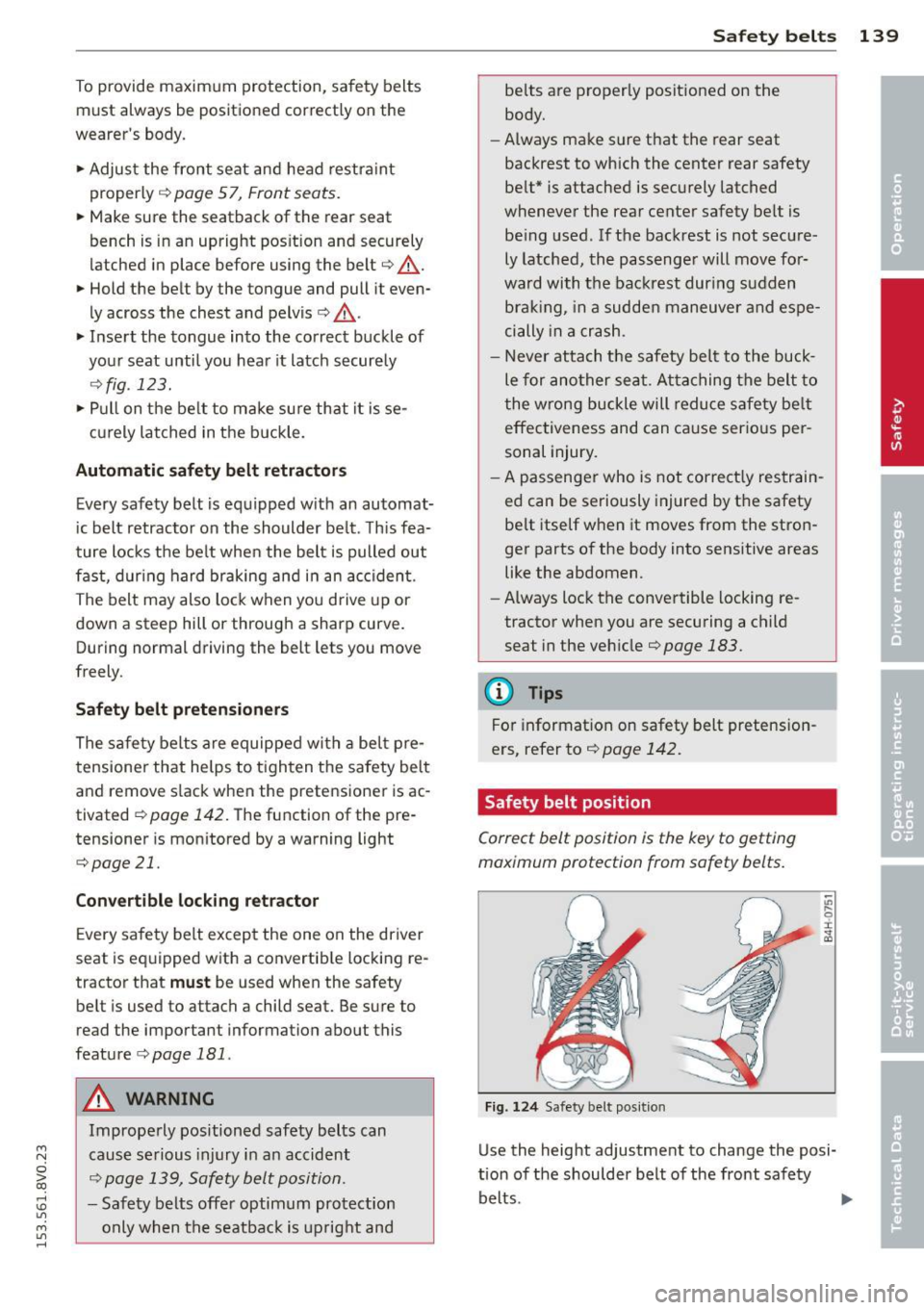
Fig. 124 Safety belt position
Use the height adjustment to change the posi
tion of the shoulder belt of the front safety
belts .
~
Page 142 of 310
140 Safety belts
_&. WARNING
Improperly positioned safety belts can
cause serious personal injury in an acci
dent.
-
- The shoulder belt should lie as close to
the center of the collar bone as possible
and should fit well on the body. Hold the
belt above the latch tongue and pull it
evenly across the chest so that it sits as
low as possible on the pelvis and there is
no pressure on the abdomen. The belt
should always fit snugly ¢
fig. 124. Pull
on the belt to tighten if necessary.
- The lap belt portion of the safety belt
must be positioned as low as possible
across pelvis and never over the abdo
men. Make sure the belt lies flat and
snug
¢ fig. 124 . Pull on the belt to tight-
en if necessary.
- A loose-fitting safety belt can cause seri
ous injuries by shifting its position on
your body from the strong bones to more
vulnerable, soft tissue and cause serious injury .
- Always read and heed all WARNINGS and
other important information
¢ page 138.
Pregnant women must also be correctly
restrained
The be st way to protect the fe tus is to make
sure that expectant mothers always wear
safety belts correctly -throughout the preg
nancy.
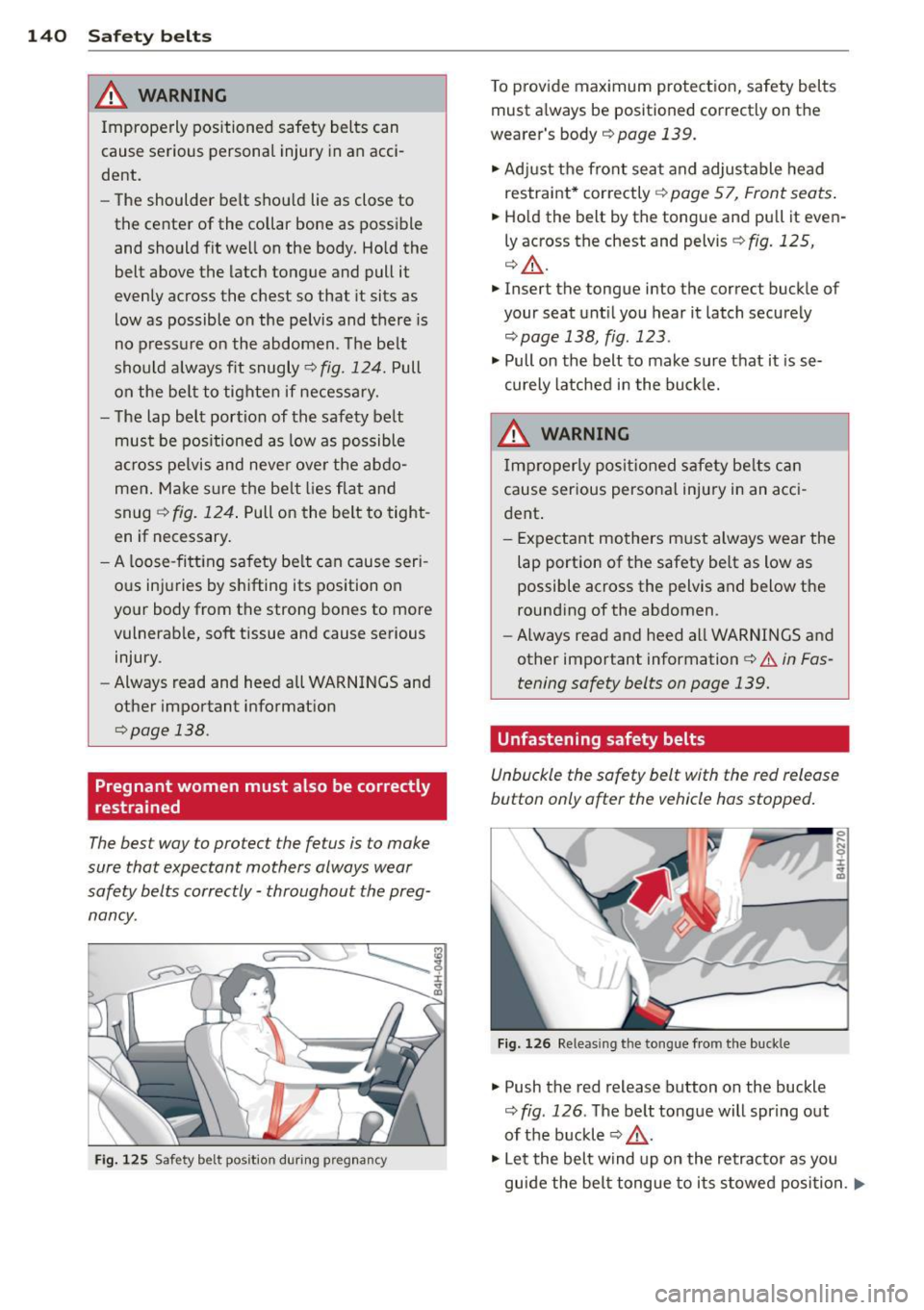
Fig . 125 Saf ety b elt pos it io n durin g pre gnancy
To provide maximum protection, safety belts
must always be pos itioned correctly on th e
wearer's body
¢ page 139.
.. Adjust the front seat and adjustable head
restraint* correctly¢
page 57, Front seats.
.. Hold the belt by the tongue and pull it even
ly across the chest and pelvis¢
fig. 125,
¢Lf1 .
.. Inser t the tongue in to the correct buckle of
your seat until you hear it latch securely
¢page 138, fig. 123.
.,. Pull on the belt to make sure that it is se
curely latched in the buckle.
A WARNING
Improperly positioned safety belts can
cause serious personal injury in an acci
dent.
-
- Expectant mothers must always wear the
lap portion of the safety belt as low as possible across the pelvis and below the
rounding of the abdomen .
- Always read and heed all WARNINGS and
other important information¢.&.
in Fas
tening safety belts on page 139.
Unfastening safety belts
Unbuckle the safety belt with the red release
button only ofter the vehicle has stopped.
,
Fig. 126 Re le asin g the tong ue fro m the buck le
.,. Push the red release button on the buckle
¢ fig. 126 . The belt tongue will spring out
of the buckle ¢
&-
.,. Let the belt wind up on the retractor as you
guide the belt tongue to its stowed position.
II>-
Page 143 of 310
....,
N
0 > co
rl I.O
"' ....,
"' rl
_& WARNING
Never unfasten safety belt while the vehi
cle is movi ng . Doing so will increase your
r isk of being injured or killed .
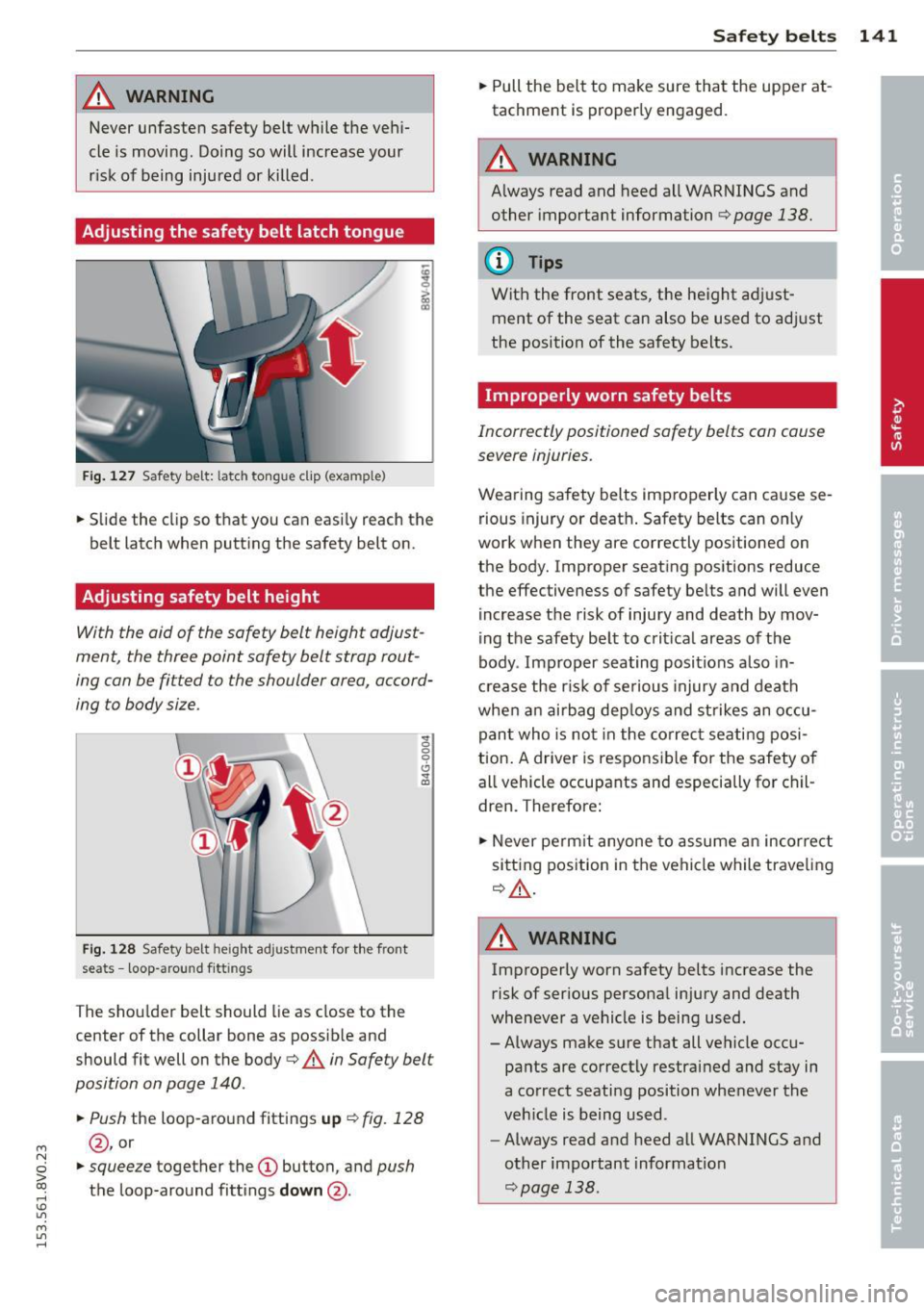
Adjusting the safety belt latch tongue
Fig. 127 Safety be lt: la tc h ton gue clip (exa mple)
.. Slide the cl ip so that you can easi ly reach the
belt latch when putt ing the safety belt on.
Adjusting safety belt height
With the aid of the safety belt height adjust
ment , the three point safety belt strap rout
ing can be fitted to the shoulder area, accord
ing to body size.
Fi g. 12 8 Safety be lt heig ht ad justment fo r th e fro nt
seats -loop -arou nd fitt ings
;g 0 0 6
" m
The sho ulder belt should lie as close to the
center of the collar bone as possib le and
should fit well on t he body
c::> A in Safety belt
position on page 140 .
.. Push
the loop-a round fittings up c::> fig . 128
@ , or
.. squee ze together the (D button, and push
the loop-around fitt ings down @.
Safety belts 141
.. Pull the belt to make sure that the uppe r at
tachment is proper ly engaged .
A WARNING
Always read and heed all WARNI NGS and
other important information
c::> page 138 .
{I) Tips
With the front seats, the height a djust
ment of the seat can also be used to ad just
the position of the sa fety belts.
Improperly worn safety belts
Incorrectly positioned safety belts can cause
severe injuries.
Wea ring sa fety belts improper ly can cause se
rious injury or deat h. Safety belts can o nly
wor k when they are correctly positioned on
the body. Imprope r seating positions reduce
the effectiveness of safety be lts and will even
increase t he risk of injury and death by mov
ing the safety be lt to crit ica l areas of the
body . Improper seating positions also in
cr ease the r is k of se rio us injury a nd death
whe n an airbag dep loys and st rikes an occu
pan t who is no t in the co rrec t seating posi
t ion . A driver is respons ible for the safety of
all vehicle occupants and especially for chil
dren. Therefore :
.. Never perm it anyone to assume an incor re ct
sitt ing pos ition in the vehicle while trave ling
c::> A .
A WARNING
Im properly worn safety be lts i ncrease the
risk of serious persona l injury and death
wheneve r a ve hicle is being used.
- Always make s ure t hat all vehicle occ u
pa nts are co rrectly restra ined and stay in
a co rrect seati ng position whenever the
veh icle is being us ed .
- Always read and heed all WARNINGS a nd
other impo rtant informat ion
c::> page 138.
Page 144 of 310
142 Safety belts
Safety belt preten
sioners
How safety belt pretensioners work
In front, side ond rear-end collisions above a
particular severity and in o rollover, safety belts are tensioned automatically.
Reversible safety belt tensioners
The safety belts on the front seats are equip
ped with power reversible tensioners . Th e fo l
lowing functions are available when the driv
er's/front passenger's safety belts are fas
tened:
- Automatic tensioners: at the start of a drive,
the safety be lts automatically adjust to the
passenger after a certain time period or ve
hicle speed.
- In certa in driving situations, the safety belts
may tighten with a reversible tensioning
f unction
~ page 94 .
- The safety belts may also tighten with this
reversible tensioning function in m inor colli
sions.
Pyrotechnic safety belt pretensioners
The safety belts are equipped with safety be lt
p retensioners. The system is activated by sen
sors in front, side and rear -end collisions of
great severity and in a rollover. This tightens
the belt and takes up be lt slack ¢.&.
in Service
and disposal of safety belt pretensioner on
page 142.
Taking up the s lack helps to reduce
forward occupant movement during a colli
sion .
A WARNING
-It is possible for the pretensioners to de
ploy incorrect ly .
- The pyrotechnic system can only provide protection for one collision .
If the pyro
technic pretensioners dep loy, the preten
sioning system must be replaced.
@ Tips
The pyrotechnic safety belt pretens ioners
can only deploy once . -
The safety belt p retensioners do not de
ploy in minor frontal and side collisions,
in rear-end co llisions, in rollovers and in
co llisions involving very little impact
force.
- A fine dust is released when the pyro technic safety belt pretensioners deploy.
This is normal and is not caused by a fire in the vehicle.
- The relevant safety requirements must
be observed when the vehicle or compo
nents of the system are scrapped. A
qualified dealership is fam iliar with
these regulations and will be pleased to
pass on the information to you.
- Be sure to observe all safety, environ
menta l and other regu lations if the veh i
cle or individual parts of the system, par
ticularly the safety belt or airbag, are to
be disposed. We recommend you have
your authorized Audi dealer perform this
service for you.
Service and disposal of safety belt
pretensioner
The safety belt pretens ioners are parts of the
safety belts on your Aud i. Installing, remov
ing, servic ing or repairing of belt pretension
ers can damage the safety belt system and
prevent it from working correctly in a co lli
sion .
T he re a re some important things you have to
know to make su re that the effectiveness o f
the system wi ll not be impaired and that dis
carded components do not cause injury or pol
lu te the environment.
A WARNING
-Improper care, servic ing and repair proce-
dures can increase the risk of personal in
jury and death by prevent ing a safety belt
pretensioner from activating when needed
or activating it unexpectedly:
- The belt pretensioner system can be act i
vated only once. If belt pretensioners have been activated, the system must be
replaced.
~
Page 145 of 310
M N
0 > co ,...., \!) 1.1'1
M 1.1'1 ,....,
-Never repair, adjust, or change any parts
of the safety belt system.
- Safety belt systems including safety belt
pretensioners cannot be repaired. Spe
cial procedures are required for removal,
installation and disposal of this system.
- For any work on the safety belt system,
we strongly recommend that you see
your authorized Audi dealer or qualified technician who has an Audi approved re
pair manual, training and special equip
ment necessary .
@) For the sake of the environment
Undeployed airbag modules and preten
sioners might be classified as Perchlorate
Material -special handling may apply, see
www.dtsc.ca .gov/hazardouswaste/per
chlorate. When the vehicle or parts of the
restraint system including airbag modules
safety belts with pretensioners are scrap
ped, all applicable laws and regulations
must be observed. Your authorized Audi
dealer is familiar with these requirements
and we recommend that you have your
dealer perform this service for you .
Safety belts 143
•
•
•
Page 146 of 310
144 Airbag sys tem
Airbag system
Important things to know
Importance of wearing safety belts and
sitting properly
Airbags are only supplemental restraints. For
airbags to do their job , occupants must al
ways properly wear their safety belts and be
in a proper seating position.
F or your safety and the safety of your passen
gers, before driving off, a lways:
• Adjust the driver's seat and steering wheel
properly ¢
page 126,
• adjust the front passenger's seat properly
¢ page 57,
• Wear safety be lts properly ¢ page 138,
• Always properly use the proper child re-
stra int to protect children¢
page 170.
In a collision, airbags must inflate within the
blink of an eye and with considerable force .
The supplementa l airbags can cause injuries if
the dr iver or the front seat passenger is not
seated properly . Therefore in order to he lp the
a ir bag to do its job, it is important, both as a
d river and as a passenge r to sit prope rly at all
times.
By keeping room between your body and the
steering wheel and the front of the passenge r
compartment, the airbag ca n inflate fully and
comp letely and provide supp lemental protec
tion in ce rtain frontal collisions¢
page 126,
Proper occupant seating positions .
For detai ls
on the operation of the seat adjustment con
t rols ¢
page 57.
It's especially important that children a re
properly restrained ¢
page 170.
There is a lot that the driver and the passen
gers can and must do to help the individua l
safety features installed in your A udi work to
gether as a system.
P rope r seat ing pos ition is important so that
the front airbag on the drive r side can do its
job. If yo u have a physical impa irment or con- dition that prevents yo
u from sitting properly
o n the driver seat with the safety belt properly
fastened and reaching the pedals , or if you
have concerns with regard to the function or
operation of the Advanced Airbag System ,
please contact your author ized Audi dealer or
qualified workshop, o r call Audi Customer Re
lations at 1-800-822-2834 fo r poss ible modi
fica tions to your ve hicle.
When the airbag system deploys, a gas gener
ator will f il l the a irbags, break open t he pad
ded cove rs, and inflate between the steering
whee l and the dr iver and between the instru
ment pane l and the fron t passenger. The a ir
bags will deflate immediately after dep loy
ment so tha t the front occupants can see
t hr ough the windshie ld again witho ut inter
ruption .
All of th is takes p lace in the b link o f an eye, so
fast that many peop le don't even realize tha t
the airbags have deployed. The airbags a lso
inflate with a great dea l of force and nothing
shou ld be in their w ay when they deploy.
Front a irbags in combination with properly
wor n safety belts slow down and lim it the oc
cupant's forward movement . T ogether they
help to prevent the drive r and front seat pas
senger from hitting pa rts of the inside of t he
vehicle while reducing the forces acting on the
occupant dur ing the crash . In this way they
help to reduce the risk of injury to the head
and upper body in the crash. A irbags do not
protect the arms or the lower parts of the
body.
Both front airbags wi ll not inflate in all fronta l
collisions . The triggering of the airbag system
depends on the vehicle dece lerat ion rate
ca used by the co llision and registered by the
electron ic control unit. If th is rate is below
the reference value programmed into the con
t rol unit , the airbags will not be trigge red,
even though the car may be badly damaged as
a res ult of the co llision . Ve hicl e damage, re
pair costs o r even the lack of ve hicle damage
is not necessari ly an indication of whe ther an
airbag shou ld inflate or not .
IJll-
Page 147 of 310
Airbag system 145
Since the circumstances will vary considerab ly
also at greater risk of injury or death
between on e collision and another , it is not
through contact with an inflating airbag .
possible to define a range of veh icle speeds
-If you are unrestrained, leaning forward,
that will cover every possible k ind and angle
sitting sideways or out of position in any
of impact that will always trigger the a irbags .
way, your risk of injury is much higher.
Important factors include, for example, the -You will a lso receive serious injuries and
nature (hard or soft) of the object which the could even be killed if you are up against
•
car h its, the ang le of impact, vehicle speed ,
• the airbag or too close to it when it in-
etc. The front airbags will a lso not inflate in
flates - even with an Advanced A irbag.
side or rea r collisions, or in ro ll-overs .
-To reduce the risk of injury when an air-
Alwa ys re memb er: Airbags will deploy only bag inflates, always wear safety belts
once, and only in certa in kinds of co llisions. properly
c::;, page 138, Safety belts
.
Your safety belts are always there to offe r pro- -
Always make certain that ch ildren age 12
tection in those s ituations in which airbags or younger always ride in the rear seat. If
are not s upposed to deploy , or when they have children a
re not properly restrained , they
already deployed ; for example , when your ve- may be severe
ly inju red or killed when an
hide strikes or is struck by another vehicle af- airbag inf
lates.
ter the first collision . -
Never let ch ildren ride un restra ined o r
This is just one of the reasons why an a irbag is improperly restrained
in the vehicle . Ad-
just the front sea ts prope rly.
a supp lementary restraint and is not a s ubsti -
-Never ride with the back rest reclined .
tute for a safety belt . The airbag system
-Always sit as far as possible from the
works most effect ively when used with the
steering whee l or the instrument panel
safety belts. Therefore, always properly wear
c::;, page 126 . your safety belts c::;, page 135 .
- Always sit upright with your back against
A WARNING the backrest of yo ur seat.
- Never p lace your feet on the instrument
Sitting too close to the steer ing whee l or
panel or on the seat . Always keep both
instrument panel will dec rease the effec-
feet on the floor in front of the seat to
tiveness of the airbags and will inc rease
help prevent serious in ju ries to the legs
the risk of pe rsonal injury in a co llision.
and hips if the airbag deploys.
- Never si t closer than 10 inches (2S cm)
-Never recline the front passenger's sea t
to the stee ring wheel or instr ument pan-
to transport objects. Items can a lso
el. move into the area of the s ide a irb ag or
- If you cannot si t mo re than 10 inches
the front airbag during bra king or in a
( 2 5 cm) from the steer ing whee l, investi-
sudden maneuver. Objects near the air-
ga te whethe r adap tive equipmen t may
bags can become projectiles and cause
be available to help you reach the pedals injury when an airbag inflates.
and increase your seating distance from
the steering wheel.
A WARNING
- All veh icle occupants and especia lly chil -
dren m ust be restrained properly when- A
irbags that have deployed in a crash must
ever riding in a vehicle . An unrestra ined be replaced.
or improperly restrained child could be -
Use on ly orig inal equipment airbags ap-
M injured by striking the inter ior or by be- proved by Audi and installed by a trained • N technician who has the necessary too
ls ~ 0 ing ejected from the vehicle during a > co sudden maneuver or impact . An unre-,...., \!) ..,., strained or imp roperly rest rained child is M ..,., ,....,
Page 150 of 310
148 Airbag system
-Take the child restraint off the front pas
senger seat and install it properly at one
of the rear seat positions if the
PASSEN
GER AIR BAG OFF
light does not stay on .
- Have the airbag system inspected by
your Audi dealer immediately.
- Always carefully follow instructions from
child restraint manufacturers when in
stalling child restraints .
A WARNING ,.
If, in exceptional circumstances, you must
install a forward or rearward-facing child
restraint on the front passenger's seat:
- Improper installation of child restraints
can reduce their effectiveness or even
prevent them from providing any protec
tion.
- An improperly installed child restraint
can interfere with the airbag as it de
ploys and seriously injure or even kill the
child -even with an Advanced Airbag
System.
- Always carefully follow the manufactur
er's instructions provided with the child
safety seat or carrier.
- Always make sure that there is nothing
on the front passenger seat that will
cause the capacitive passenger detection
system in the seat to signal to the Airbag
System that the seat is occupied by a person when it is not, or to signal that it
is occupied by someone who is heavier
than the person actually sitting on the
seat. The presence of additional objects
could cause the passenger front airbag
to be turned on when it should be off, or
could cause the airbag to work in a way
that is different from the way it would have worked without the object on the
seat.
Front airbags
Description of front airbags
The airbag system can provide supplemental
protection to properly restrained front seat occupants .
Fig. 129 Loc atio n of drive r ai rb a g : i n steering wheel
Fig. 130 Loc atio n of fro nt passe nge r's airbag: in the in
st rumen t panel
Your vehicle is equipped with an "Advanced
Airbag System" in compliance with United
States Federal Motor Vehicle Safety Standard
(FMVSS) 208 as applicable at the time your
vehicle was manufactured . The safety belts
for the seats have "pretensioners" that help to take slack out of the belt system. The pre
tensioners are also activated by the electronic control unit for the airbag system.
The front safety belts also have load limiters to help reduce the forces applied to the body
in a crash.
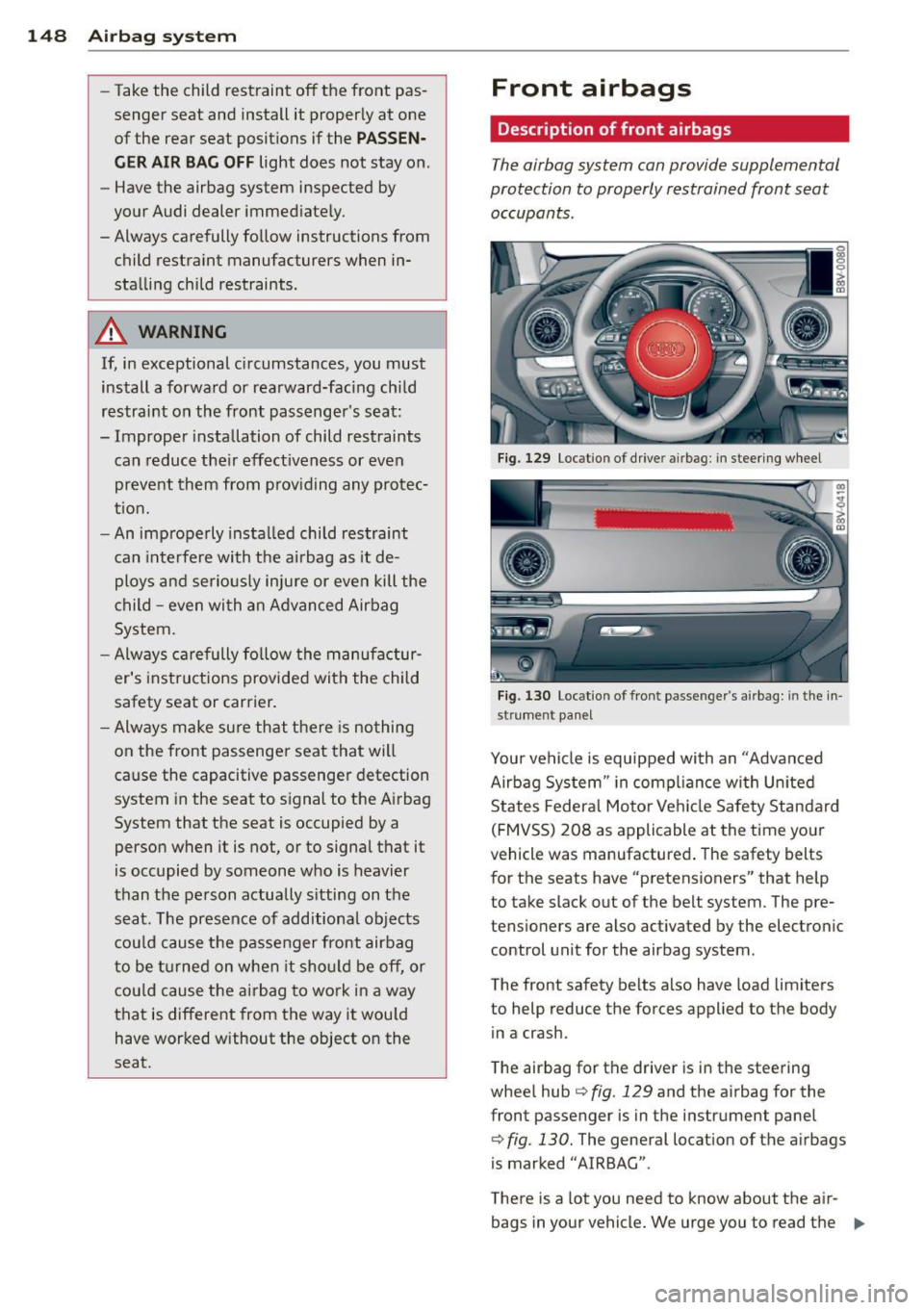
The airbag for the driver is in the steering
wheel hub
c:> fig. 129 and the airbag for the
front passenger is in the instrument panel
c::;, fig. 130. The general location of the airbags
is marked "AIRBAG".
There is a lot you need to know about the air
bags in your vehicle. We urge you to read the
II>