belt AUDI S3 2015 Repair Manual
[x] Cancel search | Manufacturer: AUDI, Model Year: 2015, Model line: S3, Model: AUDI S3 2015Pages: 310, PDF Size: 76.15 MB
Page 190 of 310
188 Child Saf ety
• Tilt the recess flap up to expose the anchor
bracket.
• Attach the tether strap anchorage hook into
the opening of the tether anchorage.
• Pull on the tether strap hook so that the
spring catch of the hook engages.
• Tighten the tether strap firmly followi ng the
ch ild restra int manufacturer's inst ruct ions .
Releasing the tethe r strap
• Loosen the tens ion following the child re
stra int manufacturer's instructions.
• Depress the spring catc h on the hook and re
lease it from the anchorage.
(D Note
If you leave the child restraint with the
t ether strap firmly insta lled for several
days, this cou ld leave a mar k on the up
h olste ry on t he seat cush ion a nd ba ckrest
in the are a whe re the te ther s tra p w as in
s t alled. The uphols tery wo uld also be per
manently stretched around the tethe r
strap . This applies especially to leather
seats .
Using tether straps on rearward-facing
child restraints
Cur rently, few rear-facing child rest raint sys
tems come w ith a tethe r. Pl ease read and
h eed the child res traint system manufactur
e r's ins tructions ca ref ully to dete rm ine how to
p roperly insta ll the tethe r.
& WARNING
-
A child in a rea rward -facing child safety
seat insta lled on the front passenger seat
w ill be seriously injured and can be k illed if
the front a irbag inflates -
even wit h an Ad
vanced Airbag System.
- The inflating a irbag wi ll hit the child
safety seat or infant carrier wit h great
force and w ill smash the c hild safety seat
and child against the backrest, ce nte r
armr est, or door.
- If you must install a rearward faci ng
child safety seat on the front passenger seat because of exceptiona
l cir cumstan
ces and the
PASSENGER AIR BAG OFF
lig ht does not come on and stay on, im
mediately insta ll the rear-fac ing c hild
safety seat i n a rear seat ing position and
have th e air bag system i nsp ecte d by your
Aud i de aler.
Additional Information
Sources of information about child
restraints and their use
There are a number of sources of add itiona l
informat ion abo ut child rest ra int selection, in
sta llation and use:
NHTSA advises that the best child safety seat
is the one that fits your ch ild and fits in your
vehicle, and that yo u will use correct ly and
co nsist ently .
Try before yo u buy!
U.S National Highway Traffic Safet y Admin
istration
Tel.: 1-888-327-4236 (TIY: 1-800-424-9153)
www.nhtsa.gov
National SAFE KIDS Campa ign
Tel.: (202) 662-0600
www.safek ids.org
Safet y BeltSafe U.S.A
Tel.: (800) 745-SAFE (English)
Tel.: (800) 747-SANO (Spanish)
www.ca rseat.org
Transport Canada Information Centre
T el.: 1-800-333-0371 o r ca ll
1-613 -998 -8616 if you are in the Ottawa area
http://www.tc.gc.ca/eng/roadsafety/
men u.h tm
Audi Customer Relations
Tel.: (800) 822-2834
Page 191 of 310
M N
0 > co ,...., \!) 1.1'1
M 1.1'1 ,....,
Smart Technology
Information about
data recorded by
vehicle control
modules
Your vehicle is not equipped with a crash data
recorder. This device is installed by some vehi
cle manufacturers to record data about crash
es so that it can be analy zed later . Crash data
recorders are also called "Event Data Record
ers ( EDR)" .
In some legal jurisdictions, it is not permitted
to access or download data recorded by pre
installed crash data recorders in order to eval
uate a crash without clear consent of the vehi
cle owner .
Your vehicle is not equipped with a crash data recorder. However it does contain a variety of
electronic control modules for various vehicle
systems such as engine function, exhaust
treatment or airbags and safety belts .
These electronic control modules record vehi cle data during normal driving for diagnosis
and repair purposes . The recording capability
of the electronic control modules is limited to
data only- no sound is recorded.
If the control
module detects a system ma lfunction or other
change in status, a very limited amount of da
ta is recorded for an extremely small period of
time . Data that is recorded in such a case may
include vehicle speed, d riving direction, the
load on the brakes and head restraints and
performance in the event of an acciden t or
other change in status . The stored data can
only be read or downloaded with special devi
ces.
Electronic stabilization
control (ESC)
Description
The Electronic Stabilization Control (ESC) con
tr ibutes to driver safety. It reduces the risk of
slipp ing and improves driving stability. ESC
Smart Technolog y 189
detects critical situations such as the vehicle
oversteering and understeering or the wheels
are spinning . The vehicle is stabilized by ap
plying the brakes or reducing engine torque.
Once the ESC is activated, the indicator light
m blinks in the instrument cluster .
The following systems are integrated in the
ESC:
Anti-lock braking system (ABS )
ABS prevents the whee ls from locking when
braking. The vehicle can still be steered even
during hard braking. Apply steady pressure to
the brake pedal. Do not pump the pedal. A
pulsing in the brake peda l indicates that the
system is acting to stabilize the vehicle.
Brake assi st sys tem
The brake assist system can decrease braking
distance. It increases braking power when the
driver presses the brake pedal quickly in emer
gency situations. You must press and hold the brake pedal until the dangerous situation is
over . In vehicles with adaptive cruise control*,
the brake assist system is more sensit ive if the
distance detected to the vehicle ahead is too
small.
Anti-slip regulation (ASR)
ASR reduces engine power when the drive
wheels begin spinning and adapts the force to
the road conditions . This makes it easier to
start , accelerate and dr ive up inclines .
Electronic differential lock (EDL)
The EDL brakes wheels that are spinning and
transfers the drive power to the other drive
wheel or wheels if the vehicle is equ ipped with
all wheel drive*). This function is not available
at higher speeds .
In extreme cases, EDL automatically switches
off to keep the brake on the braked wheel
from overheating . The vehicle is still working
correctly. EDL will switch on aga in automat i
cally when cond itions have returned to nor-
mal. .,..
•
•
•
Page 197 of 310
not used then is being generated in o rder to
maintain an optimal battery charge level.
@ Tips
- Energy management cannot overcome
the laws of physics. Note that the charge l evel and length of the battery life are
limited .
- When the start ing ability is endangered,
the (•) indicator light turns on
c!:>page20.
What you should know
Maintaining the starting ability is the highest
priority.
A lot of stress is p laced on the battery when
driving short distances, in traffic , and at co ld
times of the year. A lot of energy is used but litt le is generated. It is also critical when the
engine is not running but electrical equip ment is switched on . In this case, energy is
used but none is generated .
In situations like this, energy management
will actively regulated the distribution of en ergy.
Long periods without use
I f you do not drive your vehicle for several
days or weeks, e lectrica l equipment is gradu
ally sca led back or switched off . This reduces
energy use and ensures the vehicle will be
able to start after long periods of time. Some
conven ience functions such as opening with
the remote contro l key may not be ava ilab le.
These convenience functions will be available
again once you switch the ign ition on and
start the engine.
With the engine switched off For example, if you listen to the radio when
the engine is switched off, the batte ry w ill
drain .
~ A warning text will appear if energy consump-
~ tion could impair starting ab ility . co ,....,
~ The message shows that you need to start the
~ engine in order to charge the battery. ,....,
Smart Technolog y 195
With the engine running
Although electrical energy is generated while driving, the battery can drain. This can happen
when litt le energy is generated, and much is
used and the charge leve l of the battery is not
optimal.
To restore the ba lance of energy, components
that require large amounts of energy are tem
porari ly scaled back or switched off. Heating
systems in particular require a great deal of energy. If you notice, for example, that the
seat heating* or rear window defroster is not
working, then it has been temporar ily reduced
or switched off . These systems are availab le
again as soon as the energy balance has been
restored.
In add ition, you may notice that the idle
speed has slight ly increased . That is normal
and no cause for concern. Due to the in
creased idling speed, the additional required
energy w ill be gene rated and the battery will
be charged.
Notice about data
recorded by the Event
Data Recorder and
vehicle control
modules
Event Data Recorder
This vehicle is equipped with an Event Data Recorder ( EDR). The main purpose of an EDR
is to record, in certain crash or near crash-like
situations, such as an airbag deployment or hitting a road obstacle, data that w ill assist in
understanding how a vehicle's systems per
formed . Th e EDR is designed to record data
related to vehicle dynam ics and safety sys
tems for a short pe riod of time, typically
30 seconds or less . The EDR in this vehicle is
designed to record such data as:
- How various systems in your veh icle were
operating;
- Whether or not the driver and passenger
safety belts were buckled/fastened;
•
•
Page 198 of 310
196 Smart Technology
- How far (if at all) the driver was depress ing
the accelerator and/or brake pedal; and,
- How fast the vehicle was traveling.
These data can he lp provide a better under
stand ing of the circumstances in which crash
es and injuries occur. NOTE: EDR data are re
corded by your vehicle only if a non-trivial
crash situation occ urs; no data are recorded by
the EDR under normal driving conditions and
no personal data (e.g., name, gender, age,
and crash location) are recorded. However,
other parties, such as law enforcement, could
comb ine the EDR data with the type of per
sonally identify ing data routine ly acquired
du ring a crash invest igation.
To read data recorded by an EDR, special
equipment is required, and access to the veh i
cle or the EDR is needed . In add ition to the ve
hicle manufactu rer, othe r parties, such as law
enforcement, that have the special equip
men t, can read the information if they have
access to the vehicle or the EDR.
Some state laws restrict the retrieval or down
loading of data stored by EDRs installed in a
vehicle for the express purpose of retrieving
data after an accident or crash event without
the owner's consent.
Aud i will not access the EDR and/or similar
data or give it to others -
- unless the veh icle owner (or lessee if the ve
hicle has been leased) ag rees; or
- upon th e official request by the police; or
- upon the order of a court of law or a govern-
ment agency; or
- for the defense of a lawsuit through the ju
dicial discovery process.
- Audi may also use the data for research
about veh icle operation and safety perform
ance or provide the data to a third party for
research purposes without identifying the
spec ific vehicle or information about the
identity of its owner or lessee and o nly after
the recorded vehicle data has been ac
cessed.
Vehicle control modules
Your vehicle is also equipped with a number of
electronic control modules for various vehicle
systems, such as engine management, emis
sion control, airbags, and safety belts.
T hese electronic control mod ules record data
during norma l vehicle operation that may be
needed by trained technicians for diagnostic
and repair purposes. The recording capability
of these modu les is limited to data (no sound
is recorded). Only a small amount of data is
actually recorded over a very limited period of
t ime, or stored when a system fault is detect
ed by a contro l module . Some of the data
stored may relate to vehicle speed, direction,
or braking, as well as restraint system use and
performance in the event of a crash. Stored
data can also on ly be read and down loaded
with special eq uipment that is directly con
nected to the vehicle .
(D Tips
Your vehicle may be equipped with Audi
connect. Your use of certain A udi connect
features requires wireless services that are
provided by a third party wire less telecom
munications provider. For details regard
in g how information obtained through
Audi connect is collected, processed,
transmitted, used, and shared, please see
your contract with the wireless telecom
munications provider and the" About Audi
connect" tab in your vehicle's
MMI: I MENU I
button > Audi connect > About Audi con
nect.
Page 211 of 310
M N
0 > co ,...., \!) 1.1'1
M 1.1'1 ,....,
To avoid scratches, move the scraper only in one direction and not back and
forth.
- Never remove snow or ice from door
windows and mirrors using warm or
hot water because this could cause
cracks to form.
- To avoid damage to the rear window
defogger, do not apply any stickers on
the heating wires on the inside of the
window.
- Decorative parts/trim
- Never use chrome care or cleaning
products.
-Paint
- To reduce the risk of scratches, the ve-
hicle must be free of dirt and dust be
fore polishing or waxing.
- To prevent paint damage, do not polish
or wax the vehicle in direct sunlight.
- To reduce the risk of paint damage, do
not polish away rust spots.
- Remove cosmetics and sunscreen im
mediately · these could damage the
paint.
- Displays
-To avoid scratches, do not use dry
cleaning methods on displays.
- Controls
- Make sure that no fluids enter the con-
trols, because this could cause dam
age.
- Safety belts
- Do not remove the safety belts to clean
them.
- Never clean safety belts or their com
ponents chemically or with corrosive
fluids or solvents and never allow sharp objects to come into contact
with the safety belts. This could cause damage to the belt webbing .
- If there is damage to the webbing, the
connections, the retractors or the buck
les, have them replaced by an author
ized dealer .
-Textiles/artificial leather/Alcantara
Care and cleaning 209
- Never treat artificial leather/Alcantara
with leather care products, solvents,
floor polish, shoe polish, spot remove
or similar products.
- Have a specialist remove stubborn
stains to prevent damage.
- Never use steam cleaners, brushes,
hard sponges, etc. when cleaning.
- Do not turn on the seat heating* to dry
the seat.
- Objects with sharp edges such as zip
pers, rivets on clothing or belts can
cause damage to the surface.
- Open hook and loop fasteners, for ex
ample on clothing, can damage seat
covers. Make sure hook and loop fas
teners are closed .
-Natural leather
- Never treat leather with solvents, floor
polish, shoe polish, spot remover or
similar products.
- Objects with sharp edges such as zip
pers, rivets on clothing or belts can
cause damage to the surface.
-Never use steam cleaners, brushes,
hard sponges, etc. when cleaning.
- Do not turn on the seat heating* to dry
the seat .
- To help prevent the leather from fad
ing, do not leave the vehicle in direct
sunlight for long periods of time.
If
leaving the vehicle parked for long pe
riods of time, you should cover the
leather to protect it from direct sun
light.
(D Tips
- Insects are easier to remove from paint
that has been freshly waxed.
- Regular waxing can prevent rust spots
from forming.
•
•
•
Page 220 of 310
218 Check ing and F illin g
- Do not remove the engine cover under
any circumstances. Th is increases the
risk of burns.
- If tests need to be performed with the
engine running, there is additional dan
ger due to moving components (such as
the ribbed belt, generator and radiator
fan) and from the high voltage ign ition
system .
- Never reach into the rad iator fan . The
electric auxiliary fan is controlled by
tempe ratu re and can sw itch on suddenly.
- Pay attention to the following warn ings
listed wh en work on the fue l system or
on the electrical equipment is required.
- Always disconnect the vehicle battery
from the vehicle electrical system
- Do not smoke
- Never work near open flames
- Always have a working fire extinguisher
nearby
- To reduce the r isk of electric sho ck a nd
injury, never touch the following compo
nents when the engine is running or is
being started:
- Ignition cable
- Other components in the electronic
h igh voltage ignition system
- If you must check or perform work on
the engine while it is running:
- Set the parking brake and place these
lector lever in the P (park) posit ion
first.
- Always proceed with ext reme caut ion
so that clothing, jewelry or long hair do not become ca ugh t in the radiator fan,
fan belt o r other moving components
or do not come into contact with hot
components . Tie back long hair before
beginning work and do not wear cloth
ing that can hang down into the en
g ine.
- Limit your exposure to exhaust and
chemica ls to as short a time as poss ible
~ .&. -
A WARNING
Ca lifornia Proposition 6S Warning:
- Engine exhaust, some of its constituents,
and certain vehicle components contain
or emit chemicals known to the State of
California to cause cancer and birth de
fects and reproductive harm. In addition,
certa in flu ids contained i n veh icles and
certain products o f componen t wear con
tain or emit chemic als known to t he
State of California to ca use cancer and
birth defects or other reproductive ha rm .
- Battery posts, terminals and related ac
cessories contain lead and lead com
pounds, chemicals known to the State of
California to cause cancer and reproduc
tive harms. Wash hands after handling.
(D Note
When filling fluids, be sure not to mix the
fl ui ds up . Otherwise severe ma lf u nctions
and engine damage w ill occur.
@ For the sake of the environment
You sho uld reg ularly chec k the ground un
der your vehicle in order to detect leaks
quick ly. If there are visib le spots from oil
or other fluids, br ing your vehicle to an au
thorized Audi dealer or qua lified repair fa
cility to be checked .
Page 251 of 310
M N
0 > co ,...., \!) 1.1'1
M 1.1'1 ,....,
Tires and vehicle load limits
There are limits to the amount of load or weight that any vehi
cle and any tire can carry. Ave
hicle that is overloaded will not
handle well and is more diffi
cult to stop. Overloading can
not only lead to loss of vehicle
control, but can also damage
important parts of the vehicle
and can lead to sudden tire fail
ure, including a blowout and
sudden deflation that can cause
the vehicle to crash.
Your safety and that of your
passengers also depends on
making sure that load limits are
not exceeded. Vehicle load in
cludes everybody and every
thing in and on the vehicle.
These load limits are technical
ly referred to as the vehicle's
Gross Vehicle Weight Rating
("GVWR").
The "GVWR" includes the
weight of the basic vehicle, all
factory installed accessories, a
full tank of fuel, oil, coolant and other fluids plus maximum
load. The maximum load in
cludes the number of passen
gers that the vehicle is intend-
Tires and wheels 249
ed to carry ("seating capacity")
with an assumed weight of 1
SO lbs (68 kg) for each pas
senger at a designated seating
position and the total weight of
any luggage in the vehicle. If
you tow a trailer, the weight of
the trailer hitch and the tongue
weight of the loaded trailer must be included as part of the
vehicle load.
The
Gross Axle Weight Rating
("GAWR") is the maximum load
that can be applied at each of
the vehicle's two axles.
The Gross Vehicle Weight Rat
ing and the Gross Axle Weight
Rating are listed on the safety
compliance sticker label locat
ed on the driver's side 8-pillar.
Your Audi has 5 seating posi
tions, 2 in the front and 3 in the rear for total seating capacity
of 5. Each seating position has
a safety belt¢
page 135, Safe
ty belts.
The fact that there is an upper
limit to your vehicle's Gross Ve
hicle Weight Rating means that
the total weight of whatever is
being carried in the vehicle (in
cluding the weight of a trailer ""
' •
•
' •
Page 279 of 310
....,
N
0 > co
rl I.O
"' ....,
"' rl
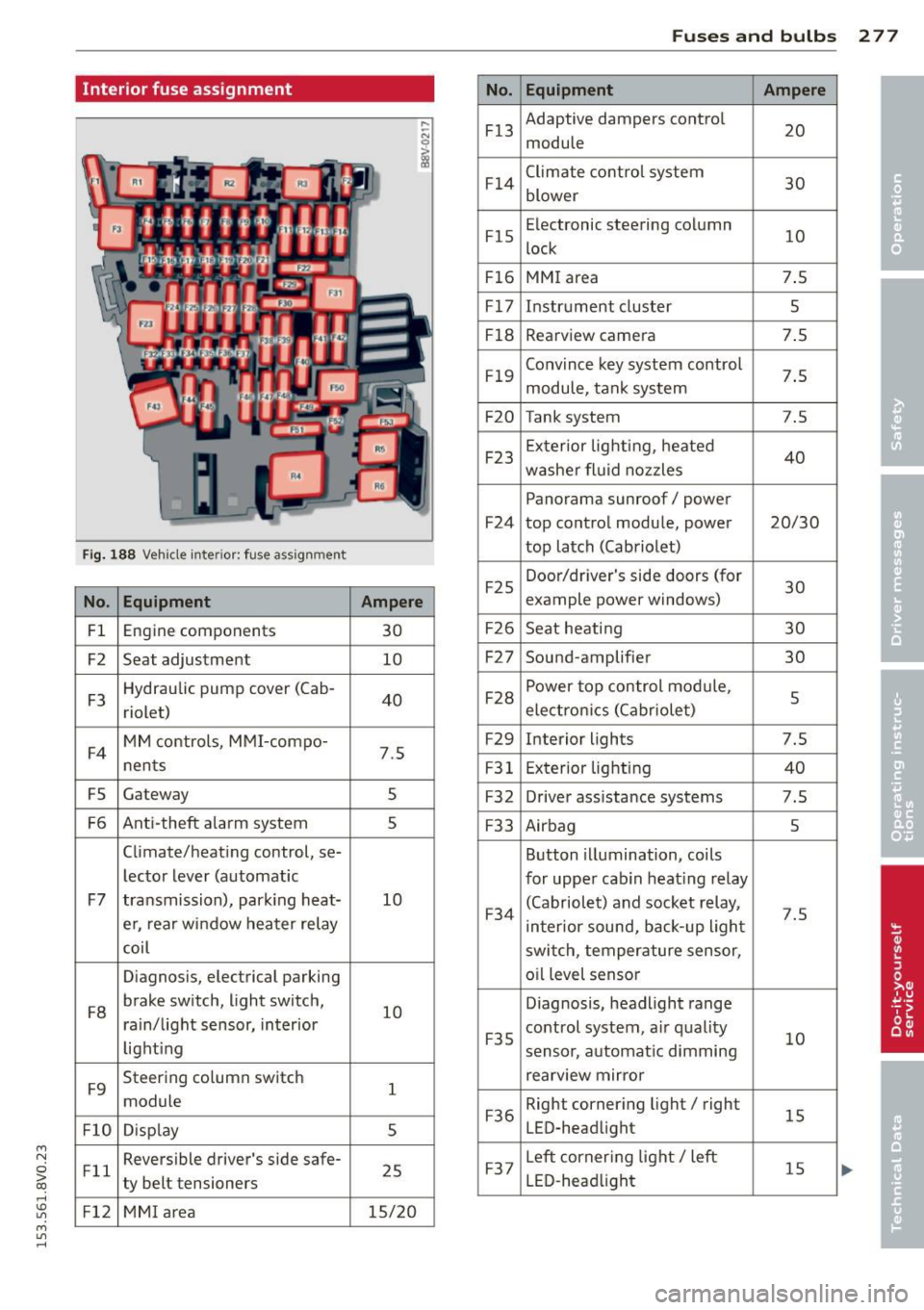
Interior fuse assignment
Fig. 188 Vehicle inter ior: fuse assignment
No . Equ ipment
Fl Engine components
F2 Seat adjustment
F 3 Hydraulic pump
cover (Cab-
riolet)
F4 MM controls, MMI-compo-
nents
FS Gateway
F 6 Anti-theft alarm system
Climate/heating control,
se-
lector lever (automatic
F7 transmission), park ing heat-
e r, rear window heater relay
coil
Diagnosis, electrical parking
F 8 brake
switch, light switch,
rain/light sensor, interior
light ing
F9 Steering
column switch
module
Fl0 Disp lay
Fll Reversible driver's
side safe-
ty belt tensioners
Fl2 MMI a rea
No .
Fl 3
Fl4
Fl5
Fl6
Fl7
Fl8
Fl9
F20
F23
F24
F25
Ampere
30 F26
10 F27
40 F28
F29
7.5
F31
s F32
5 F33
10 F34
10 F35
1 F36
5
25 F37
15/20
Fu se s and bulb s 2 77
Equipment Ampere
Adaptive dampers control
20
module
Climate control system 30
blower
Electronic steering column
10
lock
MM I area 7.5
Instrument cluster 5
Rearview camera 7.5
Conv ince key system control
7.5
module, tank system
Tank system 7.5
Ex terior lighting, heated
40
washer fluid nozzles
Panorama sunroof/ power
top control modu le, power 20/30
top latch (Cabriolet)
Door/dr iver's side doors (for
30
example power windows)
Seat heati ng 30
Sound-amplifier 30
Power top con trol module,
5
electron ics (Cabriolet)
Interior lights 7.5
Ex terior lighting
40
Driver assistance systems 7.5
Airbag 5
Button illumination, coils
for upper cab in heat ing relay
(Cabriolet) and socket relay,
7.5
interior sound, back-up ligh t
switch, temperature sensor, o il level sensor
Diagnosis, headlight range
control system, air quality
10
senso r, a utomat ic dimming
rearview mir ror
Right corner ing light/ right
15
LED-headlight
Left corner ing light/ left
15
LED -head light
Page 280 of 310
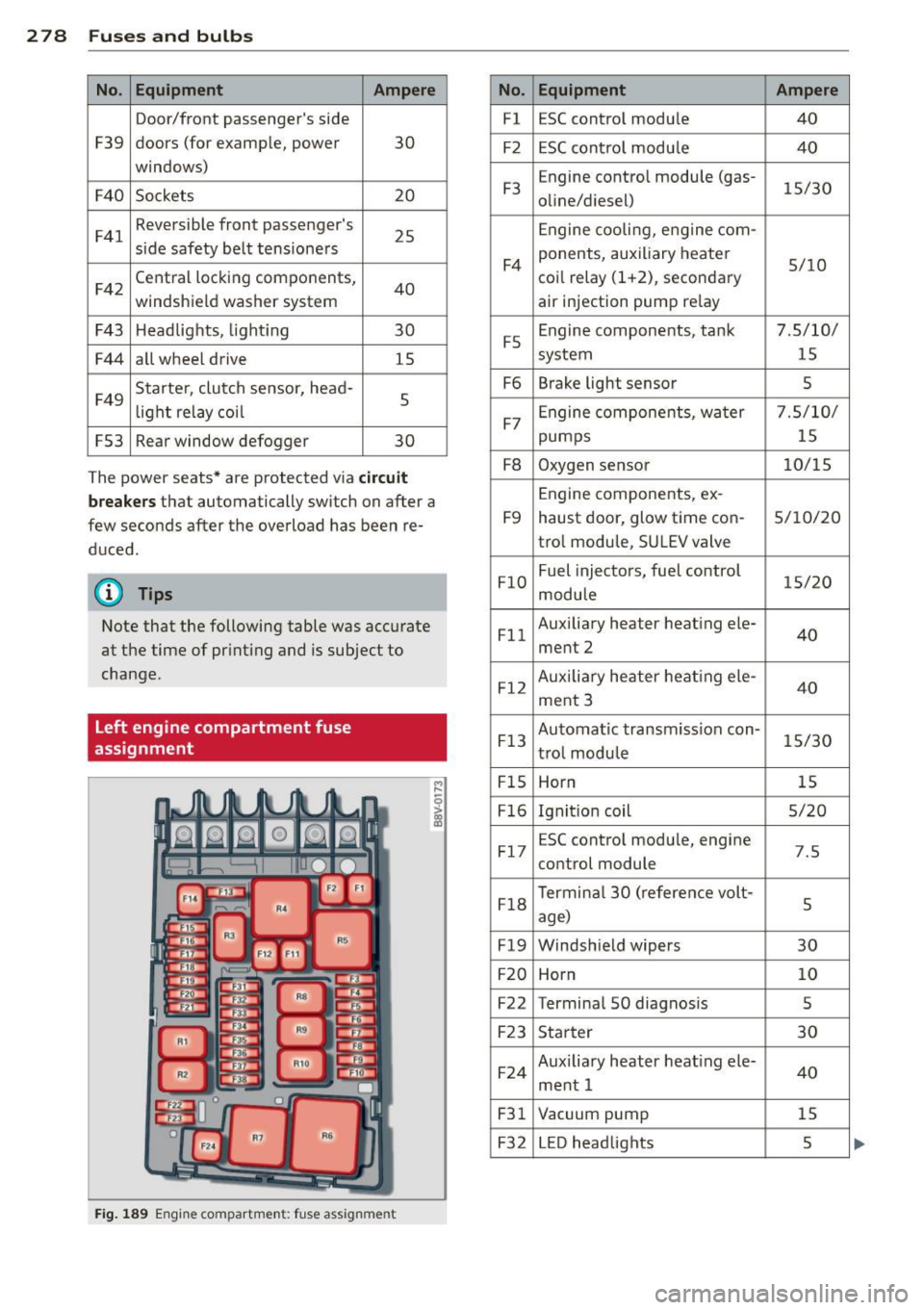
2 78 Fuses and bulbs
No . Equipment Ampere
Door/front passenger's side
F39 doors (for example, power 30
windows)
F40 Sockets 20
F41 Reversible front passenger·s
25
side safety belt tensioners
F42 Central locking components,
40
windshield washer system
F43 Headlights , light ing 30
F44 all wheel drive
15
F49 Starter, clutch sensor, head-
s light
relay coil
FS3 Rear window defogger
30
The power seats* are protected via
circuit
breakers
that automatically switch on after a
few seconds after the overload has been re
duced.
@ Tips
Note that the following table was accurate
at the time of print ing and is subject to
change.
Left engine compartment fuse
assignment
Fig. 189 Engine compartment : fuse assignment
No.
Fl
F2
F3
F4
F5
F6
F7
F8
F9
FlO
Fll
Fl2
Fl3
Fl5 Fl6
Fl7
Fl8 Fl9
F20 F22
F23
F24
F3 1
F32
Equipment Ampere
ESC control modu le 40
ESC cont rol module 40
Engine control module (gas-
15/30
oline/diesel)
Engine cooling, engine com-
ponents, auxiliary heater 5/10
coil relay (1+2), secondary
air injection pump relay
Engine components, tank 7.5/10/
system 15
Brake light sensor
5
Engine components, water 7.5/10/
pumps 15
Oxygen sensor 10/15
Engine components, ex-
haust door, glow t ime con-
5/10/20
trol module, SU LEV valve
Fuel injectors, fuel control
15/20
module
Auxiliary heater heating ele-
40
ment2
Auxi lia ry heater heating ele-
40
ment 3
Automatic transmission con- 15/30
trol module
Horn 15
Ignit ion coil 5/20
ESC contro l module, engine
7.5
control module
T ermina l 30 (reference volt-
5
age)
Windshield wipers 30
Horn 10
Terminal SO diagnosis 5
Starter 30
Auxiliary heater heat ing ele-
40
ment 1
Vacuum pump 15
LED headlights 5
Page 296 of 310
29 4 Index
Audi magnetic ride
refer to Adaptive dampers 106
Aud i Service Repa ir Ma nuals and Litera -
ture .. .. .... ............. .. .. .. .. . 289
AUTO Automatic climate control system ..... 70
Automatic headlights ......... .. .... 46
Auto Lock (centra l locking system) .... .. 36
Automatic belt retractor ............. 138
Automatic climate control system
refer to Climate control system (auto-
mat ic) ............................ 70
Automatic headlights ................. 46
Automatic post-collision braking system 190
Automatic transmission .............. 109
Driving t ips . .................. .... 111
E mergency mode .................. 115
H ill descent control ................ 113
I gnition key safety in terlock .. .. .... .. 74
Kick -down . .... . ...... ... ... ..... . 114
L aunch Contro l-Program ... .. .. .. .. . 1 15
malfunction . .. . ...... ... .. .. .... . 110
Selector lever emergency release . . . . . 116
Selector lever lock . . . . . . . . . . . . . . . . . 110
Selector lever posit ions ............. 109
Shifting manually . . . . . . . . . . . . . . . . . . 114
Steer ing whee l w ith shift paddles ..... 114
S t ron ic .. .. ..... ........ .. .. .. .. . 109
tiptronic . .. ............. .. .. .. .. . 114
Automatic wipe/wash system . . . . . . . . . . 50
Auto Safety Hotline ..... ... .. .. .... . 133
Auxiliary heater (vehicles w ith d iese l en-
g ines) .. .. .... ............. ...... .. 73
Average consumption ................. 28
Average speed . . . . . . . . . . . . . . . . . . . . . . . 28
B
Battery . .. .. ............. .. .. .. .. . 228
Charge level ... ... .... ... .. .. .... . 194
Charging . . . . . . . . . . . . . . . . . . . . . 20, 230
Energy management . ... .. .. .. .. .. . 194
Important warnings ............... 229
Indicator light . . . . . . . . . . . . . . . . . . . . . 20
Jump starting ............ .. .. .. .. . 280
Locat ion ... ... .... ...... ... ... .. . 229
Replacing the battery .............. 231 Winter operation
.... .. ..... .... . .. 228
Working on the battery . ..... ... .. .. 229
Before driving ..... ............. .... 125
Blended gasoline .. ............. .... 210
B lower
automatic Climate control system . ... . 71
Manua l climate control system ... .. .. . 69
Boos t .............................. 29
Booster seats . . . . . . . . . . . . . . . . . . . . . . 179
Boost p ressure indicator . ..... ... .. .. . 29
Brake fluid Changi ng the b ra ke fluid ........ .. .. 22 7
Checking the b rake fluid level ........ 22 7
What is the co rrect b rake fluid level? .. 2 2 7
What shou ld I do if the brake fluid warn -
ing light comes on? ..... .... ... .. .. 227
B rakes ..... .... .. .. ........... .... 191
B rake assist system . ........... .. .. 189
B rake booster ..................... 191
Indicator light ... .. ... ..... ... .. .. . 25
New brake pads . .... .. ..... ... .. .. 191
Brake system Brake fluid .... .. ............. .... 22 7
B rake fluid specifications fo r refill and re -
placement .... .. ... .. ..... ... .. .. 227
B rake pads . ..... .. .... .... ... .. .. 197
Fl uid reservoir ... .. ... ..... ... .. .. 227
Worn brake pads symbo l . . . . . . . . . . . . . 22
B rak ing
Emergency brak ing funct ion ... .. .. .. . 82
Indicator light ... ... .. ..... .... . .. . 18
Parking brake .... .. ... ..... ... .. .. . 80
Starting on inclines ............ .... . 82
B reak-in per iod ..................... 197
Brake pads . ..... ... .. ..... ... .. .. 197
T ires ... .. .... .. .. ... ..... ... .. .. 197
Bu lbs ......... ... .. .............. . 279
C
California Proposition 65 Warn ing .... . 218
Battery specific .................. . 230
Capacities AdBl ue ... .... .. ............. .... 215
Fuel tank .. .. .. .. ............. .. .. 288
Washe r fluid reservo ir .. ....... ... .. 288
Care ... .. .. .... .. .. .... . ..... ... .. 205
also refer to Cleaning .......... .. .. 205