brake light AUDI S3 2015 Owner's Guide
[x] Cancel search | Manufacturer: AUDI, Model Year: 2015, Model line: S3, Model: AUDI S3 2015Pages: 310, PDF Size: 76.15 MB
Page 195 of 310
M N
0 > co ,...., \!) 1.1'1
M 1.1'1 ,....,
the brakes. If you need to brake addit ion
ally, bra ke in intervals and not continu
ously.
(D Tips
- If the brake boos ter is not wor king, you
must p ress the brake pedal with much
more force t hen no rma l.
- If yo u retrof it your vehicle with a front
s po ile r, wheel covers or similar items,
make sure that the air f low to the front
whee ls is not interrupted. Otherwise the
brake system can become too hot.
Electromechanical
steering
The elec tromechanical steering suppor ts the
driver's s teering movements .
Powe r stee ring adapts electronically based o n
the veh icle speed.
The vehicle still has full stee ring fu nctionality
if the powe r steering fails o r whe n the eng ine
i s stopped (towi ng). To s teer, yo u must app ly
m uc h mo re fo rce than usual.
Indicator lights and messages
• Do not drive vehicle: steering defective
If th is in dicator lig ht tu rns on and stays on
and this message appears, the power steering may have fa iled.
Do
not co ntin u e dr iving . See an autho rize d
Aud i dea ler o r autho rized Aud i Service Fac ility
for assistance.
• Do not drive vehicle: steering defective
There is a malf unct io n in the electro nic steer
in g lo ck. You canno t turn the ign ition on.
Do
not tow your vehicle beca use it ca nnot be
steered. See an autho rized Aud i dea le r or au
thor ized Audi Se rv ice Facility for ass istance.
Ei:-Y Steering malfunction : you can continue
driving
I f the indicator light turns on, the steering
wheel may be more difficult to move or more
Smart Technolog y 193
sensit ive tha n usua l. The stee ring wheel may
also be at a n angle when dr iv ing stra ight .
D rive slowly to you r auth ori zed Audi de aler o r
qualifie d wo rkshop to have the ma lf u ncti on
correc ted.
II Steering lock : sy stem fault! Pl ease con
tact Service
T he re is a malfunction in the elec tronic steer
ing lock .
D rive to an author ized Audi dealer or author
ized Audi Serv ice Facility immediately to have
the malfunc tion corrected.
A WARNING
Have the sys tem ma lf u nction co rrec ted as
soon as po ssible by an aut horiz ed Aud i
d e aler or au thoriz e d Au di Service Fa cili ty,
a s this incr eases the r is k of an acciden t.
(D Tips
If th e . or l~ij indi cator ligh t only s tays
o n for a short t ime , you may con tinue dr iv
i ng.
ALL wheel drive
(quattro)
App lies to vehicles: wi th all wheel drive
In all wheel drive, all four wheels are pow
ered.
General information
In all whee l dr ive, the dr iv ing power is divi ded
between all fo ur whee ls. Thi s happens auto
matically depending on yo ur driv ing behavior
as well as the current road conditions. Refer
to
¢ page 189, Electronic stabilization con
trol (ESC) .
The all wheel drive concept is designed for
high eng ine power. Your veh icle is except ion
a lly powerfu l and has excellent driving charac
te ristics both under normal driv ing cond itions
and on snow a nd ice. Always read and follow
safety precaut ions¢ .&.. ..,.
•
•
•
Page 202 of 310
200 Driving and the environment
Vehicles use the most fuel when they are ac
celerati ng. If you anticipate what is going to
happen next, you will need to brake less and,
thus, accelerate less. let the vehicle coast
whenever poss ible -for example when you see
that the next traffic light is red.
Avoid full throttle
Driving at moderate speeds saves fuel and
improves your mileage.
.. Try and keep well be low your car's max imum
speed.
Accelerating gently reduces fuel consump
tion, engine wear, and does not disturb the
environment. F ue l consumption, exhaust emissions and en
gine noise increase disproportionately at hig h
speeds . If you drive at approximately three
quarters of top speed, fue l consumption will
be reduced by one half. Never dr ive faster
tha n the posted speed limit and weather con
d itions permit.
Reducing unnecessary idling
Even when your car is just idling it burns up
fuel.
.. Sh ut the engine off when you are not dr iving
the vehicle.
.. Do not warm up the vehicle by letting the
engine run at idle.
It is efficient to switc h off the engine when
stopped at railroad crossings and long red
lights. Turning the engine off for just 30-40
seconds saves mo re fuel than is burned by
start ing the eng in e again.
It takes a long time for the engine to warm up
fu lly when it is running at idle. However, wear
and nox ious em issions are especially high
when the engine is warming up. So you should
d rive away as soon as you sta rt the eng ine and
avoid ru nning a t high RPM wh ile the engine is
still warming up .
(D Note
Do not leave engine i dling unattended af
ter start ing. If wa rning lights sho uld come
on to indicate improper operation, they
would go unheeded. Extended idling also
produces heat , w hich could result in over
hea ting o r othe r damage to the veh icle or
othe r property.
Regular maintenance
A badly tuned engine unnecessarily wastes a
lot of fuel.
.. Have your ve hicle serviced at regu lar inter-
vals.
Having your veh icle regu larly serviced by an
authorized Aud i dealer helps to ensure that it
runs properly and econom ica lly. The cond it io n
of your veh icle not on ly affects its safety and
ability to ho ld its va lue, i t also affects
fuel
c onsumption .
Check your oil each t ime you fill your tank.
The amount of oi l used is re lated to engine
l oad and speed.
It is normal for the oil consump tion of a new
engine to reach its lowest value after a certain
mileage has been driven .
You m ust drive your ve hicle abou t 3,000 m iles
(5,000 kilometers) before you can properly
assess oil consumpt ion .
T his also ap plies to fue l consumption and en
gine o utp ut.
(D Note
- Have your veh icle ma inta in ed properly
and i n acco rdance with the service rec
ommendations in you r W arranty
& Main
t enance boo klet. l ack of proper ma inte
nance as well as im proper use of the ve
hicle will impair the function of the
em iss ion cont ro l system and cou ld lead
to damage.
Page 204 of 310
202 Trailer towing
Trailer towing Driving with a trailer
General information
Your Audi was designed primarily for passen
ger transportation .
If you plan to tow a tra iler, p lease remember
that the addit ional load will affect durab ility,
economy and performance .
T railer towing not on ly places more stress on
the vehicle, it also calls for more concentra
tion from the driver.
F or this reason, always fo llow the operating
and drivi ng i nstr uctions provided and use
common sense.
Technical requirements
Traile r hitch
Use a weight-carrying hitch conforming to the
gross trailer we ight. The hitch must be suita
b le for your veh icle and trailer and mu st be
mounted secure ly on the ve hicle's chassis at a
technically sound location . Use only a trailer
h itch with a removab le ball mount. A lways
check with the tr ailer hitch manu fac tur er to
make sure tha t you are using t he cor rect
hitch.
Do not us e a bumper hitch .
The hitch must be installed in such a way t hat
it does not interfe re with t he impact-absorb
ing bumper syst em . No mod ifications should
be made to the vehi cle exhaust and brake sys
tems . From time to time, check th at a ll hit ch
mo unt ing bo lts remain secure ly fastened.
When you are not towing a trail er, remove the
tra iler hitch ba ll mount. This prevents the
hi tch from causing d amage sho uld your ve hi
cle be str uck from be hind
¢ A .
Trailer brakes
If you r tra ile r is eq uipped w ith a braking sys
tem, check to be su re that it conforms to a ll
r egulat ions . T
he trailer hyd raulic brake system mus t not be
direct ly connected to the vehicle's hydraulic
brake system .
Safety chains
Always use s afety chains be tween your ve hicle
and t he tra ile r.
Trailer lights
Tra ile r li ghts must meet all regulations. Be
su re to c hec k w ith your Audi dea le r fo r cor rect
wiring, swi tches and relays.
Mirrors
If you are unable to see the traffic behind you
u sing the regular o utside m irrors, then you
must insta ll ext ended mirro rs . It is important
t h at you
always have clea r vis io n to the rea r.
,8. WARNING
-
Afte r removing t he trailer hit ch, d o no t
s tore it in yo ur vehicle . In case of sudden
br aking, t he h itch cou ld fly forward an d in
j ur e you or yo ur passengers .
Operating instructions
Maximum traile r weight
A trai le r fo r you r vehicle is limited to a typi cal
class 1 or class 2 trai le r.
Trailer load distribution
B e sure the load in the t ra ile r is held secure ly
i n p lace to p reven t it from shift ing forw ard,
backw ard or sideways.
Never allow a passenger to ride in a trailer
¢ A in Driving instru ctions on page 203.
Engine cooling system
Towing a trailer makes the engine work hard
er . It is impo rtant that the cooling system 's
performance is up to the additional load .
Make su re that the coo ling system has enough
fl uid .
Tire pressure
When towing a trailer, inflate the tires of your
vehicle to t he cold tire pressure listed under
ll>
Page 205 of 310
M N
0 > co ,...., \!) 1.1'1
M 1.1'1 ,....,
"Full load" on the label located on the driver's
side B-pillar (visible when the door is open).
Inflate trailer t ires to tra iler and t ire manufac
turers' specifications.
Lights
Check to make sure both vehicle and trailer
lights are working properly.
Safety chains
Be sure tra iler safety cha ins are properly con
nected from the trailer to the hitch on the ve
hicle. Leave enough slack in the chains to per
mit turning corners. When you install safety
chains, make su re they wi ll not drag on the
road when you are driving.
The chains should cross under the tra ile r
tongue to prevent it from dropping in case of
separation from the hitch.
Driving instructions
Driving with a trailer always requires extra
care and consideration.
To obtain the best poss ible handling of vehicle
and traile r, p lease note the following:
~ Do not tow a loaded tra iler when your car it
self is not loaded.
~ Be especia lly careful when passing other
vehicles.
~ Observe speed limits .
~ Do not drive at the maximum permissible
speed.
~ Always apply brakes early.
~ Monitor the temperature gauge.
Weight distribution
Towing a loaded trai ler with an empty car re
sults in a highly unstable distribution of
weight. If this cannot be avoided, drive at very
low speeds only to avoid the risk of losing
steering control.
A "balanced" rig is easier to operate and con
trol. This means that the tow vehicle should be loaded to the extent poss ible and permiss i
ble, wh ile keeping the trailer as light as poss i
ble under the circumstances . Whenever possi-
Trailer towing 203
ble, transfer some cargo to the luggage com
partment of the tow vehicle while observing
tongue load requirements and vehicle load ing
considerations.
Speed
T he higher the speed, the mo re difficult it be
comes for the driver to control the rig. Do not
drive at the maximum permissib le speed. Re
duce your speed even more if load, weather or
wind conditions are unfavorable -particularly
when going downhill.
Reduce veh icle speed
immediately if the trail
er shows the slightest sign of swaying .
Do not
try to stop the swaying by accelerating.
Observe speed limits . In some areas, speeds
for vehicles towing trai lers are lower than for
regular vehicles .
Always apply brakes early. When driving
downhi ll, shift into a lower gear to use the en
gine braking effect to s low the vehicle. Use of
the brakes alone can cause them to overheat
and fail.
Coolant temperature
The coolant temperatu re gauge <=> page 12
must be observed carefu lly. The coolant tem
perature can increase if you drive on long in
clines in a low gear at high engine speeds. Re
duce your speed immediately if the LEDs in
the top part of the display turn on.
For more information about indicator lights,
refer to .<=>
page 20.
A WARNING
Anyone not properly restrained in a mov
ing vehicle is at a much greater risk in an
accident. Never let anyone ride in your car
who is not properly wearing the restraints
provided by Audi.
Trailer towing tips
Important to know
Your vehicle handles d ifferently when towing
a trailer because of the additional weight and ..,.
•
•
•
Page 208 of 310
206 Care and cleaning
_& WARNING
- Only wash the vehicle when the ignition
is off and follow the instructions from
the car wash operator to reduce the risk
of accidents.
- To reduce the risk of cuts, protect your
self from sharp meta l components when
wash ing the underbody or the inside of
the wheel housings.
- After washing the vehicle, the braking ef
fect may be de layed due to mo isture on
the brake rotors or ice in the winter. The
brakes must be dried first with a few
careful brake applicat ions .
@ Note
- If you wash t he vehicle in an automatic
ca r wash, you must fold the exterior m ir
r o rs in to reduce the r isk of damage to
t h e m irrors. Power foldi ng exterior m ir
r o rs* must on ly be folded in and o ut us
i ng the p ower folding function.
- To prevent pa int damage, do not wash
t h e ve hicle in direc t sunli ght. -
To reduce the ris k of damage to the sur
face, do not use insect removing spong
es, kitchen sponges or similar items.
- Matte finish painted veh icle compo
nents:
- To reduce the risk of damage to the
surface, do not use polishi ng agen ts or
h a rd wax.
- Never use protect ive wax. It can de
stroy the matte fi nish effec t.
- Do not place any stickers o r mag net ic
s igns on vehicle parts painted w ith
matte fi nish pa int. The paint cou ld be
d amaged when the sticke rs o r mag nets
ar e removed. @ For the sake of the environment
Only wash the ve hicl e in facilities spec ia lly
de signed for that purpose. This will red uce
the r is k of dirty w ater contam ina ted with
oi l from entering the sewer sys tem.
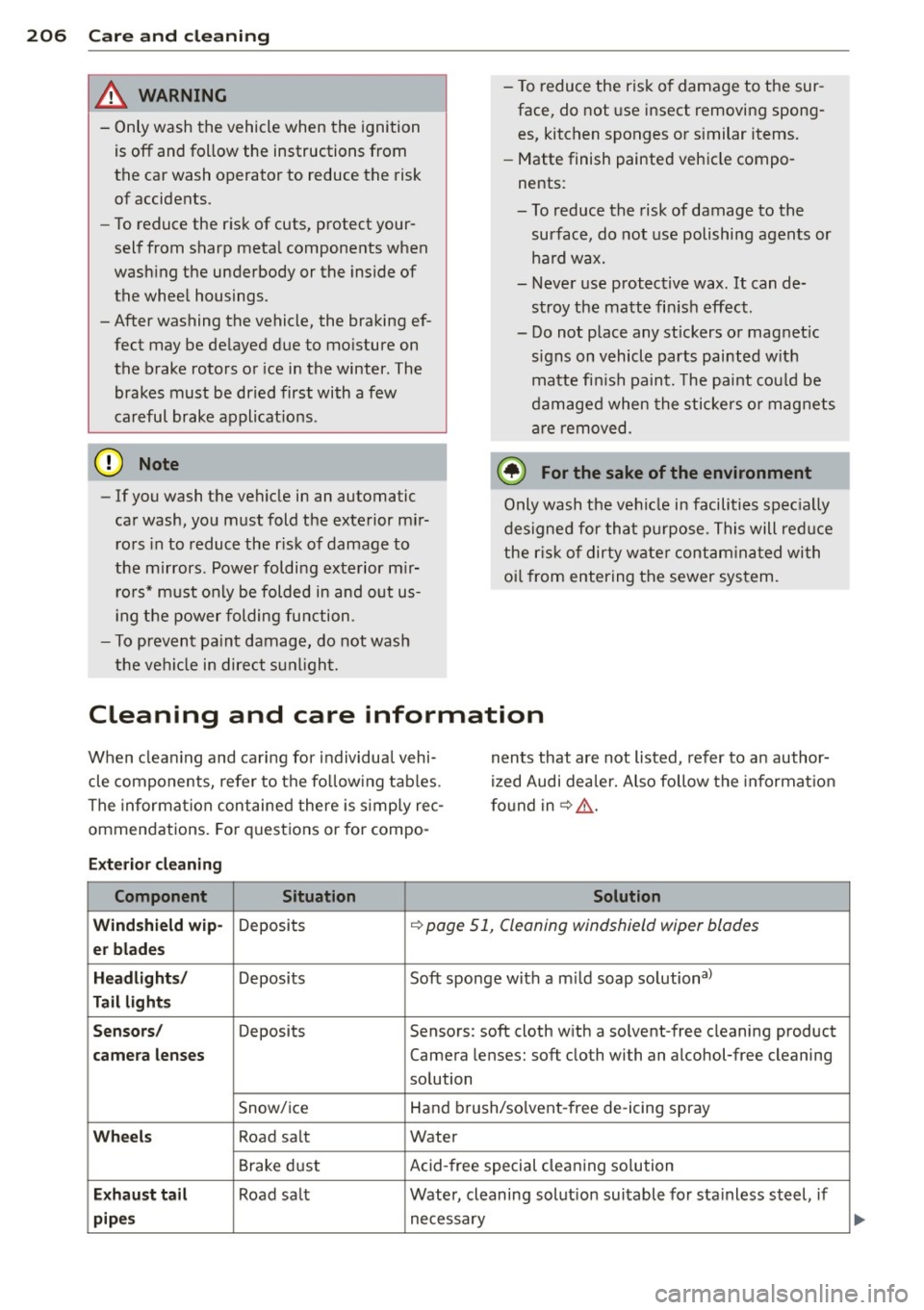
Cleaning and care information
When clea ning and ca rin g for individua l vehi
cle components, refer to the fo llow ing tab les.
The informa tion con taine d there is s imp ly rec
ommendations. Fo r quest ions or for compo -nents that ar
e not listed, refer to an author
i z ed Audi dea ler. Also follow the in format io n
f o und in¢ ,&..
Exterior cleaning
Component Situation Solution
Wind shield wip-
Deposi ts ¢ page 51, Cleaning windshield wiper blades
er blade s
H eadlights /
Deposits Soft sponge with a m ild soap solutiona>
Tail lights
Sensors /
Deposits Sensors: soft cloth with a so lvent-free cleaning product
camera lenses Camera lenses: soft cloth with an alcohol-free cleaning
so lution
Snow/ ice Hand brush/solvent -free de -icing spray
Wheels Road sa lt Water
Brake d ust Acid-free special cleaning so lution
E x haust ta il Road sa lt Water, cleaning solut ion sui table fo r sta inless steel, if
pipes necessary
Page 229 of 310
....,
N
0 > co
rl I.O
"' ....,
"' rl
Radiator fan
The radiator fan switches on automatically by
itself
An auxiliary electric radiator fan switches on
and off depending on coolan t temperature
and other vehicle operating conditions .
After you switch the engine off, the auxiliary
fan can continue running for up to 10 minutes
- even with the ignition off. It can even switch
on again later by itself<=>.& , if
- the temperature of the engine coolant rises
due to the heat build-up from the engine in
the engine compartment, or
- the engine compartment heats up because
the vehicle is parked in intense sunlight.
A WARNING
-To reduce the risk of personal injury nev
er touch the radiator fan.
- The auxiliary electric fan is temperature
controlled and can switch on suddenly
even when the engine is not running.
- The auxiliary radiator fan switches on au
tomatically when the engine coolant
reaches a certain temperature and will
continue to run until the coolant temper
ature drops.
Brake fluid
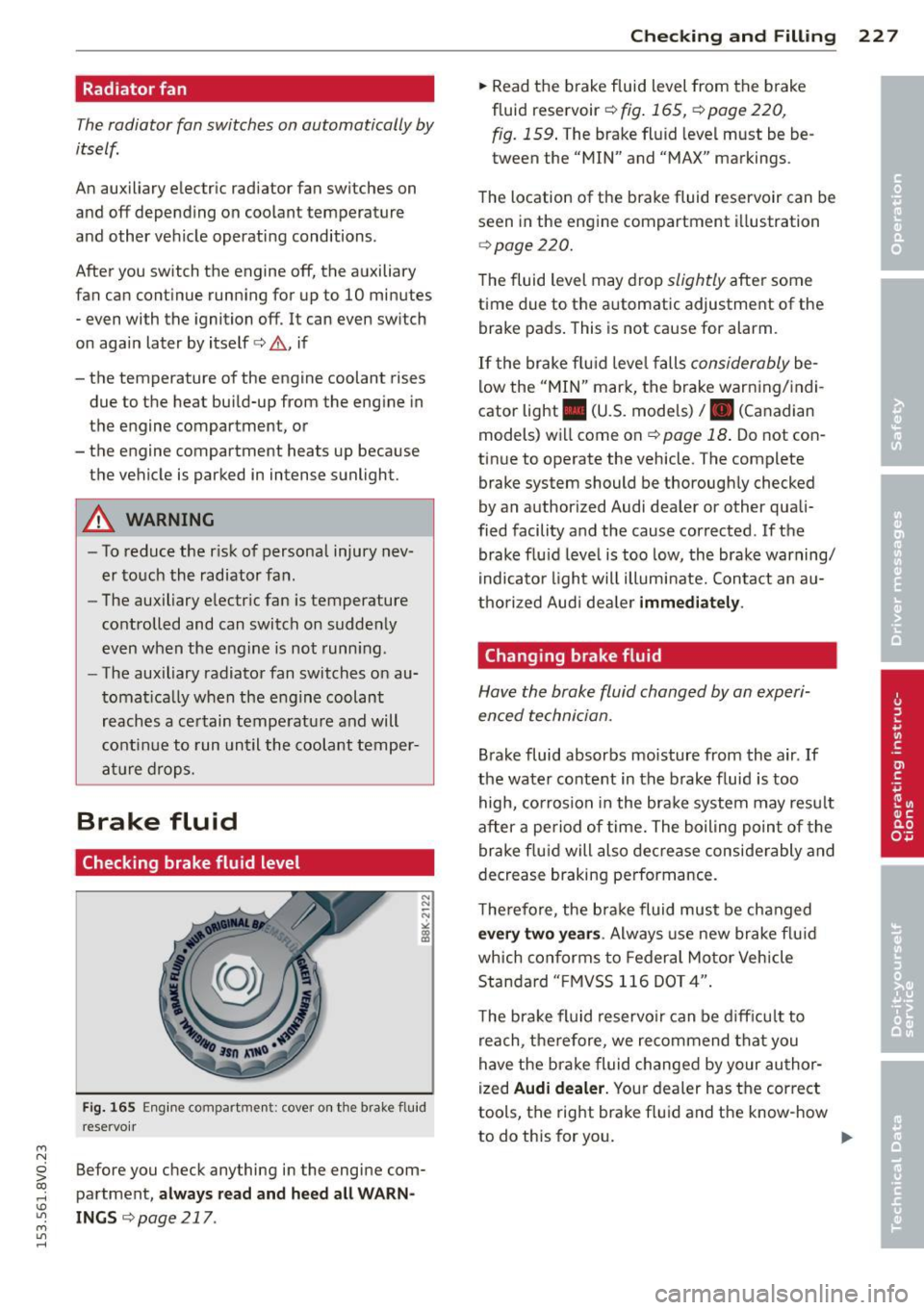
Checking brake fluid level
N
N
N
>< ~
Fig. 165 Engine compa rtment: cove r on the brake fluid
rese rvoir
Before you check anything in the engine com
partment,
always read and heed all WARN
INGS r::;, page 217 .
Checking and Filling 22 7
.. Read the brake fluid level from the brake
fluid reservoir <=>
fig. 165, <=> page 220,
fig. 159.
T he brake fluid level must be be
tween the "MIN" and "MAX" markings.
The location of the brake fluid reservoir can be seen in the engine compartment illustration
<=>page 220.
The fluid level may drop slightly after some
time due to the automatic adjustment of the
brake pads. This is not cause for alarm.
If the brake fluid level falls considerably be
low the "MIN" mark, the brake warning/indi
cator light . (U.S. models)
I. (Canadian
models) will come on
c:> page 18 . Do not con
tinue to operate the vehicle. The complete
brake system should be thoroughly checked
by an authorized Audi dealer or other quali
fied facility and the cause corrected . If the
brake fluid level is too low, the brake warning/
indicator light will illuminate. Contact an au
thorized Audi dealer
immediately.
Changing brake fluid
Have the brake fluid changed by an experi
enced technician.
Brake fluid absorbs moisture from the air . If
the water content in the brake fluid is too
high, corrosion in the brake system may result
after a period of time. The boiling point of the
brake fluid will also decrease considerably and
decrease braking performance.
Therefore, the brake fluid must be changed
every two years . Always use new brake fluid
which conforms to Federal Motor Vehicle
Standard "FMVSS 116 DOT 4".
The brake fluid reservoir can be difficult to
reach, therefore, we recommend that you
have the brake fluid changed by your author
ized
Audi dealer. Your dealer has the correct
tools, the right brake fluid and the know-how
to do this for you.
II>-
Page 230 of 310
228 Check ing and F illin g
8_ WARNING
-Brake fluid is poiso nous. It must be sto r
ed only in th e closed original container
out o f the reach of children!
- Brake fa ilure can result from old or inap
propriate brake fluid. Observe these pre
caut ions:
- Use only brake fluid that meets SAE specification
J 1703 and conforms to
Federal Motor Vehicle Standard 116.
Always check with your authorized Audi
dealer to make sure you are using the
correct brake flu id. The correct type of
brake fluid is also indicated on the
b rake fluid reservoir.
- The brake fluid must be new. Heavy use
of the brakes can cause a vapor lock if
the brake fluid is left in the system too
l ong. This can serious ly affect the effi
ciency of the bra kes as well as yo ur
safety . This could result in an acc ident.
@ Note
Brake flu id will damage the paint of your
veh icle.
@i For the sake of the environment
Because of the problem of proper d isposa l
of brake flu id as we ll as the special tools
requ ired and the ne cessary expert ise, we
recommend that you have the brake fluid
changed by your author ized Audi dealer .
Battery
General information
The battery in your Audi does not need any
maintena nce under
normal operating condi
tions. Aud i recommends having the elect ro
l yte level check by a n author ized Audi dealer
or author ized Audi Se rv ice Facili ty when there
are
high outside temperat ures or when driving
all day. The e lectrolyte level shou ld a lso be
checked each time the battery is charged
¢ page 230.
Have the batte ry checked when yo u bring your
vehicle in for an inspection . It is a good idea
to replace the battery if it is more than 5 years
o ld.
D uring certain types of airbag deployments,
the battery is disconnected from the vehicle electrical system for safety reasons¢
& in
Repair, care and disposal of the airbags on
page 160.
Di sconnecting the battery te rminals
Some vehicle functions (such as power win
dows) are not avai lable when the battery is
disconnected. These functions must be pro
grammed after the battery is reconnected. To
avo id hav ing to do this, only disconnect the
battery from the vehicle electrical system
when that is necessary to perform repairs .
To reprogram the functions, proceed as fol
lows:
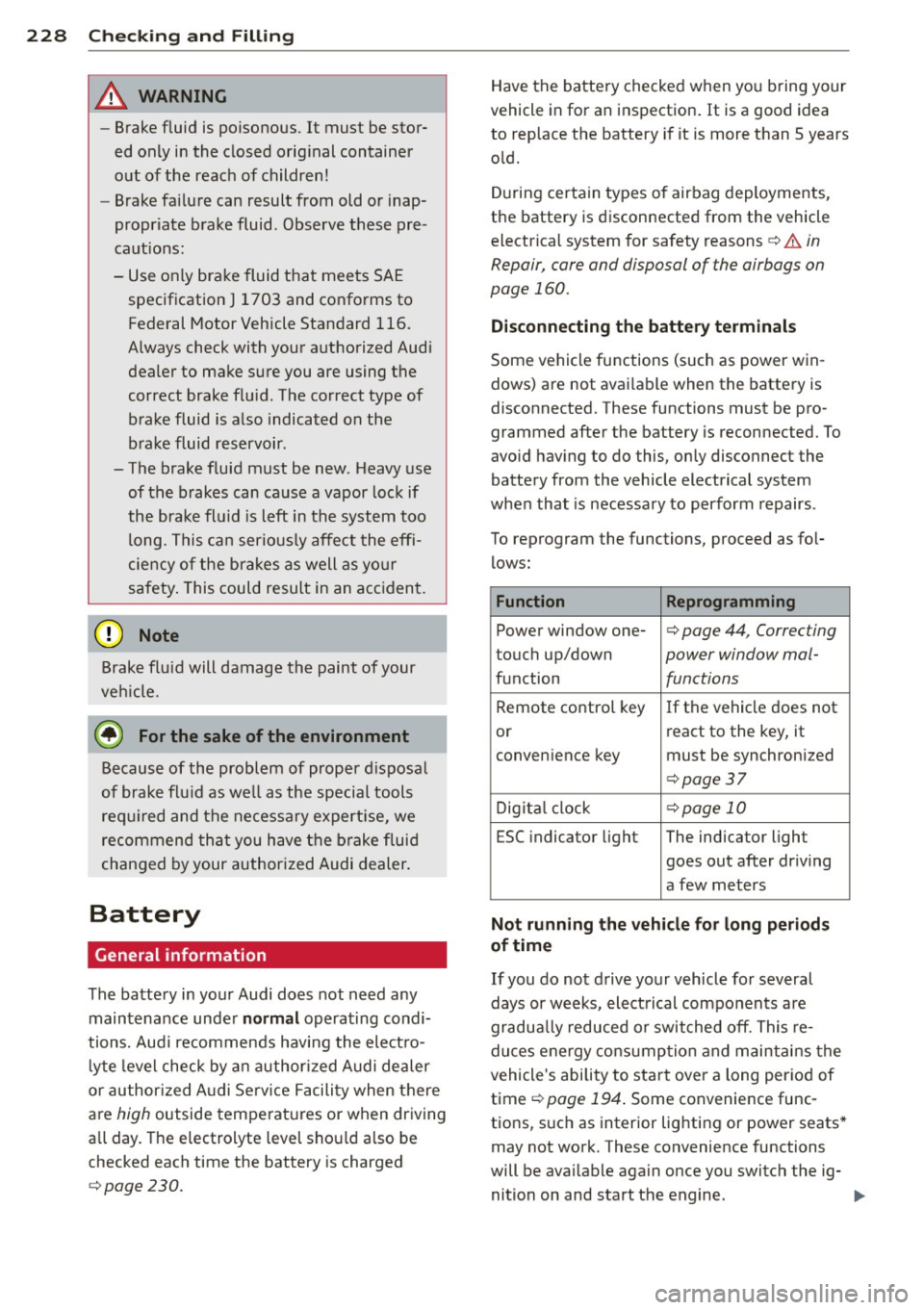
Function Reprogramming
Power window one-¢ page 44, Correcting
touch up/down power window ma/-
function functions
Remote control key
If the vehicle does not
or r
eact to the key, it
convenience key must be synchronized
¢ page37
Dig ita l cl ock ¢page 10
ESC indicator light The indicator light
goes out after driving
a few meters
Not running the vehicle for long periods
of time
If you do not drive your vehicle fo r several
days or weeks, electrical components are
gradua lly reduced or switched off. This re
duces e nergy consumption and maintains the
vehicle's ability to start over a long per iod of
time
¢ page 194. Some convenie nce func
tions, such as interior lig hting or power seats *
may not work. These convenience functions
will be ava ilable again once you switch the ig-
nition on and start the engine. .,.
Page 279 of 310
....,
N
0 > co
rl I.O
"' ....,
"' rl
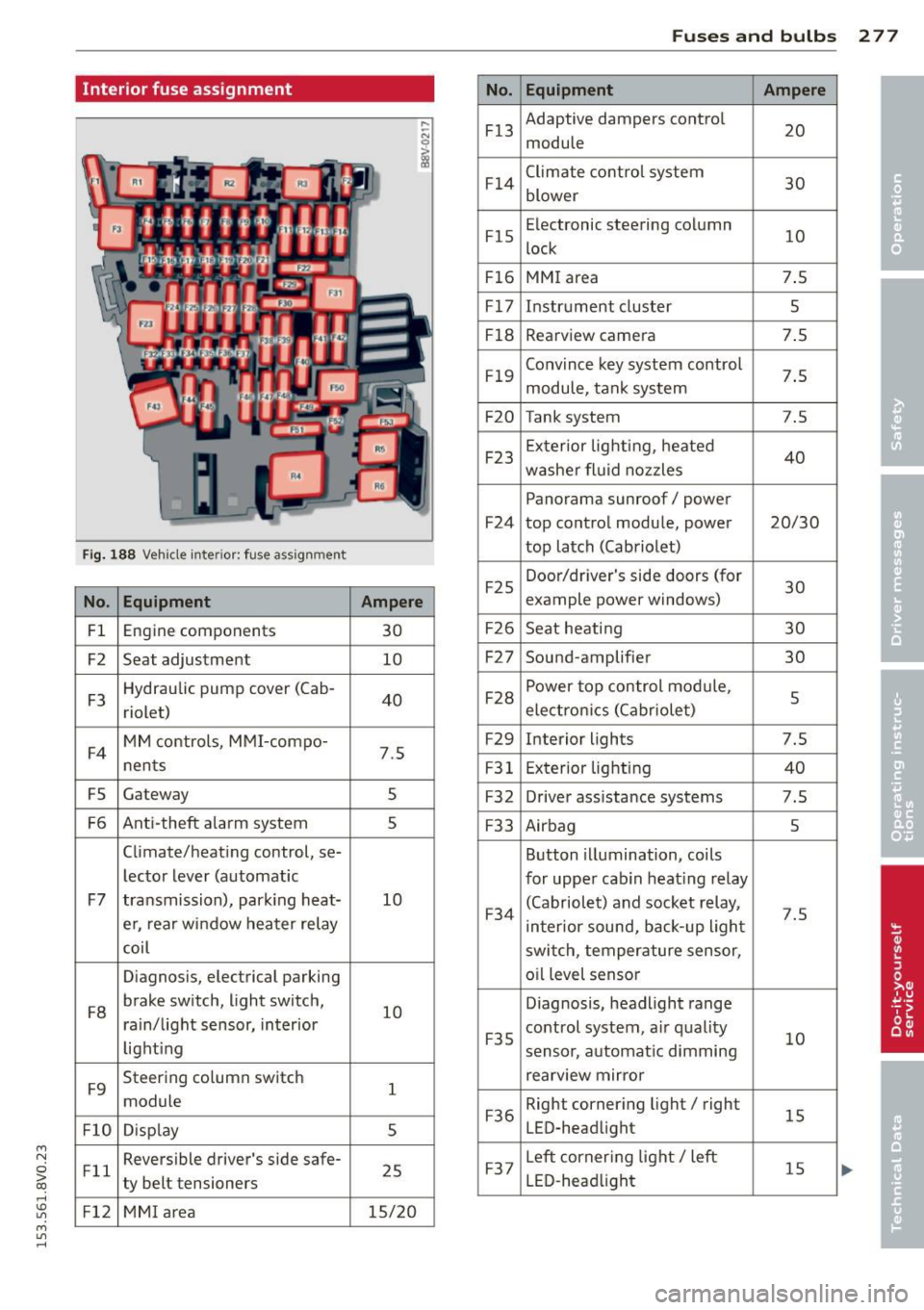
Interior fuse assignment
Fig. 188 Vehicle inter ior: fuse assignment
No . Equ ipment
Fl Engine components
F2 Seat adjustment
F 3 Hydraulic pump
cover (Cab-
riolet)
F4 MM controls, MMI-compo-
nents
FS Gateway
F 6 Anti-theft alarm system
Climate/heating control,
se-
lector lever (automatic
F7 transmission), park ing heat-
e r, rear window heater relay
coil
Diagnosis, electrical parking
F 8 brake
switch, light switch,
rain/light sensor, interior
light ing
F9 Steering
column switch
module
Fl0 Disp lay
Fll Reversible driver's
side safe-
ty belt tensioners
Fl2 MMI a rea
No .
Fl 3
Fl4
Fl5
Fl6
Fl7
Fl8
Fl9
F20
F23
F24
F25
Ampere
30 F26
10 F27
40 F28
F29
7.5
F31
s F32
5 F33
10 F34
10 F35
1 F36
5
25 F37
15/20
Fu se s and bulb s 2 77
Equipment Ampere
Adaptive dampers control
20
module
Climate control system 30
blower
Electronic steering column
10
lock
MM I area 7.5
Instrument cluster 5
Rearview camera 7.5
Conv ince key system control
7.5
module, tank system
Tank system 7.5
Ex terior lighting, heated
40
washer fluid nozzles
Panorama sunroof/ power
top control modu le, power 20/30
top latch (Cabriolet)
Door/dr iver's side doors (for
30
example power windows)
Seat heati ng 30
Sound-amplifier 30
Power top con trol module,
5
electron ics (Cabriolet)
Interior lights 7.5
Ex terior lighting
40
Driver assistance systems 7.5
Airbag 5
Button illumination, coils
for upper cab in heat ing relay
(Cabriolet) and socket relay,
7.5
interior sound, back-up ligh t
switch, temperature sensor, o il level sensor
Diagnosis, headlight range
control system, air quality
10
senso r, a utomat ic dimming
rearview mir ror
Right corner ing light/ right
15
LED-headlight
Left corner ing light/ left
15
LED -head light
Page 280 of 310
2 78 Fuses and bulbs
No . Equipment Ampere
Door/front passenger's side
F39 doors (for example, power 30
windows)
F40 Sockets 20
F41 Reversible front passenger·s
25
side safety belt tensioners
F42 Central locking components,
40
windshield washer system
F43 Headlights , light ing 30
F44 all wheel drive
15
F49 Starter, clutch sensor, head-
s light
relay coil
FS3 Rear window defogger
30
The power seats* are protected via
circuit
breakers
that automatically switch on after a
few seconds after the overload has been re
duced.
@ Tips
Note that the following table was accurate
at the time of print ing and is subject to
change.
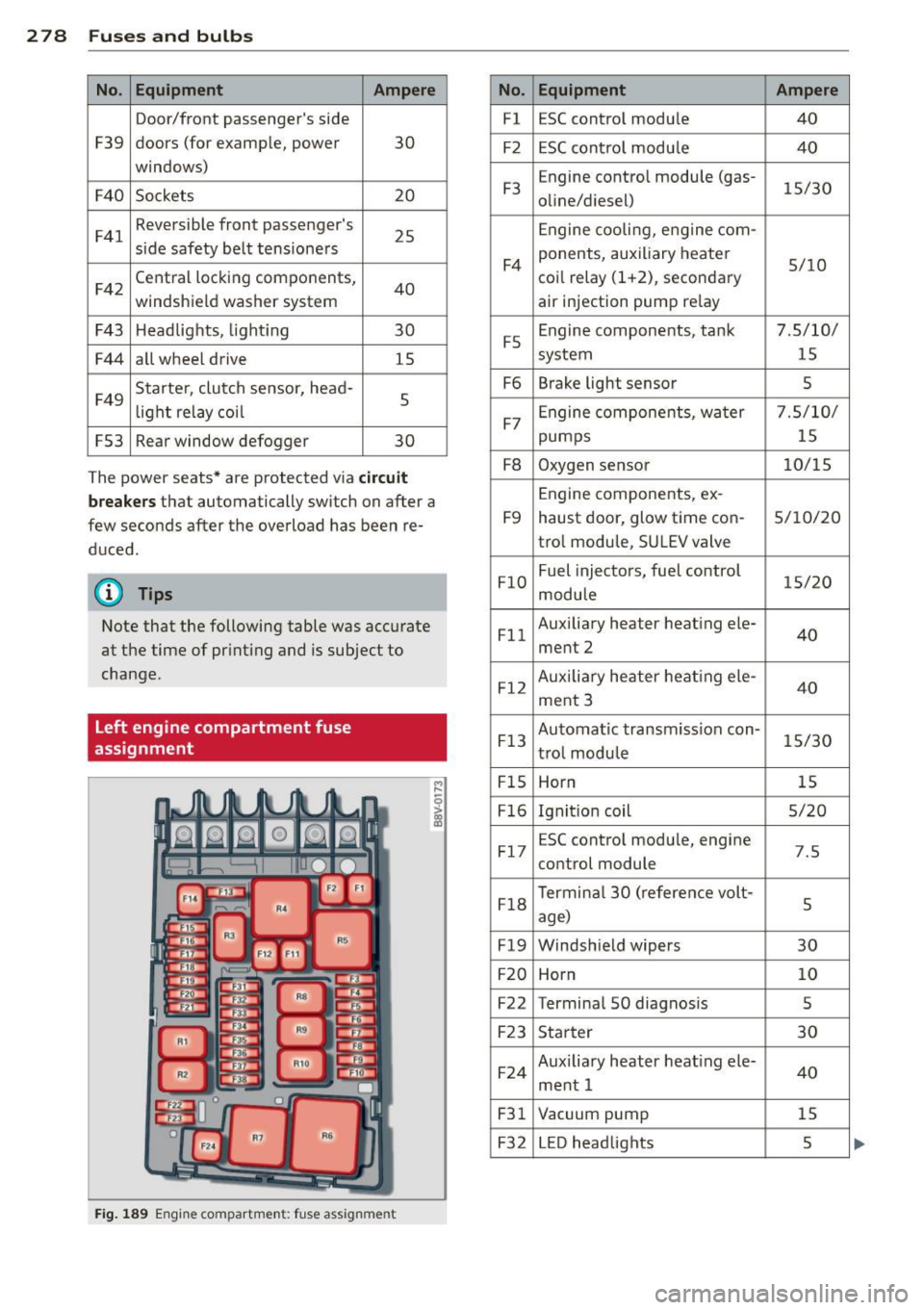
Left engine compartment fuse
assignment
Fig. 189 Engine compartment : fuse assignment
No.
Fl
F2
F3
F4
F5
F6
F7
F8
F9
FlO
Fll
Fl2
Fl3
Fl5 Fl6
Fl7
Fl8 Fl9
F20 F22
F23
F24
F3 1
F32
Equipment Ampere
ESC control modu le 40
ESC cont rol module 40
Engine control module (gas-
15/30
oline/diesel)
Engine cooling, engine com-
ponents, auxiliary heater 5/10
coil relay (1+2), secondary
air injection pump relay
Engine components, tank 7.5/10/
system 15
Brake light sensor
5
Engine components, water 7.5/10/
pumps 15
Oxygen sensor 10/15
Engine components, ex-
haust door, glow t ime con-
5/10/20
trol module, SU LEV valve
Fuel injectors, fuel control
15/20
module
Auxiliary heater heating ele-
40
ment2
Auxi lia ry heater heating ele-
40
ment 3
Automatic transmission con- 15/30
trol module
Horn 15
Ignit ion coil 5/20
ESC contro l module, engine
7.5
control module
T ermina l 30 (reference volt-
5
age)
Windshield wipers 30
Horn 10
Terminal SO diagnosis 5
Starter 30
Auxiliary heater heat ing ele-
40
ment 1
Vacuum pump 15
LED headlights 5
Page 283 of 310
....,
N
0 > co
rl I.O
"'
@ Tips
The discharged battery must be pr operly
connected to the vehicle's electrical sys
tem. When jump starting or charg ing the
battery, never connect the negative
ground cable to the batte ry negative post
because the ba ttery manager system must
be able to detect the battery's state of
charge. Always connec t the negative
g roun d cab le to t he negative ground pos t
of t he battery manager cont ro l unit.
Using jump start cables
Connect the jump start cables in the e xact or
der described below .
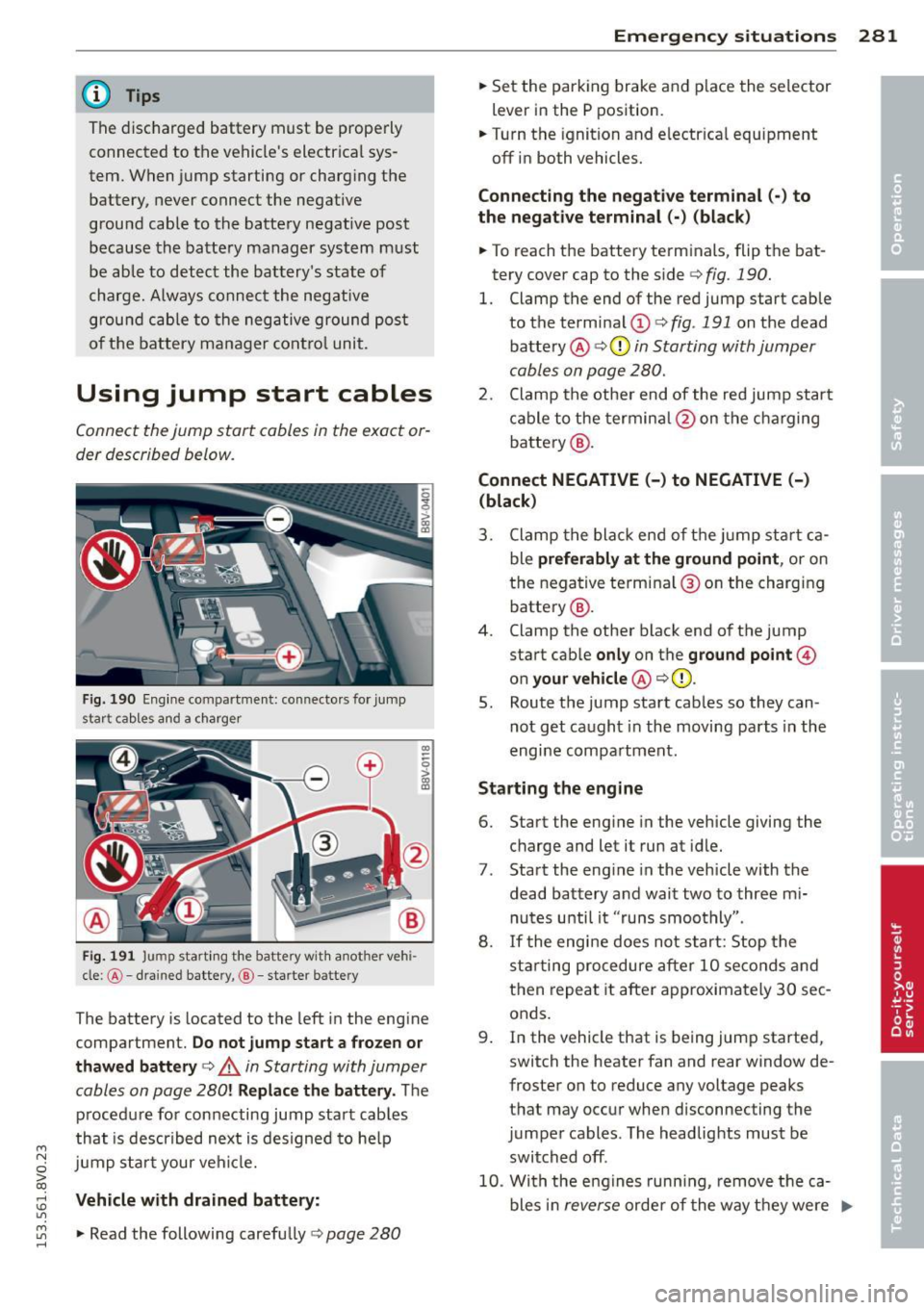
Fig . 190 Eng ine co mpar tment : connecto rs for jum p
star t cab le s an d a charger
Fig. 1 91 Jump start in g the batte ry w ith anot her ve hi
cle: @-dra ined battery ,@ -starte r bat tery
The batte ry is located to the left in the eng ine
compartment.
Do not jump start a frozen or
thawed battery
¢ A in Starting with jumper
cables on page
280 ! Replace the battery. The
p rocedu re for connecting jump start cab les
that is descr ibed next is designed to he lp
jump sta rt your ve hicl e.
Vehicle with drained battery:
~ .. Read the following carefully ¢ page 280 rl
Emergency situ ation s 281
.. Set the parking brake and p lace the selector
lever in the P position.
.. Turn the ignition and e lectr ica l equ ipment
off in both vehicles.
Connecting the negati ve terminal (-) to
the negat ive terminal (- ) ( black )
.. To r each the battery term inals, flip the bat
tery cover cap to the side ¢
fig. 190.
1. Clamp the end of the red jump start cable
to the terminal (!)¢
fig. 191 on the dead
battery @ ¢CI)
in Starting with jumper
cables on page 280 .
2. Clamp the othe r end of the red jump star t
c able to the termin al@ on t he charging
battery @.
Connect NEGATIVE (-) to NEGATIVE (-)
(black )
3. Clamp the blac k end of t he j ump sta rt ca
ble
preferably at the ground point , or on
the nega tive terminal @ on the charging
batte ry @ .
4. Clamp the other black end of the jump start cab le
onl y on the ground point@
on your vehicle @ ¢CI).
S. Route the jump start cab les so they can
not get ca ugh t in the moving parts in the
engine compa rtment.
St arting the engine
6. Start the engine in the vehicle giving the
charge and let it run at idle.
7 . Start the eng ine in the vehicle with the
dead battery and wait two to three m i
nu tes unti l it "runs smoothly".
8.
If t he engine does not s tart: Stop the
st art ing procedure afte r 10 seco nds and
then repeat it afte r approximately 30 sec
onds.
9 . In the vehicle that is be ing jump started,
switch the heater fan and rear window de
froster on to reduce any voltage peaks
t hat may occur when disconnecting the
j u mper cables . The headlights must be
switched off .
10 . Wi th the e ngin es runn ing , remov e th e ca
bles in
rever se orde r of the way t hey were ..,.