weight AUDI S3 2015 Owner's Guide
[x] Cancel search | Manufacturer: AUDI, Model Year: 2015, Model line: S3, Model: AUDI S3 2015Pages: 310, PDF Size: 76.15 MB
Page 246 of 310
244 Tires and wheels
The correct tire pressure for the
spare wheel is located on a la
bel on the driver's side 8-pillar .
Because technical changes may
be made to vehicle equipment
during the model year, always
compare the tire size designa
tion on the tire pressure label
on your vehicle with the tires on
your vehicle. Make sure that the
tire size information on the ve
hicle label is the same as the
size of the tires on the vehicle.
This is especially important if
the vehicle belongs to someone else or you bought the vehicle
with different rims/tires or you bought the vehicle as a previ
ously owned vehicle.
Remember, your safety and
that of your passengers also de
pends on making sure that load
limits are not exceeded. Vehicle
load includes everybody and ev
erything in and on the vehicle.
These load limits are technical
ly referred to as the vehicle's
Gross Vehicle Weight Rating
("GVWR"). The Gross Axle
Weight Rating ("GAWR") is the maximum load that can be ap
plied at each of the vehicle's
two axles. The Gross Vehicle Weight Rating and the Gross
Axle Weight Rating are listed
on the safety compliance stick
er label located on the driver's
side 8-pillar.
The tire pressure
label on your Audi lists the
maximum combined weight of
all of the occupants and lug gage or other cargo that the ve
hicle can carry. For the location
of the tire pressure label
~fig. 168.
A WARNING -
Overloading a vehicle can
cause loss of vehicle control,
a crash or other accident, se
rious personal injury, and
even death.
-Carrying more weight than your vehicle was designed to carry will prevent the ve
hicle from handling properly
and increase the risk of a
loss of vehicle control.
-The brakes on a vehicle that has been overloaded may not be able to stop the vehi
cle within a safe distance.
-Tires on a vehicle that has been overloaded can fail
suddenly causing loss of
control and a crash.
Page 247 of 310
M N
0 > co ...... \!) 1.1'1
M 1.1'1 ......
-Always make sure that the total load being transported - including the weight of a
trailer hitch and the tongue
weight of a loaded trailer - does not make the vehicle heavier than the vehicles
Gross Vehicle Weight Rat
ing.
_& WARNING
- Incorrect tire pressures
and/or underinflation can
lead to a serious or fatal ac
cident.
- Incorrect tire pressures
and/or underinflation cause
increased tire wear and can
affect the handling of the
vehicle.
-Incorrect tire pressures and/or underinflation can
also lead to sudden tire failure, including a blowout
and sudden deflation, caus ing loss of vehicle control.
Tires and wheels 245
Checking tire pressure
The correct tire pressure for the
tires originally installed on
your vehicle is listed on the tire pressure label located on driv er's side 8-pillar.
The recommended tire pres
sures are on the tire pressure label and in the table
¢ page 240~ Cold tire inflation
pressure.
This means that the
pressure must be checked and
adjusted when the tire has not
been driven for more than a
couple of miles (kilometers) at
low speeds during the previous
three hours. Air in the tires ex pands when the tire heats up as
a result of internal friction as it
flexes in use. The tire pressure is higher when the tire has
warmed up than when it is "cold ."
It is the inflation pressure in a
"cold" tire that counts. There
fore, you should never let air
out of a warm tire to match
"Cold tire inflation pressure" recommendations ¢
page 240.
The tires would then be under
inflated and could fail sudden
ly .
...
' •
•
' •
Page 251 of 310
M N
0 > co ,...., \!) 1.1'1
M 1.1'1 ,....,
Tires and vehicle load limits
There are limits to the amount of load or weight that any vehi
cle and any tire can carry. Ave
hicle that is overloaded will not
handle well and is more diffi
cult to stop. Overloading can
not only lead to loss of vehicle
control, but can also damage
important parts of the vehicle
and can lead to sudden tire fail
ure, including a blowout and
sudden deflation that can cause
the vehicle to crash.
Your safety and that of your
passengers also depends on
making sure that load limits are
not exceeded. Vehicle load in
cludes everybody and every
thing in and on the vehicle.
These load limits are technical
ly referred to as the vehicle's
Gross Vehicle Weight Rating
("GVWR").
The "GVWR" includes the
weight of the basic vehicle, all
factory installed accessories, a
full tank of fuel, oil, coolant and other fluids plus maximum
load. The maximum load in
cludes the number of passen
gers that the vehicle is intend-
Tires and wheels 249
ed to carry ("seating capacity")
with an assumed weight of 1
SO lbs (68 kg) for each pas
senger at a designated seating
position and the total weight of
any luggage in the vehicle. If
you tow a trailer, the weight of
the trailer hitch and the tongue
weight of the loaded trailer must be included as part of the
vehicle load.
The
Gross Axle Weight Rating
("GAWR") is the maximum load
that can be applied at each of
the vehicle's two axles.
The Gross Vehicle Weight Rat
ing and the Gross Axle Weight
Rating are listed on the safety
compliance sticker label locat
ed on the driver's side 8-pillar.
Your Audi has 5 seating posi
tions, 2 in the front and 3 in the rear for total seating capacity
of 5. Each seating position has
a safety belt¢
page 135, Safe
ty belts.
The fact that there is an upper
limit to your vehicle's Gross Ve
hicle Weight Rating means that
the total weight of whatever is
being carried in the vehicle (in
cluding the weight of a trailer ""
' •
•
' •
Page 252 of 310
250 Tires and wheels
hitch and the tongue weight of
the loaded trailer) is limited.
The more passengers in the ve hicle or passengers who are
heavier than the standard
weights assumed mean that
less weight can be carried as
luggage .
The tire pressure label on your
Audi also lists the maximum combined weight of all of the
occupants and luggage or other
cargo that the vehicle can carry.
For the location of the label
q page 240, fig. 168 .
_& WARNING
~ -
Overloading a vehicle can
cause loss of vehicle control,
a crash or other accident, se
rious personal injury, and
even death.
-Carrying more weight than
your vehicle was designed to carry will prevent the vehicle from handling properly
and increase the risk of the
loss of vehicle control.
-The brakes on a vehicle that
has been overloaded may
not be able to stop the vehi
cle within a safe distance . -Tires
on a vehicle that has
been overloaded can fail
suddenly, including a blow
out and sudden deflation,
causing loss of control and a
crash.
-Always make sure that the
total load being transported
- including the weight of a
trailer hitch and the tongue
weight of a loaded trailer -
does not make the vehicle
heavier than the vehicles
Gross Vehicle Weight Rat
ing .
Determining correct load
limit
Use the example below to cal
culate the total weight of the
passengers and luggage or oth
er things that you plan to trans port so that you can make sure
that your vehicle will not be
overloaded.
Steps for Determining
Correct Load Limit
1. Locate the statement "THE
COMBINED WEIGHT OF OC
CUPANTS AND CARGO
SHOULD NEVER EXCEED XXX .,..
Page 253 of 310
M N
0 > co ,...., \!) 1.1'1
M 1.1'1 ,....,
KG OR XXX LBS" on your ve
hicle's placard (tire inflation
pressure label)
c:> page 240,
fig. 168.
2. Determine the combined
weight of the driver and pas sengers that will be riding in
your vehicle.
3 . Subtract the combined
weight of the driver and pas sengers from
"XXX" kilo
grams or
"XXX" pounds
shown on the sticker
c:> page 240 , fig. 168.
4. The resulting figure equals
the available amount of car
go and luggage load capaci
ty. For example, if the "XXX"
amount equals 1400 lbs.
and there will be five 150 lbs. passengers in your vehi
cle, the amount of available
cargo and luggage load ca
pacity is 650 lbs. (1400-750 (5
X 150) = 650 lbs.)
5. Determine the combined weight of luggage and cargo being loaded on the vehicle.
That weight may not safely
exceed the available cargo
and luggage load capacity
calculated in Step 4.
Tires and wheels 251
6. If your vehicle will be towing a trailer, load from your trail
er will be transferred to your
vehicle. Consult this manual
to determine how this re
duces the available cargo
and luggage load capacity of
your vehicle.
~check the tire sidewall
(¢ page 254, fig . 172) to de
termine the designated load rating for a specific tire.
' •
•
' •
Page 260 of 310
258 Tires an d whee ls
tires because they meet the
h ighest standards regarding
safety and driving characteris
tics when used correctly. Your
authorized Audi dealer w ill
g ladly provide you with more
information.
Tire ply composition and materials used
T he number of plies indicates
the number of layers of rubber
coated fabric in the tire. In gen
eral, the greater the number of
plies , the more weight a tire
can support . Tire manufactur
ers also must indicate the ma
ter ia ls in the tire, wh ich include
steel, nylon, polyester, and oth
ers .
Maximum Load Rating
This number indicates the max
imum load in kilograms and
pounds that can be carried by
the tire.
Tire quality grading for
treadwear, traction, and
temperature resistance
Tread wear, trac tion and tem
perature grades
¢ page 260.
Maximum Permissible
Inflation Pressure
T his number is the g reatest
amount of air pressure that should ever be put in the tire
under normal driv ing condi
tions.
A WARNING
-Using incorrect or unmatch ed tires and/or wheels or
improper t ire and wheel
combinations can lead to loss of control , collision and
ser ious personal injury.
-Always use tires, rims and
wheel bolts that meet the
specifications of original
factory-installed tires o r
other combinations that
have been specifically ap
proved by the vehicle manu
facturer.
- Tires age even if they a re
not being used and can fail
sudden ly, especially at high
speeds. Tires that a re more
than 6 years old can on ly be
used in an eme rgency and
then with special care and
at lower speeds.
-Never mount used tires on
your vehicle if you are no t
Page 287 of 310
M N
0 > co ,...., \!) ..,.,
M ..,., ,....,
fall fro m a lift if the re is a c hange in ve
h icle we ight d istr ibut ion a nd ba lance.
This might happen, for e xamp le, w hen
heavy compone nts such as the engi ne
b lock or transmiss io n are removed .
- Whe n remov ing heavy components li ke
t hese, ancho r vehicl e to hoist o r add cor
r es pond ing w eig hts to mai ntain the cen
t e r of g ravity . Othe rwise, the v ehicl e
m ight til t or slip off th e hois t, causi ng
serious person al inju ry.
(D Note
- Be awa re of the fo llowing po in ts befo re
li fting the vehicle:
- The vehicle should never be lifted or
jacked up from unde rneath the engine
oil pan, the transmission housing, the
front or rear axle or the body side
members. This could lead to serious
damage .
- To avoid damage to the underbody or
chassis frame , a rubber pad must be
inserted between the floor jack and
the lift points.
- Before driving over a workshop hoist,
check that the vehicle weight does not
exceed the permissible lifting capacity
of the hoist.
- Before driving over a workshop hoist,
ensure that there is sufficient clear ance between the hoist and low parts
of the vehicle .
Emergency situations 285
•
•
•
Page 288 of 310
286 Technical data
Technical data
Vehicle identification
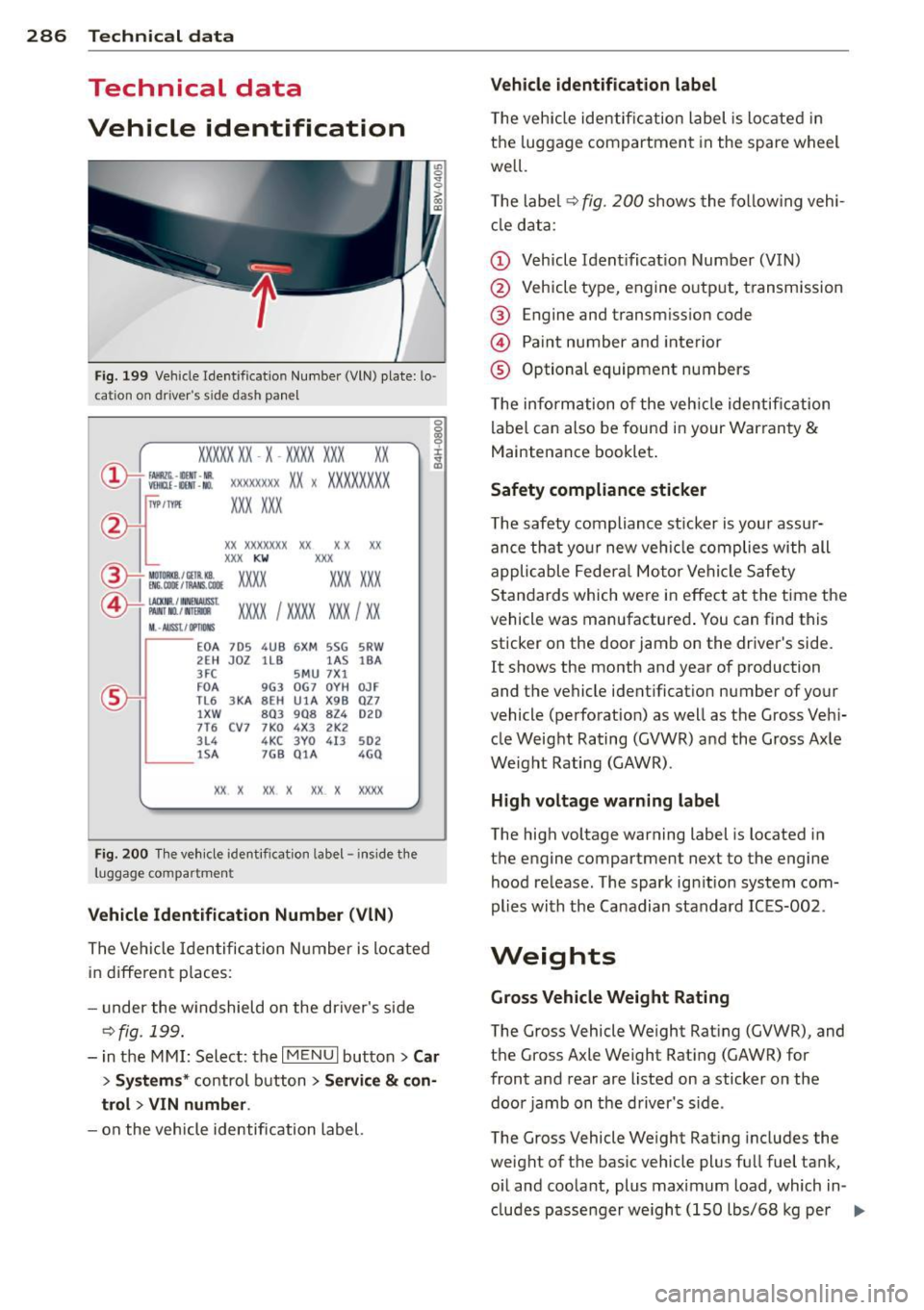
F ig. 199 Vehicle I dent ifica tion Numbe r (VlN) pla te: lo·
cat ion on driver 's side dash pane l
XXXXX XX · X -XXXX XXX
r,"\__l f~ -11!11 1 · NII. ~ V!Hlll -llllll . NO.
xx
XXXXXXXX XX X XXXXXXXX
XXX XXX IYP IT'fl'E
XX XXXX XXX X X X X XX
XXX
KW XXX
®i ~~: f :l~~ XXXX XXX XXX
@+ ~~r= XXXX I XXXX XXX I XX M,. AIIISl. / lflllllS
EO A 7D5 4 UB 6XM SSG 5RW
2E H JDZ llB l AS lBA
3FC 5MU 7Xl
FO A
9G3 OG7 O
YH OJF
TL6 J
KA BEH
UlA X9B QZ 7
l XW
8Q3 9Q8 82 4 020
7T6 CV 7 7KO 4X3 2K2
3L4 4 KC 3YO 4I3 502
lS A 7GB Q1A 4GQ
XX X XX X XX X XXXX
Fig. 2 00 Th e ve hicle identi ficat ion label -inside the
luggage co mpa rtmen t
Vehicle Id entification Number (VlN )
The Ve hicle Identific ation Number is located
in different p laces:
- under the w indshield on the driver's s ide
~fig . 199.
- in the MMI : Select: the I MENU I button> Car
> Sy ste m s* control button > Se rvic e & con
trol
> VIN number .
-on the vehicle identification label.
Vehicle identification label
The vehicle identific ation label is lo cate d in
the luggage compartment in the spare wheel
we ll.
T he label~
fig. 200 shows the fo llowing vehi
cl e d ata:
(D Vehicl e Ident ificat ion Number (VIN)
@ Vehicle type, engine outp ut, transmission
@ Engine and transm ission code
@ Pain t number a nd inte rior
® Optional equipment numbers
T he inform ation of the vehicle identification
label can also be found in your Warranty
&
Maintenance booklet.
Safety compliance sticker
T he safety complianc e sticker is your assur
ance th at your new veh icle complies with all
applicable Fede ra l Motor Vehicle S afety
Standards which were in effec t at the time the
vehicle was manufactured . You can find this
sticker on the door jamb on the driver's side.
It shows the month and year of production
and t he vehicle identificat io n number of your
vehicle (perfo ration) as well as the Gross Veh i
cle Weight Rating (GVWR) a nd the Gross Ax le
Weight Rating (GAWR) .
High voltage warning label
The high voltage warning label is located in
th e engine compartment next to the engine
hood re lease . The spark ignit ion system com
plies with the Canadian standard ICES-002.
Weights
Gross Vehicle Weight Rating
The Gross Vehicle Weight Rating (GVWR), and
the Gross Axle Weight Rat ing (GAWR) for
front and rear are listed on a sticker on the
doo r jamb on t he d river's side .
The Gross Vehicle Weight Rat ing includes the
weight of the basic vehicle plus full fuel tank,
o il and coo la nt, plus maximum load, which in
cludes passenger we ight (150 lbs/68 kg per .,..
Page 289 of 310
M N
0 > co ,...., \!) ..,.,
M ..,., ,....,
Te chn ic a l da ta 28 7
designated seating position) and luggage
weight ~&. .
Gros s Axle W eight Rating
The G ross Axle Weight Rating is the maximum
l oad that can be applied at each axle of the
vehicle ~.&. .
Vehicle capacit y weight
The vehicle capac ity we ight (max. load) is list
ed either on the dr iver's side B-pillar or inside
the fuel filler flap.
_& WARNING
- T he actual Gross Axle Weight Rat ing at
the front and rear axles shou ld not ex
ceed the permissible weights, and their
combination must not exceed the Gross
Vehicle Weight Rating .
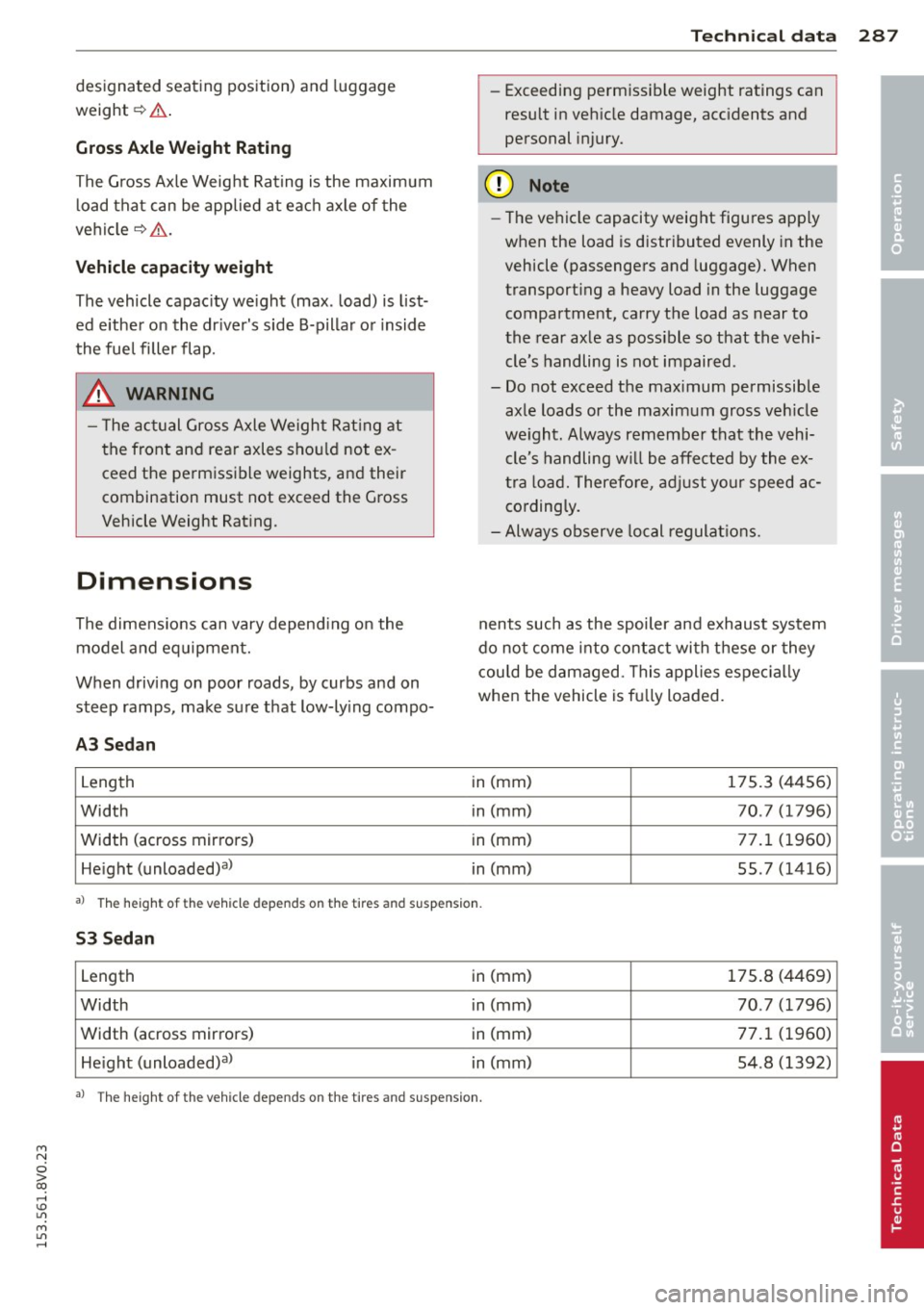
Dimensions
The dimensions can vary depend ing on the
model and equipment.
-
When driving on poor roads, by curbs and on
steep ramps, make sure that low-ly ing compo-
A3 Sed an
Length
Width
Width (across mir rors)
He ight (unloaded)a) -
Exceeding perm iss ible weight ratings can
result in vehicle damage, acc idents and
personal injury.
([) Note
-The vehicle capacity weight figures apply
when the load is d istr ibuted evenly in the
vehicle (passengers and luggage). When
transport ing a heavy load in the luggage
compartment, carry the load as near to
the rear axle as poss ible so that the vehi
cle's handling is not impaired.
- Do not exceed the maximum permissible axle loads or the maximum gross veh icle
we ight. Always remember that the vehi
cle's handling w ill be affected by the ex
tra load. Therefore, ad just yo ur speed ac
co rdingly.
- Always observe local regulat ions.
nents such as the spoiler and exhaust system
do not come i nto contact with these or they
could be damaged. This applies espec ially
when the vehicle is fu lly loaded.
in (mm)
175.3 (4456)
in (mm) 70.7 (1796)
in (mm) 77.1 (1960)
in (mm) 55.7 (1416)
al The height of the vehicle depends on the tires and suspension.
53 Sed an
Length in (mm) 175.8 (4469)
Width in (mm) 70
.7 (1796)
Width (across mirrors) in (mm) 77.1 (1960)
Height (unloaded)a) in (mm) 54.8 (1392)
a l The height of the vehicle depends on the tires and suspension.
•
•
Page 300 of 310
298 Index
Environment
Break-in period . ....... ... .. .. .... . 197
Cata lytic converter ....... ... .. .... . 198
Diese l partic ulate filter ............. 199
Disposing of your vehicle battery .... . 231
Driving at h igh speeds ......... .. ... 200
Driving to m inim ize pollution and no ise 199
Fue l economy . . . . . . . . . . . . . . . . . . . . . 199
L ett ing the ve hicle s tand and wa rm up . 200
P roper disposal of dra ined brake flu id . 227
Pr oper disposal of dra ined engine oil .. 224
Un leaded fu el .. .. ..... ... .. .. .... . 210
What should I do with an old battery? . 231
E PC (eng ine control) .......... .. .... .. 23
ESC Automatic post-collision braking sys-
tem ...... ................... ... . 190
Electron ic stabilization control . . . . . . . 189
Sport mode ...................... 190
Event Data Recorder ( EDR) ... .. .. .. .. . 195
E xterior lighting . .. ..... ... .. .. .... .. 46
E xterio r m irrors
Ad just ing .. .......... ...... ... .. .. 52
D imm ing ... ................ .... ... 53
fo ld in g .. .. .. ... ..... ..... .. .. .. .. 5 2
H ea ting .... .. . .. ..... ... .. .. .... .. 52
F
Fasten ing
Booste r seats . ........ ..... .. .. .. . 179
Convertible chi ld safety seats ..... .. . 17 7
Infant seats . .. .. ..... ... .. .. .... . 176
Fl oor mats . .. ............. .. .. .. .. . 130
Fog lights/rear fog light(s) ..... .. .. .. . . 46
F olding the exte rior mirrors
Cente r locking . ....... ... .. .. .... .. 40
Folding the rear seats . . . . . . . . . . . . . . . . . 65
Foot pedals ................. .. .... . 130
F oo twell ligh ting .......... .. .. .... .. 49
For the sake of the environment
Fueling ...................... ... . 212
L eaks .. .. ... ....... ........ ..... . 218
Rear w indow defogger . . . . . . . . . . . . . . . 7 2
Front airbags
Descr ipt ion .... ... .... ... ... ... .. . 148
H ow they work ................ ... . 154
Fronta l co llisions and the laws of physics 136 F
ront a rmrest ..... ... .. ..... ... .. .. . 58
Front passenger's door emergency locking 41
Front seats Adjusting . .... .. ............. .... 127
Child restraints in the front seat ...... 146
also refer to Seats . . . . . . . . . . . . . . 56, 64
Fuel Additives .. .... .. ............. .... 210
Blended gasoline .............. .. .. 210
Current consumption ........... .. .. . 28
Fuel filler neck . ................... 212
Fuel gauge . . . . . . . . . . . . . . . . . . . . 10, 12
Fuel ta nk capacity ... .......... .. .. 288
Gasoli ne .. .. .. .. .. ........... .. .. 210
Gaso lin e ad dit ives ................. 211
Indicator light ... .. ... ..... ... .. .. . 24
Octane rat ing .... ... .. ..... ... .. .. 210
Recommendation ... ... ..... ... .. .. 210
Sav ing fuel .... .. ............. .... 106
F uel economy messages (effic iency p ro -
gram) . ... .. .... .. ... .. .. ..... ... .. . 30
Fueling Fuel fi lle r door emergency re lease .. .. 214
Fuel gauge . . . . . . . . . . . . . . . . . . . . . . . . 12
F uel ta nk capaci ty ... .......... .. .. 288
Open ing the fue l filler door . ... .. .. .. 212
Fuses Ass ignment ..... ................ . 277
I n te rio r ... .... .. ............. .... 276
replacing .. .... .. ............. .... 276
G
Ga rment hooks .. .. ............. .. .. . 62
Gas discharge lamps ................. 279
G lossary of tire and loading term inology 235
G love compar tment ................ .. 61
CD changer ...................... .. 61
Gross Vehicle Weight Rating (GVWR) ... 286
H
Headlight range control system ... .. .. . 46
Indicator light ... .. ... ..... ... .. .. . 25
Head lights . . . . . . . . . . . . . . . . . . . . . 46, 48
Head lig hts
Cleaning ........................ . 206