weight AUDI S3 2015 User Guide
[x] Cancel search | Manufacturer: AUDI, Model Year: 2015, Model line: S3, Model: AUDI S3 2015Pages: 310, PDF Size: 76.15 MB
Page 160 of 310
158 Airbag system
- and if the electrica l capacitance registered
on the front passenger seat is equal to or
l ess than the combined capacitance of a typ
ical 1 year-old infant and one of the rear
ward-facing or forward-facing child re
stra ints listed in Federal Motor Vehicle Safe
ty Standard 208 w ith which the Advanced
Airbag System in your vehicle was certified.
If the front passenger seat is not occupied,
the front airbag will not deploy, and the
PAS
SENGER AIR BAG OFF
light will stay on . Nev
er insta ll a rearward-facing child restraint on
the front passenger seat, the safest place for
a child in any kind of child restraint is at one
of the seat ing positions on the rear seat
¢ page 146, Child restraints on the front seat
- some important things to know
and
¢ page 170, Child Safety .
If the PASSENGER AIR BAG light comes
on ...
If the PASSENGER AIR BAG OFF light comes
on when one of the conditions listed above is met , be sure to check the light regularly to
make certa in that the
PASSENGER AIR BAG
OFF
light stays on cont inuously whenever the
ignit ion is on . If the
PASSENGER AIR BAG
OFF
l ight does not appear on and does not
stay on all the time, stop as soon as it is safe
to do so and
- reactivate the system by turning the ignition
off for more than 4 seconds and then turn
i ng it on again;
- remove and re install the child restraint.
Make su re that the child restraint is properly
installed and that the safety belt fo r the
front passenger seat has been correctly
routed through the child restraint as descri
bed in the chi ld restraint man ufacturer 's in
structions;
- make sure that the convertible locking re
tractor on the safety belt for the front pas
senger seat has been activated and that the
safety belt has been pulled tight.
- make sure that no e lectrica l device (such as
a laptop, CD playe r, electronic games device,
power inverter or seat hea ter for child seats)
is placed or used on the front passenger seat
if the device is connected to the 12-volt
socket or the cigarette lighter socket;
- ma ke sure that no seat heater has been ret
rofitted or otherwise added to the front pas
senger seat;
- make s ure that nothing can interfere with
the safety belt buck les and that they are not
obstructed ;
- make sure that there are no wet objects
(such as a wet towe l) and no water or other
liquids on the front passenger seat cushion.
If the PASSENGER AIR BAG light still
does not come on ...
If the PASSENGER AIR BAG OFF light still
does not come on and does not stay on con
tinuous ly (when the ignition is switched on),
- take the child restraint off the front passen -
ger seat and install it properly at one of the
rear seat positions. Have the airbag system
inspected by your Audi dealer immed iately.
- move the child to a rear seat position and
make sure that the child is properly restrain
ed in a ch ild restra int that is appropriate for
its size and age .
The PASSENGER AIR BAG light should
NOT come on ...
The PASSENGER AIR BAG OFF light should
NO T come on when the ignition is on and an
adult is s itting in a proper seating position on
the front passenger seat. If the
PASSENGER
AIR BAG OFF
light comes on and stays on or
flashes for about S seconds wh ile d riving, un
der these circumstances, make sure that:
- the adult on the front passenger seat is
properly seated on the cente r of the seat
cushion with his or her back up aga inst the
backrest and the backrest is not reclined,
- the adult is not taking weight off the seat by
holding on to the passenger assist handle
above the front passenger door or support
ing their weight on the armrest ,
- t he safety belt is being properly wo rn and
that there is not a lot of s lack in the safety
be lt webbing,
- there are no aftermarket seat covers or
cushions or other things (such as blankets) .,..
Page 168 of 310
166 Airbag system
-Never use additional seat cushions that
cover the areas where the side airbags
deploy.
- Damage to the original seat covers or
to the seam in the area of the side air
bag module must always be repaired
immediately by an authorized Audi
dealer.
- Objects between you and the airbag can
increase the risk of injury in an accident
by interfering with the way the airbag
unfolds or by being pushed into you as
the airbag inflates .
- Never place or attach accessories or
other objects (such as cup holders, tel
ephone brackets , or even large, bulky
objects) on the doors, over or near the
area marked "AIRBAG" on the seat
backrests.
- Such objects and accessories can be
come dangerous projectiles and cause
injury if the supplemental side airbag
inflates .
- Never carry any objects or pets in the
deployment space between them and
the airbags or allow children or other
passengers to travel in this position.
- Always use the built-in coat hooks only
for lightweight clothing . Never leave any
heavy or sharp-edged objects in the
pockets that may interfere with side air
bag deployment and can cause personal
injury in an accident.
- Always prevent the side airbags from be
ing damaged by heavy objects knocking
against or hitting the sides of the seat
backs.
- The airbag system can only be triggered once. If the airbag has been triggered,
the system must be replaced by an au
thorized Audi dealership.
- Damage (cracks, deep scratches etc.) to
the original seat covers or to the seam in
the area of the side airbag module must
always be repaired immediately by an au
thorized Audi dealer. - If children are seated improperly, their
risk of injury increases in the case of an
accident
Q page 170, Child Safety.
-Never attempt to modify any compo
nents of the airbag system in any way .
- In a side collision, side airbags will not
function properly if sensors cannot cor
rectly measure increasing air pressure in
side the doors when air escapes through
larger, unclosed openings in the door
panel.
- Never drive with interior door trim pan els removed.
- Never drive when parts have been re
moved from the inside door panel and
the openings they leave have not been
properly closed.
- Never drive when loudspeakers in the
doors have been removed unless the
speaker holes have been properly closed.
- Always make certain that openings are covered or filled if additional speakers
or other equipment is installed in the
inside door panels.
- Always have work on the doors done by
an authorized Audi dealer or qualified
workshop .
Side curtain airbags
Description of side curtain airbags
The side curtain airbag system can provide
supplemental protection to properly restrain
ed occupants.
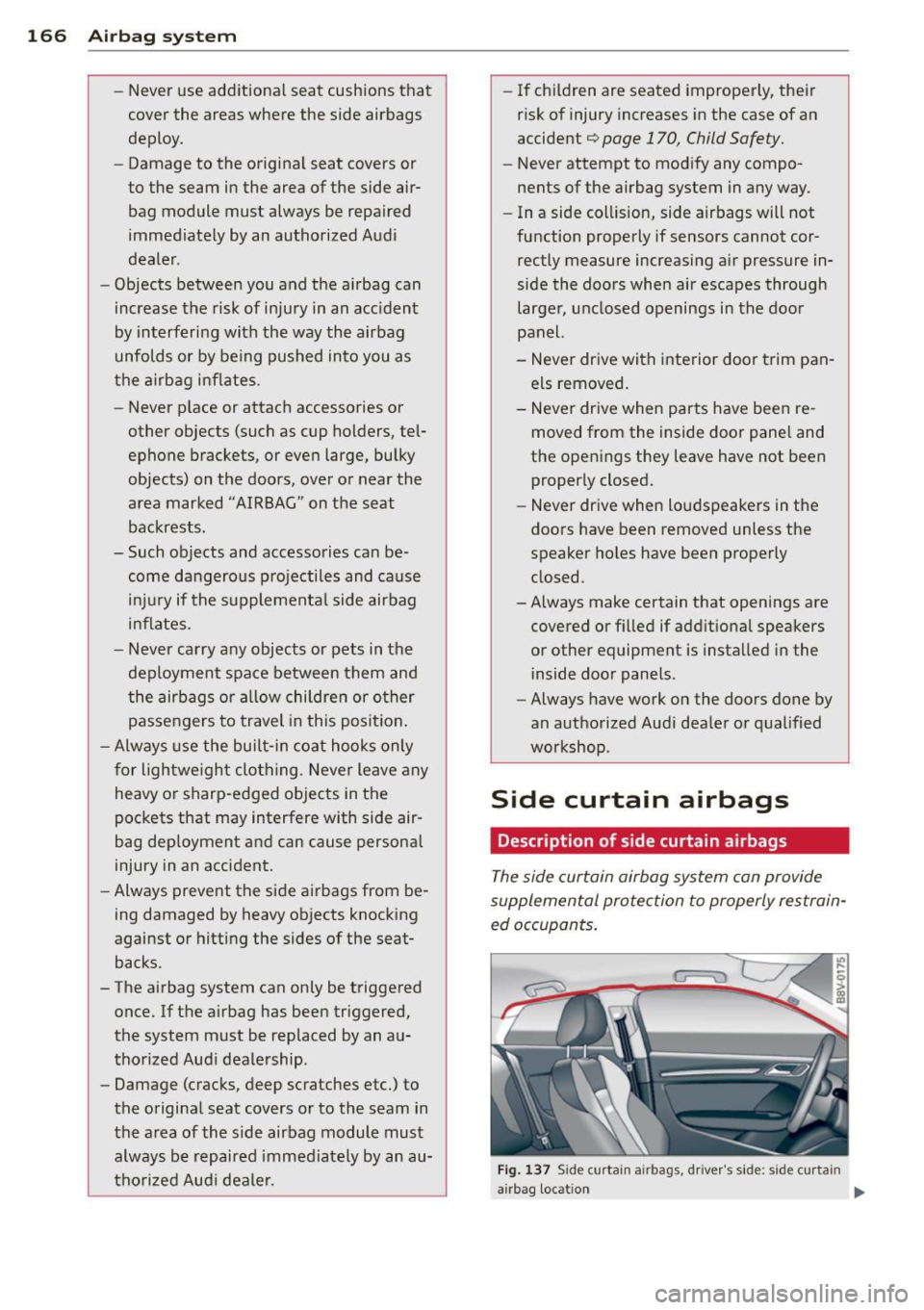
Fig. 137 S id e curta in a irbags, driv er's side: side cur ta in
airbag location ..,_
Page 170 of 310
168 Airbag system
How side curtain airbags work
Side curtain airbags can work together with
side airbags to help reduce the risk of head
and upper torso injuries for occupants who
are properly restrained.
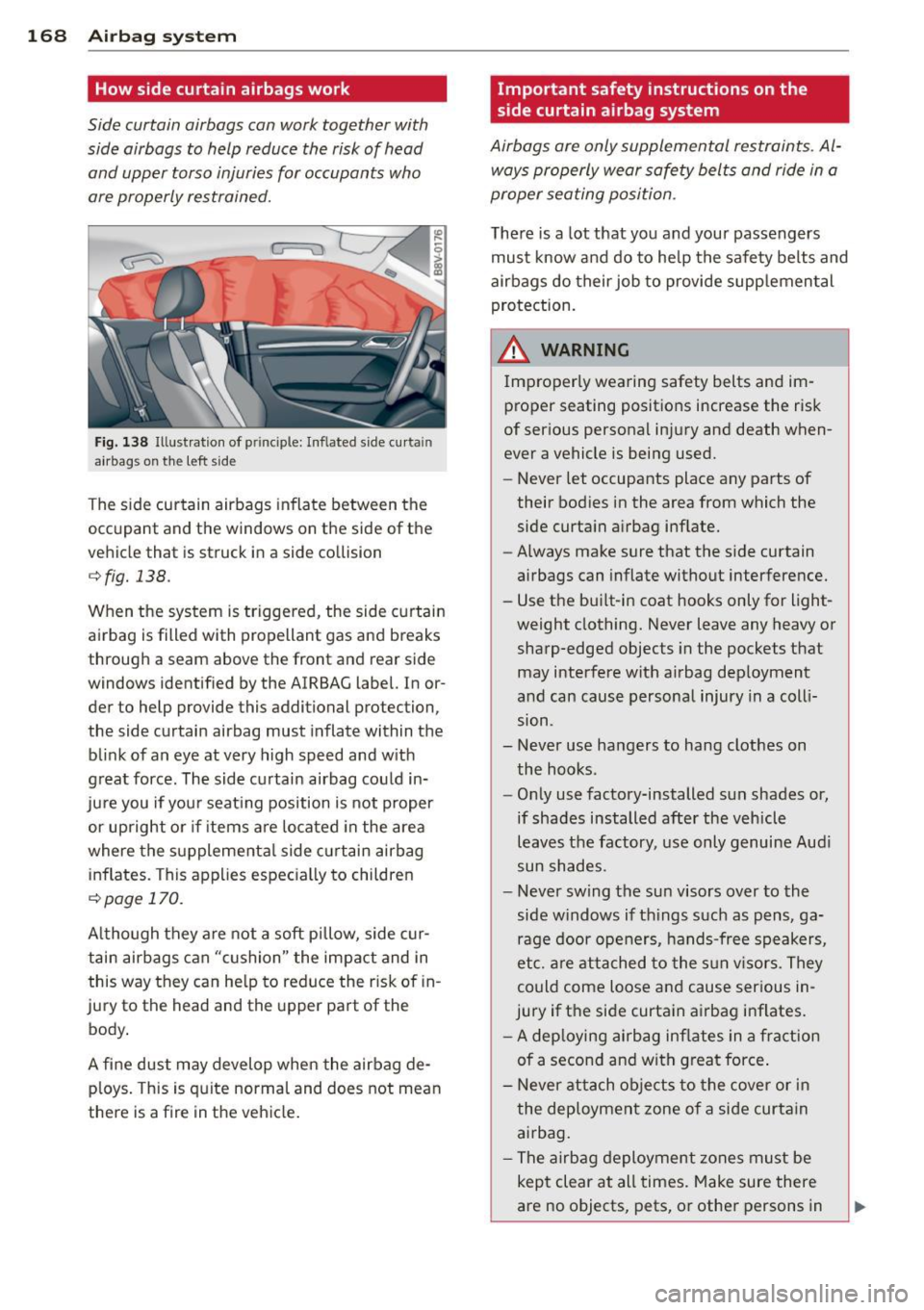
Fig. 138 Illustration of p rincipl e: In flated s ide curt ain
airbags on th e Left side
The side curtain airbags inflate between the
occupant and the windows on the side of the
vehicle that is struck in a side collision
c::> fig. 138.
When the system is triggered , the side curtain
airbag is filled with propellant gas and breaks
through a seam above the front and rear side
windows identified by the AIRBAG label. In or
der to help provide this additional pro tection,
the side curtain airbag must inflate within the
blink of an eye at very high speed and with
great force . The side curtain airbag could in
jure you if your seating position is not proper or upright or if items are located in the area
where the supplemental side curtain airbag
inflates . This applies especially to children
<=:> page 170.
Although they are not a soft pillow, side cur
tain airbags can "cushion" the impact and in
this way they can he lp to reduce the risk of in
jury to the head and the upper part of the
body .
A fine dust may develop when the airbag de ploys. This is quite norma l and does not mean
there is a fire in the vehicle. Important safety instructions on the
side curtain airbag system
Airbags are only supplemental restraints
. Al
ways properly wear safety belts and ride in o
proper seating position.
There is a lot that you and your passengers
must know and do to he lp the safety belts and
airbags do their job to provide supp lemental
protection.
A WARNING
Improperly wearing safety belts and im
proper seating positions increase the risk
of serious personal injury and death when
ever a vehicle is being used.
- Never let occupants place any parts of
their bodies in the area from which the
side curtain airbag inflate.
- Always make sure that the side curtain
airbags can inflate without interference.
- Use the built-in coat hooks only for light
weight clothing. Never leave any heavy or
sharp-edged objects in the pockets that
may interfere with airbag deployment
and can cause personal injury in a colli
sion.
- Never use hangers to hang clothes on
the hooks .
- Only use factory-installed sun shades or,
if shades installed after the vehicle
leaves the factory, use only genuine Aud i
sun shades.
- Never swing the sun visors over to the
side windows if things such as pens, ga rage door openers , hands-free speakers,
etc. are attached to the sun visors. They
could come loose and cause serious in
jury if the side curtain airbag inflates .
- A deploying airbag inflates in a fraction
of a second and with great force .
- Never attach objects to the cover or in
the deployment zone of a side curtain
airbag.
- The airbag deployment zones must be
kept clear at all times. Make sure there
are no objects, pets, or other persons in
-
Page 172 of 310
1 70 Child Saf ety
Child Safety
Important things to
know
Introduction
The rear seat is generally the safest place in a
collision.
The physical principles of what happens when
your veh icle is in a crash app ly also to chi ldren
¢ page 136, What happens to occupants not
wearing safety belts?.
But unlike adults and
teenagers, their muscles and bones are not
fu lly developed. In many respects children are
at greater risk of serious injury in crashes than
adults.
Because children's bodies are not fully deve l
oped, they require restraint systems especial
ly designed for their size, weight, and body
structure. Many countries and all states of the
United States and provinces of Canada have
laws requiring the use of approved child re
straint systems for infants and small ch ildren.
In a fronta l crash at a speed of 20 -35 mph
(30-56 km/h) the forces acting on a 13-pound
(6 kg) infant w ill be more than 20 t imes the
weight of the child. This means the weight of
the child would suddenly be more than 260 pounds (120 kg). Under these conditions,
only an appropriate ch ild restraint properly
used can reduce the risk of ser ious injury.
Child restraints, like adult safety belts, must
be used properly to be effective. Used improp
erly, they can increase the risk of serious in
jury in an accident.
Consult the child safety seat manufacturer's instructions to be sure the seat is right for
your child's size¢
page 174, Important safe
ty instructions for using child safety seats.
Please be sure to read and heed all of the im
portant information and WARNINGS about
ch ild safety, Advanced Airbags, and the instal
l ation of chi ld restraints in this chapter.
There is a lot you need to know about the Ad
vanced Airbags in your vehicle and how they
work when infants and children in child re- straints are on the front passenger seat
. Be
cause of the large amount of important infor
mation, we cannot repeat it all here . We urge
you to read the detailed information in this
owner's manual about airbags and the Ad
vanced Airbag System in your vehicle and the
very important information about transport
ing children on the front passenger seat.
Please be sure to heed the WARNINGS - they
are extremely important for your safety and
the safety of your passengers, especially in
fants and small children.
A WARNING
-Accident statistics have shown that chil
dren are generally safer in the rear seat
area than in the front seating position.
Always restrain any child age 12 and un
der in the rear.
- All vehicle occupants and especially chil
dren must be restrained properly when
ever riding in a vehicle. An unrestrained
or improperly restrained chi ld could be
injured by str iking the i nterior or by be
ing ejected from the vehicle during a
sudden maneuver or impact. An unre
strained or improperly restrained chi ld is
also at greater risk of injury or death
through contact with an inflating airbag.
- A suitable chi ld restraint properly instal
led and used at one of the rear seating positions provides the highest degree of
protection for infants and small children
in most accident situations.
A WARNING ,_
Children on the front seat of any car even
with Advanced Airbags can be ser iously in
jured or even killed when an airbag in
flates. A child in a rearward-facing child
safety seat installed on the front passen
ger seat will be seriously injured and can
be killed if the front airbag inflates.
- The inflating airbag will hit the child
safety seat or infant carrier with great
force and will smash the child safety seat and child against the backrest, center
armrest, or door.
II>-
Page 176 of 310
174 Child Safety
-Have the airbag system inspected by
your authorized Audi dealer immediate
ly.
The child seats listed in categories A to C have been statically tested by Audi only for
the Advanced Airbag function.
Important safety instructions for using
child safety seats
Correc t use of child safety seats substantially
reduces the risk of injury in an accident!
As the driver, you are responsible for the safe
ty of everybody in the vehicle, especially chil
dren :
• Always use the right child safety seat for
each child and always use it properly
c:> page 176.
• Always carefully follow the child safety seat
manufacturer's instructions on how to route
the safety belt properly through the child
safety seat.
• When using the vehicle safety belt to install
a child safety seat, you must first activate
the convertible locking retractor on the
safety belt to prevent the child safety seat
from moving
c:> page 181.
• Push the child safety seat down with your
full weight to get the safety belt really tight so that the seat cannot move forward or
sideways more than one inch (2.5 cm) .
• Secure unused safety belts on the rear seat
cc> page 176.
Always remember: Even though your vehicle is
equipped with an Advanced Airbag system, all
children , especially those 12 years and young
er, should always ride in the back seat proper
ly restrained for their age and size.
.&_ WARNING
Not using a child safety seat, using the
wrong child safety seat or improperly in stalling a child restraint increases the risk
of serious personal injury and death . -
-All vehicle occupants and especially chil
dren must be restrained properly when
ever riding in a vehicle. An unrestrained
or improperly restrained child could be
injured by striking the interior or by be
ing ejected from the vehicle during a
sudden maneuver or impact. An unre
strained or improperly restrained child is
also at greater risk of injury or death
through contact with an inflating airbag.
- Commercially available child safety seats
are required to comply with U.S. Federal
Motor Vehicle Safety Standard (FMVSS)
213 (in Canada CMVSS 213).
- When buying a child restraint, select one that fits your child and the vehicle.
- Only use child restraint systems that fully contact the flat portion of the seat cushion . The child restraint must
not tip or lean to either side . Audi does
not recommend using child safety
seats that rest on legs or tube-like
frames. They do not provide adequate
contact with the seat.
- Always heed all legal requirements per
taining to the installation and use of
child safety seats and carefully follow
the instructions provided by the manu
facturer of the seat you are using.
- Never allow children under 57 inches
(1.45 meters) to wear a normal safety
belt. They must always be restrained by a
proper child restraint system . Otherwise,
they could sustain injuries to the abdo men and neck areas during sudden brak
ing maneuvers or accidents.
- Never let more than one child occupy a
child safety seat.
- Never let babies or older children ride in
a vehicle while sitting on the lap of an
other passenger .
- Holding a child in your arms is never a
substitute for a child restraint system .
- The strongest person could not hold
the child with the forces that exist in
an accident. The child will strike the in
terior of the vehicle and can also be struck by the passenger.
Page 178 of 310
1 7 6 Child S afet y
Secure unused safety belts on the rear
seat
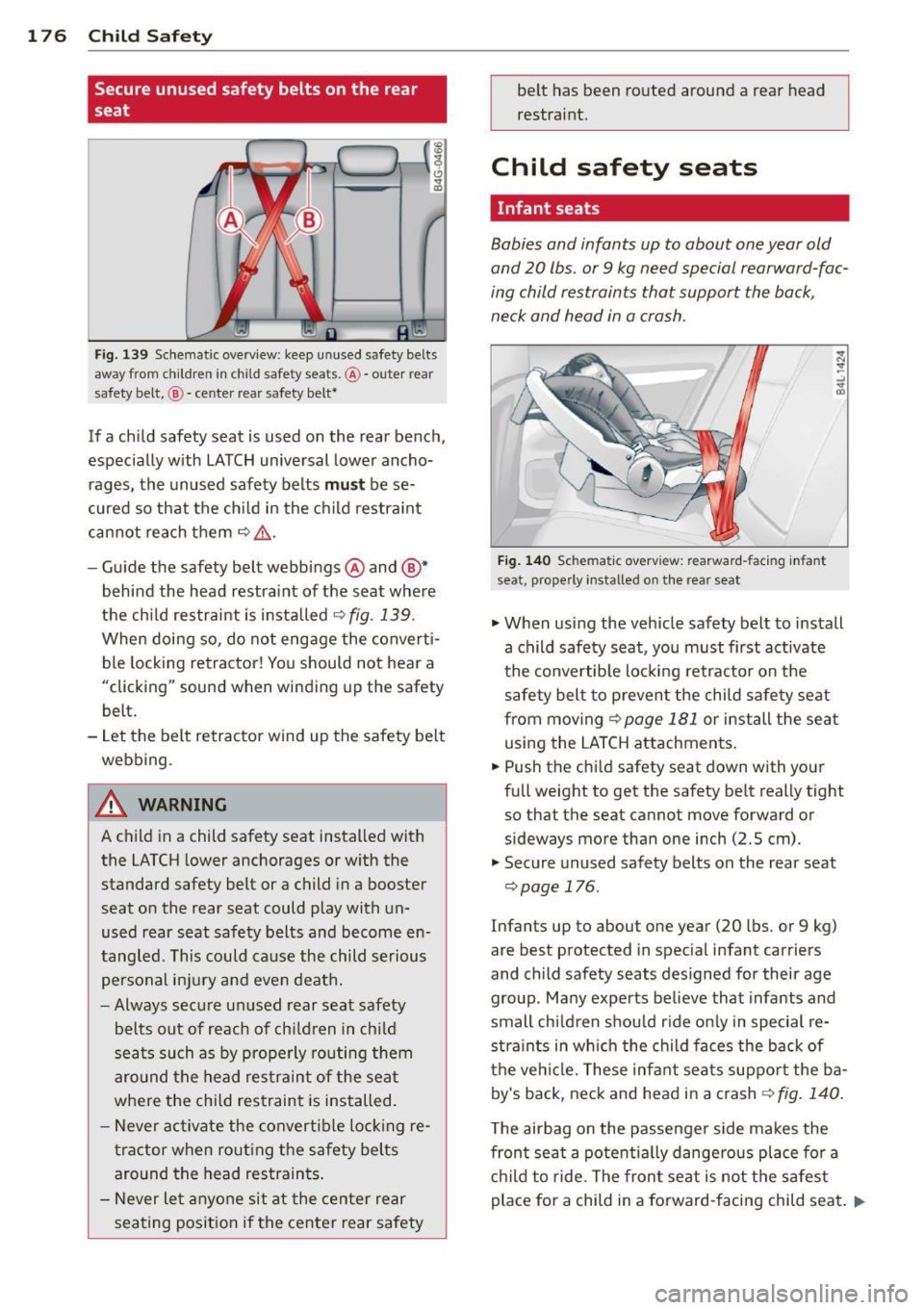
F ig. 139 Schematic overview: keep unused safety belts
away from children in child safety seats.@-outer rear
safety belt,
® -center rear safety belr
If a child safety seat is used on the rear bench,
espec ially w ith LATCH unive rsal lower ancho
rages, the unused safety belts
mu st be se
cured so that the ch ild in the child restra in t
cannot reach them¢,&..
- Gui de the safety belt webbings @and
®*
behind the head restraint of the seat whe re
the chi ld restrai nt is installed ¢
fig. 139.
When doing so, do not engage the converti
ble locking retractor! You should not hear a
"clicking" sound when winding up the safety
belt .
- Let the belt re tractor wind up the safety be lt
webbing.
A WARNING
A child in a child safety seat installed with
the LATCH lower anchorages or w ith the
standard safety belt or a child in a booster
seat on the rear seat could play with un
used rear seat safety belts and become en
tangled. This could cause the child serious personal i nju ry an d even deat h.
- Always secu re un used rear seat safety
belts out of r each of ch ildren in ch ild
seats such as by properly routi ng them
around the head restraint of the seat
where the child restraint is installed.
- Never ac tivate the convertib le lo cking re
t ractor when rou ting the s afety belts
around the head restraints .
- Never le t anyone sit at the center re ar
sea ting posit io n if the center rear safety be
lt has been ro uted around a rear head
restraint.
Child safety seats
Infant seats
Babies and infants up to about one year old
and 20 lbs . or 9 kg need special rearward-fac
ing child restraints that support the back,
neck and head in a crash.
F ig . 14 0 Schem atic overview: rearward -facing infant
seat, properly installed o n the rear seat
.,. When usi ng the vehicle safety belt to install
a child safety seat, you must first activate
the convertib le locking retr actor on the
safety belt to p revent the child safe ty seat
from mov ing¢
page 181 or ins tall the seat
using the LATCH attachmen ts.
.,.. Push the chi ld safety seat down with you r
full weight to get the safety belt really tight
so that the seat cannot move forward or
sideways more than one inch (2.5 cm).
.,. Secure unused safety belts on the rear seat
¢page 176.
Infants up to about one year (20 lbs. or 9 kg)
are best protected in spec ial infant carriers
and ch ild safety seats designed for their age
group. Many experts believe that infants and
small ch ild ren shou ld r ide o nly in special re
stra ints in wh ich the child faces the back of
the ve hicl e. These infa nt sea ts suppor t the ba
by's back, nec k and head in a crash
¢ fig. 140 .
The airbag on the passenger side makes the
fron t seat a pote ntia lly dange ro us place for a
chil d to ride. The front se at is not the s afest
place for a child in a forward-facing child seat . ..,.
Page 180 of 310
178 Child Saf ety
• When using the vehicle safety be lt to insta ll
a chi ld safety seat, you must first activate
the convertible locking retractor on the
safety belt to prevent the child safety seat
from moving ¢
page 181 or install the seat
using the LATCH attachments .
• Push the child safety seat dow n with your
full weight to get the safety belt rea lly t ight
so that the sea t ca nnot move forward or
s ideways more than one inch ( 2.5 cm)
¢page 181.
• If the child safety seat is eq uipped with a
tether strap, attach it to the tether anchors
¢ page 187.
• Secure unused safety belts on the rear seat
¢ page 176.
A toddler or child is usually too large for an in
fant restraint if it is more than one year o ld
and weighs more than 20 lbs. (9 kg) .
Todd lers and c hildren who are o lder than one
yea r up to abo ut 4 years o ld and weigh more
than 20 lbs (9 kg) up to 40 lbs . (18 kg) must
a lways be properly restrained in a ch ild safety
seat certified for the ir s ize and weight
¢
fig . 141 and ¢ fig. 142.
The airbag on the passenger side makes the
front seat a potentially dangerous place for a child to r ide . The fro nt seat is not the safest
p lace for a child in a forwa rd-facing child safe
ty seat.
It is a very dange rous p lace for an in
fant or a la rger chi ld in a rearwa rd-fa cing seat.
A WARNING
Not u sing a ch ild safety se at, using the
wrong ch ild safety sea t or improper ly in
stal ling a child restraint increases the risk
of serious personal injury and death in a
co llision or other emergency s ituation.
- Children on t he front seat of any car,
even w ith Advanced A irbags, can be seri
o usly injured or even killed when an a ir
bag inf lates. A child in a rearward-facing
child safety seat installed on the front
passenge r seat w ill be seriously injured
and can be kil led if the front ai rbag in-
-
f lates -even with an Advanced Airbag
System .
- The inflating air bag will h it the ch ild
safety seat or infant carrier with great
force and will smash the child safety seat
and child aga inst the backrest , center
arm rest, door or roof .
- Always install rear-fac ing ch ild safety
seats on the rear seat .
- If you must install a rearward fac ing
child safety seat on the front passenger
seat because of exceptiona l circumstan
ces and the
PASSENGER AIR BAG OFF
light does not come on and stay on, im
mediately insta ll t he rear-fac ing c hild
s a fety se at in a re ar seating positi on and
have the air bag system ins pected by your
Aud i deale r.
- T he rear side o f the child safety seat
should be pos itioned as close as possi ble
to the backrest on the vehicle seat .
- For a djustable head restra ints: adjust or
remove the rea r seat hea d restra int if it
is difficult to install the c hild seat w ith
the head restraint in place¢
page 59. In
stall the head restraint again immed iate
ly once the child seat is removed. Dr iv ing
without head restraints o r with head re
s traints that are not properly adjus ted
increases the risk of serious or fatal neck
in jur y drama tically.
- Always read and heed all WAR NIN GS
wheneve r using a child restraine d in ave
h icle is being u sed
¢ page 135, Safe ty
bel ts,
¢ page 1 44, Airbag system and
¢ page 170, Important things to know .
A WARNING
-
If exceptional circums tances require the
use of a fo rward-facing child restraint on
the front passenger 's seat, the child's safe
ty and well -being require that the follow
i ng spec ial precautions be taken:
- Make sure the forward- facing seat has
been designed and cert ified by its man u
facturer fo r use on a front seat with a
passenger front and side airbag.
Page 182 of 310
180 Child Saf ety
you can use the safety belt he ight ad just
ment to help adjust the shoulder portion
properly .
• Secure unused safety belts on the rear seat
¢ page 176.
Children up to at least 8 years old (over 40 lbs
or 18 kg) are best protected in chi ld safety
seats designed for their age and weight. Ex
perts say that the skeletal structure, particu
larly the pelvis, of these ch ildren is not fully
developed, and they must not use the vehicle
safety belts without a su itab le child restraint .
It is usually best to put these children in ap propriate booster seats. Be sure the booster
seat meets all applicable safety standards .
Booster seats raise the seating position of the
child and reposition both the lap and shoulder parts of the safety belt so that they pass
across the child's body in the right places. The routing of the belt over t he ch ild's body is very
important for the ch ild's protection, whet he r
or not a booster sea t is used . Children age 12
and under must always ride in the rear seat.
C hil dren who are at least 4
ft. 9 in. (57 in
ches/ 1.45 meters) ta ll can generally use the
vehicle's th ree po int lap and shoulder be lts.
Never use the lap belt portion o f the veh icle's
safety belt a lone to restrain any child, regard
less of how b ig the child is . Always remember
that ch ildren do not have the pronounced pe l
vic structure required for the proper function of lap belt portion of the vehicle's three po int
lap and shoulder belts. The child's safety ab
solutely requires that a lap belt portion of the
safety belt be fastened snugly and as low as possib le around the pelvis. Never le t the lap
be lt portion of the safety belt pass over the
chi ld's stomach or abdomen.
I n a crash, airbags must inflate within a b link
of an eye and with cons iderab le force. In orde r
to do i ts job , the airbag needs room to inflate
so that it will be there to protect the occupant
as the occupant moves forward into the air bag.
A vehicle occupant who is o ut of position and
too close to the airbag ge ts i n the way o f an inflating airbag. When an occ
upant is too
close, he or she will be st ruck violently and
will rece ive serious or possib ly even fatal in
j ury.
In order for the airbag to offer protection, it is
important that a ll vehicle occupants, especial
l y any children, who m ust be in the front seat
because of exceptiona l circumstances, be
properly restrained and as far away from the
airbag as possible . By keeping room between
the ch ild's body and the front of the passen
ger compa rtment, the a irbag can inflate com
pletely and p rov ide supplementa l prote ction
i n cer tain frontal collisions.
A WARNING
N ot using a booste r seat, using the boos
ter seat improperly, incorrectly installing a booster seat or using the vehicle safety
belt improperly increases the risk of seri
ous persona l injury and death in a collision
or other emergency situat ion. To he lp re
duce the risk of serious personal injury
and/or death:
- The shou lder belt must lie as close to the
center of the ch ild's collar bone as possi
b le and must lie flat and snug on the up
pe r body.
It must neve r lie across the
throat or ne ck. The lap belt mus t lie
across the pe lvis and neve r ac ross the
stomach o r abdomen . Make sure that the
be lt lies flat and snug. P ull on the belt to
tighten if necessary .
- Fai lure to p roperly ro ute safety belts
over a child's body will ca use seve re in ju
ries in an accident or other emergency
situation ¢
page 135.
-The rear side o f the child safety seat
should be pos itioned as close as possib le
to the backrest on the vehicle seat.
- For ad justab le head restraints: adjust or
remove the rear seat head restra int if it
is difficult to install the child seat w ith
the head restraint in place¢
page 59. In
stall the head restraint again immed iate-
ly o nce the child seat is removed. Dr iv ing
Ii),
Page 185 of 310
M N
0 > co ,...., \!) ..,.,
M ..,., ,....,
A WARNING ,~
Rearward-facing ch ild restraints:
-A chi ld in a rearward-facing child safety
seat installed on the front passenger
seat will be ser iously injured and can be
killed if the front airbag inflates -even
with an Advanced Airbag System .
- The inflating a irbag w ill hit the child
safety seat or infant carrier w ith great
force and w ill smash the ch ild safety seat
and child against the backrest, cente r
armrest, door or roo f.
- Always be especially caref ul if you must
install a rearwa rd fa cing child safety seat
on the front passenge r sea t in exception
al circumstances .
- Make su re that the
PASSENGER AIR BAG
OFF
light comes on and s tays on all the
time whenever the ignition is switched
on .
- If the
PASSENGER AIR BAG OFF light
does not come on and stay on, immedi
ately install the rea r-facing chi ld safety
seat in a rear seating position and have
the a irbag system inspected by you r Audi
dealer.
Activating the convertible locking retractor
Use the convertible locking retractor to se
cure a child restraint.
Always heed the child safety seat ma nufactur
er's instructions when install ing a chi ld re
straint in your vehicle . To activate t he conver
tible locking retracto r:
.,. Place the child restraint on a seat, prefera
bly on the rear sea t.
.,. Slow ly pull the be lt
all the way out .
.. Route it around or through the ch ild re
st ra int be lt path ¢&, .
.,. Push the child safety seat dow n with your
f ull weight to ge t the safety belt really t ight.
.,. Insert the be lt tongue into the buckle for
that seating position .
Child Safet y 183
.,. Guide the sa fe ty be lt back into the retractor
until the be lt lies flat and sn ug on the child
safety seat .
.,. You shou ld hear a "clicking" noise as the
be lt winds back into the iner tia ree l. Test the
convert ible lock ing retractor by pulling on
the belt. You sho uld no lo nger be able to
pull the be lt out of the retracto r. T he con
ver tible locking re trac to r i s now ac tiva ted .
.,. Mak e s ure t hat t he red release b utton is fac
ing away from the child rest rain t so t hat i t
can be unbuckled q uic kly .
.. Pull on the belt to make sure the safety be lt
is properly tight and fastened so that the
seat cannot move forward or sideways more
than one inch (2 .5 cm).
A WARNING
Using the wrong child restraint o r an im
p roperly installed chi ld restraint can cause
serious pe rsonal injury or death in a crash.
- Always ma ke sure that the safe ty belt re-
tracto r is loc ked when insta lling a child
safety seat. An unlocked safety belt re
tracto r can not hold the child safety seat
in place dur ing no rma l driving o r in a
cras h.
- Always buckle the child sa fe ty seat firmly
in place even i f a ch ild is not sitt ing in it.
A loose child safety seat can fly aroun d
during a sudden stop or in a crash .
- Always ma ke s ure the seat backrest to
which the child restraint is installed is in
an upright pos ition and securely latched
into place and can not fold forward . Oth
erw ise, the seatback with the child safety
seat attached to it could fly forward in
the ev ent of an accident o r othe r emer
gency situatio n.
- Always read a nd heed al l WAR NINGS
wheneve r us ing a child restrained in ave
hicle is being used ¢
page 170. Special
pre cau tions apply whe n inst alling a child
safety sea t on the fron t passenger seat
¢ page 146, Child restraints on the front
seat -some important things to know.
-
•
•
•
Page 204 of 310
202 Trailer towing
Trailer towing Driving with a trailer
General information
Your Audi was designed primarily for passen
ger transportation .
If you plan to tow a tra iler, p lease remember
that the addit ional load will affect durab ility,
economy and performance .
T railer towing not on ly places more stress on
the vehicle, it also calls for more concentra
tion from the driver.
F or this reason, always fo llow the operating
and drivi ng i nstr uctions provided and use
common sense.
Technical requirements
Traile r hitch
Use a weight-carrying hitch conforming to the
gross trailer we ight. The hitch must be suita
b le for your veh icle and trailer and mu st be
mounted secure ly on the ve hicle's chassis at a
technically sound location . Use only a trailer
h itch with a removab le ball mount. A lways
check with the tr ailer hitch manu fac tur er to
make sure tha t you are using t he cor rect
hitch.
Do not us e a bumper hitch .
The hitch must be installed in such a way t hat
it does not interfe re with t he impact-absorb
ing bumper syst em . No mod ifications should
be made to the vehi cle exhaust and brake sys
tems . From time to time, check th at a ll hit ch
mo unt ing bo lts remain secure ly fastened.
When you are not towing a trail er, remove the
tra iler hitch ba ll mount. This prevents the
hi tch from causing d amage sho uld your ve hi
cle be str uck from be hind
¢ A .
Trailer brakes
If you r tra ile r is eq uipped w ith a braking sys
tem, check to be su re that it conforms to a ll
r egulat ions . T
he trailer hyd raulic brake system mus t not be
direct ly connected to the vehicle's hydraulic
brake system .
Safety chains
Always use s afety chains be tween your ve hicle
and t he tra ile r.
Trailer lights
Tra ile r li ghts must meet all regulations. Be
su re to c hec k w ith your Audi dea le r fo r cor rect
wiring, swi tches and relays.
Mirrors
If you are unable to see the traffic behind you
u sing the regular o utside m irrors, then you
must insta ll ext ended mirro rs . It is important
t h at you
always have clea r vis io n to the rea r.
,8. WARNING
-
Afte r removing t he trailer hit ch, d o no t
s tore it in yo ur vehicle . In case of sudden
br aking, t he h itch cou ld fly forward an d in
j ur e you or yo ur passengers .
Operating instructions
Maximum traile r weight
A trai le r fo r you r vehicle is limited to a typi cal
class 1 or class 2 trai le r.
Trailer load distribution
B e sure the load in the t ra ile r is held secure ly
i n p lace to p reven t it from shift ing forw ard,
backw ard or sideways.
Never allow a passenger to ride in a trailer
¢ A in Driving instru ctions on page 203.
Engine cooling system
Towing a trailer makes the engine work hard
er . It is impo rtant that the cooling system 's
performance is up to the additional load .
Make su re that the coo ling system has enough
fl uid .
Tire pressure
When towing a trailer, inflate the tires of your
vehicle to t he cold tire pressure listed under
ll>