brake AUDI S3 2015 Repair Manual
[x] Cancel search | Manufacturer: AUDI, Model Year: 2015, Model line: S3, Model: AUDI S3 2015Pages: 310, PDF Size: 76.15 MB
Page 229 of 310
....,
N
0 > co
rl I.O
"' ....,
"' rl
Radiator fan
The radiator fan switches on automatically by
itself
An auxiliary electric radiator fan switches on
and off depending on coolan t temperature
and other vehicle operating conditions .
After you switch the engine off, the auxiliary
fan can continue running for up to 10 minutes
- even with the ignition off. It can even switch
on again later by itself<=>.& , if
- the temperature of the engine coolant rises
due to the heat build-up from the engine in
the engine compartment, or
- the engine compartment heats up because
the vehicle is parked in intense sunlight.
A WARNING
-To reduce the risk of personal injury nev
er touch the radiator fan.
- The auxiliary electric fan is temperature
controlled and can switch on suddenly
even when the engine is not running.
- The auxiliary radiator fan switches on au
tomatically when the engine coolant
reaches a certain temperature and will
continue to run until the coolant temper
ature drops.
Brake fluid
Checking brake fluid level
N
N
N
>< ~
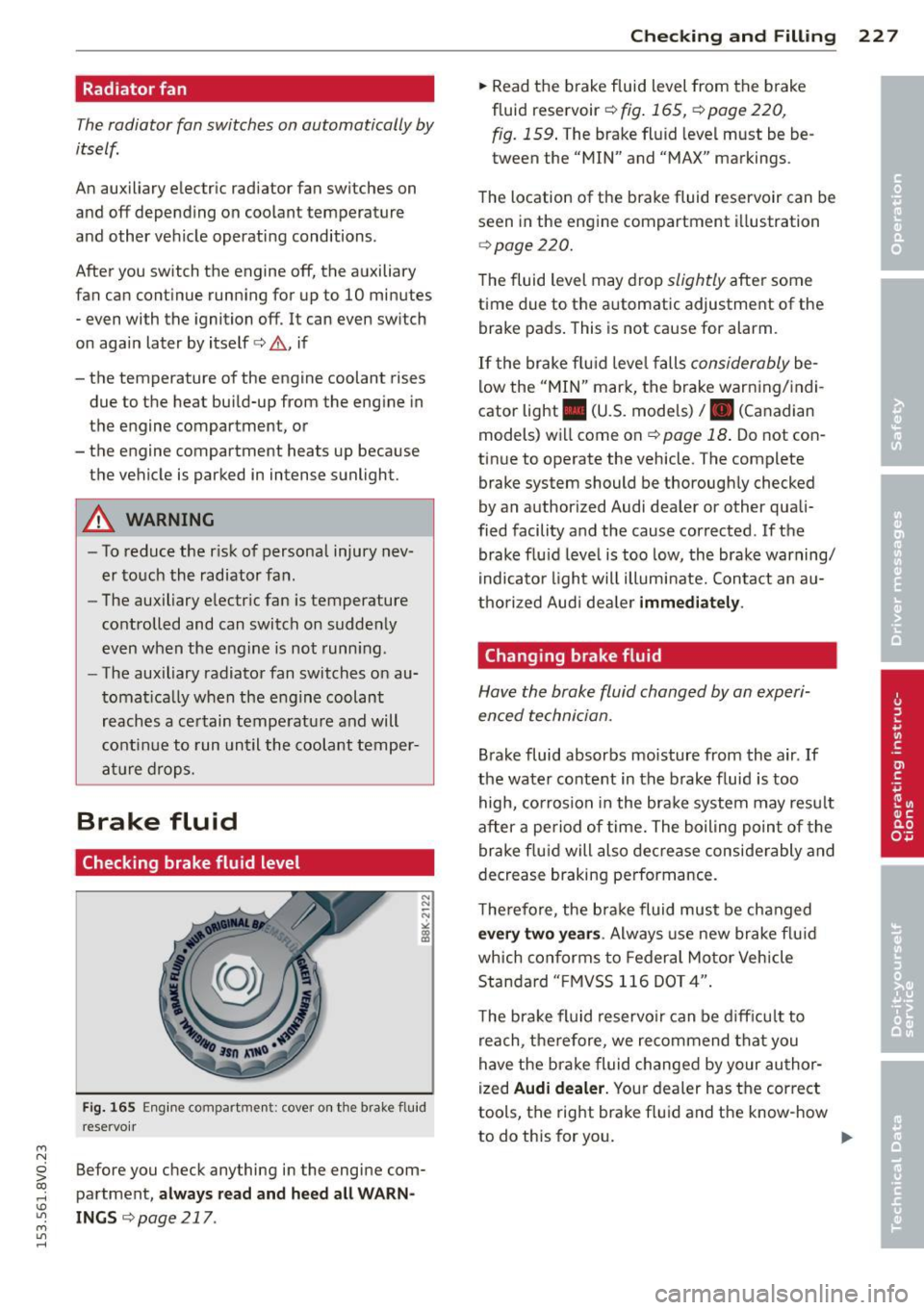
Fig. 165 Engine compa rtment: cove r on the brake fluid
rese rvoir
Before you check anything in the engine com
partment,
always read and heed all WARN
INGS r::;, page 217 .
Checking and Filling 22 7
.. Read the brake fluid level from the brake
fluid reservoir <=>
fig. 165, <=> page 220,
fig. 159.
T he brake fluid level must be be
tween the "MIN" and "MAX" markings.
The location of the brake fluid reservoir can be seen in the engine compartment illustration
<=>page 220.
The fluid level may drop slightly after some
time due to the automatic adjustment of the
brake pads. This is not cause for alarm.
If the brake fluid level falls considerably be
low the "MIN" mark, the brake warning/indi
cator light . (U.S. models)
I. (Canadian
models) will come on
c:> page 18 . Do not con
tinue to operate the vehicle. The complete
brake system should be thoroughly checked
by an authorized Audi dealer or other quali
fied facility and the cause corrected . If the
brake fluid level is too low, the brake warning/
indicator light will illuminate. Contact an au
thorized Audi dealer
immediately.
Changing brake fluid
Have the brake fluid changed by an experi
enced technician.
Brake fluid absorbs moisture from the air . If
the water content in the brake fluid is too
high, corrosion in the brake system may result
after a period of time. The boiling point of the
brake fluid will also decrease considerably and
decrease braking performance.
Therefore, the brake fluid must be changed
every two years . Always use new brake fluid
which conforms to Federal Motor Vehicle
Standard "FMVSS 116 DOT 4".
The brake fluid reservoir can be difficult to
reach, therefore, we recommend that you
have the brake fluid changed by your author
ized
Audi dealer. Your dealer has the correct
tools, the right brake fluid and the know-how
to do this for you.
II>-
Page 230 of 310
228 Check ing and F illin g
8_ WARNING
-Brake fluid is poiso nous. It must be sto r
ed only in th e closed original container
out o f the reach of children!
- Brake fa ilure can result from old or inap
propriate brake fluid. Observe these pre
caut ions:
- Use only brake fluid that meets SAE specification
J 1703 and conforms to
Federal Motor Vehicle Standard 116.
Always check with your authorized Audi
dealer to make sure you are using the
correct brake flu id. The correct type of
brake fluid is also indicated on the
b rake fluid reservoir.
- The brake fluid must be new. Heavy use
of the brakes can cause a vapor lock if
the brake fluid is left in the system too
l ong. This can serious ly affect the effi
ciency of the bra kes as well as yo ur
safety . This could result in an acc ident.
@ Note
Brake flu id will damage the paint of your
veh icle.
@i For the sake of the environment
Because of the problem of proper d isposa l
of brake flu id as we ll as the special tools
requ ired and the ne cessary expert ise, we
recommend that you have the brake fluid
changed by your author ized Audi dealer .
Battery
General information
The battery in your Audi does not need any
maintena nce under
normal operating condi
tions. Aud i recommends having the elect ro
l yte level check by a n author ized Audi dealer
or author ized Audi Se rv ice Facili ty when there
are
high outside temperat ures or when driving
all day. The e lectrolyte level shou ld a lso be
checked each time the battery is charged
¢ page 230.
Have the batte ry checked when yo u bring your
vehicle in for an inspection . It is a good idea
to replace the battery if it is more than 5 years
o ld.
D uring certain types of airbag deployments,
the battery is disconnected from the vehicle electrical system for safety reasons¢
& in
Repair, care and disposal of the airbags on
page 160.
Di sconnecting the battery te rminals
Some vehicle functions (such as power win
dows) are not avai lable when the battery is
disconnected. These functions must be pro
grammed after the battery is reconnected. To
avo id hav ing to do this, only disconnect the
battery from the vehicle electrical system
when that is necessary to perform repairs .
To reprogram the functions, proceed as fol
lows:
Function Reprogramming
Power window one-¢ page 44, Correcting
touch up/down power window ma/-
function functions
Remote control key
If the vehicle does not
or r
eact to the key, it
convenience key must be synchronized
¢ page37
Dig ita l cl ock ¢page 10
ESC indicator light The indicator light
goes out after driving
a few meters
Not running the vehicle for long periods
of time
If you do not drive your vehicle fo r several
days or weeks, electrical components are
gradua lly reduced or switched off. This re
duces e nergy consumption and maintains the
vehicle's ability to start over a long per iod of
time
¢ page 194. Some convenie nce func
tions, such as interior lig hting or power seats *
may not work. These convenience functions
will be ava ilable again once you switch the ig-
nition on and start the engine. .,.
Page 235 of 310
Tires and wheels
Tires
General notes
Tires may be the least appreci
ated and most abused parts of
a motor vehicle .
Tires may be the least appreci
ated and most abused parts of
a motor vehicle. Tires are, how
ever, one of the most important
parts of a vehicle, particularly
considering the comparatively
small patch of rubber on each
tire that assures that all-impor
tant contact between you, your
vehicle and the road.
Maintaining the correct tire
pressure, making sure that your
vehicle and its tires do not have
to carry more weight than they can safely handle, avoiding
damage from road hazards and
regularly inspecting tires for
damage including cuts, slashes
irregular wear and overall con
dition are the most important
things that you can do to help avoid sudden tire failure includ
ing tread separation and blow-
~ outs.
0 > co ,...., \!) 1.1'1
M 1.1'1 ,....,
Tires and wheels 233
Avoiding damage
If you have to drive over a curb
or similar obstacle, drive very
slowly and as close as possible
at a right angle to the curb.
Always keep chemicals includ ing grease, oil, gasoline and
brake fluid off the tires.
Inspect the tires regularly for
damage (cuts, cracks or blis
ters, etc.). Remove any foreign
bodies embedded in the treads.
Storing tires
Mark tires when you remove
them to indicate the direction
of rotation. This ensures you to be able to mount them correct
ly when you reinstall them.
When removed, the wheels or
tires should be stored in a cool, dry and preferably dark place.
Store tires in a vertical position if they are not mounted on
rims, in a horizontal position if
they are mounted on rims.
New tires
New tires have to be broken in
¢ _&. .
The tread depth of new tires
may vary , according to the type .,.
' •
•
' •
Page 237 of 310
M N
0 > co ...... \!) 1.1'1
M 1.1'1 ......
-If you notice unusual vibration or if the vehicle pulls to one side when driving, al
ways stop as soon as it is safe to do so and check the
wheels and tires for dam age.
(D Note
-Please note that summer and winter tires are de
signed for the conditions
that are typical in those sea
sons. Audi recommends using winter tires during the
winter months. Low tem peratures significantly de
crease the elasticity of
summer tires, which affects
traction and braking ability.
Tires and wheels 235
If summer tires are used in
very cold temperatures, cracks can form on the tread bars, resulting in perma
nent tire damage that can
cause loud driving noise and unbalanced tires. Audi is not
responsible for this type of
damage.
-Burnished, polished or chromed rims must not be used in winter road condi
tions. The surface of the
rims does not have suffi
cient corrosion protection
for this and could be perma
nently damaged by road salt
or similar substances.
' •
•
Glossary of tire and loading terminology
Accessory weight
means the combined weight (in
excess of those standard items
which may be replaced) of auto matic transmission, power
steering, power brakes, power
windows, power seats, radio, and heater, to the extent that
these items are available as fac
tory-installed equipment (whether installed or not).
Aspect ratio
means the ratio of the height to
the width of the tire in percent. Numbers of 55 or lower indi
cate a low sidewall for im proved steering response and
better overall handling on dry
pavement.
' •
Page 239 of 310
M N
0 > co ,...., \!) 1.1'1
M 1.1'1 ,....,
Maximum load rating
means the load rating for a tire
at the maximum permissible in
flation pressure for that tire.
Maximum loaded vehicle
weight
means the sum of:
(a) Curb weight
(b) Accessory weight
(c) Vehicle capacity weight, and
(d) Production options weight
Maximum (permissible)
inflation pressure
means the maximum cold infla
tion pressure to which a tire
may be inflated. Also called
"maximum inflation pressure."
Normal occupant weight
means 150 lbs. (68 kilograms)
times the number of occupants seated in the vehicle up to the
total seating capacity of your
vehicle.
Occupant distribution
means distribution of occu pants in a vehicle.
Outer diameter
means the overall diameter of
an inflated new tire.
Tires and wheels 237
Overall width
means the linear distance be
tween the exteriors of the side
walls of an inflated tire, includ ing elevations due to labeling,
decorations, or protective bands or ribs.
Ply
means a layer of rubber-coated
parallel cords.
Production options weight
means the combined weight of
those installed regular produc
tion options weighing over 5 lbs. (2 . 3 kg) in excess of those
standard items which they re place, not previously consid
ered in curb weight or accessory
weight, including heavy duty
brakes, ride levelers, roof rack,
heavy duty battery, and special
trim.
Radial ply tire
means a pneumatic tire in
which the ply cords that extend
to the beads are laid at sub stantially 90 degrees to the
centerline of the tread.
' •
•
' •
Page 246 of 310
244 Tires and wheels
The correct tire pressure for the
spare wheel is located on a la
bel on the driver's side 8-pillar .
Because technical changes may
be made to vehicle equipment
during the model year, always
compare the tire size designa
tion on the tire pressure label
on your vehicle with the tires on
your vehicle. Make sure that the
tire size information on the ve
hicle label is the same as the
size of the tires on the vehicle.
This is especially important if
the vehicle belongs to someone else or you bought the vehicle
with different rims/tires or you bought the vehicle as a previ
ously owned vehicle.
Remember, your safety and
that of your passengers also de
pends on making sure that load
limits are not exceeded. Vehicle
load includes everybody and ev
erything in and on the vehicle.
These load limits are technical
ly referred to as the vehicle's
Gross Vehicle Weight Rating
("GVWR"). The Gross Axle
Weight Rating ("GAWR") is the maximum load that can be ap
plied at each of the vehicle's
two axles. The Gross Vehicle Weight Rating and the Gross
Axle Weight Rating are listed
on the safety compliance stick
er label located on the driver's
side 8-pillar.
The tire pressure
label on your Audi lists the
maximum combined weight of
all of the occupants and lug gage or other cargo that the ve
hicle can carry. For the location
of the tire pressure label
~fig. 168.
A WARNING -
Overloading a vehicle can
cause loss of vehicle control,
a crash or other accident, se
rious personal injury, and
even death.
-Carrying more weight than your vehicle was designed to carry will prevent the ve
hicle from handling properly
and increase the risk of a
loss of vehicle control.
-The brakes on a vehicle that has been overloaded may not be able to stop the vehi
cle within a safe distance.
-Tires on a vehicle that has been overloaded can fail
suddenly causing loss of
control and a crash.
Page 252 of 310
250 Tires and wheels
hitch and the tongue weight of
the loaded trailer) is limited.
The more passengers in the ve hicle or passengers who are
heavier than the standard
weights assumed mean that
less weight can be carried as
luggage .
The tire pressure label on your
Audi also lists the maximum combined weight of all of the
occupants and luggage or other
cargo that the vehicle can carry.
For the location of the label
q page 240, fig. 168 .
_& WARNING
~ -
Overloading a vehicle can
cause loss of vehicle control,
a crash or other accident, se
rious personal injury, and
even death.
-Carrying more weight than
your vehicle was designed to carry will prevent the vehicle from handling properly
and increase the risk of the
loss of vehicle control.
-The brakes on a vehicle that
has been overloaded may
not be able to stop the vehi
cle within a safe distance . -Tires
on a vehicle that has
been overloaded can fail
suddenly, including a blow
out and sudden deflation,
causing loss of control and a
crash.
-Always make sure that the
total load being transported
- including the weight of a
trailer hitch and the tongue
weight of a loaded trailer -
does not make the vehicle
heavier than the vehicles
Gross Vehicle Weight Rat
ing .
Determining correct load
limit
Use the example below to cal
culate the total weight of the
passengers and luggage or oth
er things that you plan to trans port so that you can make sure
that your vehicle will not be
overloaded.
Steps for Determining
Correct Load Limit
1. Locate the statement "THE
COMBINED WEIGHT OF OC
CUPANTS AND CARGO
SHOULD NEVER EXCEED XXX .,..
Page 255 of 310
-The longer one tire is used in one location on the vehicle,
the more it wears at certain points; therefore, we recom
mend that you follow the tire
manufacturer's suggested tire
rotation intervals.
-Vehicles with front-wheel drive experience more tread
wear on the front wheels com pared to all-wheel drive (quat
tro).
-Please rotate tires as shown
¢ fig. 171.
-Extra care must be taken when
rotating direction-specific
tires
Q page 2 74.
Wheel balancing
The wheels on new vehicles are balanced. However, various sit
uations during everyday driving
can cause them to become un
balanced, resulting in vibra
tions you can usually feel
through the steering wheel.
Unbalanced wheels must be re
balanced to avoid excessive
wear on steering, suspension
and tires. A wheel must also be
rebalanced when a new tire is
M N
~ installed. co ,...., \!) 1.1"1
M 1.1"1 ,....,
Tires and wheels 253
Incorrect wheel alignment
Incorrect wheel alignment can
cause excessive tire wear, impairing the safety of the vehi
cle. If tires show excessive
wear, have the wheel alignment checked by an authorized Audi
dealer or qualified workshop.
All-wheel drive
Vehicles with quattro must al
ways have tires of the same size, construction and tread
type. For details see
¢ page 193 .
.8, WARNING
Sudden tire failure can lead
to loss of control, a crash and serious personal injury!
-Never drive a vehicle when the tread on any tire is worn down to the wear indica
tors.
-Worn tires are a safety haz ard, they do not grip well on
wet roads and increase your risk of "hydroplaning" and
loss of control.
-Always keep chemicals that can cause tire damage, such
-
as grease, oil, gasoline and
brake fluid away from tires.
~
' •
•
' •
Page 261 of 310
Tires and wheels 259
sure of their "previous histo-and sudden deflation and
ry." Old used tires may have loss of control.
been damaged even though -Temperature grades apply
the damage cannot be seen to tires that are properly in-
that can lead to sudden tire flated and not over or un-
' •
•
failure and loss of vehicle derinflated.
control. -For technical reasons it is
-All four wheels must be fit- not always possible to use
ted with radial tires of the wheels from other vehicles -
same type , size (rolling cir-
in some cases not even
cumference) and the same wheels from the same vehi-
tread pattern. Driving with cle model.
different tires reduces vehi- -If you install wheel trim
cle handling and can lead to discs on the vehicle wheels,
a loss of control. make sure that the air flow
-If the spare tire is not the to the brakes is not blocked.
same as the tires that are Reduced airflow to the
mounted on the vehicle - for brakes can them to over-
example with winter tires - heat, increasing stopping
only use the spare tire for a distances and causing a col-
short period of time and lision.
drive with extra ca re. Refit -Run flat tires may only be
the normal road wheel as used on vehicles that were
soon as safely possible. equipped with them at the
-Never drive faster than the factory. The vehicle must
maximum speed for which have a chassis designed for
the tires on your vehicle are run flat tires. Incorrect use
rated because tires that are of run flat tires can lead to
driven faster than their rat- vehicle damage or acci-
ed speed can fail suddenly. dents. Check with an au-
-Overloading tires cause heat thorized Audi dealer or tire
' M • N
0 > co build-up, sudden tire fail- specialist to see if your vehi-
......
ure, including a blowout cle can be equipped with ... \!) 1.1'1
M 1.1'1 ......
Page 264 of 310
26 2 T ire s and wheel s
loss of control, crashes and serious per
sona l injuries. Have worn or damaged tires
replaced immediate ly.
- Winter tires have maximum speed rat ing
that may be lower than your veh icle's
maximum speed .
- Never drive faster than the speed for
wh ich the winter or other tires installed
on your vehicle are rated.
A WARNING
Always adjust your driving to the road and traffic conditions. Never let the good ac
celeration of the winter tires and all-wheel
drive tempt you into taking extra r is ks. A l
ways remember:
- When brak ing, an a ll-wheel d rive vehicle
hand les in the same way as a front drive
vehicle .
- Drive carefu lly and reduce your speed on
icy and slippery roads, even winter tires
canno t he lp under blac k ice condit ions.
@) For the sake of the environment
Use summe r tires when weathe r cond i
tions perm it. They are quieter, do not wea r
as quickly and red uce f ue l cons umption.
Snow chains
Snow chains may be fitted on ly to the front
wheels, and only to certain tire sizes . Ask you r
authorized Audi dealer on which tire sizes
snow chains can be used.
I f you are going to use snow chains, then you
must install them on the front wheels at
l east.
The snow chains must h ave low-profi le links
and must not be thicker than 0 .53 inch
(13 .5 mm), including the lock.
Remove wheel ce nte r covers a nd tr im dis cs
be fore putting snow chains on yo ur vehicle
q0 . For sa fety reasons cover caps must then
be fitted over the whee l bolts. These are avai l
ab le from authorized Audi dea lers.
A WARNING
Using the wrong snow chains for your veh i
cle o r instal ling them incorrect ly can in
crease the risk of loss of cont ro l leading to
se rious pe rsonal injury .
- Snow chains are available in different
sizes . Always make sure to follow the in
structions p rov ided by t he snow cha in
manufac turer.
- When driving with snow cha ins never
d rive faster than the speed permitted for
your specific snow chains.
- Always observe local regulations.
@ Note
- Remove snow chains before dr iv ing o n
roads not covered with snow to avoid
damaging tires and wea ring the snow
chains dow n un necessa rily .
- Snow chains, which come into direc t con
tact with the whee l rim, can scrat ch or
damage it. Therefo re, make sure that the
s now chains are s uitably covered. Check
t he pos ition of t he snow chains after
driving a few yards and correct if neces
sary. Follow the inst ructions from the
snow chain man ufacturer when do ing so.
@ Tips
Where snow chains are mandatory on cer
tain roads, th is normally a lso applies to
vehicles with a ll-wheel drive .
Wheel bolts
Wheel bolts must always be tightened to the
correct torque .
The design of w heel bol ts is matched to the
f ac tory installed rims. If different rims are fit
ted, the co rrect wheel bo lts with the right
l ength and correctly shaped bolt heads must
be used. Th is ensures that wheels are fitted
securely and that the brake system functions
correct ly . .,..