tire size AUDI S3 2015 Owners Manual
[x] Cancel search | Manufacturer: AUDI, Model Year: 2015, Model line: S3, Model: AUDI S3 2015Pages: 310, PDF Size: 76.15 MB
Page 137 of 310
M N
0 > co ,...., \!) 1.1'1
M 1.1'1 ,....,
Safety belts
General notes
Always wear safety belts!
Wearing safety belts correctly saves lives!
T his chapter explains why safety belts are nec
essary, how they work and how to adjust and
wear them correctly .
~ Read all the information that follows and
heed all of the instructions and WARNINGS.
A WARNING
Not wearing safety belts or wearing them
improperly increases the risk of serious
personal injury and death.
- Safety belts are the single most effective
means available to reduce the risk of se
rious injury and death in automobile acci
dents. For your protection and that of
your passengers, always correctly wear
safety belts when the vehicle is moving .
- Pregnant women, injured, or physically
impaired persons must also use safety
belts. Like all vehicle occupants, they are
more likely to be seriously injured if they
do not wear safety belts. The best way to
protect a fetus is to protect the mother -
throughout the entire pregnancy.
Number of seats
Your Audi has a total of five seating positions:
two in the front and three in the rear. Each
seating position has a safety belt .
A WARNING
Not wearing safety belts or wearing them
improperly increases the risk of serious
personal injury and death.
- Never strap more than one person, in
cluding small children, into any belt. It is
especially dangerous to place a safety
belt over a child sitting on your lap.
- Never let more people ride in the vehicle
than there are safety belts available.
Safety belts 13 5
-Be sure everyone riding in the vehicle is
properly restrained with a separate safe
ty belt or child restraint.
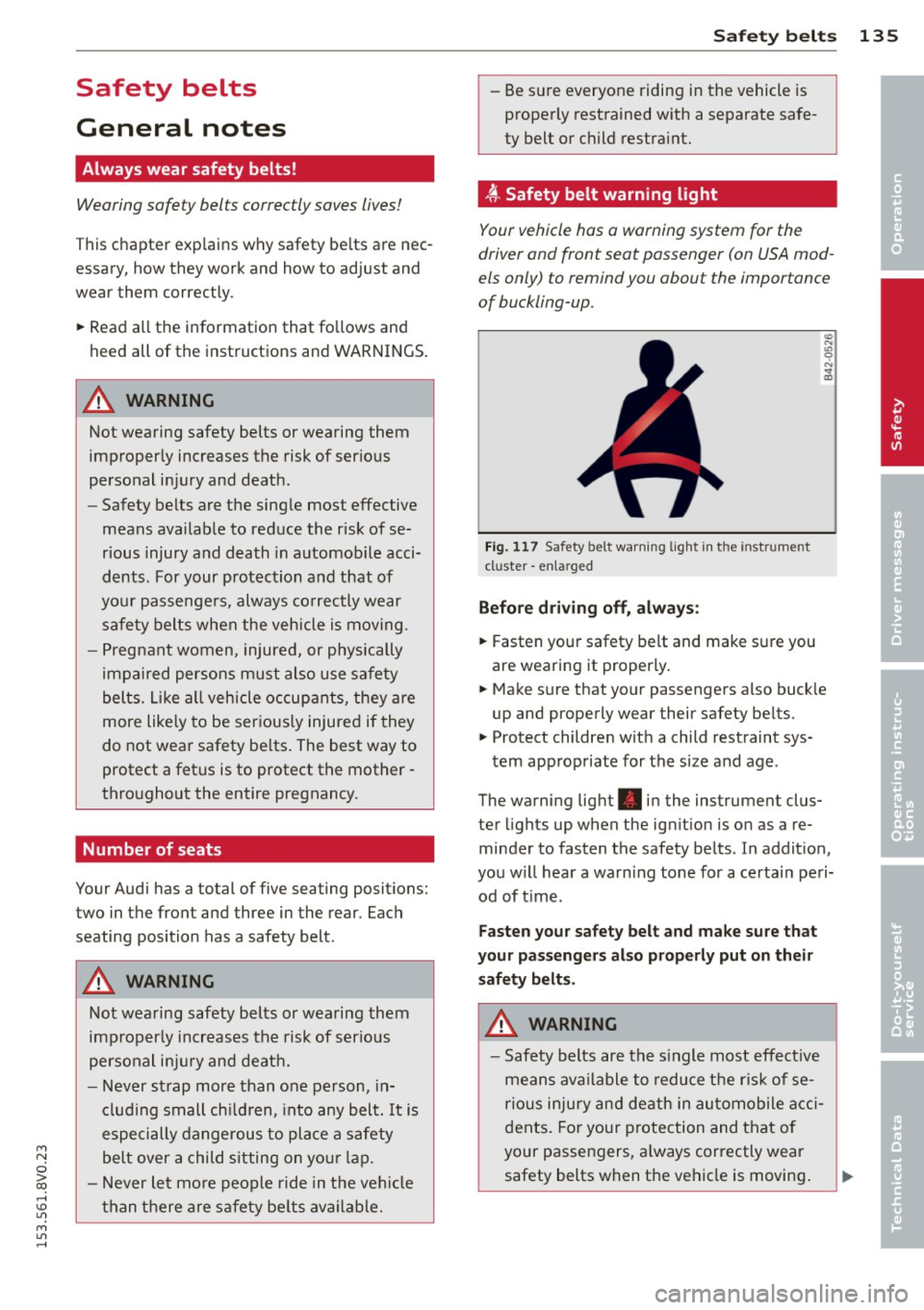
~ Safety belt warning light
Your vehicle has a warning system for the
driver and front seat passenger (on USA mod
els only) to remind you abou t the importance
of buckling-up.
Fig. 117 Safety bel t warn ing light in the instr ume nt
cl uster -enla rged
Before driving off, always:
~ Fasten your safety belt and make sure you
are wearing it properly.
~ Make sure that your passengers also buckle
up and properly wear their safety belts.
~ Protect children with a child restraint sys-
tem appropriate for the size and age .
The warning light . in the instrument clus
ter lights up when the ignition is on as a re
minder to fasten the safety belts . In addition,
you will hear a warning tone for a certain peri
od of time .
Fasten your safety belt and make sure that
your passengers also properly put on their
safety belts.
A WARNING
- Safety belts are the single most effective
means available to reduce the risk of se
rious injury and death in automobile acci
dents. For your protection and that of
your passengers, always correctly wear
safety belts when the vehicle is moving. •
•
•
Page 238 of 310
236 Tires a nd whee ls
Bead Extra load tire
means the part of the tire that means a tire design to operate
is made of steel wires, wrapped at higher loads and at higher
or reinforced by p ly cords and inflation pressures than the
that is shaped to fit the rim . corresponding standard tire .
Bead separation Extra load tires may be identi-
fied as "XL", "xl", " EXTRA
means a breakdown of the bond LOAD", or "RF" on the sidewall.
between components in the
bead .
Gross A xle Weight Rating
(" GAWR ")
Cord
means the load-carrying capaci-
means the strands forming the ty of a single axle system,
p lies in the tire .
measured at the tire-ground in-
Cold tire inflation pressure terfaces.
means the tire pressure recom-
Gross Vehicle Weight Rating
mended by the vehicle manu-( "GVWR ")
facturer for a t ire of a designat-
means the maximum total
ed size that has not been driven loaded weight of the vehicle.
for more than a couple of miles
Groove
(kilometers) at low speeds in
the three hour period before means the space between two
the tire pressure is measured or adjacent tread ribs.
adjusted.
Load rating (code )
Curb weight
means the max imum load that
means the weight of a motor a tire
is rated to carry for a giv-
vehicle with standard equip -en inflation pressure
. You may
ment including the maximum not find th
is information on all
capacity of fuel, oil, and cool- tires because it is not required
ant, air condit ioning and addi- by law.
...
tional weight of optional equip-
ment.
Page 240 of 310
238 Tires a nd whee ls
Recommended inflation
pressure
see c:::> page 236, Cold tire infla
tion pressure.
Reinforced tire
means a tire design to operate
at higher loads and at higher
inflation pressures than the
corresponding standard t ire .
Reinforced tires may be identi
fied as "XL", "xl", "EXTRA
LOAD", or "RF" on the sidewa ll.
Rim
means a meta l support for a
tire or a tire and tube assembly
upon which the tire beads are
seated .
Rim diameter
means nominal diameter of the
bead seat. If yo u change your
wheel size, you will have to pur
chase new t ires to ma tch the
new rim d iameter .
Rim size designation
means rim diameter and width.
Rim width
means nominal distance be
tween rim flanges.
Sidewall
means that por tion of a tire be
tween the tread and bead.
Speed rating (letter code)
means the speed at wh ich a tire
is designed to be driven for ex
tended periods of time . The rat
ings range from 93 mph
( 1 50 km/h) to 186 mph
( 2 98 km/h)
c:::> page 257 . You
may not find th is informat ion
on all tires because it is not re
quired by law.
The speed rating letter code,
where applicable, is molded on
the ti re sidewall and ind icates
the maximum permissible road
speeds
c:::> & in Winter tires on
page 261.
Tire pressure monitoring
system
means a system that detects
when one or more of a vehic le's
tires a re underinflated an d ill u
m inates a low tire press ure
warn ing telltale.
Tread
means that por tion of a tire
that comes into contact with
the road.
Page 243 of 310
Tires and wheels 241
Tire pressure generally refers to tant things you can do to help
the amount of air in a tire that avoid sudden tire failure. Un-it needs it to do its job and derinflated tires are a major
safely carry the combined load cause of sudden tire failure. of the entire vehicle and its con- Keeping tires at the right pres-
' •
•
tents. Tire pressure is measured sure is also important for safe
in kilopascals (kPa), the inter- and responsive vehicle han-
national measuring unit and in dling, traction, braking and
pounds per square inch (PSI) . load carrying.
Tire pressures
Tire pressure is based in part on are particularly important
the vehicles design and load when the vehicle is being driv-
limit - the greatest amount of en at higher speeds, and then
weight that the vehicle can car -especially when heavily loaded
ry safely and the tire size. The even within the permissible
proper tire pressure is frequent-load-carrying capacities ap-
ly referred to as the "recom-proved for your vehicle.
mended cold tire inflation pres-
The recommended tire pres-
sure." Air in the tires expands sures for your Audi depend on
when the tire heats up because the kind of tires on your vehicle
of internal friction when it flex- and the number of passengers
es in use. The tire pressure is and/or amount of luggage you
higher when the tire has will be transporting.
warmed up than when it is The tire pressure label is locat-
"cold." It is the inflation pres-
ed on the driver's side B-pillar.
sure in a "cold" tire that counts.
Therefore, you should never let The tire pressure label lists the
recommended cold tire infla-
air out of a warm tire to match
"cold tire inflation pressure" tion pressures for the vehicle at
its maximum capacity weight
recommendations. The tires
would then be underinflated and tires that were on your ve
-
and could fail suddenly. hicle at the time it was manu-
' M factured
. • N
0 > co Maintaining proper tire pres-
...... \!)
sure is one of the most impor-1.1'1
M 1.1'1 ......
Page 244 of 310
242 Tires and wheel s
If you wish to improve comfort See the illustration c::;, fig. 168
when operating the vehicle at for the locati on of the labe l on
normal load (up to 3 occu -driver's side B-pillar (color of
pants), you can adjust tire the actual label and exact loca-
pressures to those specified tion on the vehic le will vary
for normal vehicle load. Before slight ly) .
operat ing the vehicle at maxi -Note that the following table is
mum load , you must increase accurate at the time of going to
the ti re pressu res to those press and is subject to change .
specified for maximum vehicle In the event of discrepancies,
load c::;, &. the tire pressure labe l is locat-
Bear in mind that the tire pres- ed on the driver's side 8-pi llar
sure monitoring system can on -always takes precedence .
ly monitor the tire pressures The table below lists the rec-
you have stored . The system
ommended cold tire inflation
does not recogn ize the load
pressures for the Audi model
condition of your vehic le.
covered by your Owner's Litera-
T he effectiveness of the tire ture at the vehicle's capacity
pressure monitoring system weight and the tire sizes instal -
will be impaired if you store led on the respective mode ls as
normal load pressures but then original equipment, or as a fac-
operate the vehicle at its maxi- tory option.
...
mum load c::;, & .
Page 246 of 310
244 Tires and wheels
The correct tire pressure for the
spare wheel is located on a la
bel on the driver's side 8-pillar .
Because technical changes may
be made to vehicle equipment
during the model year, always
compare the tire size designa
tion on the tire pressure label
on your vehicle with the tires on
your vehicle. Make sure that the
tire size information on the ve
hicle label is the same as the
size of the tires on the vehicle.
This is especially important if
the vehicle belongs to someone else or you bought the vehicle
with different rims/tires or you bought the vehicle as a previ
ously owned vehicle.
Remember, your safety and
that of your passengers also de
pends on making sure that load
limits are not exceeded. Vehicle
load includes everybody and ev
erything in and on the vehicle.
These load limits are technical
ly referred to as the vehicle's
Gross Vehicle Weight Rating
("GVWR"). The Gross Axle
Weight Rating ("GAWR") is the maximum load that can be ap
plied at each of the vehicle's
two axles. The Gross Vehicle Weight Rating and the Gross
Axle Weight Rating are listed
on the safety compliance stick
er label located on the driver's
side 8-pillar.
The tire pressure
label on your Audi lists the
maximum combined weight of
all of the occupants and lug gage or other cargo that the ve
hicle can carry. For the location
of the tire pressure label
~fig. 168.
A WARNING -
Overloading a vehicle can
cause loss of vehicle control,
a crash or other accident, se
rious personal injury, and
even death.
-Carrying more weight than your vehicle was designed to carry will prevent the ve
hicle from handling properly
and increase the risk of a
loss of vehicle control.
-The brakes on a vehicle that has been overloaded may not be able to stop the vehi
cle within a safe distance.
-Tires on a vehicle that has been overloaded can fail
suddenly causing loss of
control and a crash.
Page 255 of 310
-The longer one tire is used in one location on the vehicle,
the more it wears at certain points; therefore, we recom
mend that you follow the tire
manufacturer's suggested tire
rotation intervals.
-Vehicles with front-wheel drive experience more tread
wear on the front wheels com pared to all-wheel drive (quat
tro).
-Please rotate tires as shown
¢ fig. 171.
-Extra care must be taken when
rotating direction-specific
tires
Q page 2 74.
Wheel balancing
The wheels on new vehicles are balanced. However, various sit
uations during everyday driving
can cause them to become un
balanced, resulting in vibra
tions you can usually feel
through the steering wheel.
Unbalanced wheels must be re
balanced to avoid excessive
wear on steering, suspension
and tires. A wheel must also be
rebalanced when a new tire is
M N
~ installed. co ,...., \!) 1.1"1
M 1.1"1 ,....,
Tires and wheels 253
Incorrect wheel alignment
Incorrect wheel alignment can
cause excessive tire wear, impairing the safety of the vehi
cle. If tires show excessive
wear, have the wheel alignment checked by an authorized Audi
dealer or qualified workshop.
All-wheel drive
Vehicles with quattro must al
ways have tires of the same size, construction and tread
type. For details see
¢ page 193 .
.8, WARNING
Sudden tire failure can lead
to loss of control, a crash and serious personal injury!
-Never drive a vehicle when the tread on any tire is worn down to the wear indica
tors.
-Worn tires are a safety haz ard, they do not grip well on
wet roads and increase your risk of "hydroplaning" and
loss of control.
-Always keep chemicals that can cause tire damage, such
-
as grease, oil, gasoline and
brake fluid away from tires.
~
' •
•
' •
Page 261 of 310
Tires and wheels 259
sure of their "previous histo-and sudden deflation and
ry." Old used tires may have loss of control.
been damaged even though -Temperature grades apply
the damage cannot be seen to tires that are properly in-
that can lead to sudden tire flated and not over or un-
' •
•
failure and loss of vehicle derinflated.
control. -For technical reasons it is
-All four wheels must be fit- not always possible to use
ted with radial tires of the wheels from other vehicles -
same type , size (rolling cir-
in some cases not even
cumference) and the same wheels from the same vehi-
tread pattern. Driving with cle model.
different tires reduces vehi- -If you install wheel trim
cle handling and can lead to discs on the vehicle wheels,
a loss of control. make sure that the air flow
-If the spare tire is not the to the brakes is not blocked.
same as the tires that are Reduced airflow to the
mounted on the vehicle - for brakes can them to over-
example with winter tires - heat, increasing stopping
only use the spare tire for a distances and causing a col-
short period of time and lision.
drive with extra ca re. Refit -Run flat tires may only be
the normal road wheel as used on vehicles that were
soon as safely possible. equipped with them at the
-Never drive faster than the factory. The vehicle must
maximum speed for which have a chassis designed for
the tires on your vehicle are run flat tires. Incorrect use
rated because tires that are of run flat tires can lead to
driven faster than their rat- vehicle damage or acci-
ed speed can fail suddenly. dents. Check with an au-
-Overloading tires cause heat thorized Audi dealer or tire
' M • N
0 > co build-up, sudden tire fail- specialist to see if your vehi-
......
ure, including a blowout cle can be equipped with ... \!) 1.1'1
M 1.1'1 ......
Page 263 of 310
M N
0 > co ,...., \!) 1.1"1
M 1.1"1 ,....,
Sustained high tem perature can cause the
materia l of the tire to degenerate and reduce
tire life, and excessive temperature can lead
to su dden ti re fa ilure <=>,& .
The grade C corresponds to a level of per form
a nce which a ll passenger car tires must meet
under the Federa l Motor Veh icle Safety Stand
ard No. 109. Grades Band A represent higher levels of performance on the laboratory test
wheel than the m inimum required by law.
_&. WARNING
The traction grade assigned to this t ire is
based on stra ight-ahead b raking t raction
tests, and does not include acceleration,
cornering, hydrop lan ing o r peak traction
character istics .
_&. WARNING
The temperature grade for this t ire is es
tablished for a ti re that is properly inflated
and not overloaded . Excessive speed, un
derinflation, or excessive loading, either
separately or in combination, can cause
heat buildup and possible tire fa ilure.
Winter tires
Winter tires can improve vehicle handling on
snow and ice. At temperatures below 45 °F
(7 °C) we recommend changing to winter
tires .
In some heavy snow areas, loca l governments
may require true winter or "snow" tires, those
with very deeply cut tread. These tires shou ld
only be used in pa irs and be installed on all
four wheels. Make sure you pu rchase snow
tires that are the same size and const ruct ion
type as t he other tires on your ve hicle.
If your vehicle is equipped with all-wheel
d rive*, this will improve tract ion during winte r
d riving, eve n w it h the standard t ires. Howev
e r, we strong ly recommend t hat you a lways
eq uip a ll four wheels on yo ur vehicle wi th cor
rectly fitted win ter t ires or a ll-season tires,
when winter road conditions are expected .
Tires an d wheel s 261
This also improves the veh icle's b rak ing per
formance and reduces stopping distances.
Summe r ti res prov ide les s gr ip on i ce and
snow.
Winter tires (snow tires) must always be fitted
o n all fo ur whee ls.
Ask your authorized Audi dealer or qualified
workshop for permitted winter tire sizes. Use
o nl y rad ial winter t ires.
Winter tires lose their effectiveness whe n the
tread is worn down to a depth of0 .157 inch
(4 mm) .
Only drive w ith w inter t ires under w inter con
dit ions. Summer t ires handle better when
there is no snow or ice on the roads and the
temperature is above 45 °F (7 °() .
If you have a flat tire, see notes on spare
whee l
r=;,page 254.
Please a lways remember that winter tires may
have a lower speed rating t han the tires o rigi
nally installed on your vehicle at the time it
was manufactured. P lease seer=;,
page 257,
Speed rating (letter code)
for a listing of the
speed rating le tter codes and the max imum
speed at which the tires can be d rive n.
The speed rating letter code(¢
page 238) is
o n the side wall of the t ire r=;,
page 254.
_&. WARNING
Winter t ires have maximum speed limits
that may b e lower than yo ur vehicle's max
imum speed. Always know the max imum
speed before dr iv ing off. Never dr ive faster
than the speed permitted for yo ur spe cific
win ter tires . This wi ll ca use damage to the
tires leading to an accident and ser ious
personal injury to you and your passen
gers.
_&. WARNING
Driving faster than the maximum speed
for which the winter tires on your ve hicle
were designed can cause t ire failure in
cluding a blowout and sudden d eflation,
-
•
•
•
Page 264 of 310
26 2 T ire s and wheel s
loss of control, crashes and serious per
sona l injuries. Have worn or damaged tires
replaced immediate ly.
- Winter tires have maximum speed rat ing
that may be lower than your veh icle's
maximum speed .
- Never drive faster than the speed for
wh ich the winter or other tires installed
on your vehicle are rated.
A WARNING
Always adjust your driving to the road and traffic conditions. Never let the good ac
celeration of the winter tires and all-wheel
drive tempt you into taking extra r is ks. A l
ways remember:
- When brak ing, an a ll-wheel d rive vehicle
hand les in the same way as a front drive
vehicle .
- Drive carefu lly and reduce your speed on
icy and slippery roads, even winter tires
canno t he lp under blac k ice condit ions.
@) For the sake of the environment
Use summe r tires when weathe r cond i
tions perm it. They are quieter, do not wea r
as quickly and red uce f ue l cons umption.
Snow chains
Snow chains may be fitted on ly to the front
wheels, and only to certain tire sizes . Ask you r
authorized Audi dealer on which tire sizes
snow chains can be used.
I f you are going to use snow chains, then you
must install them on the front wheels at
l east.
The snow chains must h ave low-profi le links
and must not be thicker than 0 .53 inch
(13 .5 mm), including the lock.
Remove wheel ce nte r covers a nd tr im dis cs
be fore putting snow chains on yo ur vehicle
q0 . For sa fety reasons cover caps must then
be fitted over the whee l bolts. These are avai l
ab le from authorized Audi dea lers.
A WARNING
Using the wrong snow chains for your veh i
cle o r instal ling them incorrect ly can in
crease the risk of loss of cont ro l leading to
se rious pe rsonal injury .
- Snow chains are available in different
sizes . Always make sure to follow the in
structions p rov ided by t he snow cha in
manufac turer.
- When driving with snow cha ins never
d rive faster than the speed permitted for
your specific snow chains.
- Always observe local regulations.
@ Note
- Remove snow chains before dr iv ing o n
roads not covered with snow to avoid
damaging tires and wea ring the snow
chains dow n un necessa rily .
- Snow chains, which come into direc t con
tact with the whee l rim, can scrat ch or
damage it. Therefo re, make sure that the
s now chains are s uitably covered. Check
t he pos ition of t he snow chains after
driving a few yards and correct if neces
sary. Follow the inst ructions from the
snow chain man ufacturer when do ing so.
@ Tips
Where snow chains are mandatory on cer
tain roads, th is normally a lso applies to
vehicles with a ll-wheel drive .
Wheel bolts
Wheel bolts must always be tightened to the
correct torque .
The design of w heel bol ts is matched to the
f ac tory installed rims. If different rims are fit
ted, the co rrect wheel bo lts with the right
l ength and correctly shaped bolt heads must
be used. Th is ensures that wheels are fitted
securely and that the brake system functions
correct ly . .,..