air condition AUDI S3 2016 User Guide
[x] Cancel search | Manufacturer: AUDI, Model Year: 2016, Model line: S3, Model: AUDI S3 2016Pages: 328, PDF Size: 81.78 MB
Page 148 of 328
Assist
General information
Applies to veh icles: w ith Audi side assist
®
@
©
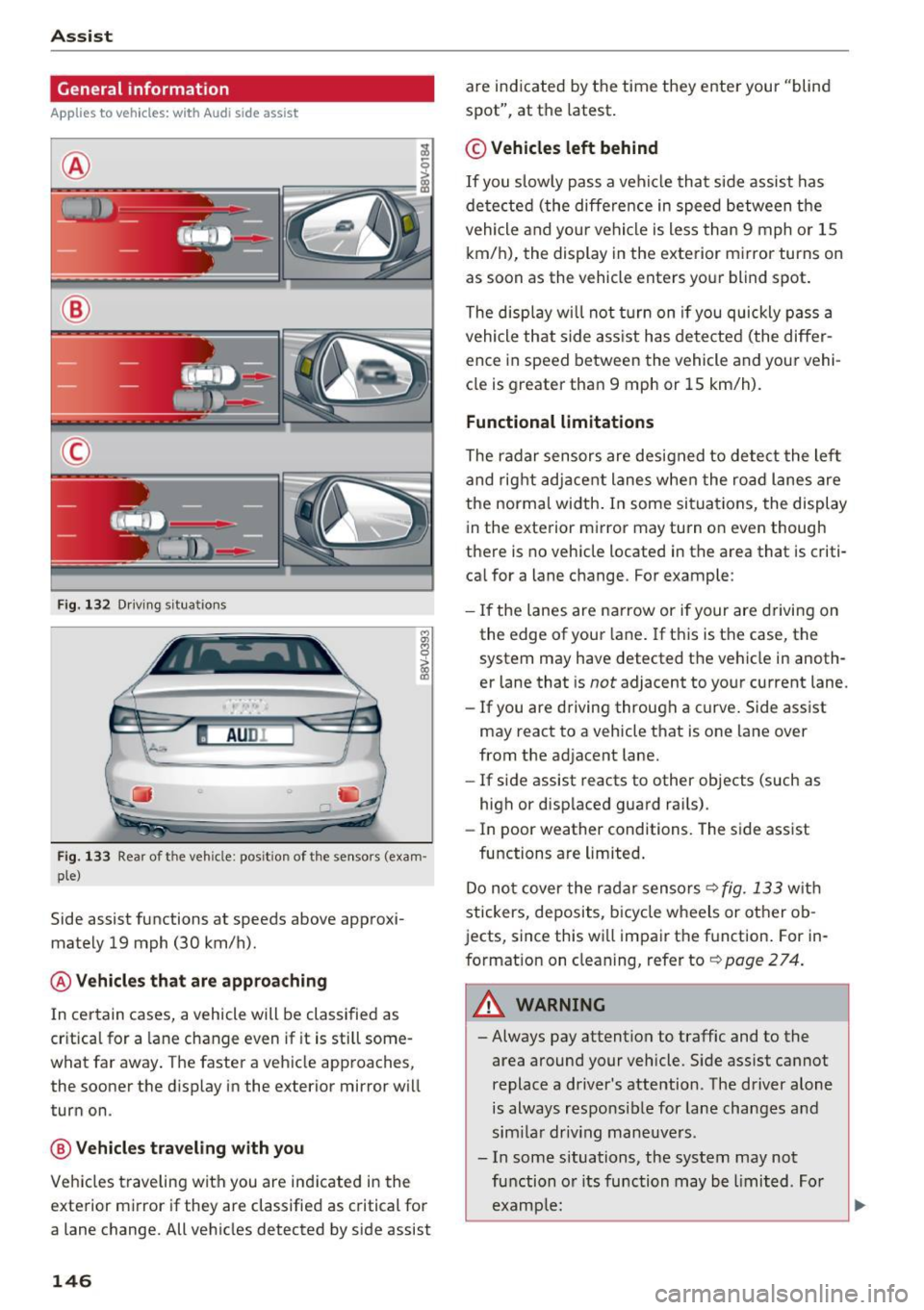
F ig. 132 Driving s itu atio ns
I AU DI
-·
Fig. 133 Rear of the vehicle: pos it ion of the senso rs (exa m·
pie)
Side assist functions at speeds above approxi·
mately 19 mph (30 km/h).
@ Vehicles that are approaching
In certain cases, a vehicle will be classified as
cr itical for a lane change even if it is still some·
what far away . The faster a veh icle approaches,
the sooner the display in the exterior mirror wi ll
turn on.
@ Vehicles traveling with you
Vehicles traveling with you are indicated in the
exterior mirror if they are classified as critical for
a lane change. All vehicles detected by side assist
146
are indicated by the time they enter your "blind
spot", at the latest .
© Vehicles left behind
If you slow ly pass a vehicle that side assist has
de tected (the diffe rence in speed between the
vehicle and your vehicle is less than 9 mph or 15
km/h), the display in the exterior mirror turns on
as soon as the vehicle enters your blind spot.
The display will not turn on if you quickly pass a
vehicle that side ass ist has detected (the differ
ence in speed between the vehicle and your vehi
cle is greater than 9 mph or 15 km/h).
Functional limitations
The radar sensors are designed to detect the lef t
and right adjacent lanes when the road lanes are
the normal width . In some situations, the display
in the exterior mirror may turn on even though
there is no vehicle located in the area that is criti·
cal for a lane c hange. For example:
- If the lanes are narrow or if your are driving on
the edge of your lane . If this is the case, the
system may have detected the vehicle in anoth·
er lane that is
not adjacent to your current lane.
- If you are driving through a curve . Side assist
may react to a vehicle that is one lane over
from the ad jacent lane.
- If side assist reacts to other objects (such as
high or disp laced guard rai ls).
- In poor weather conditions. The side assist
functions are limited.
Do not cover the radar sensors <=?
fig. 133 with
stickers, deposits, bicycle wheels or other ob
jects, since this wi ll impair the function . For in·
formation on cleaning, refer to<=?
page 274.
_& WARNING
-Always pay attention to traffic and to the
area around your vehicle. Side assist cannot
replace a d river's attention. The driver alone
is always respo nsible for lane changes a nd
similar driving maneuvers .
- In some situations, the system may not
function or its function may be limited. For
example:
-
Page 153 of 328
.... N
0 > co ....
General information
Applies to vehicles: with rear pa rk in g systems/pa rk in g system
p lus/rearv iew camera
Depending on your vehicle's equipment, various
parking aids will help you when parking and ma
neuvering.
The
rear parking system is an audible parking aid
that warns you of obstacles
behind the vehicle
¢page 152.
The parking system plus assists you when park
ing by audibly and visually indicating objects de
tected
in front of and behind the vehicle
¢ page 152.
The rearview camera shows the area behind the
vehicle in the MMI display . This display assists
you when you are cross or parallel parking. The
parking system plus functions are also available
¢ page 153.
A WARNING ,--
- Always look for traffic and check the area
around your vehicle by looking at it directly
as well. The parking system cannot replace
the driver's attention. The driver is always
responsible when entering or leaving a park
ing space and during similar maneuvers.
- Please note that some surfaces, such as
clothing, are not detected by the system .
- Sensors and cameras have blind spots in
which people and objects cannot be detect
ed . Be especially cautious of small children
and animals .
- Always pay attention to the area around the
vehicle -using the rearview mirror, too .
- The sensors can be displaced by impacts or
damage to the radiator grille, bumper,
wheel housing and the underbody . The park
ing system may become impaired as a re
sult. Have an authorized Audi dealer or au
thorized Audi Service Facility check their
function.
- Make sure the sensors are not obstructed by
stickers, deposits or other materials. If they
are the sensor function could be impaired .
I
Parking systems
For additional information on cleaning, re
fer to¢
page 274.
@ Note
-Some objects are not detected or displayed
by the system under certain circumstances:
- Objects such as barrier chains, trailer draw
bars, vertical poles or fences
- Objects above the sensors such as wall ex
tensions
- Objects with specific surfaces or struc
tures such as chain link fences or powder
snow
- If you continue driving closer to a low-lying
object, it may disappear from the sensor
range . Note that you will no longer be
warned about this obstacle.
- The sensors can be displaced by impacts or
damage to the radiator grille, bumper,
wheel housing and the underbody . The
parking system may become impaired as a
result . Have an authorized Audi dealer or
authorized Audi Service Facility check their
function.
(D Tips
- The system may provide a warning even
though there are no obstacles in the cover
age area in some situations, such as:
- certain road surfaces or for long grass .
- external ultrasonic sources e.g. from
cleaning vehicles.
- heavy rain, snow, or thick vehicle exhaust .
- We recommend that you practice parking in
a traffic-free location or parking lot to be
come familiar with the system. When doing
this, there should be good light and weath
er conditions .
- You can change the volume and pitch of the
signals as well as the display¢
page 157.
-What appears in the MMI display is some
what time-delayed.
- The sensors must be kept clean and free of
snow and ice for the park assist to operate .
151
Page 160 of 328
Intelligent Technology
Intelligent Technology
Notice about data
recorded by the Event
Data Recorder and
vehicle control modules
Event Data Re corder
This vehicle is equipped wi th an Event Data Re
corder (EDR) . The main purpose of an E DR is to
record, in certain crash or near crash -like situa
tions, such as an airbag deploym ent or h itting a
road obstacle, data that will assist in understand
ing how a veh icle 's systems performed . The EDR
is designed to record data related to veh icle dy
namics a nd safety systems for a sho rt period of
time, typically 30 seconds or less . The E DR in this
veh icle is designed to reco rd s uch data as :
- How various systems in your vehicle were oper
at ing;
- Whether or not the driver and passenger safety
belts were buckled/fastened;
- How far ( if at all) the driver was depressing the
acce lerator and/or brake peda l; and,
- How fast the ve hicle was trave ling.
These data can help provide a better understand ing of the ci rc u mstances in which c rashes and in
juries occur. NOT E: EDR data are recorded by yo ur
veh icle only if a non-trivia l crash situat ion occurs;
no data are recorded by the EDR under normal
driving conditions and no personal data (e .g .,
name, gender, age, and crash location) a re re
corded . H owever , other pa rties , such as law en
forcement, cou ld combine the EDR data w it h the
type o f person ally identifyi ng dat a routine ly ac
qu ired dur ing a crash invest igat ion .
To read data reco rded by an EDR, specia l equip
men t is req uire d, and access to the veh icle or the
E DR is needed. In ad dition to the vehicle manu
facturer, other parties, s uch a s law enforcement,
that have t he specia l equipment, can read the in
formation if they have access to the vehicle or the E DR.
Some s tate laws restrict the re trieva l or down
loading of data stored by ED Rs insta lled in a vehi
cle fo r the express purpose of retrieving data af -
158
ter an accident or crash event withou t the own
er 's consent.
Audi will not access the EDR and /or sim ilar data
o r g ive it to others -
- unless t he ve hicle ow ner (o r lessee if the vehi
cle has been leased) ag rees; o r
- upon the offic ial request by the police; or
- upon the order of a court of law or a govern-
ment agency; or
- for the defense of a lawsuit through the jud icia l
discovery process.
- Audi may also use the data for research about
veh icle operation and safety perfo rmance or
prov ide the data to a th ird party for research
purposes w itho ut identify ing t he specific vehi
cle or info rmat ion about the ident ity of its own
er or lessee and only afte r th e re co rded vehicle
d ata has been a ccessed.
Vehicle control modules
You r vehicle is also equ ipped with a number of
e lectronic cont rol modules for va rious vehicle
syste ms, such as engine ma nagement, em iss io n
contro l, air bag s, a nd safety be lts.
These electronic control modules record data
dur ing norma l vehicle operation t hat may be
n eeded by tra ined techn ic ians for d iagnost ic and
r ep air pur poses. The re cording capab ility of these
modules is lim ited to dat a (no sou nd is recor d
ed). Only a sma ll amount of data is actually re
corded over a very limited period of time, or stor
ed when a system fault is detected by a contro l
module . Some of the data stored may relate to
vehicle speed, direction, or braking, as well as re
straint system use and performance in the event
of a crash . Stored data can also only be read a nd
down loaded w it h specia l equipment that is d i
r ec tly connec ted to the vehicle.
(D Tips
Your vehicle may be e quipped w it h Aud i con
n ect . Yo ur use of certain Aud i connect fea
tures requires wire less services that are p ro
v ided by a third party wireless telecomm uni
cations provider. Fo r de tails regarding how in
fo rmation obtained through Aud i connect is
collecte d, processe d, transmitted, use d, an d ..,.
Page 164 of 328
Intelligent Technology
A WARNING
-New brake pads do not achieve their full
braking effect during the first 250 mi
-
(400 km). They must be "broken in" first .
However, you can compensate for the
slightly reduced braking force by pressing
firmly on the brake pedal. Avoid heavy brak
ing during the break-in period.
- Only apply the brakes for the purpose of
cleaning the brake system when road and
traffic conditions permit. You must not en
danger other road users. This increases the
risk of an accident.
- On steep slopes, reduce the speed and se
lect a lower gear or lower selector lever po
sition. Drive as little as possible while press
ing the brake pedal and avoid putting your
left foot on the brake pedal while driving.
This could cause the brakes to overheat and
impair the efficiency of the brakes.
- Do not let the brakes "grind" by always
keeping your foot on the brake pedal. This
can cause the brakes to overheat, increase
wear and increase braking distance unneces
sarily.
- Certain weather and operating conditions
such as driving through water, driving in heavy rain or driving after washing your ve
hicle can impair the effectiveness of the
brakes . In the winter, ice may build up on
the brake pads, rotors and drums. Check
these components by braking carefully. Ap
plying the brakes carefully several times
dries the brakes and removes ice build-up .
- The efficiency of the brakes can also be im
paired by driving for long stretches on roads
covered with salt without using the brakes.
You can remove salt deposits from the brake rotors and pads by carefully applying
the brakes several times.
- If the front spoiler is damaged or you install
another spoiler, make sure the front wheel brakes are ventilated properly . Otherwise,
the brake system could overheat, which re
duces their effectiveness .
- Failure of a brake circuit impairs braking
performance, which increases braking dis -
162
tance. Avoid driving the vehicle and have it
towed it to the nearest authorized Audi
dealer or authorized Audi Service Facility.
- Never let the vehicle roll while the engine is
stopped because this increases the risk of an
accident .
- If the brake booster is not working, you will
have to press much harder on the brake
pedal to compensate for the lack of the
booster.
(D Note
- Never let the brakes "rub" by pressing the
pedal lightly when braking is not really nec
essary. This causes the brakes to overheat
and increases braking distance and causes
wear .
- Before driving on a long stretch with steep
slopes, reduce your speed and shift to the
next lower gear This makes use of the en
gine braking effect and relieves the brakes.
If you need to brake additionally, brake in
intervals and not continuously.
(D Tips
- If the brake booster is not working, you
must press the brake pedal with much more
force than normal.
- If you retrofit your vehicle with a front spoil
er, wheel covers or similar items, make su re
that the air flow to the front wheels is not
interrupted. Otherwise the brake system
can become too hot.
Electromechanical
steering
The electromechanical steering supports the
driver's steering movements.
Power steering adapts electronically based on
the vehicle speed .
The vehicle still has full steering functionality if
the power steering fails or when the engine is
stopped (towing) . To steer, you must apply much
more force than usual. .,.
Page 168 of 328
Driving sa fe ty
Driving safety
Basics
Safe driving habits
Please remember -safe ty first!
This chapter contains important information,
tips, instruct ions and warn ings that you need to
read and observe for your own safety, the safety
of your passengers and others. We have summar ized here what you need to know about safety
be lts, a irbags, child restra ints as well as child
safety. Your safety is for us
priority number 1 . Al
ways observe the i nfo rmation and wa rn ings in
this section - for your own safety as well as that
of your passengers.
The information i n this section applies to all
model versions of yo ur vehicle . Some of the fea
tures descr ibed in t his sections may be s tanda rd
equipment on some models, or may be optional
equipment on others . If you are not sure, ask
your authorized Audi dealer.
A WARNING
- Always make sure that you follow the in
structions and heed the WARNINGS in th is
Manual.
It is in your interest and in the in
te rest of your passengers .
- Always keep the comp lete Owner's Litera
ture in your A udi when you lend or se ll your
vehicle so that this important information
will always be available to the d river and
passenge rs.
- Always keep the Owner 's literature handy so
that you can find it easily if you have ques
t ions.
- Always adjust your speed to the weather
traff ic and conditions. Follow the speed lim
its.
- Always dr ive in such a way that you can s top
yo ur vehicle s afely.
- Always adjust your speed to the genera l
flow of traffic. Follow the speed l imits.
166
· Safety equipment
The safety features are part of the occupant re
straint system and work together to help reduce the risk of injury in a wide variety of accident sit
uations.
You r safety and the safety of your passengers
should not be left to chance . Advances in tech
no logy have made a va riety of features available
to help red uce the risk of inj ury in an accident.
The following is a lis t of jus t a few of the safe ty
fea tures in yo ur Audi :
- sophisticated safety be lts fo r drive r and all pas-
senge r seat ing pos itions,
- safety belt pretensioners,
- safety bel t force lim ite rs fo r the front seats,
- safety belt he ight adjustment systems for the
front seats,
- front airbags,
- knee airbags for the front seats*
- side airbags in the front seats and outer rear
seats *,
- side c urtain airbags with eject ion mit igat ion
features,
- special LATCH anchorages for chil d rest raints,
- head rest raints fo r each seating position,
- adjustab le steer ing column .
- pre sense bas ic * (preventative passenger pro-
tect ion)
These ind iv idual safety features, can work to
gether as a system to he lp protect you and your
passengers i n a wide range of acc idents . T hese
feat ures cannot wo rk as a system if they are not
always correctly ad justed and cor rect ly used.
Safet y is everybody's responsibil ity!
Important things to do before driving
Safety is everybody 's job! Vehicle and occupant
safety always depends on the informed and care ful driver .
For your safety and the safety of your passen
gers,
before driving always:
.. Make sure tha t all lights and signals a re operat
ing correctly .
.. Make sure that the tire pressure is correct.
Page 169 of 328
.... N
0 > CX)
rl I.Cl U"I
rl I.Cl ....
.. Make sure that all windows are clean and afford
good visibility to the outside .
.. Secure all luggage and other items carefully
r=> page 64, r=> page 63.
.. Make sure that nothing can interfere with the
pedals .
.. Adjust front seat, head restraint and mirrors
correctly for your height .
.,. Instruct passengers to adjust the head re
straints accord ing to their height .
.. Make sure to use the right ch ild restraint cor
rectly to protect children
r=> page 209, Child
safety .
.. Sit properly in your seat and make sure that
your passengers do the same
r=> page 58, Front
seats .
.. Fasten your safety belt and wear it properly . Al
so instruct your passengers to fasten their safe
ty belts properly
r=> page 176.
What impairs driving safety?
Safe driving is directly related to the condition of
the vehicle, the driver as well as the driver 's abili
ty to concentrate on the road without being dis
tracted.
The driver is responsible for the safety of the ve·
h ide and all of its occupants. If your ability to
drive is impaired, safety risks for everybody in the
veh icle increase and you also become a hazard to
everyone else on the road
r=> ,&. . Th erefo re :
.. Do not let yourself be distracted by passengers
or by using a cell ular telephone.
.. NEV ER drive when yo ur dr iv ing abili ty is im
paired (by medications, alcohol, drugs, etc.).
.. Observe all traffic laws, rules of the road and
speed limits and plain common sense.
.. ALWAYS adjust your speed to road, traffic and
weather conditions.
.. Take frequent breaks on long trips. Do not drive
for more than two hours at a stretch.
.,. Do NOT drive when you are tired, under pres
su re or when you are stressed.
Dr iving safety
A WARNING
-Impaired driving safety increases the risk of
serious personal injury and death whenever a
vehicle is being used .
Correct passenger
seating pos itions
Proper seating position for the driver
The proper driver seating position is important
for safe, relaxed driving.
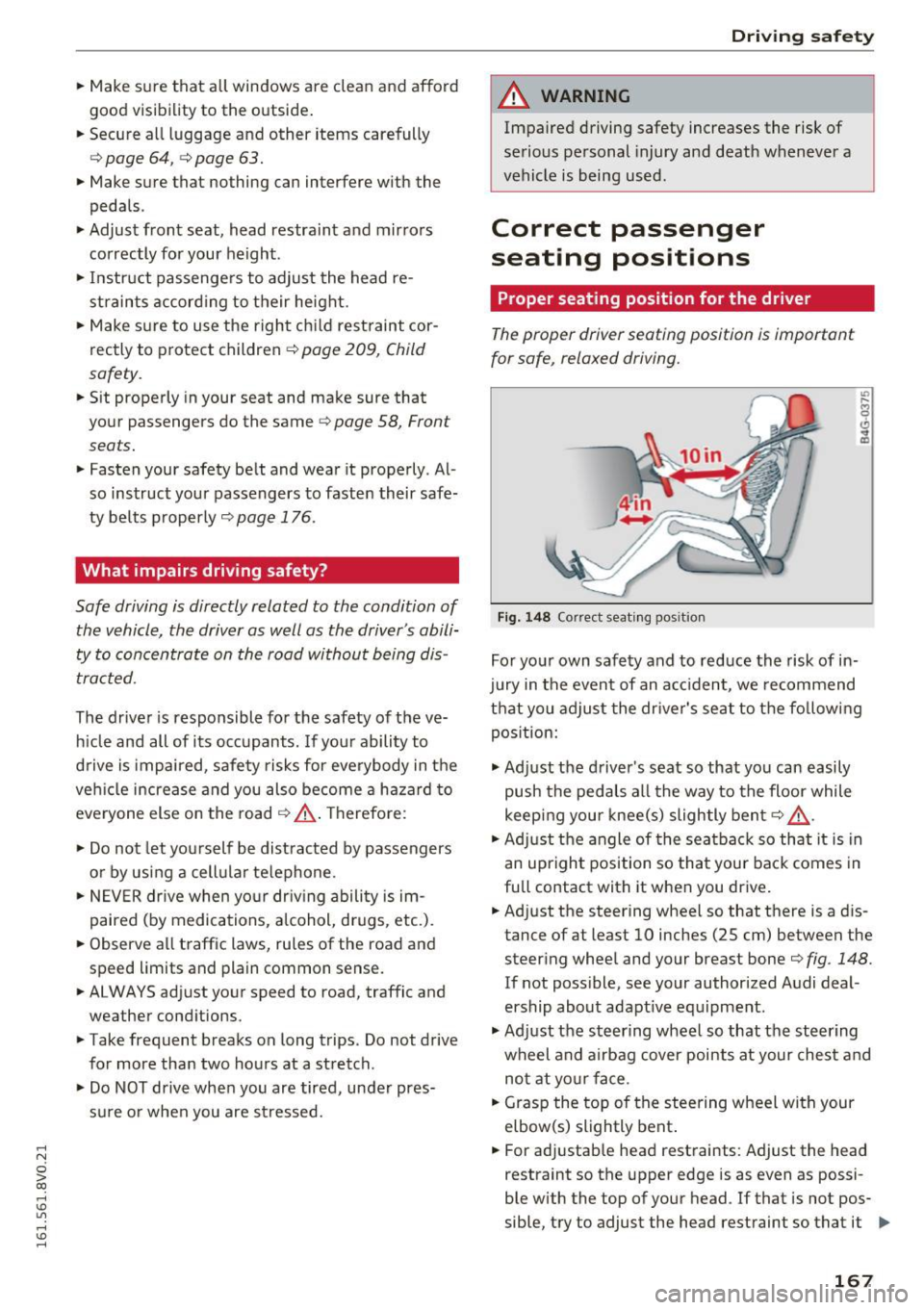
Fig. 148 Correct seating pos ition
For your own safety and to reduce the risk of in·
jury in the event of an accident, we recommend
that you adjust the dr iver's seat to the follow ing
position:
.,. Adjust the driver's seat so that you can easily
push the pedals all the way to the floor while
keep ing your knee(s) slightly bent
r=> ,&. .
.. Adjust the angle of the seatback so that it is in
an upright position so that your back comes in
full contact with it when you drive .
.. Adjust the steering wheel so that there is a d is
tance of at least 10 inches (25 cm) between the
steering wheel and your breast boner=>
fig. 148.
If not poss ible, see your authorized Audi deal·
ership about adapt ive equipment .
.,. Adjust the steering wheel so that the steering
wheel and airbag cover points at your chest and
not at your face .
.. Grasp the top of the steering wheel with your
elbow(s) slightly bent .
.. For adjustab le head restraints: Adjust the head
restraint so the upper edge is as even as possi
ble with the top of your head . If that is not pos
sible, try to adjust the head restraint so that it ..,.
167
Page 175 of 328
.... N
0 > co ....
~page 166.
A WARNING
To help prevent poisonous exhaust gas from
being drawn into the vehicle, always keep the
rear lid closed while driving .
- Never transport objects larger than those
fitting completely into the luggage area be
cause the rear lid cannot be fully closed .
-If you absolutely must drive with the rear lid
open, observe the following notes to reduce
the risk of poisoning:
- Close all w indows,
- Close the power roof*,
- Open all air outlets in the instrument pan-
el,
- Switch off the air recirculation,
- Set the fresh air fan to the highest speed .
A WARNING
-
Always make sure that the doors, all win
dows, the power roof* and the rear lid are se
curely closed and locked to reduce the risk of
injury when the vehicle is not being used.
- After closing the rear lid, always make sure
that it is properly closed and locked.
- Never leave your vehicle unattended espe
cially with the rear lid left open. A child
could crawl into the vehicle through the lug
gage compartment and close the rear lid be
coming trapped and unable to get out. Be
ing trapped in a vehicle can lead to serious
personal injury.
- Never let children play in or around the vehi
cle.
- Never let passengers r ide in the luggage
compartment. Vehicle occupants must al
ways be properly restrained in one of the ve
hicle's seating positions.
(D Tips
- Air circulation helps to reduce window fog
ging. Stale air escapes to the outside
through vents in the trim panel. Be sure to
keep these slots free and open.
Driving safety
-The tire pressure must correspond to the
load. The tire pressure is shown on the tire
pressure label. The tire pressure label is lo
cated on the driver's side B-pillar . The tire
pressure label lists the recommended cold
tire inflation pressures for the vehicle at its
maximum capacity weight and the tires that
were on your vehicle at the time it was man ufactured. For recommended tire pressures
for normal load conditions, please see chap
ter
~ page 263.
' Tie-downs
The luggage compartment is equipped with four
tie-downs to secure luggage and other items.
Use the tie-downs to secure your cargo properly
~ page 172, Loading the luggage compartment.
In a collision, the laws of physics mean that even
smaller items that are loose in the vehicle will
become heavy missiles that can cause serious in
jury. Items in the vehicle possess energy which
vary w ith vehicle speed and the weight of the
item. Vehicle speed is the most significant factor.
For example, in a frontal collision at a speed of
30 mph (48 km/h), the forces acting on a 10-lb
(4.5 kg) object are about 20 times the normal
weight of the item. This means that the weight
of the item would sudden ly be about
200 lbs. (90 kg). You can imagine the injuries
that a 200 lbs. (90 kg) item flying freely through
the passenger compartment could cause in a col
lision like th is.
A WARNING
-Weak, damaged or improper straps used to
secure items to tie-downs can fail dur ing hard
braking or in a collision and cause serious per
sona l injury.
- Always use suitable mounting straps and
properly secure items to the tie-downs in
the luggage compartment to help prevent
items from shifting or flying forward as dan
gerous missiles .
- When the rear seat backrest is folded down,
always use suitable mounting straps and
properly secure items to the tie-downs in
173
Page 188 of 328
Airbag syste m
about children and Advanced Airbags
¢page 209 .
Even tho ugh your vehicle is equipped with an Ad
vanced Airbag System, make certain that all chi l
dren, especially those 12 years and younger, al
ways ride in the back seat proper ly restrained for
their age and size. The airbag on the passenger
side makes the front seat a potentially dangerous place for a child to ride. The front seat is not the
safest place for a child in a forward-facing child
seat . It ca n be a very dangerous place for an in
fant or a c hild in a rearward-fac ing seat.
The Advanced Airbag System in your veh icle has
been cert ified to comply with the requirements
of United States Federal Motor Vehicle Safety
Standard ( FMVSS) 208, as well as Canada Motor
Veh icle Safety Standa rd (CMVSS) 208 as applica
b le at the time your vehicle was man ufa ct ur ed.
According to requi rements, the front Advanced
Airbag System on the passenger side has been
certified for "suppression" for infants of about 12 month old and younger and for "low risk de
ployment" for children aged 3 to 6 years o ld (as
defined in the standard) .
The
PAS SENGER AIR BAG O FF light in the instru
ment panel tells you when the front Advanced
Airbag on the passenger side has been turned off by the electronic control unit.
Each time you switch on the ignition, the
PAS
S ENGER AIR BAG OFF
light will come on for a
few seconds and:
- will stay on if the front passenger seat is not
occupied,
- will stay on if the electrical capacitance meas
ured by the capacitive passenger detection sys
tem for the front passenger seat equals the
combined capacitance of an infant up to about one year of age and one of the rearward-facing
or forward-facing child restraints listed in Fed
eral Motor Vehicle Safety Standard 208 w ith
which the Advanced Airbag System in your veh i
cle was certified. Fo r a listing of the child re
straints that were used to cert ify your vehicle's
compliance with the U.S. Safety Standard
¢ page 211 .
186
- will stay on if there is a sma ll child o r chi ld re
straint on the front passenger seat,
- wi ll go off if the front passenger seat is occu
pied by an adult as registered by the capacitive
passenger detectio n system ~
page 196, Mon
itoring the Advanced Airbag System.
The PAS SENGER AIR BAG OFF lig ht comes on
when electrical capacitance registered on the
front passenger seat is equal to or less than the
combined capacitance of a typical 1 year-old in
fant and one of the rearward-facing or forward
facing child restraints listed in Federal Motor Ve hicle Safety Standard 208 w ith which the Ad
vanced Airbag System in your vehicle was certi
fied .
If the total electr ical capacitance registered o n
the front passenger seat is more than that of a
typ ical 1 year-old chi ld but less than the weight
of a sma ll adult, the front airbag on the passen
ger side can deploy (the
PAS SENGER AIR BAG
OFF
light does not come on).
If the
PASSENGER AIR BAG OFF light does not
come on, the front airbag on the passenger side
has not been t urned off by the electron ic con trol
u nit and can dep loy if the con trol uni t senses an
impact t hat meets the conditions stored in its
memo ry.
For exampl e, the airbag ma y depl oy if:
- a small ch ild that is heav ier than a typ ical 1
year-old child is on the front passenger seat (regard less of whethe r the child is in one of the
child seats listed ¢
page 211), or
- a child who has outgrown ch ild restraints is on
the front passenge r seat.
If the front passenger a irbag is turned off, the
PA SSENGER AIR BAG OFF light comes on in the
i nst rument cluster and stays on .
If the front passenger airbag deploys, the Feder
al Standard requires the airbag to meet the "low
risk" dep loyment criteria to reduce the r isk of in
ju ry through interaction w ith the airbag . "Low
r isk" dep loyment occurs in those crashes that
take place at lower decelerations as defined in
the e lectronic contro l unit ¢
page 196, PASSEN-
GER AIR BAG OFF light. .,_
Page 191 of 328
,....,
N
0 > co ,....,
Objects between you and the airbag will in
crease the risk of injury in a crash by interfer
ing with the way the airbag unfolds and/or by
being pushed into you as the airbag inflates.
-Always make sure nothing is in the front air -
bag deployment zone that could be struck
by the airbag when it inflates .
- Objects in the zone of a deploying airbag
can become projectiles when the airbag de
ploys and cause serious personal injury.
- Never hold things in your hands or on your
lap when the vehicle is in use .
-
-Never place accessories or other objects
(such as cup holders, telephone brackets,
note pads, navigation systems, or things
that are large, heavy, or bulky) on the doors;
never attach then to the doors or the wind
shield; never place them over or near or at
tach them to the area marked ,,AIRBAG" on
the steering wheel, instrument panel or the
seat backrests; never place them between these areas and you or any other person in
the vehicle .
- Never attach objects to the windshield
above the passenger front airbag, such as
accessory GPS navigation units or music players. Such objects could cause serious in
jury in a collision, especially when the air bags inflate .
- Never recline the front passenger seat to
transport objects. Items can also move into
the deployment area of the side airbags or
the front airbag during breaking or in a sud den maneuver. Objects near the airbags can
fly dangerously through the passenger com
partment and cause injury , particularly
when the seat is reclined and the airbags in
flate.
A WARNING
A person on the front passenger seat, espe cially infants and small children, will receive
serious injuries and can even be killed by be
ing too close to the airbag when it inflates.
- Although the Advanced Airbag System in
your vehicle is designed to turn off the front
Airbag system
passenger airbag if an infant or a small child
is on the front passenger seat, nobody can
absolutely guarantee that deployment un
der these special conditions is impossible in
all conceivable situations that may happen
during the useful life of your vehicle .
- The Advanced Airbag System can deploy in accordance with the .,low risk" option for 3-
and 6-year-old children under the U.S. Fed
eral Standard if a child with electrical capac
itance greater than the combined capaci
tance of a typical one-year old infant re
strained in one of the forward facing or rear
ward-facing child seats with which your ve
hicle was certified is on the front passenger
seat and the other conditions for airbag de
ployment are met .
- Accident statistics have shown that children
are generally safer in the rear seat area than
in the front seating position.
- For their own safety, all children, especially
12 years and younger, should always ride in
the back properly restrained for their age
and size.
Advanced front airbag system
Your vehicle is equipped with a front Advanced
Airbag System in compliance with United States
Federal Motor Vehicle Safety Standard 208 , as
well as Canada Motor Vehicle Safety Standard (CMVSS) 208 as applicable at the time your vehi
cle was manufactured.
The front Advanced Airbag System supplements
the safety belts to provide additional protection
for the driver's and front passenger 's heads and
upper bodies in frontal crashes. The airbags in
flate only in frontal impacts when the vehicle de
celeration is high enough.
The front Advanced Airbag System for the front seat occupants is not a substitute for your safety
belts. Rather, it is part of the overall occupant re
straint system in your vehicle. Always remember
that the airbag system can only help to protect
you, if you are sitting upright, wearing your safe
ty belt and wearing it properly . This is why you
and your passengers must always be properly .,..
189
Page 199 of 328
,....,
N
0 > co ,....,
the front passenger seat . Always make sure that
the safety belt for the front passenger seat is
properly fastened.
Th e PASSENGER AIR BAG OFF light will show
the status of the front seat p assenger' s fr ontal
Ad vanced Airbag a few se cond s after the igni·
tion i s swit ched on and the ai rbag in d icator
light goes off . The PA SSEN GER AIR BA G OFF
light :
-will stay on if the front passenger seat is not
occupied;
- wi ll stay on if the electrical ca pacita nee meas
ured by the capacit ive passenger detection sys
tem for the front passenger seat equals the combined capacitance of an infant up to about
one year of age and one of the rearward-facing
o r fo rwa rd-facing ch ild restraints listed in Fed
era l Moto r Vehicle Safety Standard 208 w it h
wh ich the Advanced Airbag System in your veh i
cl e was certified; Fo r a listing of the child re
straints that were used to certify you r vehicle 's
compliance with the U.S. Safety Standard
¢ page 211 .
-will go out if the front passenger seat is occu
pied by an adult as registered by the capacitive
passenger detection system .
- The
PASSENGER AIR BAG OFF light must come
on and stay on if the ignition is on and ...
- a car bed has been insta lled on the front pas
senger seat, or
- a rearward-facing child restrai nt has been in
sta lled on the front passenger seat, or
- a forwa rd-facing child restra int has bee n instal
l ed on the front passenge r seat,
- and if the e lectr ic al capaci tance registered on
the front passenger seat is equal to or less than
the combined capacitance of a typical 1 year o ld infant and one of the rearward-facing or
forward -facing chi ld restraints listed in Federal
Motor Vehicle Safety Standard 208 w ith which
the Advanced Airbag System in your vehicle was
certified.
If the front passenger seat is not occupied, the
front airbag w ill not deploy, and the
PA SSENGER
AIR BAG OFF
light will stay on. Never install a
rearward -fac ing ch ild restraint on the front pas-
Airb ag sys tem
senger seat, the safest place for a chi ld in any
kind of child restraint is at one of the seating po
s itions on the rear seat¢
page 185, Child re
straints on the front seat -some important
things to know
and ¢ page 209, Child safety .
If the PASSENGER AIR BAG light comes
on ...
If the PA SSEN GER AIR BAG OFF light comes on
when one of the conditions listed above is met,
be sure to check the light regu larly to make cer
ta in that the
PASSENGER AIR BAG OFF l ight
stays on continuously whenever the ignition is
on. If the
PASSENGER AIR BAG OFF li ght does
not appear on and does no t stay on a ll the time,
stop as soon as it is safe to do so and
- react ivate the system by turning the ignit ion
off for more than 4 seconds a nd then turn ing it
on again;
- remove and re insta ll the chi ld restraint. Make
sure that the chi ld restraint is properly insta l
led and that the safety belt for the front pas
senger seat has been correct ly routed through
the child restraint as described in the c hild re
straint manufacturer's instructions;
- make sure that the convertible locking retrac
tor on the safety belt for the front passenge r
seat has been activated and that the safety belt has been pulled tight.
- make sure that no e lectr ica l device (such as a
laptop, CD player, e lectron ic games device,
power inverter or seat heater for ch ild seats) is
placed or used on the fro nt passenger seat if
the device is connected to the 12-volt socket or
the c igarette lighter socket;
- make sure that no seat heater has been retro
fitted or othe rw ise added to the front passen
ger seat;
- make sure that not hing can inte rfere with the
safety belt buckles and that they are not ob
structed;
- make sure that there are no wet objects (such
as a wet towe l) and no water or other liquids on
the front passenge r seat cushion. .,..
197