air condition AUDI S3 2016 Owner's Manual
[x] Cancel search | Manufacturer: AUDI, Model Year: 2016, Model line: S3, Model: AUDI S3 2016Pages: 328, PDF Size: 81.78 MB
Page 211 of 328
,....,
N
0 > co ,....,
Important information
Introduction
The rear seat is generally the safest place in a
collision .
The physical principles of what happens when
your vehicle is in a crash apply also to children
c:> page 177, What happens to occupants not
wearing safety belts? .
But unlike adults and
teenagers, their muscles and bones are not fully
developed. In many respects children are at
greater r isk of serious injury in crashes than
adults .
Because children's bodies are not fu lly devel
oped, they requ ire restraint systems especially
des igned for their size, we ight , and body struc
ture. Many countr ies and all states of the United
States and provinces of Canada have laws requir
ing the use of approved child restraint systems
for infants and small children .
In a frontal crash at a speed of 20-3 5 mph
(30-56 km/h) the forces acting on a 13-pound
(6 kg) infant will be more than 20 times the
weight of the child . This means the weight of the
child would suddenly be more than 260 pounds
(120 kg) . Under these conditions, only an appro
priate child restraint properly used can reduce
the risk of serious injury . Child restra ints, like
adult safety belts, must be used properly to be
effect ive. Used improperly, they can increase the
risk of serious injury in an accident .
Consult the child safety seat manufacturer's in
structions in order to be sure the seat is right for
your child's size
c:> page 212, Important safety
instructions for using child safety seats .
Please
be sure to read and heed all of the important in
formation and WARNINGS about child safety,
Advanced Airbags, and the installation of child restraints in this chapter.
There is a lot you need to know about the Ad
vanced Airbags in your vehicle and how they work
when infants and children in chi ld restraints are
on the front passenger seat . Because of the large
amount of important information, we cannot re-
Ch ild safety
peat it all here. We urge you to read the detailed
information in this owner's manual about airbags
and the Advanced Airbag System in your vehicle
and the very important information about trans
porting children on the front passenger seat.
Please be sure to heed the WARNINGS -they are
extremely important for your safety and the safe
ty of your passengers, especially infants and small chi ldren.
_& WARNING
- Accident statistics have shown that children
are generally safer in the rear seat area than in the front seating position . Always restrain
any child age 12 and under in the rear.
- All vehicle occupants and especially children must be restrained properly whenever riding
in a vehicle. An unrestrained or improperly restrained child cou ld be injured by striking
the inter ior or by being ejected from the ve
h icle during a sudden maneuver or impact .
An unrestrained or improperly restrained
child is a lso at greater risk of injury or death
through contact w ith an inflating a irbag.
-A suitable ch ild restraint properly installed
and used at one of the rear seating positions
provides the h ighest degree of protect ion
for infants and small children in most acci
dent situat ions .
_& WARNING
f"-"---
Children on the front seat of any car even with
Advanced Airbags can be seriously injured or
even killed when an airbag inflates . A child in
a rearward-facing chi ld safety seat installed
on the front passenger seat will be seriously i njured and can be killed if the front airbag in
flates .
- The inflating airbag will h it the ch ild safety
seat or infant carr ier with great force and
will smash the child safety seat and child aga inst the backrest, center armrest, or
door.
- Always install rear-fac ing child safety seats
on the rear seat .
- If you must install a rearward facing child
safety seat on the front passenger seat in
209
Page 248 of 328
Checking and Filling
cont inue driving. See an authorized Audi deal
er or authorized Audi Service Facility for assis
tance .
Radiator fan
The radiator fan switches on outomotico/ly by it
self.
An auxiliary elect ric radiator fan sw itches on and
off depend ing on coolant temperature and other
vehicle operating conditions.
After you switch the engine off, the auxiliary fa n
can cont inue runn ing fo r up to 10 minutes -even
with the ignition off . It ca n even switch on again
later by itself¢.&. , if
- the temperature of the engine coolant r ises due
to the heat bu ild -up from the engine in the e n
gine compartment, or
- the engine compartment heats up because the
vehicle is parked in intense sunlight .
A WARNING
-To reduce the risk of pe rsonal injury never
touch the radiator fan .
- The auxiliary electric fan is temperature
controlled and can switch on suddenly even
when the eng ine is not running.
- The auxiliary radiator fan switches on auto
matically when the engine coo lant reaches a
certain tempe rature and w ill cont inue to run
until the coolant temperature drops.
Brake fluid
Checking brake fluid level
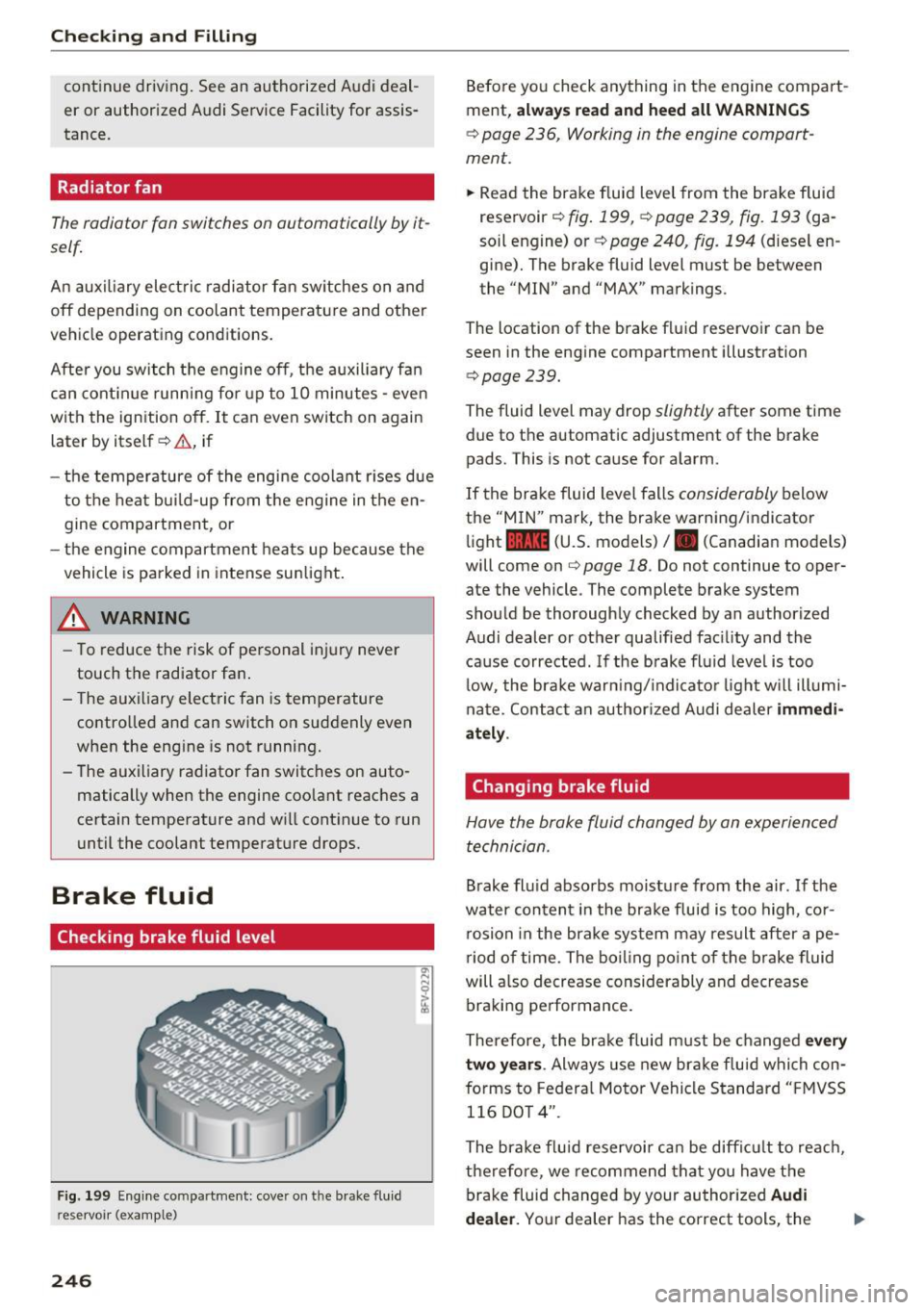
F ig . 19 9 Engine co mpar tment: cove r o n t he b rake fluid
r e servo ir (example)
246
-
Before yo u check any thing in the engine compart
ment,
always read and heed all WARNINGS
¢ page 236, Working in the engine comport
ment .
.,. Read the brake fluid level from the brake f luid
reservoir ¢
fig. 199, ¢ page 239, fig. 193 (ga
soil engine) or ¢
page 240, fig. 194 (diesel en
gine). The brake fluid level must be between
the "MIN" and "MAX" markings .
The location of the brake fl u id reservoir can be
seen in the engine compartment i llustration
q page239.
The fluid level may drop slightly after some time
due to t he automatic adjustment of the brake
pads. This is not ca use for a larm.
If t he brake fluid level falls considerably below
the "M IN" mark, the brake warning/indicator
li ght ~ (U.S. models)
I. (Canadian models)
will come on
q page 18 . Do not continue to oper
ate the vehicle . The complete brake system
shou ld be thorough ly checked by an authorized
Audi dealer or other qualified fac ility and the
cause corrected .
If the brake fl uid level is too
l ow, the bra ke war ning/ indicato r light w ill illumi
na te. Cont act an a uthor ized Audi dealer
immedi
atel y.
Changing brake fluid
Have the brake fluid changed by an experienced
technician.
B rake fl uid abso rbs moistu re from the air. If the
wa ter con ten t in the brake fluid is too high, cor
r osion in the bra ke system may res ult after ape
riod of time. The boi ling po int of the brake fluid
will a lso decrease considerably and decrease
bra king performance.
Therefore, the bra ke fluid m ust be changed
every
two year s. Always use new brake f luid which con
forms to Federa l Motor Vehicle Standard " FMVSS
116 DO T 4" .
The brake fluid reservoir can be diffic ult to reac h,
the refore, we recommend that you have t he
brake fluid changed by your author ized
Audi
dealer .
Your dealer has the correct tools, the
Page 249 of 328

,....,
N
0 > co ,....,
you.
A WARNING
- Brake fluid is poisonous. It must be stored
only in the closed original container out of
the reach of chi ldren!
- Brake failure can resu lt from old or inappro
priate brake fluid. Observe these precau
t ions:
- Use only brake flu id that meets SA E speci
fication
J 1703 and conforms to Federal
Motor Vehicle Standard 116. Always check
with your authorized Audi dealer to make
sure you are using the correct brake fluid.
The correct type of brake fluid is also indi
cated on the brake flu id reservoir.
- The brake fluid must be new. Heavy use of
the brakes can cause a vapor lock if the
brake fluid is left in the system too long.
This can ser iously affect the efficiency of
the brakes as well as your safety. This
could result in an acc ident.
(D Note
Brake fluid w ill damage the pa int of your vehi
cle.
For the sake of the environment
Because of the prob lem of proper disposal of
brake flu id as well as the special tools re
quired and the necessary expertise, we rec
ommend that you have the brake fluid
changed by your author ized Audi dealer.
Battery
General information
All work on the battery requires expert knowl
edge.
Read and foll ow t he WARNING S before check
ing anything in the engine compartment
¢ page 236, Working in the engine comport
ment.
Ch eck ing and Filling
Plug -in hybrid drive* : you can find important in
formation about the high -vo ltage battery under
¢ page 98.
The battery in yo ur Audi does not need any ma in
tenance under
normal operating conditions . Audi
recommends having the electrolyte level check
by an authorized Audi dealer or author ized Audi
Service Facility when there are
high outside tem
peratures or when dr iving all day. The e lectrolyte
level should also be checked each time the bat
tery is charged¢
page 249.
Have the battery checked when you bring your ve
hicle in for an inspection. It is a good idea to re
place the battery if it is more than 5 years old.
D uring certa in types of a irbag deployments, the
battery is d isconnected from the veh icle electri
cal system for safety reasons¢
& in Repair, core
and disposal of the airbags on page 199.
Di sco nnecting the battery te rminal s
The battery should not be disconnected. Several
vehicle functions (power windows, for example)
will be lost when the battery is disconnected. The
funct ions must be reprogrammed after connect
ing the battery. To avoid this, the battery should
only be disconnected from the vehicle electrical
system when it is absolutely necessary.
To reprogram the functions, proceed as follows:
Function Reprogramming
Power window one-¢ page 44, Correcting
touch up/down func-power window molfunc-
tion tions
Remote control key or
If the vehicle does not
Convenience key react to the key, it must
be synchronized
¢page 37
Dig ita l clock ¢page 10
ESC indicator light The indicator light goes
out after driving a few
meters
247
Page 272 of 328
Tires and wheels
Use of snow chains is o nly pe rmitted with certain
rim/t ire combinations due to tec hnical reasons .
Chec k with an autho rize d Aud i dealer or autho r
i z ed A ud i Service Fac ility to see if yo u may use
snow chains.
Use
fine-mesh snow chains . They must not add
mo re t han 0 .53 inc h (13 .5 mm) in height, i nclud
i n g the chain loc k.
You mus t remove the chains when d riving on
roads that are
free of snow . W hen roads a re free
of snow, snow c hains ca n impair handlin g and
damage the t ires, and the chains w ill quickly be
destroyed.
A WARNING
Us ing inco rrect sno w ch ains or insta lling snow
chains in co rrectly can result in loss o f vehicle
c o ntrol, w hich i ncreas es th e risk of an a cci
de nt.
(D Note
- Snow cha ins can damage t he rims/whee l
covers* if the chains com e into d ir e ct con
tact wi th th em. R emov e th e wh eel covers*
fir st. U se coat ed s now chai ns.
Low aspect ratio tires
Your Aud i is fa cto ry-equippe d wi th low aspec t ra
tio tires . These ti res have been tho roughly teste d
an d been se lected specifically for yo ur model for
their superb per fo rmance, road f eel and handling
under a variety of d riving conditions . As k yo ur au
thor ized Audi dealer for mo re details .
The low aspect ratio of these t ires is indicated by
a nume ra l of
55 or less in the tire's size designa
tion . The nume ra l r ep resents the rat io o f th e
tire's sidewall he ight i n relat ion to its tread width
expressed in percentage . Conventional tires have
a height/w idt h ratio o f 60 o r more .
The performance of low-aspect-ratio tires is par
ticularly sensitive to improper inflation pres
sure. It is therefore important that low aspect
ratio tires are inflated to the specified pressure
and that the inflation pressure is regularly
c hecked and maintained . Tire pre ssures should
270
be checked at least once a month and always
before a long trip
~ page 263.
What you can do to avoid tire and rim
damage
Low aspect ra tio tires can be damaged more eas i
l y by impact with potho les, curbs, gullies or
r idges on t he road , particularly if t he tire is un
der i n flated.
I n order to min imize the occurrence o f impact
dama ge to the tires o f your veh icle, we recom
men d that you observe the following preca u
tions:
- Always main tain recommende d inf la tion pres
sures . Check yo ur tir e pressure eve ry 2,000
m iles (3,000 km) and add a ir if necessary .
- Dr ive ca refully on roa ds w ith potholes, deep
gullies o r ridges . The impact from dr iving
throug h or over such obstacles can damage
your t ires. Impact wit h a curb may a lso cause
damage to your tires.
-After a ny impact, immed iate ly inspect you r
tires or have them inspected by the nearest au
thorized Aud i dealer. Replace a damaged tire as
soon as poss ible .
- Inspect your tires every 2,000 m iles (3,000 km)
for damage and wear . Damage is no t always
easy to s ee . Damage ca n lead to loss o f air and
unde rin flation, w hich co uld even tually cause
t ire f ailure . If yo u beli eve th at a ti re may have
bee n da mage d, re place the tire as soon as p os
sible.
- These tires may we ar m ore quick ly th an oth ers.
- Please also rem emb er tha t, whil e the se tires
delive r responsive h andli ng, they may ride less
c omf ortabl y and ma ke m ore noi se th an o ther
choi ces .
Reduced performance in winter/cold season
conditions
A ll ti res are des igned for cert ain pur poses . T he
l ow aspect r atio , ul tra hig h perform ance tires
o rigina lly installed on your vehicle are inten ded
for maximum dry and wet road performance and
handling . T hey a re not suitable fo r co ld, snowy o r
i cy weather conditions. If yo u drive under th ose
c ircumstances, you should equip yo ur vehicle
with all -season o r winter tires, which offer better
11>-
Page 275 of 328
,....,
N
0 > co ,....,
IE-Loss of pressure in at least one tire c::> ,&.
Check the tires and replace or repair if necessary.
Check/correct the pressures of all four tires. Then
store the tire pressures in the MMI
c::> page 2 73 .
mm (Tire Pressure Monitoring System) Tire
pressure: System malfunction!.
If m appears
after switching the ignition on or whi le driving
and the
IE indicator light in the instrument clus
ter blinks for approximately one minute and then
stays on, there is system malfunction. Try to
store the correct tire pressures
c::> page 2 73. If
the indicator light does not turn off or turns on
again after a short period of time, drive to an au
thor ized Audi dealer or authorized Audi Service
Facility immediately to have the malfunction cor
rected.
A WARNING
- If the tire pressure warning light IE in the
instrument cluster turns on, the pressure in
one or more tires is too low . Reduce the ve
hicle speed immediately and avoid any hard
steering or braking maneuvers. Stop as soon
as possible, check the tire and inflate the
t ir e to the correct pressure, which is speci
fied on the tire pressure label on the veh icle
c::> page 263. Driving with a ti re with low
pressure causes the tire to overheat and can
result in failure of the tire. Low pressure can
also have a negative effect on the driving
and braking behavior of the vehicle .
- Th e driver is responsible for maintaining the
correct tire pressures. You must check the
tire pressures regularly.
- Under certain conditions (such as a sporty
driv ing style, winter conditions or unpaved
roads), the pressure monitor indicator may
be delayed.
- Do not use run-flat tires on your vehicle . Us
ing them when not permitted can lead to
vehicle damage or accidents.
(D Tips
- The tire pressure monitoring system can al
so stop working when there is an ESC mal
function.
Tires and wheels
-Using snow chains may result in a system
ma lfunction.
- The tires with the identification "AO" or
"RO"
c::> page 260 have been matched with
your Audi tire pressure monitoring system .
We recommend that you use these tires.
- The tire pressure monitoring system can on
ly monitor the tire pressure of the driving
tires. Check the tire pressure of the spare
wheel in the luggage compartment so that if necessary it is ready for use.
Storing tire pressures
Applies to vehicles: with tire pressure mon itor ing system
A change in tire pressure or a change in tires
must be stored in the system.
The tire pressure is stored in the MMI.
.,. Make sure befo re storing that the tire pressures
of all four tires meet the specified va lues and
are adapted to the load. Otherwise the system
could malfunction
c::> page 263.
.. Switch on the ign ition.
.,.. Select: the I MENU I button> Car> Systems "
control button > Service & control > Tire pres
sure monitor > Store tire pressure > Yes, store
now .
(D Tips
Do not store the tire pressures if snow chains
a re installed . Otherwise the system could
malfunction.
273
Page 279 of 328
,..,
N
0 > co ,..,
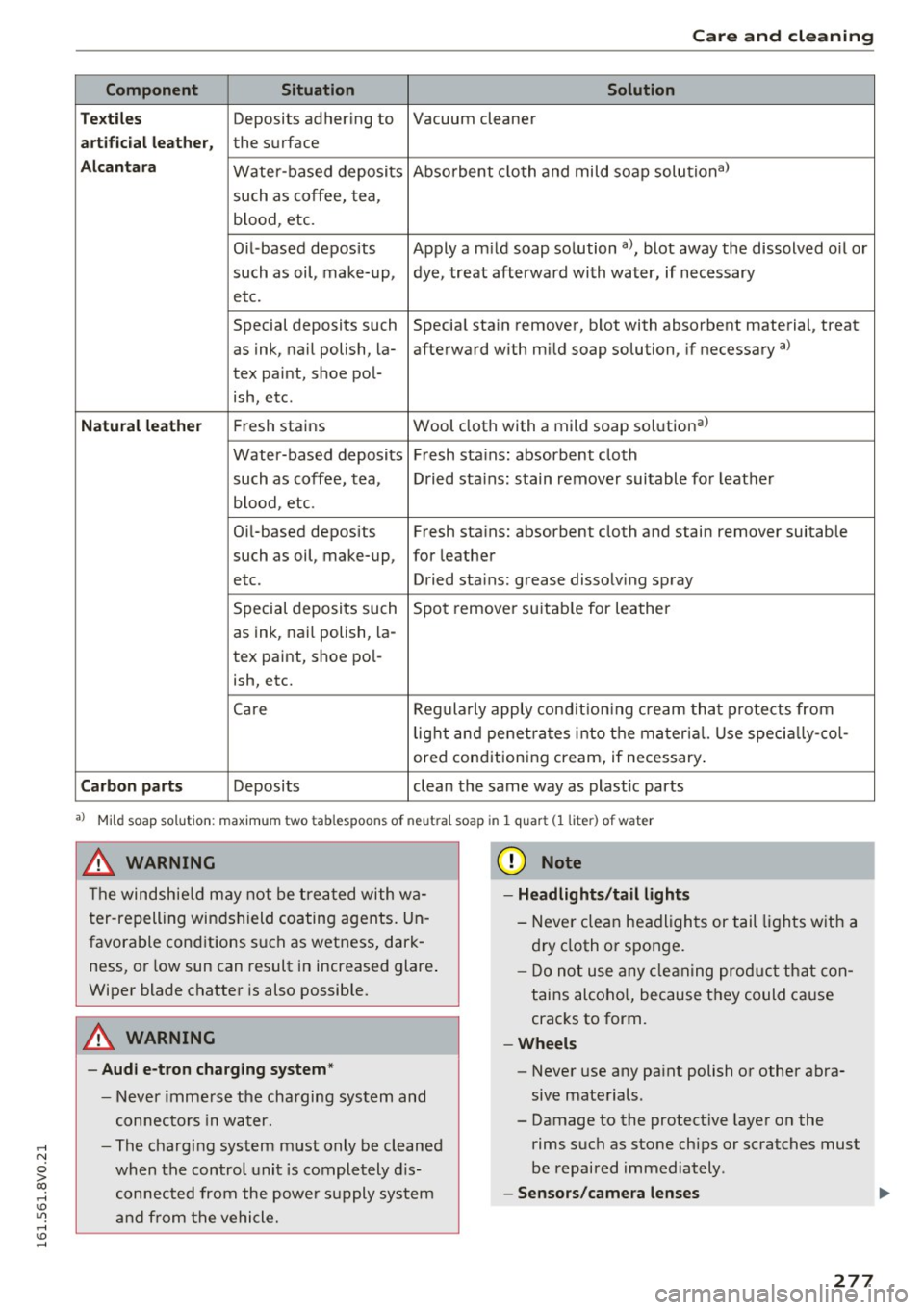
Component Situation Solution
T ex til es
Deposits adhering to Vacuum cleaner
art ificial l eather, the surface
A lcan tara Water-based deposits Absorbent
cloth and mild soap solutiona>
such as coffee, tea,
b lood, etc.
Oil -based deposits Apply a m ild soap solution
a), blot away the dissolved o il or
such as oil, make-up, dye, treat afterward with water, if necessary
etc.
Special deposits such Special stain
remover, blot with absorbent material, treat
as ink, nail polish, la- afterward with mild soap solution, if necessary
a)
tex paint, shoe pol-
ish, etc.
Natu ral le ath er Fresh stains Wool cloth with a mild soap solution a)
Water-based deposits Fresh stains: absorbent cloth
such as coffee, tea, Dried stains : stain
remover suitable fo r leather
b lood , etc.
Oi [-based deposits Fresh stains: absorbent cloth and stain
remover suitable
such as oil, make-up, for leather
etc. Dried stains : grease dissolving spray
Special deposits such Spot remove r suitab le for leather
as ink, nai l polish, la-
tex paint, shoe pol-
ish, etc.
Care Regularly apply condit ion ing c ream that protects from
lig ht and penet rates into the material. Use specia lly-co l-
ored conditioning cream, if necessary .
Carbon part s Deposits clean the same way as plast ic parts
a) Mi ld soap solution: maximum two tablespoons of neutral soap in 1 q uart (1 liter) of water
.8, WARNING
The windshield may not be trea ted with wa
ter-repelling windshield coating agents. Un
favorable cond itions such as wetness, dark
ness, or low sun can result in increased glare.
Wiper blade chatter is also possible.
A WARNING
- Audi e -tron charg ing sy stem *
- Never immerse the charging system and
connectors in water.
- The charging system m ust only be cleaned
when the control unit is completely d is
connected from the powe r su pply system
and from the vehicle.
-
({I) Note
- Hea dlight s/tail lights
- Never clean headlights or tail lights w ith a
d ry cloth or sponge.
- Do not use any cle aning product that con
tains alcoho l, because they could ca use
cracks to form.
-Whe els
- Never use any pa int polish or other abra-
sive materials.
- Damage to the protect ive layer on the
rims such as stone chips or scratches must
be repaired immediately .
-Sensor s/came ra le nses Ill-
277
Page 308 of 328
Consumer information
Consumer information
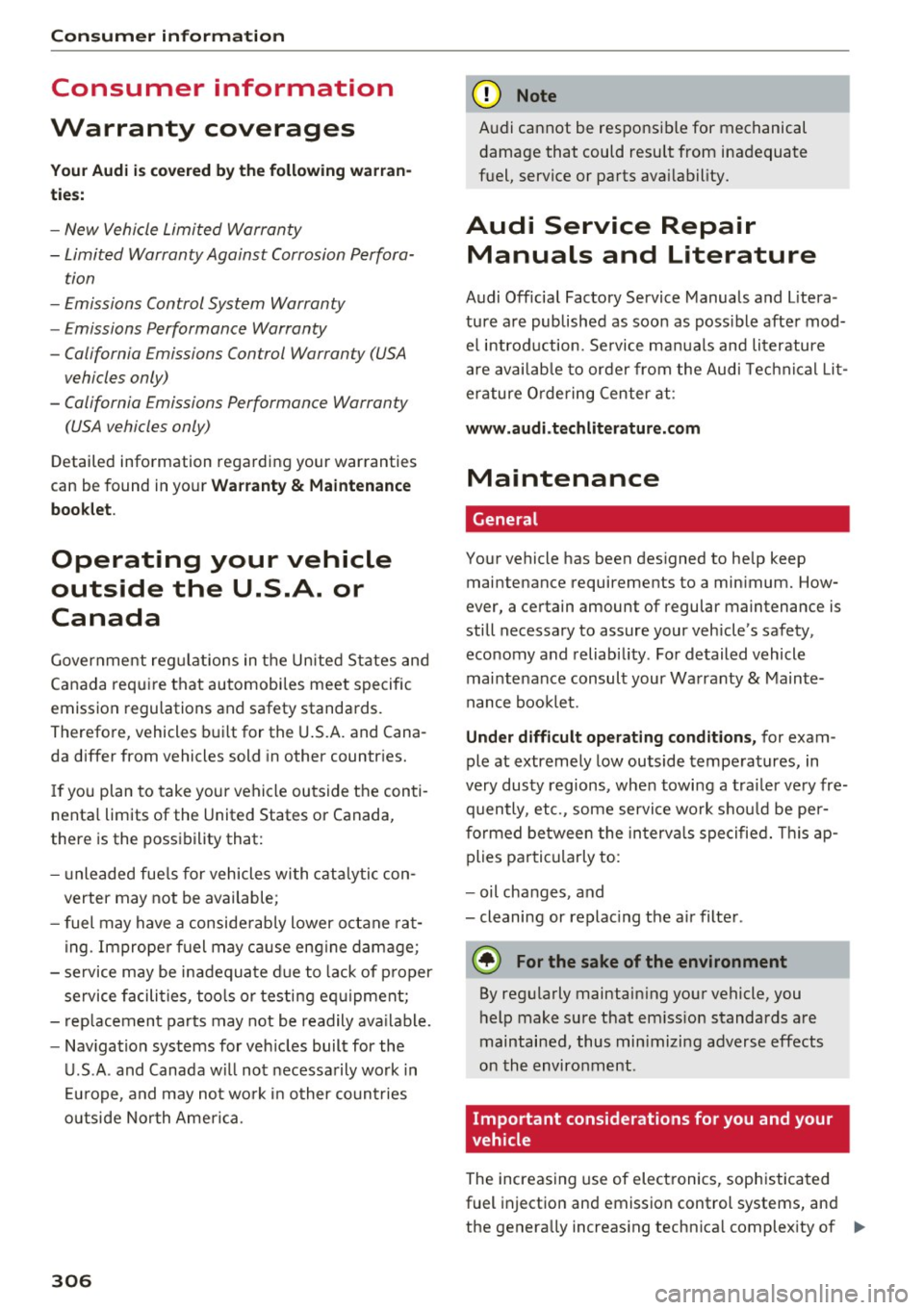
Warranty coverages
Your Audi is covered by the following warran
ties:
- New Vehicle Limited Warranty
- Limited Warranty Against Corrosion Perfora-
tion
- Emissions Control System Warranty
- Emissions Performance Warranty
- California Emissions Control Warranty (USA
vehicles only)
- California Emissions Performance Warranty
(USA vehicles only)
Detailed information regarding your warranties
can be found in your
Warranty & Maintenance
booklet .
Operating your vehicle
outside the U.S.A. or
Canada
Government regulati ons in the United States and
Canada require that automobi les meet specific
emission regulations and safety standards.
Therefore, vehicles built for the U.S.A. and Cana
da differ from vehicles sold in other countries.
If you plan to take your vehicle outside the conti
nenta l limits of the United States or Canada,
there is the poss ibility that:
- un leaded fue ls for vehicles with catalytic con
verter may not be available;
- fuel may have a considerably lower octane rat
ing . Improper fuel may cause engine damage;
- service may be inadequate due to lack of proper
service facilities, tools or testing equipment;
- r eplacement parts may not be readily available.
- Nav igation systems for veh icles built for the
U.S .A . and Canada will not necessarily work in
Europe, and may not work in other countries
outside North America.
306
(D Note
Audi cannot be responsib le for mechanical
damage that could result from inadequate
fuel, service or parts ava ilability.
Audi Service Repair
Manuals and Literature
Audi Official Factory Service Manuals and Litera
ture are published as soon as poss ible after mod
el introduction . Service manuals and literature
are available to order from the Audi Technical Lit
erature Ordering Center at :
www.audi.techliterature .com
Maintenance
General '
Your vehicle has been designed to help keep
maintenance requirements to a minimum. How
ever, a certain amount of regular maintenance is
still necessary to assure your vehicle's safety,
economy and reliability . For detailed vehicle
maintenance consult your Warranty & Mainte
nance booklet .
Under difficult operating conditions, for exam
ple at extremely low outside temperatures, in
very dusty regions, when towing a trailer very fre
quently, etc., some service work should be per
formed between the intervals specified. This ap
plies particularly to:
- oil changes, and
- cleaning or replac ing the a ir filter .
'
@) For the sake of the environment
By regularly maintain ing your vehicle, you
help make sure that em iss ion standards are
maintained, thus minimizing adverse effects
on the environment .
Important considerations for you and your
vehicle
The increasing use of electronics, sophisticated
fuel injection and emission control systems, and
the generally increas ing technica l complexity of ..,_
Page 309 of 328
today's automobiles, have steadily reduced the
scope of maintenance and repairs which can be
carried out by vehicle owners.
Also, safety and
environmental
concerns place very strict limits
on the n ature of repairs and adjustments to en
gine and transmission parts which an owner can perform .
Maintenance, adjustments and repairs usually re
quire special tools, testing devices and o ther
equipment available to specially trained work
shop personnel in order to assure proper per
formance, reliability and safety of the vehicle and
its many systems.
Improper maintenance, adjustments and repairs
can impair the operation and reliability of your
vehicle and even void your vehicle warranty .
Therefore, proof of servicing in accordance with
the maintenance schedule may be a condition for upholding a possible warranty claim made within
the warranty period.
Above all , operational safety can be adversely af
fected, creating unnecessary risks for you and
your passengers.
If in doubt about any servicing, have it done by
your authorized Audi dealer or any other properly equipped and qualified workshop. We strongly urge you to give your authorized Audi dealer the
opportunity to perform all scheduled mainte nanc e and necessary repairs. Your dealer has the
facilities, original parts and trained specialists to keep your vehicle running properly .
Performing limited maintenance yourself
The following pages describe a limited number of
procedures which can be performed on your vehi
cle with ordinary tools, should the need arise and
trained personnel be unavailable. Before per
forming any of these procedures, always thor
oughly read all of the applicable text and careful ly follow the instructions given . Always rigorously
observe the
WARNINGS provided .
Before you check anything in the engine com-
,.., partment, always read and heed all WARNINGS
N
~ c::> .&. and c::> page 236.
co ,....,
A WARNING
-Serious personal injury may occur as a result
of improperly performed maintenance, ad
justments or repairs .
- Always be extremely careful when working
on the vehicle. Always follow commonly ac
cepted safety practices and general com mon sense. Never risk personal injury.
- Do not attempt any of the maintenance,
checks or repairs described on the following pages if you are not fully familiar with these
or other procedures with respect to the ve hicle, or are uncertain how to proceed.
- Do not do any work without the proper tools
and equipment. Have the necessary work
done by your authorized Audi dealer or an
other properly equipped and qualified work
shop.
- The engine compartment of any motor vehi cle is a potentially hazardous area. Never
reach into the area around or touch the radi
ator fan.
It is temperature controlled and
can switch on suddenly - even when the en
gine is off . The radiator fan switches on au
tomatically when the coolant reaches a cer
tain temperature and will continue to run
until the coolant temperature drops.
- Always switch off the ignition before anyone
gets under the vehicle .
-Always support your vehicle with safety
stands if it is necessary to work underneath
the vehicle . The jack supplied with the vehi
cle is not adequate for this purpose and
could collapse causing serious personal in
jury.
- If you must work underneath the vehicle
with the wheels on the ground, always make
sure the vehicle is on level ground, that the
wheels are always securely blocked and that
the engine cannot be started.
- Always make sure the transmission selector
lever (automatic transmission) is in P (Park
position) and the park brake is applied .
II>
307
Page 311 of 328
,....,
N
0 > co ,....,
in the operationa l safety of your vehicle and an
increased wear of vehicle parts¢
A.
Author ized Audi dealers w ill per form this wor k in
a professional and competent manner or, in spe
cial cases, refer you to a professional company
that spec ializes in such modifications.
A WARNING
Improper repairs and mod ificat ions can
change the way veh icle systems work and
cause damage to the veh icle and ser ious per
sonal injury.
If emergency repa irs must be pe rformed else
where, have the vehicle examined by an au thorized A udi dealer as soon as possib le .
Declaration of
Compliance, Telecom munication and
Electronic Systems
Radio Frequency Devices and Radio Communica
tion Equipment User Manual Notice.
T he manufacturer is not respons ible for any radio
or TV interference caused by unauthor ized modi
fications to this equ ipment .
Devices
The fo llow ing devices each comp ly w ith FCC Part
15.19, FCC 15.21 and RSS-Gen Issue
1:
- Adaptive cruise control*
- Audi s ide ass ist*
- Cell p ho ne pac kage*
- Convenience k ey*
- E lectron ic immobilizer
- Homelink universal remote contro l"
- Remote contro l key
FCC Part 15.19
This devi ce comp lies with p art 15 of the FCC
Ru les. Ope ra tion is subject to the following two
conditions :
Consumer inf ormation
(1) This dev ice may not ca use ha rmf ul inter fer
ence, and
( 2 ) th is d evice m us t ac cep t any inte rference re
c e ived, in clu ding in terference tha t may c ause un
desired ope ra tion.
FCC Part 15.21
CAU TION:
Changes or mod ificat ions not express ly approved
by the party responsible for compliance cou ld
vo id the user's a uth ori ty to ope rate t he equ ip
me nt.
RSS-Gen Issue 1
Operat ion is subject to the following two cond i
t ions:
(1) this device may not cause inte rfe rence, and
( 2 ) this devi ce m us t a cc ep t any inte rference, in
cl udi ng interference tha t may cause undes ired
operation of the device .
309
Page 313 of 328
,....,
N
0 > co ,....,
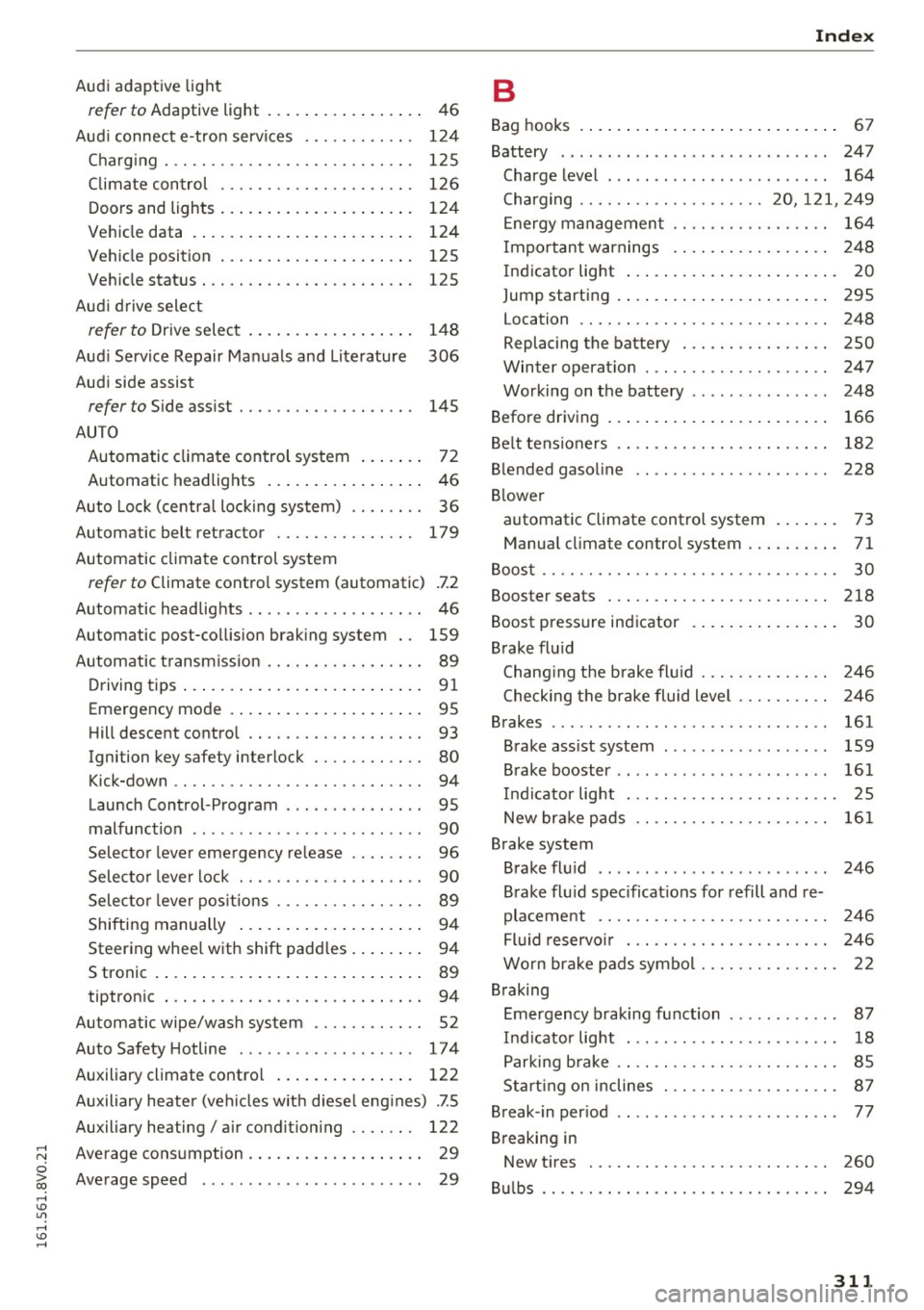
refer to Adaptive light . . . . . . . . . . . . . . . . . 46
Aud i connect e-tron services ..... .. .... .
Charg ing . .. .. .. ........... .. .. .... .
Climate control ...... .
..... .. .. .... .
Doors and lights .................... .
Vehicle data
. . ................ ..... .
Vehicle position ................ .... .
Vehicle status
. ............... .. .... .
Aud i drive select
refer to Drive select ............ ..... .
Audi Service Repair Manuals and Literature
Audi side assist
refer to Side assist .......... .. .. .. .. .
AUTO
124
125
126
124
124
125 125
148
306
145
Automatic climate control system . . . . . . . 72
Automatic headlights . . . . . . . . . . . . . . . . . 46
Auto Lock (central locking system) . . . . . . . . 36
Automatic belt retractor . . . . . . . . . . . . . . . 179
Automatic climate control system
refer to Climate control system (automatic) .7.2
Automatic headlights . . . . . . . . . . . . . . . . . . . 46
Automatic post-collision braking system . . 159
Automatic transmission . . . . . . . . . . . . . . . . . 89
Driving tips ... ................ ..... .. 91
Emergency mode . . . . . . . . . . . . . . . . . . . . . 95
Hill descent contro l . . . . . . . . . . . . . . . . . . . 93
Ignition key safety interlock . . . . . . . . . . . . 80
Kick-down · · · · · · · · · · · · · · · · · · · · . .... .. 94
Launch Control -Program . . . . . . . . . . . . . . . 95
malfunction . . . . . . . . . . . . . . . . . . . . . . . . . 90
Selector lever emergency re lease . . . . . . . . 96
Selector lever lock . . . . . . . . . . . . . . . . . . . . 90
Selector lever positions . . . . . . . . . . . . . . . . 89
Shifting manually . . . . . . . . . . . . . . . . . . . . 94
Steering whee l with shift paddles. . . . . . . . 94
S tronic · . .. .. ................ ..... .. 89
tiptronic . . . . . . . . . . . . . . . . . . . . . . . . . . . . 94
Automatic wipe/wash system . . . . . . . . . . . . 52
Auto Safety Hotline . . . . . . . . . . . . . . . . . . . 17 4
Auxiliary climate control 122
Auxiliary heater (vehicles w ith diesel eng ines) .7.5
Auxiliary heating/ air conditioning . . . . . . . 122
Average consumption . . . . . . . . . . . . . . . . . . . 29
Average speed . . . . . . . . . . . . . . . . . . . . . . . . 29
Index
B
Bag hooks . . . . . . . . . . . . . . . . . . . . . . . . . . . . 67
Battery . . . . . . . . . . . . . . . . . . . . . . . . . . . . . 247
Charge level . . . . . . . . . . . . . . . . . . . . . . . . 164
Charging . . . . . . . . . . . . . . . . . . . . 20, 121, 249
Energy management . . . . . . . . . . . . . . . . . 164
Important warnings . . . . . . . . . . . . . . . . . 248
Indicator light . . . . . . . . . . . . . . . . . . . . . . . 20
Jump starting . . . . . . . . . . . . . . . . . . . . . . . 295
Location · · .... .. .. ............... .. 248
Replacing the battery . . . . . . . . . . . . . . . . 250
Win ter operation . . . . . . . . . . . . . . . . . . . . 247
Working on the battery . . . . . . . . . . . . . . . 248
Before driving . . . . . . . . . . . . . . . . . . . . . . . . 166
Belt tensioners . . . . . . . . . . . . . . . . . . . . . . . 182
Blended gasoline . . . . . . . . . . . . . . . . . . . . . 228
B lower
automatic Climate control system . . . . . . . 73
Manual climate control system........ .. 71
Boost . . . . . . . . . . . . . . . . . . . . . . . . . . . . . . . . 30
Booster seats . . . . . . . . . . . . . . . . . . . . . . . . 218
Boost pressure indicator . . . . . . . . . . . . . . . . 30
Brake fluid Chang ing the brake flu id . . . . . . . . . . . . . . 246
Checking the brake fluid level . . . . . . . . . . 246
Brakes · · · · · .. .. .. .. 161
....... ........ ..
Brake ass ist system . . . . . . . . . . . . . . . . . . 159
Brake booster . . . . . . . . . . . . . . . . . . . . . . . 161
Indicator light . . . . . . . . . . . . . . . . . . . . . . . 25
New brake pads . . . . . . . . . . . . . . . . . . . . . 161
Brake system Brake fluid 246
Brake fluid specificat ions for refill and re
placement . . . . . . . . . . . . . . . . . . . . . . . . . 246
Fluid reservoir . . . . . . . . . . . . . . . . . . . . . . 246
Worn brake pads symbol . . . . . . . . . . . . . . . 22
Braking Emergency braking function . . . . . . . . . . . . 87
Indicator light . . . . . . . . . . . . . . . . . . . . . . . 18
Parking brake . . . . . . . . . . . . . . . . . . . . . . . . 85
Starting on inclines . . . . . . . . . . . . . . . . . . . 87
Break-in period . . . . . . . . . . . . . . . . . . . . . . . . 77
Breaking in New tires 260
Bulbs . . . . . . . . . . . . . . . . . . . . . . . . . . . . . . . 294
311