airbag AUDI S3 2016 User Guide
[x] Cancel search | Manufacturer: AUDI, Model Year: 2016, Model line: S3, Model: AUDI S3 2016Pages: 328, PDF Size: 81.78 MB
Page 160 of 328
Intelligent Technology
Intelligent Technology
Notice about data
recorded by the Event
Data Recorder and
vehicle control modules
Event Data Re corder
This vehicle is equipped wi th an Event Data Re
corder (EDR) . The main purpose of an E DR is to
record, in certain crash or near crash -like situa
tions, such as an airbag deploym ent or h itting a
road obstacle, data that will assist in understand
ing how a veh icle 's systems performed . The EDR
is designed to record data related to veh icle dy
namics a nd safety systems for a sho rt period of
time, typically 30 seconds or less . The E DR in this
veh icle is designed to reco rd s uch data as :
- How various systems in your vehicle were oper
at ing;
- Whether or not the driver and passenger safety
belts were buckled/fastened;
- How far ( if at all) the driver was depressing the
acce lerator and/or brake peda l; and,
- How fast the ve hicle was trave ling.
These data can help provide a better understand ing of the ci rc u mstances in which c rashes and in
juries occur. NOT E: EDR data are recorded by yo ur
veh icle only if a non-trivia l crash situat ion occurs;
no data are recorded by the EDR under normal
driving conditions and no personal data (e .g .,
name, gender, age, and crash location) a re re
corded . H owever , other pa rties , such as law en
forcement, cou ld combine the EDR data w it h the
type o f person ally identifyi ng dat a routine ly ac
qu ired dur ing a crash invest igat ion .
To read data reco rded by an EDR, specia l equip
men t is req uire d, and access to the veh icle or the
E DR is needed. In ad dition to the vehicle manu
facturer, other parties, s uch a s law enforcement,
that have t he specia l equipment, can read the in
formation if they have access to the vehicle or the E DR.
Some s tate laws restrict the re trieva l or down
loading of data stored by ED Rs insta lled in a vehi
cle fo r the express purpose of retrieving data af -
158
ter an accident or crash event withou t the own
er 's consent.
Audi will not access the EDR and /or sim ilar data
o r g ive it to others -
- unless t he ve hicle ow ner (o r lessee if the vehi
cle has been leased) ag rees; o r
- upon the offic ial request by the police; or
- upon the order of a court of law or a govern-
ment agency; or
- for the defense of a lawsuit through the jud icia l
discovery process.
- Audi may also use the data for research about
veh icle operation and safety perfo rmance or
prov ide the data to a th ird party for research
purposes w itho ut identify ing t he specific vehi
cle or info rmat ion about the ident ity of its own
er or lessee and only afte r th e re co rded vehicle
d ata has been a ccessed.
Vehicle control modules
You r vehicle is also equ ipped with a number of
e lectronic cont rol modules for va rious vehicle
syste ms, such as engine ma nagement, em iss io n
contro l, air bag s, a nd safety be lts.
These electronic control modules record data
dur ing norma l vehicle operation t hat may be
n eeded by tra ined techn ic ians for d iagnost ic and
r ep air pur poses. The re cording capab ility of these
modules is lim ited to dat a (no sou nd is recor d
ed). Only a sma ll amount of data is actually re
corded over a very limited period of time, or stor
ed when a system fault is detected by a contro l
module . Some of the data stored may relate to
vehicle speed, direction, or braking, as well as re
straint system use and performance in the event
of a crash . Stored data can also only be read a nd
down loaded w it h specia l equipment that is d i
r ec tly connec ted to the vehicle.
(D Tips
Your vehicle may be e quipped w it h Aud i con
n ect . Yo ur use of certain Aud i connect fea
tures requires wire less services that are p ro
v ided by a third party wireless telecomm uni
cations provider. Fo r de tails regarding how in
fo rmation obtained through Aud i connect is
collecte d, processe d, transmitted, use d, an d ..,.
Page 168 of 328
Driving sa fe ty
Driving safety
Basics
Safe driving habits
Please remember -safe ty first!
This chapter contains important information,
tips, instruct ions and warn ings that you need to
read and observe for your own safety, the safety
of your passengers and others. We have summar ized here what you need to know about safety
be lts, a irbags, child restra ints as well as child
safety. Your safety is for us
priority number 1 . Al
ways observe the i nfo rmation and wa rn ings in
this section - for your own safety as well as that
of your passengers.
The information i n this section applies to all
model versions of yo ur vehicle . Some of the fea
tures descr ibed in t his sections may be s tanda rd
equipment on some models, or may be optional
equipment on others . If you are not sure, ask
your authorized Audi dealer.
A WARNING
- Always make sure that you follow the in
structions and heed the WARNINGS in th is
Manual.
It is in your interest and in the in
te rest of your passengers .
- Always keep the comp lete Owner's Litera
ture in your A udi when you lend or se ll your
vehicle so that this important information
will always be available to the d river and
passenge rs.
- Always keep the Owner 's literature handy so
that you can find it easily if you have ques
t ions.
- Always adjust your speed to the weather
traff ic and conditions. Follow the speed lim
its.
- Always dr ive in such a way that you can s top
yo ur vehicle s afely.
- Always adjust your speed to the genera l
flow of traffic. Follow the speed l imits.
166
· Safety equipment
The safety features are part of the occupant re
straint system and work together to help reduce the risk of injury in a wide variety of accident sit
uations.
You r safety and the safety of your passengers
should not be left to chance . Advances in tech
no logy have made a va riety of features available
to help red uce the risk of inj ury in an accident.
The following is a lis t of jus t a few of the safe ty
fea tures in yo ur Audi :
- sophisticated safety be lts fo r drive r and all pas-
senge r seat ing pos itions,
- safety belt pretensioners,
- safety bel t force lim ite rs fo r the front seats,
- safety belt he ight adjustment systems for the
front seats,
- front airbags,
- knee airbags for the front seats*
- side airbags in the front seats and outer rear
seats *,
- side c urtain airbags with eject ion mit igat ion
features,
- special LATCH anchorages for chil d rest raints,
- head rest raints fo r each seating position,
- adjustab le steer ing column .
- pre sense bas ic * (preventative passenger pro-
tect ion)
These ind iv idual safety features, can work to
gether as a system to he lp protect you and your
passengers i n a wide range of acc idents . T hese
feat ures cannot wo rk as a system if they are not
always correctly ad justed and cor rect ly used.
Safet y is everybody's responsibil ity!
Important things to do before driving
Safety is everybody 's job! Vehicle and occupant
safety always depends on the informed and care ful driver .
For your safety and the safety of your passen
gers,
before driving always:
.. Make sure tha t all lights and signals a re operat
ing correctly .
.. Make sure that the tire pressure is correct.
Page 169 of 328
.... N
0 > CX)
rl I.Cl U"I
rl I.Cl ....
.. Make sure that all windows are clean and afford
good visibility to the outside .
.. Secure all luggage and other items carefully
r=> page 64, r=> page 63.
.. Make sure that nothing can interfere with the
pedals .
.. Adjust front seat, head restraint and mirrors
correctly for your height .
.,. Instruct passengers to adjust the head re
straints accord ing to their height .
.. Make sure to use the right ch ild restraint cor
rectly to protect children
r=> page 209, Child
safety .
.. Sit properly in your seat and make sure that
your passengers do the same
r=> page 58, Front
seats .
.. Fasten your safety belt and wear it properly . Al
so instruct your passengers to fasten their safe
ty belts properly
r=> page 176.
What impairs driving safety?
Safe driving is directly related to the condition of
the vehicle, the driver as well as the driver 's abili
ty to concentrate on the road without being dis
tracted.
The driver is responsible for the safety of the ve·
h ide and all of its occupants. If your ability to
drive is impaired, safety risks for everybody in the
veh icle increase and you also become a hazard to
everyone else on the road
r=> ,&. . Th erefo re :
.. Do not let yourself be distracted by passengers
or by using a cell ular telephone.
.. NEV ER drive when yo ur dr iv ing abili ty is im
paired (by medications, alcohol, drugs, etc.).
.. Observe all traffic laws, rules of the road and
speed limits and plain common sense.
.. ALWAYS adjust your speed to road, traffic and
weather conditions.
.. Take frequent breaks on long trips. Do not drive
for more than two hours at a stretch.
.,. Do NOT drive when you are tired, under pres
su re or when you are stressed.
Dr iving safety
A WARNING
-Impaired driving safety increases the risk of
serious personal injury and death whenever a
vehicle is being used .
Correct passenger
seating pos itions
Proper seating position for the driver
The proper driver seating position is important
for safe, relaxed driving.
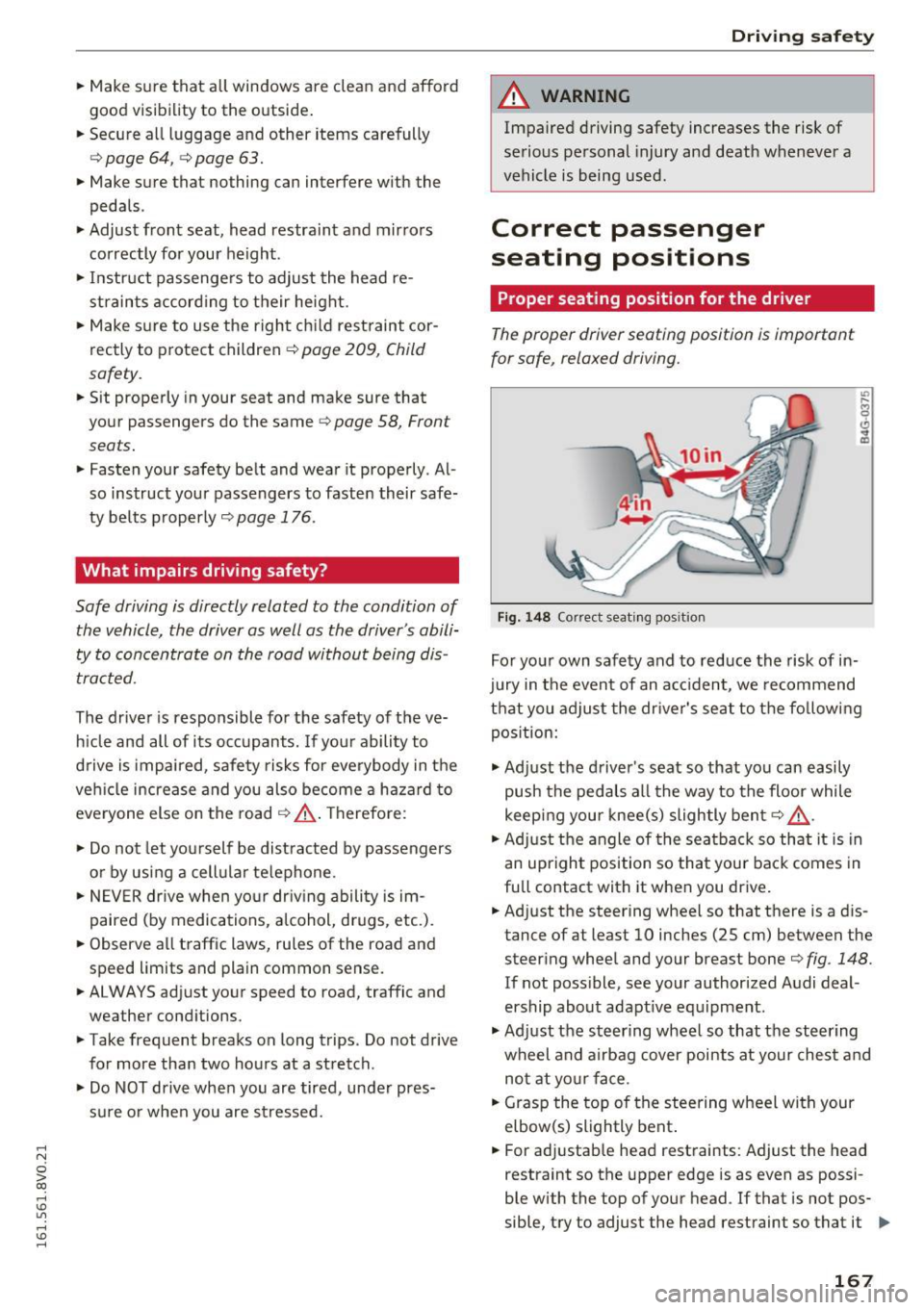
Fig. 148 Correct seating pos ition
For your own safety and to reduce the risk of in·
jury in the event of an accident, we recommend
that you adjust the dr iver's seat to the follow ing
position:
.,. Adjust the driver's seat so that you can easily
push the pedals all the way to the floor while
keep ing your knee(s) slightly bent
r=> ,&. .
.. Adjust the angle of the seatback so that it is in
an upright position so that your back comes in
full contact with it when you drive .
.. Adjust the steering wheel so that there is a d is
tance of at least 10 inches (25 cm) between the
steering wheel and your breast boner=>
fig. 148.
If not poss ible, see your authorized Audi deal·
ership about adapt ive equipment .
.,. Adjust the steering wheel so that the steering
wheel and airbag cover points at your chest and
not at your face .
.. Grasp the top of the steering wheel with your
elbow(s) slightly bent .
.. For adjustab le head restraints: Adjust the head
restraint so the upper edge is as even as possi
ble with the top of your head . If that is not pos
sible, try to adjust the head restraint so that it ..,.
167
Page 170 of 328
Driving safety
is as close to this position as possible. Move the
head restraint so that it is as close to the back
of the head as possible.
"' Fasten and wear safety belts correctly
<=> page 179.
"'Always keep both feet in the footwell so that
you are in control of the vehicle at all times.
For detailed information on how to adjust the
driver's seat, see
<=> page 59.
A WARNING
Drivers who are unbelted, out of position or
too close to the airbag can be seriously in
jured by an airbag as it unfolds. To help re
duce the risk of serious personal injury:
- Always adjust the driver's seat and the
steering wheel so that there are at least
10 inches
(25 cm) between your breastbone
and the steering wheel.
- Always adjust the driver's seat and the
steering wheel so that there are at least
4 inches (10 cm) between the knees and the
lower part of the instrument panel.
- Always hold the steering wheel on the out
side of the steering wheel rim with your
hands at the 9 o'clock and 3 o'clock posi
tions to help reduce the risk of personal in
jury if the driver's airbag inflates.
- Never hold the steering wheel at the
12 o'clock position or with your hands at
other positions inside the steering wheel
rim or on the steering wheel hub. Holding
the steering wheel the wrong way can cause
serious injuries to the hands, arms and head if the driver's airbag inflates.
- Pointing the steering wheel toward your
face decreases the ability of the supplemen
tal driver's airbag to protect you in a colli
sion.
- Always sit in an upright position and never
lean against or place any part of your body
too close to the area where the airbags are
located.
- Before driving, always adjust the front seats
properly and make sure that all passengers
are properly restrained.
168
-
- For adjustable head restraints: before driv
ing, always also adjust the head restraints
properly.
- Never adjust the seats while the vehicle is
moving. Your seat may move unexpectedly
and you could lose control of the vehicle.
- Never drive with the backrest reclined or tilted far back! The farther the backrests are
tilted back, the greater the risk of injury due
to incorrect positioning of the safety belt
and improper seating position .
- Children must always ride in child seats
<=> page 209 . Special precautions apply
when installing a child seat on the front
passenger seat
c> page 184.
· Proper seating position for the front
passenger
The proper front passenger seating position is
important for safe , relaxed driving.
For your own safety and to reduce the risk of in
jury in the event of an accident, we recommend
that you adjust the seat for the front passenger
to the following position :
"'Adjust the angle of the seatback so that it is in
an upright position and your back comes in full
contact with it whenever the vehicle is moving.
"' For adjustable head restraints: adjust the head
restraint so the upper edge is as even as possi
ble with the top of your head. If that is not pos
sible, try to adjust the head restraint so that it
is as close to this position as possible
<=> page 170 . Move the head restraint so that it
is as close to the back of the head as possible.
"' Keep both feet flat on the floor in front of the
front passenger seat .
"' Fasten and wear safety belts correctly
<=> page 179 .
For detailed information on how to adjust the
front passenger's seat, see
9 page 58 .
A WARNING
Front seat passengers who are unbelted, out
of position or too close to the airbag can be
Page 171 of 328
,....,
N
0 > co ,....,
unfolds. To help reduce the risk of serious
personal injury:
- Passengers must always sit in an upright po
sition and never lean against or place any
part of their body too close to the area
where the airbags are located .
- Passengers who are unbelted, out of posi
tion or too close to the airbag can be seri ously injured by an a irbag as it unfolds w ith
great force in the blink of an eye.
-Always make sure that there are at least 10 inches (25 cm) between the front pas
senger's breastbone and the instrument
panel.
- Always make sure that there are at least
4 inches (10 cm) between the front passen
ger's knees and the lower part of the instru
ment panel.
- Each passenger must always sit on a seat of
their own and properly fasten and wear the safety belt belonging to that seat.
- Before driving, always adjust the front pas
senger seat properly.
- For adjustable head restraints: befo re driv
ing, always also adjust the head restraints
properly.
- Always keep you r feet on the floor in front
of the seat. Never rest them on the seat, in
strument panel, out of the window, etc. The
airbag system and safety be lt will not be
able to protect you properly and can even in
crease the risk of injury in a crash.
- Never drive with the backrest reclined or
tilted far back! The farther the backrests are
ti lted back, the greater the risk of injury due
to incorrect positioning of the safety belt
and improper seating position .
- Children must a lways ride in child seats
<=> page 209. Special precautions apply
when installing a child seat on the front
passenge r seat¢
page 184 .
Driving safety
Proper seating positions for passengers in
rear seats
Rear seat passengers must sit upright with both
feet on the floor consistent with their physical
size and be properly restrained whenever the ve
hicle is in use.
To reduce the risk of injury caused by an incorrect
seat ing pos ition in the event of a sudden brak ing
maneuver or an accident, your passengers on the
rear bench seat must always observe the fo llow
ing :
.,. For adjustab le head restraints: adjust the head
restraint so the upper edge is as even as possi
ble with the top of your head. If that is not pos
sible, try to adjust the head restraint so that it
is as close to this position as possible
¢page 170 .
.,. Keep both feet flat in the footwell in front of
the rear seat.
.,. Fasten and wear safety belts properly
¢page 179 .
.,. Ma ke sure that ch ild ren are a lways properly re
s trained in a child restra int that is app ropr iate
for their size and age ¢
page 209.
A WARNING
Passengers who are improperly seated on the
rear seat can be serious ly injured in a crash.
- Each passenger must always sit on a seat of
their own and properly fasten and wear the
safety belt belonging to that seat.
- Safety belts only offer maxim um protection
when the safety belts are properly posi
tioned on the body and secure ly latched. By
not sitting upright, a rear seat passenger in
creases the risk of personal injury from im
properly posit ioned safety belts!
- For adjustable head restraints: always ad
just the head restraint properly so that it can give maximum protect ion .
169
Page 172 of 328
Driving safety
Proper adjustment of head restraints
Applies to veh icles: w ith adj ustable head restra ints
Correctly adjusted head restraints are an impor
tant part of your vehicle 's occupant restraint sys
tem and can help to reduce the risk of injuries in
accident situations .
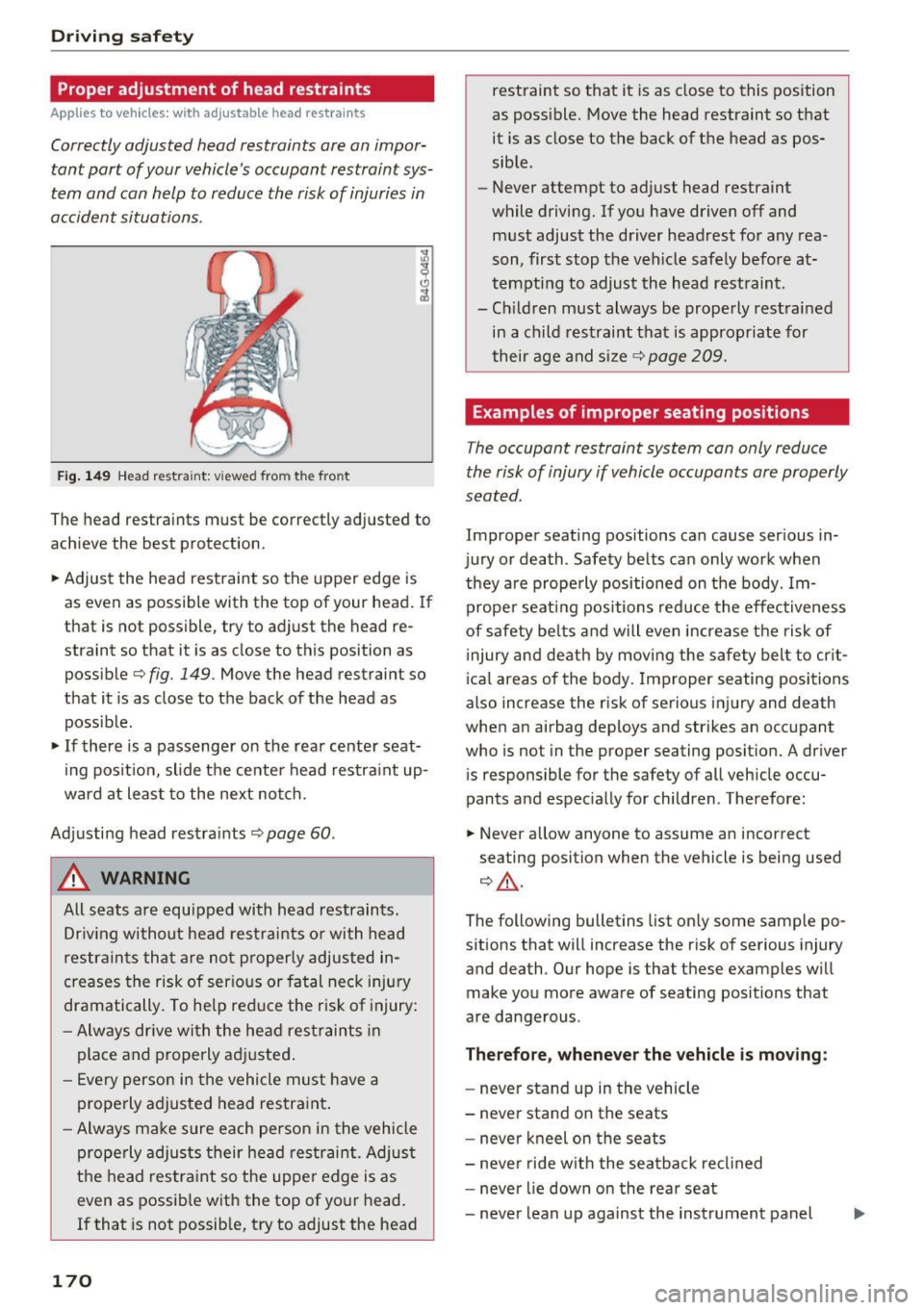
Fig. 149 Head rest ra int: v iewed fro m the fro nt
The head restraints must be correctly adjusted to
achieve the best protection.
"Adjust the head restraint so the upper edge is
as even as possible with the top of your head. If
that is not possible, try to adjust the head re
straint so that it is as close to this position as
possible¢
fig. 149 . Move the head restraint so
that it is as close to the back of the head as
possible .
" If there is a passenger on the rear center seat
ing pos ition, slide the center head restraint up
ward at least to the next notch.
Adjusting head restraints¢
page 60.
A WARNING
All seats are equipped with head restraints.
Driv ing without head restraints or with head
restra ints that are not properly adjusted in
creases the risk of serious or fatal neck injury
dramatically. To help reduce the r isk of injury:
- Always dr ive with the head restraints in
place and properly adjusted .
- Every person in the vehicle must have a
properly adjusted head restraint.
- Always make sure each person in the vehicle
properly adjusts their head restraint. Adjust
the head restraint so the upper edge is as
even as possib le with the top of your head.
If that is not possible, try to adjust the head
170
-
restraint so that it is as close to this position
as possible. Move the head restraint so that
it is as close to the back of the head as pos
sible .
- Never attempt to adjust head restraint
while driving. If you have driven off and
must adjust the driver headrest for any rea
son, first stop the vehicle safely before at
tempting to adjust the head restraint.
- Ch ildren must always be properly restrained
in a child restraint that is appropriate for
their age and size¢
page 209.
Examples of improper seating positions
The occupant restraint system can only reduce
the risk of injury if vehicle occupants are properly
seated .
Improper seating positions can cause serious in
jury or death . Safety belts can only work when
they are properly positioned on the body. Im proper seating positions reduce the effectiveness
of safety belts and will even increase the risk of
i njury and death by moving the safety belt to crit
ica l areas of the body. Improper seating positions
also increase the risk of serious injury and death
when an airbag deploys and strikes an occupant
who is not in the proper seating position. A driver
is responsible for the safety of all vehicle occu
pants and especially for children . Therefore:
" Never allow anyone to assume an incorrect
seating position when the vehicle is being used
9 & .
The following bulletins list on ly some samp le po
sitions that will increase the risk of serious injury
and death . Our hope is that these examples will
make you more aware of seating positions that
are dangerous .
Therefore, whenever the vehicle is moving :
-never stand up in the vehicle
- never stand on the seats
- never kneel on the seats
- never ride with the seatback reclined
- never lie down on the rear seat
- never lean up against the instrument panel
Page 173 of 328
,....,
N
0 > co ,....,
- never sit sideways
- never lean out the window
- never put your feet out the window
- never put your feet on the instrument panel
- never rest your feet on the seat cushion or back
of the seat
- never ride in the footwell
- never ride in the cargo area
8_ WARNING
Improper seating posit ions increase the r isk
of serious personal injury and death whenever
a vehicle is being used.
- Always make sure that all vehicle occupants
stay in a proper seating position and are
properly restrained whenever the vehicle is
being used.
Driver's and front
passenger's footwell
Important safety instructions
Appl ies to vehicles: with knee airbags
8_ WARNING
Always make sure that the knee airbag can in
flate without interference. Objects between
yourself and the airbag can increase the risk
of injury in an accident by interfering with the
way the airbag deploys or by being pushed in
to you as the airbag deploys .
- No persons (children) or anima ls shou ld ride
in the footwell in front of the passenger
seat.
If the airbag dep loys, this can result in
serious or fatal injuries .
- No objects of any kind should be carried in
the footwell area in front of the driver's or
passenger's seat. Bulky objects (shopping
bags, for example) can hamper or prevent
proper deployment of the airbag . Small ob
jects can be thrown through the vehicle if
the airbag deploys and injure you or your
passengers.
Driving safety
Pedal area
Pedals
The pedals must always be free to move and
must never be interfered with by a floor mat or
any other object.
Make sure that all pedals move freely without in
terference and that nothing prevents them from
returning to their original positions .
Only use floor mats that leave the pedal area free
and can be secured with floor mat fasteners .
If a brake circuit fails, increased brake pedal trav
el is required to bring the vehicle to a full stop.
8_ WARNING
--
Pedals that cannot move freely can cause loss
of vehicle control and increase the risk of seri
ous injury.
- Never place any objects in the driver's foot
well. An object could get into the pedal area
and interfere with pedal function. In case of
sudden braking or an accident, you would
not be able to brake or acce lerate!
-Always make sure that nothing can fall or
move into the driver's footwell.
Floor mats on the driver side
Always use floor mats that can be securely at tached to the floor mat fasteners and do not in
terfere with the free movement of the pedals.
.. Make sure that the floor mats are properly se
cured and cannot move and interfere with the
pedals~ &-
Use only floor mats that leave the pedal area un
obstructed and that are firmly secured so that
they cannot slip out of position . You can obtain
suitable floor mats from your author ized Audi
Dealer.
Floor mat fasteners are installed in your Audi .
Floor mats used in your vehicle must be attached
to these fasteners . Properly securing the floor
Ill>
171
Page 180 of 328
Safe ty belts
Never rely o n airbags alone for protection . Even
when they deploy, airbags provide only additional
protection. A irbags are not supposed to dep loy in
all kinds of accidents. A lthough your Audi is
equipped w ith airbags, all vehicle occupants, in
cluding the driver, must wear safety belts cor
rectly in order to minimize the risk of severe in
jury or death in a crash .
Remember too, that airbags will deploy only
once and that your safety belts are a lways there
to offer protect ion in those accidents in wh ic h
airbags are not supposed to deploy or when they
have a lready dep loyed. Unbel ted occupants can
a lso be thrown o ut of the veh icle where eve n
mo re severe or fatal injur ies can occur .
It is also important for the rear pass enge rs to
wear safety belts co rrectly. Unbelted passengers
i n t he rea r seats endanger no t on ly themse lves
but also the drive r and other passengers
~ fig . 155. In a frontal collision they will be
thrown forward violently, where they can hit and
in jure the driver and/or front seat passenger.
Safety belts protect
People think it's possible to use the hands to
brace the body in a minor collision . It's simply
not true!
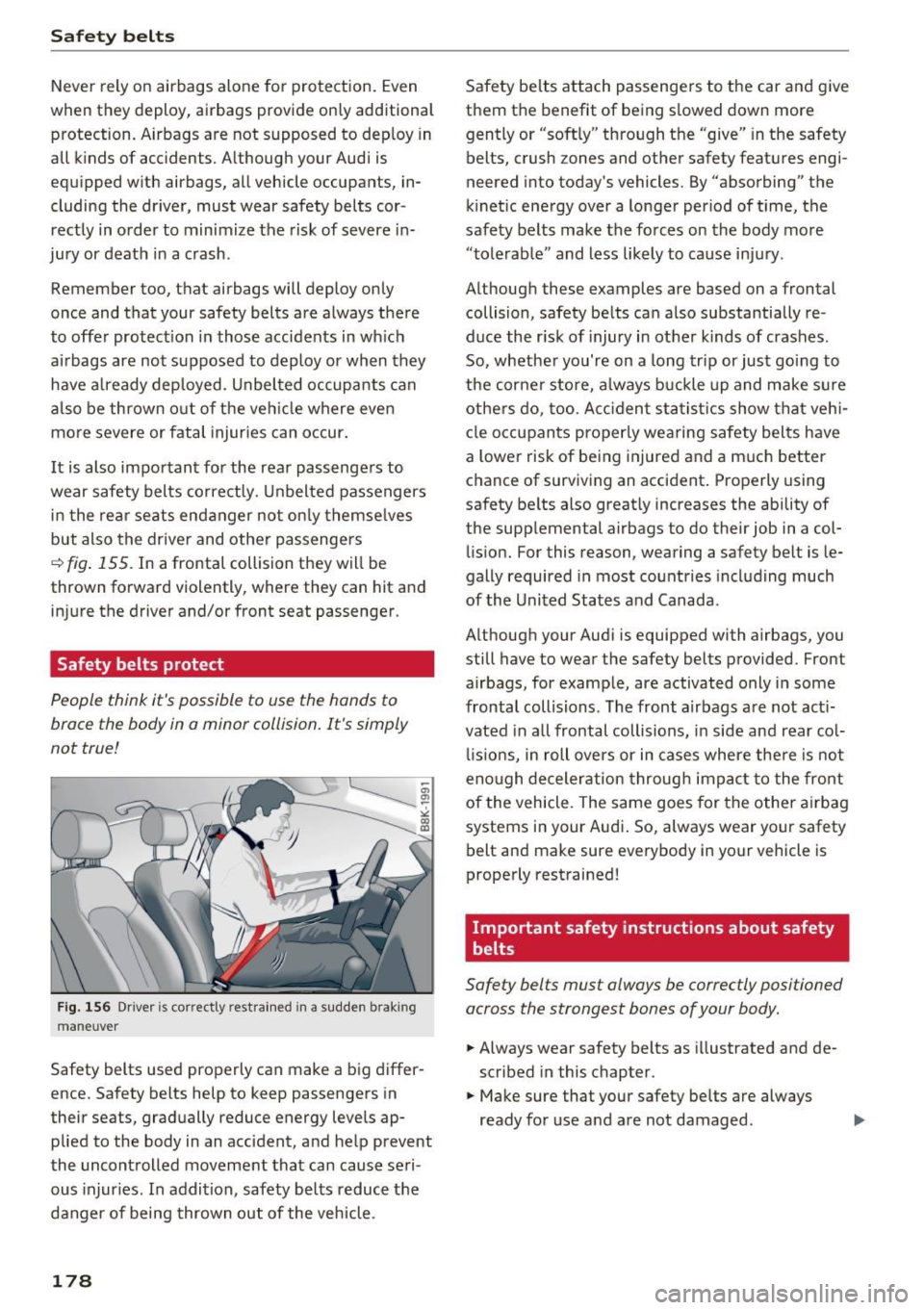
F ig . 1 56 Driver is correctly restrai ned in a sudde n braking
m aneuver
Safety belts used properly can make a b ig d iffer
ence. Safety belts help to keep passengers in
their seats, gradually reduce energy levels ap
plied to the body in an accident, and he lp prevent
the uncont rolled moveme nt that can cause seri
ous injur ies. In addition, safety belts reduce the
danger of being thrown out of the veh icle .
178
Safety be lts attach passengers to the car an d give
them the benefit of being s lowed down more
gently or "soft ly" thro ugh the "give" in the safety
belts, crush zones and other safety feat ures engi
neered into today's vehicles. By "absorbing" the
k inet ic energy over a longer per iod of t ime, the
safety belts make the forces on the body more
"tole rab le" and less likely to cause inj ury.
Although these examples are based on a frontal
collision, safety be lts ca n also substantially re
duce the r isk o f injury in ot her kinds of crashes.
So, whethe r yo u're on a long trip or just going to
the cor ne r store, a lways b uckle up and make s ure
othe rs do, too. Ac ciden t stat ist ics show that veh i
cl e o ccupants prope rly wearing safety bel ts have
a lowe r risk of being injured and a m uch better
chance of surviving an acc ident . Properly using
safety be lts also great ly increases the ability of
the supp lemental airbags to do their job in a col
li sion. For this reason, wearing a safety belt is le
gally required in most countries including much
of the United States and Canada .
Although your Aud i is equipped with airbags, you
still have to wear the safety belts provided. Front
airbags, for examp le, are activated only in some
frontal collisions. The front airbags are not act i
vated in all frontal collisions, in side and rear co l
li sions, in roll overs or in cases where the re is not
eno ugh deceleration throug h impa ct to the front
of the vehicle. The same goes for the other a irbag
systems in your Audi. So, always wear your safety
belt and make sure everybody in your vehicle is
properly rest rained!
Important safety instructions about safety
belts
Safety belts must always be correctly positioned
across the strongest bones of your body.
.,. Always wear safety belts as illustrated and de
scribed in this chapter.
.,. Make sure that your safety be lts are always
ready fo r use a nd are not damaged .
Page 184 of 328
Safe ty belts
Adjusting safety belt height
With the aid of the safety belt height adjust
ment, the three point safety belt strap routing
can be fitted to the shoulder area, according to
body size.
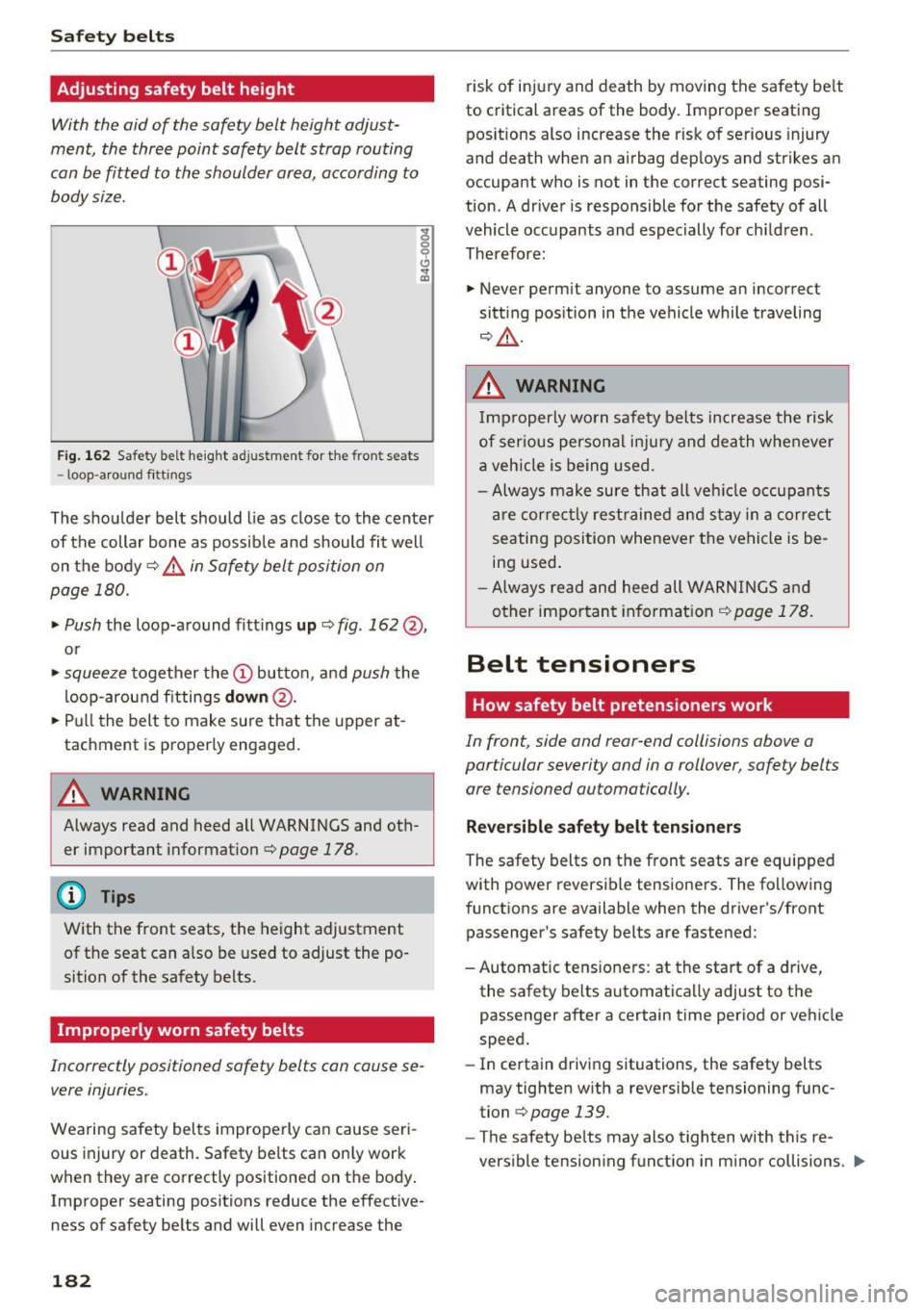
F ig . 1 62 Safety belt he ight adjustment for t he fr ont seats
- loop -a ro und f it t ings
The shou lder belt should lie as close to the center
of the collar bone as possib le and should fit well
on the body
c::> &. in Safety belt position on
page 180.
... Push
the loop-around fitt ings up c::> fig . 162 @,
or
... squeeze together the (D button, and push the
loop-around fittings
down @.
... Pull the belt to make sure that the upper at
tachment is properly engaged.
A WARNING
Always read and heed all WARNINGS and oth
er important informat ion
c::>page 178.
(D Tips
With the front seats, the height adjustment
of the seat can a lso be used to adjust the po
sition of the safety belts.
Improperly worn safety belts
Incorrectly positioned safety belts con cause se vere injuries.
Wearing safety bel ts improperly can cause seri
ous injury or death. Safety be lts can on ly work
when they are correctly positioned on the body .
Improper seating positions reduce the effect ive
ness of safety be lts and will even increase the
182
risk of injury and death by moving the safety be lt
to c ritical areas of the body . Improper seating
pos itions also increase the risk of serious injury
and death when an airbag deploys and strikes an
occupant who is not in the correct seating posi
tion . A driver is responsible for the safety of all
vehicle occupants and especially for children .
Therefore:
... Never permit anyone to assume an incorrect
sitt ing pos ition in the vehicle while traveling
c::> ,&. .
A WARNING
Imp roperly worn safety belts increase the risk
of ser ious perso nal inju ry and dea th whenever
a veh icle is being used.
- Always make sure that all veh icle o ccupants
are cor rec tly restrained a nd stay in a corre ct
seating position whenever the vehicle is be
ing used .
- Always read and heed all WARNINGS a nd
other important informat ion
c::> page 178 .
Belt tensioners
How safety belt pretensioners work
In front, side and rear-end collisions above a
particular severity and in a rollover, safety belts
are tensioned automatically.
Reversible safet y belt ten sioner s
The safety belts on the front seats are equipped
with power reversible tensioners. The fo llowing
functions are available when the driver's/front passenger's safety belts are fastened:
-Automatic tens ioners: at the start of a drive,
the safety be lts automatically adjust to the
passenger after a certain time period or vehicle
speed.
- In certain driving situations, the safety belts
may tighten with a reversib le tensioning func
tion
c::> page 139.
-The safety be lts may also tighten with this re
vers ible tension ing funct ion in m inor collisions.
II>
Page 185 of 328
,....,
N
0 > co ,....,
The safety belts are equipped with safety belt
p re tensioners . The system is activated by sensors
in front, side and rear -end collisions of great se
verity and in a rollover. This tightens the belt and
takes up belt slack
q & in Service and disposal of
safety belt pretensioner on page 183.
Taking up
the slack helps to reduce forward occupant
movement dur ing a coll is ion.
A WARNING
- It is possible for the pretensione rs to deploy
incorrectly.
- The pyrotechnic system can only prov ide
protection for one coll ision. If the pyrotech
nic pretensione rs deploy, the pretens ion ing
system mus t be replaced.
The pyrotechnic safety belt pretens ioners can
only deploy once.
- The safety belt pretensioners do not dep loy
i n minor frontal, side and rea r-end colli
s io ns.
- A fine d ust is released when the pyrotechnic
safety be lt pretens ioners deploy. This is nor
mal and is not caused by a fire in the vehi
cle.
- The re levant safety req uirements must be
obse rved w hen the ve hicle or components
of the system are sc rapped. A qualified
dealersh ip is familiar w ith these regu lations
and will be p leased to pass on the informa
tion to you.
- Be sure to observe all safety, environmental and other regulations if the vehicle or indi
vidual parts of the system, particularly the
safety be lt or airbag, are to be disposed. We
recommend you have your author ized Audi
dealer perform this serv ice for you.
Service and disposal of safety belt preten
sioner
The safe ty belt pretens ione rs are pa rts of the
safety be lts on yo ur Audi. Installing, removing,
servicing or repairing of belt pretensioners can
S afet y be lts
damage the safety belt system and prevent it
from working correctly in a col lision .
T he re are some important things you have to
k now to make s ure tha t the effectiveness of the
system will not be impaired and that d iscarded
components do not cause injury or pollute the
environment.
A WARNING
-
Imp roper care, servicing and repair proce
dures can increase the risk of personal in jury
and death by preventing a safety belt preten
sioner from activating when needed or act i
vating it unexpectedly:
- The belt pretensioner system can be activat ed only once. If belt pretens ioners have
been activated, the system must be re
p la ced.
- Never repair, adjust, or change any parts of
the safety belt sys tem.
- Safety belt systems including safety belt
p retensioners cannot be repai red. Spec ial
p ro cedures are required fo r removal, instal
lation and di$pO$al of thi$ $y$tem.
- For any wo rk on the safety belt system, we
s trong ly recommen d that you see yo ur au
thor ized A udi dealer or qualified techn ician
who has an Audi approved repair man ual,
tra ining and special equipment necessa ry.
@ For the sake of the environment
U nd eployed a irbag modules and p retension
ers might be classif ied as Pe rc hlo ra te Ma teri
a l - special handling may apply, see
www.dtsc.ca.gov/hazardouswaste/perchlo r ate. When the vehicle or parts of the re
straint system including airbag modu les safe
ty belts with pretensioners are scrapped, all
applicable laws and regu lations must be ob
se rved. Your authorized Audi dealer is familiar
with these requirements and we recommend
that you have your dealer perform this service
fo r yo u.
183