check oil AUDI S3 2016 User Guide
[x] Cancel search | Manufacturer: AUDI, Model Year: 2016, Model line: S3, Model: AUDI S3 2016Pages: 328, PDF Size: 81.78 MB
Page 244 of 328
Checking and Filling
-If you have the impression your engine con
sumes excessive amounts of oil, we recom
mend that you consult an authorized Aud i
dealer to have the cause of your concern
properly diagnosed. Keep in mind that the
accurate measurement of oil consumpt ion
requires great care and may take some
time. An authorized Audi dealer has instruc
tions about how to measure oil consump
tion acc urately.
Checking the engine oil level
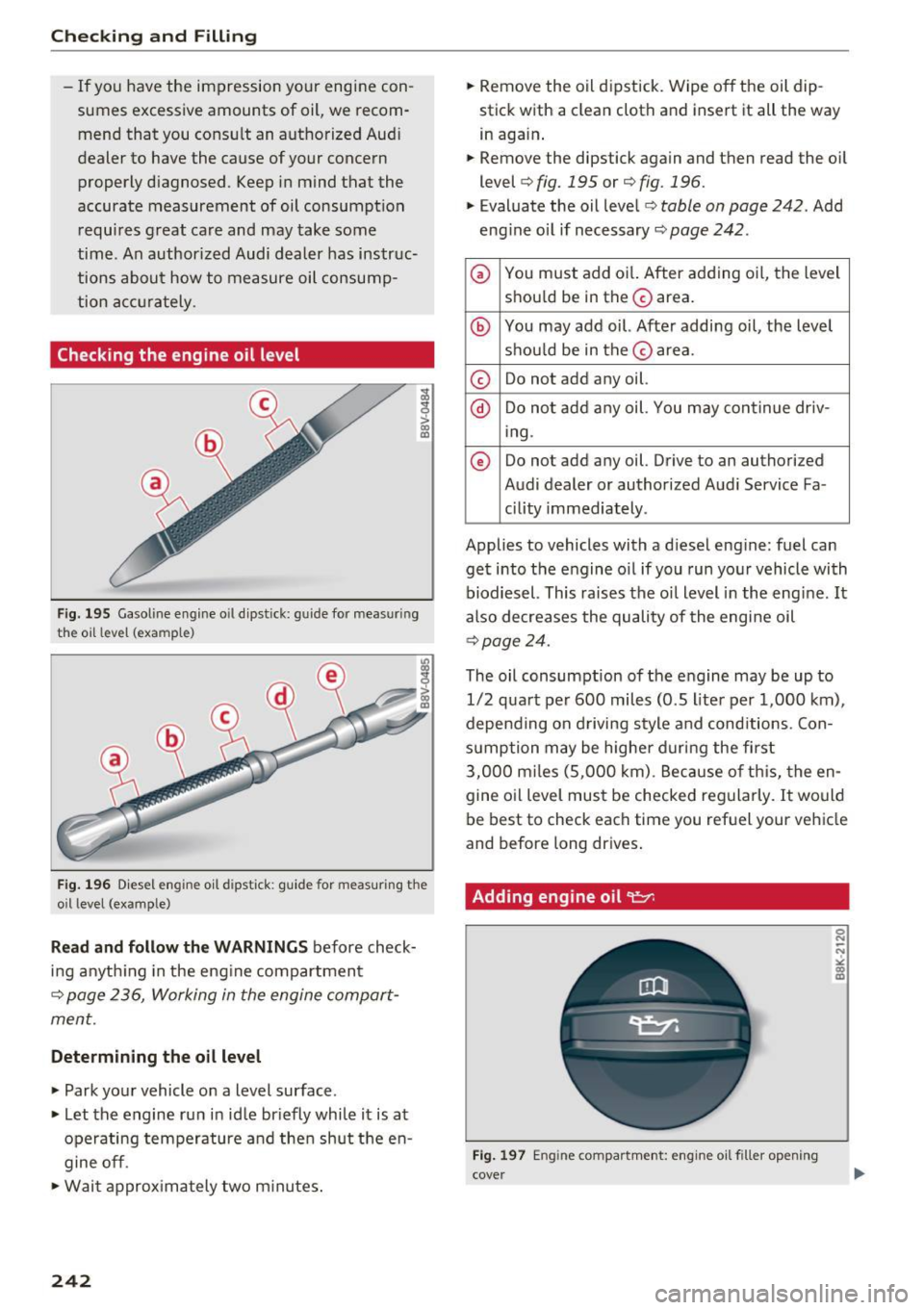
Fig . 19 5 Gasol ine eng ine oil dipstick: guide for measuring
the oil level (example)
Fig . 1 96 Diesel engine oil dipstick: guide for meas uring the
oil level (example)
Read and follow the W ARN INGS before check
i n g anyth ing in the eng ine compartmen t
¢ page 236, Working in the engine compart
ment.
Determining the oil level
• Park your vehicle on a level surface .
• Let the engine run in id le br iefly whi le it is at
operating temperature and the n shut the e n
gine off .
• Wai t approx imately two m inutes .
242
• Remove the oil dipstick. Wipe off the oil dip
stick with a clean cloth and insert it all the way
in aga in .
• Remove the dipstick again and then read the o il
level
¢ fig. 195 or ¢fig. 196.
• Evaluate the oil level¢ table on page 242. Add
eng ine oi l if necessary ¢
page 242.
~ You must add oi l. After adding oil, the level
shou ld be in the
0 area .
® You may add oil. After adding oil, the level
shou ld be in the
Cs) area.
0 Do not add any oil.
@ Do not add any oil. You may con tinue driv-
ing .
0 Do not add any oil. Drive to an authorized
Audi dealer or authorized Audi Service Fa-
cility immediately.
Applies to vehicles with a d iesel eng ine: fuel can
get into the engine o il if you run your vehicle with
biodiesel. This raises the o il level in the eng ine. It
also decreases the quality of the engine oil
¢page 24.
The oil consumption o f the engine may be up to
1/2 qua rt per 600 miles (0.5 l ite r per 1,000 km),
depending on d riving style and cond itions. Con
sumption may be highe r during the firs t
3,000 miles (5,000 km) . Bec ause of this, the en
gine o il level must be checked regularly.
It would
be best to check each time you refuel your veh icle
and before long drives .
Adding engine oil~
Fig. 19 7 Eng ine compartment: engine oil filler open ing
cove r
0
N
-N ' "" CD m
Page 245 of 328
,....,
N
0 > co ,....,
ing anything in the engine compartment
c::> page 236, Working in the engine compart
ment.
.. Turn the engine off.
.. Unscrew the engine oil filler opening cap~
c::>fig.197, c::>page239, fig.193 .
.. Carefully add 0.5 quart (0.5 liter) of the appro
priate oil
c::> page 240.
.. Check the oil level again after two minutes
c::> page 242, Checking the engine oil level .
.,. Add o il, if necessary.
.. Close the engine oil filler cap and push the dip
stick all the way in .
A WARNING ,--
- When adding oil, do not let oil drip onto hot
engine components . There could be risk of a
fire.
- You must secure the cap on the oi l filler
opening correctly so that oil does not leak
out onto the hot engine and exhaust system
when the eng ine is running, because this is
a fire hazard.
- Always clean skin thoroughly if it comes into contact with engine oil.
(D Note
-Applies to vehicles with a gasoline engine:
the oil level cannot be above the
0 range
c> page 242, fig. 195 or else yo u risk dam
aging the catalytic converter and the en
gine . Contact an authorized Audi dealer or
authorized Audi Serv ice Facility to have ex
cess oil extracted if necessary .
-Applies to vehicles with a diesel eng ine: the
oil level must not be in the
G) range
c::>page 242, fig. 196-The oil must not be
extracted or else you risk damaging the en
gine. Drive to an authorized Aud i dealer or
authorized Audi Service Facility immediate
l y.
- Do not mix any additional l ubricants into
the engine o il. Damage cause by such addi
tives is not covered by the warranty.
Checking and Filling
{® For the sake of the environment
-Oil shou ld never enter the sewer system or
come into contact with the ground.
- Pay attention to lega l requirements when
disposing of empty oil containers .
Changing the engine oil
We recommend that have your oil changed by an
authorized Audi dealer or a qualified service sta
tion .
Before you check anything in the engine compart
ment,
always read and heed all WARNINGS
c::> page 236.
The engine o il must be changed according to the
intervals specified in your Warranty
& Mainte
nance book let. This is very important because the
lubricating properties of oil diminish gradua lly
during norma l vehicle use.
Under some circumstances the engine oil shou ld
be changed more frequent ly. Change oil more of
ten if you drive mostly short distances, operate
the vehicle in dusty areas or under predominantly
stop-and-go traff ic conditions, or have your vehi
cle where temperatures remain below freezing
for extended periods.
Detergent additives in the oi l will make fresh oil
look dark after the engine has been running for a
short time. This is normal and is not a reason to
change the oil more often than recommended.
Because of the problem of proper disposal, along
with the special tools and necessary expertise re
quired, we strongly recommend that you have
your o il changed by an authorized
Audi dealer or
a qualified service stat ion.
If you choose to change your oil yourself, please
note the following important information:
A WARNING ,-~
To reduce the risk of personal injury if you
must change the engine oil in your vehicle
yourself:
- Wear eye protection.
243
Page 246 of 328

Checking and Filling
-To reduce the risk of burns from hot engine
oil, let the engine cool down to the touch.
- When removing the oil drain plug with your
fingers, stay as far away as possible. Always
keep your forearm parallel to the ground to
help prevent hot oil from running down your
arm.
- Drain the oil into a container designed for
this purpose, one large enough to hold at least the total amount of oil in your engine .
- Engine oil is poisonous. Keep it well out of
the reach of children .
- Continuous contact with used engine oil is
harmful to your skin. Always protect your
skin by washing oil off thoroughly with soap
and water .
CD Note
Never mix oil additives with your engine oil.
These additives can damage your engine and
adversely affect your Audi Limited New Vehi
cle Warranty.
@ For the sake of the environment
-Before changing your oil, first make sure
you know where you can properly dispose of
the used oil.
- Always dispose of used engine oil properly.
Do not dump it on garden soil, wooded
areas, into open streams or down sewage
drains.
- Recycle used engine oil by taking it to a used
engine oil collection facility in your area, or
contact a service station.
Cooling system
Coolant
The engine coolant performs two functions: it
keeps the engine from overheating and it pro tects the engine from freezing in the winter.
The cooling system is sealed and generally re
quires little attention.
The cooling system has been filled at the factory
with a permanent coolant which does not need to
be changed. The coolant consists of a mixture of
244
specially conditioned water and the manufactur
er's glycol-based coolant additive Gl3 antifreeze
with anticorrosion additives (50% for USA mod els; 60% for Canadian models). This mixture
both assures the necessary frost protection and
protects metal components in the engine's cool
ing system from corrosion and scaling. It also
raises the boiling point of the coolant.
Do not reduce the concentration of the coolant in
the summer by adding plain water.
The propor
tion of coolant additive must be at least 50%
but not more than 60%
to maintain antifreeze
protection and cooling efficiency. If the coolant
frost protection is too low, the coolant could
freeze and damage the vehicle heating and en
gine cooling system.
For year-round driving, antifreeze is added at the
factory for temperatures down to:
--31°F(-35°C)USA
- - 40 °F ( - 40 °C) Canada.
If you must add coolant, use a mixture of water
and coolant additive. Mixing the coolant additive
with distilled water is recommended.
A WARNING
Before you check anything in the engine com
partment, always read and heed all WARN
INGS
~ page 236.
CD Note
- Before winter sets in, have the coolant
checked to see if the coolant additive in your
vehicle is sufficient to meet the climate con ditions. This is especially important if you
live in a region where the winter is extreme
ly cold.
If necessary, increase the proportion
of coolant additive to 60%.
- When adding coolant additive to your cool
ing system, remember:
- We recommend using only coolant addi
tive Gl2++ or G13 (check the label) for
your vehicle. This coolant additive is avail
able at authorized Audi dealers. Other
types of antifreeze can significantly re
duce corrosion protection. The resulting
Page 247 of 328
.... N
0 > CX)
.... I.Cl U"I
.... I.Cl ....
corrosion can cause a loss of coolant and
serious engine damage .
- Do not add any type of radiator leak sealant
to your vehicle's engine coolant . Adding ra
diator repair fluid may adversely affect the
function and performance of your cooling
system and could result in damage not cov
ered by your New Vehicle Limited Warranty.
Adding coolant
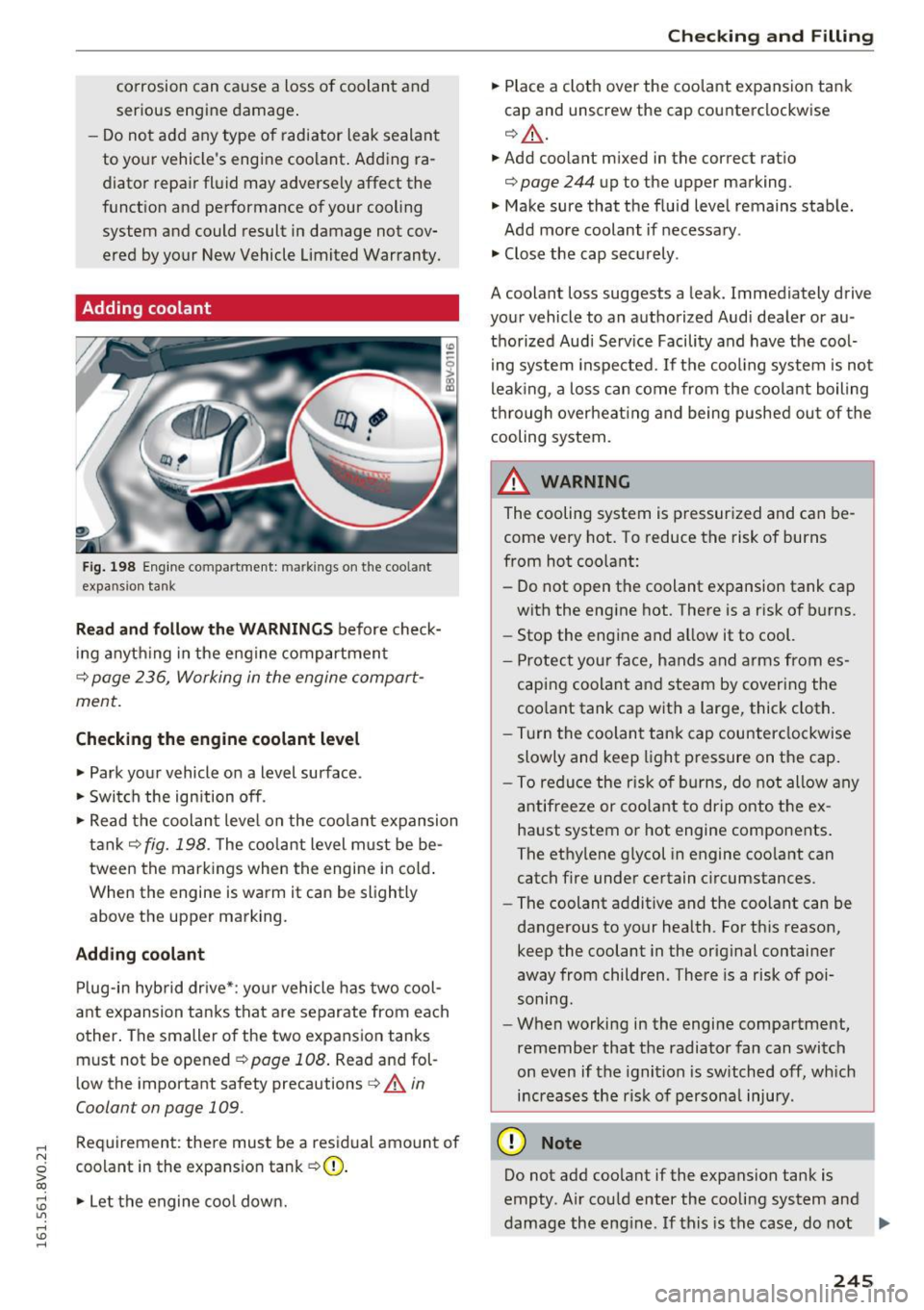
F ig . 198 Engine compa rtment: mark in gs on t he coo lant
expa nsion tank
Read and follow the WARNINGS before check
ing anything in the engine compartment
¢ page 236, Working in the engine compart
ment.
Checking the engine coolant level
• Park your vehicle on a level surface .
• Switch the ignition off .
• Read the coolant level on the coolant expansion
tank
¢ fig. 198 . The coolant level must be be
tween the markings when the engine in cold .
When the engine is warm it can be slightly above the upper marking.
Adding coolant
Plug-in hybrid drive*: your vehicle has two cool
ant expansion tanks that are separate from each
other. The smaller of the two expansion tanks
must not be opened
¢ page 108. Read and fol
low the important safety precautions ¢
A in
Coolant on page 109.
Requirement: there must be a residual amount of
coolant in the expansion tank ¢(D .
• Let the engine cool down .
Checking and Filling
• Place a cloth over the coolant expansion tank
cap and unscrew the cap counterclockwise
¢ A .
• Add coolant mixed in the correct ratio
¢
page 244 up to the upper marking.
• Make sure that the fluid level remains stable.
Add more coolant if necessary.
• Close the cap securely .
A coolant loss suggests a leak. Immediately drive
your vehicle to an authorized Audi dealer or au
thorized Audi Service Facility and have the cool
i ng system inspected. If the cooling system is not
leak ing, a loss can come from the coolant boiling
through overheat ing and being pushed out of the
cooling system .
,&_ WARNING
-= -The cooling system is pressurized and can be
come very hot. To reduce the risk of burns
from hot coolant:
- Do not open the coolant expansion tank cap
with the engine hot. There is a risk of burns.
- Stop the engine and allow it to cool.
- Protect your face, hands and arms from es-
caping coolant and steam by covering the
coo lant tank cap with a large, thick cloth.
- Turn the coolant tank cap counterclockwise
slowly and keep light pressure on the cap.
- To reduce the risk of burns, do not allow any
antifreeze or coolant to drip onto the ex
haust system or hot engine components.
The ethylene glycol in engine coo lant can
catch fire under certain circumstances .
- The coolant additive and the coolant can be
dangerous to your health . For th is reason,
keep the coolant in the original container
away from children. There is a risk of poi
soning .
- When working in the engine compartment,
remember that the radiator fan can switch
on even if the ignition is switched off, wh ich
increases the risk of persona l injury.
(J) Note
Do not add coolant if the expansion tank is
empty . Air could enter the cooling system and
damage the eng ine.
If this is the case, do not ..,_
245
Page 248 of 328
Checking and Filling
cont inue driving. See an authorized Audi deal
er or authorized Audi Service Facility for assis
tance .
Radiator fan
The radiator fan switches on outomotico/ly by it
self.
An auxiliary elect ric radiator fan sw itches on and
off depend ing on coolant temperature and other
vehicle operating conditions.
After you switch the engine off, the auxiliary fa n
can cont inue runn ing fo r up to 10 minutes -even
with the ignition off . It ca n even switch on again
later by itself¢.&. , if
- the temperature of the engine coolant r ises due
to the heat bu ild -up from the engine in the e n
gine compartment, or
- the engine compartment heats up because the
vehicle is parked in intense sunlight .
A WARNING
-To reduce the risk of pe rsonal injury never
touch the radiator fan .
- The auxiliary electric fan is temperature
controlled and can switch on suddenly even
when the eng ine is not running.
- The auxiliary radiator fan switches on auto
matically when the engine coo lant reaches a
certain tempe rature and w ill cont inue to run
until the coolant temperature drops.
Brake fluid
Checking brake fluid level
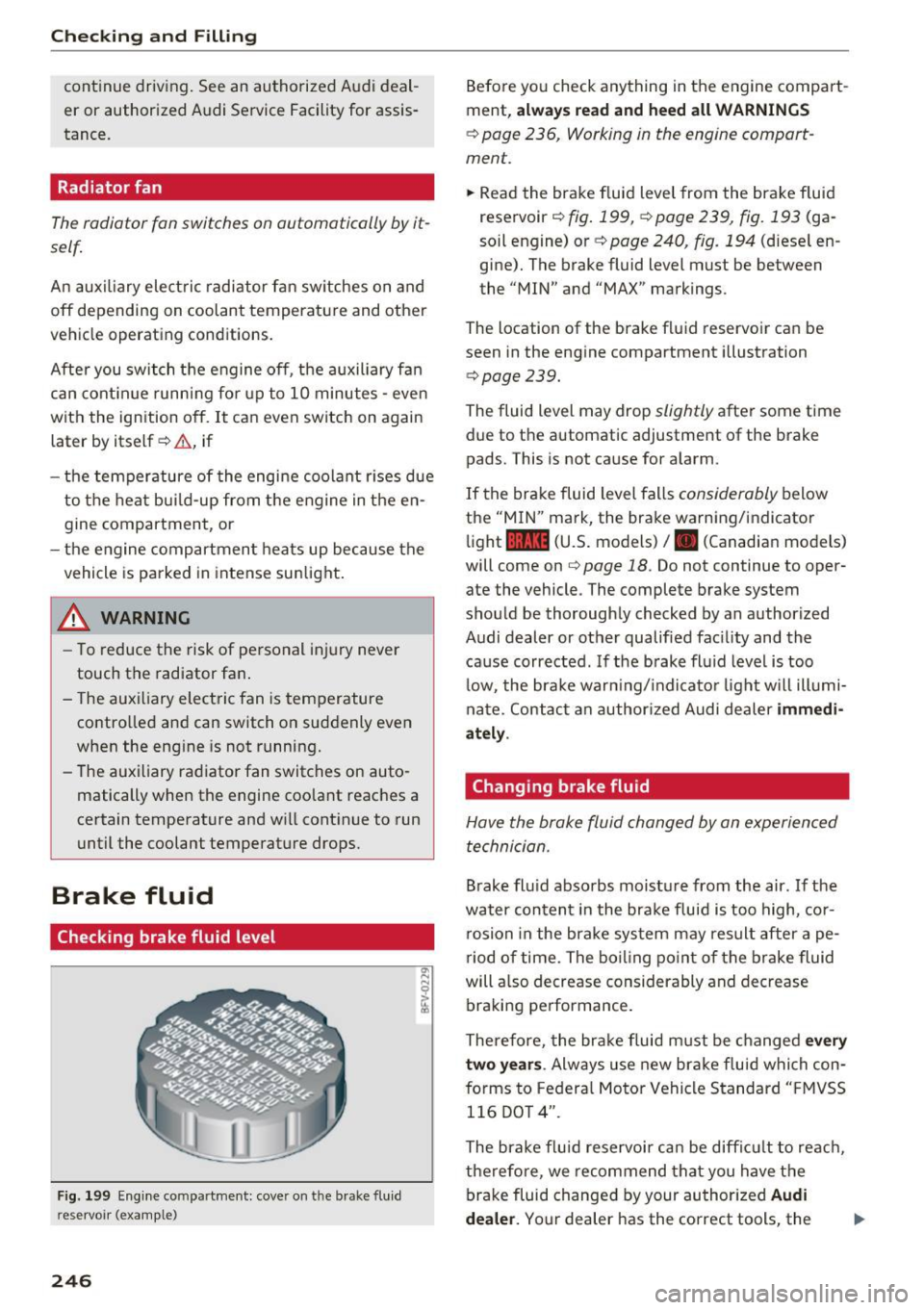
F ig . 19 9 Engine co mpar tment: cove r o n t he b rake fluid
r e servo ir (example)
246
-
Before yo u check any thing in the engine compart
ment,
always read and heed all WARNINGS
¢ page 236, Working in the engine comport
ment .
.,. Read the brake fluid level from the brake f luid
reservoir ¢
fig. 199, ¢ page 239, fig. 193 (ga
soil engine) or ¢
page 240, fig. 194 (diesel en
gine). The brake fluid level must be between
the "MIN" and "MAX" markings .
The location of the brake fl u id reservoir can be
seen in the engine compartment i llustration
q page239.
The fluid level may drop slightly after some time
due to t he automatic adjustment of the brake
pads. This is not ca use for a larm.
If t he brake fluid level falls considerably below
the "M IN" mark, the brake warning/indicator
li ght ~ (U.S. models)
I. (Canadian models)
will come on
q page 18 . Do not continue to oper
ate the vehicle . The complete brake system
shou ld be thorough ly checked by an authorized
Audi dealer or other qualified fac ility and the
cause corrected .
If the brake fl uid level is too
l ow, the bra ke war ning/ indicato r light w ill illumi
na te. Cont act an a uthor ized Audi dealer
immedi
atel y.
Changing brake fluid
Have the brake fluid changed by an experienced
technician.
B rake fl uid abso rbs moistu re from the air. If the
wa ter con ten t in the brake fluid is too high, cor
r osion in the bra ke system may res ult after ape
riod of time. The boi ling po int of the brake fluid
will a lso decrease considerably and decrease
bra king performance.
Therefore, the bra ke fluid m ust be changed
every
two year s. Always use new brake f luid which con
forms to Federa l Motor Vehicle Standard " FMVSS
116 DO T 4" .
The brake fluid reservoir can be diffic ult to reac h,
the refore, we recommend that you have t he
brake fluid changed by your author ized
Audi
dealer .
Your dealer has the correct tools, the
Page 254 of 328
Checking and Filling
Service interval display
The service interval display detects when your ve
hicle is due for service.
The service interval display works in two stages:
-Inspection or oil change reminder: after a cer-
tain distance driven, a message appears in the
instrument cluster display each time the igni
tion is switched on or off . The remaining dis
tance or time is displayed briefly.
- Inspection or oil change due: if yo ur vehicle
has reached an inspection or oi l change interval
or both intervals at the same time, the mes
sage
Inspection due! or Oil change due! or Oil
change and inspection due!
appears briefly af
ter switching the ignition on/off .
Checking service intervals
You can check the remaining distance or time un
til the next oil change or next inspection in the
MMI. Select the
I MENU I button> Car> Systems *
control button > Service & control > Service in
tervals .
Resetting the indicator
Your authorized Audi dealer or authorized Audi
Serv ice Facility will reset the serv ice interval dis
p lay after performing service.
If you perform an oil change yourself to the Audi
specifications, you must reset the service interval
d isp lay.
To reset the display, select the
I MENU ! button >
Car > Systems * control button > Service & con
trol
> Service intervals > Reset oil change inter
val.
([) Note
-Only reset the oil change indicator if the oil
was changed.
- Following the service intervals is critical to
maintain ing the service life and va lue of
your vehicle, especially the engine. Even if
the m ileage on the vehicle is low, do not ex
ceed the time for the next service.
- Calculating the time to the next oil change
i s interrupted when the ve hicle battery is
disconnected. If the vehicle is not driven for
252
a long period of time, check the mainte
nance schedule so that you can fo llow the
maintenance intervals.
Page 255 of 328
,..., N 0 > 00 ,..., \D Ln ,..., \D ....
Tires and wheels
Wheels
General information
... Check your tires regularly for
damage (punctures, cuts, cracks
and bulges). Remove foreign ob
jects from the tire tread.
.,. If driving over c urbs or similar
obstacles, drive slowly and ap
proach the curb at an angle.
.,.Have faulty tires or rims re
placed immediately.
... Protect your tires from oil,
grease and fuel.
.,.Mark tires before removing
them so that the same running direction can be maintained if
they are reinstalled .
... Lay tires flat when storing and
store them in a cool, dry location
with as little exposure to light as possible.
(D Note
-Please note that summer and winter tires are designed for
the conditions that are typical in those seasons. Audi recom
mends using winter tires dur
ing the winter months. Low
temperatures significantly de
crease the elasticity of summ
er tires, which affects traction
Tires and wheels
and braking ab ility. If summer
tires are used in very cold
temperatures, cracks can form on the tread bars, result ing in
permanent tire damage that
can cause loud driving noise
and unbalanced tires.
-Burnished, polished or chromed rims must not be
used in winter driving condi
tions. The surface of the rims does not have sufficient corro
sion protection for this and
could be permanently dam
aged by road salt or sim ilar
substances.
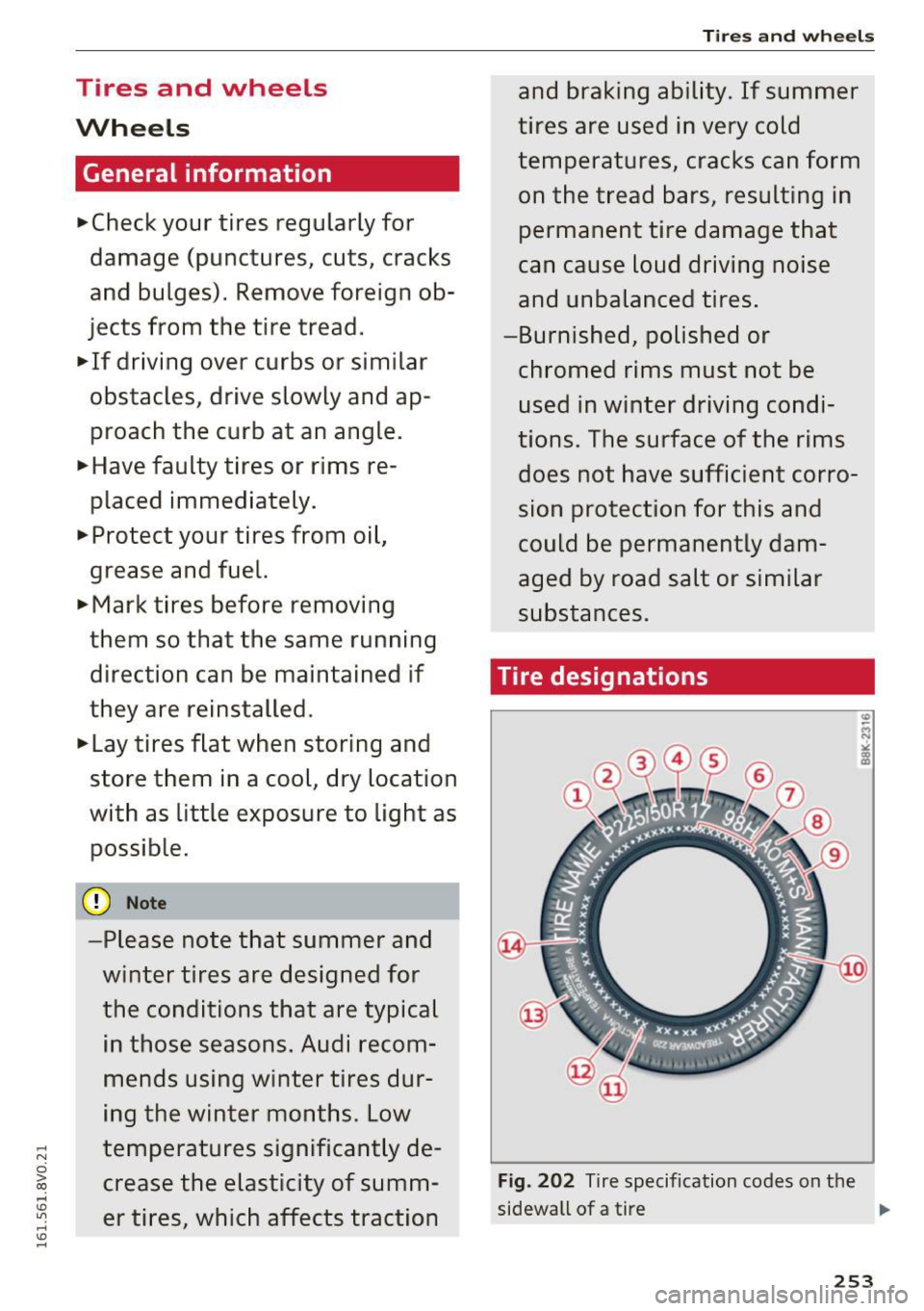
Ti re designations
Fig. 202 Tire specification codes on the
sidewall of a tire .,.
253
Page 302 of 328
Emergency situations
distribut ion and ba lance . This might hap
pen, for example, when heavy compo
nents such as the engine block or trans
miss io n are removed.
- When removing heavy components like
th ese, a nch or vehicle to ho ist o r add corre
sponding weights to maintain the cen ter of
gr avity. Otherwise , th e vehicle migh t ti lt or
s li p off the h ois t, causing ser ious perso nal
rnJury.
0 Note
- Be aware of t he following poi nts before lift
i ng t he veh icle:
-The vehicle should never be lifted or
jacked up from underneath the engine oil
pan , the transmission housing, the front
or rear axle or the body side members.
This could lead to serious damage.
- To avoid damage to the underbody or
chassis frame, a rubber pad must be in·
serted between the floor jack and the lift points.
- Before driving over a workshop hoist,
check that the vehicle weight does not
exceed the permissible lifting capacity of
the hoist .
- Before driving over a workshop hoist, en
sure that there is sufficient clearance be
tween the hoist and low parts of the ve ·
hide .
300
Page 317 of 328
,....,
N
0 > co ,....,
adding . ... .. ............... .. .... . 242
Changing . . . . . . . . . . . . . . . . . . . . . . . . . . 243
Checking the oil level . . . . . . . . . . . . . . . . . 242
Dipstick .. .. .. .............. 239,240,242
Indicator light . . . . . . . . . . . . . . . . . . . . . . . 20
o ·l · 1 consumption . . . . . . . . . . . . . . . . . . . . . 241
Specification and viscosity . . . . . . . . . . . . . 240
Temperature indicator . . . . . . . . . . . . . . . . . 32
Use . .. .. .. .. .... .. .. ....... .. .. .. . 242
Engine preheater . . . . . . . . . . . . . . . . . . . . . . 7 S
Engine speed limitation (indicator light) . . .
24
Environment
Break-in period . . . . . . . . . . . . . . . . . . . . . . . 77
Catalytic converter . . . . . . . . . . . . . . . . . . .
232
Diesel particulate filter . . . . . . . . . . . . . . . 233
Disposing of your vehicle battery . . . . . . . 250
Driving at high speeds . . . . . . . . . . . . . . . . . 78
Letting the vehicle stand and warm up . . . . 7 8
Proper disposal of drained brake fluid . . . 246
Proper disposal of drained engine oil . . . . 243
Unleaded gasoline . . . . . . . . . . . . . . . . . . . 228
What should I do with an old battery? . . . 250
EPC (engine control) . . . . . . . . . . . . . . . . . . . . 23
ESC
Automatic post-collision braking system .
159
Electronic stabilization control . . . . . . . . . 159
Sport mode . . . . . . . . . . . . . . . . . . . . . . . . 160
also refer to Electronic Stabilization Control
(ESC) . . . . . . . . . . . . . . . . . . . . . . . . . . . . . .
159
ESP
refer to Electronic Stabilization
Control (ESC) . . . . . . . . . . . . . . . . . . . . . . .
159
Event Data Recorder (EDR) . . . . . . . . . . . . . 158
Exterior lighting . . . . . . . . . . . . . . . . . . . . . . . 46
Exterior mirrors
Adjusting . . . . . . . . . . . . . . . . . . . . . . . . . . . SO
D' . 1mming ... .. ................ ..... .. 51
folding . . . . . . . . . . . . . . . . . . . . . . . . . . . . . SO
Heating . . . . . . . . . . . . . . . . . . . . . . . . . . . . . SO
F
Fastening
Booster seats . . . . . . . . . . . . . . . . . . . . . . .
218
Convertible child safety seats . . . . . . . . . . 216
Infant seats .. .... .... ..... ... ... .. . 215
Filling AdBlue
with bottle
Index
235
Floor mats . . . . . . . . . . . . . . . . . . . . . . . . . . . 171
Fog lights/rear fog light(s) . . . . . . . . . . . . . . 46
Folding the exterior mirrors
Center locking . . . . . . . . . . . . . . . . . . . . . . .
39
Folding the rear seats . . . . . . . . . . . . . . . . . . . 65
Foot pedals . . . . . . . . . . . . . . . . . . . . . . . . . .
171
Footwell lighting . . . . . . . . . . . . . . . . . . . . . . 49
For the sake of the env ironment
Environmentally-friendly driving . . . . . . . . 77
Fueling . . . . . . . . . . . . . . . . . . . . . . . . . . . .
230
Leaks. . . . . . . . . . . . . . . . . . . . . . . . . . . . . . 237
Rear w indow defogger...... ...... .. .. . 74
Front airbags Description . . . . . . . . . . . . . . . . . . . . . . . . .
188
How they work . . . . . . . . . . . . . . . . . . . . . . 194
Frontal collisions and the laws of physics . . 177
Front armrest . . . . . . . . . . . . . . . . . . . . . . . . . 59
Front passenger's door emergency locking . . 41
Front seats
Adjusting . . . . . . . . . . . . . . . . . . . . . . . . . .
168
Child res traints in the front seat . . . . . . . . 185
also refer to Seats 57,64
Fuel Additives . . . . . . . . . . . . . . . . . . . . . . . . . . .
228
Blended gasoline . . . . . . . . . . . . . . . . . . . . 228
Current consumption . . . . . . . . . . . . . . . . . . 29
Fuel filler neck . . . . . . . . . . . . . . . . . . . . . . 230
Fuel gauge . . . . . . . . . . . . . . . . . . . . . . . 10, 12
Fuel tank capacity . . . . . . . . . . . . . . . . . . . 303
Gasoline . . . . . . . . . . . . . . . . . . . . . . . . . . . 228
Gasoline additives . . . . . . . . . . . . . . . . . . . 229
Indicator light . . . . . . . . . . . . . . . . . . . . . . . 24
Saving fuel .. .. .. .. .............. 77, 148
Fuel economy messages (efficiency program) 3.1
Fueling
Fuel filler door eme rgency release . . . . . .
232
Fuel gauge . . . . . . . . . . . . . . . . . . . . . . . . . . 12
Fuel tank capacity . . . . . . . . . . . . . . . . . . . 303
Open ing the fuel filler door . . . . . . . . . . . . 230
Fuses
Assignment . . . . . . . . . . . . . . . . . . . . . . . .
292
Interior . . . . . . . . . . . . . . . . . . . . . . . . . . . . 291
replacing . . . . . . . . . . . . . . . . . . . . . . . . . . 29 1
315