ignition AUDI S3 2016 Repair Manual
[x] Cancel search | Manufacturer: AUDI, Model Year: 2016, Model line: S3, Model: AUDI S3 2016Pages: 328, PDF Size: 81.78 MB
Page 220 of 328
Child safety
airbag system inspected by your authorized
Audi dealer.
- Take the child restraint off the front passen
ger seat and install it properly at one of the
rear seat positions if the
PASSENGER AIR
BAG OFF
light does not stay on whenever
the ignition is switched on .
Booster seats and safety belts
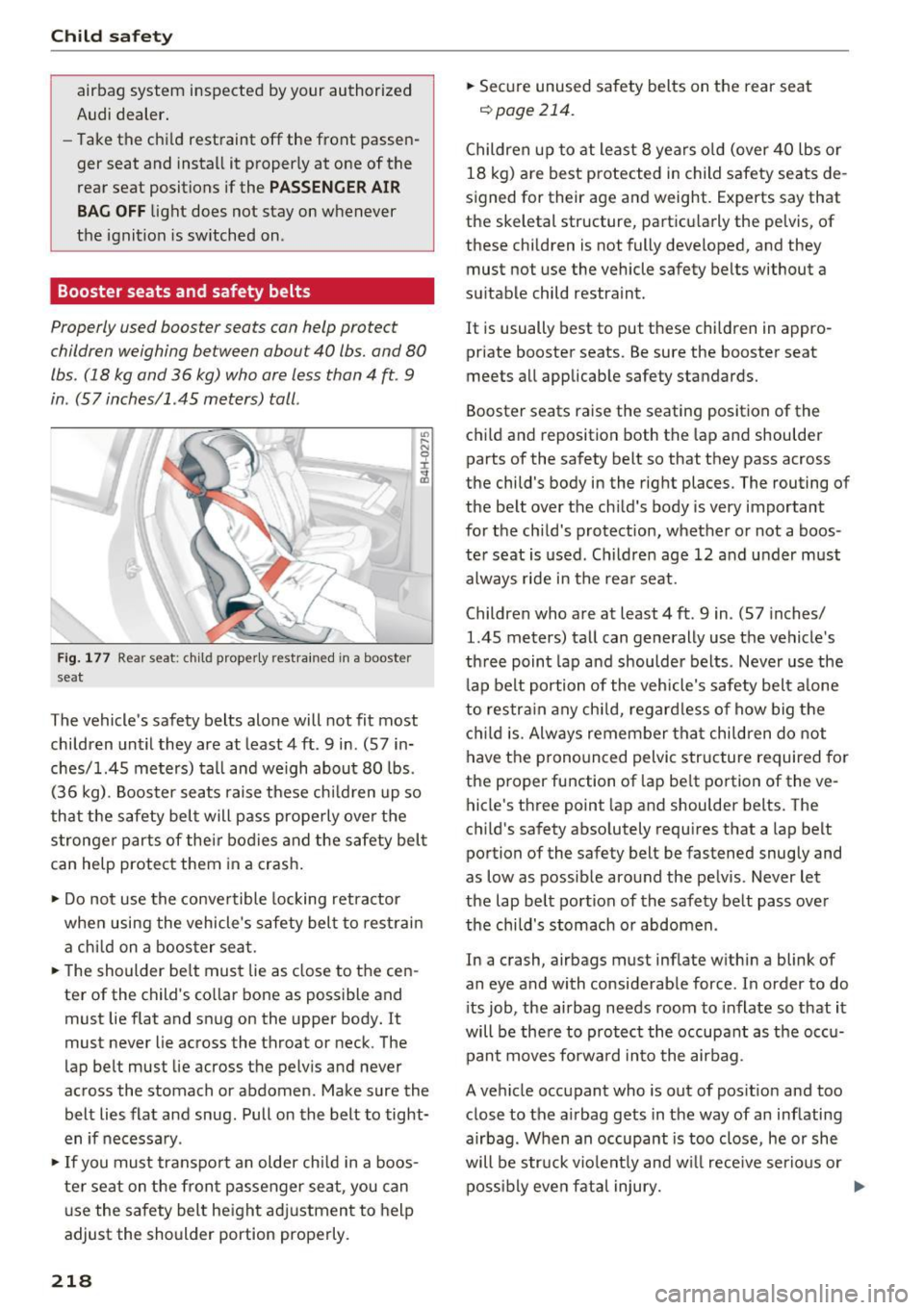
Properly used booster seats con help protect
children weighing between about 40 lbs. and 80
lbs. (18 kg and 36 kg) who ore less than 4
ft. 9
in . (57 inches/1 .45 meters) toll .
Fig. 177 Rear seat: c hil d p rop erly restrain ed in a booster
seat
"' ,...
i i
The vehicle's safety belts alone will not fit most
children until they are at least 4
ft. 9 in . (57 in
ches/1.45 meters) tall and weigh about 80 lbs .
(36 kg). Booster seats raise these chi ldren up so
that the safety belt will pass properly over the
stronger parts of their bodies and the safety bel t
can help protect them in a crash.
• Do not use the convertible locking retractor
when using the vehicle's safety bel t to rest rain
a chi ld on a boos ter seat.
• The shoulder be lt must lie as close to the cen
ter of the child's collar bone as possible and
must lie flat and snug on the upper body. It
must never lie across the throat or neck. The
lap belt must lie across the pelv is and never
across the stomach or abdomen . Make sure the
belt lies flat and snug. Pull on the belt to tight
en if necessary .
• If you must transpo rt an older child in a boos
ter seat on the front passenger seat, you can
use the safety belt he ight adjustment to help
adjust the shoulder portion properly .
218
• Secure unused safety belts on the rear seat
r=;, page 214 .
Children up to at least 8 years o ld (over 40 lbs or
18 kg) are best protected in child safety seats de
signed for their age and weight. Experts say that
the skeletal structure, particularly the pelvis, of
these children is not fully developed, and they
must not use the vehicle safety belts without a
su itable child restraint.
It is usually best to put these chi ldren in appro
priate booster seats. Be sure the booster seat
meets all applicable safety standards.
Booster seats raise the seating position of the
chi ld and reposition both the lap and shoulder
parts of the safety belt so that they pass across
the child 's body in the right places. The routing of
the belt over the ch ild's body is very important
for the child's p rotection, whether or not a boos
te r seat is used. Children age 12 and under must
always ride in the rear seat.
Children who are at least 4
ft . 9 in . (57 inches/
1.45 meters) tall can generally use the vehicle's
three point lap and shoulder belts. Never use the
l ap belt portion of the veh icle's safety belt a lone
to restrain any child, regard less of how big the
child is. Always remember that children do not
have the pronounced pelvic structure required for
the proper function of lap be lt portion of the ve
hicle's three point lap and shoulder belts. The
child's safety abso lutely requires that a lap belt
portion of the safety belt be fastened snugly and
as low as possible around the pelvis . Never let
the lap belt portion of the safety belt pass over
the chi ld's stomach or abdomen .
In a crash, airbags must inflate with in a blink of
an eye and with considerab le force . In order to do
its job, the airbag needs room to inflate so that it
will be there to protect the occupant as the occu
pant moves forwa rd into the airbag .
A vehicle occupant who is out of pos it ion and too
close to the a irbag gets in the way of an inflating
a irbag . When an occupant is too close, he or she
will be struck violent ly and will rece ive serious or
possibly even fata l injury. ..,.
Page 221 of 328
,....,
N
0 > co ,....,
important that all vehicle occupants, especia lly
any children, who must be in the front seat be
cause of exceptional circumstances, be properly restrained and as far away from the airbag as
possible . By keeping room between the child 's
body and the front of the passenger compart
ment , the airbag can inflate comp letely and pro
vide supp lemental protect ion in certain frontal
coll is ions.
A WARNING
Not using a booster seat, using the booster
seat improperly, incorrectly insta lling a boos
ter seat or using the vehicle safety belt im
properly increases the risk of serious personal
injury and death in a collision or other emer
gency situat ion. To help reduce the risk of se
r ious personal injury and/or death:
- The shoulder belt must lie as close to the
center of the child's collar bone as possible
and must lie flat and snug on the upper
body .
It must neve r lie across the throat or
neck. The lap belt must lie across the pelv is
and never across the stomac h or abdomen .
Make sure tha t the belt lies fla t and sn ug.
Pull on the belt to tighten if necessary.
- Failure to p roperly route safety belts over a
child 's body will cause severe injuries in an
accident or other emergency situation
¢ page 176.
-The rear side of the child sa fety seat should
be pos itioned as close as poss ible to the
backrest on the vehicle seat .
- For adjustable head restraints: adjust or re
move the rear seat head restraint if it is dif
ficult to install the child seat with the head
restra int in place ¢
page 60. Install the
head restraint again immediately once the
child seat is removed. Driving w ithout head
restra ints or w ith head restraints that are
not properly adjusted increases the risk of
serious o r fa ta l neck injury d ramatically .
- Children on the front seat of any car, even
with Advanced Ai rbags, can be se riously in
jured or even killed when a n ai rbag inflates.
- Never let a child stand or knee l on any seat,
for example the front seat.
-
Ch ild safety
-Never let a chi ld ride in the cargo area of
your veh icle.
- Always remember that a chi ld leaning for
ward, sitting sideways or out of position in any way du ring an accident can be struck by
a dep loying airbag. Th is w ill result in serious
personal injury or death .
- If you must install a booster seat on the
front passenger seat because of exceptiona l
circumstances the
PASSENGER AIR BAG
OFF
li ght must come on and stay on, when
eve r the ignit ion is switched on.
- If the PASSENGER AIR BAG OFF light does
not come on and stay on, perfo rm the
checks desc ribed ¢
page 196, Monitoring
the Advanced Airbag System.
- Take the child restra int off the front passen
ge r seat an d install it prope rly at one of the
rear seat positions if the
PASSENGER AIR
BAG OFF
light does not stay on whenever
the ignition is switched on .
- Always read and heed all WARNINGS when
ever using a chi ld restrained in a vehicle is
be ing used
¢ page 176, Safety belts,
¢ page 184, Airbag system and
¢ page 209, Important information.
Securing child seats
Securing a child safety seat using a safety
belt
Safety belts for the rear seats and the front pas
senger can be locked with the convertible locking
retractor to properly secure child safety seats .
The safety belts emergen cy loc king retractors for
the rear seats safety be lts and fo r th e front pas
senger's sea t sa fe ty be lt have a conve rtible lock
ing retractor for child restraints . The safety be lt
must be lock ed so that be lt webbing cannot un
ree l. The retractor can be activated to lock the
safety belt and prevent the safety belt webbing
from loosening up dur ing norma l d riving. A ch ild
safety seat can on ly be properly installed when
the safety belt is locked so that the ch ild and
child safety seat will stay in place.
Always remember : Even though your veh icle is
equipped with an Advanced Airbag system, all
219
Page 222 of 328
Child safety
children, especially those 12 years and younger,
should always ride in the back seat properly re
strained for their age and size.
.&_ WARNING
-
Improperly installed child safety seats in
crease the risk of serious personal injury and
death in a collision.
- Always make sure that the safety belt re
tractor is locked when installing a child
safety seat . An unlocked safety belt retrac
tor cannot hold the child safety seat in place during normal driving or in a crash.
-Always buckle the child safety seat firmly in
place even if a child is not sitting in it . A
loose child safety seat can fly around during
a sudden stop or in a collision.
- Always make sure that the rear seat back
rest to which the center rear safety belt* is
attached is securely latched whenever the
rear center safety belt is being used to se
cure a child restraint.
- If the backrest is not securely latched, the
child and the child restraint will be thrown
forward together with the backrest and will
strike parts of the vehicle interior. The child
can be seriously injured or killed.
- Never install rear-facing child safety seats
or infant carriers on the front passenger
seat. A child will be seriously injured and can be killed when the passenger airbag in
flates.
- The inflating airbag will hit the child safety
seat or infant carrier with great force and
will smash the child safety seat and child
against the backrest, center armrest, door
or roof.
- Always install rear-facing child safety seats
or infant carriers on the rear seat.
- Forward-facing child safety seats or infant
carriers installed on the front passenger's
seat may interfere with the deployment of
the airbag and cause serious injury to the
child.
- It is safer to install a forward-facing child
safety seat on the rear seat.
- Always read and heed all WARNINGS when
ever using a child restrained in a vehicle is
220
being used¢ page 209. Special precautions
apply when installing a child safety seat on
the front passenger seat¢
page 185, Child
restraints on the front seat -some impor
tant things to know.
.&_ WARNING
Always take special precautions if you must
install a forward or rearward-facing child re
straint on the front passenger's seat in excep
tional situations:
- Whenever a forward or rearward-facing
child restraint is installed on the front pas
senger seat, the
PASSENGER AIR BAG OFF
light must come on and stay on whenever
the ignition is switched on.
- If the
PASSENGER AIR BAG OFF light does
not come on and stay on, perform the
checks described ¢
page 196, Monitoring
the Advanced Airbag System.
- Take the child restraint off the front passen
ger seat and install it properly at one of the rear seat positions if the
PASSENGER AIR
BAG OFF light does not stay on whenever
the ignition is switched on.
- Improper installation of child restraints can
reduce their effectiveness or even prevent
them from providing any protection .
- An improperly installed child restraint can
interfere wi th the airbag as it deploys and
seriously injure or even kill the child.
- Always carefully follow the manufacturer's
instructions provided with the child safety
seat or carrier .
- After checking to make sure that the child
restraint is properly installed, make certain
that the child restraint is correctly recog
nized by the capacitive passenger detection
system in the front passenger seat and that
the
PASSENGER AIR BAG OFF light signals
the correct front passenger frontal airbag
status.
_&. WARNING
Forward-facing child restraints:
-
Page 223 of 328

,....,
N
0 > co ,....,
has been designed and certified by its man
ufacturer for use on a front seat with a pas
senger front and side airbag.
- Never put the forward-facing child restraint
up, against or very near the instrument pan
el.
- Always move the passenger seat into its
rearmost position in the seat's fore and aft
adjustment range, as far away from the air
bag as possib le before installing the for
ward-facing child restra int. The backrest
must be adjusted to an up right posit ion.
- Make sure that the
PASSEN GER AI R BA G
OFF
light comes on and stays on all the time
whenever the ignition is switched on.
_& WARNING
Rearwa rd-facing child restra ints:
- A ch ild in a rea rwa rd-facing child safety seat
installed on the front passenger seat wi ll be
seriously injured and can be killed if the
front airbag inflates - even with an Ad
vanced Airbag System .
- The inflating airbag will hit the child safety
seat or infant carrier with great force and
will smash the chi ld safety seat and chi ld
against the backrest, center armrest, door
or roof.
- Always be especially careful if you must in
stall a rearward facing child safety seat on
the front passenger seat in exceptional c ir
cumstances.
- Make sure that the
PA SSEN GER AIR BA G
OFF
light comes on and stays on all the time
whenever the ignition is switched on .
- If the
PASSEN GER A IR BAG OFF light does
not come on and stay on, immediately in
stall the rear-fac ing ch ild safety seat in a
rear seat ing pos ition and have the airbag
system inspected by your Aud i deale r.
Ch ild safety
Activating the convertible locking retractor
Use the convertible locking retractor to secure a
child restraint .
Always heed the ch ild safety seat manufacturer's
instruct ions when installing a child restraint in
your vehicle. To activate the convertible locking retractor:
.. Place the child restraint on a seat, preferably
on the rear seat.
.. Slowly pull the belt
all the w ay out .
.. Route it around or through the child restra int
be lt path
¢ & .
.. Push the ch ild safety seat down with you r full
weight to get the safety belt really tight.
.. Insert the belt tongue into the buckle for that
seating position.
.. Guide the safety belt back into the retractor un
til the belt lies flat and snug on the child safety
seat.
.. You should hear a ''cl icking" noise as the belt
w inds back into the inertia reel. Test the con
vert ible lock ing retractor by pull ing on the belt.
You shou ld no longer be able to pull the belt
out of the retractor. The convertib le loc kin g re
t ractor is now activated.
.. Make sure that the red release button is facing
away from the c hild restraint so that it can be
unbuckled quickly .
.. Pull on the belt to make sure the safety belt is
properly tight and fastened so that the seat
cannot move forward or sideways more than
one inch (2 .5 cm) .
_& WARNING
Using the wrong ch ild rest raint o r an improp
e rly inst alled child restra int can cause se rious
personal injury or death in a crash.
- Always make sure that the safety be lt re
tr actor is locked when installing a child
safety seat . An un locked safety be lt retrac
tor cannot hold the ch ild safety seat in p lace
during normal driving or in a crash.
- Always buckle the child safety seat fi rm ly in
p lace even if a child is not sitting in it. A
loose child safety seat can fly a round during
a sudden stop or in a crash. .,.
221
Page 233 of 328
,....,
N
0 > co ,....,
found on a lab el located on the inside of the fue l
f ill er door . For ad dit ional information on fuel, re
fer to
c:> page 228.
The fuel tank capacity of your vehicle can be
found in the
T ec hnical Da ta c:> page 303 .
To avoid fuel spill ing or evaporating from the f uel
tank always close fuel filler cap properly and
comp letely. An improperly closed fue l filler cap
may a lso cause the MIL lamp
c:> page 26 to come
on.
A WARNING
Not paying attention when fueling or han
dling fuel incorrectly can lead to fires, exp lo
sions or serious in juries.
- Fuel ignites eas ily and can cause serious
burns and other injuries.
-
- If you do not switch the eng ine off when fu
eling and/or do not insert the fuel nozz le
completely into the tank opening, fuel can
leak out or run over . Leaked fuel can ignite
and sta rt a fi re .
- Do not use the telephone while fueling. The electromagnet ic rays can cause spa rks,
w hich can ignite fuel vapors and sta rt a fi re .
- Do not s it in you r vehicle while fueling . If
yo u must make an except io n and enter your
vehicle again wh ile fue ling , close the door
and touch met al to discharge static electri c
ity befo re touching the fue l nozzle. Static
elect ricity can create sparks, whic h can ig
nite vapors when f ue li ng.
- Do not smoke or have an open flame i n the
area when fueling your vehicle or filling a
fuel container because this increases the risk of an explos ion.
- For your safety, carrying f uel containers in
your vehicle is not recommended. Whether
full or empty, the conta iner can leak and
cause a fire in the event of an accident.
- If you must make an exception and trans port a fuel container, note the following:
- Never fill the fuel containe r with fuel
while it is in or on the vehicle. S tat ic elec
t ricity is d isc har ged when filling wh ich can
Ch eck ing and Filling
cause the fuel vapors to ignite and in
creases the risk of an exp losion.
- Always place a fue l container on t he
ground before fill ing .
- Always hold the fue l nozzle completely in
the fuel conta iner when fill ing.
- If the fuel containe r is made of meta l, the
fuel nozzle must always be in contact with
the container when filling it with f uel. This
~revents static elect ricity from discharg
ing .
- Never spill fue l in the vehicle or the lug
gage compartment. Evaporated fuel is ex
plosive and increases the risk of serious in
jury or death .
- Fo llow lega l requirements when using,
stor ing and transporting fuel containers .
- Make su re the f uel container conforms to
industry standards (ANSI/ASTM F852-86).
(D Note
- Remove spilled fue l from vehicle pa int im
mediately, because it can damage paint.
- Never drive unt il the fuel tank is complete ly
empty. The irreg ular s upply of fue l that re
sults from that can cause eng ine misfires.
Uncombusted fuel will enter the exhaust
system and increase the risk of damage to
t he cata lytic converter .
- If the fuel tank runs complete ly empty in a
vehicle with a
diesel engine , the ignition
must remain switched on fo r at least 30
seconds afte r refueli ng before starti ng the
eng ine.
It may t ake longer than u sual fo r
t he engine to s tart, even up to a minute .
T his is because t he air must f irst b leed ou t
of the fue l system when starting the engine.
@ For the sake of the environment
- If the fue l nozzle is use d co rrectly, it w ill in
dica te t hat the t ank is full the first t ime it
switches off a utomatica lly. Do not try to
add more fuel, because it can spill ove r. A l
so, the expansion space in the tank w ill fill
'
w hich can resu lt in fuel sp illing out when it
becomes wa rm and pollut ing the e nviron
ment.
231
Page 234 of 328
Checking and Filling
@ Tips
Fue l can age and may lead to prob lems when
starting. Audi recommends replacing the fuel
in your vehicle within six months.
@ Tips
- If the engi ne is running while fueling, va
pors can escape or the fuel can spill over.
Because of th is, the fuel no zzle switches off
before the tank is full.
- Do not fuel the vehicle when the ignition is
switched on. Otherwise, the fuel gauge may
not show t he correct level after fueling the
vehicle .
- Diesel veh icles are equ ipped with a diesel
misfueling guard
1>. It allows the vehicle to
be f ueled on ly w ith a diesel fuel pump noz
zle .
- A wo rn o r damaged nozzle or a nozzle that
i s too smal l may not be ab le to open the
diesel misfueling protector . If this is the
case, try t urning the nozzle before inserting
i t in the f uel fille r neck, u se a d ifferent fue l
pump or see an aut horized Audi dea ler or
a uthorized Audi Service Facility fo r assis
tance .
- The misf ueling guard does not open when
adding fue l from a fue l conta iner . You can
bypass it by adding the diesel fuel slow ly.
- The fuel filler door on your ve hicle does not
l ock when you lock the vehicle from the in
side.
l ) Ma rket -specifi c
232
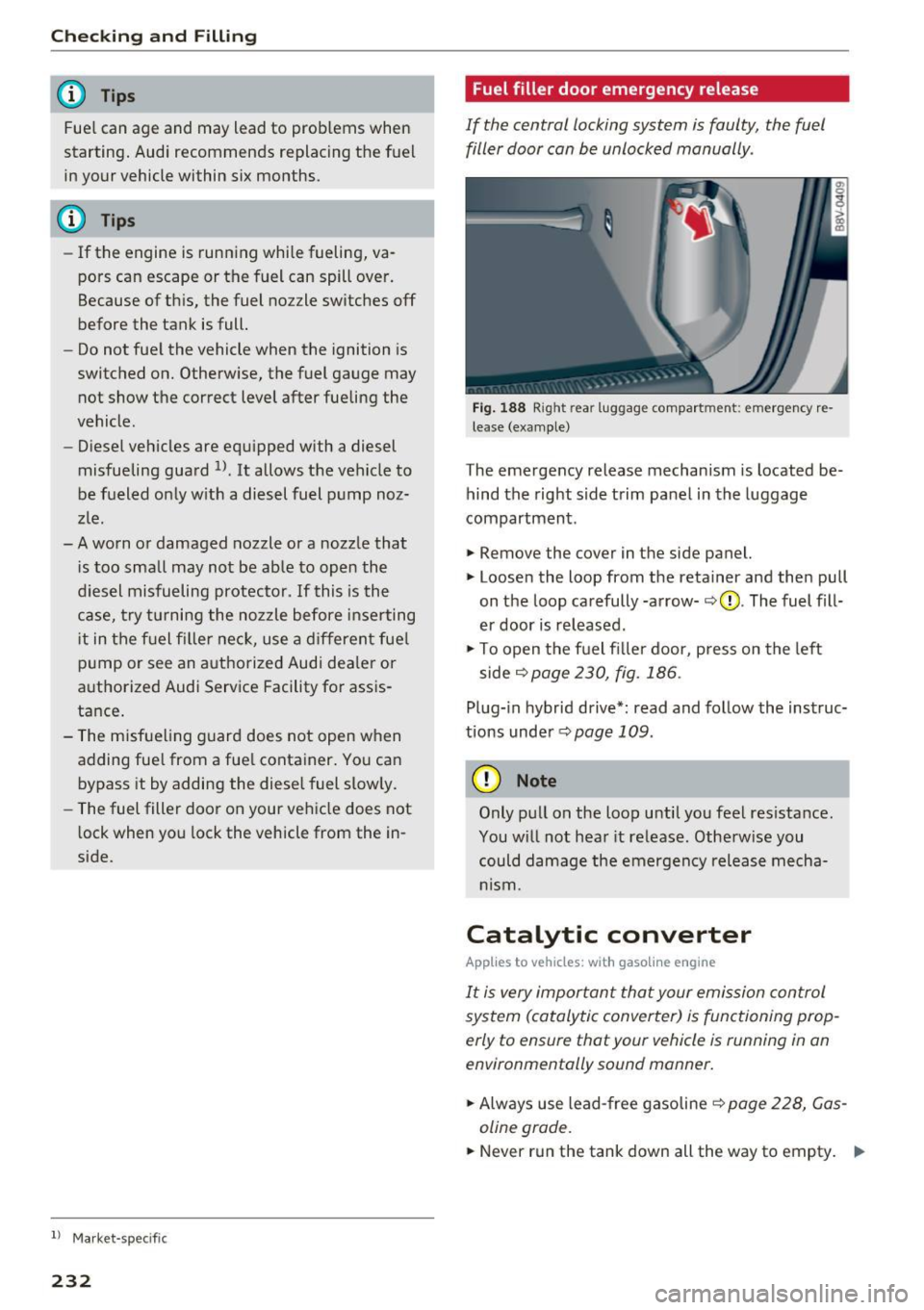
Fuel filler door emergency release
If the cen tral locking system is faulty, the fuel
filler door can be unlocked manually .
Fig. 188 Right re ar l ug gag e compa rtm en t: em erg enc y re
lease (example)
T he emergency release mechan ism is located be
hind the right s ide trim panel in the luggage
compartment.
.,. Remove the cover in the side panel.
.,. Loosen the loop from the retainer and then pull
on the loop carefully-arrow-
~ CD. The fuel fill
er door is released .
.,. To open the f uel filler door, press on the left
side
~ page 230, fig. 186 .
Plug-in hybrid drive*: read and follow the instruc
tions unde r
Qpage 109.
(D Note
Only pu ll on the loop until you feel res ista nce .
You wil l not hear it re lease. Otherw ise you
could damage the emergency release mecha
n ism .
Catalytic converter
Applies to vehicles: with gasol ine engine
It is very important tha t your emi ssion control
sys tem (ca talytic conv erter) is functioning prop
erly to ensure that your vehicle is running in an
env ironmentally sound manner .
.,. Always use lead-free gasoline ~ page 228, Gas
oline grade .
.,. Never run the tank down all the way to empty . ..,.
Page 236 of 328
Check ing and F illing
Selective catalytic
reduction (AdBlue)
General information
Applies to vehicles: with diesel engine
In vehicles with selective cata lytic reduction, a
urea solution (AdB lue) is injected into the ex
haust system before a nitrogen oxide catalytic
converter to reduce nitrogen emissions.
Ad B lue is the marketing name for Diesel Exha ust
Fl uid (DEF).
The AdBl ue is carried in a separate ta nk in the ve
hicle. The Ad Blue usage accounts for approxi
mate ly 0.5% to 1.2% of the diesel f uel that is
used .
W hen a message about refilling the Ad B lue ap
pears in the instrument cluster disp lay, you must
refill the Ad Blue you rself or have it refilled by an
author ized Audi dealer or authorized Audi Service
Facility ¢
page 235.
A WARNING
-
Failure to heed AdBlue refill informat ion in
the instrument cluster can prevent the vehicle
from being started and dr iven . If the vehicle
cannot be driven and an emergency arises,
perso na l in jur y can occur.
- Always have the AdBlue tank refilled well
before the tank runs dry .
(D Tips
-The instrument cluster display indicates the
distance rema ining t hat can be driven
¢ page 234. If the AdBlue tank is com
plete ly empty, the engine wi ll not start
again after the ignition is sw itched off.
- Ad B lue is req uired by law to operate this ve
hicle.
234
· Messages in the instrument cluster display
Applies to vehicles: with diesel engine
T he display indicates if the Ad Blue level is low or
if there is a system malfunction .
AdBlue level low
Yo u w ill be informed if the AdB lue in the tank
drops below a certain level.
AdBlue /;) Refill xxx l -xxx l Ad Blue . Range
1500 mi (2400 km)
This message appears w hen the re is on ly enough
Ad Blue left to dr ive the dis tance indicated in the
driver information system . Refi ll the recom
mended amount of Ad Blue . The sma ller va lue
given in the message rep resents the minim um
amount and the larger value is the maxim um
amount.
AdBlue /9 Refill xxx l -x xx l Ad Blue ! No restart
in
600 miles ( 1000 km). See owner 's manual
This message appears w hen the re is on ly enough
Ad B lue left to drive the distance indicated in the
driver information system . Refi ll the recom
mended amount of Ad Blue. Otherwise the engine
will not sta rt again if you stop it once the dis
tance indicated h as been driven. The smaller val
ue g iven in the message represents the m inimum
amount and t he larger value is the maxim um
amount . As long as the indicator
li gh t is on , you can chec k the rema ining range in
t h e tr ip comp ute r*.
Refill xxx l -xxx l Ad Blu e! Engine
start not po ssible! See owner 's manu al
This message appears when the Ad Blue tank is
empty . Fill the Ad Blue . Otherwise you w ill not be
able to sta rt the engi ne aga in once you stop it .
The Ad Blue must be refilled when the amount in
the tank has reached the min imum level
¢ page 235 , Filling AdBlue .
¢'4 Incorrect filling /system malfunction
A message appea rs if the Ad Blue tank was fi lled
with a f lu id other than Ad Blue and the system
has detected that the tank was filled incorrectly,
or if there is a system malfunction.
Page 238 of 328
Checking and Filling
CJ) Note
-Only use Ad Blue that conforms to the
standard ISO 22241-1. Do not mix any addi
tives with the AdBlue and do not dilute it
with water.
- Only use refill bottles that are approved for your vehicle. Using other systems can cause Ad Blue to leak.
- Do not add Ad Blue to the diesel tank or add diesel fuel to the Ad Blue tank. Do not start
the engine under any circumstances if the
wrong fuel is filled in the tank . There is a
risk of damaging the fuel tank system and
the engine . See an authorized Audi dealer or
authorized Audi Service Facility for assis
tance.
- AdBlue attacks surfaces such as painted ve
hicle components, plastic and carpet. Re
move the fluid as quickly as possible with a
damp cloth and plenty of cold water. If the
Ad Blue has already crystallized, use warm
water and a sponge. AdBlue residue that is
not removed will crystallize and can damage
the affected surface .
- Do not store the refill bottle in the vehicle.
If it leaks, the escaping Ad Blue could dam
age the vehicle interior .
- Do not allow Ad Blue to come into contact
with clothing. If there is contact with the
fluid, flush immediately with plenty of wa
ter .
(D Tips
-You can obtain refill bottles from an author
ized Audi dealer or authorized Audi Service
Facility .
- Follow the Ad Blue manufacturer's instruc
tions for use and storage .
- A permitted refill bottle contains approxi
mately 1.9 liters of AdBlue .
- Ad Blue can freeze at very low temperatures.
If this happens, the system will not detect
that the Ad Blue was refilled and it will con
tinue to inform you of the low AdBlue level.
The message turns off as soon as the tank
thaws out again.
236
Engine compartment
Working in the engine compartment
Special care is required if you are working in the
engine compartment
For work in the engine compartment such as
checking and filling fluids, there is a risk of in
jury, scalding, accidents, and burns. For this
reason, follow all the following listed warnings
and general safety precautions. The engine
compartment is a dangerous area.
¢ .&. .
.8, WARNING
To reduce the risk of injuries, complete the
following steps before opening the hood:
- Turn the engine off.
- Switch the ignition off.
- Set the parking brake.
- Place the selector lever in the P position.
- Let the engine cool down.
- Never open the hood when you see that
steam or coolant drips from the engine
compartment- there is a danger of burns!
Wait until no steam or coolant flows out.
- Keep children away from the engine com
partment.
- Never spill fluids on a hot engine. These flu
ids (such as the freeze protection contained in the coolant) can catch fire.
- Avoid short circuits in the electrical system,
especially the battery.
- When working in the engine compartment,
remember that the radiator fan can switch
on even if the ignition is switched off, which
increases the risk of personal injury.
- Never open the cap on the coolant expan
sion tank when the engine is warm . The
cooling system is under pressure.
- To protect your face, hands, and arms from
hot steam or coolant, cover the cap with a
large cloth when opening.
- Do not remove the engine cover under any
circumstances . This increases the risk of
burns.
- If tests need to be performed with the en-
-
gine running, there is additional danger due ~
Page 239 of 328
.... N
0 > CX)
.... I.Cl U"I
.... I.Cl ....
to moving components (such as the ribbed belt, alternator and radiator fan) and from
the high-voltage ignition system.
- Never reach into the radiator fan. The elec
tric auxiliary fan is controlled by tempera
ture and can switch on suddenly.
- Pay attention to the following warnings list ed when work on the fuel system or on the
electrical equipment is required.
- Always d isconnect the vehicle battery
from the vehicle electrical system
- Do not smoke
- Never work near open flames
- Always have a working fire extinguisher nearby
- To reduce the risk of electric shock and in
jury, never touch the following components when the eng ine is running or is being start
ed:
- Ignition cable
- Other components in the electronic h igh -
voltage ignition system
- If you must check or perform work on the engine while it is running:
- Set the parking brake and place the selec
tor lever in the P (park) position first .
- Always proceed with extreme caution so
that clothing, jewelry or long ha ir do not
become caught in the radiator fan, fan
be lt or other moving components or do
not come into contact with hot compo
nents. Tie back long hair before beginning
work and do not wear cloth ing that can
hang down into the engine.
- L imit your exposure to exhaust and chemi
cals to as short a time as possible~&.
_& WARNING
California Proposition 65 Warning:
- Engine exhaust, some of its constituents,
and certain vehicle components contain or
em it chem icals known to the State of Cali
fornia to cause cancer and birth defects and reproductive harm. In addition, certain flu
ids contained in vehicles and certain prod
ucts of component wear contain or emit
chemicals known to the State of California
C hecki ng an d Fill in g
to cause cancer and birth defects or other
reproductive harm.
- Battery posts, terminals and related acces
sories contain lead and lead compounds,
chemicals known to the State of California
to cause cancer and reproductive harms.
Wash hands after handling.
(D Note
When filling fluids, be sure not to mix the f lu
i ds up. Otherwise severe malfunctions and en
gine damage will occur.
@ For the sa ke of the environment
You should regularly check the ground under
your vehicle in order to detect leaks quickly. If there are visible spots from oil or other fluids, bring your veh icle to an authorized Audi deal
er or authorized Aud i Serv ice Facility to be
checked.
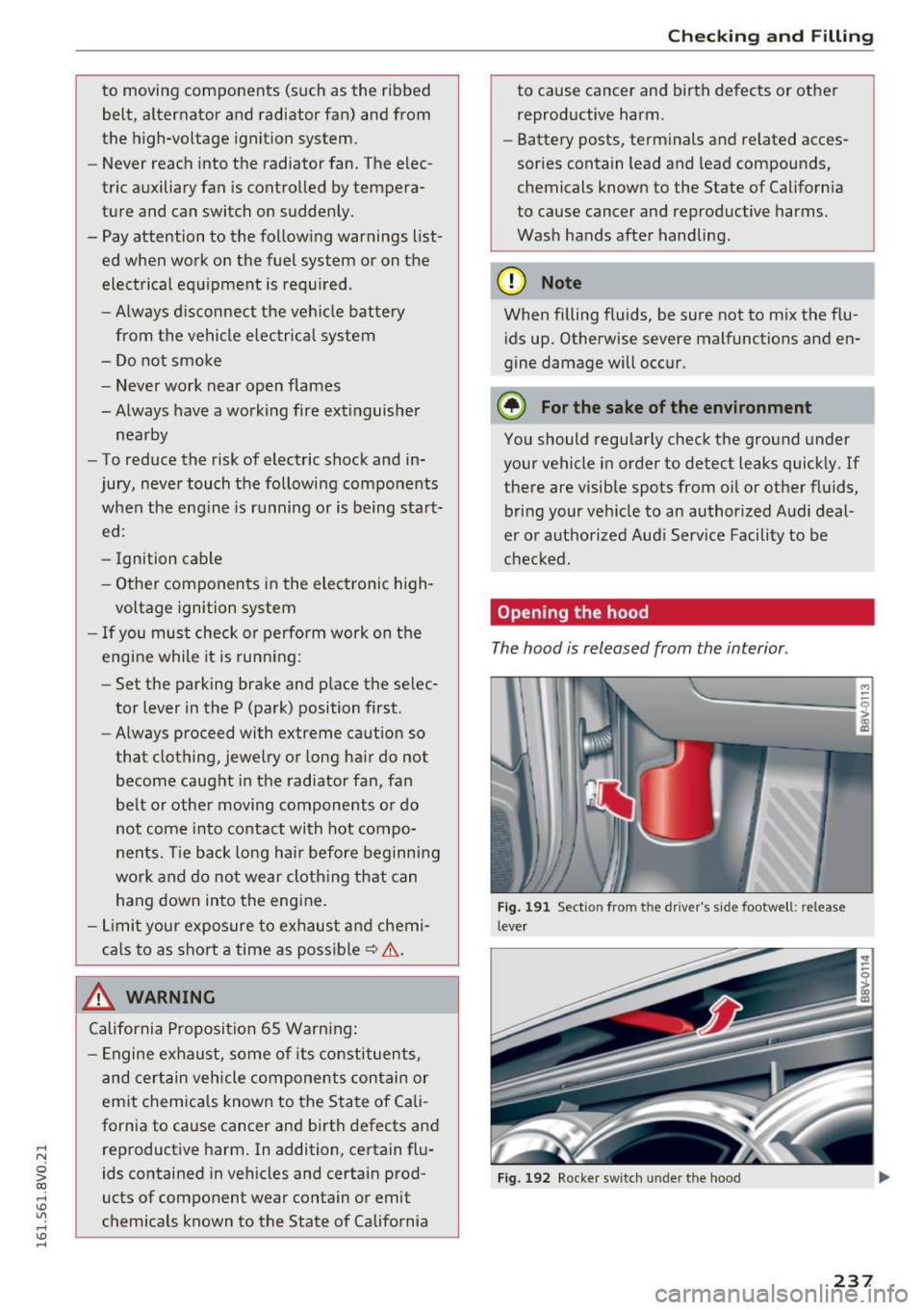
Opening the hood
The hood is released from the interior .
Fig. 191 Sectio n from t he driver 's side footwell: release
lever
Fig. 192 Rocker switch under the hood
237
Page 240 of 328

Check ing and F illing
Read and follo w the WARN IN GS before check
ing anything in the engine compartment
c::> page 236, Working in the engine compart
ment.
Make sure the wiper arms are not raised up from
the windshield. Otherwise the paint could be
damaged .
Applies to vehi cles w ith p lug-in hybrid dr ive* :
switch the ignition off before re leasing the hood
so that the gasoline engine does not start auto mat ica lly.
... With the driver's door open, pull the lever be
low the instrument panel in the direction of the
arrow
c::> fig. 191 .
... Raise the hood s lightly c::> ,&. .
... Press the rocker switch under the hood upward
c::> fig. 192. This releases the catch.
... Open the hood .
A WARNING
Never open the hood when you see that steam
or coolant drips from the engine compart-
238
ment- there is a dange r of bu rns! Wait unt il
no steam or coolant flows out.
Closing the hood
... Push the hood down until the force of the strut
is overcome.
... Let the hood fall lightly into the latch .
Do not
press it in .
c::> ,&..
A WARNING
If the hood is not latched complete ly, it could
f ly up wh ile you are dr iving and obst ruct your
vision .
- For safety reasons, the hood m ust always be
closed securely while driv ing. Because o f
this, always chec k the hood after closing it
to make sure it is latched correctly. The
hood is latched if the front corners cannot
be lifted.
- If you notice that the hood is not latched
while you are driving, stop immed iate ly and
close it, because this increases the risk of an
accident.