change time AUDI S3 SEDAN 2015 User Guide
[x] Cancel search | Manufacturer: AUDI, Model Year: 2015, Model line: S3 SEDAN, Model: AUDI S3 SEDAN 2015Pages: 282, PDF Size: 71.14 MB
Page 117 of 282
M N
0 > co ,...., \!) ..,.,
..,.,
..,., ,....,
Parking systems
General information
Applies to vehicles: with rea r parking sys te m s/park in g system
p lus/rearview camera
Depending on your vehicle's equipment, various
parking aids will help you when parking and ma
neuvering.
The
rear parking system is an audible parking aid
that warns you of obstacles
behind the vehicle
¢ page 116.
The parking system plus assists you when park
ing by audibly and visually indicating objects de
tected
in front of and behind the vehicle
¢ page 116.
The rearview camera shows the area behind the
vehicle in the MMI display. This display assists
you when you are cross or parallel parking. The
parking system plus functions are also available
¢page 117.
A WARNING ,--
- Always look for traffic and check the area
around your vehicle by looking at it directly
as well. The parking system cannot replace
the driver's attention. The driver is a lways
responsible when entering or leaving a park
ing space and during similar maneuvers .
- Please note that some surfaces, such as
clothing, are not detected by the system.
- Sensors and cameras have blind spots in
which people and objects cannot be detect
ed . Be especially cautious of small children
and animals .
- Always pay attention to the area around the
vehicle - using the rearview mirror, too.
- The sensors can be displaced by impacts or
damage to the radiator grille, bumper,
wheel housing and the underbody . The park
ing system may become impaired as a re
sult . Have an authorized Audi dealer or au
thorized Audi Service Facility check their
function.
- Make sure the sensors are not obstructed by
st ickers, deposits or other materials.
If they
are the sensor function could be impaired .
'
Parking systems
For additional information on cleaning, re
fer to
¢ page 235.
@ Note
- Some objects are not detected or displayed
by the system under certain circumstances:
- Objects such as barrier chains, trailer draw
bars, vertical poles or fences
- Objects above the sensors such as wall ex
tensions
- Objects with specific surfaces or struc
tures such as chain link fences or powder
snow
- If you continue driving closer to a low-lying
object, it may disappear from the sensor
range. Note that you will no longer be
warned about this obstacle.
- The sensors can be displaced by impacts or
damage to the radiator grille, bumper,
wheel housing and the underbody. The park
ing system may become impaired as a re
sult. Have an authorized Audi dealer or au
thorized Audi Service Facility check their
function.
(D Tips
- The system may provide a warning even
though there are no obstacles in the cover
age area in some situations, such as:
- certain road surfaces or for long grass .
- external ultrasonic sources e.g. from
cleaning vehicles.
- heavy rain, snow, or thick vehicle exhaust.
- We recommend that you practice parking in
a traffic-free location or parking lot to be
come familiar with the system. When doing
this, there should be good light and weather
conditions.
- You can change the volume and pitch of the
signals as well as the display¢
page 121 .
-What appears in the MMI display is some
what time-delayed.
- The sensors must be kept clean and free of
snow and ice for the park assist to operate .
115
Page 162 of 282
Airb ag syst em
Monitoring the
Advanced Airbag System
:A Airbag monitoring indicator light
Two separate indicators monitor the function of
the Advanced Airbag System: the airbag moni
toring indicator light and the
PASSEN GER AIR
BAG OF F
light.
The Advanced Airbag System as we ll as the side
airbags and side curtain airbags with ejection
mitigation features (including the electronic con
trol unit, sensors and system wiring) are all
monitored continuously to make sure that they
are functioning properly whenever the ignition is
on . Every time you turn on the ignition, the air
bag system indicator light
fl will come on for a
few seconds (function check) .
The sy stem mu st be inspe cted when t he
indicato r lig ht
II:
- does not come on when the ignition is switched
on,
- does not go out a few seconds after you have
switched on the ignition, or
- comes on while driving.
If an airbag system ma lf u nction is detected, the
indicator light will first start flashing to catch the
driver's attention and then stay on continuously
to serve as a constant reminder to have the sys
tem inspected immediately .
If a malfunction occurs that turns the front air
bag on the passenger side off, the
PA SSE NGE R
A IR BAG OFF
light will come on and stay on
whenever the ignition is on.
.,&. WARNING
An airbag system that is not funct ion ing prop
erly cannot p rovide supplemental protect ion
in a frontal crash.
- If the airbag indicato r light
c::> page 20
comes when the vehicle is be ing used, have
the system inspected immediate ly by yo ur
authorized Aud i dealer .
It is possible t hat
the a irbag will inflate when it is not s up
posed to, or wi ll not inf late when it should.
160
PASSENGER AIR BAG OFF l ight
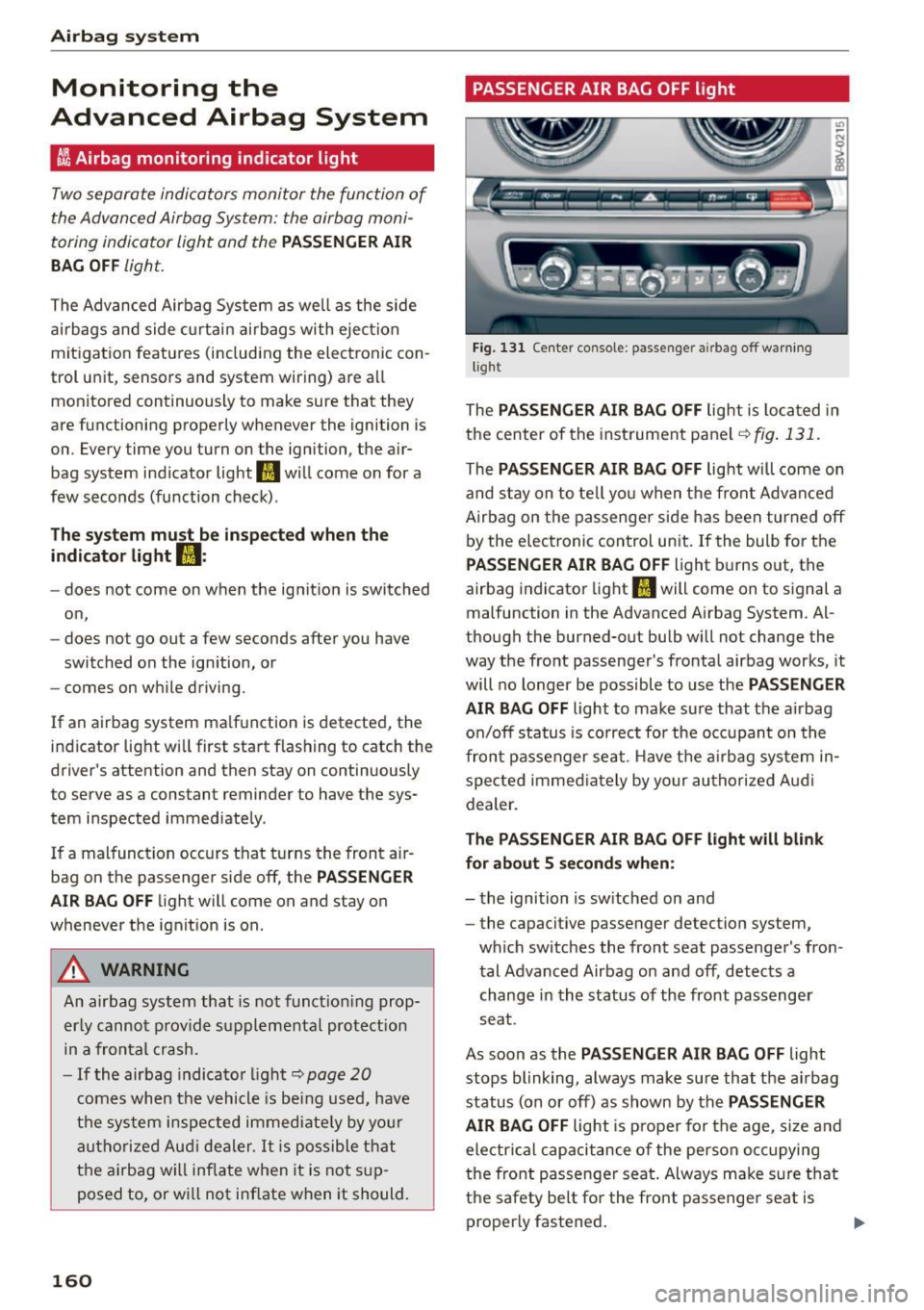
Fig. 131 Center console: passe nge r air bag off warning
light
The PASSENGER AIR BAG OFF light is located in
the center of the instrument panel
r:!;> fig. 131.
The PAS SENGER AIR BAG OFF light will come on
and stay on to te ll you when the front Advan ced
Airbag on the passenger side has been turned off by the electronic control unit. If the bulb fo r the
PASSENGER AIR BAG OFF light b urns o ut, the
airbag indicator light
rl will come on to s ignal a
malfunction in the Advanced A irbag System. Al
though the burned-out bulb will not change the
way the front passenger's frontal airbag works, it
will no longer be possible to use the
PASSENGER
A IR BAG OFF
light to make sure that the a irbag
on/off status is correct fo r the occupant on the
front passenger seat . Have the a irbag system in
spected immed iately by your au thorized A ud i
dealer.
Th e P ASSENGER AIR BAG OFF light will blink
for about 5 se cond s when :
- the ignition is sw itched on and
- the capacitive passenger detection system,
which switches the front seat passenger's fron
tal Advanced Airbag on and off, detects a
change in the status of the front passenger
seat.
As soon as the
PASS ENG ER AIR BAG O FF light
stops blinking, always make sure that the a irbag
status (on or off) as shown by the
PASSENGER
AIR BAG OFF
light is proper for the age, size and
electrical capacitance of the person occupying
the front passenger seat . Always make sure that
the safety be lt for the front passenger seat is
proper ly fastened . .,..
Page 165 of 282
M N
0 > co ,...., \!) ..,.,
..,.,
..,., ,....,
seat into its rearmost position in the seat's
fore and aft adjustment range, as far away
from the airbag as possible . The backrest
must be adjusted to an upright position .
Make sure that the
PASSENGER AIR BAG
OFF
light comes on and stays on all the time
whenever the ignition is switched on.
A WARNING
- If the PASSENGER AIR BAG OFF light does
not go out when an adult is sitting on the
front passenger seat after taking the steps
described above, make sure the adult is
properly seated and restrained at one of the
rear seating positions.
- Have the airbag system inspected by your
Audi dealer before transporting anyone on
the front passenger seat.
(D Tips
If the capacitive passenger detection system
determines that the front passenger seat is
empty, the frontal airbag on the passenger
side will be turned off, and the
PASSENGER
AIR BAG OFF light will stay on .
Repair, care and disposal of the airbags
Parts of the airbag system are installed at many
different places on your Audi . Installing, remov
ing , servicing or repairing a part in an area of the
vehicle can damage a part of an airbag system
and prevent that system from working properly
in a collision.
There are some important things you have to know to make sure that the effectiveness of the
system will not be impaired and that discarded
components do not cause injury or pollute the
environment.
A WARNING
-
Improper care, servicing and repair proce
dures can increase the risk of personal injury
and death by preventing an airbag from de
ploying when needed or deploying an airbag
unexpectedly:
Airbag system
-Never cover, obstruct, or change the steer
ing wheel horn pad or airbag cover or the in
strument panel or modify them in any way.
- Never attach any objects such as cup holders
or telephone mountings to the surfaces cov
ering the airbag units.
- For cleaning the horn pad or instrument
panel, use only a soft, dry cloth or one mois
tened with plain water . Solvents or cleaners
could damage the airbag cover or change
the stiffness or strength of the material so
that the airbag cannot deploy and protect
properly.
- Never repair, adjust, or change any parts of
the airbag system.
-All work on the steering wheel, instrument
panel, front seats or electrical system (in
cluding the installation of audio equipment,
cellular telephones and CB radios, etc.)
must be performed by a qualified technician
who has the training and special equipment
necessary.
- For any work on the airbag system, we strongly recommend that you see your au
thorized Audi dealer or qualified workshop.
- Never modify the front bumper or parts of
the vehicle body.
- Always make sure that the side airbag can inflate without interference:
- Never install seat covers or replacement upholstery over the front seatbacks that
have not been specifically approved by
Audi .
- Never use additional seat cushions that
cover the areas where the side airbags in
flate.
- Damage to the original seat covers or to
the seam in the area of the side airbag
module must always be repaired immedi
ately by an authorized Audi dealer.
- The airbag system can deploy only once. Af
ter an airbag has been deployed, it must be
replaced with new replacement parts de
signed and approved especially for your Audi model version. Replacement of complete
airbag systems or airbag components must be performed by qualified workshops only.
Make sure that any airbag service action is
163
Page 176 of 282
Child safety
Advanced front airbag system and children
Your vehicle is equipped with a front "Advanced
Airbag System" in compliance with United States Federal Motor Vehicle Safety Standard (FMVSS)
208 as applicable at the time your vehicle was
manufactured.
The Advanced Airbag system in your vehicle has
been certified to meet the "low-risk" require
ments for 3- and 6-year old children on the pas
senger side and small adults on the driver side.
The low risk deployment criteria are intended to
reduce the risk of injury through interaction with
the airbag that can occur, for example, by being
too close to the steering wheel and instrument panel when the airbag inflates. In addition, the
system has been certified to comply with the
"suppression " requirements of the Safety Stand
ard, to turn off the front airbag for infants up to
12 months who are restrained on the front pas
senger seat in child restraints that are listed in
the Standard.
Even though your vehicle is equipped with an Ad
vanced Airbag system, all children, especially
those 12 years and younger, should always ride in
the back seat properly restrained for their age
and size. The airbag on the passenger side makes
the front seat a potentially dangerous place for a
child to ride. The front seat is not the safest place
for a child in a forward-facing child safety seat .
It
can be a very dangerous place for an infant or a
larger child in a rearward-facing seat .
The vehicle's Advanced Airbag System has a ca
pacitive passenger detection system in the front
passenger seat cushion that can detect the pres
ence of a baby or a child in a child restraint sys
tem on this seat.
The capacitive passenger detection system regis
ters the changes that result in an electrical field
when a child, a child restraint, and a baby blanket
are on the front passenger seat. The change in
the measured capacitance due to the presence of
a child, a child restraint, and a baby blanket on
the front passenger seat is related to the child re
straint system resting on the seat. The measured
capacitance of a child restraint system varies de-
174 pending
on the type of system and specific make
and model.
The electrical capacitance of the various types, makes, and models of child restraints specified
by the U.S.National Highway Traffic Safety Ad
ministration (NHTSA) in the relevant safety
standard are stored in the Advanced Airbag Sys
tem control unit together with the capacitances
typical of infants and a 1-year old child. When a
child restraint is used on the front passenger seat
with a typical 1 year-old infant, the Advanced Air
bag System compares the capacitance measured
by the capacitive passenger detection system
with the data stored in the electronic control
unit.
Child restraints and Advanced front airbag
system
Regardless of the child restraint that you use,
make sure that it has been certified to meet Unit
ed States Federal Motor Vehicle Safety Standards
and has been certified by its manufacturer for
use with an airbag. Always be sure that the child
restraint is properly installed at one of the rear
seating positions. If in exceptional circumstances
you must use it on the front passenger seat, care
fully read all of the information on child safety
and Advanced Airbags and heed all of the appli cable WARNINGS. Make certain that the child
and child restraint are correctly recognized by the
capacitive passenger detection system in the
front passenger seat, that the front passenger airbag is turned off, and that the airbag status is
always correctly signaled by the
PASSENGER AIR
BAG OFF
light .
Many types and models of child restraints have
been available over the years, new models are in
troduced regularly incorporating new and im
proved designs and older models are taken out of
production. Child restraints are not standardized.
Child restraints of the same type typically have
different weights and sizes and different "foot
prints", the size and shape of the bottom of the
child restraint that sits on the seat, when they
are installed on a vehicle seat . These differences
make it virtually impossible to certify compliance
with the requirements for advanced airbags with ..,.
Page 203 of 282
....,
N
0 > co
rl I.O
"'
"'
"'
rl
Checking and Filling
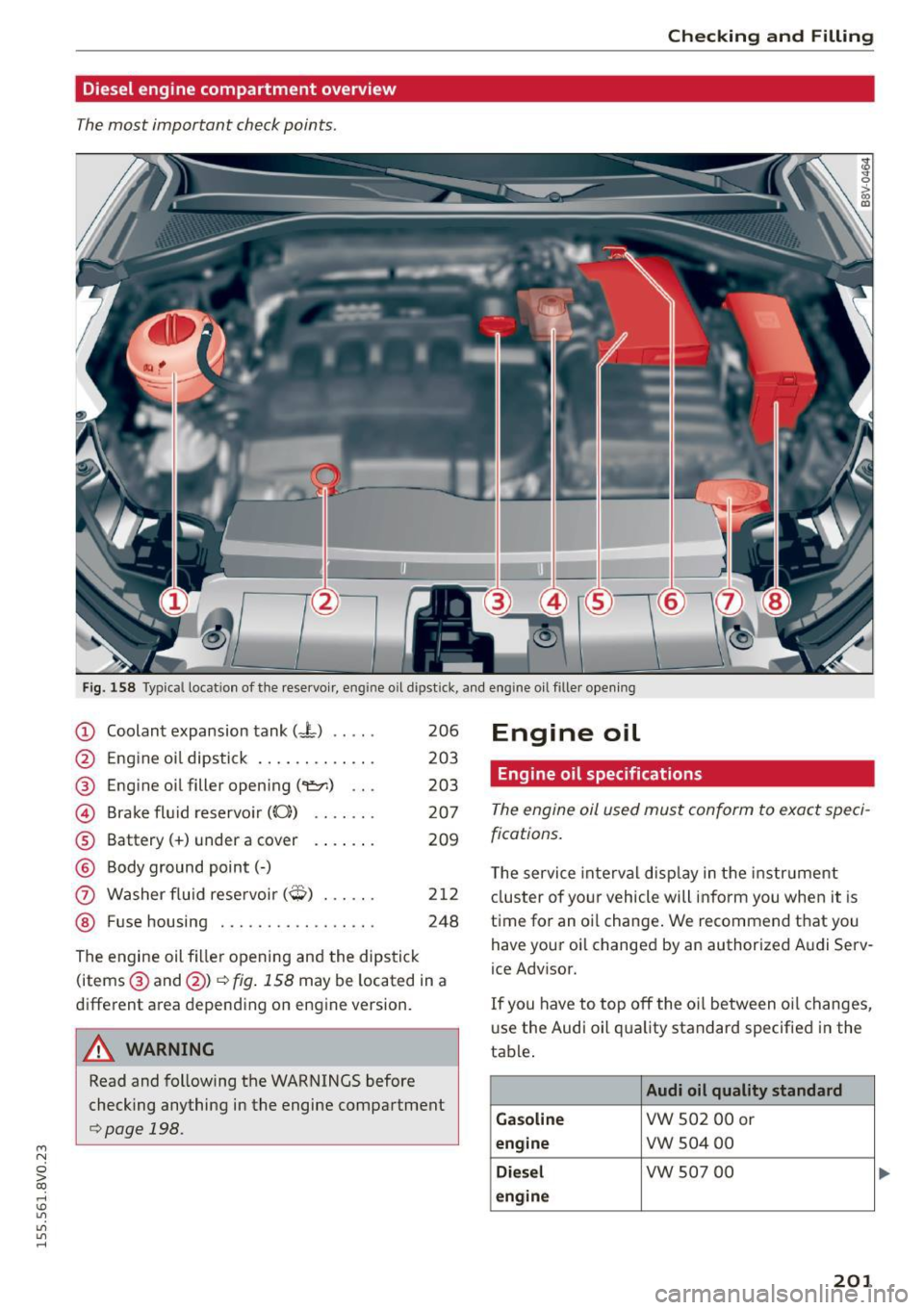
Diesel engine compartment overview
The most important check points .
Fig. 158 Typical locat ion of the reservoi r, eng ine oil dipstick, and engine o il filler opening
CD Coolant expansion tank (-L) .....
@
®
©
®
®
(J)
®
Engine oil dipstick ... ...... ... .
Engine oil filler opening (~) .. .
Brake fluid reservoir
(0))
Battery(+) under a cover
Body ground point(-)
Washer fluid reservoir
(O) ..... .
Fuse housing .......... ...... .
206
203
203 207
209
212
248
The engine oil filler opening and the dipstick
(items ® and @)¢
fig . 158 may be located in a
d ifferent area depending on engine version.
A WARNING
-
Read and following the WARNINGS before
checking anything in the engine compartment
¢page 198.
Engine oil
Engine oil specifications
The engine oil used must conform to exact speci
fications.
T he service interval display in the instrument
cluster of your vehicle will inform you when it is
time for an oi l change. We recommend that you
have your oil changed by an authorized Audi Serv
ice Advisor.
If you have to top off the oil between o il changes,
use the Audi oil qua lity standard specified in the
table .
Audi oil quality standard
Gasoline
VW 502 00 or
engine vw 504 00
Diesel VW 507 00
engine
201
Page 204 of 282
Checking and F ill in g
Using the proper engine o il is important for the
functionality and service life of the engine. Your
engine was factory-fi lled w ith a high-quality o il
which can usually be used throughout the ent ire
year.
@) Note
Your L imited New Vehicle Warranty does not
cover damage or malfunctions due to failure
to follow recommended ma intenance and use
requ irements as set forth in the Audi Ow ne r's
Manual and Wa rranty
& Ma intenance booklet .
- Use only a high quality eng ine oil t hat ex-
pressly comp lies w ith the Audi o il quality
standard specified for your vehicle's e ngine .
Using a ny other oil can cause se rious engine
damage.
- Do not mix any lubricants o r othe r addit ives
i nto the engine oil. Doing so can cause en
g ine damage.
(D Tips
If you need to add oil and there is none availa
ble that meets the Audi o il quality standard
y o ur eng ine requires, you m ay add a total of
no more than 0.5 quart/li ter o f a h igh-quali ty
"synthet ic"oil that meets the fo llowing speci
fications .
- V ehicles wi th gasoline engine: AC EA A3 o r
API SM with a viscosity grade of SAE 0W- 30,
SAE SW -30 or SAE SW-40 .
- Vehicles with d iesel engine: ACEA C3 o r
API CF with a viscosity g rade of SAE 0W-30
or SAE SW-30.
- Fo r more information abo ut engine oi l t h at
has been approved for your vehicle, please
contact either your a uthorized Audi dea ler
or Audi Customer Relations at
1 (800) 822-2834 or visit ou r web site at
www.aud iusa.com or www .aud icanada .ca.
Engine oil consumption
The engine in your vehicle depends on an ade
quate amount of oil to lubricate and cool all of
its moving parts .
In order to provide effective lubrication and cool ing of in ternal engine components, all internal
202
combust ion engines consume a certa in amoun t
of oil. Oil consumptio n varies from engine to en
gine and may change sign ificant ly over the li fe of
the engine . Typically, eng ines with a specif ied
break-in period (see
¢ page 70) consume more
o il dur ing the break-in per iod than they consume
after oil consumption has s tabilized .
Under normal cond itions, the rate of oil con
sump tion depends on the quality and viscos ity of
the oil, the RPM (revolutions per minute) at
wh ich the engine is operated, the ambie nt tem
perature and road cond it ions . Furthe r facto rs a re
t h e amo unt of o il di lution from water conde nsa
t ion or fue l residue and the ox idat ion leve l o f the
o il. As any engine is s ubject to wear as mileage
builds up, the oil consumption may increase ove r
time unt il rep lacement of wo rn components may
become necessary.
With a ll these va riab les coming into p lay, no
standard rate of oil consumption can be estab
li shed or spec ified. There is no alte rnative to reg
ul ar and frequent checking o f the oil leve l, see
Note .
If the yellow engine oi l level warning sym bo l Ill
in the instrument cluster lights up, yo u should
check the o il level as soon as possible
¢ page 203. Top off the oil at your earliest con
venience
¢ page 203.
A WARNING
Before you c heck anythi ng in the eng ine com
partment, always read and heed al l WAR N
IN GS ¢page 198.
(D Note
Driving w it h an insufficient o il level is likely to
cause severe damage to the engine.
(D Tips
- The oil pressure warning d isplay. is not
an indicator of the oil level. Do not rely on
it. Instead, check th e oil level in your en
gine at regular intervals, preferably each
time you refuel , and alway s before going
on a long trip.
Page 206 of 282
Checking and Filling
"' Check the oil level again after two minutes
¢ page 203 , Checking the engine oil level.
"'Add oil, if necessary.
"'Close the engine oil filler cap and push the dip
stick all the way in.
A WARNING
- When adding oil, do not let oil drip onto hot
engine components. There could be risk of a
fire.
- You must secure the cap on the oil filler
opening correctly so that oil does not leak
out onto the hot engine and exhaust system
when the engine is running, because this is
a fire hazard.
- Always clean skin thoroughly if it comes into
contact with engine oil.
(D Note
- Applies to vehicles with gasoline engines:
the oil level cannot be above the
0 range
¢ page 203, fig. 159, because this can
cause damage to the catalytic converter or
the engine. Contact an authorized Audi
dealer or authorized Audi Service Facility to
have excess oil extracted if necessary.
- Applies to vehicles with diesel engines: the
oil level must not be in the
(v range
¢ page 203, fig. 160 -The oil must not be
extracted, because this can damage the en
gine. Drive to an authorized Audi dealer or
authorized Audi Service Facility immediate ly .
- Do not mix any additional lubricants into
the engine oil. Damage cause by such addi
tives is not covered by the warranty.
@ For the sake of the environment
- Oil should never enter the sewer system or
come into contact with the ground.
- Pay attention to legal requirements when
disposing of empty oil containers .
204
· Changing the engine oil
We recommend that have your oil changed by an
authorized Audi dealer or a qualified service sta tion.
Before you check anything in the engine compart
ment,
always read and heed all WARNINGS
¢ page 198.
The engine oil must be changed according to the
intervals specified in your Warranty & Mainte
nance booklet . This is very important because the
lubricating properties of oil diminish gradually
during normal vehicle use.
Under some circumstances the engine oil should
be changed more frequently. Change oil more of
ten if you drive mostly short distances, operate
the vehicle in dusty areas or under predominantly stop-and-go traffic conditions, or have your vehi
cle where temperatures remain below freezing
for extended periods.
Detergent additives in the oil will make fresh oil
look dark after the engine has been running for a
short time. This is normal and is not a reason to
change the oil more often than recommended.
Because of the problem of proper disposal, along
with the special tools and necessary expertise re
quired, we strongly recommend that you have
your oil changed by an authorized
Audi dealer or
a qualified service station.
If you choose to change your oil yourself , please
note the following important information:
A WARNING
To reduce the risk of personal injury if you
must change the engine oil in your vehicle
yourself:
- Wear eye protection.
-
- To reduce the risk of burns from hot engine
oil, let the engine cool down to the touch.
- When removing the oil drain plug with your
fingers, stay as far away as possible. Always
keep your forearm parallel to the ground to
help prevent hot oil from running down your
arm.
Page 209 of 282
with the ignition off. It can even switch on again
l ater by itself~.& , if
- the temperature of the engine coolant rises due to the heat bui ld-up from the eng ine in the en
gine compartment, or
- the engine compar tment heats up because the
vehicle is parked in intense sunlight.
A WARNING , --
- To reduce the risk of personal injury never
touch the radiator fan.
- The auxiliary e lectric fan is temperature con
trolled and can switch on suddenly even
when the engine is not running.
- The aux iliary radiator fan switches on auto
matically when the engine coo lant reaches a
certain temperature and will continue to run
until the coolant temperature drops.
Brake fluid
Checking brake fluid level
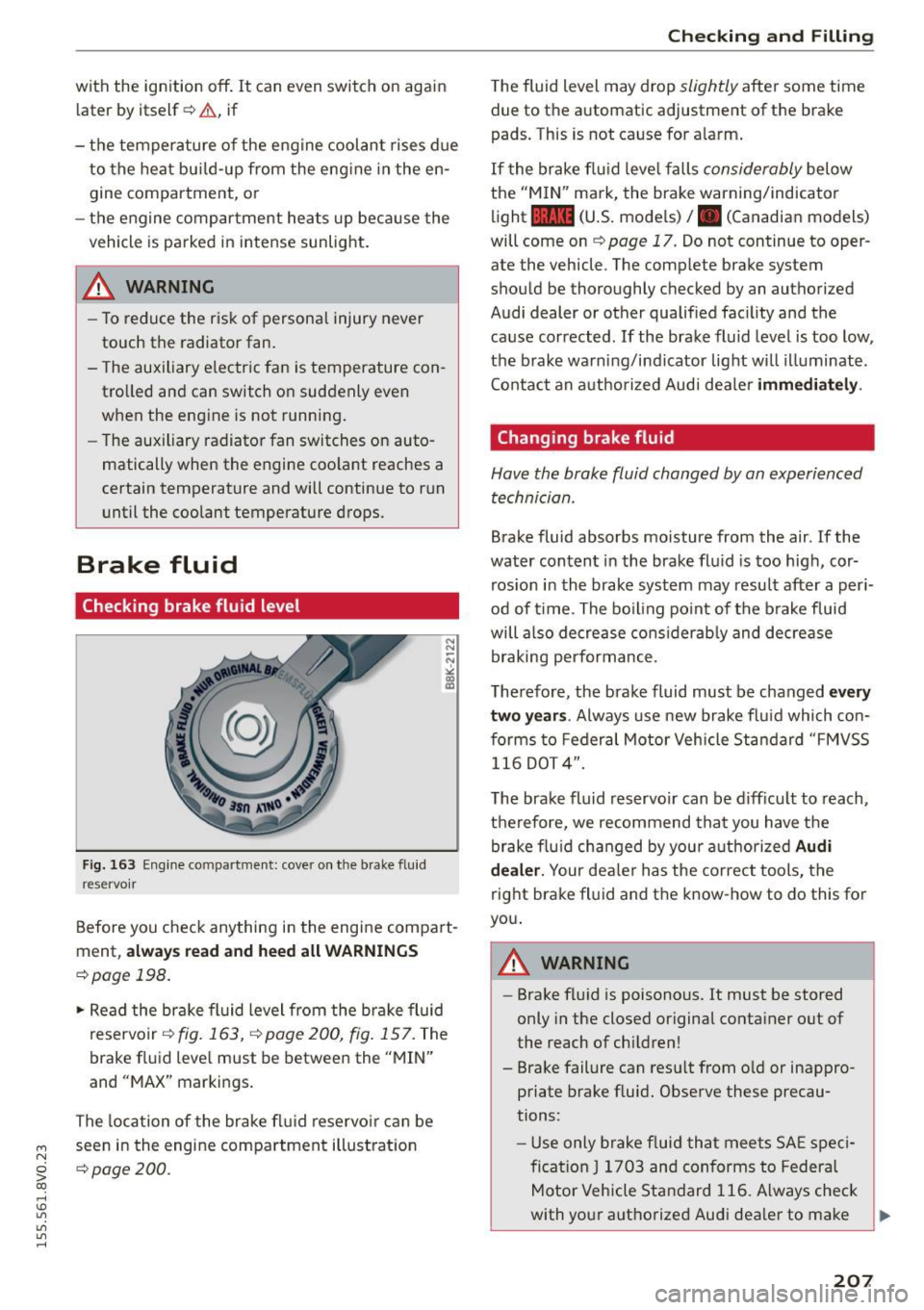
Fig. 163 Engine compa rt m ent: cove r on the brake fluid
reservo ir
N N -N
"' :ll
Before you check anything i n the engine compa rt
ment,
al ways re ad and h eed all W ARN INGS
~page 198.
... Read the brake fluid level from the b ra ke fluid
reservoir
r¢ fig. 163, r:¢ page 200, fig. 157. The
brake f luid leve l must be between the "MIN"
and "MAX" markings.
The location of the brake fl uid reservo ir can be
...., seen in the engine compartment illustration
N
~ r¢ page 200.
co
rl I.O
"'
"'
"'
rl
Check in g and Fillin g
The fluid level may drop slightly after some time
due to the automatic adjustment of the brake
pads . This is not cause for a larm.
If the brake f luid leve l falls considerably below
the "MIN" mark, the brake warning/indicator
light
1111 (U.S. mode ls) I. (Canadian models)
will come on
~ page 17. Do not continue to oper
ate the vehicle . The comp lete brake system
should be thoroughly checked by an authorized
Audi dealer or other qualified fac ility and the
cause corrected . If the brake flu id level is too low,
the brake warning/indicator light wi ll illuminate .
Contact an a uthorized Audi dea ler
immedi ate ly .
Changing brake fluid
Have the brake fluid changed by an experienced
technician.
Brake fluid absorbs moisture from the air. If the
water content in the brake flu id is too hig h, cor
ros ion in the brake system may result after a per i
od of t ime. The bo iling po int of the brake fluid
will a lso decrease cons iderab ly and decrease
braking performance.
Therefore, the brake fluid must be changed
e ve ry
tw o years .
Always use new brake flu id which co n
forms to Federal Motor Vehicle Standard "FMVSS
116 DOT 4".
The brake fluid reservoir can be diff icu lt to reach,
therefore, we recommend tha t you have the
brake flu id changed by you r authorized
Audi
de aler.
Your dea le r has the correct tools, the
right brake fluid and the know-how to do this for
you .
A WARNING
- -
-Brake flu id is poisonous. It must be stored
only in the closed original conta iner out of
the reach of children !
- Brake failure can resu lt from o ld or inappro
priate brake fluid. Observe these precau
tions:
- Use only brake fluid that meets SA E spe ci
ficat ion
J 1703 and conforms to Federa l
Motor Vehicle Standard 116. Always check
with your a uthorized Audi dea ler to make
~
207
Page 210 of 282
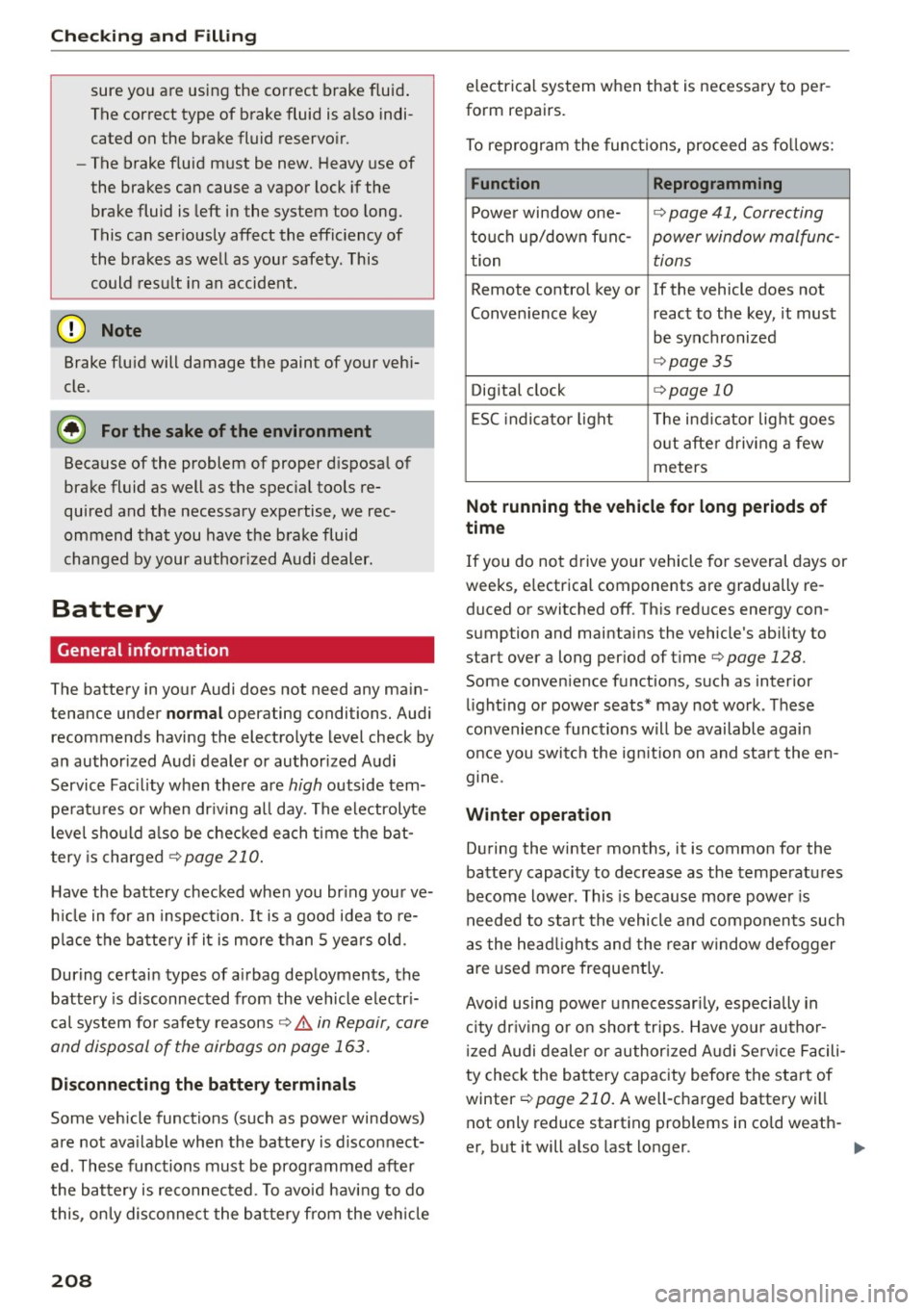
Checking and F ill in g
sure you are using the correct brake f luid .
The correct type of brake fluid is also indi
cated on the brake fluid reservoir .
- The brake fluid must be new. Heavy use of
the brakes can cause a vapor lock if the
brake fluid is left in the system too long.
This can ser iously affect the effic iency of
the brakes as well as your safety . This
could res ult in an accident.
(D Note
Brake flu id will damage the paint of your vehi
cle .
@ For the sake of the environment
Because of the problem of proper d isposa l of
brake fluid as well as the spec ia l tools re-
quired and the necessary expertise, we rec
ommend tha t you have the b rake fluid
changed by your author ized Audi dealer.
Battery
General information
The battery in yo ur Audi does not need any ma in
tenance under normal operating conditions. Aud i
recommends having the electro lyte level check by
an author ized Audi dealer or author ized Audi
Service Fac ility when the re a re
high outside tem
pe ratu res or when dr iv ing a ll day. The electroly te
leve l sho uld also be checked ea ch t ime the bat
t ery is charged
9 page 210 .
Have the battery checked when you br ing you r ve
hicle in fo r an inspec tio n. It is a good idea to re
p la ce the batte ry if i t is more than 5 ye ars old .
During certai n types of a irbag dep loyments, the
battery is disconnect ed from the vehicle electr i
cal system fo r safety reasons
9 .&. in Repair, care
and disposal of the airbags on page 163.
Disconnecting the battery terminals
Some veh icle functions (such as power windows)
are not ava ilable when the batte ry is disco nnect
ed. These functions must be programmed after
the ba ttery is reconnec ted. To avoid havi ng to do
t his , on ly disconnect the b attery from the veh icle
208
electrica l sys tem when that is necessa ry to pe r
form repairs.
To reprogram the func tion s, proceed as fo llows:
Function Reprogramming
P owe r window one-
9 page 41, Correcting
to uch up/down f unc-power window malfunc-
tion tions
Remote control key o r If the vehicle does not
Conve nience key reac t to the key , it must
be synchronized
9 page 35
Digita l clock 9 page 10
ESC indi cato r light The ind icator lig ht goes
o ut afte r driving a few
meters
Not running the vehicle for long periods of
time
If you do not d rive yo ur vehicle for several days or
weeks, e lectr ica l components are gradua lly re
duced or switched off. Th is red uces energy con
s u mption and maintains the vehicle's ability to
start over a long per iod of t ime ¢
page 128.
Some conven ience functions , such as inter ior
li ght ing or power seats* may not wo rk . These
convenienc e functions w ill be availabl e agai n
o nce you swi tch the ig nition on and sta rt the en
gine.
Winter operation Du ring the winter months , it is common for the
batte ry capaci ty to dec rease as the tempe rat ur es
become lower . This is because more powe r is
needed to start the vehicle and componen ts such
as the he ad lights and the rear window defogger
are used more frequent ly.
Avoid using powe r unnecessar ily, especially in
c ity dr iv ing o r o n short trips . H ave yo ur au thor
iz ed Audi de aler or author ized A udi Se rv ice Facili
ty check the ba ttery capacity before the start of
winter ¢
page 210. A well-charged battery will
not only reduce starting problems in co ld weath
er, but it will a lso last longer .
Page 214 of 282
Checking and Filling
of vehicle batteries improperly is very danger
ous to the environment.
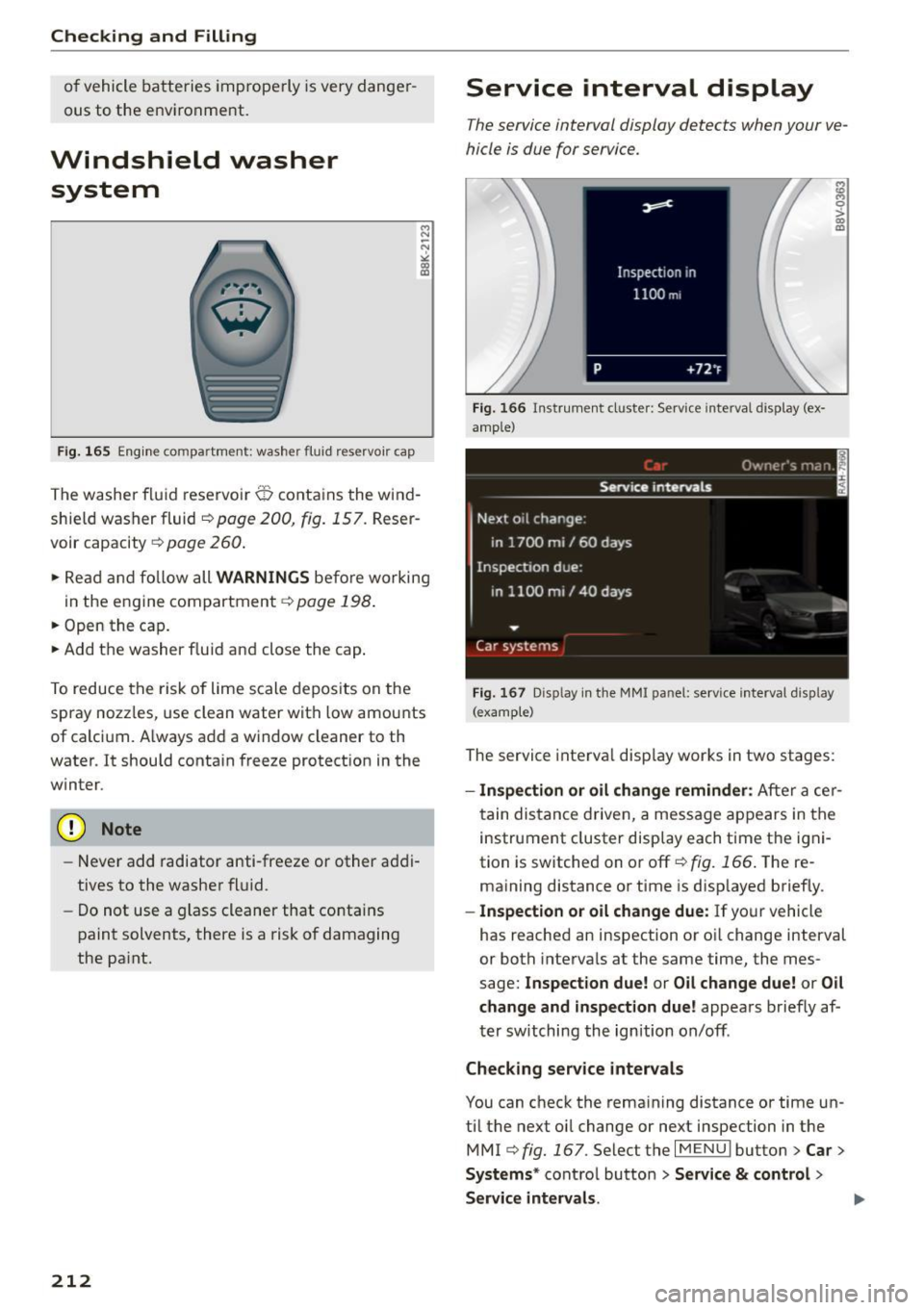
Windshield washer system
F ig . 165 Eng ine compartment: washer fluid reservoir cap
M
"' -')'
"" 00 a,
The washer fluid reservoir O contains the wind
shield washer fluid¢ page 200, fig. 157. Reser
voir capacity¢ page 260.
"' Read and follo w all
WARNINGS before working
in the engine compartment ¢page
198 .
... Open the cap .
... Add the washer f luid and close the cap .
To reduce the risk of lime scale depos its on the
spray nozzles, use clean water with low amounts
of calcium. Always add a window cleaner to th
water. It should contain freeze protection in the
winter.
(D Note
- Never add radiator anti-freeze or other addi
tives to the washer fluid.
- Do not use a glass cleaner that contains
paint solvents, there is a risk of damaging
the pa int.
212
Service interval display
The service interval display detects when your ve
hicle is due for service.
Fig. 166 Instrument cluster: Service interval display (ex·
amp le)
Fig. 167 Display in the MMI panel: service interval display
(example)
l6 M 0 ;:;. co m
The service interval display works in two stages:
-Inspection or oil change reminder: After a cer
tain distance driven, a message appears in the
instrument cluster display each time the igni
tion is switched on or off¢ fig. 166. The re
maining distance or time is disp layed briefly.
- Inspection or oil change due: If your vehicle
has reached an inspection or oi l change interval
or both intervals at the same time, the mes
sage:
Inspection due! or Oil change due! or Oil
change and inspection due!
appears briefly af
ter switching the ignition on/off.
Checking service intervals
You can check the rema ining distance or time un
til the next oil change or next inspection in the
MMI
¢ fig. 167. Select the I MENU I button> Car>
Systems*
control button > Service & control >
Service intervals.