heating AUDI S3 SEDAN 2015 User Guide
[x] Cancel search | Manufacturer: AUDI, Model Year: 2015, Model line: S3 SEDAN, Model: AUDI S3 SEDAN 2015Pages: 282, PDF Size: 71.14 MB
Page 91 of 282
....,
N
0 > co
rl I.O
the malfunction corrected. If the indicator light
and the driver message do not turn off, do not
continue dr iv ing. See an authorized Audi dealer
or authorized Audi Service Facility for assistance .
rm Transmission malfunction: you can continue
driving
Drive to an authorized Aud i dealer or authorized
Aud i Service Facility immediately to have the
malfunction corrected.
rm Transmission malfunction: no reverse gear
(you can continue driving)
Drive to an authorized Aud i dealer or authorized
Audi Service Fac ility immediately to have the
malfunction corrected.
rm Transmission malfunction: You can continue
driving in D until engine off
Drive the vehicle away from moving traffic and
park. See an authorized Audi dealer or authorized
Audi Service Fac ility for assistance.
rm Transmission overheating! Please adapt
driving style
Continue driving moderate ly. When the indicator
light turns off, you can continue driving normally.
rm Transmission: Please press brake pedal and
select gear again
If the transmission malfunctions because the
temperature is too high, a message appears
when the transmission is coo led.
Selector lever emergency re lease
Appl ies to vehicles: with S tronic transm ission
If the vehicle's power supply foils, the selector
lever can be released in an emergency.
"'
"'
"' Fig. 77 Selector lever: removing the cove r rl
Automatic transmission
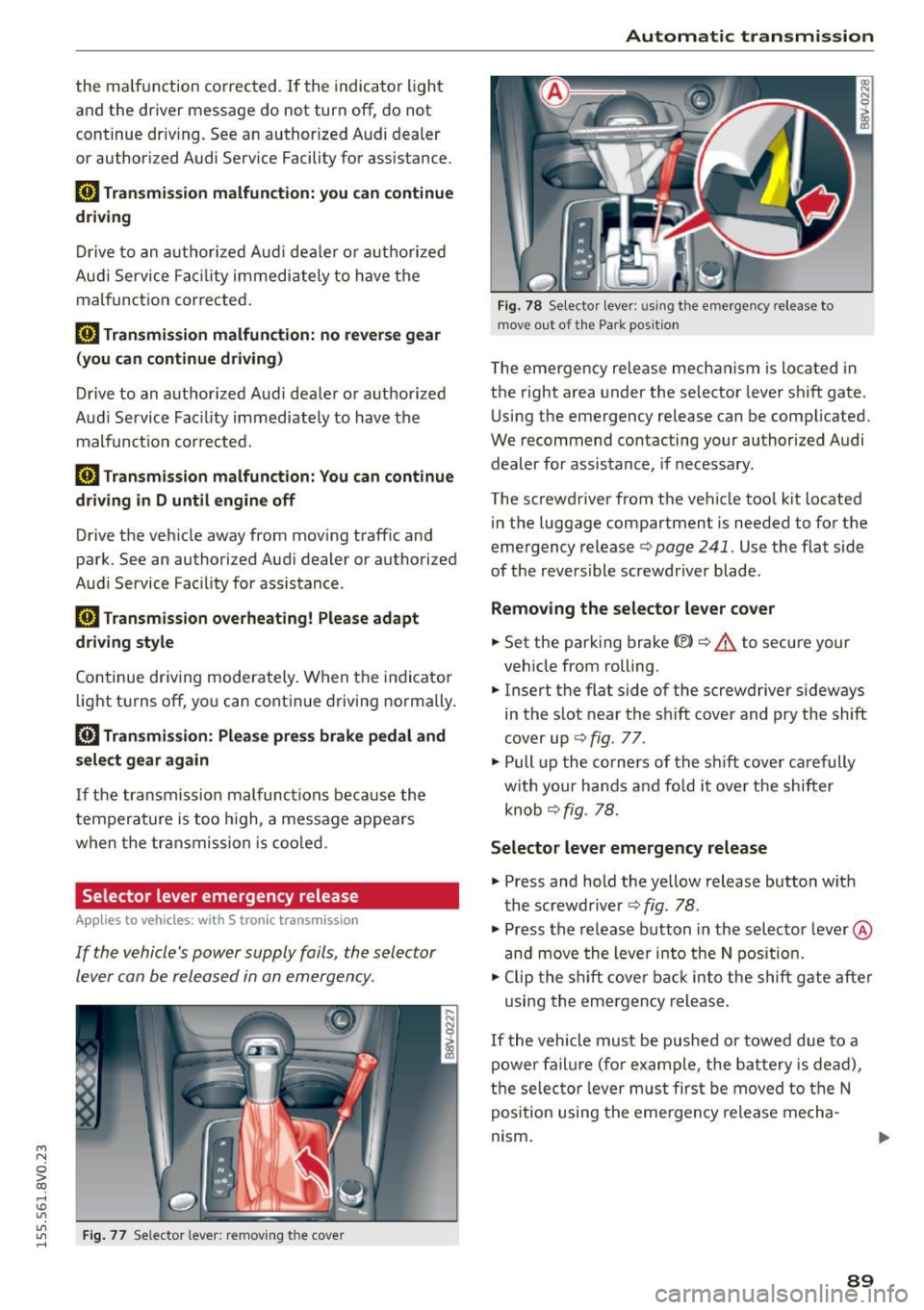
Fig. 78 Selector lever: u sing the emergency release to
move out of the Park position
The emergency release mechanism is located in
the right area under the selector lever shift gate.
Using the emergency release can be complicated.
We recommend contacting your authorized Audi dealer for assistance, if necessary.
The screwdriver from the vehicle too l kit located
in the luggage compartment is needed to for the
emergency release
c> page 241. Use the flat side
of the reversible screwdriver blade .
Removing the selector lever cover
.. Set the parking brake «Ell c> A to secure your
vehicle from rolling.
.. Insert the flat side of the screwdriver s ideways
in the slot near the shift cover and pry the shift
cover up ¢
fig. 77 .
.. Pull up the co rners of the sh ift cover carefully
with your hands and fo ld it over the shifter
knob ¢
fig. 78.
Selector lever emergency release
.. Press and hold the yellow release button with
the screwdriver ¢
fig. 78.
.. Press the release button in the selector lever ®
and
move the lever into the N position.
.. Clip the shift cover back into the shift gate after
using the emergency release.
If the vehicle must be pushed or towed due to a
power failure (for example, the battery is dead),
the selector lever must first be
moved to the N
position using the emergency release mecha
nism .
89
Page 97 of 282
....,
N
0 > co
rl I.O
"'
"'
"'
rl
-Please note that unconsciously "resting"
your foot on the accelerator pedal prevents the cruise control from braking. This is due
to the control system be ing overr idden by
the driver 's acceleration .
-If there is a b rake system malfunction such
as overheating when the speed warning sys
tem is switched on, the braking function in
the system will be deactivated. The remain
ing speed warni ng system fu nctions will re
ma in active, as long as the~ (USA mod
els) /. (Canada models) indicator light is
on .
{i) Tips
-The cruise cont ro l system is idea l for
stretches with speed limits. The driver i s re
spons ible for adhering to the cor rect speed.
- The cruise cont ro l rema ins active when
s hift ing ge ars.
- The brake lights turn on when the bra kes
are activated.
Switching on
Applies to vehicles: with c ruise contro l system
0
f
®t
0
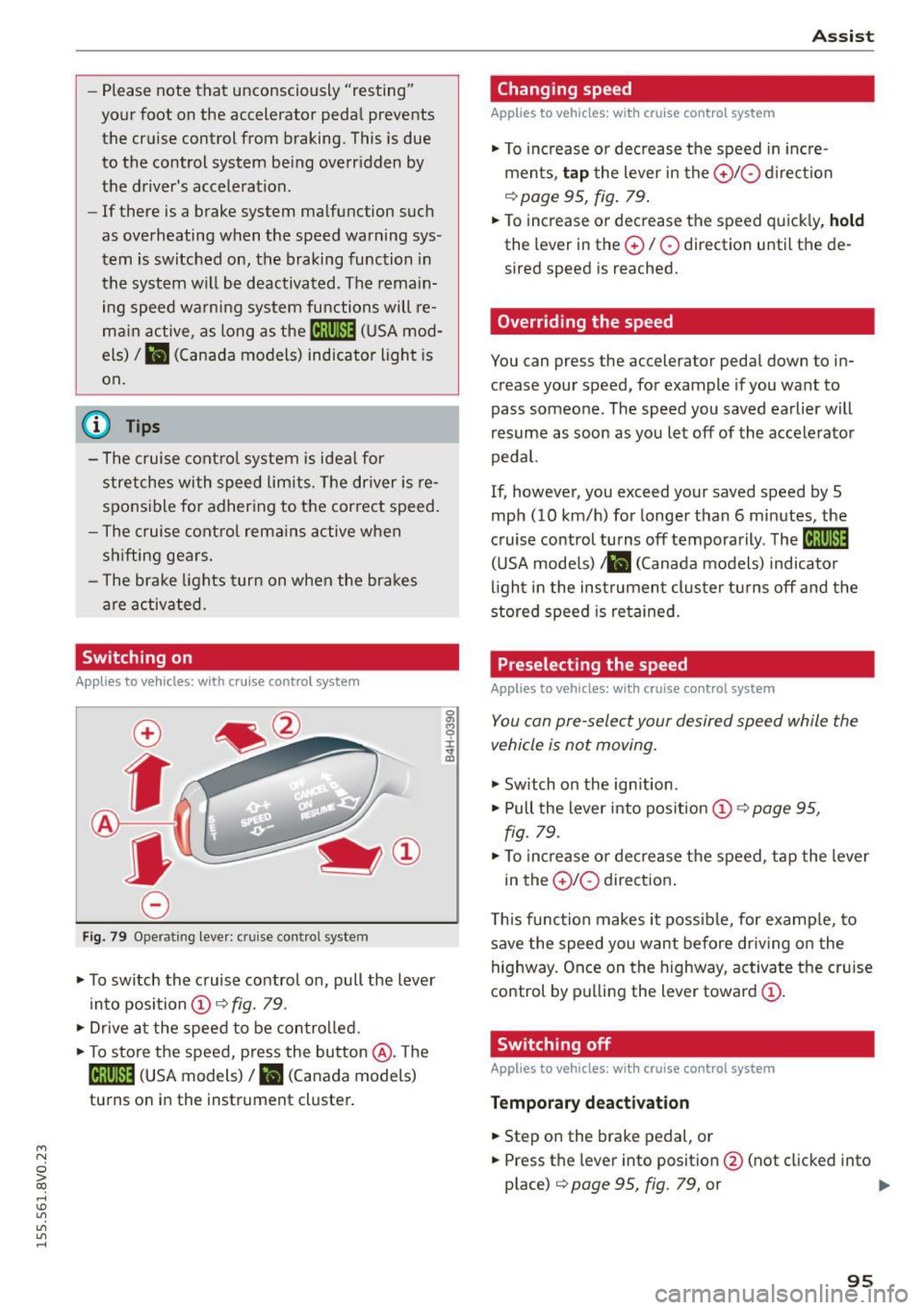
Fi g. 7 9 Operating leve r: cruise co ntro l system
.. To switch th e cruise control on, pull the lever
in to posi tion @~
fig. 79 .
., Drive a t the speed to be con trolled.
.. To store the speed, press the button @. T he
[ij;\1)~14 (USA models)/ Ii.I (Canada models)
tu rns o n in the instrument cluster.
A ssi st
Changing speed
Applies to vehicles: with cruise control system
., To increase o r dec rease the speed in in cre
ments,
tap t he lever in the 0 10 d ire ct io n
q page 95, fig . 79 .
.. To increase or decrease the speed quick ly, hold
the lever in the 0 / 0 direction u ntil the de
sired speed is reached.
Overriding the speed
You can press the accelerator pedal down to in
crease your speed, for example if you want to
pass someone. The speed you saved earlier will
resume as soon as you let off of the accele rato r
pedal.
If, howeve r, you exceed your saved speed by 5
mph (10 km/h) for longe r than 6 minutes, the
c ruise control turns off temporarily . The
M;\1)~14
(U SA mode ls) ;lB (Canada models) indicator
li ght in the instrumen t cluster t urns off and the
stored speed is re tained.
Preselecting the speed
Applies to vehicles: with cruise control system
You can pre-select your desired speed while the
vehicle is not moving.
., Switch on the ign ition .
.. Pull the lever into pos ition
(D 9 page 95,
fig. 79 .
., To increase or de crease t he speed, tap the lever
in the
0 10 direction .
T his function makes it poss ible, for examp le, to
save the speed you want before dr iv ing o n the
highway. Once on the h ighway, activa te the cru ise
control by p ulling the lever toward
(D .
Switching off
Appl ies to vehicles: with cruise cont rol system
Temporary deactivat ion
.. Step on the brake pedal, or
.. Press the lever into position @(not clicked into
place)
q page 95, fig. 79, or ..,
95
Page 125 of 282
M N
0 > co ,...., \!) 1.1"1
1.1"1
1.1"1
,....,
shared, please see your contract with the
wireless telecommunications provider and the
"About Aud i connect" tab in your vehicle's
MMI: ! MENUI button> Audi connect > About
Audi connect .
Electronic stabilization
control (ESC)
Description
The E lectronic Stabilization Contro l (ESC) reinfor
ces driver safety. It reduces the risk of slipping
and improves driving stability. ESC detects criti
cal s ituations such as the vehicle oversteering
and understeering or the wheels a re spinning.
The vehicle is stabilized by applying the brakes or
reducing engine torque. Once the ESC is activat
ed, the indicator light
DJ blinks in the instru
ment cluster.
The fol low ing systems a re integrated in the ESC:
Anti-lock braking system (ABS)
ABS prevents the wheels from locking when brak
i ng. The vehicle can still be steered even during
hard braking . Apply steady pressure to the brake
pedal. Do not pump the pedal. A pulsing in the
brake pedal ind icates that the system is acting to
stabilize the vehicle .
Brake assist system
The brake assist system can decrease braking d is
tance . It increases braking power when the driver
presses the brake pedal quickly in emergency s it
uations. You must press and hold the brake pedal
unti l the dangerous sit uation is ove r. In vehicles
with adaptive cruise control *, the brake assist
system is more sensit ive if the distance detected
to the vehicle ahead is too small.
Anti-slip regulation (ASR)
ASR reduces engine power when the drive whee ls
begin spinning and adapts the force to the road
conditions. This makes it easier to start, acceler
ate and drive up inclines.
Intelligent Technology
Electronic differential lock (EDL)
The EDL brakes whee ls that are spinning and
trans fers the drive power to the other drive wheel
or whee ls if the vehicle is equipped with all wheel
drive*). This function is not available at higher
speeds.
In extreme cases, EDL automatically switches off
to keep the brake on the braked wheel from over
heating. The vehicle is still working correct ly. EDL
will switch on again automatically when condi
tions have returned to normal.
Steering recommendation
The ESC helps to stabilize the vehicle by changing
the steering torque .
Selective wheel torque control
Selective wheel torque control is used when dr iv
i ng on curves. The front wheel on the inside of
the curve o r both wheels on the inside of the
curve are braked selectively as needed . This al
lows more precise driving in curves .
Automatic post-collision braking system
The "Automat ic post -collision braking system"
can help to reduce the ris k of sliding and of other
collisions after an accident. If the airbag control
module detects a collision above a certain vehicle
speed, the vehicle is braked by the ESC.
T he vehicle does not brake automatically if:
- the driver presses the accelerator pedal, or
- the braking force generated by the pressed
brake pedal is greater than the brak ing force
that would be initiated by the system, or
- the ESC, the brake system or the vehicle electr i
cal system are not funct ion ing .
A WARNING
-The ESC and its integrated systems cannot
overcome the limits posed by natural phys i
cal laws. This is especially important on slip
pery or wet roads .
If the systems begin act
ing to stabilize your vehicle, you should im-
mediately a lter your speed to match the ..,.
123
Page 131 of 282
M N
0 > co ,...., \!) 1.1'1
1.1'1
1.1'1
,....,
With the engine switched off
The battery will dra in if you use functions s uch as
listening to the radio while the engine is switched
off.
The vehicle 's ability to start may be impaired by
the energy use, a message w ill appear in the In
fotainment system disp lay.
The message ind icates that the system will
switch off automatically soon.
If you would like
to continue using the functions, you must start
the eng ine.
With the engine running
Although electrical energy is generated wh ile
driving, the batte ry can drain. This can happen
when little energy is gene rated, and much is used
and the charge level of the battery is not optima l.
To restore the balance of energy, components
that require large amounts of energy are tempo
r ar ily sca led back or switched off. Heating sys
tems in particular require a great deal of energy.
If you notice, for example, that the seat heating*
or rear window defroster is not working, then it
has been temporari ly reduced or switched off .
These systems are avai lab le aga in as soon as the
energy balance has been restored.
In addition, you may notice that the idle speed
has slightly increased . That is normal and no
cause for concern. Due to the increased idling
speed, the add itional required energy w ill be gen
erated and the battery will be charged .
Intelligent Technology
129
Page 193 of 282
fill up at busy gas stations where the seasonal
adjustment is more likely to be made in time.
(D Note
- Methanol f uels which do not meet these re
quirements may cause corrosion and dam
age to plastic and rubber components in the
fuel system.
- Do not use fue ls that fail to meet the speci
fied criteria in this chapter.
- If you are unable to determine whethe r o r
not a particular fue l blend meets the speci
fications, ask your service station or its fuel
supplier.
- Do not use fuel for which the contents can
not be identified.
- Fuel system damage and performance prob
lems resulting from the use of fue ls differ
ent from those specified are not the respon
s ibility of Audi and are not covered under
the New Vehicle or the Emission Control
System Warranties.
- If you experience a loss of fuel economy or
driveability and performance problems due
to the use of one of these fuel b lends, we
recommend that you sw itch to unb lended
fuel.
Gasoline additives
A ma jor concern among many auto manufactur
ers is carbon deposit build-up caused by the type
of gasoline you use.
Although gasol ine grades differ from one manu
facture r to another, they have certa in things in
common . All gasoline grades contain substances
that can cause deposits to collect on vita l engine
parts, such as fue l injectors and intake valves. A l
though most gasoline brands include additives to
keep engine and fuel systems clean, they are not
equally effective .
Audi recommends using TOP TIER Detergent Gas
oline. For more information on TOP TIER Deter-
"' gent Gasoline, please go to the off icial webs ite
N
~ (www .toptiergas.com).
co ,...., \!) 1.1'1
1.1'1
1.1'1
,....,
Checking and Fillin g
After an extended period o f using inadeq uate
fuels, carbon deposit build-ups can rob your en gine of peak performance .
(D Note
Damage or malf u nction due to poor fuel qual
ity is not cove red by the Audi New Vehicle
Limited Wa rranty.
Diesel fuel
Applies to vehicles: with diesel engine
Always use ULSD (Ultra Low Su lfur Diesel) No. 2 .
The ULSD No. 2 meets the ASTM 0975.
Diesel fuel w ith concen tra tions of biodiese l hig h
er than 5
% such as Bl 1, B20 or 8100 are strictly
prohibited .
Se rv ice stat io n fue l pumps a re labe led with the
correct fue l information for easy recognit ion by
the user .
If the diese l fue l pump is not labe led
ask the station operator w hat fue l is being dis
pensed before fi lling up your vehicle.
UL SD No. 2 may not be available outside the USA
and Canada . Be sure to check before traveling to
other countr ies .
UL SD No. 2 can become thicke r in very cold tem
pera tures, and th is can impa ir t he engine's start
ing and running. Depending on the season, gas
stations provide ULSD No . 2 that flows better in
cold temperatures so that you can continue oper
at ing your vehicle as usual.
@ Note
- Yo ur vehicle's diesel engine was designed
soley for use with ULSD No. 2. Therefore,
never use gasoline, heating oil, other fuels
or flow improvers. These conta in substances
that will severe ly damage the fuel system
and the engine . Such damage will not be
covered by you r New Veh icle Limited War
ranty.
- If you put any amount of incorrect fuel i n
the fuel tank, do not start the eng ine under
any circumstances. Immediate ly co ntact t he
nearest authori zed Aud i dealer or autho r
ized Aud i Service Fac ility for assistance .
191
Page 197 of 282
M N
0 > co ,...., \!) ..,.,
..,.,
..,., ,....,
The catalytic conve rter is an efficient "clean -up"
device bui lt into the exhaust system of the vehi
cle. The catalytic converter burns many of the
pollutants in the exhaust gas before they are re
leased into the atmosphere.
The exclusive use of unleaded fue l is critically im
portant for the life of the catalytic converter and
proper functioning of the engine .
A WARNING
The temperature of the exhaust system is
high, both when driving and after stopping
the engine.
- Never touch the exhaust tail pipes once they
have become hot. This could result in burns.
- Do not park or operate the vehicle in areas
where the hot exhaust system may come in contact with dry grass, brush, fue l spill or
other material which can cause a fire .
- Do not apply additional undercoating or
rustproofing on o r near the exha ust man i
fold, exhaust pipes, catalyt ic converte r or
heat s hields. Dur ing driv ing, the subs tance
u5ed for undercoating could overheat and
cause a fire .
(D Note
-Be awa re that just one tank f illing wit h lead
ed
f uel will a lready se riously degrade the
performance of the c ata lytic conver ter.
- Do not exceed the co rrect engine oil leve l
9page203.
-Do not d rive until the fuel tank becomes
complete ly empty. The eng ine could misfi re.
U nburned f uel co uld also ge t in to the e x
haust system and this could ca use the cata
l ytic converter to overheat.
- Do no t sw itch off the ignition wh ile the vehi
cle is moving.
- Do not con tinue to oper ate yo ur vehicle un
der these cond itions, as o therwise fue l can
r each the catalytic converte r. This cou ld re
su lt in overheating of the converter, requir
i ng its replacement.
- To assure efficient ope ration of the Emission
Control System:
Checking and Fillin g
- Have your vehicle maintained properly and
in accordance with the serv ice recommen
dat ions in yo ur Warranty
& Maintenance
booklet.
- Lack of prope r maintenance as we ll as im
p roper use of the vehicle will impair the
f u nction of the emission control system
and could lead to damage.
@ For the sake of the environment
Even when the Emission Control System is op
erating properly, the exha ust gas can have a
su lfur-like exhaust gas sme ll under some op
erating states. Th is depends on the s ulfur
content of the fuel b eing used. Us ing a diffe r
ent bra nd of fue l may he lp, or fi lling the tank
wi th lead-free su per grade gaso line.
Diesel particulate filter
App lies to vehicles: wit h diese l eng ine
T he diese l part icu late filter filters nearly all of
the soot pa rticles ou t of the exha ust. The filter
cl ea ns itself a utoma tic all y unde r no rm al driving
con dit ions. If the filte r cannot clean itse lf (for ex
amp le, because yo u are only driving sho rt distan
ces), th e fi lter becomes clogged with soot and
the
II symbol for the diese l partic ulate filter il
l uminates
9page 22.
A WARNING
-Do not park your veh icle over flammable
materials such as grass or leaves because
the high temperature of the diesel part icu
la te filte r could sta rt a fi re.
-
- Do not app ly an underbody protectant in the
exhaust system area or a fire cou ld start.
Selective catalytic
reduction
General information
App lies to vehicles: wit h diese l eng ine
In veh icles with selective catalytic reduction, a
u rea solution (AdBlue) is injected into the ex
haust system before a nitrogen oxide cata lytic
conve rter to redu ce nitrogen emissions.
195
Page 207 of 282
M N
0 > co ,...., \!) ..,.,
..,.,
..,., ,....,
-Drain th e oi l into a container desi gned for
this purpose, one large enough to ho ld at
least the total amount of oil in your engine .
- Engine oil is poisonous . Keep it well out of
the reach of children.
- Continuo us contact with used engine oil is
harmful to your sk in. A lways protect your
sk in by washing oil off thoroughly w ith soap
and water.
(D Note
Never mix oi l addit ives with your engine oi l.
These additives can damage your eng ine and
adversely affect your Audi Limited New Veh i
cle Warranty .
@) For the sake of the environment
-Before changing your oi l, f irst make sure
you know where you can properly dispose of
the used oil.
- Always d ispose of used engine oil proper ly.
Do not dump it on garden soil, wooded
areas, into open streams or down sewage
d rains .
- Recycle used e ngine oi l by taking it to a used
engine oil collection facility in your area, or
contact a service station .
Cooling system
Coolant
The engine coolant performs two functions: it
keeps the engine from overheating and it pro
tects the engine from freezing in the winter.
The cooling system is sea led and generally re
q ui res lit tle atten tion.
The cooling system has been filled at the factory
w ith a pe rma nen t coolan t which does no t need to
be ch anged . T he coolant consists o f a mixture o f
specia lly condit ioned wa ter and the man ufactu r
er's glycol -based coolant additive Gl3 antifreeze
with anticor rosion add itives (SO% for USA mod
e ls · 60% for Canadian models) . Th is m ixture bot h
'
assures the nece ssary fros t protection and p ro-
tects meta l components in the engine 's cooling
Checking and Fillin g
system from corrosion and scaling . It also raises
t h e boiling point of the coo lant .
D o no t redu ce the con cen tra tion of the coolan t in
the summer by ad ding plain water.
The prop or
tion of coolant additive mu st be at least 50%
but not more than 60%
to maintai n antifr eeze
protection and cooling efficiency . If the coo lant
frost pro tec tion is too low, the coo lant co uld
freeze and damage the vehicle heating and en
gine cooling system .
For year- ro und driving, antifreeze is added at the
factory for temperatures down to :
-- 31°F(-3S° C)USA
- -40 °F ( - 40 ° C) C anada.
If you must add coolant, use a mixture of water
and coolant additiv e. Mix ing the coo lant add it ive
with dis tilled wa te r is recommended .
A WARNING
Befo re you c hec k anythi ng i n the engi ne com
partment, always re ad and heed a ll WA RN
IN GS
~page 198.
(D Note
- Befor e wi nter sets in , have the coo la nt
c hecke d to see if the cool an t additive in you r
vehicle is sufficient to meet the climate con
ditions . This is espec ia lly impo rtant if you
live in a region where the winter is extreme
ly cold . If necessary, increase the proportion
of coolant additive to 60%.
- When adding coolant additive to yo ur cool
ing system, remember:
- We recommend us ing o nly coo la nt addi
tive G12 ++ o r G13 ( che ck the label) fo r
your ve hicl e. This coolant addi tive is av ail
a ble at autho rized Aud i dea le rs . Othe r
types of ant ifreeze can significant ly re
d uce corrosion protection. The resulting
corrosion can ca use a loss o f coolant and
serious engine damage.
- Do not add any type of rad iator leak sealant
to y our vehicle's engine coolant. Adding ra
diator repa ir fluid may adversely affect the
function and perfo rmance of your cooling .,,.
205
Page 208 of 282
Checking and Fill in g
system and could result in damage not cov
ered by your New Vehicle Limited Warranty.
Adding coolant
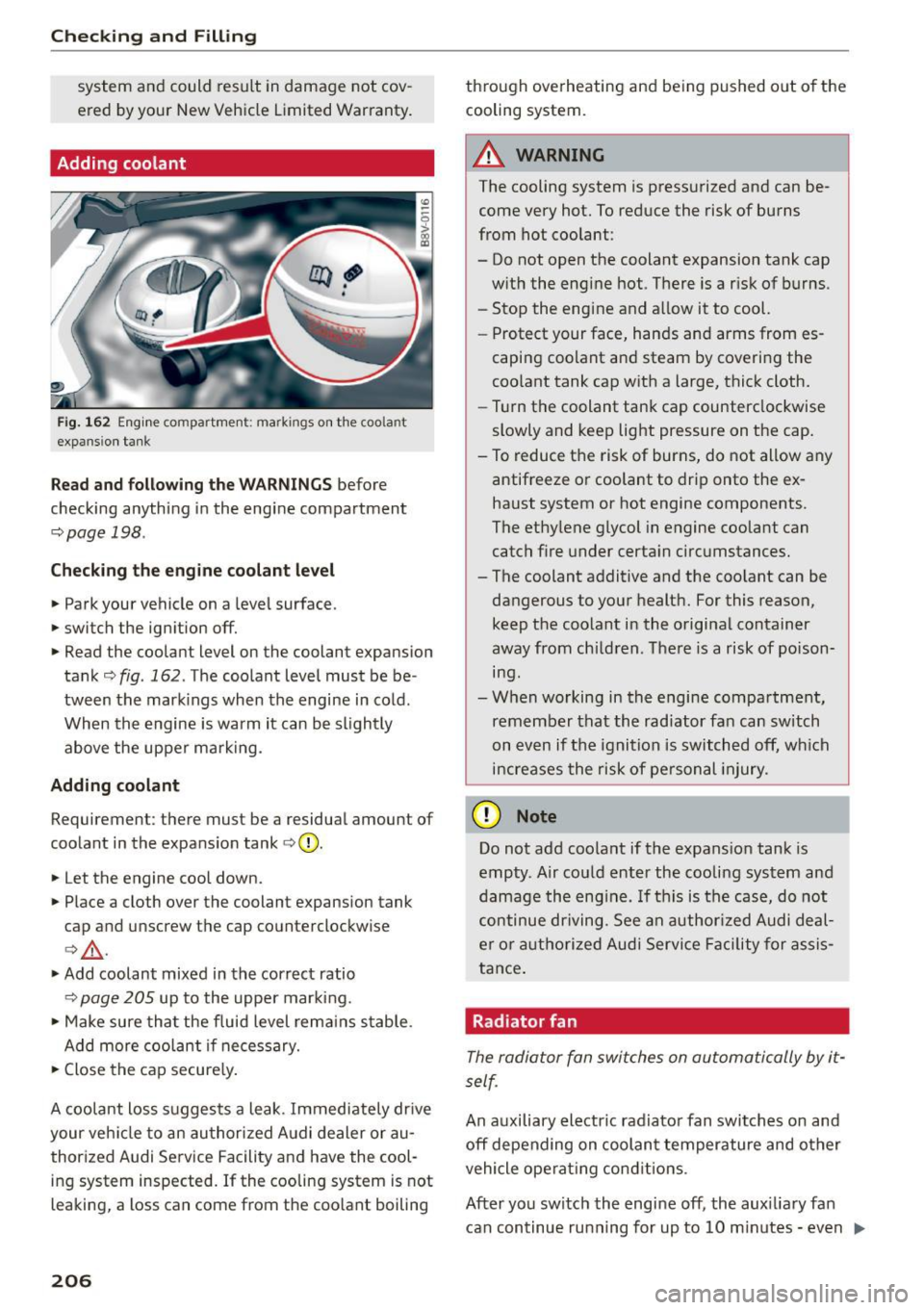
Fig. 162 Eng ine compartment: ma rkings on the coola nt
expans ion tank
Read an d follo wing the WARNINGS before
checking anything in the engine compartment
r::;,page 198.
Checking the engine coolant level
.. Park your vehicle on a level surface.
.. switch the ignition off.
.. Read the coolant level on the coolant expansion
tank
r::;, fig . 162 . The coolant level must be be
tween the mark ings when the engine in cold .
When the engine is warm it can be slightly
above the upper marking .
Adding coolant
Requirement: there must be a residual amount of
coolant in the expans ion tank
c> Q).
.. Let the engine cool down.
.. Place a cloth over the coolant expansion tank
cap and unscrew the cap counterclockwise
<=>& .
.,. Add coolant mixed in the correct ratio
r::;, page 205 up to the upper marking .
.. Make sure that the fluid level rema ins stable.
Add more coolant if necessary.
.. Close the cap secure ly.
A coolant loss s uggests a leak. Immediate ly drive
your veh icle to an authorized A udi dealer or au
thor ized Audi Service Facility and have the cool
ing system inspected.
If the cooling system is not
leaking, a loss can come from the coolant boiling
206
thro ugh ove rheating and being pushed out o f the
cooling system.
A WARNING
The cooling system is pressurized and can be
come very hot. To reduce the risk of burns
from hot coolant:
- Do not open the coolant expansion tank cap
w ith the engine hot. There is a risk of burns .
- Stop the eng ine and a llow it to cool.
- Protect your face, hands and arms from es-
caping coolant and steam by covering the
coo lant tank cap with a large, thick cloth.
- Turn the coolant tank cap counterclockwise
slowly and keep light pressure on the cap.
- To reduce the risk of burns, do not allow any
antifreeze or coolant to drip onto the e x
haust system or hot engine components.
The ethy lene glycol in engine coola nt can
catch fire under certa in circumstances.
- The coolant additive and the coolant can be
dangerous to your health. For this reason,
keep the coolant in the o riginal container
away from ch ildren . The re is a risk of poison
ing .
- W hen working in the engine compartment,
remember that the rad iator fa n can switch
on ev en if the ignition is switched off, wh ich
increases the risk of pe rsonal injury.
@ Note
Do not add coolant if the expans ion tank is
empty . Air cou ld enter the cooling system and
damage the eng ine. If this is the case, do not
continue driving. See an author ized Audi deal
er or a uth ori zed Audi Service Facility for a ssis
ta nce .
. Radiator fan
The radiator fan switches on automatically by it
self
An a uxiliary electric radiato r fan switches on and
off depending on coolan t temperature and other
vehicle ope rat ing cond itions .
After yo u sw itch the engine off, the aux ilia ry fan
can continue running for up to 10 m inutes -even .,,.
Page 241 of 282
M N
0 > co ,...., \!) 1.1'1
1.1'1
1.1'1
,....,
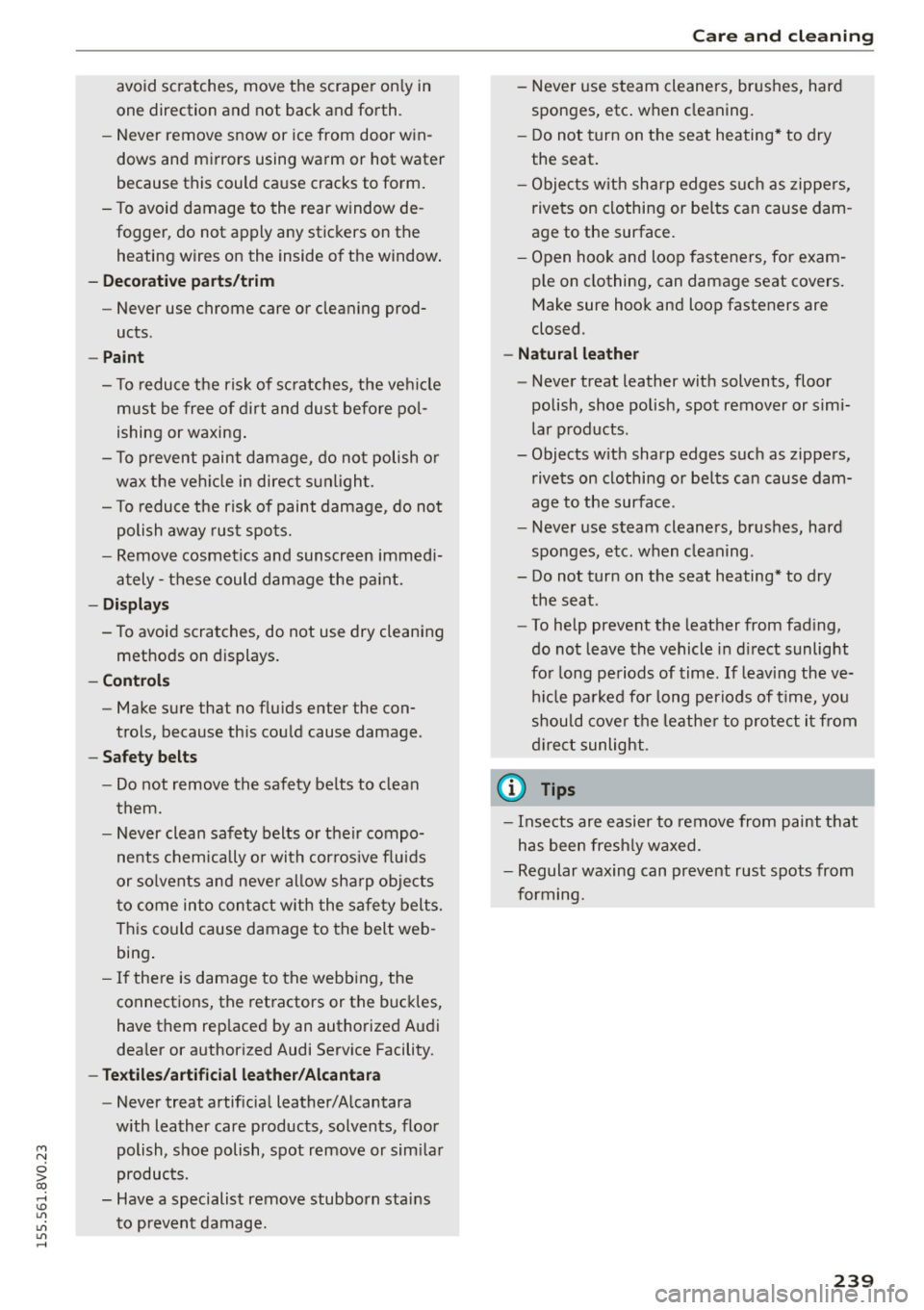
avoid scratches, move the scraper only in
one direction and not back and forth.
- Never remove snow or ice from door win
dows and mirrors using warm or hot water
because this could cause cracks to form.
- To avoid damage to the rear window de
fogger, do not apply any stickers on the
heating wires on the inside of the window.
- Decorative parts/trim
- Never use chrome care or cleaning prod-
ucts .
- Paint
- To reduce the risk of scratches, the vehicle
must be free of dirt and dust before pol
ishing or waxing.
- To prevent paint damage, do not polish or
wax the vehicle in direct sunlight.
- To reduce the risk of paint damage, do not
polish away rust spots.
- Remove cosmetics and sunscreen immedi
ately -these could damage the paint.
- Displays
- To avoid scratches, do not use dry cleaning
methods on displays.
- Controls
- Make sure that no fluids enter the con-
trols, because this could cause damage.
- Safety belts
- Do not remove the safety belts to clean
them.
- Never clean safety belts or their compo
nents chemically or with corrosive fluids
or solvents and never allow sharp objects
to come into contact with the safety belts.
This could cause damage to the belt web
bing.
- If there is damage to the webbing, the
connections, the retractors or the buckles,
have them replaced by an authorized Audi
dealer or authorized Audi Service Facility.
- Textiles/artificial leather/Alcantara
- Never treat artificial leather/Alcantara
with leather care products, solvents, floor polish, shoe polish, spot remove or similar
products.
- Have a specialist remove stubborn stains
to prevent damage.
Care and cleaning
- Never use steam cleaners, brushes, hard
sponges, etc. when cleaning.
- Do not turn on the seat heating* to dry
the seat.
- Objects with sharp edges such as zippers,
rivets on clothing or belts can cause dam
age to the surface.
- Open hook and loop fasteners, for exam
ple on clothing, can damage seat covers.
Make sure hook and loop fasteners are
closed .
- Natural leather
- Never treat leather with solvents, floor
polish, shoe polish, spot remover or simi
lar products .
- Objects with sharp edges such as zippers, rivets on clothing or belts can cause dam
age to the surface .
- Never use steam cleaners, brushes, hard
sponges, etc. when cleaning .
- Do not turn on the seat heating* to dry the seat.
- To help prevent the leather from fading,
do not leave the vehicle in direct sunlight
for long periods of time . If leaving the ve
hicle parked for long periods of time, you
should cover the leather to protect it from
direct sunlight.
(D Tips
- Insects are easier to remove from paint that
has been freshly waxed .
- Regular waxing can prevent rust spots from
forming.
239
Page 251 of 282
....,
N
0 > co
rl I.O
"'
"'
"'
rl
-Some of the equipment listed in the follow
ing tables applies only to certain model
versions or certain opt ional equ ipment.
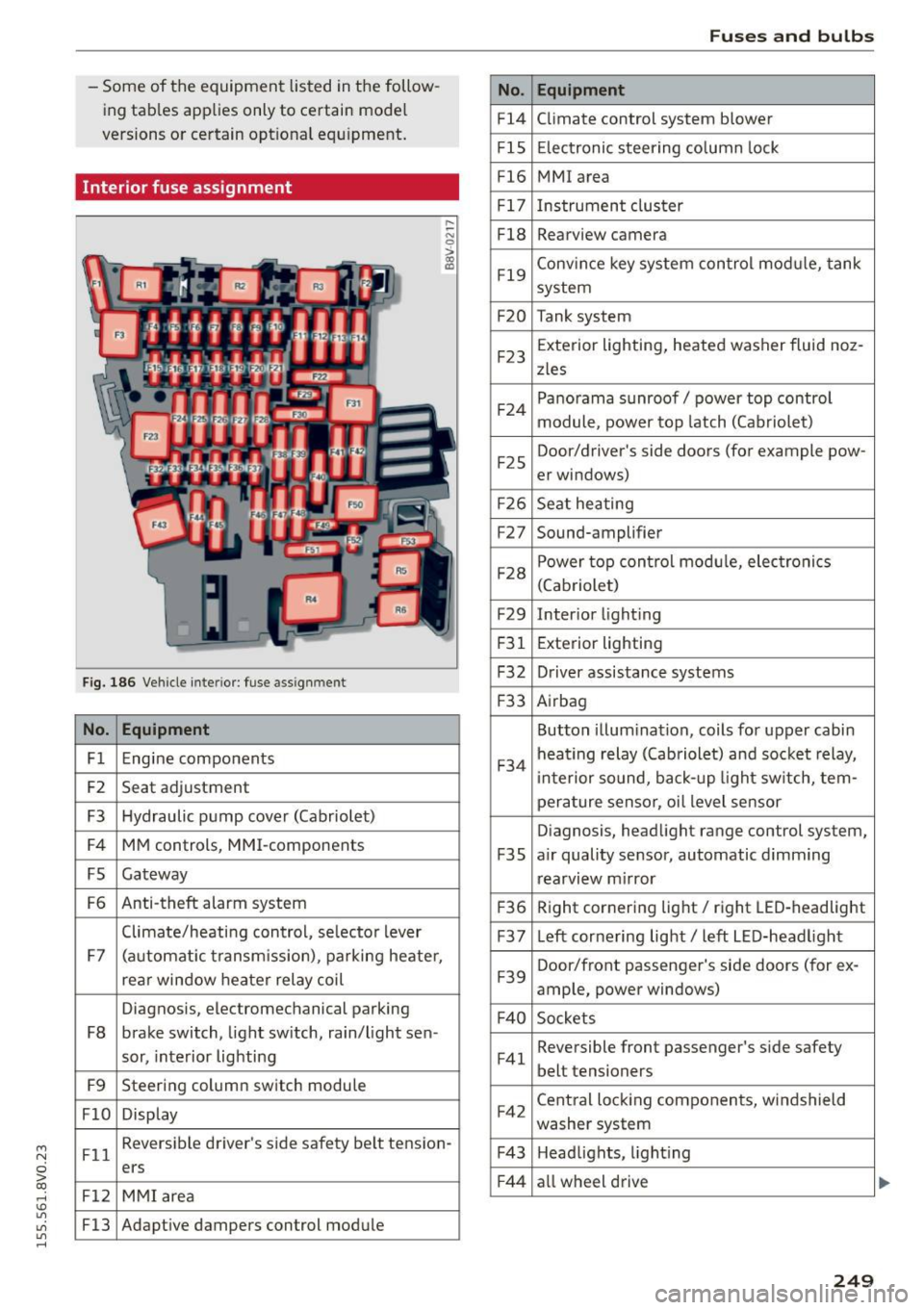
Interior fuse ass ignment
F ig. 186 Vehicle interior: fuse assignment
No. Equipment
Fl Engine components
F2 Seat
adjustment
F3 Hydraulic pump cover (Cabriolet)
F4 MM
controls, MMI-components
FS Gateway
F6 Anti-theft
alarm system
Climate/heati ng control, selector lever
F7 (automat ic transm ission), parking heater,
rear window heater relay coil
Diagnosis, electromechanical parking
F8 brake switch, light switch, rain/light sen-
sor, interior lighting
F9 Steering column switch module
FlO Display
.... ~ N
0
>
"' (0
Fll Reversible
driver's side safety belt tension-
ers
F12 MMI area
F13 Adapt ive dampers control module
No.
Fl4
FlS
Fl6
F 1 7
F18
F19
F20
F23
F 24
F 25
F 26
F27
F28
F29
F 31
F32
F 33
F34
F3S
F 36
F37
F 39
F 40
F 41
F42
F43
F 44
Fu ses a nd bulb s
Equipment
Climate control system blower
Electronic steering co lumn lock
MMI area
Instrument cluster
Rearview camera
Conv ince key system control mod ule, tank
system
Tank system
Exterior lighting, heated washer fluid noz-
zles
Panorama sunroof/ power top control
module, power top latch (Cabriolet)
Door/driver 's side doors (for example pow-
er windows)
Se at heating
Sound-amplifier
Power top control modu le, electronics
(Cab riolet)
Inter ior light ing
E xterior lighting
Driver assistance systems
Airbag
Button illumination, coils for upper cabin
heating relay (Cab riolet) and socket relay,
i nte rior sound, back- up light sw itch, tern-
perature sensor, oi l level sensor
Diagnosis, headlight range control system,
a ir quality sensor, automatic d imming
rearview m irror
Right cornering light/ right LED-headlight
Left cornering light/ left LED-headlight
Door/front passenger's side doors (for ex-
ample, power windows)
Sockets Reversible front passenger's side safety
belt tensioners
Central locking components, windshield
washer system
Head lights, l ight ing
a ll wheel drive
249