ESP AUDI S3 SEDAN 2015 Repair Manual
[x] Cancel search | Manufacturer: AUDI, Model Year: 2015, Model line: S3 SEDAN, Model: AUDI S3 SEDAN 2015Pages: 282, PDF Size: 71.14 MB
Page 200 of 282
Checking and F ill in g
damp cloth and plenty of cold water. If the
AdB lue has already crysta llized, use warm
water and a sponge. AdBl ue res idue that is
not removed will crysta lli ze and can damage
the affected s urface.
- Do not store the ref ill bottle in the vehicle.
If it leaks, the escaping Ad Blue cou ld dam
age the veh icle inter ior.
- Do not allow Ad Blue to come into contact
with clothing. If there is contact with the
flu id, flush immed iate ly w ith plenty of wa
ter .
@ Tips
-You can obtain refill bott les from an author
i zed Audi dealer or authorized Audi Service
Facility .
- Follow the Ad Blue manufacturer 's instruc
tions for use and storage .
Engine compartment
Working in the engine compartment
Special care is required if you are working in the
engine compartment
For work in the engine compartment such as
c h ecking and filling fluid s, there i s a risk of in
jury, scalding , accid ents, and burns. F or thi s
rea son, follow all the following li sted warning s
and general safety precautions. The engine
c ompartment is a dangerous area!
~ &
A WARNING
To reduce the risk of injur ies, complete the
following steps before opening the hood :
- Turn the eng ine off.
- switch the ignit ion off .
- Set the parking b rake.
- Pla ce the sele ctor leve r in the P pos ition.
- Let the engine coo l down .
- Never open the hood when you see that
steam o r coolan t drips from the engine
compartment- there is a da nger of burns!
Wait un til no steam o r coolant flows ou t.
- Keep children away from the engine com
partm ent.
198
-
- Never sp ill fluids on a hot engine . These fl u
ids (such as the freeze protection conta ined
in the coolant) can catch fire.
- Avoid short circ uits in the e lectrica l system,
especially the battery.
- When working in the engine compa rtment,
remember that the radiator fan can switch
on even if the ignition is switched off, wh ich
increases the risk of pe rsonal injury.
- Never open the cap on the coolant expan
si on tank when the engine is warm . The
cooli ng system is under p ress ure .
- To protect yo ur face, hands, and a rms from
hot steam or coolant, cover the cap with a large cloth when o pening.
- Do not remove the engine c over under any
circumstances . T his i ncreases the r isk of
burns.
- If tests need to be per formed with t he en
gine running, there is additional danger due
to mov ing components (such as the rib bed
be lt , a lternator a nd radiator fan) a nd from
the high v olt age ignit io n sy stem.
-Never reac h into the radiato r fan . The e lec
tric aux iliar y fan i s controlled by tempera
ture and can swi tch on sudden ly.
- Pay attention to t he fo llow ing warnings list
ed when w ork on the fue l system o r on the
elec tric al equipmen t is requ ired .
- Always d isconnect the vehicle battery
from the vehicle electrical system
- Do not smo ke
- Never work near open flames
- Always have a work ing fire exting uis her
near by
- To reduce t he risk of e le ct ric shock and in
jury, never touch the following components
when t he engine is running or is bein g start
e d :
- Ign ition cable
- Other components in the electronic h igh
vo ltage ignition system
- If you must check or perform work o n the
e ngine whi le it is running:
- S et t he parki ng bra ke and pla ce the selec
t or lever in the P (park) posi tion first .
Page 207 of 282
M N
0 > co ,...., \!) ..,.,
..,.,
..,., ,....,
-Drain th e oi l into a container desi gned for
this purpose, one large enough to ho ld at
least the total amount of oil in your engine .
- Engine oil is poisonous . Keep it well out of
the reach of children.
- Continuo us contact with used engine oil is
harmful to your sk in. A lways protect your
sk in by washing oil off thoroughly w ith soap
and water.
(D Note
Never mix oi l addit ives with your engine oi l.
These additives can damage your eng ine and
adversely affect your Audi Limited New Veh i
cle Warranty .
@) For the sake of the environment
-Before changing your oi l, f irst make sure
you know where you can properly dispose of
the used oil.
- Always d ispose of used engine oil proper ly.
Do not dump it on garden soil, wooded
areas, into open streams or down sewage
d rains .
- Recycle used e ngine oi l by taking it to a used
engine oil collection facility in your area, or
contact a service station .
Cooling system
Coolant
The engine coolant performs two functions: it
keeps the engine from overheating and it pro
tects the engine from freezing in the winter.
The cooling system is sea led and generally re
q ui res lit tle atten tion.
The cooling system has been filled at the factory
w ith a pe rma nen t coolan t which does no t need to
be ch anged . T he coolant consists o f a mixture o f
specia lly condit ioned wa ter and the man ufactu r
er's glycol -based coolant additive Gl3 antifreeze
with anticor rosion add itives (SO% for USA mod
e ls · 60% for Canadian models) . Th is m ixture bot h
'
assures the nece ssary fros t protection and p ro-
tects meta l components in the engine 's cooling
Checking and Fillin g
system from corrosion and scaling . It also raises
t h e boiling point of the coo lant .
D o no t redu ce the con cen tra tion of the coolan t in
the summer by ad ding plain water.
The prop or
tion of coolant additive mu st be at least 50%
but not more than 60%
to maintai n antifr eeze
protection and cooling efficiency . If the coo lant
frost pro tec tion is too low, the coo lant co uld
freeze and damage the vehicle heating and en
gine cooling system .
For year- ro und driving, antifreeze is added at the
factory for temperatures down to :
-- 31°F(-3S° C)USA
- -40 °F ( - 40 ° C) C anada.
If you must add coolant, use a mixture of water
and coolant additiv e. Mix ing the coo lant add it ive
with dis tilled wa te r is recommended .
A WARNING
Befo re you c hec k anythi ng i n the engi ne com
partment, always re ad and heed a ll WA RN
IN GS
~page 198.
(D Note
- Befor e wi nter sets in , have the coo la nt
c hecke d to see if the cool an t additive in you r
vehicle is sufficient to meet the climate con
ditions . This is espec ia lly impo rtant if you
live in a region where the winter is extreme
ly cold . If necessary, increase the proportion
of coolant additive to 60%.
- When adding coolant additive to yo ur cool
ing system, remember:
- We recommend us ing o nly coo la nt addi
tive G12 ++ o r G13 ( che ck the label) fo r
your ve hicl e. This coolant addi tive is av ail
a ble at autho rized Aud i dea le rs . Othe r
types of ant ifreeze can significant ly re
d uce corrosion protection. The resulting
corrosion can ca use a loss o f coolant and
serious engine damage.
- Do not add any type of rad iator leak sealant
to y our vehicle's engine coolant. Adding ra
diator repa ir fluid may adversely affect the
function and perfo rmance of your cooling .,,.
205
Page 210 of 282
Checking and F ill in g
sure you are using the correct brake f luid .
The correct type of brake fluid is also indi
cated on the brake fluid reservoir .
- The brake fluid must be new. Heavy use of
the brakes can cause a vapor lock if the
brake fluid is left in the system too long.
This can ser iously affect the effic iency of
the brakes as well as your safety . This
could res ult in an accident.
(D Note
Brake flu id will damage the paint of your vehi
cle .
@ For the sake of the environment
Because of the problem of proper d isposa l of
brake fluid as well as the spec ia l tools re-
quired and the necessary expertise, we rec
ommend tha t you have the b rake fluid
changed by your author ized Audi dealer.
Battery
General information
The battery in yo ur Audi does not need any ma in
tenance under normal operating conditions. Aud i
recommends having the electro lyte level check by
an author ized Audi dealer or author ized Audi
Service Fac ility when the re a re
high outside tem
pe ratu res or when dr iv ing a ll day. The electroly te
leve l sho uld also be checked ea ch t ime the bat
t ery is charged
9 page 210 .
Have the battery checked when you br ing you r ve
hicle in fo r an inspec tio n. It is a good idea to re
p la ce the batte ry if i t is more than 5 ye ars old .
During certai n types of a irbag dep loyments, the
battery is disconnect ed from the vehicle electr i
cal system fo r safety reasons
9 .&. in Repair, care
and disposal of the airbags on page 163.
Disconnecting the battery terminals
Some veh icle functions (such as power windows)
are not ava ilable when the batte ry is disco nnect
ed. These functions must be programmed after
the ba ttery is reconnec ted. To avoid havi ng to do
t his , on ly disconnect the b attery from the veh icle
208
electrica l sys tem when that is necessa ry to pe r
form repairs.
To reprogram the func tion s, proceed as fo llows:
Function Reprogramming
P owe r window one-
9 page 41, Correcting
to uch up/down f unc-power window malfunc-
tion tions
Remote control key o r If the vehicle does not
Conve nience key reac t to the key , it must
be synchronized
9 page 35
Digita l clock 9 page 10
ESC indi cato r light The ind icator lig ht goes
o ut afte r driving a few
meters
Not running the vehicle for long periods of
time
If you do not d rive yo ur vehicle for several days or
weeks, e lectr ica l components are gradua lly re
duced or switched off. Th is red uces energy con
s u mption and maintains the vehicle's ability to
start over a long per iod of t ime ¢
page 128.
Some conven ience functions , such as inter ior
li ght ing or power seats* may not wo rk . These
convenienc e functions w ill be availabl e agai n
o nce you swi tch the ig nition on and sta rt the en
gine.
Winter operation Du ring the winter months , it is common for the
batte ry capaci ty to dec rease as the tempe rat ur es
become lower . This is because more powe r is
needed to start the vehicle and componen ts such
as the he ad lights and the rear window defogger
are used more frequent ly.
Avoid using powe r unnecessar ily, especially in
c ity dr iv ing o r o n short trips . H ave yo ur au thor
iz ed Audi de aler or author ized A udi Se rv ice Facili
ty check the ba ttery capacity before the start of
winter ¢
page 210. A well-charged battery will
not only reduce starting problems in co ld weath
er, but it will a lso last longer .
Page 211 of 282
M N
0 > co ,...., \!) er,
er,
er,
,....,
A WARNING ,~
- Work on the battery requires expert knowl
edge. Contact an authorized Aud i dealer or
authorized Audi Service Fac ility for informa
t ion regarding the v ehicl e batte ry. There is a
risk for chemical burns or e xplosions.
- Never open the vehicle battery . Do no t try to
change the batte ry elect ro lyte level. Other
wise ex plosive gas will e scape from the bat
tery and increase the r is k of an explosion.
@ Tips
If your vehicle is not driven for severa l wee ks
in very cold tempe ratu res, remove the battery
and store it in a pla ce where i t will no t freeze.
This preven ts the bat tery from being d am
aged and needing to be replaced .
Working on the battery
Be especially careful when working on or near
the battery.
The bat te ry is loc ated in t he luggage compart
men t under the floor. Before yo u check any thing
i n the l uggage comp artme nt,
read and heed all
WARNINGS
q ,&. .
Always heed the sa fety warning s, when working
on the vehicle battery o r th e veh icle elec trical
sys tem to preven t inju ry.
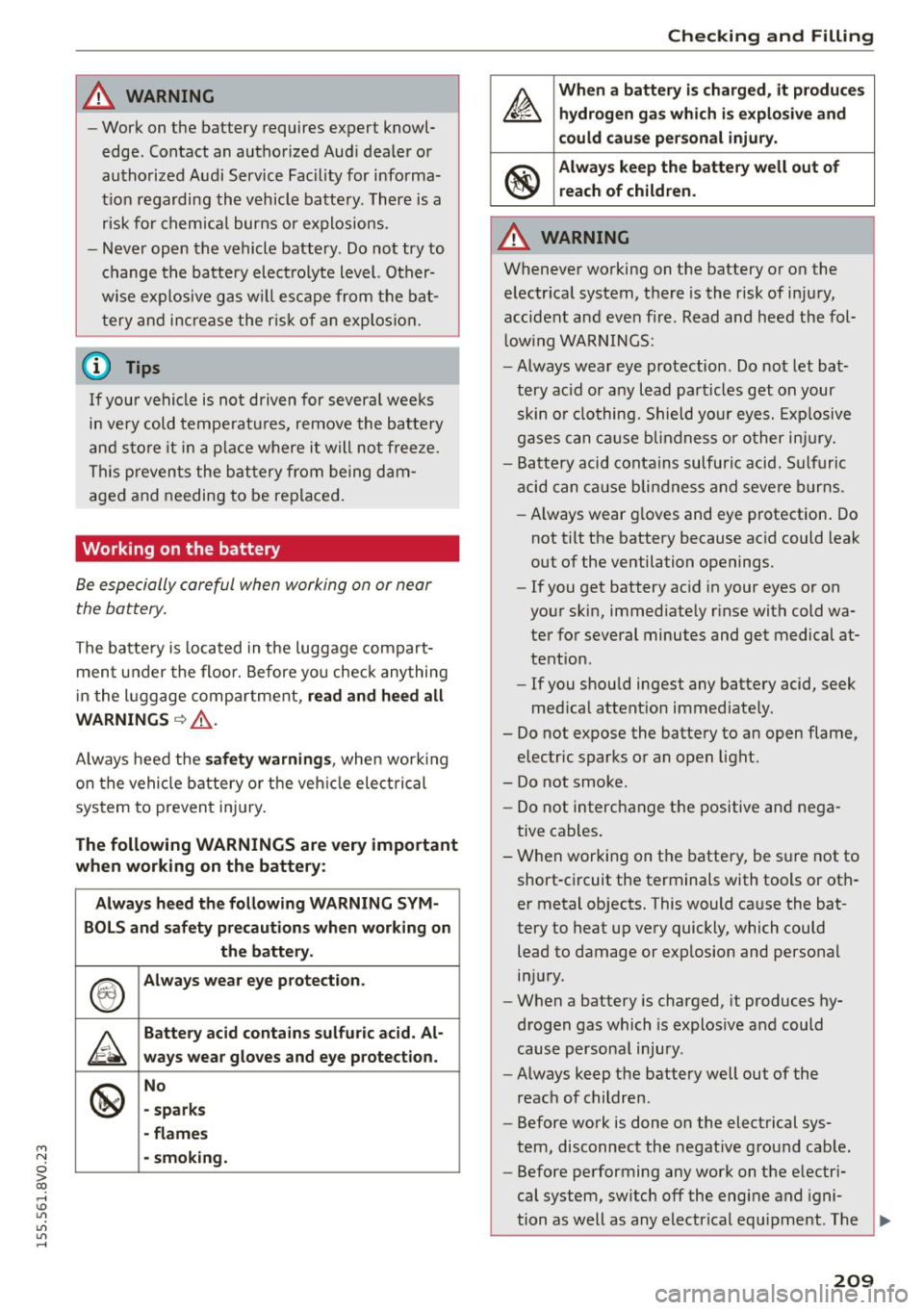
The following WARNINGS are very important
when work ing on the battery:
Always he ed the following WARNING SYM-
BOLS and safety pre caution s wh en working on
the battery .
®
Always wear eye protect ion.
A
Battery acid contains sulfuric acid. Al ·
ways wear gloves and eye protection.
@
No
• sparks
- flame s
- smok ing.
Checking and Fillin g
&
When a battery is charged, it produce s
-hydrog en gas which i s explo siv e a nd
c ould cau se p ers onal injury.
®
Always keep the battery well out of
reach of children .
A WARNING ..,__ -
Whenever working on the battery or on the
electr ica l system, the re is the risk of in jury,
accident and even fi re. Read and heed the fol
l ow ing WARNI NGS:
- Always wear eye protection. Do not let bat
tery ac id or a ny lead particles get on your
skin o r clothing. Shield yo ur eyes. Exp losive
gases can ca use blindness or o ther in jury.
- Battery acid conta ins sulfuric acid. Sulfuric
acid can ca use b lindness and severe burns.
- Always wear g loves and eye protection. Do
not tilt the battery because ac id could leak
out of the ventilation openings.
- If you get battery ac id in your eyes or on
your s kin, immed iate ly r inse with cold wa
ter fo r several minutes and get medical at
tent ion.
- If you shou ld ingest any battery acid , seek
med ica l attent io n immed iate ly.
- Do not expose the batte ry to an open flame,
electric sparks or an open light.
- Do not smoke.
- Do not interchange the positive and nega-
tive cables .
- When working on the battery , be s ure not to
short-c ircuit the terminals with tools or oth
er metal objects . This would ca use the bat
tery to heat up very quickly , which could
lead to damage or exp losion and perso nal
in jur y.
- When a battery is charged, it produces hy
drogen gas which is e xplos ive and could
cause persona l injury .
- Always keep the battery well out of the
reach of children.
- Before work is done on the electrical sys
tem, disconnect the negat ive g round cab le.
- Before performing any work on t he e lectr i
cal system, sw itch
off the engine and igni-
tion as well as any electrical equ ipme nt. The .,..
209
Page 213 of 282
M N
0 > co ,...., \!) 1.1'1
1.1'1
1.1'1
,....,
can be cracked due to ice formation and can leak battery acid.
Battery charging (Maximum charging rate of
30 amps / 14.8 Volt)
When charging at
low voltages (e.g . with a trickl e
charger ), the battery cab les do not have to be
d isconnected first. The battery caps shou ld
not
be opened when charg ing a battery .
It is not necessary to remove the battery from
the luggage compartment, and it is also not nec
essary to disconnect the cables .
Fast charging the battery (charg ing rate
a bo ve 14.8 Volt s)
F or technical reasons do not use a battery charg
er that us es voltage greater than 14 .8 Volts to
charge your vehicle's battery.
A WARNING
Charging a battery can be dangerous.
- Always fo llow the operating instructions
provided by the battery charger manufactur
er when charging y our battery.
- Never charge a frozen battery. It may ex
plode because of gas trapped in the ice. Al
low a frozen battery to thaw o ut first.
- Do not reuse batteries which were frozen .
The battery hous ing may have cracked and
weakened when the battery froze.
- Charge the battery in a well ventilated area .
Keep away from open flame or electrical
spark . Do not smoke. Hyd rogen gas generat
ed by the battery is explos ive .
- To reduce the danger of explosion, never co nnect or disconnect cha rger cables while
the cha rger is operating .
- Fast charg ing a battery is dangerous and
should only be attempted by a competent
tec hnician with the p roper equipment .
- Battery acid that may spill during charg ing
should be washed off w ith a so lution of
wa rm water and baking so da t o n eutrali ze
t he a cid .
Checking and Fillin g
(D Note
Never use a fast charger as a booster to start
the engine . This will ser iously damage sensi
tive electronic components, s uch as control
units, relays, radio, etc., as well as the battery
charger .
Battery replacement
The new bat tery mus t hove the some specifica
tions and dimensions as the original equipmen t
battery.
Intelligent energy management in your vehicle is
responsible for distributing the electrical energy
t h roughout your vehicle
Q page 128 . The intelli
gent energy management system w ill keep the
engine batt ery charged better than vehicles with
out this system. To ma ke s ure t he add it iona l elec
t rical energy is av ailabl e once again afte r yo u
have changed the battery, we recommend tha t
yo u install batteries of the same type and man u
facture on ly (the same as those insta lled at the
t ime yo ur vehicle was delivered). Specifications
are listed on the battery hous ing . Your author
ized dealer must code the battery in the energy
manageme nt system to enab le you to use the en
ergy ma nagement fu nctions cor rectly afte r re
plac ing the battery .
The new battery mus t have the same capacity ,
vo ltage (12 -volts), amperage, construction and
plug seal ing.
When install ing the battery, make sure the ign i
t ion and all electr ica l consumers are switched off.
(D Note
Make sure the ventilat ion hose on the side of
the battery is connected, otherwise f umes or
battery acid can lea k out.
~ For the sake of the environment
Because o f the prob lem of proper disposal of
a battery, we recommend you r authorized
A udi dealer change the battery for you. Bat
teries contain sulfur ic acid and lead and must
always be dispose d of properly in complia nce
with a ll envi ronm ental regulations. Disposing ..,.
211
Page 215 of 282
M N
0 > co ,...., \!) 1.1'1
1.1'1
1.1'1
,....,
Resetting the indicator
Your authorized Audi dealer or authorized Audi
Service Facility will reset the service interval dis
play after performing service.
If you perform an oil change yourself to the Audi
specifications, you must reset the service interval
display.
To reset the display, select the
I MENU I button>
Car > Systems* control button > Service & con
trol
> Service intervals > Reset oil change inter
val.
(1) Note
- Only reset the oil change indicator if the oil
was changed.
- Following the service intervals is critical to
maintaining the service life and value of
your vehicle, especially the engine. Even if
the mileage on the vehicle is low, do not ex
ceed the time for the next service.
- Calculating the time to the next oil change
is interrupted when the vehicle battery is
disconnected. If the vehicle is not driven for
a long period of time, check the mainte
nance schedule so that you can follow the
maintenance intervals.
Checking and Filling
213
Page 218 of 282
Tires and wheels
be happy to provide more infor
mation .
® Mud and snow capabilit y
"M/S" or "M+S" indicates the tire
has characteristics that make it
suitab le for driving on mud and
snow.
& indicates a winter tire.
@ Compos ition of the tire cord
and materi als
The number of plies indicates the
number of rubberized fabric lay
ers in the tire. In general : the
more laye rs, the more weight a
tire can carry. Tire manufacturers
must also specify the materials
used in the tire. These include
steel , nylon, polyester and other
materials.
@ Maximum permitted load
This number indicates the maxi
mum load in kilograms and
pounds that the tire can carry.
@ Uniform tire quality grade
standards for treadwear,
traction and temperature
resistance
Treadwear, traction and tempera
ture ranges r:>
page 231.
@ Running direction
The arrows indicate the running
direction o f unidirectional tires .
216
You m ust always follow the speci
fied runn ing direction
.:> page 245.
@ Maximum permitted
inflation pressure
This number indicates the maxi
mum pressure to which a tire can
be inflated under normal operat
ing condit ions .
Glossary of tire and loading
terminology
Accessory weight
means the combined we ight (in
excess of those standard items
which may be replaced) of auto
matic transmission, power stee r
ing, power brakes , power win
dows, power seats, radio, and heater, to the extent that these
items are available as fac to ry-in
stalled equipment (w hether in
stalled or not).
Aspect ratio
means the ratio of the height to
the width of the tire in percent .
Numbers of 55 or lower ind icate a
low si dewall for imp roved steer
ing response and better overa ll
handling on dry pavement . .,.
Page 223 of 282
Occupant loading and distri
bution for vehicle normal load
for various designated seating
capacities
Refer to the tire inflation pressure
labe l
c:::> page 224, fig. 171 for
the number of seating positions .
Refer to the table
c:::> table on
page 226
for the number of peo
ple that correspond to the vehicle
normal load.
New tires or wheels
Audi recommends having all work on tires or wheels performed by
an authorized Audi dea ler or au
thorized Audi Service Facility.
These facilities have the proper knowledge and are equ ipped with
the required tools and replace
ment parts .
.,,. New tires do not yet have the
opt imum adhesion properties .
Drive carefully and at moderate
speeds for the first 350 m iles
(500 km) with new tires .
.,,. Use tires of the same construc
tion, size (rolling circumference)
and as close to the same tread pattern as possible on all four
wheels .
Tires a nd whe els
.,,. Do not replace tires individually.
At least replace both tires on the same axle at the same time .
.,,. Audi recommends that you use
Audi Original equipment tires. If
you would like to use different
tires, please note that the tires
may perform different ly even if
they are the same size
c:::> ,& .
.,,. If you would like to equip your
vehicle with a tire/rim combina
tion that is different from what
was installed at the factory, con sult with an authorized Audi
dealer or authorized Audi Service
Facility before making a pur
chase
c:::> ..1,. .
The spare tire* is different from
the regular tires installed on the
vehicle -for example, if winter
tires or wide tires are installed -
then only use the spare tire* tem
porarily in case of emergency and
drive carefully while it is in use. It
should be replaced with a regular
tire as soon as possible.
On
all wheel d riv e vehicles, all
four wheels must be equipped
with tires that are the same brand
and have the same construction
and tread pattern so that the drive system is not damaged by
22 1
Page 225 of 282
"' N
~
-Have an authorized Audi dealer or authorized Audi Service Facili
ty check the wheel alignment if
there is unusual wear.
-Have the wheels rebalanced if an imbalance is causing noticeable
vibration in the steering wheel.
If you do not, the tires and other
vehicle components could wear
more quickly .
Treadwe ar indic ato r
Original equipment tires contain
treadwear indicators in the tread pattern, which are bars that are
1/16 inch (1.6 mm) high and are
spaced even ly around the tire per
pend icular to the running direc
tion
¢ fig. 169. The letters "TW I"
or triangles on the tire sidewall indicate the location of the tread
wear indicators.
The tires have reached the mini mum tread depth
l) when they
have worn down to the treadwear
indicators. Replace the tires with
new ones¢ &.
Whe el rot ation
Rotating the wheels regularly is
recommended to ensure the tires
;;; l) Obey any applicable regu lation s in your ~
~ country . ....
Tires and wheels
wear evenly. To rotate wheels, in
stall the wheels from the rear
axle on the front axle and vice ver
sa. This will allow the tires to
have approximately the same
length of service life.
F or unidirectional tires, make sure
the tires are installed according to
the running direction indicated on
the tire sidewall¢
page 245.
Hidden damage
Damage to tires and rims can of
ten occur in locations that are hid
den. Unusual vibrations in the ve
hicle or pulling to one side may
indicate that there is tire damage .
Reduce your speed immed iately .
Check the tires for damage. If no
damage is visible from the out
side, drive slowly and carefully to
the nearest authorized Audi deal
er or authorized Audi Service Fa
cility to have the vehicle inspect
ed.
A WA RNING
-
Tread that has worn too low or
different tread depths on the
tires can reduce driving safety.
This can especially have a
223
Page 233 of 282
M N
0 > co ,...., \!) 1.1'1
1.1'1
1.1'1
,....,
In o rder to m inim ize the occu rrence o f impac t
damage to the t ires of your vehicle, we recom
mend that you observe the following precau
tions :
- Always maintain recommended in flat ion p res
s ur es . Check yo ur tire p ress ure every 2,000
miles (3,000 km) and add air if necessary.
- Drive carefu lly on roa ds with potholes, deep
gul lies or ridges. The impact from driving
th ro ugh or over such obstacles can damage
your tires. Impact with a curb may also cause damage to your tires.
- After any impact, immediately inspect your
tires or have them inspected by the nearest a u
thorized Aud i dea ler . Replace a damaged tire as
soon as poss ible .
- Inspect your t ires every 2,000 miles (3 ,000 km)
for damage and wear. Damage is not always
easy to see. Damage can lead to loss of a ir and
underinflation, which cou ld eventually cause
t ir e fa il ur e.
If yo u be lieve that a ti re may h ave
been d amaged, rep lace the tire as soon as pos
s ible.
= T hese tires m ay we ar m ore q uic kly than ot hers.
- Please a lso remember that, wh ile thes e tir es
deliver respons ive handling, t hey may ride less
c o m fort ably and m ake more noise t han other
cho ices .
Reduced performance in winter/cold season
conditions
All t ires are des igned for cert ain purposes. The
l ow aspec t ratio, u ltra high per formance tires
originally insta lled on yo ur vehicle a re intended
for maximum dry and wet road perfo rmance an d
h andling. They are not suitable for cold, snowy or
icy weather cond it ions . If you drive under those
circumstances , you should equip your vehicle
w ith a ll-season or winter tires , which offer better
traction under those cond itions . We suggest you
use the re commended snow o r a ll-s eason t ires
specified fo r you r vehicle , or the ir eq uivalent.
Refe r to ¢
page 229 for mo re deta iled informa
tion regard ing winter tires .
Uniform tire quality grading
- Tread wear
Tires and wheels
- Traction AA A B C
- Temper ature A BC
Quali ty g rades can be found where applicab le on
t h e tire side wa ll between tread shoulder a nd
max imum sec tion wid th
~ page 214, fig . 168.
For example: Tread wear 200 , Traction AA, Tem
perature
A.
All passenger car t ires must conform to Federa l
Safety Requirements in addition to these grades.
Tread wear
T he tread wear g rade is a comparative rating
based on the wear rate of the t ire when tested
u nder contro lled c onditions on a specified gov
ernment test course.
F or example, a tire gra ded 15 0 wo uld wear one
and one half (1 1/2) times as we ll on the govern
ment course as a t ire g raded 100.
T he re lative per forman ce of tires depends upon
t h e actual cond itions of thei r use, however, and
may depart significantly from the norm due to
variations in driv ing habits, service p ract ices and
differences in road c haracteristics and climate.
Traction
T he traction gra des, from highest to lowest, are
AA , A , Ban d
C. Those g rades represent t he tire's
ability to stop on wet pavement as meas ured un
der contro lled conditions on specified govern
ment test s urfaces of asphalt a nd c oncrete . A tire
marked C may have poor traction performance
~ A .
Temperature
The temperature grades are A (the highest), B,
and C, representing the t ire's resistance to the
generation of heat a nd its ability to diss ipate
heat when tested u nder cont ro lled conditions on
a spec ified indoor labora to ry test wheel.
Sustained h igh temperature can cause the mate
ria l of the tire to degenerate and reduce ti re life,
and excess ive temperature can lead to s udden
t ir e fail ure¢ ,&. . .,,.
231