inflation AUDI S3 SEDAN 2015 Owners Manual
[x] Cancel search | Manufacturer: AUDI, Model Year: 2015, Model line: S3 SEDAN, Model: AUDI S3 SEDAN 2015Pages: 282, PDF Size: 71.14 MB
Page 139 of 282
M N
0 > co ..... \!) 1.1"1
1.1"1
1.1"1
.....
-Please observe information on safe driving
~page 130.
A WARNING
To help prevent poisonous exhaust gas from
being drawn into the vehicle, always keep the
rear lid closed while driving .
- Never transport objects larger than those
fitting completely into the luggage area be
cause the rear lid cannot be fully closed.
- If you absolutely must drive with the rear lid
open, observe the following notes to reduce
the risk of poisoning:
- Close all windows,
- Close the power roof*,
- Open all air outlets in the instrument pan-
el,
- Switch off the air recirculation,
- Set the fresh air fan to the highest speed.
A WARNING
Always make sure that the doors, all windows,
the power roof* and the rear lid are securely
closed and locked to reduce the risk of injury
when the vehicle is not being used.
-After closing the rear lid, always make sure
that it is properly closed and locked.
- Never leave your vehicle unattended espe
cially with the rear lid left open . A child
could crawl into the vehicle through the lug
gage compartment and close the rear lid be
coming trapped and unable to get out. Be
ing trapped in a vehicle can lead to serious
personal injury.
- Never let children play in or around the vehi
cle.
- Never let passengers ride in the luggage
compartment. Vehicle occupants must al
ways be properly restrained in one of the ve hicle's seating positions.
(D Tips
- Air circulation helps to reduce window fog
ging. Stale air escapes to the outside
through vents in the trim panel. Be sure to keep these slots free and open.
Driving safety
-The tire pressure must correspond to the
load. The tire pressure is shown on the tire
pressure label. The tire pressure label is lo
cated on the driver's side B-pillar. The tire
pressure label lists the recommended cold
tire inflation pressures for the vehicle at its
maximum capacity weight and the tires that
were on your vehicle at the time it was man ufactured. For recommended tire pressures
for normal load conditions, please see chap
ter ~
page 224.
' Tie-downs
The luggage compartment is equipped with four
tie-downs to secure luggage and other items.
Use the tie-downs to secure your cargo properly
~page 136, Loading the luggage compartment.
In a collision, the laws of physics mean that even
smaller items that are loose in the vehicle will
become heavy missiles that can cause serious in
jury. Items in the vehicle possess energy which
vary with vehicle speed and the weight of the
item. Vehicle speed is the most significant factor.
For example, in a frontal collision at a speed of
30 mph (48 km/h) , the forces acting on a 10-lb
(4.5 kg) object are about 20 times the normal
weight of the item. This means that the weight
of the item would suddenly be about
200 lbs. (90 kg). You can imagine the injuries
that a 200 lbs. (90 kg) item flying freely through
the passenger compartment could cause in a col
lision like this.
A WARNING
-Weak, damaged or improper straps used to
secure items to tie-downs can fail during hard
braking or in a collision and cause serious per
sonal injury .
- Always use suitable mounting straps and
properly secure items to the tie-downs in
the luggage compartment to help prevent
items from shifting or flying forward as dan
gerous missiles.
- When the rear seat backrest is folded down,
always use suitable mounting straps and
properly secure items to the tie-downs in
137
Page 153 of 282
M N
0 > co ,...., \!) 1.1'1
1.1'1
1.1'1
,....,
take place at lowe r decelerations as defined in
the electronic contro l unit ¢
page 160, PASSEN
GER AIR BAG OFF light.
Always remember, a chi ld seat or infant carrie r
installed on the front seat may be struck and
knocked out of position by the rapidly inflating
passenger's a irbag in a frontal collision . The air
bag could greatly reduce the effectiveness of the
child restraint and even ser iously injure the ch ild
during inflation .
For this reason, and because the back seat is the
safest place for ch ildren -when properly restrain
ed according to their age and s ize -we strongly
recommend that ch ild ren always s it in the back
seat
¢ page 172, Child safety .
A WARNING
A child in a rearward-facing child seat instal
led on the front passenger seat w ill be seri
ously in jured and can be killed if the front air
bag inflates -even with an Advanced Airbag
System.
- T he inflating a irbag w ill hit the child seat or
infant carrier w ith great force and will
smash the child seat and child against the
backrest, center armrest, door or roof.
-
- Always install rear -facing child seats on the
rear seat.
- If you mus t install a rearward facing child
seat on the front passenger seat beca use of
exceptional circ umstances and the
PASSEN ·
GER AIR BAG OFF
light does not come on
and stay on, immediately install the rear
facing child seat in a rear seating position
and have the a irbag system inspected by
yo ur Audi dealer.
- Forward-fac ing ch ild seats installed on the
front passenger's seat may interfere with
the deployment of the airbag and cause se rious persona l injury to t he ch ild.
A WARNING
If, in exceptional c ircumstances, you mus t in
stall a forward-facing ch ild restraint on the
front passenger's seat :
- Always make sure the forward-fac ing seat
h as been designed and ce rtified by i ts man-
Airbag syste m
ufacturer for use on a front seat with a pas
senger front and s ide a irbag.
- Never put t he fo rward-facing child restraint
up aga inst or very near the instrument pan
el.
- Always move the passenge r seat into its
rearmost pos ition in the seat's fore and aft
ad justment range, as far away from the a ir
bag as possible before installing the for
ward-facing child restraint. The backrest
m ust be adjusted to an upr ight position .
- Make sure that the
PASSENGER AIR BAG
OFF
li ght comes on and stays on all the time
wheneve r the ignit ion is switched on.
A WARNING
= -To reduce the risk of serious inju ry, ma ke su re
that t he
PASSENGER AIR BAG OFF ligh t will
b e d isplayed whenever a ch ild restr aint is in
stalled on the front passenger seat and the
ignition is switched on.
- If the PASSENGER AIR BAG OFF light does
not stay on, pe rform the checks describe d
~ page 160, Monitoring the Advanced Air ·
bag System.
-Take the chi ld restraint off the front passen
ge r seat and install it properly at one of the
rea r seat positions if the
PASSENGER AIR
BAG OFF
light does not stay on.
- Have the airbag system inspected by your
Aud i dealer immediately.
- Always carefu lly follow instr uctions from
child restraint manufacturers when instal
ling child restraints.
A WARNING
If, in except ional circumstances, you m ust in
stall a forward or rearward-fac ing ch ild re
straint on the front passenger's seat:
- Improper installation of ch ild restra ints can
red uce their effectiveness or even prevent
them from providing any pro tect ion.
- An improperly installed ch ild restra int can
interfere with the airbag as it deploys and
serio usly injure or even kill the child -even
with an Advanced A irbag Sys tem.
~
151
Page 218 of 282
Tires and wheels
be happy to provide more infor
mation .
® Mud and snow capabilit y
"M/S" or "M+S" indicates the tire
has characteristics that make it
suitab le for driving on mud and
snow.
& indicates a winter tire.
@ Compos ition of the tire cord
and materi als
The number of plies indicates the
number of rubberized fabric lay
ers in the tire. In general : the
more laye rs, the more weight a
tire can carry. Tire manufacturers
must also specify the materials
used in the tire. These include
steel , nylon, polyester and other
materials.
@ Maximum permitted load
This number indicates the maxi
mum load in kilograms and
pounds that the tire can carry.
@ Uniform tire quality grade
standards for treadwear,
traction and temperature
resistance
Treadwear, traction and tempera
ture ranges r:>
page 231.
@ Running direction
The arrows indicate the running
direction o f unidirectional tires .
216
You m ust always follow the speci
fied runn ing direction
.:> page 245.
@ Maximum permitted
inflation pressure
This number indicates the maxi
mum pressure to which a tire can
be inflated under normal operat
ing condit ions .
Glossary of tire and loading
terminology
Accessory weight
means the combined we ight (in
excess of those standard items
which may be replaced) of auto
matic transmission, power stee r
ing, power brakes , power win
dows, power seats, radio, and heater, to the extent that these
items are available as fac to ry-in
stalled equipment (w hether in
stalled or not).
Aspect ratio
means the ratio of the height to
the width of the tire in percent .
Numbers of 55 or lower ind icate a
low si dewall for imp roved steer
ing response and better overa ll
handling on dry pavement . .,.
Page 219 of 282
Bead
means the part of the tire that is
made of steel wires, wrapped or
reinforced by ply cords and that is
shaped to fit the rim.
Bead separation
means a breakdown of the bond
between components in the bead.
Cord
means the strands forming the
plies in the tire .
Cold tire inflation pressure
means the tire pressure recom
mended by the vehicle manufac
turer for a tire of a designated
size that has not been driven for
more than a couple of miles (kilo
meters) at low speeds in the three
hour period before the tire pres
sure is measured or adjusted.
Curb weight
means the weight of a motor ve
hicle with standard equipment in
c luding the maximum capacity of
fuel, oil, and coolant, air condi
tioning and add itional weight of
optional equipment.
E xtra load t ire
means a tire designed to operate
at higher loads and at higher in -
Tires a nd whe els
flation pressures than the corre
spond ing standard tire. Extra load
tires may be identified as "XL",
" xl", "EXTRA LOAD", or "RF" on
the sidewall.
Gross A xle Weight R ating
( " GAWR")
means the load -carrying capacity
of a single axle system, measured
at the tire-ground interfaces .
Gross Vehicle Weight Rating
(" GVWR ")
means the maximum total loaded
weight of the vehicle.
Groove
means the space between two ad
jacent tread ribs.
Load rating (code )
means the maximum load that a
tire is rated to carry for a given in
flation pressure . You may not find
this information on all tires be cause it is not required by law.
Ma ximum load rating
means the load rating for a tire at
the maximum permissible infla
tion pressure for that tire.
Ma ximum loaded vehicle
weight
means the sum of:
217
...
Page 220 of 282
Tires and wheels
(a) Curb weight
(b) Accessory weight
(c) Vehicle capacity weight, and
(d) Production options weight
Ma ximum (permissible )
inflation pres su re
means the max imum cold infla
tion pressure to which a tire may be inflated. Also called "maxi
mum inflation pressure."
Normal occupant weight
means 150 lbs. (68 kilograms)
times the number of occupants
seated in the vehicle up to the to
tal seating capacity of your vehi
cle .
Occupant d istribution
means distribution of occupan ts
in a vehicle .
Outer diameter
means the overall diameter of an
inflated new tire.
Overall width
means the l inear distance be
tween the exteriors of the side
walls of an infla ted tire, including
elevations due to labeling , deco
rations, or protective bands or
ribs.
2 18
Ply
means a layer of rubber -coated
parallel cords.
Production options weight
means the comb ined weight of
those installed regular production
options weighing over 5 lbs. (2.3 kg) in excess of those standard
items which they rep lace, not pre
viously considered in cu rb weight
or accessory weight, including heavy duty brakes, ride levelers,
roof rack, heavy duty battery, and
special trim.
Radial ply tire
means a pneumatic tire in which
the ply co rds that extend to the
beads are laid at substantially 90
deg rees to the centerline of the
tread.
Recommended inflation
pressure
see ~ page 217 , Cold tire infla
tion pressure.
Reinforced tire
means a tire designed to operate
at higher loads and at higher in
flation pressures than the corre sponding standard tire. Rein
forced tires may be identified as
Page 223 of 282
Occupant loading and distri
bution for vehicle normal load
for various designated seating
capacities
Refer to the tire inflation pressure
labe l
c:::> page 224, fig. 171 for
the number of seating positions .
Refer to the table
c:::> table on
page 226
for the number of peo
ple that correspond to the vehicle
normal load.
New tires or wheels
Audi recommends having all work on tires or wheels performed by
an authorized Audi dea ler or au
thorized Audi Service Facility.
These facilities have the proper knowledge and are equ ipped with
the required tools and replace
ment parts .
.,,. New tires do not yet have the
opt imum adhesion properties .
Drive carefully and at moderate
speeds for the first 350 m iles
(500 km) with new tires .
.,,. Use tires of the same construc
tion, size (rolling circumference)
and as close to the same tread pattern as possible on all four
wheels .
Tires a nd whe els
.,,. Do not replace tires individually.
At least replace both tires on the same axle at the same time .
.,,. Audi recommends that you use
Audi Original equipment tires. If
you would like to use different
tires, please note that the tires
may perform different ly even if
they are the same size
c:::> ,& .
.,,. If you would like to equip your
vehicle with a tire/rim combina
tion that is different from what
was installed at the factory, con sult with an authorized Audi
dealer or authorized Audi Service
Facility before making a pur
chase
c:::> ..1,. .
The spare tire* is different from
the regular tires installed on the
vehicle -for example, if winter
tires or wide tires are installed -
then only use the spare tire* tem
porarily in case of emergency and
drive carefully while it is in use. It
should be replaced with a regular
tire as soon as possible.
On
all wheel d riv e vehicles, all
four wheels must be equipped
with tires that are the same brand
and have the same construction
and tread pattern so that the drive system is not damaged by
22 1
Page 224 of 282
Tires and wheels
different tire speeds. For this rea
son, in case of emergency, only
use a spare tire* that is the same
circumference as the regular tires.
.&,. WARNING -
-Only use tire/rim combina
tions and suitable wheel bolts
that have been approved by
Audi. Otherwise, damage to
the vehicle and an accident could result.
-For technical reasons, it is not
possible to use tires from oth
er vehicles - in some cases,
you cannot even use tires from
the same vehicle model.
-Make sure that the tires you select have enough clearance
to the vehicle. Replacement
tires should not be chosen
simply based on the nominal size, because tires with a dif
ferent construction can differ greatly even if they are the
same size . If there is not
enough clearance, the tires or
the vehicle can be damaged
and this can reduce driving
safety and increase the risk of
an accident.
-Only use tires that are more
than 6 years old when abso-
222
lutely necessary and drive
carefully when doing so.
-Do not use run-flat tires on
your vehicle. Using them when not permitted can lead to ve
hicle damage or accidents.
-If you install wheel covers on
the vehicle, make sure they al
low enough air circulation to
cool the brake system. If they
do not, this could increase the
risk of an accident.
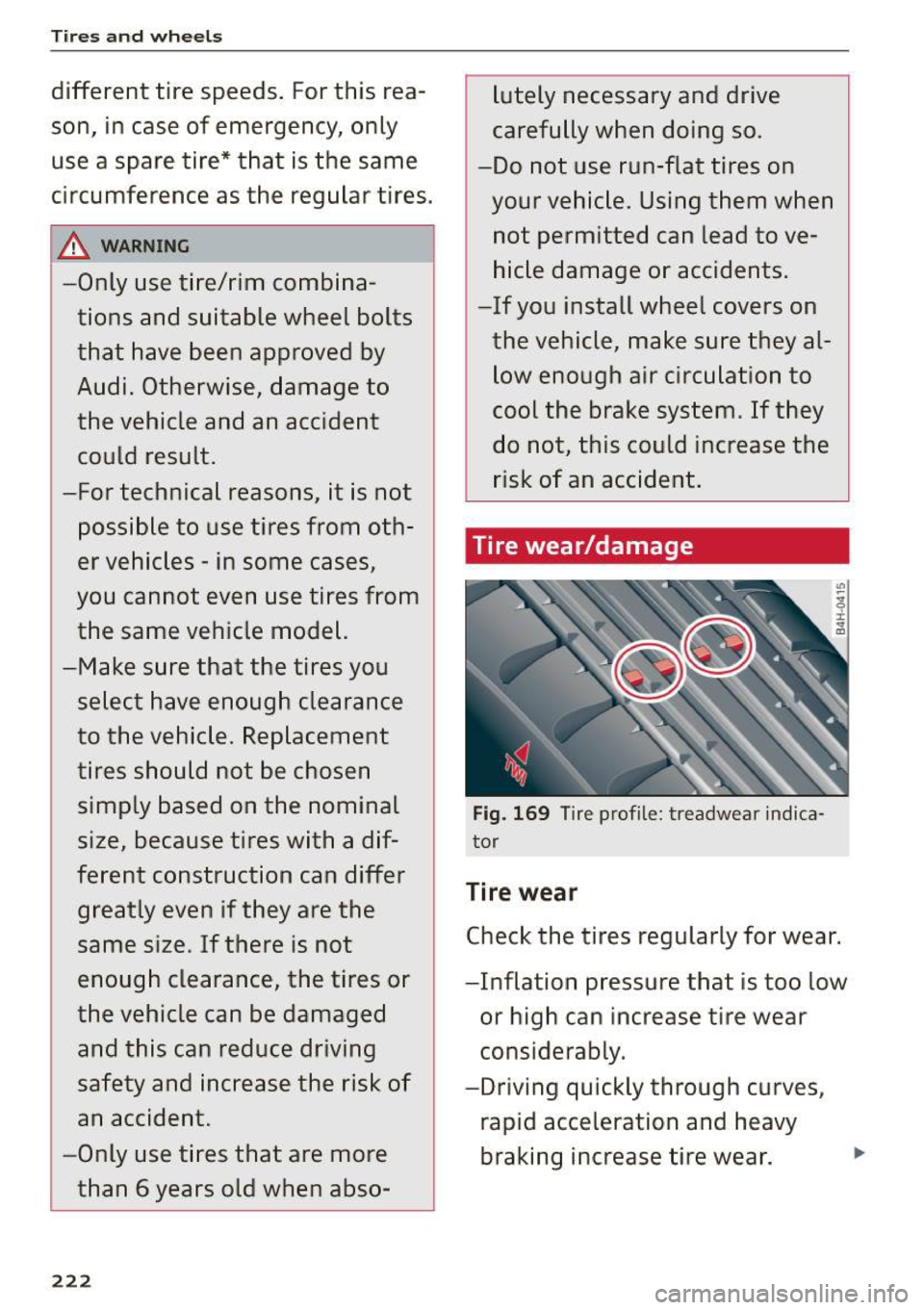
Tire wear/damage
Fig. 169 Tire profil e: treadwear indica
tor
Tire wear
Check the tires regularly for wear.
-Inflation pressure that is too low
or high can increase tire wear
considerably.
-Driving quickly through curves, rapid acceleration and heavy
braking increase tire wear.
..
Page 230 of 282
Tires and wheels
are listed on the safety compli
ance sticker label located on the
driver's side B-pillar
¢ page 224,
fig. 170 .
& WAR NING
-
Overloading a vehicle can cause
loss of vehicle control, a crash
or other acc ident, serious per
sonal injury, and even death.
-Carrying more weight than your vehicle was designed to carry will prevent the vehicle
from handling properly and in crease the risk of the loss of
vehicle control.
-The brakes on a vehicle that
has been overloaded may not
be able to stop the vehicle
within a safe distance .
-Tires on a vehicle that has been overloaded can fail sud
denly, including a blowout and
sudden deflation, causing loss of control and a crash.
-Always make sure that the to tal load being transported -
inc luding the weight of a trail
er hitch and the tongue
weight of a loaded trailer -
does not make the vehicle
heavier than the vehicle's
Gross Vehicle Weight Rating.
228
Determining correct load
limit
Use the example below to calcu
late the total weight of the pas
sengers and luggage or other
things that you plan to transport so that you can make sure that
your vehicle will not be overload
ed.
Step s for Determining Correct
Load Limit
1. Locate the statement "THE
COMBINED WE IGHT OF OCCU
PANTS AND CARGO SHOULD
NEVER EXCEED XXX KG OR XXX
L BS"on your vehicle's placard
(tire inflation pressure label)
¢ page 224, fig . 170 .
2. Determine the combined
weight of the drive r and pas
sengers that will be riding in
your vehic le.
3. Subtract the combined weight of the driver and passengers
from "XXX" kilograms or "XXX"
pounds shown on the sticker
¢ page 224, fig . 170 .
4. The resulting figure equals the
available amount of cargo and luggage load capacity . For ex
ample, if the
"XXX" amount
equals 1400 lbs . and there will ...
Page 232 of 282
Tires and wheel s
-Always adapt your driving to the road and
traff ic conditions. Dr ive carefully and red uce
yo ur speed on icy or slippery roads. Even
winter tires can lose tract io n on black ice .
@ For the sake of the environment
Reinstall summer tires at the appropriate
time, because they provide better handling
when roads are free of snow a nd ice. Summer
tires cause less road noise, tire wear and fuel
consumptio n.
(D Tips
You can also use all season tires instead of
w inte r tires. Please note that in some coun
t ries w here winter tires are requ ired, on ly win
t er tire s wi th the .& symbol may be pe rm it
t ed.
Snow chains
Snow chains improve traction in the snow .
.,. Only install snow chains on the front wheels.
Th is applies also to veh icles with all wheel
drive* .
.,. Ch eck and correct the seating of th e snow
c h ains if necessa ry afte r dri ving a few feet. Fo l
l ow the ins tructions from the manuf acturer.
.,. Note t he max imum permit ted speed w hen driv
ing with snow chains . Do not exceed 30 mph
(SO km/h).
Snow chains not only improve the
driving in win
ter road conditions, but a lso t he
braking .
Use of s now chai ns is o nly pe rm itted with certa in
r im/t ire comb ina tion s due to techn ica l reason s.
Chec k w ith an au thori zed A udi d ealer or au tho r
ized A udi Service Facility to see if yo u may use
snow cha ins.
Use
fine -mesh snow chain s. They mus t not add
mo re th an 0 .5 3 inch ( 13.S mm) in height, in clu d
ing the chain lock.
You must remove the chai ns when dr iv ing on
roads tha t are
free of snow. W hen r oads are free
of snow, snow chains can imp air handling an d
230
'
damage the tires, and the chains wi ll quick ly be
dest royed.
A WARNING
Using incorrect snow chains o r insta lling snow
cha ins incor rectly can res ult in loss of veh icle
c o ntrol, which increases the risk of an acc i
dent.
(D Note
- Snow chains can damage the rims/wheel
cove rs* if the c hains come into direct c on
tact with them. Remove the wheel covers*
first . Use coa ted snow cha ins.
Low aspect ratio tires
Your A udi is fac to ry-eq uipped w ith low aspect ra
t io t ires. These t ires have been thoroug hly tes ted
a nd been sele cted specifi ca lly f or your mode l for
the ir su perb pe rformance, r oad fee l and h andlin g
u nder a var iety of dr iv ing con ditions. As k your au
t h orized Aud i dea le r fo r more details .
The low aspe ct ratio of these tires is ind icated by
a n umer al of
55 or less in the t ire's s ize design a
tion . The nume ral represents the ratio of the
ti re's si dewall height in relatio n to its tread width
expressed i n pe rcentage. Conventional tires have
a height/width rat io o f 60 o r more .
The performance of low-aspect-ratio tire s is par
ticularly sensitive to imprope r inflation pres
sure. It is therefore important that low aspect ratio tires are inflated to the specified pressure
and that the inflation pressure is regularly
checked and maintained. Tire pressures should be checked at least once a month and always
b efor e a long trip
Q page 224 .
What you can do to avoid tire and rim
damage
Low aspect rat io tires can be damaged mo re eas i
l y by impact w ith potho les, c urbs , g ull ies o r
r idges on t he road, pa rti cularly if th e tire is un
der i nflated.
Page 233 of 282
M N
0 > co ,...., \!) 1.1'1
1.1'1
1.1'1
,....,
In o rder to m inim ize the occu rrence o f impac t
damage to the t ires of your vehicle, we recom
mend that you observe the following precau
tions :
- Always maintain recommended in flat ion p res
s ur es . Check yo ur tire p ress ure every 2,000
miles (3,000 km) and add air if necessary.
- Drive carefu lly on roa ds with potholes, deep
gul lies or ridges. The impact from driving
th ro ugh or over such obstacles can damage
your tires. Impact with a curb may also cause damage to your tires.
- After any impact, immediately inspect your
tires or have them inspected by the nearest a u
thorized Aud i dea ler . Replace a damaged tire as
soon as poss ible .
- Inspect your t ires every 2,000 miles (3 ,000 km)
for damage and wear. Damage is not always
easy to see. Damage can lead to loss of a ir and
underinflation, which cou ld eventually cause
t ir e fa il ur e.
If yo u be lieve that a ti re may h ave
been d amaged, rep lace the tire as soon as pos
s ible.
= T hese tires m ay we ar m ore q uic kly than ot hers.
- Please a lso remember that, wh ile thes e tir es
deliver respons ive handling, t hey may ride less
c o m fort ably and m ake more noise t han other
cho ices .
Reduced performance in winter/cold season
conditions
All t ires are des igned for cert ain purposes. The
l ow aspec t ratio, u ltra high per formance tires
originally insta lled on yo ur vehicle a re intended
for maximum dry and wet road perfo rmance an d
h andling. They are not suitable for cold, snowy or
icy weather cond it ions . If you drive under those
circumstances , you should equip your vehicle
w ith a ll-season or winter tires , which offer better
traction under those cond itions . We suggest you
use the re commended snow o r a ll-s eason t ires
specified fo r you r vehicle , or the ir eq uivalent.
Refe r to ¢
page 229 for mo re deta iled informa
tion regard ing winter tires .
Uniform tire quality grading
- Tread wear
Tires and wheels
- Traction AA A B C
- Temper ature A BC
Quali ty g rades can be found where applicab le on
t h e tire side wa ll between tread shoulder a nd
max imum sec tion wid th
~ page 214, fig . 168.
For example: Tread wear 200 , Traction AA, Tem
perature
A.
All passenger car t ires must conform to Federa l
Safety Requirements in addition to these grades.
Tread wear
T he tread wear g rade is a comparative rating
based on the wear rate of the t ire when tested
u nder contro lled c onditions on a specified gov
ernment test course.
F or example, a tire gra ded 15 0 wo uld wear one
and one half (1 1/2) times as we ll on the govern
ment course as a t ire g raded 100.
T he re lative per forman ce of tires depends upon
t h e actual cond itions of thei r use, however, and
may depart significantly from the norm due to
variations in driv ing habits, service p ract ices and
differences in road c haracteristics and climate.
Traction
T he traction gra des, from highest to lowest, are
AA , A , Ban d
C. Those g rades represent t he tire's
ability to stop on wet pavement as meas ured un
der contro lled conditions on specified govern
ment test s urfaces of asphalt a nd c oncrete . A tire
marked C may have poor traction performance
~ A .
Temperature
The temperature grades are A (the highest), B,
and C, representing the t ire's resistance to the
generation of heat a nd its ability to diss ipate
heat when tested u nder cont ro lled conditions on
a spec ified indoor labora to ry test wheel.
Sustained h igh temperature can cause the mate
ria l of the tire to degenerate and reduce ti re life,
and excess ive temperature can lead to s udden
t ir e fail ure¢ ,&. . .,,.
231