warning AUDI S3 SEDAN 2017 Owners Manual
[x] Cancel search | Manufacturer: AUDI, Model Year: 2017, Model line: S3 SEDAN, Model: AUDI S3 SEDAN 2017Pages: 400, PDF Size: 67.32 MB
Page 311 of 400
a, a, ..... N
" N ..... 0 N > 00
Tether anchors and tether straps
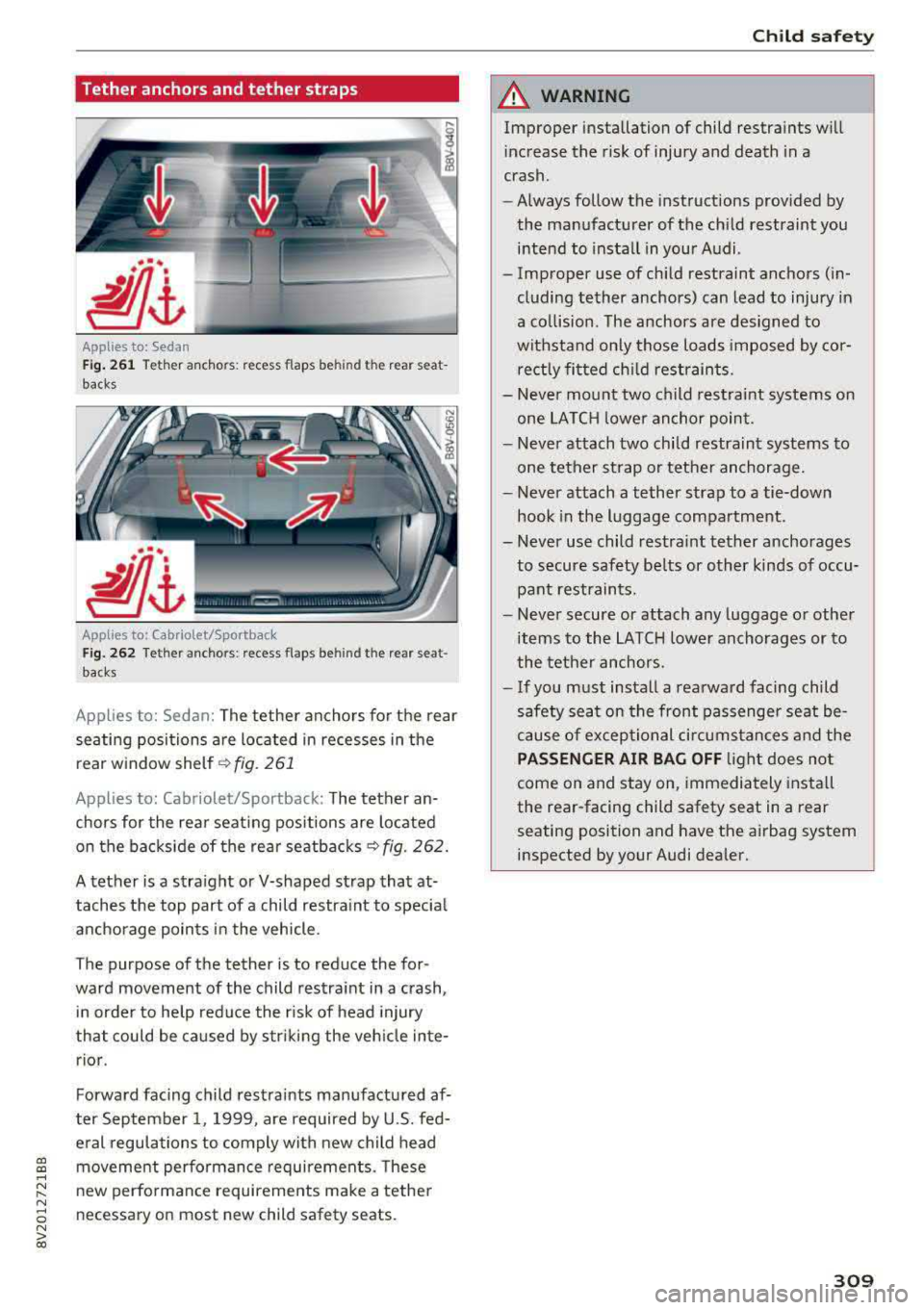
Applies to: Sedan
Fig. 261 Tether anchors: recess flaps behind the rear seat
backs
Applies to: Cabriolet/Sportback
Fig. 262 Tethe r anchors: recess flaps behind the rear seat
backs
Applies to: Sedan: The tether anchors for the rear
seating positions are located in recesses in the
rear window
shelf ~ fig. 261
Applies to: Cabriolet/Sportback : The tether an
chors for the rear seating positions are located
on the backside of the rear seatbacks
~ fig. 262.
A tether is a straight or V-shaped strap that at
taches the top part of a child restraint to special
anchorage points in the vehicle .
T he purpose of the tether is to reduce the for
ward movement of the child restraint in a crash,
in order to help reduce the risk of head injury
that could be caused by striking the vehicle inte
rior .
Forward facing child restraints manufactured af
ter September 1, 1999, are required by U .S. fed
eral regulations to comply with new child head
movement performance requirements . Th ese
new performance requirements make a tether
necessary on most new child safety seats .
Child safety
A WARNING
-Improper installation of child restraints will
increase the risk of injury and death in a
crash.
- Always follow the instructions provided by
the manufacturer of the child restraint you
intend to install in your Audi .
- Improper use of child restraint anchors (in
cluding tether anchors) can lead to injury in
a collision . The anchors are designed to
withstand only those loads imposed by cor
rectly fitted child restraints.
- Never mount two child restraint systems on
one LATCH lower anchor point.
- Never attach two child restraint systems to
one tether strap or tether anchorage.
- Never attach a tether strap to a tie-down
hook in the luggage compartment.
- Never use child restraint tether anchorages to secure safety belts or other kinds of occu
pant restraints.
- Never secure or attach any luggage or other
items to the LATCH lower anchorages or to
the tether anchors.
- If you must install a rearward facing child
safety seat on the front passenger seat be
cause of exceptional circumstances and the
PASSENGER AIR BAG OFF light does not
come on and stay on, immediately install
the rear-facing child safety seat in a rear
seating position and have the airbag system inspected by your Audi dealer.
309
Page 313 of 400
CXl CXl .... N ,.__
N .... 0 N > 00
A WARNING ,~
Improper use of the LATCH system can in
crease the risk of serious personal injury and
death in an acc ident.
-
-These anchors were developed only for child
safety seats using the "LATCH" system.
- Never attach other child safety seats, belts
or other objects to these anchors.
- Always make sure that you hear a click when
latching the seat in place. If you do not hear
a click the seat is not secure and could fly
forward and hit the interior of the vehicle,
o r be ejected from the vehicle.
A WARNING
Improper installation of child restraints will
increase the risk of injury in an acc ident.
- Always follow the child restra int system
manufacturer's instruct ions for proper in
sta llation of the child restraint system and
proper use of tether straps as well as the
lower anchorages or safety be lts in your ve
hicle.
- Always read and heed the important infor
mation and WARNINGS about child safety
and the installation of child restraint sys
tems
c> page 292, Child safety.
Using tether straps on rearward-facing
child restraints
Currently, few rear-facing child restraint systems
come w ith a tether . Please read and heed the
child restraint system manufacturer 's instruc
tions carefully to determine how to properly in
stall the tether.
A WARNING
A child in a rearward-facing chi ld safety seat
installed on the front passenger seat w ill be
seriously injured and can be killed if the front
airbag inflates - even w ith an Advanced Airbag
System.
- The inflating a irbag w ill hit the child safety
seat or infant carrier with great force and
will smash the ch ild safety seat and child
Child safety
against the backrest, center armrest, or
door.
- If you must install a rearward facing child
safety seat on the front passenger seat be
cause of exceptional circumstances and the
PASSENGER AIR BAG OFF light does not
come on and stay on, immediately install
the rear-facing child safety seat in a rear
seating position and have the air bag system
inspected by your Audi dealer.
Additional information
Sources of information about child
restraints and their use
There are a number of sources of additional in
formation about child restraint selection, instal
lation and use:
NHTSA advises that the best child safety seat is
the one that fits your child and fits in your veh i
cle, and that you w ill use correctly and cons is
tent ly.
Try
before you buy!
U.S National Highway Traffic Safety Administra
tion
Tel. : 1-888-327-4236 (TTY: l-800-424-91S3)
http://www .nhtsa.gov
http://www .safercar .gov
National SAFE KIDS Campaign
Tel.: (202) 662-0600
http://www .safekids .org
Safety BeltSafe U.S.A
Tel.: (800) 745-SAFE (English)
Tel. : (800) 747-SANO (Spanish)
http://www .carseat.o rg
Transport Canada Information Centre
Tel.: 1-800-333-0371 or ca ll 1-613-998-8616 if
you are in the Ottawa area
http://www .tc .gc .ca/ eng/roadsafety/men u. htm
Audi Customer Relations
Tel.: (800) 822-2834
311
Page 315 of 400
CXl CXl .... N r--N .... 0 N > 00
-If you are unable to determine whether or
not a particular fuel blend meets the speci
ficat ions, ask your service station or its fuel
supplier.
-Do not use fuel for which the contents can
not be identified.
-Fuel system damage and performance prob
l ems resulting from the use of fue ls diffe r
ent from those specified are not the respon
s ibility of Audi and are not covered under
the New Veh icle or the Emiss ion Control
System Warrant ies .
-If you experience a loss of fue l economy or
driveability and pe rformance problems due
to the use of one of these fuel blends, we r ecommend that you switch to unblended
fuel.
Gasoline additives
A ma jor concern among many auto manufactur
ers is carbon deposit build-up ca used by the type
of gasoline yo u use.
A lt hough gasoline grades d iffer from one manu
facturer to another, they have cer tain things in
common . A ll gasoline grades contain substances
that can cause deposits to collect on vita l engine
parts, such as fue l injectors and intake valves.
Al
though most gasoline brands include additives to
keep engine and fuel systems clean, they are not
equally effective .
Aud i recommends using TOP TIER Detergent Gas
oline. For more informat ion on TOP TIER Dete r
gent Gasoline, please go to the official website
(www.toptiergas .com) .
After an extended period of using inadequate
fuels, carbon deposit build-ups can rob your
en
g ine of peak performance.
CD Note
Damage or malfunction due to poor fuel q ual
ity is not covered by the Aud i New Vehicle
Limited Warranty.
Ch eck ing and Filling
Refueling
Fuel filler neck
The fue l filler neck is located on the rig ht rea r
s ide panel behind the fuel fille r flap .
If the power lock ing system shou ld fail, yo u can
st ill open the flap manually
-fo r detailed instruc
tio ns see
9 page 315.
You can find the fuel tank capacity of your vehicle
i n
c::;, page 375 .
The label on the inside of the f uel fi ller flap tells
you the correct fuel for your vehicle. For more in
f ormat ion about fuel spec ificat ions, see
9 page 312.
Your vehicle fuel tank has an onboard refue lling
vapor recovery system. This feature helps to pre
vent fuel vapors from escaping from the tank and polluting the environme nt wh ile you refue l yo ur
vehicle . In order to fill the tank p roper ly w hile
pro tect ing t he e nvir onment, p lease follow t his
r efue ling p rocedure ca refully.
_& WARNING
Un der normal opera ting co nd it io ns, neve r car
ry additional f uel con tainers in your car. Gas
canisters and other containers used to trans
port fue l can be dange rous. Such containe rs,
f ull or empty, may leak and could cause a fire
i n a co llision. If you must transpo rt fuel to
use for your lawn mower, snow blower, etc .,
be ve ry careful and always observe local and
sta te laws rega rding the use, transportation
and storage of su ch f uel con tainers. Make cer
t ai n t he co ntain er meets industry standards
(ANSI/AS TM F8S2
-86).
CD Note
Never drive your veh icle until the fue l tank is
complete ly empty. The irreg ular s upply of
f u el can cause misfiring. Gaso lin e c ould enter
the e xhaust sys tem an d damage the cat aly tic
conve rter.
313
Page 316 of 400
Checking and Filling
Fueling
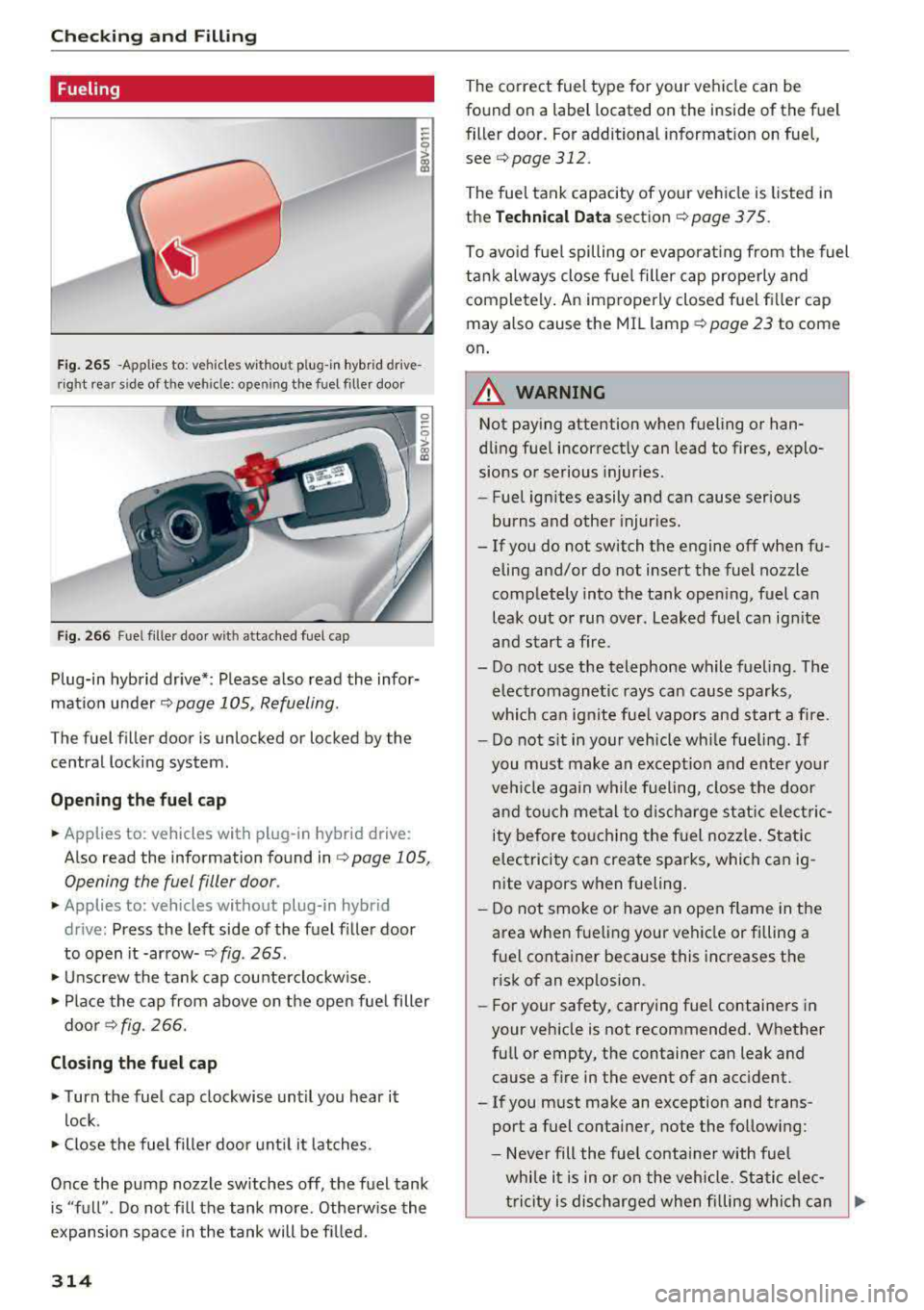
Fig . 265 -Applies to: veh icles wi tho ut p lug -in hybrid dr ive
ri ght rea r side of t he veh icle: ope nin g the fuel filter door
Fig. 266 Fue l fi ll er doo r w it h attached fuel cap
Plug-in hybrid drive* : Please a lso read the infor
matio n under
¢page 105, Refueling.
The fuel filler door is unlocked or locked by the
central locking system.
Op en ing th e fuel cap
"' Applies to : vehicles with p lug-in hybri d drive :
Also read the information found
in c> page 105,
Opening the fuel filler door .
"'Applies to : vehicles wi tho ut plug-in hybrid
dr ive: Press the left side of the fuel filler door
to open it-arrow-
¢ fig . 265.
"' Unscrew the tank cap counterclockw ise.
"' Place the cap from above on the open fue l filler
door ¢ fig. 266.
Closing th e fu el cap
"' Turn the fuel cap clockwise until you hear it
lock.
"' Close the fuel fille r door unt il it l atches.
Once the pump nozzle sw itches off, the fuel tank
is
" full" . Do not fi ll the tank more . Otherw ise the
expansion space in the tank will be f illed.
314
The correct fuel type for your vehicle can be
found on a label located on the inside of the fuel
filler door. For additional informat ion on fuel,
see
¢ page 312.
The fuel tank capacity of your ve hicle is listed in
the
T echn ical Dat a section ¢ page 375.
To avoid fuel spilling or evaporat ing from the fuel
tank always close fue l fi ller cap properly and
completely . An improperly closed fuel fi ller cap
may also cause the MIL
l amp ¢ page 23 to come
on .
_& WARNING
Not pay ing attention when fueling or han
dling fuel incorrectly can lead to fires, explo
sions or serious injur ies.
-Fue l ignites easily and can cause serious
burns and other injur ies.
-
-If you do not switch the engine off when fu
eling and/or do not insert the fuel nozzle
completely into the tank open ing, fuel can
leak out or run over . Leaked fuel ca n ign ite
and start a fire.
-Do not use the telephone while f ueling. The
elec tromagnetic rays ca n cause sparks,
which can ignite fue l vapors and start a fire.
- Do not sit in your vehicle wh ile fue ling. If
you must make an exception and ente r your
veh icle agai n while fueling, close the door
an d touch me tal to d ischarge stat ic elect ric
ity before to uching the f uel nozz le . Static
electricity can create spa rks, which can ig
nite vapors when fueling.
-Do not smoke or have an open flame in the
area when fueling your vehicle or fi lling a
fue l container because this increases the
risk of an explosion.
-For your safety, carrying fuel containers in
your vehicle is not recommended. W hether
fu ll or empty, the container can leak and
cause a fire in the event of an acc ident.
- If you must make an exception and trans- port a fuel container, note the fo llow ing:
- Never fill the fuel container with fuel
while i t is in o r on the vehicle. Static e lec
tricity is discharged whe n filling w hich can
.,._
Page 318 of 400
Check ing and F illing
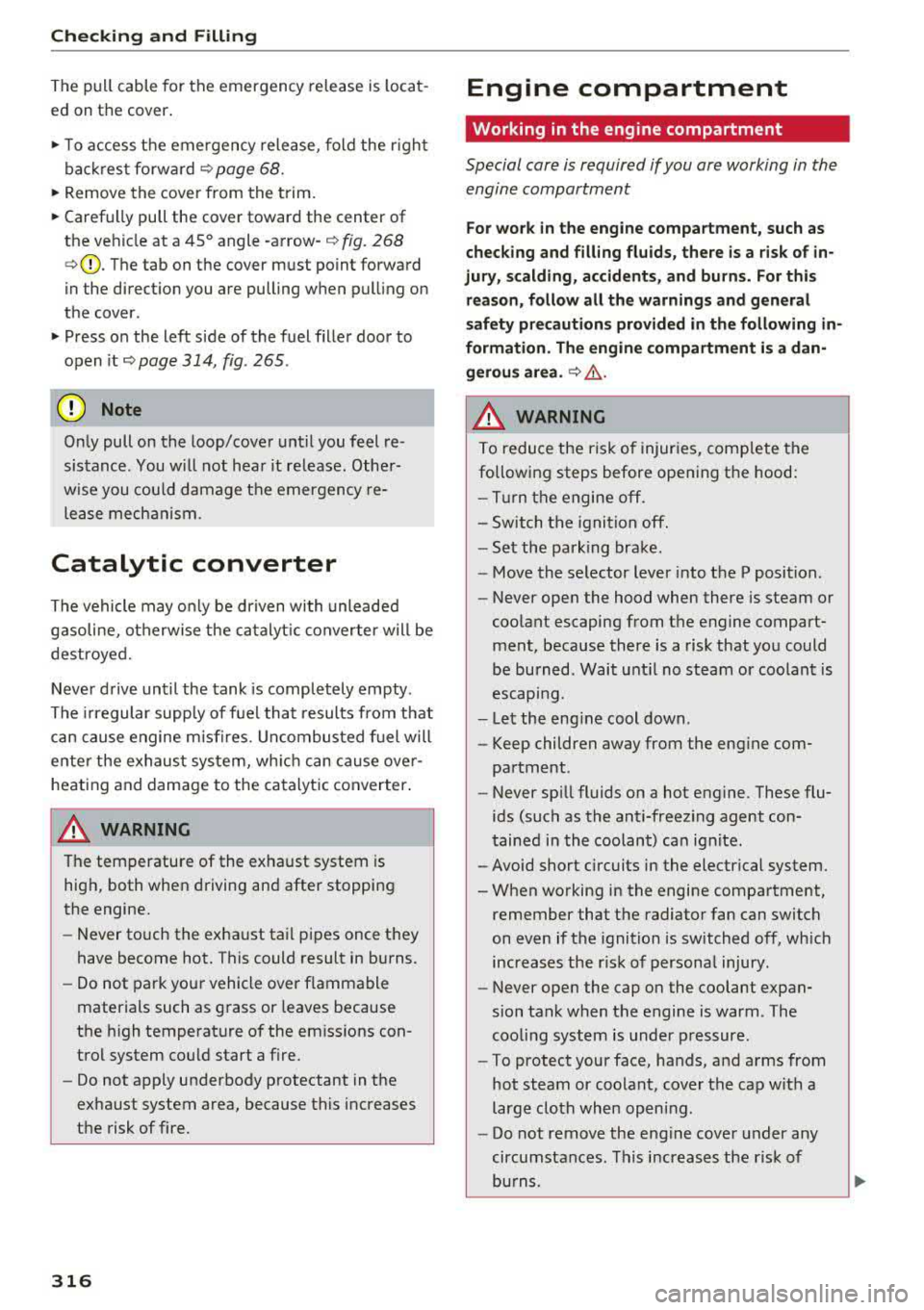
The pull cable for the emergency release is locat
ed on the cover .
.,. To access t he e mergency release, fold the r ight
bac kres t
forwa rd ¢ page 68 .
.,. Remove the cover from the trim .
.,. Carefully pull the cover toward the center of
the ve hicle at a 45° angle
-arrow- ¢ fig. 268
c>(D . The tab on the cover must point forward
in the direct ion you are pulling when pull ing on
the cover.
.,. Press on the left s ide of the fuel f ille r door to
open it
¢ page 314, fig . 265 .
(D Note
Onl y pull on the loop/cove r unt il you feel re
sistance. You wi ll not hea r it re lease . Other
w ise you cou ld damage t he emergency re
lease mecha nism .
Catalytic converter
The vehicle may o nly be driven with unleaded
g a soline, otherwise the catalyt ic converter will be
destroyed.
Never d rive until the tank is completely empty .
The irregular supp ly of f uel that results from t hat
can cause engine m isfi res. Uncombusted fuel will
ente r the exhaust sys tem, w hich can ca use ove r
heating and damage to the catalyt ic converter .
& WARNING
The tem perature of the ex ha ust system is
high, both when driving and after stopping
the engine.
-
- Never touch the exha ust ta il pipes once t hey
have become hot. This could result in burns.
- Do not park your vehicle over flammable
materials such as g rass or leaves because
the h igh temperat ure of the emiss ions con
trol system cou ld start a f ire.
- Do not apply underbody protectant in the
exhaust system area, because this increases
t h e risk of fire.
316
Engine compartment
· Working in the engine compartment
Special care is required if you are working in the
engine compartment
For work in the engine compartment, such as
checking and fill ing fluids , the re is a risk of in
jury, scalding, accidents , and burns. For this
reason, follow all the warnings and general
safety precaut ions provided in the following in ·
formation . The engine compartment is a dan
gerous area.
c> & .
& WARNING
To reduce the ris k of injur ies, comp lete the
following steps before opening the hood:
- Tur n the engine off.
- S witch the igni tion off.
- Set the park ing brake.
- Move the selector lever into t he P position.
- Never ope n the hood when there is steam o r
coo lant escaping from the engine compart
ment, because there is a risk that yo u could
be burned . Wait unt il no steam or coolant is
escapi ng.
- L et the eng ine cool down .
- Keep children away from the eng ine com-
pa rtment .
- Never sp ill fluids on a hot engine . These flu
ids (such as the anti-freezing agent con
tained in the coolant) ca n ignite.
- Avoid short c ircuits in the electrical system.
- When working in the engine compa rtment,
remember that the radiator fan can switch
on even if t he ignition is switched off, wh ich
increases the r is k of persona l injury.
- Never open the cap on the coolant expan
sion tank when the engine is warm . The
coo ling syste m is under p ressure.
- To protect your face, hands, and a rms from
hot steam or coolant, cover the cap with a
large cloth when opening .
- Do not remove the engine cover under any
circumstances . Th is i ncreases the risk of
burns .
-
Page 319 of 400
CXl CXl .... N ,.__
N .... 0 N > 00
-If tests need to be performed with the en
gine running, there is additional danger due
to moving components (such as the ribbed belt, alternator and radiator fan) and from
the high-voltage ignition system.
-Never reach into the radiator fan. The elec
tric auxiliary fan is controlled by tempera
ture and can switch on suddenly.
-Do not under any circumstances activate the
throttle inadvertently (for example, by hand
from the engine compartment) if the vehi
cle is stationary but the engine is running
and a gear is engaged. Otherwise, the vehi
cle will start to move immediately and this
could result in an accident.
-Pay attention to the following warnings list
ed when work on the fuel system or on the
electrical equipment is required.
- Do not smoke .
-Never work near open flames.
- Always have a working fire extinguisher
nearby
- All work on the battery or electrical system
in your vehicle can result in injuries, chemi •
cal burns, accidents or burns. Because of
this, all work must be performed
only by an
authorized Audi dealer or authorized Audi
Service Facility.
-To reduce the risk of electric shock and in
jury, never touch the following components when the engine is running or is being start
ed :
- Ignition cable
-Other components in the electronic high-
voltage ignition system
-If you must check or perform work on the
engine while it is running:
-Set the parking brake and place the selec
tor lever in the P (park) position first .
- Always proceed with extreme caution so
that clothing, jewelry or long hair do not
become caught in the radiator fan, fan
belt or other moving components or do
not come into contact with hot compo
nents. Tie back long hair before beginning
work and do not wear clothing that can
hang down into the engine .
Checking and Filling
-Limit your exposure to exhaust and chemi
cals to as short a time as possible
c:> A .
A WARNING
-California Proposition 65 Warning:
-Engine exhaust, some of its constituents,
and certain vehicle components contain or
emit chemicals known to the State of Cali
fornia to cause cancer and birth defects and
reproductive harm . In addition, certain flu
ids contained in vehicles and certain prod
ucts of component wear contain or emit
chemicals known to the State of California
to cause cancer and birth defects or other
reproductive harm.
- Battery posts, terminals and related acces
sories contain lead and lead compounds,
chemicals known to the State of California
to cause cancer and reproductive harms.
Wash hands after handling.
(D Note
When filling fluids, be sure not to mix the flu
ids up. Otherwise severe malfunctions and en
gine damage will occur.
@ For the sake of the environment
You should regularly check the ground under
your vehicle in order to detect leaks quickly. If
there are visible spots from oil or other fluids, bring your vehicle to an authorized Audi deal
er or authori zed Audi Service Facility to be
checked.
317
Page 320 of 400
Checking and Filling
Opening and closing the hood
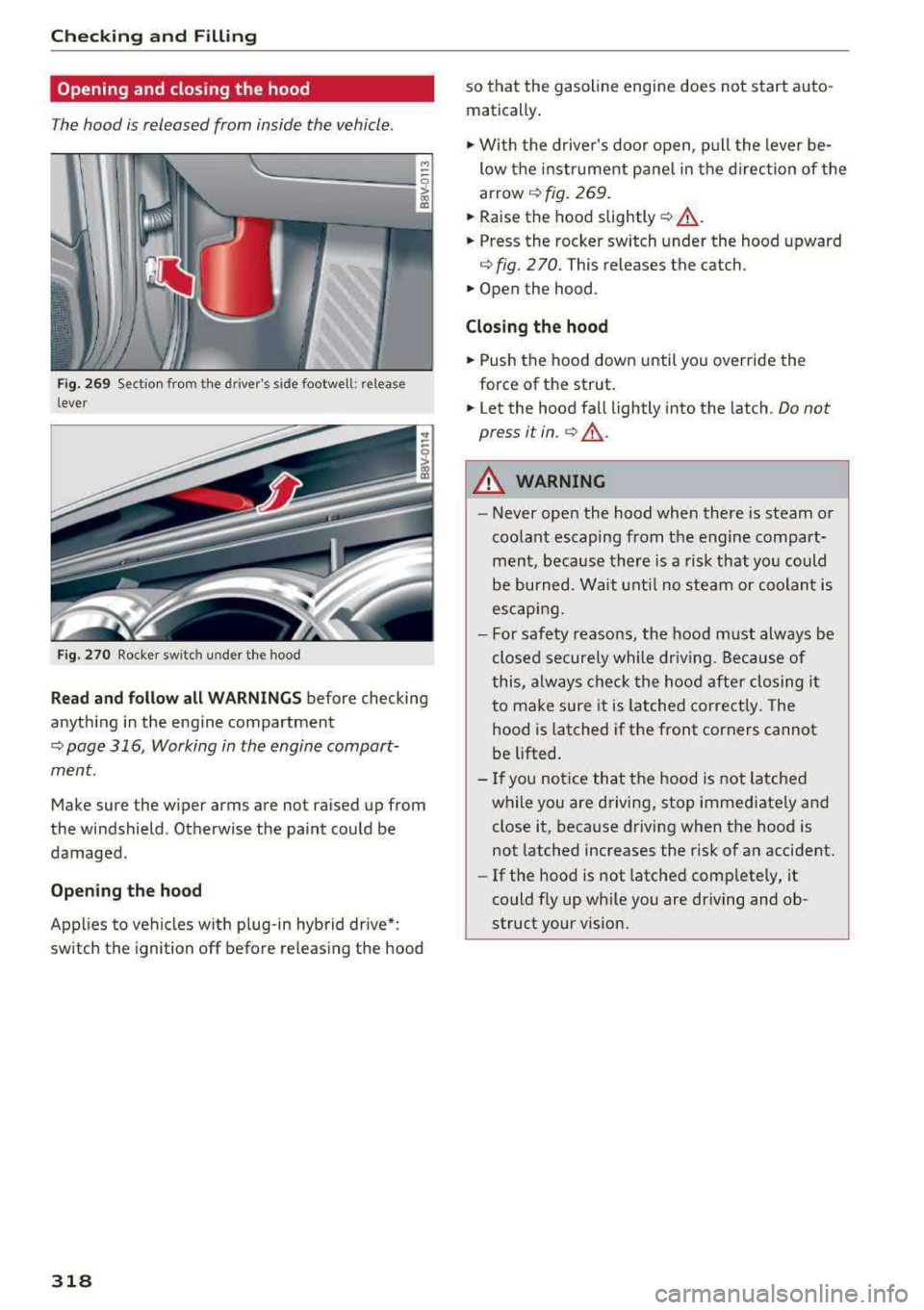
The hood is released from inside the vehicle .
M ~
-...::;:;========-d ~
Fi g. 269 Sect ion from th e driver's side footwell: release
l ever
F ig. 270 Rocker switc h under the hood
m
Read and f oll ow all W ARNINGS before checking
anything in the engine compartment
q page 316, Working in the engine comport
ment .
Make sure the wiper arms are not raised up from
the w indshield . Otherwise the paint could be
damaged.
Open ing the ho od
App lies to vehicles w ith plug-in hybrid drive *:
switch the ignition off before re leasing the hood
318
so that the gasoline engine does not start auto
matically .
.,. With the drive r's doo r open, pull the lever be
low the instr ument pane l in the d irection of the
arrow
q fig. 269.
... Raise the hood slightly 9 .&, .
... Press the rocker switch under the hood upward
qfi g. 270. This releases the catch .
... Open the hood .
Closing the hood
... Push the hood down unti l you override the
force of the strut .
... Let the hood fall lightly into the latch . Do not
press it in .
q .&,.
A WARNING
--Never open the hood when there is steam or
coolant escaping from the engine compart
ment, because there is a risk that yo u could
be bu rned. Wait unt il no steam or coolant is
escaping.
- For safety reasons, the hood m ust always be
closed securely while driv ing. Because of
this, always c heck the hood after closing it
to make sure it is latched correctly. The
hood is latched if the front corners cannot
be lifted.
- If you notice that the hood is not latched while you are driving, stop immediate ly and
close it, because driving when the hood is
not latched increases the risk of an accident.
- If the hood is not latched comp letely, it
could f ly up while you are driving and ob
struct your vision.
Page 321 of 400
a, a, ..... N
" N ..... 0 N > 00
Checking and Filling
Engine compartment overview
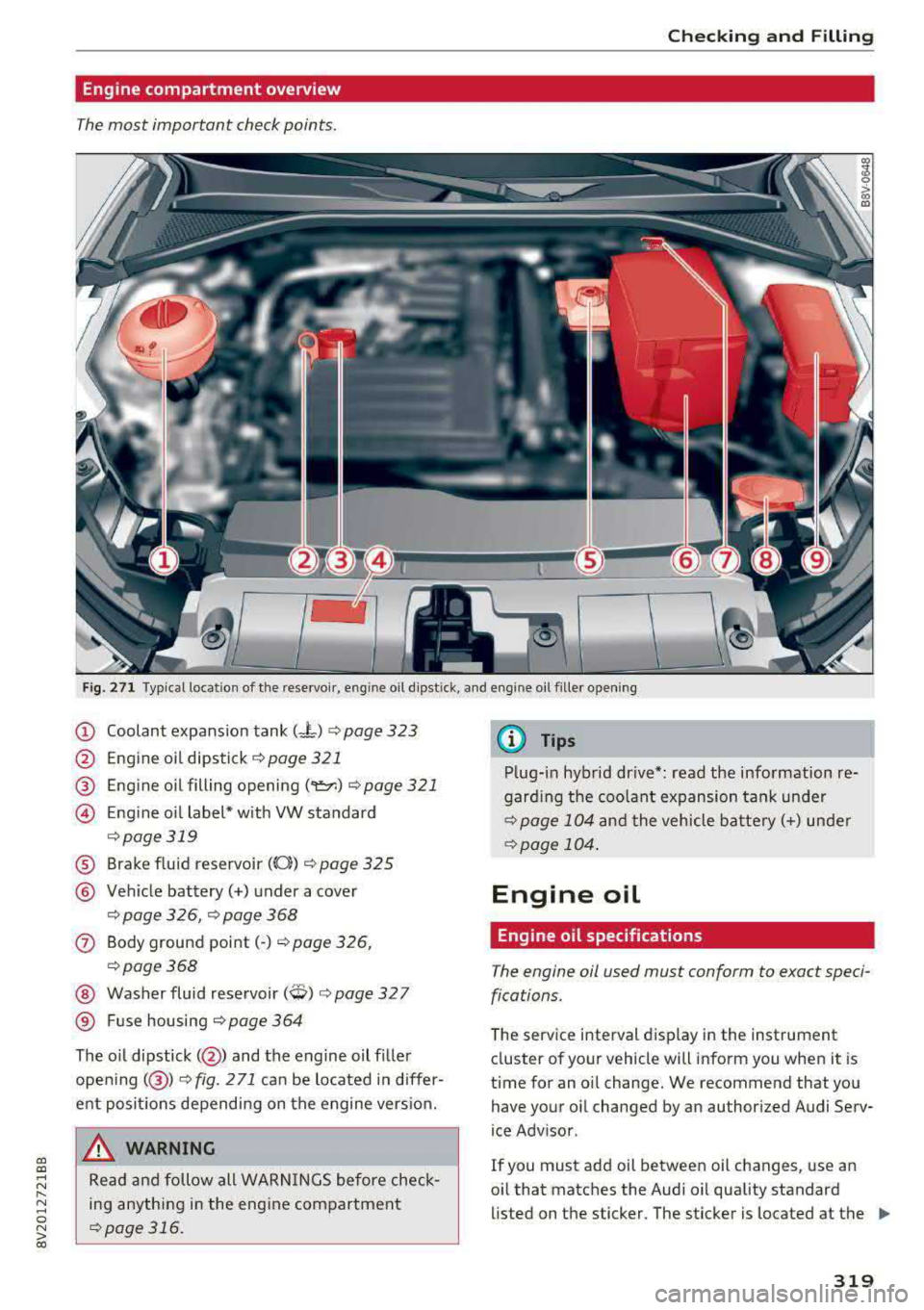
The most important check points .
-
Fig. 271 Typical location of the reservoir , engine oil dipst ick, and eng ine oil filler opening
(D Coolant expansion tank (-"-) ¢ page 323
@ Engine oil dipstick¢ page 321
® Eng ine oil filling opening ('er.) ¢page 321
@ E ng ine o il label* w ith VW standard
¢ page 319
® Brake fluid reservoir ((0}) ¢ page 325
@ Vehicle battery(+) under a cover
¢ page 326, ¢ page 368
0 Body ground point(-) ¢page 326,
¢page 368
@ Washer fluid reservoir (W) ¢ page 32 7
® Fuse housing ¢ page 364
The o il dipstick( @) and the engine oil f iller
opening( @)
¢fig. 271 can be located in differ
ent posit ions depending on the engine vers ion.
A WARNING
Read and follow all WARN INGS before check
ing anything in the engine compartment
¢page 316.
(D Tips
Plug-in hybrid drive*: read the information re
garding the coolant expansion tank under
¢page 104 and the vehicle battery(+) under
¢page 104 .
Engine oil
Engine oil specifications
The engine oil used must conform to exact speci
fications.
The service interval display in the instrument
cluster of your vehicle will inform you when it is
time for an oil change . We recommend that you
have your oil changed by an authorized Audi Serv
ice Advisor .
If you must add oil between oil changes , use an
oil that matches the Audi oil quality standard
li sted on the sticker. The sticker is located at the
Ill>
319
Page 322 of 400
Checking and Filling
front of the engine compartment¢ page 319,
fig.271.
Audi recommends
~ castroL //g/:fl;[ff}g f'rf!J7.f'"«JD,'1A1.
Audi recommends Longlife high performance
engine oil from Audi Genuine Parts
Using the proper engine oil is important for the
functionality and s ervice life of the engine. Your
engine was factory-filled with a high -quality oil
which can usually be used throughout the entire
year .
(D Note
Your Limited New Vehicle Warranty does not
cover damage or malfunctions due to failure
to follow recommended maintenance and use
requirements as set forth in the Audi Owner's
Manual and Warranty
& Maintenance booklet .
-Use only a high quality engine oil that ex-
pressly complies with the Audi oil quality
standard specified for your vehicle's engine .
Using any other oil can cause serious engine
damage.
-Do not mix any lubricants or other additives
into the engine oil. Doing so can cause en
gine damage.
(D Tips
If you need to add oil and there is none availa
ble that meets the Audi oil quality standard
your engine requires, you may add a total of
no more than 0.5 qt (0.5 l) of a high-quality
"synthetic"oil that meets the following speci
fications.
-ACEA A3 or API SM with a viscosity grade of
SAE 0W-30, SAE 5W-30 or SAE 5W-40.
-For more information about engine oil that
has been approved for your vehicle, please
contact either your authorized Audi dealer
or Audi Customer Relations at 1 (800) 822-2834 or visit our web site at
www .audiusa.com or www .audicanada.ca .
320
· Engine oil consumption
T he engine in your vehicle depends on on ade
quate amount of oil to lubricate and cool oil of
its moving ports .
In order to provide effective lubrication and cool
ing of internal engine components, all internal
combustion engines consume a certain amount
of oil. Oil consumption varies from engine to en gine and may change significantly over the life of
the engine . Typically, engines with a specified
break-in period
(see ¢ page 74) consume more
oil during the break-in period than they consume
after oil consumption has stabilized.
Under normal conditions, the rate of oil con
sumption depends on the quality and viscosity of
the oil , the RPM (revolutions per minute) at
which the engine is operated, the ambient tem perature and road conditions. Further factors are
the amount of oil dilution from water condensa
tion or fuel residue and the oxidation level of the
oil. As any engine is subject to wear as mileage
builds up, the oil consumption may increase over
ti me until replacement of worn components may
become necessary.
With all these variables coming into play, no standard rate of oil consumption can be estab
lished or specified . There is no alternative to reg
ular and frequent checking of the oil level , see
Note.
If the yellow engine oil level warning symbol II
in the instrument cluster lights up, you should
check the oil level as soon as possible
¢ page 321. Top off the oil at your earliest con
venience
¢ page 321.
A WARNING
Before you check anything in the engine com
partment, always read and heed all WARN
INGS
¢ page 316.
(D Note
Driving with an insufficient oil level is likely to
cause severe damage to the engine.
IJII,
Page 323 of 400
a, a, ..... N
" N ..... 0 N > 00
@ Tips
- The oil pre ssure w arning display. i s not
an indicator of the oil level. Do not rel y on
it. Instead , check the oil level in your en
gine at regular inte rval s, preferably each
t ime you refuel , and alway s befo re going
on a long trip.
- If you have the impression your engine con
sumes excessive amounts of oil, we recom
mend that you cons ult an autho rized Aud i
dealer to have the cause of your concern
properly d iagnosed . Keep in mind that the
accurate measurement of oil consump tion
requi res great care and may take some
time. An a uthorized Audi dea ler has instruc
tions about how to measure oil consump
tion accurately .
Checking the engine oil level and adding
engine oil
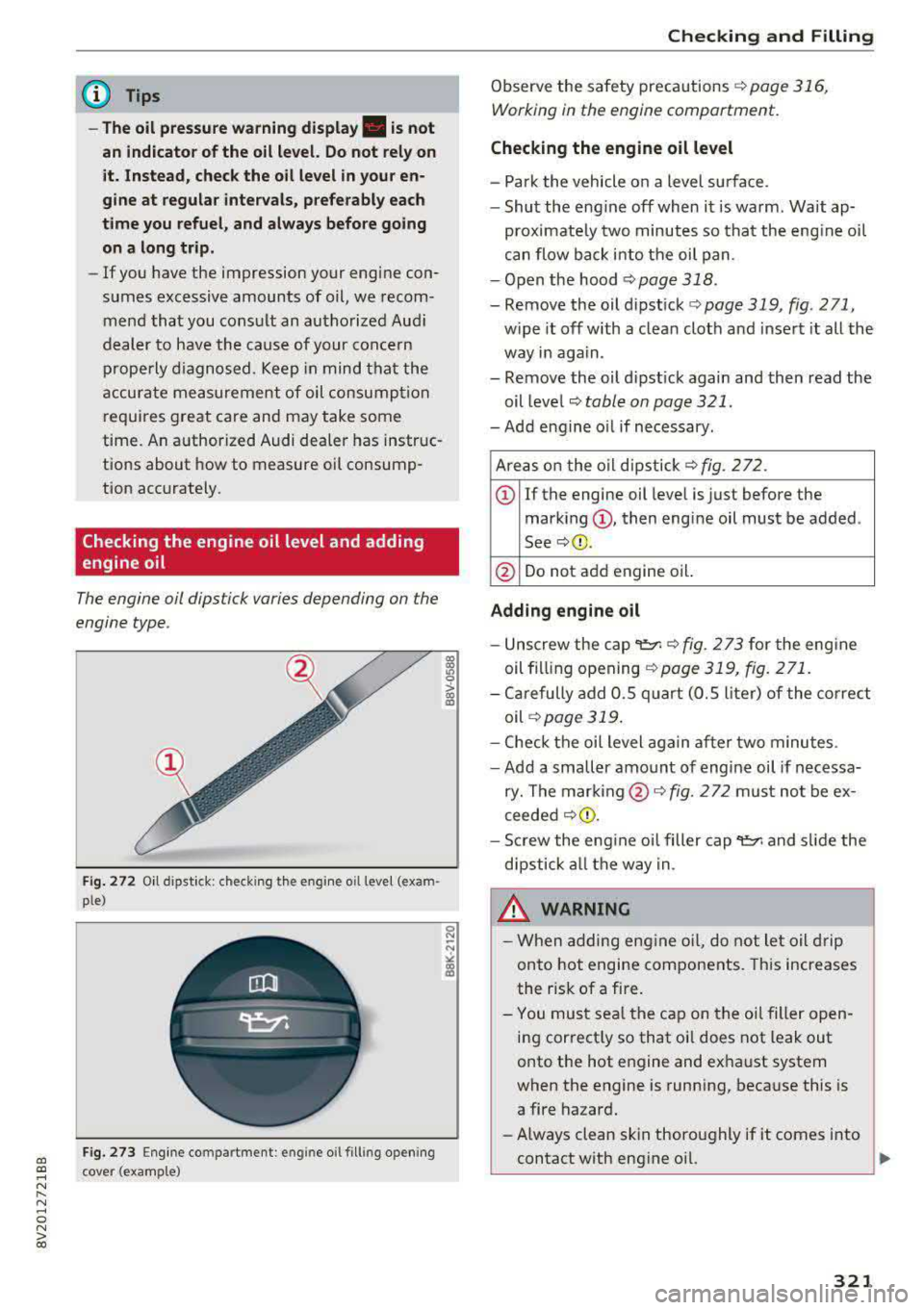
The engine oil dips tick varies depending on the
engine type .
Fig. 272 Oil dipst ic k: checking t he e ngin e oi l leve l (exa m
p le)
F ig. 273 Engine co mpartment : engin e o il fil ling opening
cover (examp le )
I
>
"' IX)
Checking and Filling
Observe the safety precautions ¢ page 316,
Working in the engine compartment.
C hecking the engine oil level
- Park the vehicle o n a level su rface .
- Shut the eng ine off when it is warm . Wait ap-
proximate ly two minutes so tha t the eng ine oil
can flow back into the oil pan .
- Open the hood
¢ page 318 .
-Remove the oil d ipst ick ¢ page 319, fig . 271,
w ipe it off w ith a clean cloth and insert it all the
way in aga in .
- Remove the oil d ipst ick again and then read the
oil leve l ¢
table on page 321 .
- Add engine oil if necessary .
Areas o n the o il
d ipstick ¢ fig. 272.
CD If the engine oil level is just before the
marking
(D , then eng ine oil must be added .
See
¢ (I).
@ Do not add engine oil.
Adding engine oil
-Unscrew the cap "I=:?: ¢ fig . 2 7 3 for the eng ine
oil fill ing opening
¢ page 319, fig. 271.
-Carefully add 0 .5 quart (0.5 lite r) of the co rrect
oil
¢ pag e 319.
-Check the oil level aga in after two minutes .
- Add a smaller amo unt of engine oil if necessa-
ry. The
mar king@ ¢fig. 272 mus t not be ex
ceeded
¢ (I).
-Screw the eng ine oi l filler cap 'l=:71 and s lide the
d ipstick a ll the way in .
_& WARNING
-When adding eng ine oi l, do not let oil d rip
onto hot engine components. This increases
the risk of a fire.
-You must sea l the cap on the oil filler open
ing correct ly so that oi l does not leak out
onto the hot engine and exhaust system
when the engine is running, beca use this is
a fire hazard.
- Always clean skin thoroughly if it comes into
contact with eng ine oil.
,..
321