led AUDI S3 SEDAN 2018 Owners Manual
[x] Cancel search | Manufacturer: AUDI, Model Year: 2018, Model line: S3 SEDAN, Model: AUDI S3 SEDAN 2018Pages: 404, PDF Size: 62.3 MB
Page 342 of 404
Wheels
front and rear axles are the same
size¢&.
Rotating the tires regularly is rec
ommended to ensure the tires
wear evenly . To rotate the tires,
install the tires from the rear axle
on the front axle and vice versa.
This will allow the tires to have
approximately the same length of
service life.
For unidirectional tires, make
sure the tires are installed accord
ing to the running direction indi
cated on the tire sidewall
¢page 368.
Hidden damage
Damage to tires and rims can of
ten occur in locations that are hidden . Unusual vibrations in the
vehicle or pulling to one side may
indicate that there is tire damage.
Reduce your speed immediately.
Check the tires for damage. If no
damage is visible from the out
side, drive slowly and carefully to
the nearest authorized Audi deal
er or authorized Audi Service Fa
cility to have the vehicle inspect
ed .
340
.&_ WARNING
-Tread that has worn too low or
different tread depths on the
tires can reduce driving safety.
This can increase the risk of an
accident because it has a neg
ative effect on handling, driv
ing through curves, and brak
ing, and because it increases
the risk of hydroplaning when
driving through deep puddles.
- Applies to: RS models: de
pending on the equipment,
the widths of the standard
summer tires may be different
on the front and rear axles.
The wider tires are mounted
on the front axle. The tires
must not be rotated .
Page 344 of 404
Wheels
-The tire must flex more if the
tire pressure is too low or if
the vehicle speed or load are
too high. This heats the tire up
too much. This increases the
risk of an accident because it
can cause the tire to burst and
result in loss of vehicle con
trol.
-Incorrect tire pressure in creases tire wear and has a
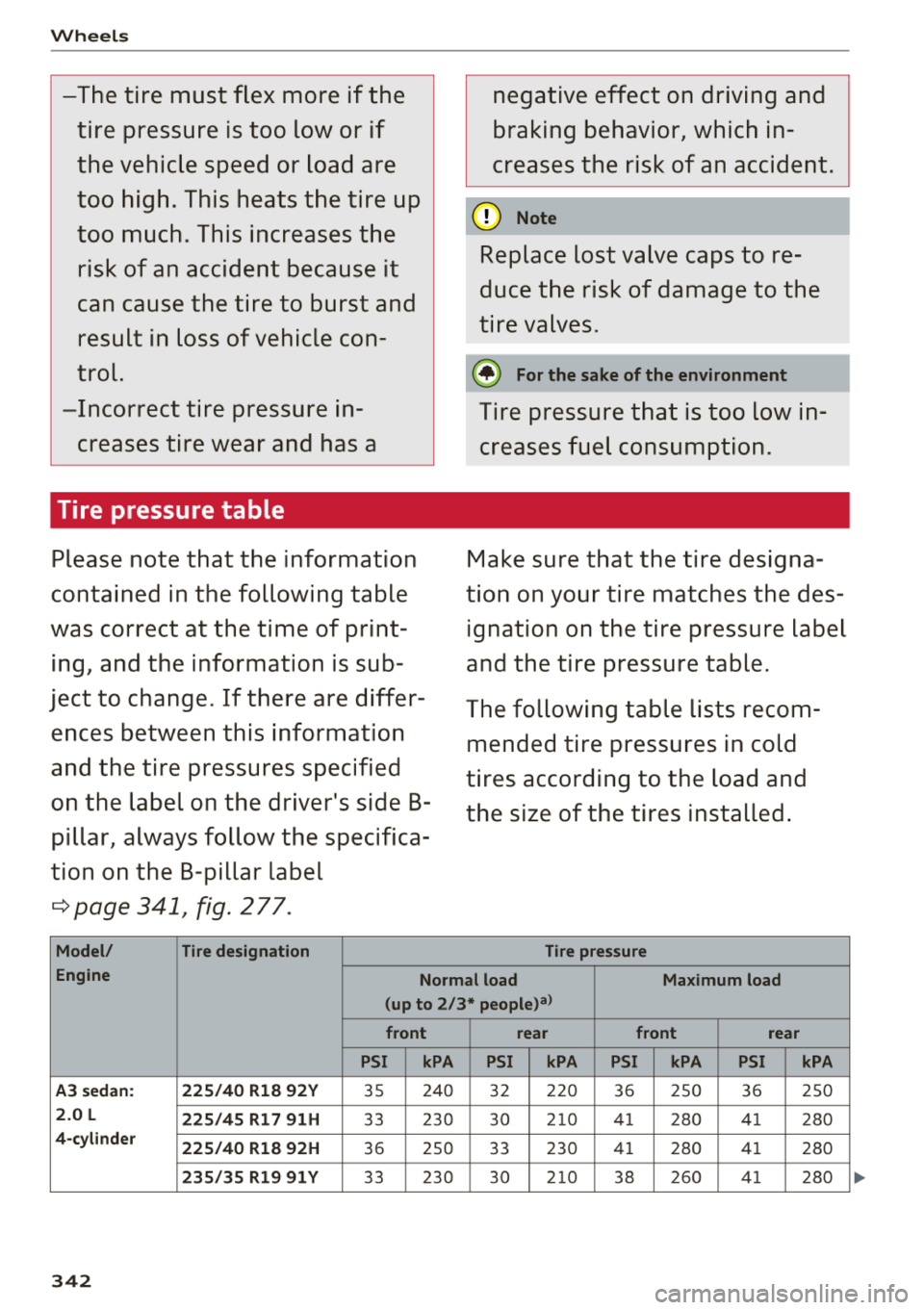
Tire pressure table
Please note that the information
contained in the following table
was correct at the time of print
ing, and the information is sub
ject to change. If there are differ
ences between this information
and the tire pressures specified
on the label on the driver's side B
pillar, always follow the specifica
tion on the B-pillar label
c> page 341 , fig. 2 77.
Model/ Tire designation
negative effect on driving and
braking behavior, which in
creases the risk of an accident.
@ Note
Replace lost valve caps to re
duce the risk of damage to the
tire valves.
@ For the sake of the environment
Tire pressure that is too low in creases fuel consumption.
Make sure that the tire designa
tion on your tire matches the des
ignation on the tire pressure label
and the tire pressure table.
The following table lists recom mended tire pressures in cold
tires according to the load and
the size of the tires installed.
Tire pressure
Engine Normal load Maximum load
(up to 2/3*
people)al
front rear front rear
PSI kPA PSI kPA PSI kPA PSI kPA
A3 sedan: 225/40 R18 92Y 35 240 32 220 36 250 36 250
2.0 L
225/45 R17 91H 33 230 30 210 41 280 41
280
4-cylinder
225/40 R18 92H 36 250 33 230 41
280 41 280
235/35 R19 91 Y 33 230 30 210 38 260 41 280
342
Page 346 of 404
Wheels
vehicle's Gross Veh ic le Weig ht
R ati ng
("GVWR").
The "GVWR" includes the weight
of the basic vehicle, all factory in
stalled accessories, a full tank of
fuel, oil, coolant and other fluids
plus maximum load. The maxi
mum load includes the number of
passengers that the vehicle is in
tended to carry ("seating capaci
ty") with an assumed weight of 150 lbs . (68 kg) for each passen
ger at a designated seating posi
tion and the total weight of any luggage in the vehicle. If you tow
a trailer, the weight of the trailer
hitch and the tongue weight of
the loaded trailer must be includ
ed as part of the vehicle load .
The
Gro ss Ax le W eight Rating
("GAWR") is the maximum load
that can be applied at each of the
vehicle's two axles .
T he fact that there is an upper
limit to your vehicle's Gross Vehi
cle Weight Rating means that the
total weight of whatever is being
carried in the vehicle (including
the weight of a trailer hitch and
the tongue weight of the loaded
trailer) is limited . The more pas
sengers in the vehicle or passen -
344
gers who are heavier than the
standard weights assumed mean
that less weight can be carried as luggage .
The Gross Vehicle Weight Rating and the Gross Axle Weight Rat ing
are listed on the safety compli
ance sticker labe l located on the
driver's side B-pillar.
1.8. WARNING
Overloading a vehicle can cause loss of vehicle control, a crash
or other accident, serious per
sonal injury, and even death.
-Carrying more weight than your vehicle was designed to carry will prevent the vehicle
from handling properly and increase the risk of the loss of
vehicle control.
-The brakes on a vehicle that has been overloaded may not
be able to stop the vehicle
within a safe distance .
-Tires on a vehicle that has been overloaded can fail sud
denly, including a blowout and
sudden deflation, causing loss
of contro l and a crash.
-Always make sure that the to tal load being transported
-..
Page 349 of 404
u. 00 .-< N l' N .-< 0 N > 00
A WARNING
Using incorrect snow chains or installing snow
chains incorrectly can result in loss of vehicle
control, which increases the risk of an acci
dent.
@ Note
Snow chains can damage the rims/wheel cov
ers* if the chains come into direct contact
with them. Remove the wheel covers* first .
Use coated snow chains.
(D Tips
When using snow chains, it may be useful to
switch on sport mode
¢page 149.
Low-profile tires
App lies to: ve hicles with low -profi le tires
Compared to other tire/rim combinations, low
profile tires offer a wider tread surface and a
la rger r im diameter with shorter tire sidewalls.
This results in an agile driving style. However, it
may reduce the level of comfort and increase
road noise when driving on roads in poor condi
tion.
L ow -profile tires can become damaged more
quickly than standard tires when driving over
large bumps, potholes, manhole
covers, and
curbs. Therefore, it is particularly important to
maintain the correct tire
pressure¢ page 341.
To reduce the risk of damage to the tires and rims, drive very carefully on poor roads.
Check your wheels regularly
every 2,000 mi
(3,000 km) for damage. For example, check for
bulges/cracks on the tires or deformations/
cracks on the rims.
After a heavy impact or damage, have the tires
and rims inspected or replaced immediately by
an authorized Audi dealer or authorized Audi
Service Facility .
L ow -profile tires can wear out faster than stand
ard tires.
Wheels
Uniform tire quality grading
- Tread wear
- Traction AA ABC
- Temperature ABC
Quality grades can be found where applicable on
the tire side wall between tread shoulder and
maximum section width
¢ page 331, fig. 275.
For example: Tread wear 200 , Traction AA, Tem
perature
A.
All passenger car tires must conform to Federal
Safety Requirements in addition to these grades.
Tread wear
The tread wear grade is a comparative rating
based on the wear rate of the tire when tested
under controlled cond it ion s on a specified
gov
ernment test course.
For example, a tire graded 150 would wear one
and one half (1 1/2) times as well on the govern
ment course as a tire graded 100.
The relative performance of tires depends upon
the actual conditions of their use, however, and
may depart significantly from the norm due to
variations in driv ing habits, service practices and
differences in road characteristics and climate.
Traction
The traction grades, from highest to lowest, are
AA , A, Band
C. Those grades represent the tire's
ability to stop on wet pavement as measured un
der controlled conditions on specified govern
ment test surfaces of asphalt and concrete. A tire
marked C may have poor traction performance
¢,& .
Temperature
The temperature grades are A (the highest), B,
and C, representing the tire's resistance to the
generation of heat and its ability to dissipate
heat when tested under controlled conditions on
a specified indoor laboratory test wheel.
Sustained high temperature can cause the mate
rial of the tire to degenerate and reduce tire life,
and excessive temperature can lead to sudden
tire
failure ¢,& .
347
Page 351 of 404
u. 00 .-< N l' N .-< 0 N > 00
individual tires. If the pressure changes in one or
more tires, this is indicated in the instrument
cluster display with an
RE ind icator light and a
message . If only one tire is affected, the location
of that tire w ill be ind icated.
The tire pressures must be stored in the menu
d isp lay aga in each time the press ures c hange
(sw itching between part ial and fu ll load p res
sure) or after changing or replac ing a tire on your
ve hicle
r=>page 349 . The t ire pressure monitor
in g sys tem only monito rs t he tire pressure you
have stored . Refe r to the ti re p ressure labe l for
the recommended ti re p ressure for you r veh icle
r=>page 341, fig. 278.
Tire tread circumference and v ibrat ion character
i stics can change a nd cause a t ire pressure warn
in g if:
- the tire pressure i n one or more tires is too low
- the tire has structura l damage
- the tire was replaced o r the tire p ressure was
changed and it was not stored
r=> page 349
- one si de of the vehicle is more heavily loaded
than the other
- th e whee ls on one ax le are mo re heavi ly loaded
t h an the others (for examp le, w hen tow ing a
trailer or when driv ing up and down hills)
- snow c hains a re installed
- the spare t ire* is ins talle d
- on ly one tire w as replaced on each ax le
Indicator lights
RE -loss of pressu re in at least one tire r=> ,&. .
Check the ti res and rep lace o r repa ir if necessary .
C heck/ co rrect t he p ressures of a ll four tires. Then
s to re t he ti re p ressures i n the men u
r=> page 349 .
mm (Ti re Pressure Monitori ng System) Tire
pressure: malfunction! See owner's manual. If
mm appears after switching t he ign it io n on o r
while driving and the
RE i ndicato r light in the in
s trumen t cluster blinks fo r approxim ately one
minu te and t hen stays o n, there is system ma l
f u nction. Check/cor rect the pressu res on all fo ur
tires an d sto re t he p ressures
r=> page 349. If the
ind icator light does turn
off or turns on again af
ter a short per iod of t ime, drive to an author ized
Wheels
Audi dealer or author ized A udi Se rvice Fac ility im
med iate ly to have the ma lfu nction co rrected.
A WARNING
--
- If the tire p ressure ind icator appears in the
instr ument cluster disp lay, reduce your
speed immediately and avoid any hard
steer ing o r braking maneuvers . Stop as soon
as poss ible and check the tires and the ir
p ressures.
- The drive r is responsible fo r maintain ing the
correct tire press ures . You must check the
tire p ressures regularly.
- Unde r ce rtain condit ions (such as a sporty
d riving s tyle, win ter condi tions or unpaved
roads), the pressu re moni tor indicator may
be de layed.
- Do not use run -flat tires on your vehicle. Us
ing them when no t pe rm itted can lead to
veh icle d amage o r acc id en ts .
(D Tips
- The tire p ressure mon itoring system can al
so s top working w hen
th ere is a n ESC/ ABS
m alfunc tion.
- Us ing snow chains may resul t in a system
m alfu nction.
- The tire p ressure mon itoring system in your
Audi was calibrat ed with "Audi Original
Ti res"
r=>page 33 7. Usi ng these tires is rec
ommende d.
- The tire p ressure mon itoring system can on
ly moni to r the tire p res sure o f the d riving
t ires. Check the tir e press ure o f the spare
wheel in the l uggage compa rtment so tha t
if necessary it is ready for use .
Storing tire pressures
Applies to: vehicles wit h Tir e Pressure Monito rin g Syste m in·
dicator
A change in tire pr essure or a change in tires
must be stored in the system.
Make su re before stori ng that the tire p ressures
of all fo ur tir es meet the specified val ues and a re
adapted to the load
r=> pag e 339. .,,.
349
Page 352 of 404
Wheels
~ Select in the Infotainment system: IMENUI but
ton
> Vehicle > left control button > Service &
checks > Tire pressure monitoring > Store tire
pressure> Yes, store now.
(D Tips
Do not store the tire pressures if snow chains
are installed.
Tire pressure monitoring
system
(.L) General notes
Each tire, including the spare (if provided),
should be checked monthly when cold and inflat
ed to the inflation pressure recommended by the
vehicle manufacturer on the vehicle placard or
tire inflation pressure label. (If your vehicle has
tires of a different size than the size indicated on
the vehicle placard or t ire inflation pressure la
bel, you should determine the proper tire infla
tion pressure for those tires).
As an added safety feature, your vehicle has been
equ ipped w ith a t ire pressure monitoring system
(TPMS) that illuminates a low tire pressure tell
tale when one or more of your tires is significant
ly under-inflated. Accordingly, when the low tire
pressure telltale illuminates, you should stop and
check your tires as soon as possible, and inflate
them to the proper pressure. Driving on a signifi
cantly under-inflated tire causes the tire to over heat and can lead to tire failure . Under -inflation
also reduces fuel efficiency and tire tread life,
and may affect the vehicle's handling and stop
p in g ability.
Please note that the TPMS is not a substitute for
proper tire maintenance, and it is the driver's re
sponsibility to maintain correct tire pressure,
even if under-inflation has not reached the leve l
to trigger illuminat ion of the TPMS low tire pres
sure telltale .
Your vehicle has also been equipped with a TPMS
malfunct ion indicator to indicate when the sys
tem is not operating properly. The TPMS mal
function indicator is combined with the low tire
pressure telltale. When the system detects a
350
malfunction, the telltale will flash for approxi
mately one minute and then remain continuously
illuminated. This sequence will continue upon
subsequent vehicle start-ups as long as the mal
function exists.
When the malfunction indicator is illuminated,
the system may not be able to detect or signal
low tire pressure as intended. TPMS malfunctions
may occur for a variety of reasons, including the
installation of replacement or alternate tires or
wheels on the vehicle that prevent the TPMS
from functioning properly. Always check the
TPMS malfunction tel ltale after replac ing one or
more tires or wheels on your vehicle to ensure
that the replacement or alternate tires and
wheels allow the TPMS to continue to function
properly.
Description
Applies to: vehicles with tire pressure monitoring system
The tire pressure monitoring system monitors
the pressure in the four tires when driving.
The system uses sensors that measure the tema
perature and pressure in the tires. The data is
sent from these sensors to the control module by
radio frequency .
The tire pressure monitoring system shows the
current pressures and temperatures of the tires
in the Infotainment system while driving
¢ page 351. It also compares the current tire
pressures with the stored tire pressures and
gives a warning if the tire pressure is different
from what is stored
¢ page 351.
The system does not detect if the stored tire
pressures match the recommended tire pres
sures . You must store the tire pressures again
¢ page 352:
- every time the tire pressures change, for exam
ple when the load in the vehicle changes,
- after replacing a tire, or
- if wheels with new wheel sensors are used.
Page 354 of 404
Wheels
~ Adapt your driving style to the situation.
~ Stop as soon as possible and check the tire(s) .
~ If it is possible to continue driving, see an au-
thorized Audi dea ler or authorized Audi Service
Facility immediately and have your tire(s) re
paired or replaced.
A WARNING
Read and follow the important information
and
notes ~ page 350.
Storing new tire pressures
App lies to: ve hicles w ith tire press ure m on itoring system
Correctly stored tire pressure specifications are
necessary for reliable tire pressure monitoring.
-
It is always necessary to store the tire pressures
when the tire pressures are modified, for exam ple due to a change in load. or when new sensors
are installed .
~ Before storing the tire pressures, make sure the
tire pressures of all four tires meet the speci
fied values and are adapted to the load
~ page 341, fig . 2 78 . Only correct and store
the pressure in tires whose temperature is ap
prox imat ely the same as the ambient tempera
ture .
If the temperature of the tire is higher
than the ambient air temperature, the tire
pressure must be increased approximate ly
3 .0 PSI (0 .2 bar) above the va lue on the sticker .
~ Switch the ignition on.
~ Select in the Infotainment system: IMENUI but
ton
> Vehicle > left control button > Service &
checks > Tire pressure monitoring > Store tire
pressure > Yes, store now .
After storing the
tire pressu res, the t ire pressu re monitoring sys
tem measures the current pressures wh ile driv
in g and stores them as the new specified pres
sures.
~ If the changed tire pressures are not displayed
in the Infotainment system, drive the vehicle
for approximate ly 10 minutes so that the sen
sor signal from the wheels is received again.
During this adaptation phase, --.-- is displayed
for the pressure and temperature and the tire
pressure mon itor ing system is only partially
ava ilable. It only provides a warning if one or
352 more
tire pressures is below the minimum per
mitted specified pressure.
If the
[I] ind icator light turns on and the mes
sage
Tire pressure : wheel change detected .
Please check all tires and store pressures in
MMI also appears, the system has detected that
the position of the sensors has changed because
of a tire rotation, or that new sensors were in
stalled. Store the new tire pressures.
A WARNING
Read and follow the important information
and notes
~pag e 350.
Malfunctions
Applies to: vehicles with t ire pressure mo nitori ng syste m
If the tire pressure monitoring system is not
available, t he
mm in dicator light appears in the
instr umen t cluste r display along with the mes
sage
Tire pressure : malfun ction! See owner's
manual.
-
If the ffim ind icator light appears after switch
in g the ignitio n on or wh ile dr iving and the
[IJ in
dicator light also blinks for approximately one
minute and then stays on, there is a system ma l
function . The fo llowing are examples of situa
tions that could cause a malfunction:
- If the message appears at the end of the adap
tation phase, the system may not detect one or
several of the whee l sensors necessary for pres
sure monitoring. This may res ult from one or
more whee ls being installed without wheel sen
sors or with incompatible wheel sensors.
- A wheel sensor or another component has
fa iled.
- Using snow chains can affect the function of
the system because of the shielding effect of
the chains.
- The tire pressure monitoring system is not
avai lab le due to a ma lfunction.
- Transmitters with the same frequency, such as
headphones or remote-controlled devices, may
cause a temporary system malfunct ion due to
the strong electromagnetic field.
.,.
Page 358 of 404
Care and cl eaning
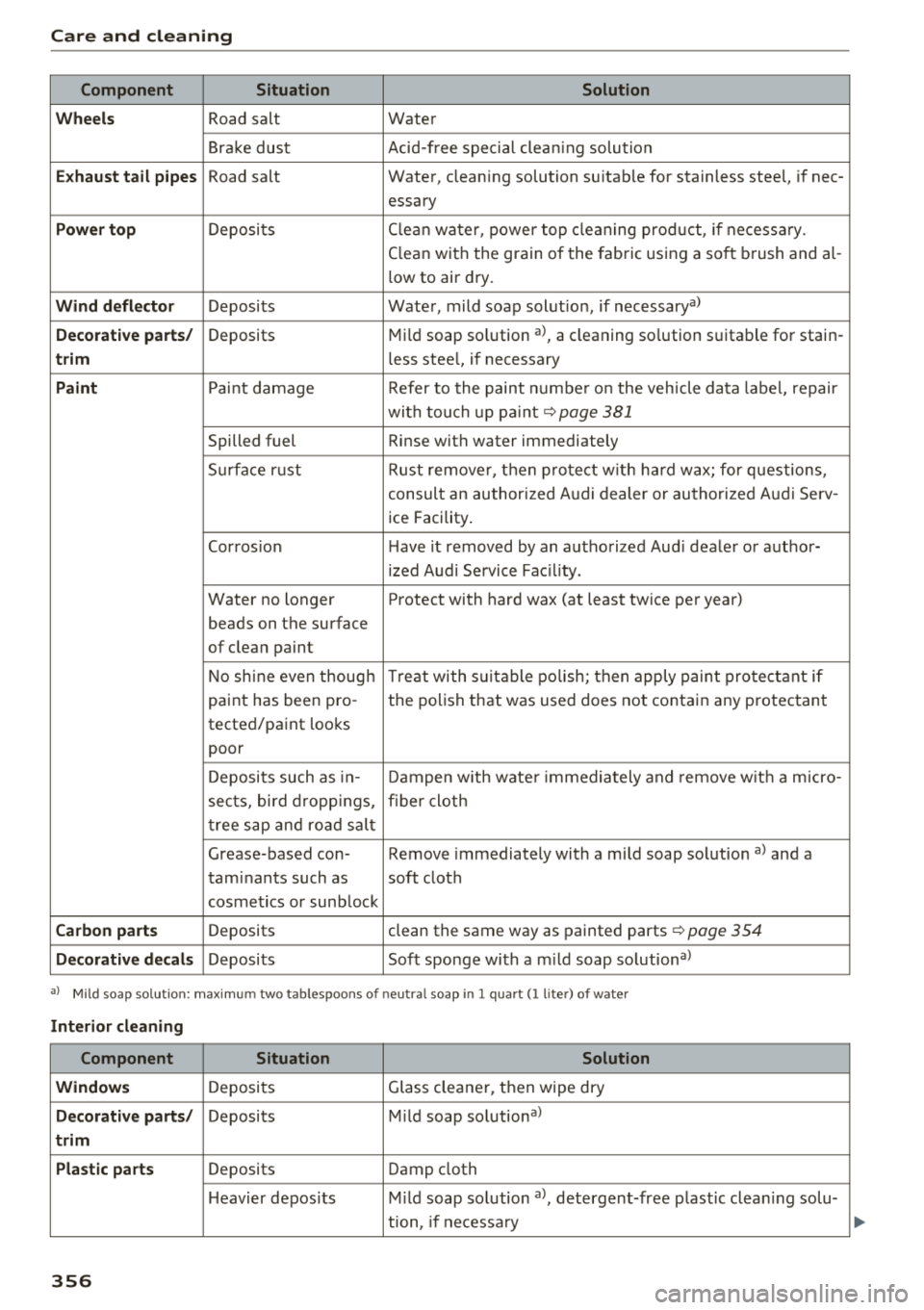
Component Situation Solution
W hee ls
Road salt Water
Brake dust Acid-free special cleaning solution
Ex haust t ail p ipe s Road salt Water, cleaning solution suitab le for stainless steel, if nee-
essary
P ow er t op Deposits Clea n water, power top clean ing prod uct, if necessa ry.
C lean with the grain of the fabric using a soft brush and al -
l ow to air dry .
Wind deflect o r Deposits Water, mild soap solut ion, if necessaryal
Dec orat ive part s/ Deposits Mild soap so
lution al, a cleaning so lution suitable for stain-
trim less stee l, if necessary
Paint Paint damage Refer to the paint numbe r on the veh icle data label, repair
with touch up pa int¢
page 381
Spilled fuel Rinse with water immediately
S urface r ust Rust remover, then protect w ith hard wax; for questions,
consult an authorized Audi dealer or authorized Audi Serv -
ice Facility .
Corros ion Have it removed by an authorized Aud i dealer or author-
i zed Audi Service Fac ility.
Water no longer Protect with hard wax (at least twice per year)
beads on the surface
of clean paint
No sh ine even though Treat with s uitable polish; then apply paint protectant if
paint has been pro- the polish that was used does not contain any protectant
tected/paint looks poor
Deposits such as in- Dampen w ith wate r immediately and remove w it h a m icro-
sects, bird dropp ings, fiber cloth
tree sap and road salt
Grease-based con-Remove immediately with a mild soap solution al and a
tam inants such as soft cloth
cosmetics or sunblock
Ca rbon part s Deposits clean the
same way as painted parts ¢ page 354
Decorat ive decal s Deposits Soft sponge with a mild soap so lutional
a ) Mild soap so lution: maxim um two tablespoo ns of neut ra l soap i n 1 quart (1 liter) of water
Int erior cleaning
Component Situation Solution
Wind ows
Deposits Glass cleaner, then
wipe dry
Deco ra tive part s/ Deposits Mild soap solutional
trim
Pla stic part s
Deposits Damp cloth
Heavier deposits M ild soap so lution al, detergent-free p lastic clean ing solu-
tion, if necessa ry
356
Page 360 of 404
Care and cl eaning
- Camera len se s
- Never use warm or hot water to remove
snow or ice from the camera lens. Th is
could cause the lens to crack .
- Never use abras ive clean ing mater ia ls or
alcohol to clean the camera lens . This
cou ld cause scratches and cracks.
- Pow er top
- Remove bi rd dropp ings immedia tely.
- Never use gasoline, spot remover, ben-
zene, pa int thinne r or other solvents to re
move.
- Door windows
- Remove snow and ice on windows and ex-
terior mirrors with a p lastic scraper. To
avoid scratches, move the scraper on ly in
one direction and not back and forth.
- Never remove snow or ice from door win
dows and m irrors using warm or hot water
because this could cause cracks to form .
- To avoid damage to the rear w indow de
fogger, do not apply any stickers on the
heating w ires on the inside of the window.
- Decorative parts /trim
- Never use chrome care or cleaning p rod-
ucts.
- Paint
-To red uce the risk of scratches, the vehicle
must be free of dirt and dust before pol
ishing or waxing.
- To prevent paint damage, do not polish or
wax the veh icle in direct sunlight.
- To red uce the risk of paint damage, do not
polish away rust spots.
- Remove cosmetics and sunscreen immedi
ately - these could damage the paint.
- Di spla ys/ instrument cluster
- The d isplays/instrument cluster and the
trim surrounding them must not be
cleaned with dry cleaning methods be
cause they could be scratched .
- Make sure that the instrument cluster is
switched off and has cooled off before
cleaning it .
- Make sure no fluids enter the spaces be tween the instrument cluster and the
trim, because that could ca use damage.
35 8
-Controls
- Make sure that no flu ids enter the con-
trols, because this could cause damage .
-Safety belts
- Do not remove the safety belts to clean
them.
- Never clean safety belts or their compo
nents chem ica lly or with co rrosive fluids
or solven ts and never allow sharp objec ts
to come into contact with the safety belts .
This could ca use damage to the belt web
bing.
- If there is damage to the webbing, the
connections, the retractors or the buckles, have them replaced by an authorized Audi
dealer or authorized Aud i Serv ice Facility .
-Te xtile s/artificial leather / Alcantara
- Never treat art ificial leather/Alcantara
with leathe r ca re products, solvents, floor
polish, shoe polish, spot remove o r similar
p rodu cts.
- H ave a spec ial ist remove stubborn stains
to prevent damage .
-Never use steam cleaners, brushes, hard
sponges, etc. when cleaning.
- Do not turn on the seat heating* to dry the seat .
- Objects w ith sharp edges, such as zippers
or rivets on clothing or belts, can cause
damage to the surface .
- Open hook and loop fasteners, for exam
ple on clothing, can damage seat covers .
Make sure hook and loop fastene rs a re
closed.
- Na tural leather
- Never treat leather with solvents, floor
polish, shoe polish, spot remover or simi
lar products.
- Objects with sharp edges, such as zippers
or rivets on clothing or belts, can cause
damage to the surface.
- Never use steam cleaners, brushes, hard
sponges, etc. when cleaning.
- Do not turn on the seat heating* to dry the
seat.
- To he lp prevent the leather from fading,
do not leave the vehicle in direct sunlight
Page 365 of 404
u. 00 .-< N l' N .-< 0 N > 00
A WARNING
-Read and follow the manufacturer's safety
precautions o n the compressor and in th e
in structions on t he bottle of sealant .
- If a tire pressure of 29 ps i (200 kPA) cannot
r e ached after inflating for 6 minutes, then
the tire is too severely damaged . Do not
continue d riving.
- If the t ire cannot be repaired with the tire
sealant, see an authorized Audi dealer or au
tho rized Aud i Serv ice Facility for ass istance.
(D Tips
Do not operate the compressor for more than
six m inutes continuously, or it can overheat.
Once the compressor has coo led, you can con
tinue to use it.
Completing
Applies to: vehicles with tire mobility kit
.,. Affix the st icke r that says "max . S O mph (max .
80 km/h)" that is provided with the tire mobili
ty kit within the driver's field of vision .
.,. Stop the vehicle after driving for about 10 mi
nutes and check the tire pressure.
.,. If the t ire pressure is lower than 19 ps i (130
kPA), then the tire is too severely damaged. Do
not cont inue driving.
A WARNING
Pay attent ion to the following after repair ing
the ti re:
- Do not drive faster than SO mph (80 km/h) .
- Avoid hard acceleration, brak ing sharp ly,
and fast cornering.
- The veh icle may become more diff icult to
control.
- If the t ire is too severely damaged, see an
authorized Audi dealer or authorized Aud i
Service Facility for assistance .
@ For the sake of the environment
You can give the used t ire sealant bottle to an
author ized Audi dealer or authorized Audi
Serv ice Facility for disposal.
Em ergenc y ass is tanc e
(D Tips
Remember to obtain a new bott le of sealant
from an authorized A udi dealer or authorized
Audi Service Fac ility after repairing a tire.
Replacing wheels
Before changing a wheel
Observe the following precautions for your own
and your passenger's safety when changing a wheel.
.,. After you experience a t ire failure, pull the car
we ll away from moving traffic and try to reach
level grou nd befo re yo u stop ¢&, .
.,. All passengers should leave the car and move
t o a safe location ( for ins tance, behind the
gua rdrail) ¢&, .
.,. Engage the pa rking brake to prevent your vehi
cle from rolling unintentiona lly ¢
_A .
.,. Move selector le ver to position P ¢ _A .
... Jfyou are towing a trai ler, unhitch the trailer
from your vehicle.
.,. Take the jack ~ page 360 and the sp a re tire
ca:;, page 369 out of the luggage compartment .
A WARNING
You or you r passengers could be injure d while
ch anging a whee l if you do no t follow these
safety precaut ions :
- If you have a fla t tire, move a safe dis tance
off the road. Turn off the eng ine, turn the
emergency flashers on and use other warn
ing devices to alert other motorists.
- Make sure that passenge rs wait in a safe
p lace away from the vehicle and well away
from the road and traffic.
- To help preven t the vehicle from moving
suddenly and possib ly slipping off the jack,
always fully set the park ing brake and bloc k
the front and back of the wheel diagonally
opposite the wheel being changed. When
one front wheel is lifted off the ground,
p lacing the Au toma tic Transmission in P
(Park) will
not prevent the vehicle from
mov ing.
363