OE number AUDI S3 SEDAN 2018 Service Manual
[x] Cancel search | Manufacturer: AUDI, Model Year: 2018, Model line: S3 SEDAN, Model: AUDI S3 SEDAN 2018Pages: 404, PDF Size: 62.3 MB
Page 334 of 404
Wheel s
0 US DOT number (TIN) and
manufacture date
T he manufacture date is listed on
the tire sidewall (it may only ap
pear on the inner side of the tire) :
DOT ... 2217 ...
means, for example, that the tire
was produced in the 22nd week of
the year 2017.
@ Audi Original Tires
Audi Original equipment tires
with the designation
"AO" have
been specially matched to your
Audi. When used correctly, these
tires meet the highest standards
for safety and handling. An au
thorized Audi dealer or author
ized Audi Service Facility will be
able to provide you with more in
formation.
® Mud and snow capability
"M/5" or "M+S" indicates the tire
is suitable for driving on mud and
snow.
& indicates a winter tire.
@ Composition of the tire cord
and materials
T he number of plies indicates the
number of rubberized fabric lay
ers in the tire . In general: the
more layers, the more weight a
tire can carry. Tire manufacturers
332
must also specify the materials
used in the tire. These include
steel, nylon, polyester and other materials.
@ Maximum permitted load
This number indicates the maxi
mum load in kilograms and
pounds that the tire can carry.
@ Uniform t ire quality grade
standards for treadwear ,
traction and temperature resistance
Treadwear, traction and tempera
ture ranges
q page 347 .
@ Running d ir e ction
The arrows indicate the running
direction of unidirectional tires.
You must always follow the speci
fied running direction
q page 368 .
@ Maximum permitted
inflation pressu re
This number indicates the maxi
mum pressure to which a tire can
be inflated under normal operat
ing condit ions.
Page 335 of 404
u. a, ... N
" N ... 0 N > a:,
Glossary of tire and loading
terminology
Accessory weight
means the combined weight ( in
excess of those standard items
which may be replaced) of auto matic transmission , power steer
ing, power brakes, power win
dows, power seats, radio, and
heater, to the extent that these
items a re available as factory- in
stalled equipment (whether i n
stalled or not) .
Aspect ratio
means the ratio of the height to
the width of the tire in percent .
Numbers of 55 or lower indicate a
low s idewall for improved steer
ing response and better overall
handling on dry pavement.
Bead
means the part of the tire that is
made of steel wires, wrapped or
reinforced by ply cords and that is
shaped to fit the rim .
Bead separation
means a breakdown of the bond
between components in the bead .
Wheel s
Cord
means the strands forming the
plies in the tire .
Cold tire inflation pressure
means the tire pressure recom
mended by the vehicle manufac
turer for a tire of a designated
size that has not been driven for
more than a couple of miles (kilo
meters) at low speeds in the
three hour period before the tire pressure is measured or adjusted .
Curb weight
means the weight of a motor ve
hicle with standard equipment in
cluding the maximum capacity of
fuel, oil , and coolant, air condi
tioning and additional weight of
optional eq uipm ent .
Extra load tire
means a tire designed to operate
at higher loads and at highe r in
flation pressures than the corre
sponding standard tire . Extra load
tires may be identified as "X L",
"xl", "EXTRA LOAD", or "RF" on
the sidewall.
.,.
333
Page 336 of 404
Wheel s
Gross Axle Weight Rating
("GAWR ")
means the load -carrying capacity
of a single axle system, measured
at the tire -ground interfaces.
Gross Vehicle Weight Rating
(" GVWR ")
means the maximum total loaded
weight of the vehicle .
Groove
means the space between two ad
jacent tread ribs .
Load rating (code )
means the maximum load that a
tire is rated to carry for a given in
flation pressure. You may not find
this information on all tires be
cause it is not required by law .
Max imum load rating
means the load rating for a tire at
the maximum permissible infla
tion pressure for that tire.
Ma ximum loaded vehicle
weight
means the sum of:
(a) Curb weight
(b) Accessory weight
(c) Vehicle capacity weight, and
(d) Production options weight
33 4
Maximum (permissible)
inflation pressu re
means the maximum cold infla
tion pressure to which a t ire may
be inflated. A lso called "maxi
mum inflat ion pressure."
Normal occupant weight
means 150 lbs. (68 kilograms)
times the number of occupants seated in the vehicle up to the to
tal seating capacity of your vehi
cle.
Occupant distribution
means distribution of occupants
in a vehicle.
Outer diameter
means the overall diameter of an
inflated new tire.
Overall width
means the linear distance be
tween the exteriors o f the side
walls of an inflated tire , includ ing
elevations due to labeling, deco rations, or protective bands or
ribs .
Ply
means a layer of rubber-coated
parallel cords .
Page 338 of 404
Wheels
maximum permissible road
speeds . See also ¢
A in General
information on page 330 .
Tire pressure monitoring
system *
means a system that detects
when one or more of a vehicle's
tires are underinflated and illumi
nates a low tire pressure warning
telltale .
Tread
means that portion of a tire that
comes into co ntact with the road.
Tread separat ion
means pulling away of the tread
from the tire carcass.
Treadwear indicators (TWI)
means the projections within the
pr incipal grooves designed to g ive
a vis ual indication of the degrees
of wear of the tread . See
¢ page 339, Treadwear indicator
for more information on measu r
ing tire wear.
Uniform Tire Quality Grading
is a tire information system devel
oped by the United States Nat ion
a l Highway Traffic Safety Admin
istration ( NHTSA) tha t is designed
to he lp buyers make relative com-
33 6
parisons among tires . The UTQG
is not a safety rat ing and not a
guarantee that a tire will last for
a prescribed number of miles (kilo meters) or perform in acer
t ain way . It simply g ives tire buy
ers add itiona l information to
combine with other considera
tions , such as price, brand loyalty
and dealer recommendations. U n
de r UT QG, tires a re graded by the
tire manufacturers in three areas: treadwear, tract ion, and tempera
ture res istance. The UTQG info r
mation on the tires , molded into
the si dewalls .
U.S. DOT Tire Identification
Number (TIN)
This is the tire's "serial number".
It beg ins with the letters
"DO T"
and indicates that the tire meets
all federal s tandards. The next
two numbers or le tters indicate
the plant whe re it was ma nufac
tured, and t he last four num bers
represent the week and year of
manufacture. Fo r example,
DOT ... 2217 .. .
means that the tire was produced
in the 22nd week o f 2017. The
other numbers are ma rketing co
des that may or may not be used
~
Page 339 of 404
u. a, ... N
" N ... 0 N > a:,
by the tire manufacturer. This in
formation is used to contact con sumers if a tire defect requires a
recall.
Vehicle capacity weight
means the rated cargo and lug
gage load plus 150 lbs . (68 kilo
grams) times the vehicle's desig
nated seating capacity.
Vehicle ma ximum load on the
tire
means that load on an indiv idual
tire that is determined by distrib
uting to each axle its share of the
maximum loaded vehicle weight
and dividing by two.
Vehicle normal load on the tire
means that load on an indiv idual
tire that is determined by distrib uting to each axle its share of the
curb weight, accessory weight,
and normal occupant weight (dis
tributed in accordance
with ¢ ta
ble on page 342)
and dividing by
two .
Occupant loading and distr i
bution for vehicle normal load
for various designated seating
capacities
Refer to the tire inflation pres
s u re
label¢ page 341, fig . 2 78
Wheels
for the n umber of seating posi
tions . Refer to the table
¢ table
on page 34 2
for the number of
people tha t correspond to the ve
hicle normal load.
New tires or wheels
Audi recommends having all work
on tires o r wheels performed by
an authorized Audi dealer or au
thorized Audi Service Facility.
These facilities have the proper
knowle dge and are eq uipped with
the requ ired too ls and replace
ment parts.
.,. New tires do not yet have the
optimum g ripping properties .
Drive carefully and at mode rate
speeds for the first 350 miles
(500 km) with new tires.
.,. Only use tires with the same de
s ign , size (rolling circumfer
ence), and as close to the same
tread pattern as possible on all
four whee ls .
.,. Applies to: RS models : only use
tires with the same design and
the same tread pattern on all
four whee ls.
.,. Do not replace tires indiv idually .
At least replace both tires on the
same axle at the same time .
...
337
Page 346 of 404
Wheels
vehicle's Gross Veh ic le Weig ht
R ati ng
("GVWR").
The "GVWR" includes the weight
of the basic vehicle, all factory in
stalled accessories, a full tank of
fuel, oil, coolant and other fluids
plus maximum load. The maxi
mum load includes the number of
passengers that the vehicle is in
tended to carry ("seating capaci
ty") with an assumed weight of 150 lbs . (68 kg) for each passen
ger at a designated seating posi
tion and the total weight of any luggage in the vehicle. If you tow
a trailer, the weight of the trailer
hitch and the tongue weight of
the loaded trailer must be includ
ed as part of the vehicle load .
The
Gro ss Ax le W eight Rating
("GAWR") is the maximum load
that can be applied at each of the
vehicle's two axles .
T he fact that there is an upper
limit to your vehicle's Gross Vehi
cle Weight Rating means that the
total weight of whatever is being
carried in the vehicle (including
the weight of a trailer hitch and
the tongue weight of the loaded
trailer) is limited . The more pas
sengers in the vehicle or passen -
344
gers who are heavier than the
standard weights assumed mean
that less weight can be carried as luggage .
The Gross Vehicle Weight Rating and the Gross Axle Weight Rat ing
are listed on the safety compli
ance sticker labe l located on the
driver's side B-pillar.
1.8. WARNING
Overloading a vehicle can cause loss of vehicle control, a crash
or other accident, serious per
sonal injury, and even death.
-Carrying more weight than your vehicle was designed to carry will prevent the vehicle
from handling properly and increase the risk of the loss of
vehicle control.
-The brakes on a vehicle that has been overloaded may not
be able to stop the vehicle
within a safe distance .
-Tires on a vehicle that has been overloaded can fail sud
denly, including a blowout and
sudden deflation, causing loss
of contro l and a crash.
-Always make sure that the to tal load being transported
-..
Page 353 of 404
u. 00 .-< N l' N .-< 0 N > 00
A WARNING
-The tire pressure monitoring system assists
the driver in monitoring tire pressures . The
driver is responsible for having the tires in
flated to the correct pressure.
- Do not change the tire pressure when the
temperature of the tire is extremely high.
This could result in serious damage to the
tire and even cause the tire to burst, in
creasing the risk of an accident.
- A tire with low pressure flexes more. This
heats the tire up too much. This could cause
the tread to separate and even cause the
tire to burst, increasing the risk of an acci
dent.
- The tire pressure monitoring system does
not warn about damage or defects in the
tire construction that could cause the tire to burst, for example . Inspect your tires regu
larly .
(D Tips
-If tires are replaced, the sensors/valves do
not need to be removed or replaced. Just re
placed the valve stem and, if necessary, the
valve and the wheel electronics. If you have
questions, see an authorized Audi dealer or
authorized Audi Service Facility .
- An incorrect display or a malfunction in the
tire pressure monitoring system can occur
after using the tire mobility kit . Have the
sensors replaced by an authorized Audi
dealer or authorized Audi Service Facility.
- For an explanation on conformity with the
FCC regulations in the United States and the
Industry Canada regulations, see
r=;,page 386.
Displaying tire pressures/temperatures
Applies to: vehicles with tire pressure mo nito ring system
Requirement: you must be driving the vehicle.
"'Select in the Infotainment system: the I MENU I
button > Vehicle > left control button > Service
& checks > Tire pressure monitoring > Display
tire pressures.
Wheels
The current tire pressures are shown in green,
yellow or red numbers in the Infotainment sys
tem:
- Green: the current tire pressure and the speci
fied tire pressure are approximately the same.
- Yellow: the current tire pressure is too low
compared to the specified tire pressure.
-Red: the current tire pressure is extremely low
compared to the specified tire pressure .
The specified tire pressure is the last tire pres
sure that was stored
r=;, page 352.
Note that the tire pressure also depends on the
temperature of the tire. The tire pressure in
creases as the engine becomes warmer while
driving.
A WARNING
Read and follow the important information
and notes
"*page 350.
(D Tips
The tire pressure or temperature is not dis
played while the vehicle is stationary and in
adaptation mode. Dashes--.-- are shown in
place of the pressure and temperature.
ill Tire pressure loss
Applies to: vehicles with tire press ure mo nito ring system
-
If the [tE indicator light turns on, the pressure in
at least one tire is too low or new sensors were
not adapted:
RE Indicator light turns on after turning the
ignition on
The tire pressure is too low compared to the
specified pressure .
.,. Check and store the tire pressure(s) the next
time it is possible
"*page 352.
RE Indicator light turns on while driving
Wheels with new sensors were not adapted or
the tire pressure has reached a critical level com
pared to the specified pressure.
"'Avoid unnecessary steering and braking maneu-
vers.
..,_
351
Page 383 of 404
LL co ..... N
" N ..... 0 N > co
Technical data
Vehicle specifications
XXXXX XX -X -XXXX XXX XX
®-+ : ::::::. XX XXXXX X XX X XXXXX XXX
IYP /lffl XXX XXX
X X XXXXXXX X X X X XX
X XX KW XXX
®i ~= -:~~ XXXX XXX XXX
©+ ~ rur:i~ xxxx I xxxx XXX I xx
II. · AIJSli t I OPTIONS
E0A 7D 5 4U B 6XM SSG SR W
2 EH J0 Z 1LB 1AS 1BA
3FC SM U 7Xl
F 0 A 9G3 0G7 0 YH 0JF
TL 6 3 KA 8EH UlA X 9B 0Z7
l XW
803
908 8Z4 020
7 T6 CV 7
71<0 4X3 21< 2
3L4 4 KC 3Y0 413 5 02
1S A 7GB
01A 4GQ
XX. X XX X X X X XXXX
F ig. 308 Vehicle ident ifica tion labe l
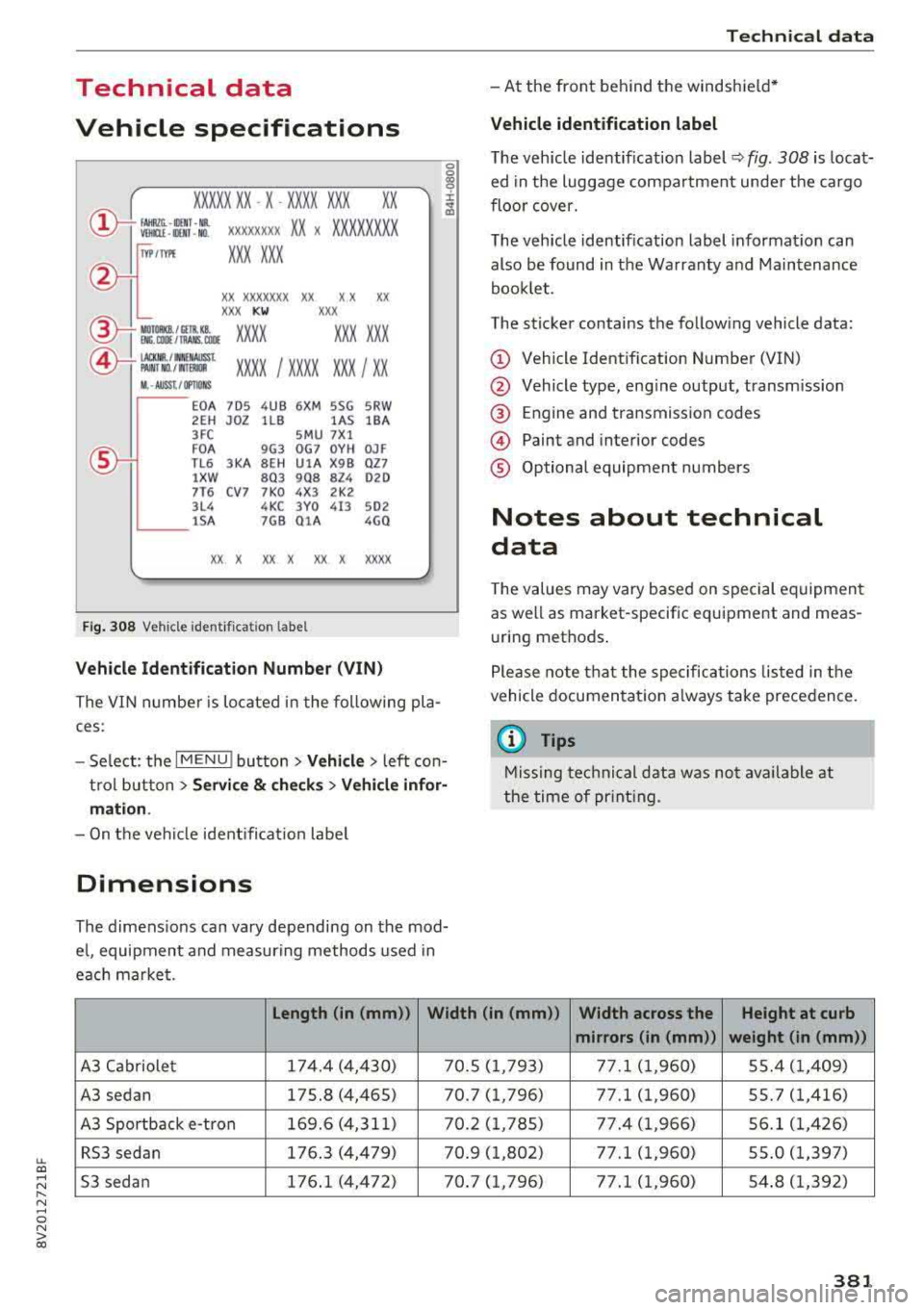
Vehicle Identification Number (VIN )
The VIN n umber is located in the following pla
ces :
0
0
~ :x:
t rol button
> Servi ce & check s > Vehicle infor
mati on.
-On t he vehicle identificat io n labe l
Dimensions
The dimens ions can vary depending on the mod
e l, equipment and measuring methods used in
each marke t.
Technical data
-At the front behind the windshield *
Vehicle identification label
The vehicle identification label~ fig. 308 is loca t
ed in the luggage compartment unde r the cargo
floor cover.
The vehicle identification label informat ion can
also be found in the Warranty and Maintenance
booklet .
The sticker contains the following vehicle data :
© Vehicle Identification Number (VIN)
@ Vehicle type, eng ine output, transmission
@ Engine and transmission codes
@ Paint and interior codes
® Optional equipment numbers
Notes about technical
data
T he values may vary based on special equipment
as well as market-specif ic equipment and meas
u ring methods .
Please note that the specific ations listed in the
vehicle documen tat ion a lways take preceden ce.
{i) Tips
M issing tec hni cal data was not ava ilable at
t he time of pr int ing.
Length (in (mm )) Width (in (mm )) Width across the
Height at curb
mirrors (in (mm )) weight (in (mm))
A3 Cabriole t 17 4.4 (4,430) 70.S (
1,793) 77.1 (1,960) 5S.4 (1,409)
A3 sedan 17 5 .8 (4,465) 70. 7 (1,796) 77.1 (1,960) 5S.7 (1,416)
A3 Sportback e-tron 169.6 (4,311) 7
0.2 (1 , 78S) 77.4 (1 ,966) 56.1 ( 1,426)
RS3 sedan 176.3 (4,479) 70.9 (1,802) 77.1 (1,960) 5S.0 (1,397)
S3 sedan 176
.1 (4,4 72) 70 . 7 (1 ,796) 77.1 ( 1,960) 54 .8 (1,392)
381
Page 386 of 404
Consum er Info rmation
today's automobi les, have steadi ly red uced the
scope of maintenance and repairs which can be
carried out by veh icle owners.
Al so , sa fet y and
en vironmental
concerns place very strict limits
on the nature of repairs and adjustments to en
g ine and transmission parts w hich an owner can
perform .
Maintenance, adjustments and repairs usually re
qu ire special tools, testing devices and other
equ ipment available to specially trained work
shop personnel in order to assure proper per
forma nce, re liab ility and safety of the ve hicle and
its many systems .
Improper maintenance, adjustments and repairs
can impair the operation and reliab il ity of your
ve hicle and eve n void your vehicle warra nty .
Therefo re, proof of se rvicing in accordance w ith
the m aintenance schedule may be a condition fo r
up hold ing a possible wa rranty claim made wi thin
the warranty pe riod.
Above all, ope rational safety can be adversely af
fected, c re ating unnecessa ry risks fo r you and
your passengers.
I f in doubt about any servicing, have it done by
your author ized Audi dealer or any other prope rly
eq uipped and qualified workshop . We strongly
urge yo u to g ive your author ized Audi dealer the
opportunity to perform a ll scheduled mainte
nance and necessary repairs. Your dealer has the
facilities, origina l parts and tra ined specialists to
keep your veh icle running properly.
Performing limit ed maint enanc e yourself
The fo llowing pages describe a limited number of
procedures whic h can be performed on your ve hi
cle with ordinary tools, should the need arise and
tra ined personnel be unava ilable. Before per
forming any of these procedures, always thor
ough ly read all of the app licab le text and carefu l
ly follow the instructions g iven . Always rigorously
observe the
W ARNINGS prov ided .
Befo re yo u check an ything in the engine com
partment , alway s read and h eed all WARNINGS
c> .&. and c> page 318 .
384
A WARNING
-Ser ious personal injury may occur as a result
of improperly performed maintenance, ad
justments or repairs .
- Always be extreme ly careful when work ing
on the vehicle . Always follow commonly ac
cepted safety practices and general com mon sense. Never r is k personal in jury.
- Do not attempt any of the maintenance,
checks or repairs described on the following pages if you are not fu lly fam il iar with these
or other procedu res with respect to the ve
hicle, or are uncertain how to proceed.
- Do not do any work wi thout the prope r tools
and eq uipmen t. H ave the necessary wo rk
done by your authorized Audi dealer or an
other properly equipped and qualified work
shop.
- The engine compartment of any motor vehi
cle is a potentially hazardous area . Never
reach into the area around or touch the radi
ator fan. It is temperature controlled and
can switch on suddenly - even when the en
gine is off . The radiato r fan switches on au
tomatically when the coolant reaches a cer
tain tempe rature and w ill cont inue to run
until the coolant temperature d rops.
- Always sw itch off the ignition before anyone
gets under the vehicle.
- Always support your vehicle with safety
stands if it is necessary to work underneath
the vehicle. The jack supp lied with the veh i
cle is no t adequate fo r th is pu rpose and
could collapse causing serious personal in
jury .
- If you must wor k unde rneath the vehicle
w ith the wheels on the g round, always make
sure the vehicle is on level ground, that the
wheels a re always sec urely blocked and that
the engine cannot be started.
- Always make sure the transmission se lector
lever (automatic t ransm iss ion) is in P (Park
position) and the pa rk b rake is applied .
Ill>
Page 393 of 404
u. 00 .-< N l' N .-< 0 N > 00
Driving time ... ... .. ..... ... .. .. ... 17 , 18
Dust filter
refer to Pollutant filte r . . . . . . . . . . . . . . . . 68
DVD dr ive (media dr ives) 224
Dynamic vo lume
refer to System vo lume . . . . . . . . . . . . . . . 248
E
E-ma il 184
e-tron
Navigation . . . . . . . . . . . . . . . . . . . . . . . . . 217
also refer to P lug-in hyb rid dr ive . . . . . . . . 92
eco mode (automatic climate control system) .69
E conomical route . . . . . . . . . . . . . . . . . . . . . 208
E ff iciency program . . . . . . . . . . . . . . . . . . . . . 1 9
Electric drive . . . . . . . . . . . . . . . . . . . . . . . . . . 92
E le ct ric range . . . . . . . . . . . . . . . . . . . . . . . . 217
Electromechanical parking brake . . . . . . . . . 81
Electromechanica l steering . . . . . . . . . . . . . 15 1
Elect ronic D ifferent ial Lock (EDL) . . . . . . . . 148
Electronic immob ilizer . . . . . . . . . . . . . . . . . . 32
E lect ronic S tabili zation Control ( ESC) . . . . . 148
Emergency assistance . . . . . . . . . . . . . . . . . 360
Emergency braking function . . . . . . . . . . . . . 82
E me rgency flashe rs . . . . . . . . . . . . . . . . . . . . S 1
Emergency operat ion
Fuel filler door . . . . . . . . . . . . . . . . . . . . . . 317
Emergency starting .. ..... ... .. .. .... . 375
E m iss ions cont rol system . . . . . . . . . . . . . . 317
Energy consumers . . . . . . . . . . . . . . . . . . . . . 18
E ne rgy management . . . . . . . . . . . . . . . . . . 152
E ng ine
Coolant . . . . . . . . . . . . . . . . . . . . . . . . . . . . 324
Ju mp starting . . . . . . . . . . . . . . . . . . . . . . . 375
Ju mp s tarting (plug -in hyb rid drive) . . . . . 102
M essages . . . . . . . . . . . . . . . . . . . . . . . . . . . 78
Start/Stop system . . . . . . . . . . . . . . . . . . . . 79
Starting/stopping (button) . . . . . . . . . . . . . 76
Starting/stopping (key) . . . . . . . . . . . . . . . . 7 S
Warm ing up/coo ling down . . . . . . . . . . . . . 72
E ng ine compartmen t
Opening/closing the hood . . . . . . . . . . . . . 320
Overview ..... ... .. ..... ... .. .. .... . 32 1
Safety preca utions . . . . . . . . . . . . . . . . . . . 3 18
E ng ine data
refer to Spo rt displays . . . . . . . . . . . . . . . . . 20
Ind ex
Engine oi l
Adding . . . . . . . . . . . . . . . . . . . . . . . . . . . . 321
Chang ing . . . . . . . . . . . . . . . . . . . . . . . . . . 324
Checking oil level . . . . . . . . . . . . . . . . . . . . 321
Consumption . . . . . . . . . . . . . . . . . . . . . . . 321
Dipst ick .... ... .. .. ................ . 321
Oil change interval . . . . . . . . . . . . . . . . . . . 328
T emperature display . . . . . . . . . . . . . . . . . . 19
Enhanced view . . . . . . . . . . . . . . . . . . . . . . . . 14
Ente ring characte rs/numbers (speller) . . . . 161
Entering letters (speller) . . . . . . . . . . . . . . . 161
Entertainment sliding menu . . . . . . . . . . . . 159
E nt ry/ exit lig hting . . . . . . . . . . . . . . . . . . . . . S 1
Entry assistance
refer to Seats . . . . . . . . . . . . . . . . . . . . . . . . 60
Environment Proper disposa l of drained engine oil . . . . 324
U nleaded gasoline . . . . . . . . . . . . . . . . . . . 314
E SC
refer to Electronic Stabilization
Control (ESC) . . . . . . . . . . . . . . . . . . . . . . . 148
E vent Data Reco rder ( EDR) . . . . . . . . . . . . . 152
Exterior lighting . . . . . . . . . . . . . . . . . . . . . . . 49
E xterior mirrors . . . . . . . . . . . . . . . . . . . . . . . 53
Folding . . . . . . . . . . . . . . . . . . . . . . . . . . . . . 53
Folding settings . . . . . . . . . . . . . . . . . . . . . . 35
Ex terna l voice ope ra tion . . . . . . . . . . . . . . . . 175
F
Factory default sett ings
Mult i Media Interface . . . . . . . . . . . . . . . . 244
Fader (sound) . . . . . . . . . . . . . . . . . . . . . . . . 24 7
F astening
Booster seats . . . . . . . . . . . . . . . . . . . . . . . 304
Convertib le child safety seats . . . . . . . . . . 302
Infant seats . . . . . . . . . . . . . . . . . . . . . . . . 300
Fast forwarding/rewind ing (a udio/video
f ile) . . . . . . . . . . . . . . . . . . . . . . . . . . . . . . . . 232
Fast forwarding (aud io/video file) . . . . . . . . 232
Fast route 208
Favor ites
Med ia . . . . . . . . . . . . . . . . . . . . . . . . . . . . . 234
Nav iga tion . . . . . . . . . . . . . . . . . . . . . . . . . 203
T elep hone . . . . . . . . . . . . . . . . . . . . . . . . . . 182
Federal Commun ications Comm iss ion (FCC) 386
File formats (med ia drives) . . . . . . . . . . . . . 237
391