warning AUDI S4 2008 Owners Manual
[x] Cancel search | Manufacturer: AUDI, Model Year: 2008, Model line: S4, Model: AUDI S4 2008Pages: 342, PDF Size: 15.01 MB
Page 212 of 342
Child safety
210Child safetyPoints to remember if children are
travelling in the carIntroduction
Statistics show that children are generally safer on the
rear seat than on the front passenger's seat.Children under 12 years of age shou ld normally travel on the rear
seat
2). Children travelling on the rear seat must use a child restraint
system or the seat belts provided, depending on their age, height
and weight. For safety reasons, the child restraint system should be
installed behind the front passenger's seat.
The physical principles involved and the forces acting in a collision
apply to children just as much as adults ⇒ page 195, “Forces acting
in a collision”. But, unlike adults, children do not have fully devel-
oped muscle and bone structures. This means that children are
subject to a greater risk of injury.
To reduce this risk, children must always use special child restraint
systems when travelling in the car.
Use only child restraint systems which are officially approved under
the European standard ECE R 44 and are suitable for the child. ECE R
refers to the Economic Commission of Europe Recommendation,
which categorises child restraint systems in 5 groups ⇒page 213,
“Child seat categories”. Child restraints that have been tested and
approved under the ECE R 44 standard bear the ECE-R 44 test mark
on the seat (the letter E in a circle with the test number below it).
We recommend using child restraint systems from the range of
Audi Genuine Accessories available from Audi dealers. The
“Huckepack” range includes suitable restraint systems for all ages. These systems have been specially developed and tested for use in
Audi vehicles and comply with the ECE-R 44 standard.
Follow the manufacturer's instru
ctions and observe any statutory
requirements when installing and using child restraints ⇒ in
“Important safety notes for using child safety seats”.
Important safety notes for using child safety seats
Correct use of child safety seats can help to reduce the
risk of injury in an accident.
WARNING
•
All vehicle occupants, especially children, must wear a seat
belt while the vehicl e is in motion.
•
Children who are less than 1.5 metres tall must not wear a
normal seat belt without a child rest raint, as this could cause inju-
ries to the abdominal and neck areas.
•
Babies and children must neve r travel on another occupant's
lap.
•
A suitable child safety seat can protect your child ⇒page 213,
“Child safety seats”.
•
Never allow two children to o ccupy one child safety seat.
•
Never leave a child without supervision in a child safety seat.
•
Never allow a child to travel in the car without a suitable child
restraint.
•
Never allow a child to stand up or kneel on a seat while the car
is moving. In an ac cident, the child coul d be catapulted through
the car, causing possibly fatal injuries to itself and other occu-
pants.
2)Observe any restrictions or regulations to the contrary.
document_0900452a81b1b9de.book Seite 210 Donnerstag, 26. Juli 2007 9:16 09
--4 -
-T
&
•
-+ +-
Page 213 of 342
Child safety211
Controls
Safety
Driving tips
General maintenance
Self-help
Technical data
•
If children lean forward or are otherwise out of position when
the car is moving, they are at greater risk of injury in an accident.
This is particularly the case if the child is travelling on the front
passenger's seat and the airbag system is triggered in an accident.
There is then a risk of serious or potentially fatal injury.
•
To ensure proper protection, it is important to wear the seat
belts in the co rrect position ⇒page 197, “How to wear seat belts
properly”. Always check that th e belt is properly positioned
according to the instru ctions provided by the manufacturer of the
child safety seat. Incorrectly worn seat belts can give rise to inju-
ries even in a minor collision.
•
Never install a rearward-facing child safety seat on the front
passenger's seat if the front pass enger's airbag has not been deac-
tivated ⇒page 211 .
•
Extra caution is advised if you ar e installing a child safety seat
using the same mounting bolts as the existing car seat belts. The
bolts must be screwed in all the way to the full depth of the
mounting holes and ti ghtened to a torque of 50 Nm. Failure to
observe this precaution could result in potentially fatal injury. We
recommend having the installation performed by a qualified
workshop.
Using a child safety seat on the front passenger's seat
Whenever possible, child safety seats should always be
installed on the rear seat.For safety reasons, we recommend that child safety seats should be
installed on the rear seats whenever possible. However, if you have
to use a child seat on the front passenger's seat when there is no
other alternative , it is most important to note the following warn-
ings:
WARNING
•
Do not use a rearward-facing child safety seat on the front
passenger's seat unless the fr ont passenger's airbag has been
deactivated. The child seat would be directly in the path of the
airbag as it inflates, and the child could sustain serious or fatal
injuries if the airbag were to be deployed.
•
However, if you have no alte rnative but to use a rearward-
facing child seat on the front passenger's seat, the front
passenger's airbag must be deac tivated beforehand by means of
the key-operated switch* ⇒page 208. Failure to observe this
precaution could result in serious or potentially fatal injury.
•
Make sure that the front passen ger's airbag is reactivated by
means of the key-operated switch* as soon as the child seat is no
longer needed on the front passenger's seat.
•
When using a child safety seat of the type which faces in the
direction of travel, the front pass enger's seat must be moved back
to the rearmost position.
WARNING (continued)
document_0900452a81b1b9de.book Seite 211 Donnerstag, 26. Juli 2007 9:16 09
--4 -
-T
&
A
f---------t
ill
-+
•
+-
•
Page 214 of 342
Child safety
212Applies to vehicles: with side airbagsImportant notes on side airbags and child safety
Children must never sit too close to the opening for the
side airbag.The side airbags offer increased protection in a side-on collision.
In order to be effective, the side airbags need to inflate very quickly
(within fractions of a second) ⇒page 205, “How the side airbags
work”.
The airbag inflates with such force that injury can be caused if the
occupant is not sitting upright, or if there are any objects close to
the opening for the side airbag. This applies particularly to children if they are travelling in a way
which does not comply with the statutory safety regulations.
Incorrect position – danger
of injury from the side
airbag
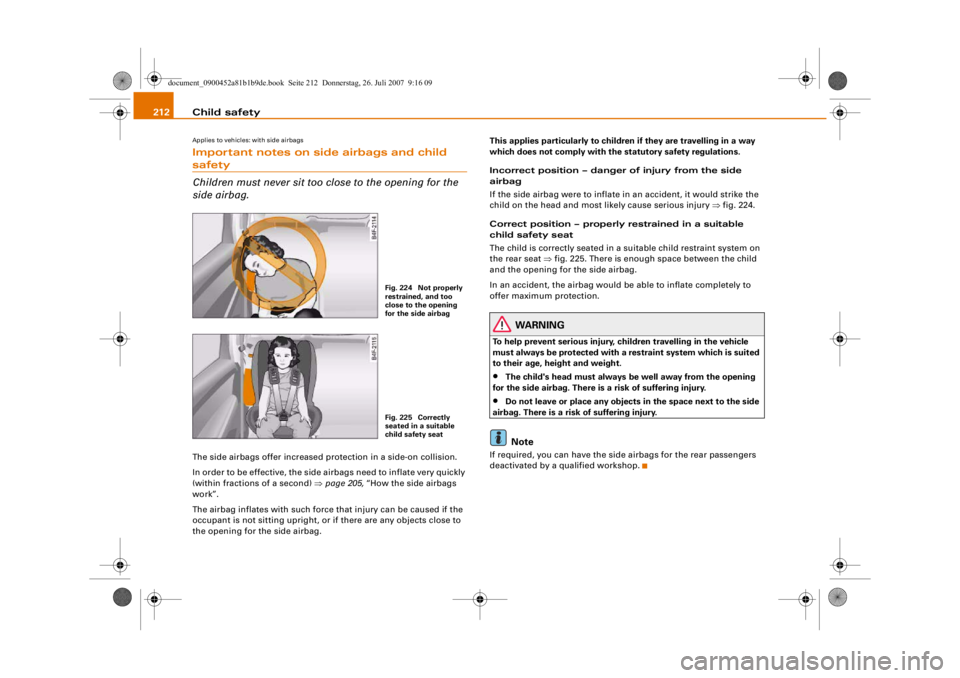
If the side airbag were to inflate in an accident, it would strike the
child on the head and most likely cause serious injury ⇒fig. 224.
Correct position – properly restrained in a suitable
child safety seat
The child is correctly seated in a suitable child restraint system on
the rear seat ⇒ fig. 225. There is enough space between the child
and the opening for the side airbag.
In an accident, the airbag would be able to inflate completely to
offer maximum protection.
WARNING
To help prevent serious injury, children travelling in the vehicle
must always be protected with a restraint system which is suited
to their age, he ight and weight.•
The child's head must always be well away from the opening
for the side airbag. There is a risk of suffering injury.
•
Do not leave or place any object s in the space next to the side
airbag. There is a risk of suffering injury.Note
If required, you can have the side airbags for the rear passengers
deactivated by a qualified workshop.
Fig. 224 Not properly
restrained, and too
close to the opening
for the side airbagFig. 225 Correctly
seated in a suitable
child safety seat
document_0900452a81b1b9de.book Seite 212 Donnerstag, 26. Juli 2007 9:16 09
--4 -
-T
-+
I
+-
[I]
•
Page 215 of 342
Child safety213
Controls
Safety
Driving tips
General maintenance
Self-help
Technical data
Child safety seatsChild seat categories
Only use child restraint systems that are officially
approved and suitable for the child.Child restraint systems are covered by the European standard
ECE R 44 (issued by the Economic Commission of Europe).
The child seats are divided into 5 categories:
Children who are taller than 1.5 metres can use the existing seat
belts without a booster cushion.
Child restraints that have been tested and approved under the ECE
R 44 standard bear the ECE-R 44 test mark on the seat (the letter E
in a circle with the test number below it).
Child safety seat: category 0 / 0+
A suitable child safety seat and a correctly worn seat belt
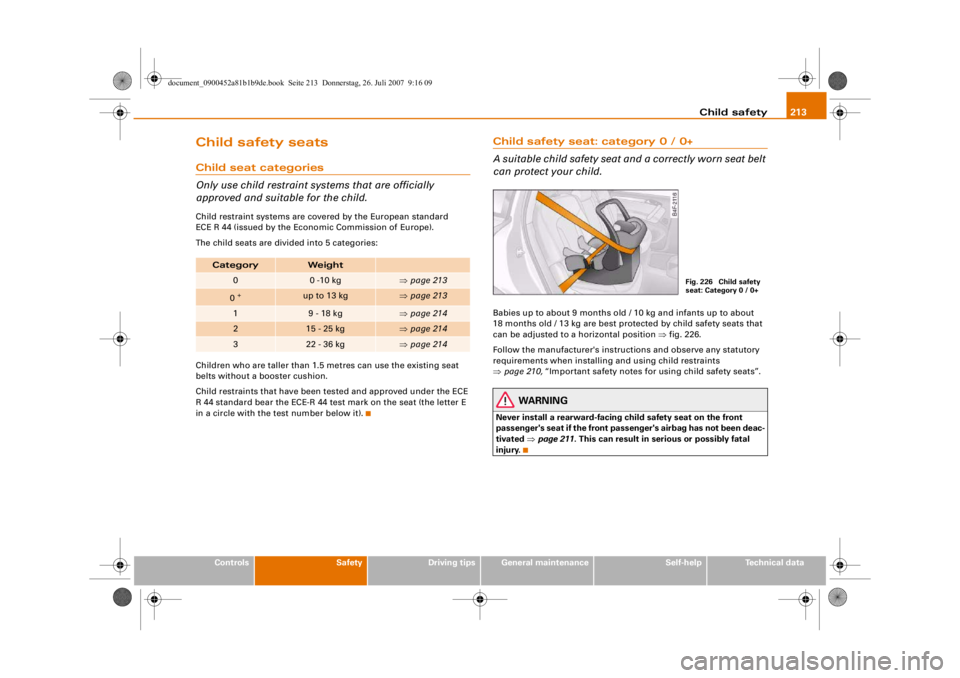
can protect your child.Babies up to about 9 months old / 10 kg and infants up to about
18 months old / 13 kg are best protected by child safety seats that
can be adjusted to a horizontal position ⇒fig. 226.
Follow the manufacturer's instru ctions and observe any statutory
requirements when installing and using child restraints
⇒ page 210, “Important safety notes for using child safety seats”.
WARNING
Never install a rearward-facing child safety seat on the front
passenger's seat if the front pass enger's airbag has not been deac-
tivated ⇒page 211 . This can result in serious or possibly fatal
injury.
Category
Weight
0
0 -10 kg
⇒ page 213
0 +
up to 13 kg
⇒page 213
1
9 - 18 kg
⇒page 214
2
15 - 25 kg
⇒page 214
3
22 - 36 kg
⇒page 214
Fig. 226 Child safety
seat: Category 0 / 0+
document_0900452a81b1b9de.book Seite 213 Donnerstag, 26. Juli 2007 9:16 09
--4 -
-T
-+ +-
•
Page 216 of 342
Child safety
214Child safety seats: category 1
A suitable child safety seat and a correctly worn seat belt
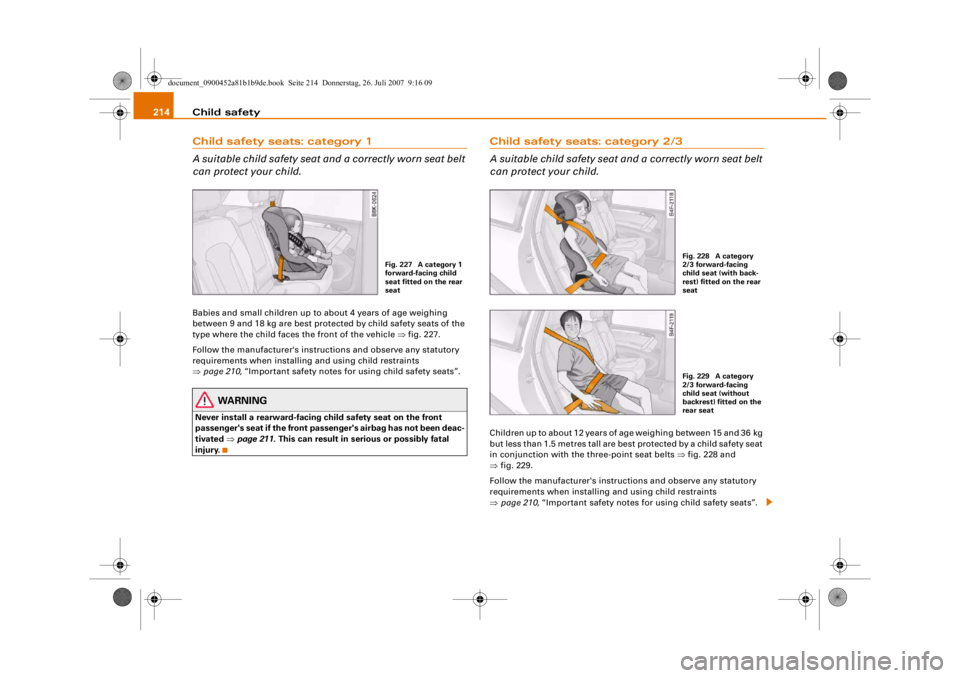
can protect your child.Babies and small children up to about 4 years of age weighing
between 9 and 18 kg are best protected by child safety seats of the
type where the child faces the front of the vehicle ⇒fig. 227.
Follow the manufacturer's instructions and observe any statutory
requirements when installing and using child restraints
⇒ page 210, “Important safety notes for using child safety seats”.
WARNING
Never install a rearward-facing child safety seat on the front
passenger's seat if the front pass enger's airbag has not been deac-
tivated ⇒page 211 . This can result in serious or possibly fatal
injury.
Child safety seats: category 2/3
A suitable child safety seat and a correctly worn seat belt
can protect your child.Children up to about 12 years of age weighing between 15 and 36 kg
but less than 1.5 metres tall are best protected by a child safety seat
in conjunction with the three-point seat belts ⇒fig. 228 and
⇒ fig. 229.
Follow the manufacturer's instru ctions and observe any statutory
requirements when installing and using child restraints
⇒ page 210, “Important safety notes for using child safety seats”.
Fig. 227 A category 1
forward-facing child
seat fitted on the rear
seat
Fig. 228 A category
2/3 forward-facing
child seat (with back-
rest) fitted on the rear
seatFig. 229 A category
2/3 forward-facing
child seat (without
backrest) fitted on the
rear seat
document_0900452a81b1b9de.book Seite 214 Donnerstag, 26. Juli 2007 9:16 09
--4 -
-T
-+ +-
Page 217 of 342
Child safety215
Controls
Safety
Driving tips
General maintenance
Self-help
Technical data
WARNING
The diagonal part of the belt s hould be positioned roughly over the
centre of the shoulder and fit clos ely against the upper part of the
body. It must never be allowed to run across the neck. The lap part
of the belt should fit closely over the hips. It must not be posi-
tioned over the stomach. Pull the bel t tight if necessary to take up
any slack.
Note
We recommend that you fit child safety seats with backrests.
document_0900452a81b1b9de.book Seite 215 Donnerstag, 26. Juli 2007 9:16 09
--4 -
-T
[I]
•
-+ +-
Page 220 of 342
Child safety
218Possible alternatives for securing a child safety seat
A child safety seat can be secured on the rear seats and
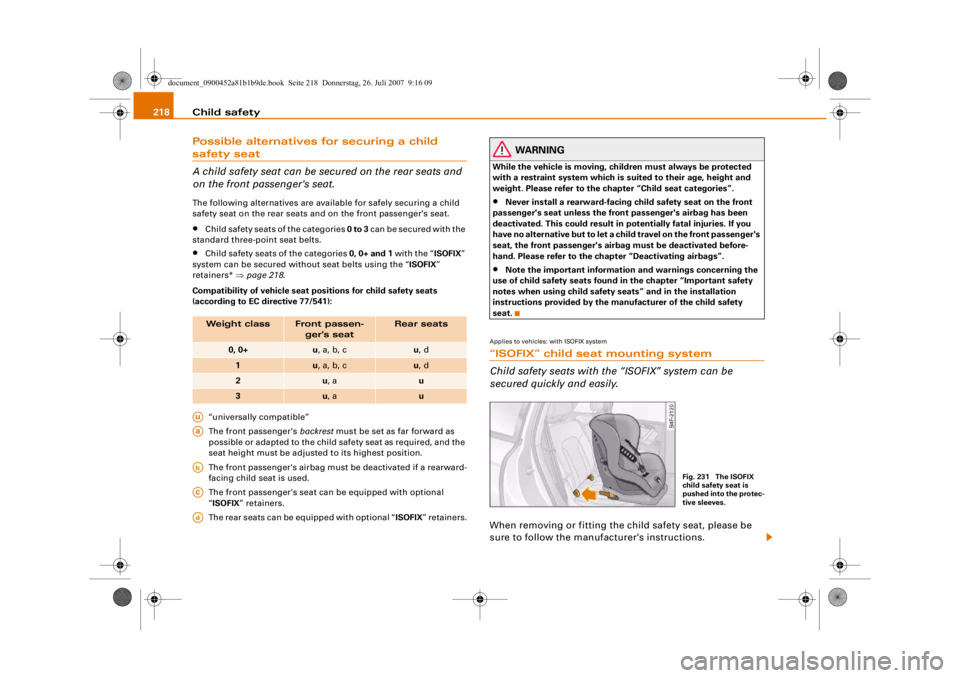
on the front passenger's seat.The following alternatives are available for safely securing a child
safety seat on the rear seats and on the front passenger's seat.•
Child safety seats of the categories 0 to 3 can be secured with the
standard three-point seat belts.
•
Child safety seats of the categories 0, 0+ and 1 with the “ISOFIX”
system can be secured without seat belts using the “ ISOFIX”
retainers* ⇒page 218 .
Compatibility of vehicle seat positions for child safety seats
(according to EC directive 77/541):
“universally compatible”
The front passenger's backrest must be set as far forward as
possible or adapted to the child safety seat as required, and the
seat height must be adjusted to its highest position.
The front passenger's airbag must be deactivated if a rearward-
facing child seat is used.
The front passenger's seat ca n be equipped with optional
“ ISOFIX ” retainers.
The rear seats can be equipped with optional “ ISOFIX” retainers.
WARNING
While the vehicle is moving, chil dren must always be protected
with a restraint system which is suited to their age, height and
weight. Please refer to the chapter “Child seat categories”.•
Never install a rearward-facing ch ild safety seat on the front
passenger's seat unless the fr ont passenger's airbag has been
deactivated. This could result in potentially fatal injuries. If you
have no alternative but to let a ch ild travel on the front passenger's
seat, the front passenger's airbag must be deactivated before-
hand. Please refer to the chapter “Deactivating airbags”.
•
Note the important information and warnings concerning the
use of child safety seats found in the chapter “Important safety
notes when using child safety seats” and in the installation
instructions provided by the manufacturer of the child safety
seat.
Applies to vehicles: with ISOFIX system“ISOFIX” child seat mounting system
Child safety seats with the “ISOFIX” system can be
secured quickly and easily.When removing or fitting the child safety seat, please be
sure to follow the manufacturer's instructions.
Weight class
Front passen-
ger's seat
Rear seats
0, 0+
u, a, b, c
u, d
1
u , a, b, c
u, d
2
u, a
u
3
u, a
u
AuAaAbAcAd
Fig. 231 The ISOFIX
child safety seat is
pushed into the protec-
tive sleeves.
document_0900452a81b1b9de.book Seite 218 Donnerstag, 26. Juli 2007 9:16 09
--4 -
-T
-+
•
+-
Page 221 of 342
Child safety219
Controls
Safety
Driving tips
General maintenance
Self-help
Technical data
– Fit the protective sleeves onto the retainers
between the backrest and the seat cushion ⇒page 218,
fig. 231.
– Push the mountings on the child safety seat into the protective sleeves until they engage audibly (2x)
⇒page 218, fig. 231.
– Pull on the child safety seat to check whether both
catches have engaged properly.Child safety seats with the “ISOFI X” system can be secured quickly
and safely on the rear seat* or on the front passenger's seat*.
Detailed fitting instructions are supplied with the child safety seat.
Child seats with “ISOFIX” mountings are available from Audi dealers
and specialist retailers.
If required, the “ISOFIX” mounting system can be retrofitted.
WARNING
The retainers used here are specially designed for child safety
seats with “ISOFIX” mountings. Do not attempt to secure other
types of child safety seat, seat belts or other objects with these
retainers – this could result in serious or possibly fatal injury.
AA
AB
document_0900452a81b1b9de.book Seite 219 Donnerstag, 26. Juli 2007 9:16 09
--4 -
-T
. I
+-
Page 224 of 342
Intelligent technology
222Intelligent technologyElectronic stabilisation program (ESP)DescriptionESP increases the car's stability. It reduces the tendency to skid and
improves the stability and roadhold ing of the vehicle. ESP detects
critical handling situations, such as understeer, oversteer and
wheelspin on the driven wheels. It stabilises the vehicle by braking
individual wheels or by reducing the engine torque. The warning
lamp
in the instrument cluster starts flashing as soon as the ESP
intervenes.
The ESP incorporates the functions of the anti-lock brake system
(ABS), the traction control system (ASR), the electronic differential
lock (EDL) and the dynamic steering*.
Anti-lock brake system (ABS)
ABS prevents the wheels from locking up under braking until the
vehicle has reached a virtual standstill. You can continue to steer the
vehicle even when the brakes are on full. Keep your foot on the brake
pedal and do not pump the brakes. You will feel the brake pedal
pulsate while the anti-lock brake system is working.
Brake assist system
The brake assist system can speed up the braking process and
shorten the braking distance. It au tomatically boosts the braking
force if you press the brake pedal quickly in an emergency. On vehi-
cles with adaptive cruise control*, the brake assist system will build
up a small amount of pressure in the hydraulic brake system if it
senses that you are too close to the vehicle in front.
Traction control system (ASR)
In the event of wheelspin, the traction control system reduces the
engine torque to match the amount of grip available. This helps the
car to start moving, accelerate or climb a gradient. Electronic differential lock (EDL)
When the EDL detects wheelspin, it brakes the spinning wheel and
directs the power to the other driven wheel (or wheels on quattro*
versions). This function is active up to about 100 km/h.
To prevent the disc brake of the braked wheel from overheating, the
EDL cuts out automatically if subjected to excessive loads. The
vehicle can still be driven. The EDL will switch on again automati-
cally when the brake has cooled down.
Dynamic steering*
On vehicles with dynamic steering*, the ESP can also intervene in
the steering to stabilise the vehicle in critical situations.
WARNING
•
The grip provided by the ESP,
ABS, ASR, EDL and dynamic
steering* systems is still subject to the physical limits of adhesion.
Always bear this in mind, especia lly on wet or slippery roads. If
you notice the systems cutting in , you should reduce your speed
immediately to suit the road and traffic conditions. Do not let the
extra safety provided tempt you into taking any risks when driving
– this can cause accidents.
•
Please remember that the acciden t risk always increases if you
drive fast, especially in corners or on a slippery road, or if you
follow too close behind th e vehicle in front of you. Please bear in
mind that even ESP, ABS, brak e assist, EDL, ASR and dynamic
steering* cannot compensate for the increased accident risk.
•
When accelerating on a uniformly slippery surface (for instance
all four wheels on ice or snow), pr ess the accelerator gradually and
carefully. The driven wheels may ot herwise start to spin (in spite
of the integrated control systems), which would impair the car's
stability and could lead to an accident.
document_0900452a81b1b9de.book Seite 222 Donnerstag, 26. Juli 2007 9:16 09
--4 -
-T
-+ +-
Page 225 of 342
Intelligent technology223
Controls
Safety
Driving tips
General maintenance
Self-help
Technical data
Note
•
To ensure that the ASR works properly, all four wheels must be
fitted with identical tyres. Any differences in the rolling radius of the
tyres can cause the system to reduce engine power when this is not
desired.
•
Should a malfunction occur in the ABS or EDL, both the ABS
warning lamp
and the ESP warning lamp
⇒ page 19 will light
up.
•
In the event of a malfunction in the ESP system, the warning
lamp ⇒ page 17 will light up.
•
If a malfunction should occur in the ABS, the ESP, EDL and ASR
will also be out of action.
•
The systems can make noises when they intervene.
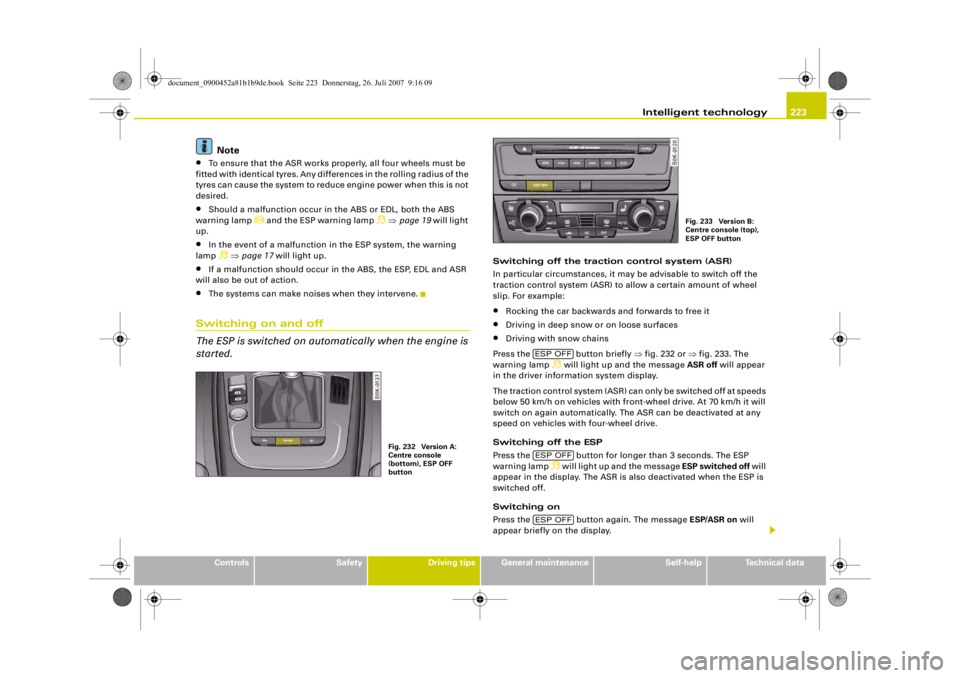
Switching on and off
The ESP is switched on automatically when the engine is
started.
Switching off the traction control system (ASR)
In particular circumstances, it may be advisable to switch off the
traction control system (ASR) to allow a certain amount of wheel
slip. For example:•
Rocking the car backwards and forwards to free it
•
Driving in deep snow or on loose surfaces
•
Driving with snow chains
Press the button briefly ⇒fig. 232 or ⇒fig. 233. The
warning lamp
will light up and the message ASR off will appear
in the driver information system display.
The traction control system (ASR) can only be switched off at speeds
below 50 km/h on vehicles with front-wheel drive. At 70 km/h it will
switch on again automatically. The ASR can be deactivated at any
speed on vehicles with four-wheel drive.
Switching off the ESP
Press the button for longer than 3 seconds. The ESP
warning lamp will light up and the message ESP switched off will
appear in the display. The ASR is also deactivated when the ESP is
switched off.
Switching on
Press the button again. The message ESP/ASR on will
appear briefly on the display.
Fig. 232 Version A:
Centre console
(bottom), ESP OFF
button
Fig. 233 Version B:
Centre console (top),
ESP OFF button
ESP OFFESP OFFESP OFF
document_0900452a81b1b9de.book Seite 223 Donnerstag, 26. Juli 2007 9:16 09
--4 -
-
(I]
T
•
-+
I I
+-
I I
I I