child seat AUDI S4 2008 User Guide
[x] Cancel search | Manufacturer: AUDI, Model Year: 2008, Model line: S4, Model: AUDI S4 2008Pages: 342, PDF Size: 15.01 MB
Page 193 of 342
Safe driving191
Controls
Safety
Driving tips
General maintenance
Self-help
Technical data
Examples of incorrect sitting positions
Occupants can suffer severe or fatal injuries injuries if
they sit in an incorrect position while the vehicle is
moving.Seat belts can only provide maximum protection if the belt
webbing is positioned correctl y. Sitting out of position
greatly reduces the effectiveness of the seat belts and
increases the risk of injury since the belt webbing is not
worn in the position for which it is designed. The driver is
responsible for the safety of all vehicle occupants, espe-
cially for children.
– Never allow anyone to sit out of position while the vehicle is moving ⇒.The following list shows just some examples of incorrect sitting
positions which can be dangerous to all occupants. The list is not
complete, but will help to make you aware of possible dangers
which can be avoided.
Therefore, whenever the vehicle is moving:•
never stand up in the vehicle,
•
never stand on the seats,
•
never kneel on the seats,
•
never travel with the backrest reclined too far,
•
never lean against the dash panel,
•
never lie down on the rear seat,
•
never sit on the front edge of a seat,
•
never sit sideways,
•
never lean out of the window,
•
never put your feet out of the window,
•
never put your feet on the dash panel,
•
never put your feet on the seat cushion,
•
never ride in the footwell,
•
never travel on a seat with out wearing the seat belt,
•
never climb into the luggage compartment.
WARNING
Sitting out of position increases the risk of severe injuries.•
Sitting out of position exposes the occupants to potentially
fatal injuries: if the airbags inflate they can strike any occupant
who is not in one of th e designed seat positions.
•
Before starting a trip, sit in the correct position and stay in this
position as long as the vehicle is moving. Before every trip, make
sure all passengers are sitting in the correct positions and remain
correctly seated at all times ⇒page 73, “Seats and storage”.
Pedal are aPedal s
The pedals must always be free to move and must never
be obstructed by floor mats or any objects in the footwell.– Make sure that the accelerator, brake and clutch pedals
are not obstructed and can be pressed all the way down
to the floor.
– Make sure that all pedals are able to return freely to their original positions.Only use floor mats which leave the pedal area free and can be
securely fastened in the footwell.
If one of the brake circuits should fail, increased brake pedal travel
will be required to bring the vehicle safely to a stop.
document_0900452a81b1b9de.book Seite 191 Donnerstag, 26. Juli 2007 9:16 09
--4 -
-T
•
-+ +-
Page 195 of 342
Safe driving193
Controls
Safety
Driving tips
General maintenance
Self-help
Technical data
inside. In this case the child wo
uld be unable to get out of the
vehicle without help. This could have fatal consequences.
•
Never allow children to play in or around the vehicle. Always
close and lock the boot lid and all the doors when you leave the
vehicle.
•
Never let passengers ride in the luggage compartment. All
occupants must be properly restrained by the seat belts at all
times ⇒page 194 .Note
•
Air circulation in the vehicle helps reduce fogging of the
windows. Used air escapes through ventilation slots in the rear of
the vehicle. Make sure that these ventilation slots are not
obstructed.
•
Suitable belts for securing loads to the fastening rings* are
commercially available.
Applies to vehicles: with fastening ringsFastening rings
Unsecured loads are a hazard to all vehicle occupants.There are fastening rings in the luggage compartment
which can be used to secure luggage and other objects
⇒ page 79 .
– Use the fastening rings to secure items safely in the luggage compartment ⇒ in “Loading the luggage
compartment” on page 79.During a collision or an accident, even small and light objects can
possess so much energy that they can cause very severe injuries.
The amount of this “kinetic energy” depends on the speed of the vehicle and the weight of the object. The most significant factor,
however, is the speed of the vehicle.
An example: An object weighing 4.5 kg is lying unsecured in the
vehicle. During a frontal collision at a speed of 50 km/h, this object
generates a force corresponding to 20 times its weight. That means
that the effective weight of the object increases to about 90 kg. You
can imagine the severity of the injuries which might be sustained if
this “projectile” strikes an occupant as it flies through the
passenger compartment.
WARNING
If items of luggage or other obje
cts are secured to the fastening
rings with inappropriate or da maged retaining cords, injuries
could result in the event of sudden braking or a collision.•
To prevent pieces of luggage or other objects from flying
forward, always use appropriate retaining cords which are prop-
erly secured to the fastening rings.
•
Never secure a child seat on the fastening rings.
WARNING (continued)
document_0900452a81b1b9de.book Seite 193 Donnerstag, 26. Juli 2007 9:16 09
--4 -
-T
[I]
-+
•
•
+-
Page 196 of 342
Seat belts
194Seat beltsWhy is it so important to use seat
belts?Seat belts provide effective protection
The common belief that passengers can brace their
weight with their hands in a minor collision is false.It is an established fact that seat belts provide good protection in
accidents. Therefore wearing a seat belt is required by law in most
countries.
Properly worn seat belts hold the occupants in the best position for
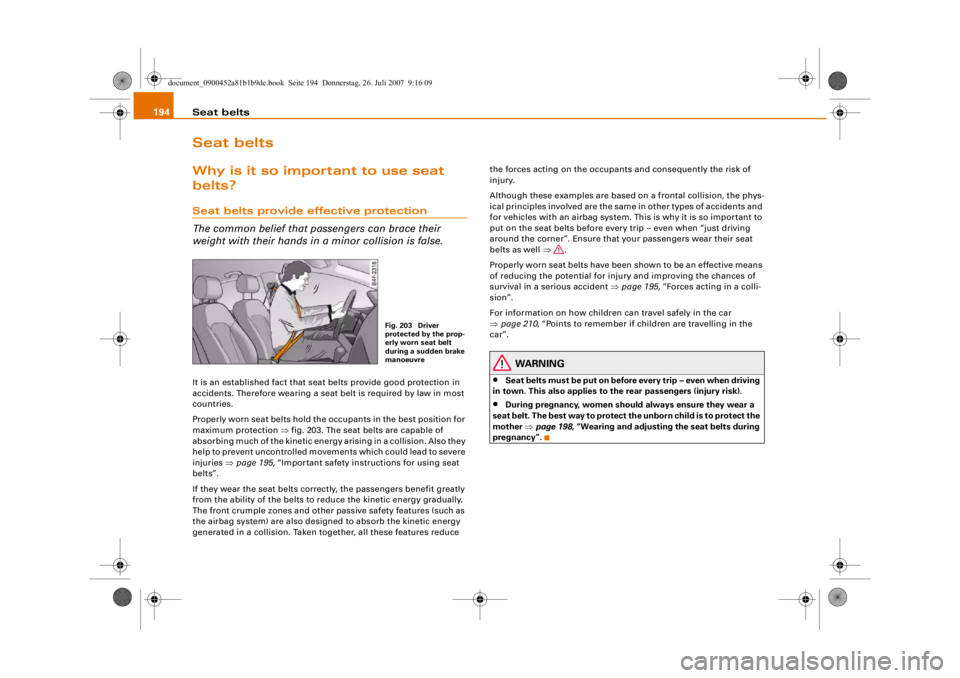
maximum protection ⇒fig. 203. The seat belts are capable of
absorbing much of the kinetic energy arising in a collision. Also they
help to prevent uncontrolled movements which could lead to severe
injuries ⇒page 195, “Important safety instructions for using seat
belts”.
If they wear the seat belts correc tly, the passengers benefit greatly
from the ability of the belts to re duce the kinetic energy gradually.
The front crumple zones and other passive safety features (such as
the airbag system) are also designed to absorb the kinetic energy
generated in a collision. Taken together, all these features reduce the forces acting on the occupants and consequently the risk of
injury.
Although these examples are based on
a frontal collision, the phys-
ical principles involved are the same in other types of accidents and
for vehicles with an airbag system. This is why it is so important to
put on the seat belts before every trip – even when “just driving
around the corner”. Ensure that your passengers wear their seat
belts as well ⇒.
Properly worn seat belts have been shown to be an effective means
of reducing the potential for injury and improving the chances of
survival in a serious accident ⇒page 195, “Forces acting in a colli-
sion”.
For information on how children can travel safely in the car
⇒ page 210, “Points to remember if children are travelling in the
car”.
WARNING
•
Seat belts must be put on before ev ery trip – even when driving
in town. This also applies to th e rear passengers (injury risk).
•
During pregnancy, women should always ensure they wear a
seat belt. The best way to protect the unborn child is to protect the
mother ⇒page 198, “Wearing and adjusting the seat belts during
pregnancy”.
Fig. 203 Driver
protected by the prop-
erly worn seat belt
during a sudden brake
manoeuvre
document_0900452a81b1b9de.book Seite 194 Donnerstag, 26. Juli 2007 9:16 09
--4 -
-T
-+ +-
•
Page 197 of 342
Seat belts195
Controls
Safety
Driving tips
General maintenance
Self-help
Technical data
Important safety instructions for using seat belts
There are a number of safety points concerning the seat
belts which you should remember. This will help to reduce
the risk of injury in an accident.
WARNING
•
The seat belts can only provi de maximum protection if the
seats are adjusted properly ⇒page 73, “Seats and storage”.
•
To ensure proper protection, it is important to wear the seat
belts in the co rrect position ⇒page 197, “How to wear seat belts
properly”. Ensure that the seat belts are worn exactly as recom-
mended in this chapter. Belts wh ich are not worn properly can
increase the risk of injury in accidents considerably.
•
Do not allow the seat belt to be come twisted or jammed, or to
rub on any sharp edges.
•
Never allow two passengers (even children) to share the same
seat belt. It is especially dangerou s to place a seat belt over a child
sitting on your lap.
•
Do not wear the belt over hard or fragile objects (such as
glasses or pens, etc. ) because this can cause injuries.
•
Loose, bulky clothing (such as an overcoat over a jacket)
impairs the proper fit an d function of the belts.
•
The belts must be kept clean, otherwise the retractors may not
work properly ⇒page 250, “Seat belts”.
•
The slot in the seat belt buckle must not be blocked with paper
or other objects, as this can prev ent the latch plate from engaging
properly.
•
The latch plate of the belt mu st always be engaged in the
correct buckle for that seat, ot herwise the belt will not be fully
effective.
•
Check the condition of the seat bel ts at regular intervals. If you
notice that the belt webbing, fi ttings, retractor mechanism or buckle of any of the belts is da
maged, the belt must be replaced
by a qualified workshop.
•
The seat belts must not be remov ed or modified in any way. Do
not attempt to repair a damaged belt yourself.
•
Seat belts which have been worn in an accident and stretched
must be replaced by a qualified workshop. The belt anchorages
should also be checked.
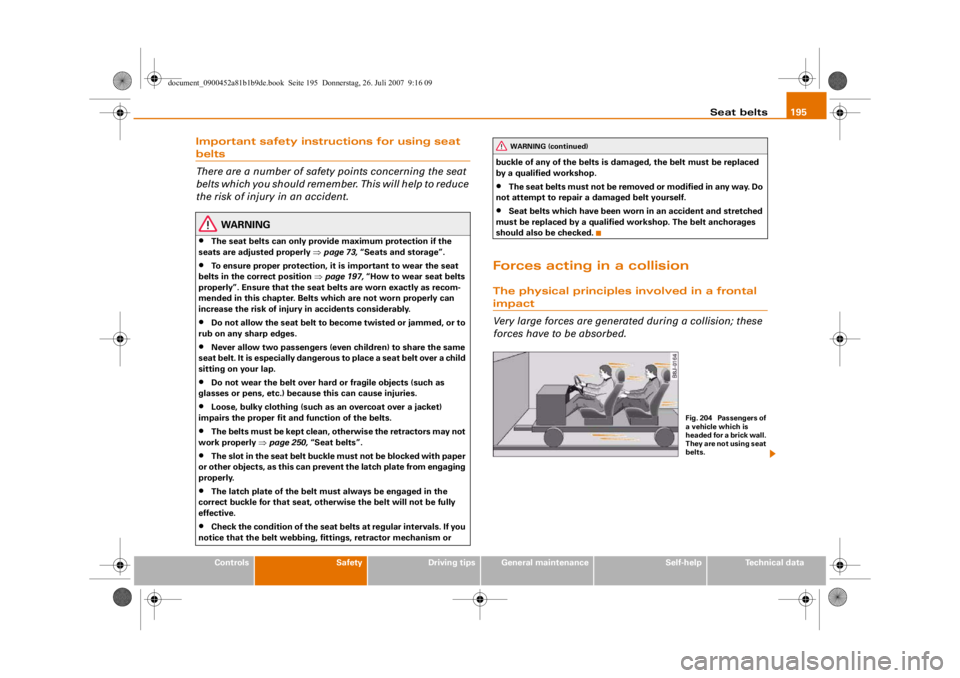
Forces acting in a collisionThe physical principles involved in a frontal impact
Very large forces are generat ed during a collision; these
forces have to be absorbed.
WARNING (continued)
Fig. 204 Passengers of
a vehicle which is
headed for a brick wall.
They are not using seat
belts.
document_0900452a81b1b9de.book Seite 195 Donnerstag, 26. Juli 2007 9:16 09
--4 -
-T
•
-+ +-
Page 200 of 342
Seat belts
198The height of the front seat on your vehicle can be adjusted in order
to match the position of the seat belt to your height.
WARNING
•
The diagonal part of the belt s hould never be positioned across
the neck, but roughly over the centre of the shoulder; it should fit
closely against the upper part of the body. The lap part of the belt
must be worn tightly across the hips, and not over the abdomen
⇒ page 197, fig. 210. Pull the belt tight if necessary to take up any
slack.
•
Always make sure that belt is positioned properly. Incorrectly
worn seat belts can give rise to injuries even in a minor collision.
•
Seat belts worn too loose can re sult in injuries because they
allow excessive forward movement in a crash; the occupant will
be brought to a sudden stop by the belt webbing.
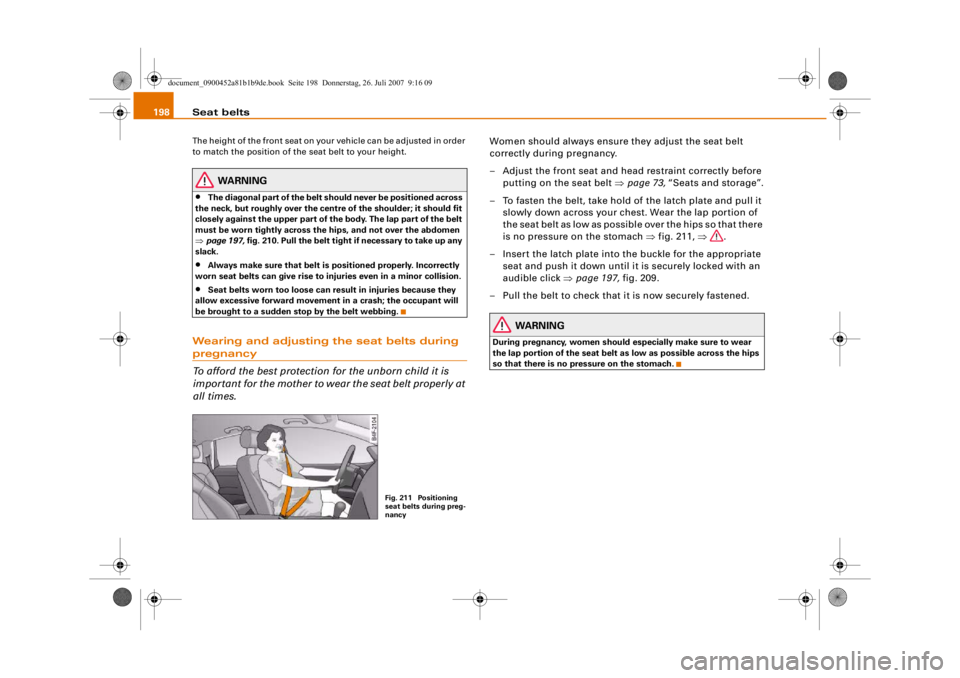
Wearing and adjusting the seat belts during pregnancy
To afford the best protection for the unborn child it is
important for the mother to wear the seat belt properly at
all times.
Women should always ensure they adjust the seat belt
correctly during pregnancy.
– Adjust the front seat and head restraint correctly before putting on the seat belt ⇒page 73, “Seats and storage”.
– To fasten the belt, take hold of the latch plate and pull it slowly down across your chest. Wear the lap portion of
the seat belt as low as possible over the hips so that there
is no pressure on the stomach ⇒fig. 211, ⇒.
– Insert the latch plate into the buckle for the appropriate seat and push it down until it is securely locked with an
audible click ⇒page 197, fig. 209.
– Pull the belt to check that it is now securely fastened.
WARNING
During pregnancy, women should especially make sure to wear
the lap portion of the seat belt as low as possible across the hips
so that there is no pressure on the stomach.
Fig. 211 Positioning
seat belts during preg-
nancy
document_0900452a81b1b9de.book Seite 198 Donnerstag, 26. Juli 2007 9:16 09
--4 -
-T
-+
•
--- ~I& __ ·~
+-
Page 206 of 342
Airbag system
204Important safety notes on the front airbag system
There are a number of safety points concerning the airbag
system which you should remember. This will help to
reduce the risk of injury in an accident.
WARNING
•
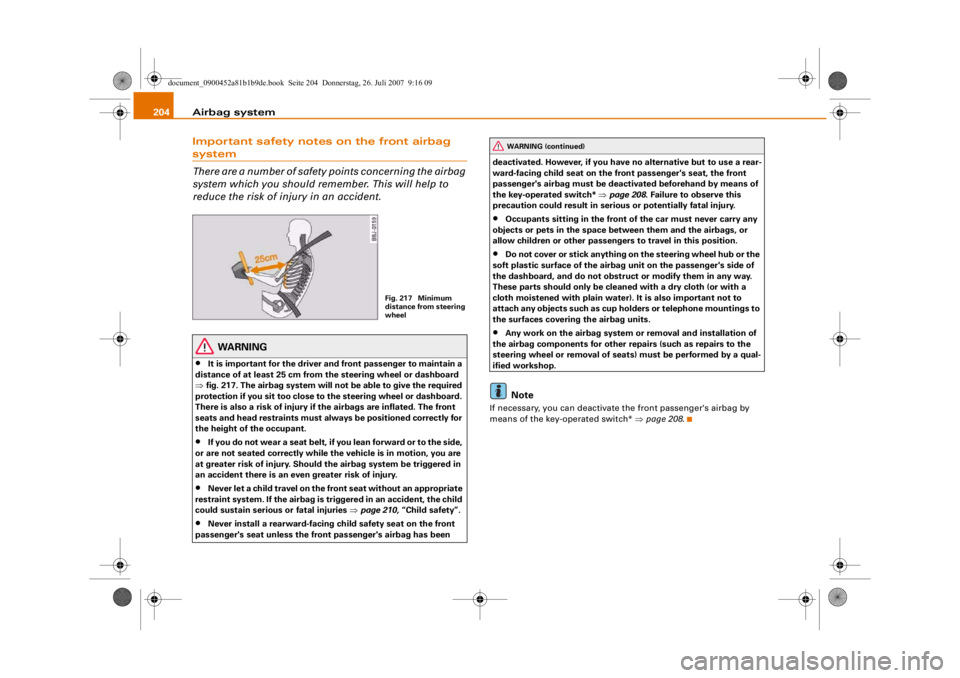
It is important for th e driver and front passenger to maintain a
distance of at least 25 cm from the steering wheel or dashboard
⇒ fig. 217. The airbag system will not be able to give the required
protection if you sit too close to the steering wheel or dashboard.
There is also a risk of injury if the airbags are inflated. The front
seats and head restraints must always be positioned correctly for
the height of the occupant.
•
If you do not wear a seat belt, if you lean forward or to the side,
or are not seated correctly while th e vehicle is in motion, you are
at greater risk of injury. Should the airbag system be triggered in
an accident there is an even greater risk of injury.
•
Never let a child travel on the front seat without an appropriate
restraint system. If the airbag is tr iggered in an accident, the child
could sustain serious or fatal injuries ⇒page 210, “Child safety”.
•
Never install a rearward-facing child safety seat on the front
passenger's seat unless the fron t passenger's airbag has been deactivated. However, if you have
no alternative but to use a rear-
ward-facing child seat on the front passenger's seat, the front
passenger's airbag must be deac tivated beforehand by means of
the key-operated switch* ⇒page 208 . Failure to observe this
precaution could result in serious or potentially fatal injury.
•
Occupants sitting in the front of the car must never carry any
objects or pets in the space between them and the airbags, or
allow children or other passengers to travel in this position.
•
Do not cover or stick anything on the steering wheel hub or the
soft plastic surface of the airbag unit on the passenger's side of
the dashboard, and do not obstruct or modify them in any way.
These parts should only be cleaned with a dry cloth (or with a
cloth moistened with plain water). It is also important not to
attach any objects such as cup holders or telephone mountings to
the surfaces covering the airbag units.
•
Any work on the airbag system or removal and installation of
the airbag components for other repairs (such as repairs to the
steering wheel or removal of seats) must be performed by a qual-
ified workshop.Note
If necessary, you can deactivate the front passenger's airbag by
means of the key-operated switch* ⇒page 208 .
Fig. 217 Minimum
distance from steering
wheel
WARNING (continued)
document_0900452a81b1b9de.book Seite 204 Donnerstag, 26. Juli 2007 9:16 09
--4 -
-T
-+
f------&
-----------i
+-
[I]
•
Page 208 of 342
Airbag system
206Important safety notes on the side airbag system
There are a number of safety points concerning the airbag
system which you should remember. This will help to
reduce the risk of injury in an accident.
WARNING
•
If you do not wear a seat belt, if you lean forward, or are not
seated correctly while th e vehicle is in motion, you are at greater
risk of injury should the side airbags on the front seats or the outer
rear seats* be triggered in an accident. This applies particularly to
children if they are not properly protected by a child restraint
system ⇒page 212, “Important notes on side airbags and child
safety”.
•
If children are not seated correctly, they are at greater risk of
injury in an accident. This is particularly the case if the child is
travelling on the front passenger's seat and the airbag system is
triggered. This could result in serious or potentially fatal injury
⇒ page 210, “Child safety”.
•
It is also important not to attach any accessories (such as cup
holders) to the doors. This would impair the protection offered by
the side airbags (front and rear*).
•
The sensors for the airbags are lo cated in the front doors. You
must therefore not make any modifications to the doors or door
trim (e.g. retrofitting loudspeakers ), as this could impair the func-
tion of the side airbags. Any dama ge to the front doors could lead
to faults in the system. Repairs or any other work on the front
doors must therefore always be carried out by a qualified work-
shop.
•
The built-in coat hooks should only be used for lightweight
clothing. Do not leave any heavy or sharp-edged objects in the
pockets.
•
Do not apply excessive force to the sides of the backrests (such
as hard knocks or kicks), as this could damage parts of the system.
The side airbags could then fail to operate when required.
•
If you intend to fit protective covers over the seats, these must
be of the specific type approved for use on Audi seats with side
airbags. Conventional seat covers would obstruct the side airbag
when it inflates out of the ba ckrest, and seriously reduce the
airbag's ef fectiveness.
•
Any damage to the original seat upholstery or around the
seams of the side airbag units must be repaired immediately by a
qualified workshop.
•
Any work involving the side airbag system or removal and
installation of the airbag components for other repairs (such as
repairs to the seats) must always be performed by a qualified
workshop. Otherwise the airbag system may fail to work
properly.WARNING (continued)
document_0900452a81b1b9de.book Seite 206 Donnerstag, 26. Juli 2007 9:16 09
--4 -
-T
-+
•
+-
Page 211 of 342
Airbag system209
Controls
Safety
Driving tips
General maintenance
Self-help
Technical data
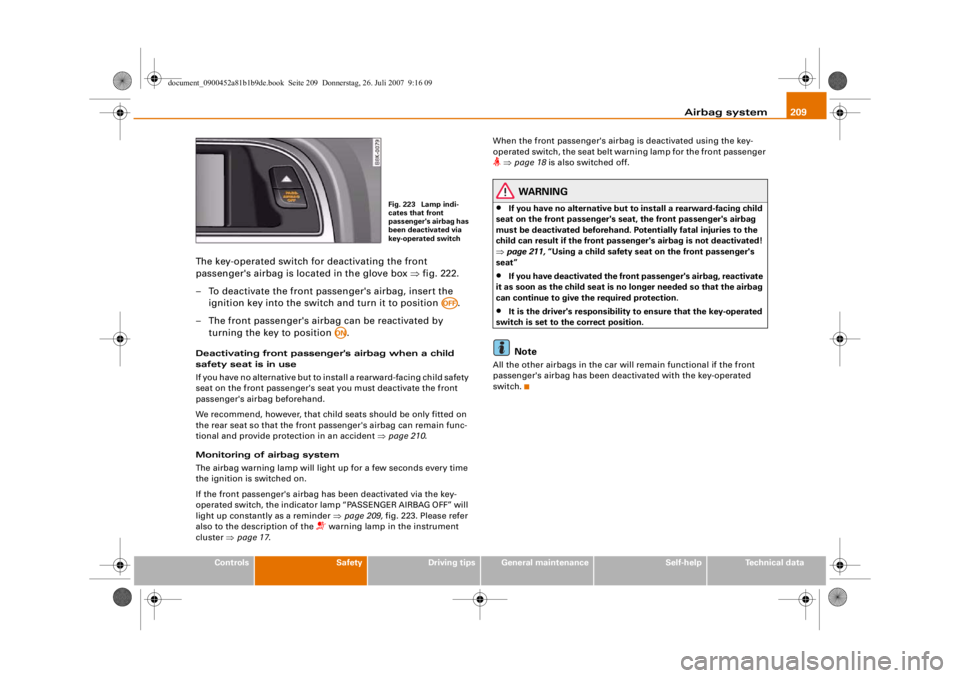
The key-operated switch for deactivating the front
passenger's airbag is located in the glove box ⇒fig. 222.
– To deactivate the front passenger's airbag, insert the ignition key into the switch and turn it to position .
– The front passenger's airbag can be reactivated by turning the key to position .Deactivating front passenger 's airbag when a child
safety seat is in use
If you have no alternative but to i nstall a rearward-facing child safety
seat on the front passenger's seat you must deactivate the front
passenger's airbag beforehand.
We recommend, however, that child seats should be only fitted on
the rear seat so that the front passenger's airbag can remain func-
tional and provide protection in an accident ⇒page 210 .
Monitoring of airbag system
The airbag warning lamp will light up for a few seconds every time
the ignition is switched on.
If the front passenger's airbag ha s been deactivated via the key-
operated switch, the indicator lamp “PASSENGER AIRBAG OFF” will
light up constantly as a reminder ⇒page 209, fig. 223. Please refer
also to the description of the
warning lamp in the instrument
cluster ⇒page 17 . When the front passenger's airbag is deactivated using the key-
operated switch, the seat belt warning lamp for the front passenger
⇒ page 18 is also switched off.
WARNING
•
If you have no alternative but to install a rearward-facing child
seat on the front passenger's se at, the front passenger's airbag
must be deactivated beforehand. Po tentially fatal injuries to the
child can result if the front passenger's airbag is not deactivated!
⇒ page 211, “Using a child safety seat on the front passenger's
seat”
•
If you have deactivated the fron t passenger's airbag, reactivate
it as soon as the chil d seat is no longer needed so that the airbag
can continue to give the required protection.
•
It is the driver's responsibility to ensure that the key-operated
switch is set to the correct position.Note
All the other airbags in the car will remain functional if the front
passenger's airbag has been deactivated with the key-operated
switch.
Fig. 223 Lamp indi-
cates that front
passenger's airbag has
been deactivated via
key-operated switch
AOFF
AON
document_0900452a81b1b9de.book Seite 209 Donnerstag, 26. Juli 2007 9:16 09
--4 -
-T
-+
[I]
+-
•
Page 212 of 342
Child safety
210Child safetyPoints to remember if children are
travelling in the carIntroduction
Statistics show that children are generally safer on the
rear seat than on the front passenger's seat.Children under 12 years of age shou ld normally travel on the rear
seat
2). Children travelling on the rear seat must use a child restraint
system or the seat belts provided, depending on their age, height
and weight. For safety reasons, the child restraint system should be
installed behind the front passenger's seat.
The physical principles involved and the forces acting in a collision
apply to children just as much as adults ⇒ page 195, “Forces acting
in a collision”. But, unlike adults, children do not have fully devel-
oped muscle and bone structures. This means that children are
subject to a greater risk of injury.
To reduce this risk, children must always use special child restraint
systems when travelling in the car.
Use only child restraint systems which are officially approved under
the European standard ECE R 44 and are suitable for the child. ECE R
refers to the Economic Commission of Europe Recommendation,
which categorises child restraint systems in 5 groups ⇒page 213,
“Child seat categories”. Child restraints that have been tested and
approved under the ECE R 44 standard bear the ECE-R 44 test mark
on the seat (the letter E in a circle with the test number below it).
We recommend using child restraint systems from the range of
Audi Genuine Accessories available from Audi dealers. The
“Huckepack” range includes suitable restraint systems for all ages. These systems have been specially developed and tested for use in
Audi vehicles and comply with the ECE-R 44 standard.
Follow the manufacturer's instru
ctions and observe any statutory
requirements when installing and using child restraints ⇒ in
“Important safety notes for using child safety seats”.
Important safety notes for using child safety seats
Correct use of child safety seats can help to reduce the
risk of injury in an accident.
WARNING
•
All vehicle occupants, especially children, must wear a seat
belt while the vehicl e is in motion.
•
Children who are less than 1.5 metres tall must not wear a
normal seat belt without a child rest raint, as this could cause inju-
ries to the abdominal and neck areas.
•
Babies and children must neve r travel on another occupant's
lap.
•
A suitable child safety seat can protect your child ⇒page 213,
“Child safety seats”.
•
Never allow two children to o ccupy one child safety seat.
•
Never leave a child without supervision in a child safety seat.
•
Never allow a child to travel in the car without a suitable child
restraint.
•
Never allow a child to stand up or kneel on a seat while the car
is moving. In an ac cident, the child coul d be catapulted through
the car, causing possibly fatal injuries to itself and other occu-
pants.
2)Observe any restrictions or regulations to the contrary.
document_0900452a81b1b9de.book Seite 210 Donnerstag, 26. Juli 2007 9:16 09
--4 -
-T
&
•
-+ +-
Page 213 of 342
Child safety211
Controls
Safety
Driving tips
General maintenance
Self-help
Technical data
•
If children lean forward or are otherwise out of position when
the car is moving, they are at greater risk of injury in an accident.
This is particularly the case if the child is travelling on the front
passenger's seat and the airbag system is triggered in an accident.
There is then a risk of serious or potentially fatal injury.
•
To ensure proper protection, it is important to wear the seat
belts in the co rrect position ⇒page 197, “How to wear seat belts
properly”. Always check that th e belt is properly positioned
according to the instru ctions provided by the manufacturer of the
child safety seat. Incorrectly worn seat belts can give rise to inju-
ries even in a minor collision.
•
Never install a rearward-facing child safety seat on the front
passenger's seat if the front pass enger's airbag has not been deac-
tivated ⇒page 211 .
•
Extra caution is advised if you ar e installing a child safety seat
using the same mounting bolts as the existing car seat belts. The
bolts must be screwed in all the way to the full depth of the
mounting holes and ti ghtened to a torque of 50 Nm. Failure to
observe this precaution could result in potentially fatal injury. We
recommend having the installation performed by a qualified
workshop.
Using a child safety seat on the front passenger's seat
Whenever possible, child safety seats should always be
installed on the rear seat.For safety reasons, we recommend that child safety seats should be
installed on the rear seats whenever possible. However, if you have
to use a child seat on the front passenger's seat when there is no
other alternative , it is most important to note the following warn-
ings:
WARNING
•
Do not use a rearward-facing child safety seat on the front
passenger's seat unless the fr ont passenger's airbag has been
deactivated. The child seat would be directly in the path of the
airbag as it inflates, and the child could sustain serious or fatal
injuries if the airbag were to be deployed.
•
However, if you have no alte rnative but to use a rearward-
facing child seat on the front passenger's seat, the front
passenger's airbag must be deac tivated beforehand by means of
the key-operated switch* ⇒page 208. Failure to observe this
precaution could result in serious or potentially fatal injury.
•
Make sure that the front passen ger's airbag is reactivated by
means of the key-operated switch* as soon as the child seat is no
longer needed on the front passenger's seat.
•
When using a child safety seat of the type which faces in the
direction of travel, the front pass enger's seat must be moved back
to the rearmost position.
WARNING (continued)
document_0900452a81b1b9de.book Seite 211 Donnerstag, 26. Juli 2007 9:16 09
--4 -
-T
&
A
f---------t
ill
-+
•
+-
•