child seat AUDI S4 2008 Owner's Manual
[x] Cancel search | Manufacturer: AUDI, Model Year: 2008, Model line: S4, Model: AUDI S4 2008Pages: 342, PDF Size: 15.01 MB
Page 214 of 342
Child safety
212Applies to vehicles: with side airbagsImportant notes on side airbags and child safety
Children must never sit too close to the opening for the
side airbag.The side airbags offer increased protection in a side-on collision.
In order to be effective, the side airbags need to inflate very quickly
(within fractions of a second) ⇒page 205, “How the side airbags
work”.
The airbag inflates with such force that injury can be caused if the
occupant is not sitting upright, or if there are any objects close to
the opening for the side airbag. This applies particularly to children if they are travelling in a way
which does not comply with the statutory safety regulations.
Incorrect position – danger
of injury from the side
airbag
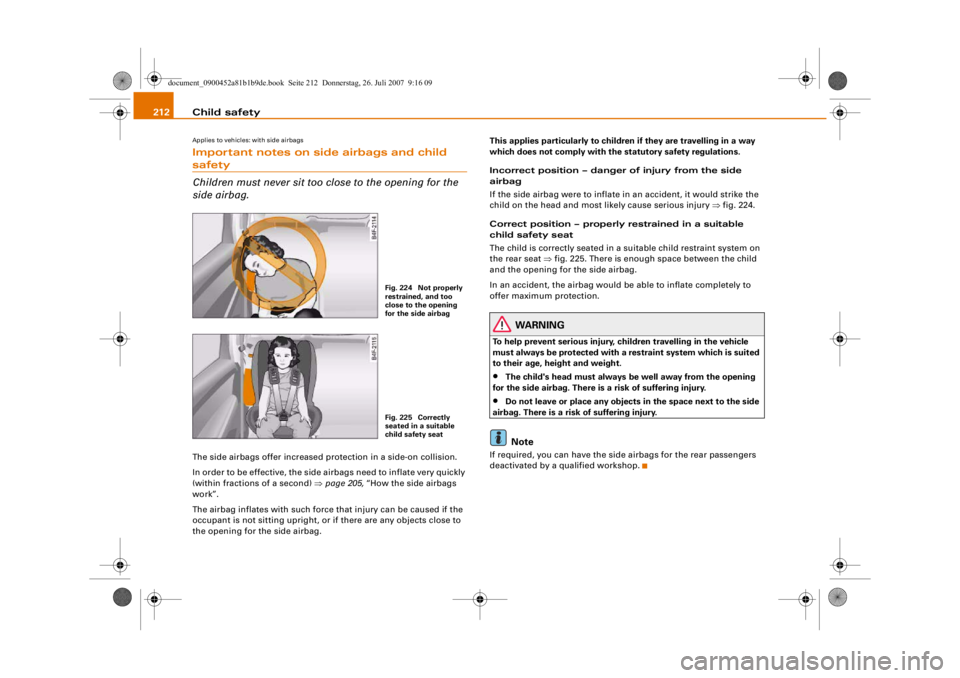
If the side airbag were to inflate in an accident, it would strike the
child on the head and most likely cause serious injury ⇒fig. 224.
Correct position – properly restrained in a suitable
child safety seat
The child is correctly seated in a suitable child restraint system on
the rear seat ⇒ fig. 225. There is enough space between the child
and the opening for the side airbag.
In an accident, the airbag would be able to inflate completely to
offer maximum protection.
WARNING
To help prevent serious injury, children travelling in the vehicle
must always be protected with a restraint system which is suited
to their age, he ight and weight.•
The child's head must always be well away from the opening
for the side airbag. There is a risk of suffering injury.
•
Do not leave or place any object s in the space next to the side
airbag. There is a risk of suffering injury.Note
If required, you can have the side airbags for the rear passengers
deactivated by a qualified workshop.
Fig. 224 Not properly
restrained, and too
close to the opening
for the side airbagFig. 225 Correctly
seated in a suitable
child safety seat
document_0900452a81b1b9de.book Seite 212 Donnerstag, 26. Juli 2007 9:16 09
--4 -
-T
-+
I
+-
[I]
•
Page 215 of 342
Child safety213
Controls
Safety
Driving tips
General maintenance
Self-help
Technical data
Child safety seatsChild seat categories
Only use child restraint systems that are officially
approved and suitable for the child.Child restraint systems are covered by the European standard
ECE R 44 (issued by the Economic Commission of Europe).
The child seats are divided into 5 categories:
Children who are taller than 1.5 metres can use the existing seat
belts without a booster cushion.
Child restraints that have been tested and approved under the ECE
R 44 standard bear the ECE-R 44 test mark on the seat (the letter E
in a circle with the test number below it).
Child safety seat: category 0 / 0+
A suitable child safety seat and a correctly worn seat belt
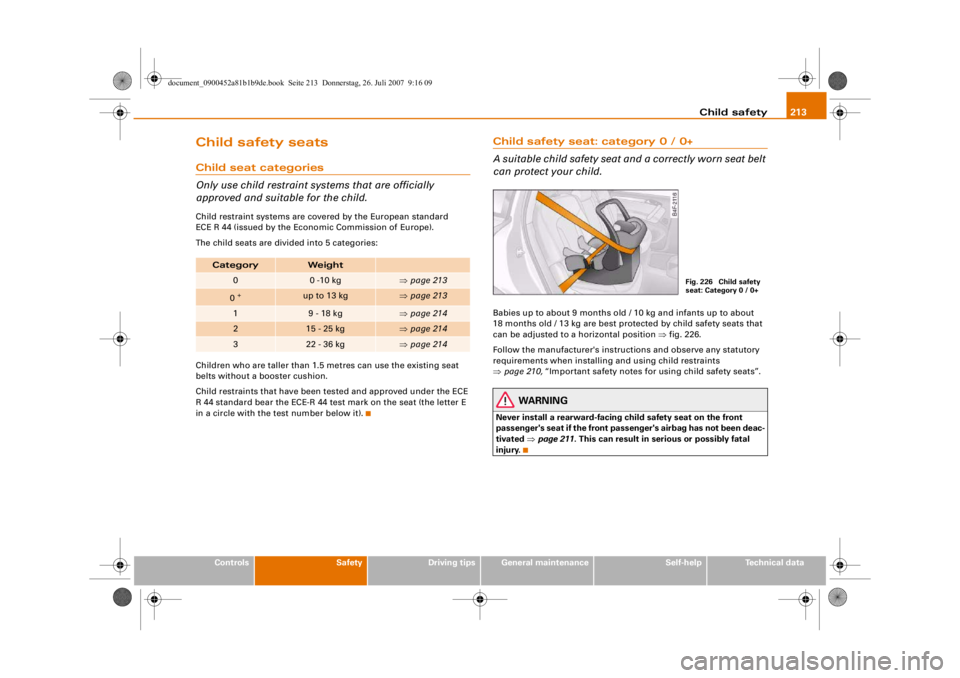
can protect your child.Babies up to about 9 months old / 10 kg and infants up to about
18 months old / 13 kg are best protected by child safety seats that
can be adjusted to a horizontal position ⇒fig. 226.
Follow the manufacturer's instru ctions and observe any statutory
requirements when installing and using child restraints
⇒ page 210, “Important safety notes for using child safety seats”.
WARNING
Never install a rearward-facing child safety seat on the front
passenger's seat if the front pass enger's airbag has not been deac-
tivated ⇒page 211 . This can result in serious or possibly fatal
injury.
Category
Weight
0
0 -10 kg
⇒ page 213
0 +
up to 13 kg
⇒page 213
1
9 - 18 kg
⇒page 214
2
15 - 25 kg
⇒page 214
3
22 - 36 kg
⇒page 214
Fig. 226 Child safety
seat: Category 0 / 0+
document_0900452a81b1b9de.book Seite 213 Donnerstag, 26. Juli 2007 9:16 09
--4 -
-T
-+ +-
•
Page 216 of 342
Child safety
214Child safety seats: category 1
A suitable child safety seat and a correctly worn seat belt
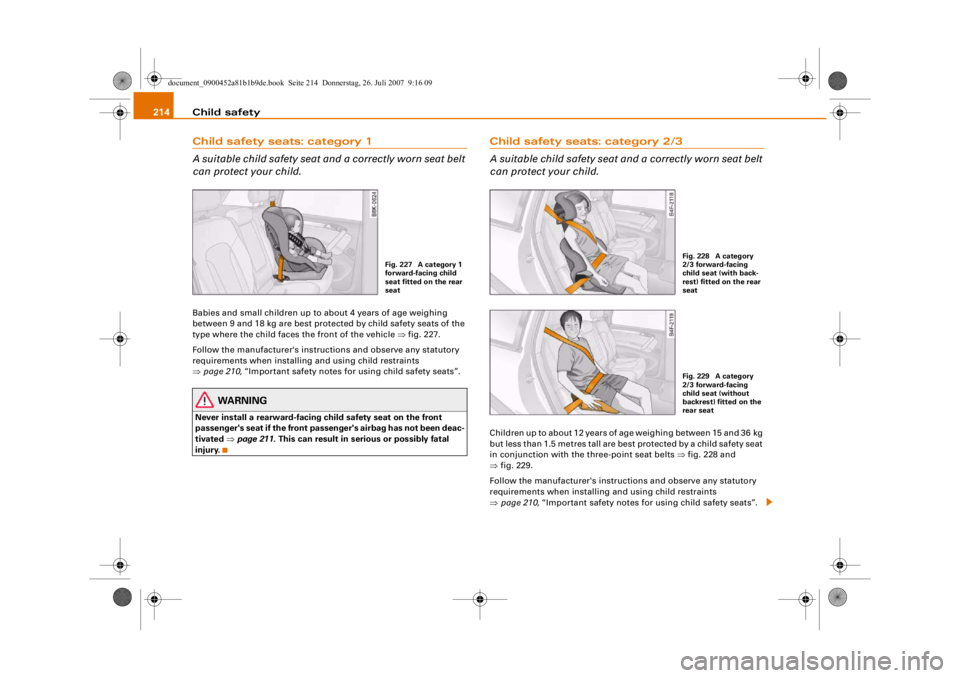
can protect your child.Babies and small children up to about 4 years of age weighing
between 9 and 18 kg are best protected by child safety seats of the
type where the child faces the front of the vehicle ⇒fig. 227.
Follow the manufacturer's instructions and observe any statutory
requirements when installing and using child restraints
⇒ page 210, “Important safety notes for using child safety seats”.
WARNING
Never install a rearward-facing child safety seat on the front
passenger's seat if the front pass enger's airbag has not been deac-
tivated ⇒page 211 . This can result in serious or possibly fatal
injury.
Child safety seats: category 2/3
A suitable child safety seat and a correctly worn seat belt
can protect your child.Children up to about 12 years of age weighing between 15 and 36 kg
but less than 1.5 metres tall are best protected by a child safety seat
in conjunction with the three-point seat belts ⇒fig. 228 and
⇒ fig. 229.
Follow the manufacturer's instru ctions and observe any statutory
requirements when installing and using child restraints
⇒ page 210, “Important safety notes for using child safety seats”.
Fig. 227 A category 1
forward-facing child
seat fitted on the rear
seat
Fig. 228 A category
2/3 forward-facing
child seat (with back-
rest) fitted on the rear
seatFig. 229 A category
2/3 forward-facing
child seat (without
backrest) fitted on the
rear seat
document_0900452a81b1b9de.book Seite 214 Donnerstag, 26. Juli 2007 9:16 09
--4 -
-T
-+ +-
Page 217 of 342
Child safety215
Controls
Safety
Driving tips
General maintenance
Self-help
Technical data
WARNING
The diagonal part of the belt s hould be positioned roughly over the
centre of the shoulder and fit clos ely against the upper part of the
body. It must never be allowed to run across the neck. The lap part
of the belt should fit closely over the hips. It must not be posi-
tioned over the stomach. Pull the bel t tight if necessary to take up
any slack.
Note
We recommend that you fit child safety seats with backrests.
document_0900452a81b1b9de.book Seite 215 Donnerstag, 26. Juli 2007 9:16 09
--4 -
-T
[I]
•
-+ +-
Page 218 of 342
Child safety
216Fitting child safety seatsGeneral information
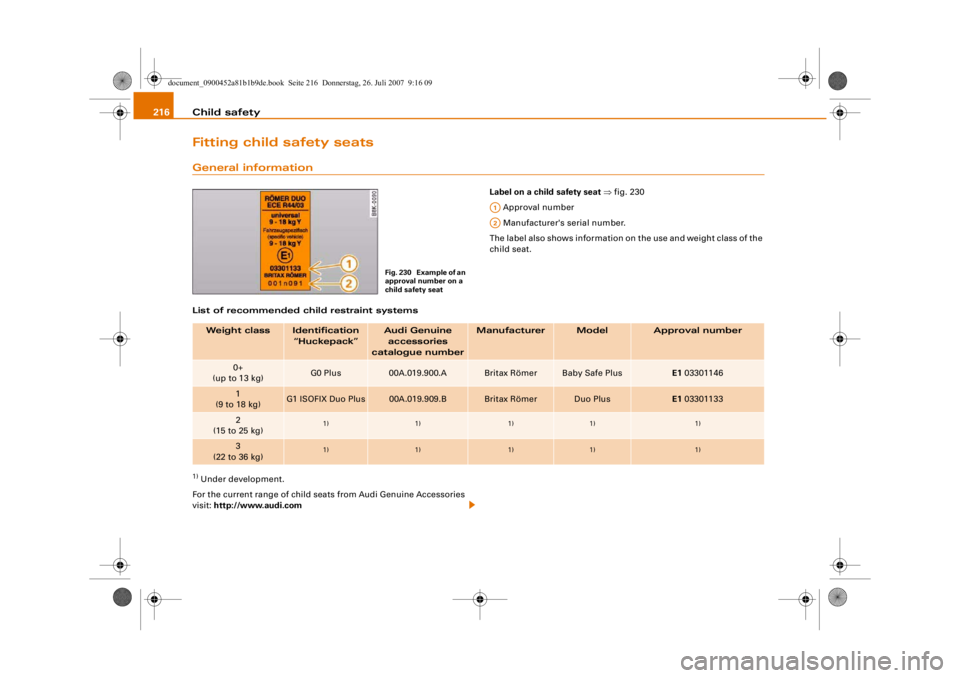
Label on a child safety seat ⇒ fig. 230
Approval number
Manufacturer's serial number.
The label also shows information on the use and weight class of the
child seat.
List of recommended child restraint systems
1) Under development.
For the current range of child seats from Audi Genuine Accessories
visit: http://www.audi.com
Fig. 230 Example of an
approval number on a
child safety seat
A1A2
Weight class
Identification
“Huckepack”
Audi Genuine accessories
catalogue number
Manufacturer
Model
Approval number
0+
(up to 13 kg)
G0 Plus
00A.019.900.A
Britax Römer
Baby Safe Plus
E1 03301146
1
(9 to 18 kg)
G1 ISOFIX Duo Plus
00A.019.909.B
Britax Römer
Duo Plus
E1 03301133
2
(15 to 25 kg)
1)
1)
1)
1)
1)
3
(22 to 36 kg)
1)
1)
1)
1)
1)
document_0900452a81b1b9de.book Seite 216 Donnerstag, 26. Juli 2007 9:16 09
--4 -
-T
AOMERDUO
~
ECE ......
~
uni-1
.2:
l•1 111gY F='m
p I
c..--l•1 111gY @ ~ 013111133
1
-::;an~ ~
-+ +-
Page 219 of 342
Child safety217
Controls
Safety
Driving tips
General maintenance
Self-help
Technical data
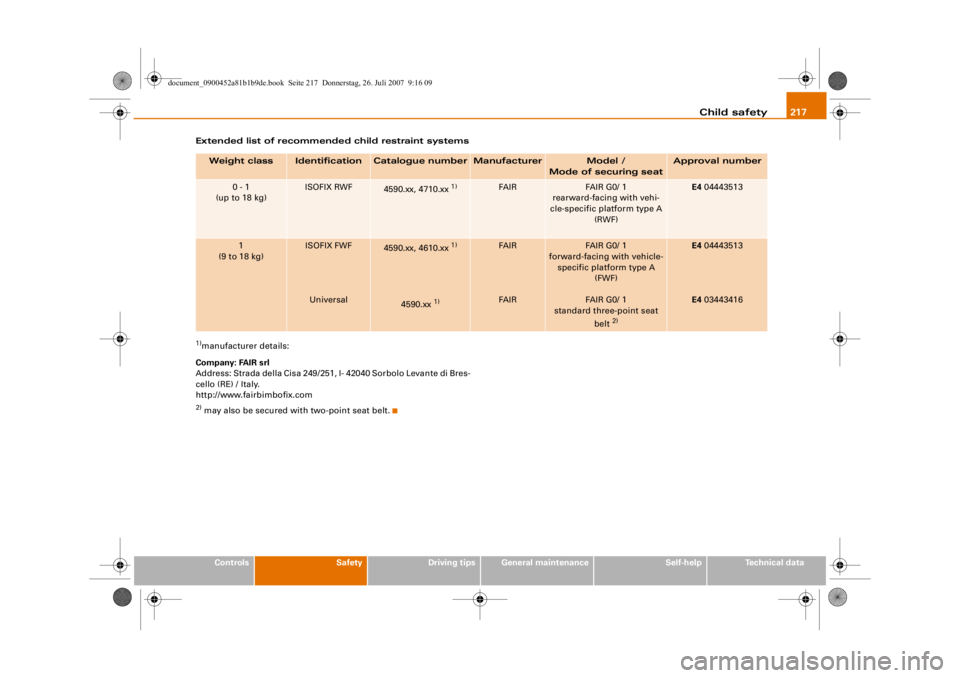
Extended list of recommended child restraint systems
1)manufacturer details:
Company: FAIR srl
Address: Strada della Cisa 249/251, I- 42040 Sorbolo Levante di Bres-
cello (RE) / Italy.
http://www.fairbimbofix.com2) may also be secured with two-point seat belt.Weight class
Identification
Catalogue number
Manufacturer
Model /
Mode of securing seat
Approval number
0 - 1
(up to 18 kg)
ISOFIX RWF
4590.xx, 4710.xx
1)
FAIR
FAIR G0/ 1
rearward-facing with vehi-
cle-specific platform type A
(RWF)
E4 04443513
1
(9 to 18 kg)
ISOFIX FWF
Universal
4590.xx, 4610.xx
1)
4590.xx
1)
FAIR
FAIR
FAIR G0/ 1
forward-facing with vehicle- specific platform type A (FWF)
FAIR G0/ 1
standard three-point seat
belt
2)
E4 04443513
E4 03443416
document_0900452a81b1b9de.book Seite 217 Donnerstag, 26. Juli 2007 9:16 09
--4 -
-T
-+ +-
•
Page 220 of 342
Child safety
218Possible alternatives for securing a child safety seat
A child safety seat can be secured on the rear seats and
on the front passenger's seat.The following alternatives are available for safely securing a child
safety seat on the rear seats and on the front passenger's seat.•
Child safety seats of the categories 0 to 3 can be secured with the
standard three-point seat belts.
•
Child safety seats of the categories 0, 0+ and 1 with the “ISOFIX”
system can be secured without seat belts using the “ ISOFIX”
retainers* ⇒page 218 .
Compatibility of vehicle seat positions for child safety seats
(according to EC directive 77/541):
“universally compatible”
The front passenger's backrest must be set as far forward as
possible or adapted to the child safety seat as required, and the
seat height must be adjusted to its highest position.
The front passenger's airbag must be deactivated if a rearward-
facing child seat is used.
The front passenger's seat ca n be equipped with optional
“ ISOFIX ” retainers.
The rear seats can be equipped with optional “ ISOFIX” retainers.
WARNING
While the vehicle is moving, chil dren must always be protected
with a restraint system which is suited to their age, height and
weight. Please refer to the chapter “Child seat categories”.•
Never install a rearward-facing ch ild safety seat on the front
passenger's seat unless the fr ont passenger's airbag has been
deactivated. This could result in potentially fatal injuries. If you
have no alternative but to let a ch ild travel on the front passenger's
seat, the front passenger's airbag must be deactivated before-
hand. Please refer to the chapter “Deactivating airbags”.
•
Note the important information and warnings concerning the
use of child safety seats found in the chapter “Important safety
notes when using child safety seats” and in the installation
instructions provided by the manufacturer of the child safety
seat.
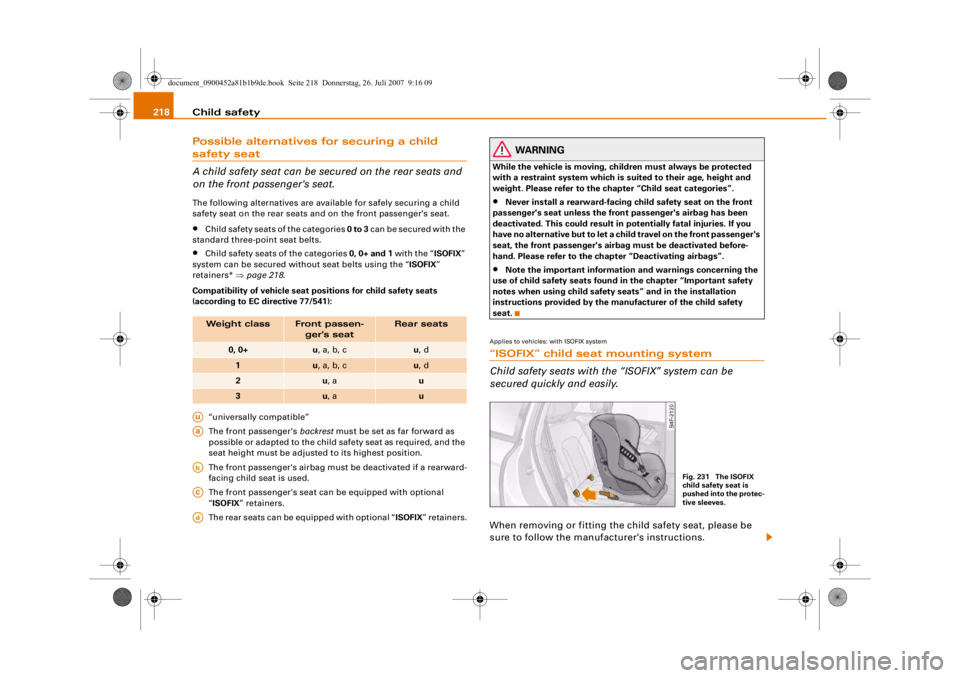
Applies to vehicles: with ISOFIX system“ISOFIX” child seat mounting system
Child safety seats with the “ISOFIX” system can be
secured quickly and easily.When removing or fitting the child safety seat, please be
sure to follow the manufacturer's instructions.
Weight class
Front passen-
ger's seat
Rear seats
0, 0+
u, a, b, c
u, d
1
u , a, b, c
u, d
2
u, a
u
3
u, a
u
AuAaAbAcAd
Fig. 231 The ISOFIX
child safety seat is
pushed into the protec-
tive sleeves.
document_0900452a81b1b9de.book Seite 218 Donnerstag, 26. Juli 2007 9:16 09
--4 -
-T
-+
•
+-
Page 221 of 342
Child safety219
Controls
Safety
Driving tips
General maintenance
Self-help
Technical data
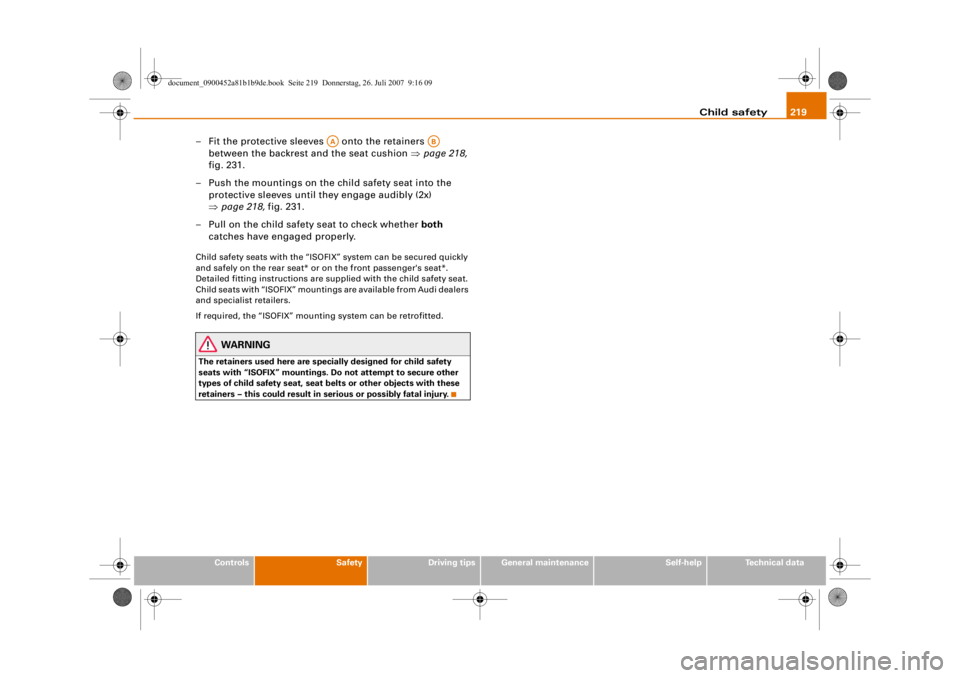
– Fit the protective sleeves onto the retainers
between the backrest and the seat cushion ⇒page 218,
fig. 231.
– Push the mountings on the child safety seat into the protective sleeves until they engage audibly (2x)
⇒page 218, fig. 231.
– Pull on the child safety seat to check whether both
catches have engaged properly.Child safety seats with the “ISOFI X” system can be secured quickly
and safely on the rear seat* or on the front passenger's seat*.
Detailed fitting instructions are supplied with the child safety seat.
Child seats with “ISOFIX” mountings are available from Audi dealers
and specialist retailers.
If required, the “ISOFIX” mounting system can be retrofitted.
WARNING
The retainers used here are specially designed for child safety
seats with “ISOFIX” mountings. Do not attempt to secure other
types of child safety seat, seat belts or other objects with these
retainers – this could result in serious or possibly fatal injury.
AA
AB
document_0900452a81b1b9de.book Seite 219 Donnerstag, 26. Juli 2007 9:16 09
--4 -
-T
. I
+-
Page 250 of 342
Care of vehicle and cleaning
248water to remove any residue left by the paste. To do so, use a damp
cloth or sponge and then dab th e stain with an absorbent cloth.
Treat chocolate or make-up stains with a washing paste and then
rinse off with water (using a damp sponge).
A spirit-based cleaner can be used to remove grease, oil, lipstick or
ball point pen. Then dab the dissolved grease or colour particles off
with an absorbent cloth or similar. You may also have to treat the
stain once more using washing paste and water.
If the covers or textile trim panels are badly soiled we recommend
that you have them cleaned by a professional cleaning company.
Note
Please make sure you close any velcro fasteners on your clothing, as
these could otherwise damage the upholstery.Applies to vehicles: with leather upholsteryNatural leather
Audi does everything possible to preserve the special
qualities of leather as a natural product.General notes
We have a wide selection of leathers. The main type used is nappa
in various forms, that is leather with a smooth surface in a selection
of colours.
The amount of dye used determines the appearance and properties
of leather. If the leather is left in a more natural state, it retains its
typical natural appearance and is pleasant and comfortable for the
seat occupants. Fine veins, healed scars, insect bites, wrinkles and
a subtle variation in shading remain visible; these are the character-
istic features of genuine natural leather.
Natural napped leather does not ha ve a protective surface coating
of dye. It is therefore somewhat more prone to damage. You should bear this in mind if children or pets often travel in the car, or if there
are other factors that
could lead to damage.
Types of leather with a coloured surface coating are likely to be
more resistant to damage. This has a great advantage for day-to-day
use. However, this means that the typical natural characteristics of
the surface are less apparent, though this does not affect quality.
Cleaning and care
Because of the natural properties of the specially selected hides
employed, the finished leather has a certain sensitivity to grease
and dirt, etc. so a degree of care is required in everyday use and
when looking after the leather. Dark clothing (especially if damp or
incorrectly dyed) may stain leather upholstery. Dust and grit in the
pores and seams can have an abrasive effect and damage the
surface of the leather. Therefore leather should be cleaned at
regular intervals, depending on the actual amount of use. When
they have been in use for a certain time, your car seats will acquire
a typical and distinctive patina. This is characteristic for real leather
upholstery, and is a sign of genuine quality.
To maintain the value of natural leather you should note the
following points:
Caution
•
Avoid exposing leather to direct sunlight for long periods, other-
wise it may tend to lose some of its colour. If the car is left for a
prolonged period in the bright sun, it is best to cover the leather.
•
Sharp-edged objects on clothing, such as belts, zip fasteners,
rivets or similar, can also leave permanent scratches and rough
marks on the surface of the leather.Note
•
Use a suitable impregnating cream wi th ultra-violet protection at
regular intervals and after cleaning. This cream will nourish and
moisturise the leather, keep it supple and able to breathe. In addi-
tion, it will also help to protect the surface of the leather.
document_0900452a81b1b9de.book Seite 248 Donnerstag, 26. Juli 2007 9:16 09
--4 -
-T
[I]
•
-+ +-
0 [I]
Page 266 of 342
Checking and topping up fluids
264Please note that certain convenience features, such as the Audi
advanced key*, the remote control ke y or the electrical seat adjust-
ment may not be available when you unlock the vehicle. These func-
tions will be restored when you swit ch on the ignition and start the
engine.
Winter conditions
At low temperatures the battery has to work very hard. It also
provides only a fraction of the starting power it has at normal
temperatures.
For this reason, we recommend having the battery checked and
charged if necessary before the start of winter ⇒page 265 .
WARNING
•
All work on batteries requires s pecialist knowledge. For queries
regarding the vehicle battery please contact an Audi dealership or
other qualified workshop (risk of chemical burns / risk of explo-
sion).
•
The battery must not be opened. Do not attempt to make any
changes to the electrolyte level of the battery. Otherwise, there is
a risk that a mixture of oxygen and hydrogen gas can accumulate
and cause an explosion.Note
If the vehicle is to be left standing for a period of several weeks at
extremely low temperatures, the battery should be removed from
the vehicle. This ensures that it cannot “freeze up” and be
damaged.
Important safety warnings for handling a car battery
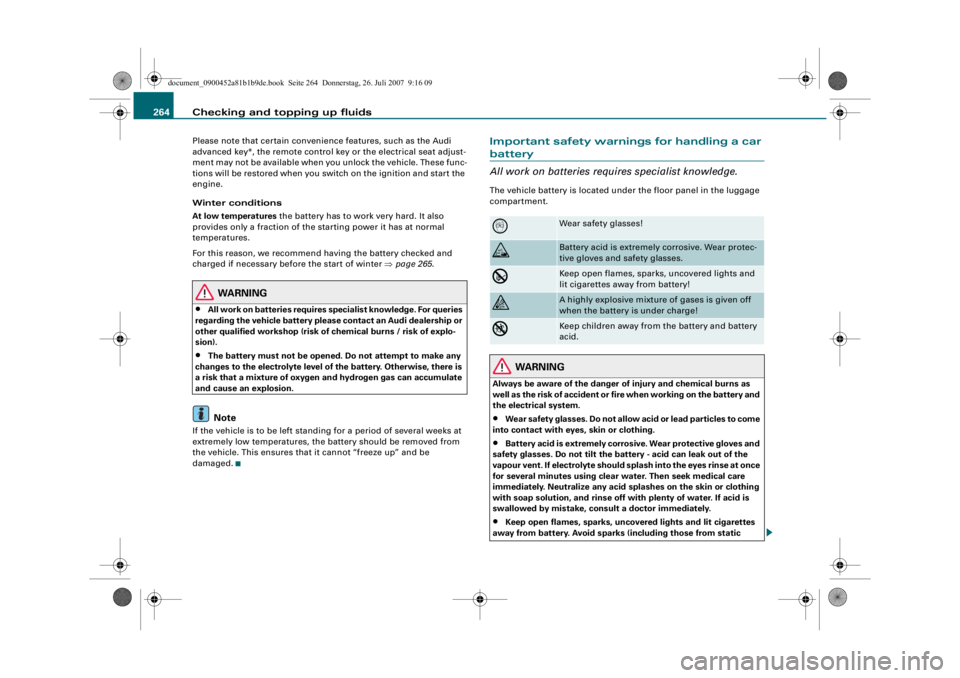
All work on batteries requires specialist knowledge.The vehicle battery is located unde r the floor panel in the luggage
compartment.
WARNING
Always be aware of the danger of injury and chemical burns as
well as the risk of accident or fire when working on the battery and
the electrical system.•
Wear safety glasses. Do not allow acid or lead particles to come
into contact with eyes, skin or clothing.
•
Battery acid is extremely corrosi ve. Wear protective gloves and
safety glasses. Do not tilt the ba ttery - acid can leak out of the
vapour vent. If electrolyte should splash into the eyes rinse at once
for several minutes using clear wa ter. Then seek medical care
immediately. Neutralize any acid splashes on the skin or clothing
with soap solution, and rinse off with plenty of water. If acid is
swallowed by mistake, cons ult a doctor immediately.
•
Keep open flames, sparks, uncovered lights and lit cigarettes
away from battery. Avoid sparks (including those from static
Wear safety glasses!
Battery acid is extremely corrosive. Wear protec-
tive gloves and safety glasses.
Keep open flames, sparks, uncovered lights and
lit cigarettes away from battery!
A highly explosive mixture of gases is given off
when the battery is under charge!
Keep children away from the battery and battery
acid.
document_0900452a81b1b9de.book Seite 264 Donnerstag, 26. Juli 2007 9:16 09
--4 -
-T
-+ +-
[I]
•